Browsing Category

News

News, People

2009 Hall of Fame Special Award: Breandan O Caollai

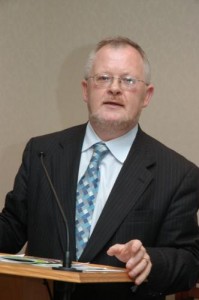
Breandan O Caollai

Breandan O Caollai

By Kathy McGee Burns

Breandan O Caollai, deputy consul general of Ireland, will receive a special award at the 9th annual Delaware Valley Irish Hall of Fame Dinner. He has become a favorite friend and special angel to the Philadelphia Irish Community.

He was born in and proud of an area, 5km north west of Dublin City called Cabra. Breandan said this is a Badge of Honor.He was educated at St. Declan’s Christian Brothers School. He received a BA and H.Dip.Ed from the University College Dublin.He also has an MA from the Institute of Public Administration. In the evenings, he furthered his education by doing graduate work at St. Patrick’s College, Maynooth.

Breandan is married to Carmel and has a son, Eoin and teenage daughters, Fiona and Siobhan. He has been in America for three years and resides in New York City. Prior to the US, he has served his government in Italy, Belgium and the UK.

Breandan has a special affinity for Philadelphia. It is difficult to uproot children and take them from familiar surroundings but the O Caollai’s first trip to the City of Brotherly Love was the ice breaker. The family was the guest of Jean and Russ Wylie (former President of the Friendly Sons of St. Patrick) who took them to dinner at the Hard Rock Café. For Fiona and Siobhan, this was the best treat and brought big smiles from the O Caollai’s teens.

Even through his wonderful worldly travels, Breandan finds Philadelphia to be a fabulous place. He describes it as “a beautiful city rich in history and yet modern in thinking.” He vividly remembers walking the “green path” in Center City, a trip made from the Commodore Barry Statue to the Irish Memorial to Penn’s Landing. He compares his first sight of the Memorial to that of Iwo Jima which is in Arlington, Va. It had a great impact on him.

One of his favorite places is the Irish Center. He refers to it as a hive. You can go from room to room and enjoy the sheer warmth and discover pieces of Ireland; the ceilis, the County societies, the GAA, the fireside room, the big ballroom and the 32 County Flags that encircle the ceiling. It gives everyone an appreciation of both sides of our world.

Breandan O Caollai’s opportunity to say thank you to Philadelphia was the role he played in bringing the Naval vessel LE Eithne to Penn’s Landing. It was a wonderful experience for all of us. The ships captain, John Barry, entertained the Irish community with a cocktail party aboard ship, designed to let us see the genuine hospitality of the Irish Navy and the beaming faces of the sailors, men and women alike.

We reciprocated by hosting a football game between the crew and the GAA followed by a great party at the Center.

Breandan will spend one more year in America. He says he will be sad to leave. “This has been a tremendous experience for me,” he says. He told me he will never forget our great vitality and our ongoing support of the Irish peace movement. “Ireland could never have peace without the help of Irish America,” he says.
News, People

2009 Irish Hall of Fame Inductee: Joe Montgomery

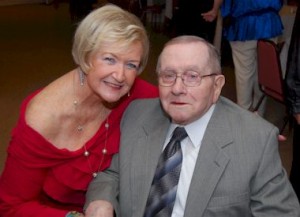
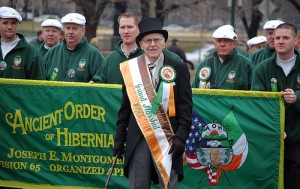
Joseph E. Montgomery

Joseph E. Montgomery

By Kathy McGee Burns

“A Gentleman is one who puts more into the world than he takes out.”—George Bernard Shaw

Joe Montgomery’s friend and long time associate, Bob Gessler, says, “Joseph Mongomery is the gold standard for what it means to be an Irish Gentleman.” Joe is being honored by the Delaware Valley Irish Hall of Fame on November 15th, as it celebrates its 9th Annual Awards Dinner.

His whole life represents service to his country, religion, profession and heritage. He is the ultimate family man and true friend to all. Born in 1919 (yes, that makes him 90), he is the son of John J. and Rose Moran Montgomery. Joe’s father had been sickly off and on following World War I. He died when Joe was 10, forcing him to be “the man of the family.” This was during the Depression years.

Rumor has it that Joe Montgomery’s fathers people were from Cavan but we definitely know that Rose Moran’s family came from County Mayo. His Great Grandfather David Moran served in the Civil War, first on the USS Galena, commissioned in 1862, an unclad screw steamer that was part of a unit of Admiral David Farragut. Later he finished his service on the USS Philadelphia.

Joe was a dutiful student at Epiphany of Our Lord School (11th and Jackson), serving as an altar boy and a choir member. He also attended the Purple and the Gold, Roman Catholic High School. While he was there, he played for a team called the “Mighty Mites,” named for their collective lack of height. Three of his teammates went on to be champion players for St. Joseph College: Matt Goukas, Dan Kenny and John Mc Mena-
min.

Montgomery enlisted in the Army Air Corp, 1939, and spent 44 months in Panama and the Pacific Theatre. He managed to rise to the rank of top sergeant.

Marriage was easy for Joe, all 55 years of it, because he had captured the heart of the beautiful, Mary Collis. Mary, whose family was from Sligo, was a member of Trans- figuration Parish. Joe sang in their choir from 1937 to 1980. They had three children, Kathleen, Patrick and Joanne. Mary was Joe’s right hand. When I mentioned her name, there was glee in his voice and he said, What about her! She was the only one for him and he was the only one for her. “Mary made me look good.” They worked side by side in all they did. Mary passed away in 1998.

Joe worked as a Teamster for 35 years retiring in 1981.

Joe Montgomery’s dedication to service for others and especially for Irish causes defines his character. Here are some of his accomplishments:

  • He is the Past President of the Irish-American Societies of the Delaware Valley and honored as their Man of the Year in 1983.
  • Past President of the Commodore John Barry U.S.N. Society
  • Past Chairman of the Philadelphia Chapter National Immigration Committee
  • Past President of the St. Patrick’s Day Observance Committee
  • Grand Marshal of the St. Patrick’s Parade 1993
  • Advisory Committee of the “Treasures of Early Irish Art”

Joe told me that the year he was Grand Marshal there was a terrible blizzard. The rules state that there is no rain date but the then Mayor, Edward Rendell, insisted that the march go on the following week.

Joe Montgomery’s greatest love is his AOH, Division #65. He served as tpresident for 42 years and now holds the title of president emeritus. He has also been the state AOH president, served four terms as Philadelphia president and in1992, Joe was awarded the highest honor: Gold Card Life Member.
He is also the recipient of an honor unprecedented in the history of the Ancient Order of Hibernians. On the 100th Anniversary of Division 65, the members decided to name the group after Montgomery. All AOH divisions are named after deceased members. But Joe had once commented that given his long-time service to the AOH, that maybe when he died they would name the division after him. At the ceremony, former Philadelphia Police Commissioner John Timoney said Joe was the first person he ever knew that got his dying wish while he was still alive.

“Those fellows couldn’t treat their own fathers better than they treat me,” Joe told me. During the 2007 national convention in New Orleans they bought him a first class plane ticket. When he balked, they said, “You are first class.”

Fellow Div. 64 member Jim Kilgallen says Joe Montgomery is king of the one liners. A few of his best:

  • John McDoe would give an aspirin a headache
  • John McDoe could start a fight in an empty room
  • John McDoe is as cold as a landlady’s heart
  • John McDoe is as popular as a widow with a pension.

All of his AOH brothers have stories to tell about Joe Montgomery. Pat Mulhern said Joe doesn’t have an enemy in the world. “At conventions, everyone knows him; they run up to him and practically kiss his ring.” I asked Joe Martin what was interesting about Joe. He laughed and said “Everything about Joe Montgomery is interesting.”

News, People

2009 Irish Hall of Fame Inductees: Sean and Johanna McMenamin

The McMenamins

The McMenamins

By Kathy McGee Burns

“Take, if you must, this little bag of dreams.
Unloose the cord, and they will wrap you round.”

These are words written by William Butler Yeats, a poet, dramatist, Nobel Prize winner and a Sligo man, buried beneath Benbulben. His words have great meaning for Sean and Johanna McMenamin, 2009 Hall of Fame inductee.

Johanna Kilroy McMenamin, is from Sligo, youngest of eight children born to Nora and Luke. Her town, Bellaghy, was a small market town with a main street and a railroad line which separated it from Charlestown, County Mayo.

And Sean is the oldest of 6, a Mayo man from Killadangan, 3 miles from Westport. This is an old Druid town and the burial site of the mythical King of Killa Dangan, his servant, Thulera, the twin sons of O’Malley and a one-legged Englishman named Cox. The area is demarcated by a circle with five randomly standing, pointed stones. Sean said that from his front door you could see Clew Bay and from the back, Croagh Patrick. The McMenamin parents were P.J.( a farmer) and Maggie (a nurse).

Johanna attended Lowpark National School and the Maris Convent for Girls and she shared this experience with her best friend of 60 years, Attracta O’Malley, who now lives in Philadelphia. Attracta remembers Johanna as very shy and well loved by her teachers.

Sean was educated by the Christian Brothers and eventually attended Westport Technical School where he specialized in construction trades. After graduation, Sean had the wanderlust and moved to England to serve his apprenticeship. In the winter of ’66, when the immigration laws were tightening, Sean decided to come to America. Would it be Pittsburgh or New York? That’s what Sean had to decide. While coming to grips with this dilemma, he traveled to Philadelphia to visit his cousin, Austen McGreal and his wife, Margie. This is where that bag of dreams starts to fill up. Austen said, “Give Philadelphia a try!”

Sean has always believed that his life was full of many twists of fate.
In the meantime, Johanna had come here in 1962 to join some of her family and was working with Attracta at General Accident Insurance Company. She was busy having fun with all of her new friends, attending dances at Connelly’s, 69th Street and The Irish Center.

Two weeks after Sean settled into his new home, his friend Hughie O’Malley took him to the Irish Center. On the very day that the Mayo Men’s Club began to accept women members and became the Mayo Association, Sean joined. He had also been drafted into the Army, an event he welcomed. As fate would have it again, he was assigned to Ft. Monmouth, New Jersey, as a MP, Stockade Guard Commander. In August of 1966, on a Sunday night, he and his friend, Tommy Moffit, went to the Irish Center to join Tommy’s sisters, Attracta and Kathleen and their friend Johanna Kilroy. Yes, it was love at first sight! The cord to the bag of dreams was starting to unloosen.

They spent a lot of time double dating with Attracta Moffit and Tom O’Malley. As a matter of fact the two couples married two weeks apart in 1968.
Sean and Johanna have been married for 41 years. They are such a lovely couple, sweet, caring and giving. They are totally devoted to each other and through their love and respect for traditions, they have devoted themselves to the needs of the Irish Center.

Sean was President of the Mayo Association in 1972; treasurer of the Mayo Association; secretary of the Gaelic Athletic Association; and president of the Irish Center. One of his greatest achievements and loves is the library. He and local historian Billy Brennan found an empty room on the second floor of the Center, plastered the walls, laid the floors, electrified the circuits, painted, carpeted, and stacked it with books. Their joint love of Irish history and literature has left us all with one of the greatest attributes of the Irish Center. They have collected many treasured books and publications. Students from various universities have often used that 50-year-old library for research.

Johanna, like Sean, has been a 40-year member of Mayo, quietly working behind the scenes, supporting the activities of the members and her more visible husband. She and Attracta worked diligently to get an airport at Knock. She was involved with the Philadelphia Ceili Group in the early 60’s. Many a fundraiser was successful because of the generous touch of Johanna.

The McMenamins live in Cheltenham and have raised 4 children: daughters, Margaret, married to Jimmy Kilkenny (Kaylee, Kiera, and Maura); Noreen, married to Steve Diehl (Johanna and Patrick); Eileen, married to John DiTore; and son, Sean.

They are two special people, who fate brought together, and wrapped its bagful of dreams round them. We are so very lucky to know them and be honoring them on the 15th of November.

News

Taking You Home to Mayo

Maureen Brett Saxon greets Tommy Moffit.

Maureen Brett Saxon greets Tommy Moffit.

The most electrifying moment in the Mayo Association banquet came toward the end, when the new Miss Mayo was announced. When Caitlin Lotty’s name was called out, she looked startled, surprised, pleased, thrilled, blown away, shocked,stunned, gobsmacked—everything all in one.

The second-year nursing student at Neumann University calmed down fairly quickly (although the smile never faded), and she accepted her crown and sash with grace, thanking the association and saying that the honor would show just how much nurses could accomplish.

The Mayos also conferred the president’s award upon Kathleen Gavin Murtaugh. The Sweetheart of Mayo—and she really fits the name—was Agnes McCafferty.

Aside from the awards, the Mayo banquet was a night of music, dance and fun. The Philadelphia Irish Center ballroom was filled nearly to capacity.

We have some photos and a bit of video from the night.

Check out the video.

Music, News

Irish Music for a Sacred Cause

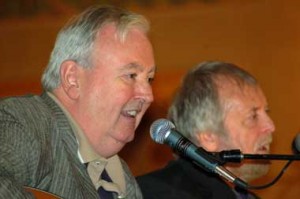
Robbie O'Connell and Mick Moloney.

Robbie O'Connell and Mick Moloney.

Father John McNamee, the former pastor of St. Malachy Church, looked out onto the audience gathered for Sunday’s annual Irish music concert with Mick Moloney and friends, and marveled at how the tradition has helped keep the parish school open and thriving.

“The only way we can keep this school open,” he said, “is through our own effort. Thanks to you, we cost the archdiocese nothing.”

Keeping the school in business is a costly proposition, but it apparently pays big dividends to the kids who attend. Roughly 50 percent of students attending city public schools drop out before they finish high school—but St. Malachy’s kids determinedly swim against that discouraging tide. Ninety-five percent of the school’s students finish high school, Father Mac said.

Thanks to Mick Moloney and a small group of immensely talented fellow musicians—including fiddler Dana Lyn, uilleann piper Jerry Sullivan, accordion player Billy McComiskey, and singer Robbie O’Connell—the school acquired a healthy infusion of cash from the fans who nearly filled all the pews. It’s a tradition Moloney has carried on for over two decades. “Here it is 25 years, and here it is Mick’s still coming,” said Father Mac.

We have photos from the concert, and several videos. Check them out.

The videos: 

Mick Moloney and Friends Play a Medley of Reavy Tunes
http://www.irishphiladelphia.com/video/mickreavey

The Emigrant and Lough Derg
http://www.irishphiladelphia.com/video/sullivanjigs

Yesterday’s Men
http://www.irishphiladelphia.com/video/yesterdaysmen

The First Half Closer
http://www.irishphiladelphia.com/video/firsthalf

An O’Carolan Tune
http://www.irishphiladelphia.com/video/mickocarolan

The House In The Glen/The Bohola Jig/Josie McDermott’s/Free And Easy
http://www.irishphiladelphia.com/video/mickopeningset

News, People

Ireland’s “Immigration Bishop” Visits Philadelphia

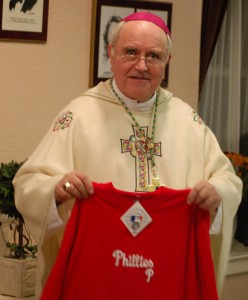
Derry Bishop Seamus Hegarty with his Phillies shirt, a gift from the Philadelphia Derry Society.

Derry Bishop Seamus Hegarty with his Phillies shirt, a gift from the Philadelphia Derry Society.

As he prepared to say a Requiem Mass for the souls of the faithful departed at Philadelphia’s Irish Center on Tuesday night, Dr. Seamus Hegarty, the Bishop of Derry, Ireland, paused to acknowledge the living who are far from peace.

The chairman of the Irish Episcopal Council for Emigrants, in Philadelphia briefly on a multi-city tour to meet with immigrants, was clearly moved by the stories he heard from undocumented Irish who had lost loved ones in Ireland and were forced to grieve alone, far from family and friends, because they could not return home. Illegal aliens can’t risk returning to their country of origin for fear that they will not be allowed back in the United States where they may have American-born children.

“It’s one of the things that really got to me,” said the Bishop, who has served the Derry diocese since 1994. “It’s a double tragedy for people who have lost someone and then aren’t able to go home and grieve with their families. I lost my own mother when I was seven, so I know how they feel.”

Bishop Hegarty spent part of the day at the Irish Immigration Center in Upper Darby. But not far from his mind were the immigrants he’d met in Boston. “They’re hurting very badly there,” he said. “I met many people who were bereaved and unable to go home and they were just devastated.”

He used the message of the Gospel to urge those in attendance to put pressure on the political powers-that-be to pass comprehensive immigration reform bills that would create legal pathways for the undocumented to become citizens. In Matthew 25:31-45, Jesus promised that those who fed the hungry, gave drink to the thirsty, welcomed strangers, clothed the naked, cared for the sick, and visited those in prison will sit to the right of him in heaven “because whatever you did for one of the least of these brothers of mine, you did for me.”

“The attitude that ‘as long as I’m allright, I don’t care about you, is not the Irish way,” he said in his homily. “We had nothing and we shared our nothingness with each other. You need to forge a community here that carries out the message that the interest of one is the interest of all. Reaching out to people is a gift and certainly will not go unrewarded.”

The Philadelphia Donegal Association and the Derry Society participated in the Mass and the reception that followed. Bishop Hegarty also renewed old acquaintances, including Mary McHugh of Lindenwold, NJ, who knew the bishop as a youngster in Kilcar, County Donegal, where he was born. “I was born and raised in Scotland, but my mother grew up in Kilcar and my father was from the next village, so I spent my summers there,” she said. “The bishop is actually related to me through my mother. When you grow up in these little towns and villages, you keep the connections.”

Bishop Hegarty was on his way to Washington, DC, to meet with US legislators about immigration issues and was clearly aware of the effect the visit of one Irish bishop would have. “I’m sure they’ll be very gracious and as soon as I’m gone they’ll forget all about it,” he said to laughter. “That’s why you need to pressurize them. . . You can do something. We are all responsible for one another’s welfare. Use your voice in a responsible and constructive way to try to improve the welfare of immigrants.”

Siobhan Lyons, executive director of the Philadelphia Irish Immigration Center, was Bishop Hegarty’s host for much of the day.

“We were delighted to welcome Bishop Hegarty to Philadelphia.,” she says. “The Irish Apostolate has been a strong supporter of the Irish diaspora and we deeply appreciate the work they do on behalf of the Irish community in the United States. I particularly welcome their efforts in the campaign for comprehensive immigration reform and wish the bishop the best of luck in Washington DC.

“But Bishop Hegarty is right when he says we can’t sit back and wait for other people to solve our problems,” Lyons says. “We must use our voices and our votes to advocate for the most vulnerable in our community, and that includes the undocumented. I hope everyone will listen to his message and make sure their representatives know that the Irish community supports comprehensive immigration reform. “

News

Will the Parade Pass Us By?

During the worst recession in 80 years, with an unemployment rate inching up like holiday weight gain, you might think that whether the City of Philadelphia funds or doesn’t fund the St. Patrick’s Day parade is a non-issue. Petty. Paltry. Pale by comparison.

But not to parade director Michael Bradley. Nor to the thousands who plan their last Sunday before March 17 around the nation’s second oldest (starting in 1771, it has marched continuously every year) St. Paddy’s Day Parade. Traditions are by their very nature part of our history, allowing us to mark time or relive the past–a rare gift, which is what makes it so hard for us to let go of them.

So Bradley will be fighting City Hall again this year—not to have the city pick up the entire freight for the parade, but to give the Irish and all the other ethnic groups who march every year down the Parkway, Broad Street, or through a neighborhood, a break on the bill.

“We’re not out to get the city to cover 100 percent of everything,” says the Delware County businessman, who also runs the Irish Festival on Penn’s Landing in June. “Everyone should kick in. I proposed that the city provide $125,000 and the state another $125,000 and that will cover the expenses for all the ethnic parades. We need everyone to compromise. It can’t be us 100% and them zero.”

Bradley will be testifying next Tuesday before City Council which is holding hearings on the parade costs, which are higher than in most large cities. In Chicago, for example, the city not only allows parade organizers (the local plumbers union) to dye the Chicago River green, it only tags them with an $8,000 bill, says director Kevin Sherlock. The organizers make up the rest of the money they need—including $27,000 for “terrorist insurance”—at an annual fundraiser in January

“For $8,000 we get a lot,” says Sherlock, who is vice president of the Chicago Journeyman Plumbers Union Local 130. “I can’t complain. The street sweepers keep the streets spotlessly clean, the city supplies port-a-potties all over the place, they close the streets down for us, set up the staging area, all traffic is stopped. We get a tremendous amount of help and support from the city.”

Along with Michael Blichasz, co-host of the Pulaski Day March, Bradley formed a group called Ethnic Americans United which includes representatives from the Puerto Rican, Italian, German, Greek, and other ethnic communities whose parades might not get off the curb this year. Or ever again. As Blichasz said in a letter to Mayor Michael Nutter, “the unaffordable fees being charged this year threaten the parades’ continued existence.”

That was certainly true for the Columbus Day parade. It didn’t happen this year. Though the Mummer’s Parade is expected to march down Broad Street as usual, the city will be delivering organizers a bill too—one much larger than last year, when the last-minute announcement that the city wasn’t going to pick up the tab nearly caused the strutting to stop dead on Two Street. Last minute donations and fundraisers—and the gesture by the city to forgive $300,000 in costs because of the short notice– saved the Mummers’ parade. The city will not be so forgiving this year. Last year’s St. Patrick’s Day parade was also shortened to save thousands in police and sanitation bills, and shortfalls were made up by donations and 11th hour fundraisers.

Bradley has also asked for an accounting from the city on the fees they’re charging for items like portable rest rooms, police, and bleachers. “I looked at the sanitation fees and I felt they were fair,” says Bradley. “But I contacted the port-a-potty vendor and their price was half what the city is charging us. I’m also concerned about the security costs. The police are wonderful, but I can’t believe that some of them can’t be working straight time. They can’t all be on overtime.”

He pointed to the last year’s Phillies’ World Series parade which, he said, cost the city $1 million. “I was told they bring lots of money to the city,” he says, “but so do we. We hold all our meetings in Center City, put up out-of-town bands in the city, bring people into the city for the day where they spend money. I want some acknowledgement of that.”

Though some have suggested that the parade be moved out into the suburbs, Bradley doesn’t think it’s a good idea. Many suburban communities now have their own parades. And for 239 years—before the Declaration of Independence was signed–it’s been the Philadelphia St. Patrick’s Day Parade. “All of these ethnic parades celebrate city neighborhoods,” he argues. “We don’t want to see these traditions go by the wayside.”

What can you do? Write a letter to Mayor Nutter or the Philadelphia City Council in support of the efforts of Ethnic Americans United before next Tuesday’s City Council meeting.

News, People

Hibernians Present O’Hanlon With MacBride Humanitarian Award

While it was the occasion of his wedding anniversary, Editor-in-Chief of the Irish Echo newspaper Ray O’Hanlon stood without his wife at the podium to accept the Ancient Order of Hibernians Sean MacBride Humanitarian Award. The award was presented in Philadelphia at the annual president’s dinner presided over by AOH National President Seamus Boyle.

The award is named for Dr. Sean MacBride, the Irish statesman and Nobel Peace Prize winner whose name is attached to the MacBride Principles on Fair Employment for Northern Ireland. MacBride, who died in 1988, had a long and distinguished life. He fought for Irish independence, was at one point chief of staff of the IRA, later became an Irish government minister, and helped found a number of international organizations, including Amnesty International.

Ray O’Hanlon had been selected as the MacBride recipient based on balloting conducted among National Board members and State presidents of both the AOH and LAOH. The purpose of the prestigious Sean MacBride Humanitarian Award is specifically stated in the AOH National Constitution: “To memorialize the human rights contributions made by Nobel Peace Laureate Dr. Sean MacBride and to recognize the efforts of others who make similar contributions in the cause of peace, justice, and the economic well-being of the Irish people…” (Article XXVII).

Ray O’Hanlon has been a most significant force in reporting on the many generations of the Irish Diaspora in the United States, the experiences of the new Irish who have recently immigrated to America, and the ongoing challenges of transforming the North of Ireland.

Having immigrated to the United States in 1987 from his native Ireland, he immediately became recognized as a major voice of the Irish-American press. In 1988 Ray began working as a journalist at the Irish Echo and, coincidentally, was immediately assigned to work on the MacBride Principles campaign. As a direct result of his careful research, Ray quickly became a major promoter for the passage of MacBride legislation in many states. The MacBride Principles gave Irish-American advocates for the North, such as the AOH and LAOH, a solid opportunity to educate legislators regarding the real reasons for conflict in the Six Counties.

Ray became associate editor at the Irish Echo in 2007 and has since risen to the post of editor-in-chief. Over the course of his career in journalism, Ray has reported from three continents, has appeared on numerous TV and radio shows on both sides of the Atlantic, and has found the time to author a book on a subject dear to his heart, The New Irish Americans, which was published in 1998 and subsequently received the Washington Irving Book Award. Amazingly, on the very day that The New Irish Americans was published, May 1, 1998, Ray was sworn in as a United States citizen.

Ray’s writing has consistently reflected the ideals and cultural concerns of Hibernians, always assuring that both the AOH and LAOH have received proper recognition and that our viewpoint has been clearly and fairly represented in the Irish Echo. On more than one occasion O’Hanlon has described the Hibernians as, “The bricks and mortar of Irish America.”

O’Hanlon spoke of MacBride as a man who spoke “Truth” which is important to all of us in the Irish community. Speaking about the Irish-American media O’Hanlon pointed out that “we exist because our (Irish Americans) stories continue to be told. And he concluded by telling a well impressed audience that when it comes to the Irish-American community “The story is still not fulfilled.”