Monthly Archives:

October 2009

People

The Ghost and Paul Gallagher

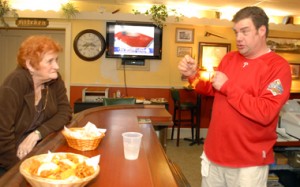
Kathleen Murtagh listens to Paul Gallagher tell his ghostly tale at the Irish Center.

Kathleen Murtagh listens to Paul Gallagher tell his ghostly tale at the Irish Center.

Paul Gallagher is used to being the last man standing at the Irish Center on Friday nights. After the final patron leaves, the longtime bartender closes up the center, latching windows, flicking off lights, locking doors. His last job is to clean up after the weekly Friday night Texas hold ‘em game in the front dining room.

But, on one Friday night just a few weeks ago, as he was just about to scoop up the poker chips, he discovered that his solitary work wasn’t so solitary. He was not alone. Someone was supervising the job.

“The doors were locked and I’d just closed the window and I don’t know who it was, but I felt something cold pass through me, like a breeze, right through my chest right here,” says Gallagher, patting the center of his chest. “And then I heard someone say, ‘What are you going to do now, Paul?’”

Later, he says, he took it as a philosophical question. But at the time, the answer was simple and practical. “I left the chips there, turned out the light, locked up and got out of there,” says the South Philly native, who says he’s not easily shaken. “I was scared to death.”

On his way home, he decided to stop at his neighborhood after-hours club for a stiff one. “I walked in and the bartender there who’s a friend of mine says, ‘Jesus Christ, Paul, you look like you’ve seen a ghost.’ I said, ‘I didn’t see one but I felt and heard one.’”

Gallagher has no explanation for the phenomenon. He’d just learned that morning that a friend and longtime patron had died, but he didn’t recognize the voice he heard. “I’ve heard stories about this place and other people have said they thought it was haunted.” In fact, confirms Irish Center manager John Nolan, one of his predecessors died in the office that Nolan uses now in the more than century old building that has been, variously, a car club, a Jewish center, and a caterer’s hall before it was purchased in 1958 by the Commodore Barry Society.

Gallagher had a previous close encounter with the ghost of Emlen Street, but only by proxy. “My girlfriend said that when she was sitting at the bar she felt a cold breeze brush by her legs. But this is the first time something has happened to me.”

His ghostly encounter hasn’t stopped Gallagher from being at his post on Friday nights, and he should be there this Friday, October 30, for the Samhain Rambling House event—an evening of jokes, songs, dancing, and stories to celebrate the Irish version of Halloween.

Maybe, if you ask him, he’ll tell you a real ghost story.

The Samhain Rambling House costs $5 and will feature music by Vince Gallagher, Kevin Brennan and Patsy Ward; quizzes with prizes; special awards for the best costume, scariest story, and best performance; and free refreshments and drink specials. Bring your best party piece, or just enjoy everyone else’s talent.

If none of that gets your broomstick off the ground, the center recently installed three new 42-inch plasma screen TVs where you can watch “Ghost Whisperer.” Or your favorite sport.

Or you can sit in on the Texas Hold ‘Em game. If you dare.
People

How To Be Irish in Philly This Week

This is the weekend that former Philly (and Galway) folklorist and musician Mick Moloney comes back to town with some friends to hold a benefit concert for St. Malachy’s School in north Philadelphia.

St. Malachy’s, founded in the mid 19th century by Irish immigrants, is unique among the area’s Catholic parochial schools. It doesn’t charge tuition or take money from the Archdiocese. It’s supported strictly by donation, and the concert on Sunday, November 1, is the big fundraiser. It’s usually standing room only, so get there early. The concert is held in the jewel of a church next to the school and we’re betting Clancy Brothers’ alum Robbie O’Connell is one of the “friends” this year.

It’s one of four fabulous concerts in the area this week. But before that. . . .

On Saturday, the Irish community celebrates national Ancient Order of Hibernians President Seamus Boyle—a Philly boy—at a testimonial dinner at the Radisson on Route 1 in Philadelphia.

Also on Saturday, the group Burning Bridget Cleary will be performing a Halloween Show at the Tin Angel in Philadelphia. This is an exciting, up-and-coming Celtic group that’s worth stiffing some trick-or-treaters to see.

Then, on Monday, the previously mentioned Robbie O’Connell will be doing a special peformance at The Shanachie Pub in Ambler. But save some of that yen for Irish music for Friday night, November 6, when Pat Egan, Laura Byrne Egan, and Jim Eagan come to the Irish Center and sing and play the songs of local composer Ed Reavy.

On Tuesday, November 3, author and filmmaker Mary Pat Kelly will be at Villanova reading from her book, “Galway Bay,” which is based on the story of her great-great-great grandmother who escaped from Ireland in the 1840s and settled in Chicago. Kelly has produced several award-winning PBS documentaries including “To Live for Ireland,” a portrait of Nobel Peace Prize winner John Hume. She has also worked as a Hollywood screenwriter.

On Tuesday night, Seamus Hegarty, Bishop of Derry, who is visiting the area will celebrate a Mass at 7 PM at the Irish Center.

On Friday, the Church of the Holy Family in Sewell, NJ, has invited the Hooligans to help them celebrate their first Irish Festival, which will include dancers, bagpipers, and food.

Details? You know where to look.

Music

Review: The Irish Tenors Christmas

It’s beginning to look a lot like Christmas.

Yes, I know we haven’t even gotten past Halloween yet. The Reese’s cups are still unopened in the cabinet. (Unopened so far, anyway.)

But, still, when “The Irish Tenors Christmas” CD arrived in the mail from the Tenors’ promoter, I just had to plug it into the player and start the Season of Joy a couple of months early. A weird sort of thing to do when the daytime temperature still occasionally bumps up into the 70s, but there it is.

If you have an Irish Christmas music collection—we certainly do, and feel free to tell us what’s in your collection—you might want to add this one to your play mix. There’s much to like about this collection of standards, sung by one of the best classically-trained ensembles—and thoroughly Irish.

I have to say that not all of the tunes are a complete success. Classically-trained tenors can do a superb job on most of the standards—as witness the opening track, “Hark the Herald Angels Sing,” and later tracks “Mary Did You Know” and “Silent Night.” These are particularly listenable—tailor-made to show off the superb voices of Finbar Wright, Anthony Kearns and Karl Scully.

And there’s an interesting surprise in the mix: Shane McGowan’s great and heart-breakingly beautiful “Fairytale of New York.” I didn’t expect to like this at all. It just didn’t seem to be a good choice for guys who sing in tuxedoes.

And yet, somehow it succeeds beautifully, lush orchestration and all—and cleansed of some of the darkness. Perhaps it is a testament to the strength of the song. Maybe you just can’t hurt it. (Unless the Jingle Bell dogs do it.) But I have to say, the Tenors’ approach to the tune is respectful and restrained. I’m a believer.

Still, two of the selections just don’t work at all: The “Feliz Navidad Medley” and “Jingle Bell Rock.” All of those trilled R’s just sound silly in the old Bill Haley standard. (“That’s the Jingle Bell r-r-r-r-r-r-rock.”)

But on balance, I think you’ll be happy to add it to your stack of holiday CDs—when we get closer to the holidays, that is.

News

Kathleen Kennedy Townsend Speaks on Church Reform

By Diane Dugan

On a cool October night when the Fightin’ Phils were facing down the Dodgers in the game that would clinch the National League title, members of Voice of the Faithful/Greater Philadelphia and interested members of the public gathered in the Church on the Mall in Plymouth Meeting to meet with Kathleen Kennedy Townsend, former Democratic lieutenant governor of Maryland.

Since leaving office in 2003, Kennedy Townsend has served on a number of non-profit boards and currently is an adjunct professor at Georgetown University’s School of Public Policy. Voice of the Faithful (VOTF), an international organization of 35,000 founded in 2002 in response to the clergy sexual abuse scandal, had invited Kennedy Townsend to discuss some of the issues in her 2007 book, “Failing America’s Faithful: How Today’s Churches Are Mixing God With Politics and Losing Their Way.”

The eldest daughter of Ethel and Robert F. Kennedy and a lifelong active Catholic, Kennedy Townsend began writing her book about seven years ago because, as she says, she had seen the relationship between church and politics change. Religion has come to be associated with the political right-wing, and by focusing so much on issues like abortion, same-sex marriage, and stem-cell research—which are “important, but not the only issues”—the Catholic Church has risked appearing “too partisan.”

She feels that the election of Barack Obama has helped the Catholic Church, explaining that the Vatican actually likes a lot of his positions (e.g., global poverty, climate change), and that he’s enormously popular in areas of the world where the Church wants to succeed. (A case in point is Africa, whose Catholic bishops just delivered a scathing denunciation of corrupt regimes in Angola and Uganda.)

“Reading the tea leaves” in her journeys around the world, Kennedy Townsend says, she perceives a shift going on in the Vatican, its recent aggressive bid for traditional Anglicans being what she calls a “desperate gasp.”

Kennedy Townsend was raised to believe in the importance of giving back, her parents often quoting St. Luke’s “To whom much has been given, much is expected.” She told of being taken to the Senate Rackets Committee hearings as a child when her father was investigating the corrupt Teamsters’ union, and the physical threats to her and her siblings as a result of his work. And she shared one of my favorite “Bobby” anecdotes: RFK speaking to a crowd of African-Americans in Indianapolis on the night of Martin Luther King’s murder, about the pain of losing a beloved brother to a violent death, and the necessity of meeting violence not with more of the same, but “with love, and wisdom, and compassion.” While many American cities erupted in riots that night, there were none in Indianapolis. These and other experiences taught her two things, she says: that doing good often comes at great personal cost; and that our God must be one of compassion and love.

Kennedy Townsend spoke movingly of the critical importance of the Church throughout her life, not just in terms of spiritual consolation but also its long, admirable record in support of human rights and social justice. She acknowledged that “the Roman Catholic Church has had problems with me” because of her stands on various issues, denying her speaking engagements at Catholic schools in her home diocese of Baltimore. Professing herself a big supporter of VOTF and their work (their mission is “Keep the Faith; Change the Church”), she feels reform-minded Catholics need to focus on positives, citing current Church involvement in issues like health care, climate change and immigration.

Internally, however, there’s much work to be done. Kennedy Townsend made a comparison between the role of Poland’s Solidarity movement, which laid the groundwork for the eventual collapse of communism in Eastern Europe, and that of the laity. The laity have a responsibility, she says, to create alternatives, such as the election of bishops and economic transparency. There are many ways to make a difference.

Two of the biggest mistakes the Church has made in recent times, Kennedy Townsend thinks, were the encyclical Humanae Vitae (banning the use of artificial contraceptives) and the clergy sexual abuse scandal. Both events had the unintended effect of making many faithful Catholics rebel. She closed by urging her audience to “write to the Pope! He’s been listening to the right wing; get him used to hearing from the left.”

Food & Drink

Margaret M. Johnson’s Teatime Fruitcake

This fruitcake comes from Dromoland Castle (Newmarket-on-Fergus).

Ingredients

1 cup water
1 cup (4 ounces) raisins
1 cup (4 ounces) sultanas (golden raisins)
2 ounces red glace cherries
1-1/2 Tablespoons dark rum
1-1/2 Tablespoons sherry
1 teaspoon vanilla extract
1/2 cup (1 stick) unsalted butter, at room temperature, plus more for greasing
1/2 cup superfine sugar
2 large eggs
1 cup self-rising flour
1 teaspoon pumpkin pie spice or mixed spice (see note)

The day before baking, in a medium saucepan over medium heat, bring the water to a boil.

Stir in the raisins, sultanas and cherries, and cook for 3 minutes.

Drain the fruit and transfer to a small bowl.

Stir in the rum, sherry and vanilla.

Let cool for 30 minutes, then cover and let stand for 24 hours at room temperature.

On the day of baking, preheat the over to 300 degrees.

Line a 9- by 5- by 3-inch loaf pan with waxed paper. Butter the paper.

Beat the 1/2 cup of butter and the sugar with an electric mixer until light an fluffy.

Beat in the eggs, one at a time, beating well after each addition.
With a wooden spoon, fold in the flour and spice.

Stir in the reserved fruit mixture.

Transfer the batter to the prepared pan and bake for 65 to 70 minutes, until a skewer inserted into the center comes out clean.
Remove from the oven and let cool completely in the pan on a wire rack.

Invert the cake onto the rack, peel off the waxed paper, and wrap the cake in aluminum foil.

Let sit overnight at room temperature before cutting into slices.

Serves 8 to 10.

Note: To make mixed spice, put 1 Tablespoon coriander seeds, 1 crushed cinnamon stick, 1 teaspoon whole cloves, and 1 teaspoon allspice berries in a spice or coffee grinder. Process until finely ground. Add 1 teaspoon freshly grated nutmeg and 2 teaspoons ground ginger. Mix thoroughly, stirring by hand. Store in an airtight container.

Source: Tea & Crumpets, by Margaret M. Johnson (Chronicle Books, 2009). Reprinted with permission of the author.

Columns, How to Be Irish in Philly

How to Be Irish in Philly This Week

We could all use a few laughs and there will be more than a few when the Irish Comedy Tour rolls into town on Sunday at the Sellersville Theatre. It’s also your chance to see former Philly guy, Pat Godwin, late of the John DeBella Morning Zoo and Howard Stern radio programs.

But, before that happens, local documentary maker John Foley’s poignant and patriotic film, The Color Bearers, which features former Eagle Vince Papale, will be shown at the FirstGlance Philadelphia Film Festival at the Franklin Theater at the Franklin Institute on Saturday. The film explores the courage of those who carried the flag in the Revolutionary and Civil wars.

So, you think you can dance? Or sing? Or play a bodhran? America’s Got Talent Season 5 auditions are being held at Pennsylvania’s Convention Center on Saturday and they’re looking for Irish acts. So drag your harp or your pipes on down and show them how it’s done.

There are also a couple of fundraisers on Saturday. AOH/LAOH Div. 87 is holding a benefit to raise money to help member George Lees repair his motorized wheelchair. Paddy’s Well is at Brittingham’s Irish Pub in Lafayette Hill on Sunday afternoon to drum up support and money for Jessica Reed, daughter of Paddy’s Well bass player Frank Reed, who suffers from cystic fibrosis. Jessica recently underwent a lung transplant and her medical costs are high. Also on the bill, Oliver McElhone, The King Brothers, and Seamus McGroary.

What happened to the Celtic Tiger? That’s the focus of a panel discussion on Tuesday at the Rittenhouse Hotel, sponsored by the Irish American Business Chamber and Network. Dublin representatives from Baker Tilly, one the world’s leading accounting firms, will explore the issue of Ireland’s economy.

On Friday, don your scariest costume (yes, anything you wore back in the ‘80s will be fine) and head over to the Irish Center in Mt. Airy for the Samhain Rambling House and celebrate Halloween Irish style. We’ve heard that there have been some ghostly manifestations at the center (no, really), so you may want to bring your ouija board. Check back with us later in the week to get the whole story!

People

Five Questions for a Woman of a Thousand (Or So) Voices

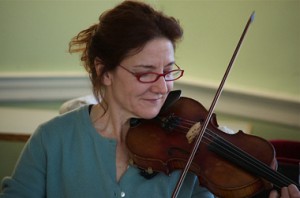
Hollis Payer in her other job--teaching Irish fiddle.

Hollis Payer in her other job--teaching Irish fiddle.

Whether it’s a straightforward, sunny commercial for Lifetime television or a local radio ad for Philly Phlash, the next voice you hear might be that of Hollis Payer.

Hollis is a well-known voiceover artist from the Philadelphia area, lending her well-toned vocal chords to many commercial enterprises.

But you’re also just as likely to hear another signature Hollis Payer sound—that of her Irish fiddle playing. Drop around the Philadelphia Irish Center on some nights, and you might hear the strains of Hollis’ fiddle music emanating from one of the Center’s side rooms.

We chatted with Hollis about both of her amazing talents.

1. You seem to be able to interpret the spoken characteristics of a lot of character types. I imagine you’ve been doing this kind of work for a while to be as accomplished as you are. Do you hear voices?

Do I hear voices? Not since the medication kicked in! The truth is: Yes! I hear voices, I hear music, I’m tuned into and pick up on all sorts of sounds. I’ve always loved language, poetry, words. As a child, I thought I was going to be a crack journalist, like yourself, but then I went to the University of Chicago and studied linguistics. And left there to work as an actor.

2. How did you get into voiceover work?

It was a different world when I first started on this path. I’d never really heard of voice work, but a friend who worked as a producer told me I should look into it. My initial response: “They pay people to do that?” The only person doing v-o’s in Philadelphia at that time was Scott Sanders… he still is, by the way, and is legend in this business… so I called him up and asked him for advice! Get a good demo and start shopping it around was what he said. So I did. I found an entree in the pharmaceutical world, which is very media intensive and requires attention to pronunciation. With my Catholic high school Latin, I was a natural!

3. The serious authoritative voice or the dotty grandma—which one do you prefer to do?

Serious sounding authority—especially when you suspect no one’s listening to you anyway—can get a bit tedious, don’t you think? I like making up character voices. I got to “voice” (yes, it’s become a verb now) a series of animated shows where I played a smart-alecky “science boy,” and recently was heard as a “prissy dog” for an animated commercial. My most favorite job was creating voices for several characters in a DVD series of fairy tales—that were packaged along with a wrist watch and sold at Walmart.

4. How long have you been playing Irish fiddle and how’d you get into it? (I know … sneaky two questions.)

My grandfather gave me a violin when I was 8 years old and I did the standard school orchestra instruction for several years, switching to the cello in high school just because they needed someone to do that! I didn’t really pick up the fiddle to play traditional Irish music until I heard the Chieftains in 1980. Boil the Breakfast Early had just come out and I’d never heard anything like it. It was an epiphany—I had to “get” that noise. I went to Ireland for the first time a few months later, hitching around with my fiddle and hanging out at sessions, pestering people to teach me tunes. I settled back in the states in Portland, Oregon and pestered Kevin Burke to teach me more, and thus began my pestering fiddle career.

5. How do your voiceover talents and your fiddle playing go together? What is there about you that wants to do both?

Both voice work and fiddle playing have been like gifts dropped into my lap. I thought I had talent, but I never imagined it would take either of these surprising forms. Deep listening is at the heart of both. As I said in response to your first question, I’ve always been acutely aware of the sounds of this world, am profoundly moved by words and music and have the crazy need to express all of this in some way.

People

Sinn Fein’s Gerry Adams Meets with Local GAA Footballers

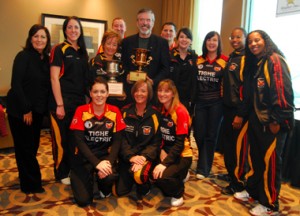
Gerry Adams, center, with the Mairead Farrell Ladies Junior Football Club in Philadelphia.

Gerry Adams, center, with the Mairead Farrell Ladies Junior Football Club in Philadelphia.

It seemed like the perfect name, says Angela Mohan. When she and Siobhan Trainor were casting about for a name for their new ladies Gaelic football club, they wanted to honor a strong Irish woman. They picked Mairead Farrell, the Belfast-born IRA fighter who spent 10 years in prison and was killed by British soldiers on Gibraltar in 1988.

The insignia associated with Farrell was a phoenix rising from the ashes. It seemed appropriate. Mohan and Trainor have both been involved with other football teams in the Philadelphia area that have folded and later been reborn as interest and the number of seasoned Irish players waxed and waned.

Their new team still relies on the Irish—often with summer visitors that Mohan recruits—but is now bucked up by Americans, many of them superb athletes on the basketball courts, but who have never played the game that started in Ireland the early 14th century.

Nevertheless, the women took home the Sean P. Cawley Cup as Philadelphia’s regional champions after a tough game against the Notre Dames last summer on the fields of Cardinal Dougherty High School.

But it was the name of their team that caught the attention of Gerry Adams, a member of Northern Ireland’s parliament and longtime head of Sinn Fein, the political party closely affiliated with the IRA.

A few months ago, he sent them a letter,commending them for commemorating the life of Mairead Farrell who, he said, “was a very special young woman whose love for her country encompassed its history and culture, including Gaelic games.”

The letter concluded, “I wish you well and hope to see you in Philadelphia in the future.” A typical sign-off. . .except that Adams meant it.

Last Friday, October 16, before Adams attended the annual banquet of the Irish Society in Philadelphia at the Penns Landing Hyatt, he spent half an hour chatting, laughing and posing for pictures with members of the team who came suited up and with a gift—a Mairead Farrell jersey. “I hope it’s extra large,” he joked.

With him was Rita O’Hare, the Sinn Fein representative to the United States, with whom Farrell had stayed in Dublin after her release from prison. “I’m glad Mairead’s name is being used and still being heard,” said O’Hare. Adams, she said was very enthusiastic about meeting the team that bears her name. “Plus he’s mad about GAA,” she laughed.