Monthly Archives:
October 2012
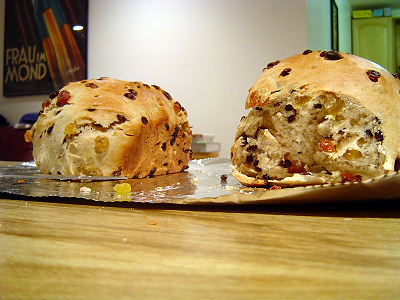
p-content/uploads/2012/10/Barmbrack-300×225.jpg” alt=”Scarily good barmbrack” width=”300″ height=”225″ /> Scarily good barmbrack
With Halloween just around the corner, we thought it would be fun to bring an old story back to life. It’s a story from 2007 that was pretty popular because it featured a yummy, seasonally appropriate recipe. Dig in.
If you’re being Irish this Halloween, first, you need to call it Samhain, which, of course, is not pronounced at all as it looks. (We checked the message boards of the Daltai na Gaeilge and they say, “sa-whin. The a in sa should rhyme with the a in ‘a-ha!’ and there is a slight ‘wh’ as in ‘who’ and then win.”)
Most experts agree our Halloween has Celtic origins. In the old days, people believed that as summer gave way to fall (which it’s showing little signs of doing these days), the dead roamed the earth, so to keep them outside, the Irish would leave little offerings of food on their doorsteps. Today, those little offerings of food include bite-sized Snickers, which seem a bit trivial when you’re dealing with the dearly departed, but what do we know?
The ancient Celts may have been trying to keep the dead away from their Barmbrack cakes, which is a traditional Samhain food. Really a fruit bread, it’s usually studded with little items–a rag, a coin, and a ring–that presage your fortune for the next year. If you get the rag, you have probably invested unwisely in bank stocks and can look forward to a miserly year. If you get the coin, most of your money is tied up in safe investments or in an ING account where it is multiplying like bunnies. Getting a ring is a sign of impending romance, continued happiness, or, if it’s an emerald-cut diamond in a platinum setting, a current romance that is moving to the next level. We made some of that up.
In any case, it’s a yummy cake, and Margaret Johnson, author of “The Irish Pub” and “The Irish Spirit” cookbooks, who has shared recipes with us in the past, offers this delicious version that does not contain any of those crunchy ingredients.
Barmbrack
3 cups flour
1 teaspoon grated nutmeg
1/2 teaspoon salt
1/4 cup (1/2 stick) butter
3/4 ounce active dried yeast
2 tablespoons sugar
1 1/4 cups milk
2 eggs, beaten
1 1/2 cups golden raisins
1 1/2 cups currants
1 cup candied mixed peel
In a medium bowl, sift together the flour, nutmeg, and salt. With a pastry cutter, blend in the butter until it resembles coarse crumbs. In a separate bowl, combine the yeast with 1 teaspoon of the sugar. Add the remaining sugar to the flour mixture and blend well.
In a saucepan over medium heat, heat the milk to just below boiling then add to the yeast and sugar. Stir in the all but a little of the eggs (reserve a tablespoon for use as a glaze) and add to the dry ingredients. Knead lightly to produce an elastic dough. With a wooden spoon, fold in the fruit. Transfer to a well-greased 8-inch round cake pan. Cover with a clean cloth and leave in a warm place to rise (it should double in size in about 1 hour.) Preheat oven to 400°F.
Brush the top of the brack with a beaten egg to glaze. Bake until golden, or until a skewer inserted into the center comes out clean, 50 to 60 minutes.
Serves 8.
The Watson brothers, who unearthed the stories and the bodies of the Duffy’s Cut victims, will be telling real ghost stories at the Irish Center on October 28.
If you’re anywhere near Havertown on Sunday morning, stop by Sacred Heart Church on Wilson and Manoa Roads. Some good-hearted folks are holding a huge bake sale to raise money to defray the medical expenses of a young couple from Belfast whose four-year-old son is in Children’s Hospital in Philadelphia.
Last week, we wrote about little Oscar Knox, who was born with a rare genetic condition, and then developed a rare form of cancer that strikes mainly babies and children. Supporters in Ireland raised about $400,000 to bring “wee Oscar” to Philadelphia for potentially life-saving cancer treatment, but while here, his doctors found he also had a rare complication from previous cancer treatment that means he can’t undergo immunotherapy, a relatively new treatment that trains the body’s immune system to fight cancer on its own.
As of Friday morning, Oscar was still at CHOP, though he was out of the intensive care unit and plans were being made to take him home, where his two-year-old sister, Isobella—known as “Izzy”—is waiting for him.
The Knoxes ran through the money that was supposed to pay for the immunotherapy—instead, it paid for Oscar’s treatment for pulmonary hypertension, the new illness that has kept him in Philadelphia since October 6. The Knoxes knew no one in Philadelphia when they arrived, but a large group of supporters has grown around them. Sunday’s bake sale is just the first of many fundraisers planned to help the family and little Oscar cope with the setbacks. That will be your good deed for the week.
There are plenty of fun events this week. It’s the final week to catch “A Slow Air,” a Scottish play produced by the Inis Nua Theater Company at the Off Broad Street Theater at First Baptist Church on Sansom Street in Philadelphia.
On Saturday night, catch Dick Hensold on the Northumbrian pipes—small, quiet bagpipers from Northeast England—at the Water Gallery in Lansdale. Several local Irish musicians have their jewelry and art at the gallery, which also has live music on a regular basis. It’s just down the street from Molly Maguires, a popular Irish pub which also has live music. There’s your Saturday night, right there.
Or, if you’re in Bethlehem, catch Timlin and Kane at the St. James Pub at the Sands Casino, where they’re pretty much the house band.
Jamison fans—and it’s hard not to be a Jamison fan once you hear them—can find their faves at Curran’s in Bensalem on Saturday night.
If you have that good old republican (with a small “r”) spirit, join the group planning a centennial commemoration of the Easter Rising at the MacSwiney Club in Jenkintown on Sunday afternoon.
On Sunday evening, celebrate Samhain (that’s Halloween to you non-Irish speakers) at the Irish Center with ghost stories! And they’re straight from the ghosts’ mouth, literally. They’ll be told by Frank and Bill Watson, who are responsible for discovering the bodies and revealing the stories of the 52 Irish immigrants and railway workers who died or were killed during a cholera epidemic at an area called Duffy’s Cut in Malvern nearly 200 years ago, and a paranormal investigator who has worked at the archeological dig. That starts at 5 PM.
The dancers and music lovers who used to spend Sundays at the late, great Emmett’s Place in Philadelphia are holding a reunion at the Rising Sun VFW—with Emmett Ruane himself—on Sunday night. Expect music, dancing, and lots of camaraderie.
A word about next weekend: It’s the annual Mick Moloney and Friends fundraising concert at St. Malachy’s Church in Philadelphia on Sunday November 4. Mick and his friends—all top Irish musicians—will also be stopping at Villanova the night before to raise some money for the Literacy Council.
When he was a folklore PhD candidate and professor at Penn many years ago, Moloney, who is from Limerick, helped reinvigorate the Irish music scene in Philadelphia. While in the city, he befriended St. Malachy’s pastor (now emeritus) John McNamee and has given concerts every year to benefit the mission parish in North Philadelphia and, across the river, Sacred Heart Parish in Camden, NJ.
/irishphiladelphia.com/wp-content/uploads/2012/10/Oscar-photo.jpg” alt=”” width=”380″ height=”380″ /> “Wee Oscar” at Children’s Hospital in Philadelphia.
The story kept popping up everywhere: Facebook, Twitter, newspapers, TV. The story of an adorable four-year-old Belfast boy who not only had a rare genetic disorder, but who had also developed a rare and aggressive cancer.
The genetic disorder is Jacobesen’s Sydrome, which affects 1 in 100,000 children. It can cause problems with motor skills (sitting, standing and walking), learning difficulties, and even physical problems, including heart defects.
The cancer is neuroblastoma, which also affects 1 in 100,000 children. It’s a malignant tumor developing from nerve tissue that usually occurs in infants and children.
Getting one was bad enough. Getting two. . .”He’s been pretty unlucky,” admits his father, Stephen, a hospital engineer in Belfast.
Bad luck has been dogging “wee Oscar,” as he’s known in the Twitterverse, from Belfast to Philadelphia, where his parents brought him in early October to undergo immunotherapy, a treatment only available in one place in the UK, that uses special antibodies to train the body’s immune system to fight off the cancer on its own.
Supporters, including Olympic boxer Paddy Barnes, and many GAA players in Antrim and Tyrone, had raised more than $400,000 to pay for Oscar’s treatment at Children’s Hospital of Philadelphia (CHOP). On October 6, Stephen, his wife, Leona, a software developer, flew over with Oscar and his two-year-old sister, Isobella, known as Izzy.
But the October 13 blog entry by Leona tells it all. “It all goes wrong in Philadelphia,” is the headline. Oscar, who had just finished a course of radiotherapy for his cancer, was undergoing testing at CHOP when doctors discovered another problem. It was pulmonary hypertension, abnormally high blood pressure in the arteries of the lungs that makes the right side of the heart work harder than it normally does to pump blood through the narrowed arteries in the lungs. It’s also rare.
“The doctors suspect that it may have to do with his chemo or stem cell transplants, but they don’t know,” says Stephen.
For a few days, it looked like it was going to be this latest rare disease to strike Wee Oscar that was going to take him away. “He was pretty sick. The doctors didn’t know if he was going to make it so they prepared us for the worst,” says Stephen. The Knoxes even said their goodbyes, letting little Izzy spend a last few moments with her brother.
It appeared to be the last of a series of cruel blows. Before he was diagnosed with neuroblastoma, Oscar had made such strides in therapy that he was attending a mainstream play group at home. “He had done really, really well,” says Stephen. “One of our biggest worries is that we would have to go to a special school, but he was on par with the other kids so we were over the moon about that.”
Even the neuroblastoma appeared to be in remission when they bundled Oscar onto a plane to come to Philadelphia.
But, on Thursday, October 18, Leona’s blog told a much different story. “He did it, Oscar did it! He fought his way back from the brink and is doing remarkably well,” she wrote.
“He really bounced back,” says Stephen. “He’s on the mend. And we’re hoping to get him home very soon and get the problem with his lungs treated so he can get back to normal, though he won’t be able to have the immunotherapy.”
The Knox family is planning to leave Philadelphia next week. But Philadelphia won’t be far from their minds—and hearts. They didn’t know anyone when they arrived, but they do now.
Thanks to those tweets and Facebook posts, members of the Philadelphia Irish community found the little boy and his family and swathed them in love. “We were shown unbelievable support,” says Stephen. “People got in touch with us through Twitter and Facebook. They came to the hospital, bringing homecooked meals, gifts for the kids. People offered to have us come and live with them and offered us the use of their cars. This was an incredible effort of the Irish community here in Philadelphia. We’ve been very well looked after.”
Among those who reached out were Havertown native Aisling Travers and Irish-born Fidelma McGroary, who traveled to CHOP on Sunday to bring a gift basket of Irish food and balloons for Oscar. “We had seen on Twitter that Oscar loved balloons. We didn’t think we’d get in so we were going to leave everything at the nurse’s station but they told us to go around to his room,” says Aisling, who is a student at West Chester University. “Leona was overwhelmed and started crying. We were the first people they met and soon people were bringing dinners down and sending e-cards. They were overwhelmed by the generosity.”
On October 28, a Tyrone native, Brian Magarity, and his wife, Laurie, will be running a bake sale at Sacred Heart Parish in Havertown to raise money to help the Knoxes, who went through the entire $400,000 just keeping Oscar alive in Philadelphia. (“Thankfully we were in the best hospital in the world, or he might not be here,” says Stephen.) The local group that’s formed around Oscar will also be selling wrist bands and t-shirts. Other events are also in the works. (Check our calendar for listings and details.)
There are a lot of sick kids in the world. What is it about Oscar that touched so many hearts. “He’s so cute!” says Aisling, who visited Oscar on her birthday on Friday and was gifted with a stream of blown kisses.
In fact, says his dad, it may his genetic disorder that gives him “a very special wee personality.”
He doesn’t have an ounce of shyness in him. “He talks to everybody and is always laughing and joking,” says Stephen. “He’s always happy and positive. It’s unbelievable, after all he’s come through.”
Though the Knoxes are looking forward to going home, Stephen says they’re also “a little sorry” they aren’t going to be in Philadelphia for six months as they’d planned. “So many people here reached out to us and made us feel well looked-after. We’ll never forget it.”