Monthly Archives:

May 2008

Columns, How to Be Irish in Philly

How to Be Irish in Philly This Week

Like to spend a day speaking Irish? Then sign up for the 2009 Satharn na nGael to be held May 31 at the Miquon School in Conshohocken. You’ll also get a sampling of Irish music, poetry, customs and folklore. Language classes are held in the morning and afternoon, interspersed with informal workshops. Sessions are offered in tin whistle, concertina, uilleann pipes, and even Irish language on the Internet.

This year you can also see and hear two topnotch Irish traditional musicians , Micheál Ó Raghallaigh (concertina) and Ivan Goff (uillean pipes). Even if you don’t spend the day speaking Irish, you can pay $10 and hear them in an evening concert that starts at 6 PM at the school. The two will also be playing next Saturday, June 7, at the Coatesville Cultural Society.

If you knew the Irish Center “when,” you might want to consider having lunch there on Sunday. Billed as the “Young at Heart” event, the Center is offering a meal at 2 PM for those 55 and older (we resemble that) so you can see the new changes at the center (it’s looking gorgeous), reminisce, and dance. If you need a lift, contact Geraldine Quigg (215-884-4948) or Nancy Cantwell (215-483-7990).

There are a few sporting events ahead. On Sunday, the Philadelphia Donegal GFC (Four Provinces) is facing the Down GFC in Gaelic Park in the Bronx. The following Saturday, they’re taking on Derry.

Scythian is playing on Friday, June 6, at the Philadelphia Museum of Art. Also that day, the always-fun Celtic Festival that AOH Div. 1 holds in Mont Clare, PA.

The Fourth Annual Celtic Festival is being held on June 7 at Historic Cold Spring Village in Cape May, NJ with the usual bagpipers, Celtic music, craft vendors, and an all-day Irish buffet (and it’s way more than a six pack and a potato, trust us).

Not to be repetitive, but the Frank McCourt musical, “The Irish and How They Got That Way,” will be at the Walnut Theater until the end of June.

Coming up: Rose of Tralee pageant on June 20 and the rocking Irish Festival on Penns Landing on June 21.

Arts

Answered Prayers

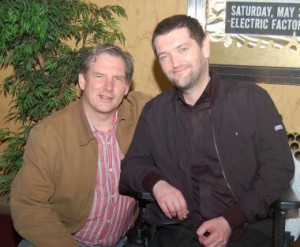
Philadelphia documentary maker John Foley and Fergus O'Farrell.

Philadelphia documentary maker John Foley and Fergus O'Farrell.

Philadelphia film maker John Foley met Fergus O’Farrell in 2000, when the musician was working at the reception desk at the Hotel Eldon, which his father owned.

Foley had just cashed out of his dotcom business and was fulfilling a dream: to show his four children the places in Western Europe he had discovered on his business travels “and to go seek our Irish roots.”

I asked John about his friendship with Fergus and this is what he wrote:

My 4 children, Lauren, Sean, Ali, and Julian and I flew into Dublin, rented a van, and made our way from town to town, staying in B&B’s in most places to get to know the towns and the people better. We visited Limerick, Bunratty, The Burren, The Cliffs of Moher, Bantry, Kenmare, Cork City, Baltimore, Cobh, and some other towns as well.. Of course we spent a few days in Dingle and drove the Ring of Kerry.

We were interested in the story of Michael Collins, (ok, I was interested) and so we stayed at the Eldon Hotel in Skibbereen, where Collins had his last meal before his assassination.

This was in the third week of July 2000, and on the 17th, my youngest Julian turned 8. I wanted to get a little birthday cake and a gift for him but didn’t want to leave him alone. I asked the hotel proprietor, a cheerful man in a wheelchair named Fergus O’Farrell, if he wouldn’t mind looking after Julian while I ran an errand.

He and his wife Li were only too happy to help and so off I went to get a cake and a gift.

When I returned, Julian had fallen asleep in the lobby of the Eldon on a couch in the front room.

As we were leaving the hotel on the 18th of July, Fergus gave me two CD’s, and said “I’m a musician, here are some of my records, I hope you like them”. As we drove the road from Skibbereen to Cork City, I popped the CD in and the opening string parts of “Cain and Abel” played through the speakers. I almost drove off the road. I was a professional musician in the 70’s, and I still play when I can. I am a great fan of music and stay as active as I can to hear and learn the best music. This was some of the most beautiful, soulful, mature, and highly competent music I had heard in my life. I had no idea, but we were the guests of a musical genius – someone that the music intelligentsia of Ireland had known for some time – but sadly the international record labels had been keeping a secret.

Over the years I stayed in touch with Fergus, writing by e-mail frequently, speaking on the phone occasionally. I so much wanted to hear Ferg with his band Interference perform, but a throat condition and Ferg’s advancing MD were keeping him from singing and travelling.

Over the years I learned more about Interference – how they were actually a cult legend in Ireland, influencing top artists like the Frames and Hothouse Flowers. I also learned that they were sort of a super-group, as top musicians from Ireland and other parts of Europe would drift into and out of Interference to make records and perform very occasionally.

In about 2002 Fergus was feeling much better and interference began performing again. But their gigs always seemed to spring up very spontaneously and so getting to see them proved impossible. But all the while we continued to correspond and our friendship grew as we schemed to somehow get Interference noticed in America.

I fantasized about interference playing in America – that if I couldn’t get Mohammed to the mountain, maybe I could bring the mountain to Mohammed. The likelihood seemed slim.

By 2006 Ferg and Interference were playing more regularly and he was working on a new record. He sent me “sketches” of songs he was working on – essentially music tracks, maybe just chords, some a little more developed. He may have a verse or a chorus of lyrics, or in many cases he would scat the vocal melody so the lyrics could be developed later. His lyric collaborator, Malcom Mac Clancy, would frequently work that way. I sent Ferg lyrics for one track called “the na na song” (because he scatted the words na na na na na na for the melody), but he wrote back saying he didn’t feel they fit. I later spoke with Malcom about the sketches, and he said “You know, I love that na na song. I submitted two sets of lyrics to Ferg for it and he passed on both. I want to NAIL that song, I love it.” So apparently, the song is important to Ferg and I felt better about not having my lyrics picked.

In 2007, interference were (and in Ireland, that’s how they say it – “Interference are a band….”) scheduled to perform in the Czech Republic, and I tried to work it out to see them there, but I just could not make the arrangement work. Foiled again.

Instead, I decided to schedule a trip to visit Ferg in his home town of Schull in West Cork. There was an International Guitar Festival in Clonakilty in September, and I figured if I could not see Interference, I could hear good music and hang with Ferg and his wife Li.

After I made the arrangements, I happened to go see a little indie film called once at the little art house cinema in Bala Cynwyd. I had seen the trailers, and I knew that Glen Hansard was a wonderful musician and a friend of Fergus’, so I decided to go. About halfway through the movie, there is a scene in Glen’s kitchen where his friends gather for a round of Noble Calls – each person taking a turn singing a song. And there was Fergus and Interference singing one of my favorite songs, “Gold”! I jumped up from my seat and yelled out “atta boy Ferg!” Then I quickly sat down a little embarrassed, but the people around me were nice about it. He had never bothered to mention that he was in a film that would play in America.

The mountain had not come to Mohammed, but a film of the mountain had come.

The trip to Ferg’s along the Irish sea coast was stunning. I passed through the sea coast town of Bonmahon, where my great grandmother and her family had lived. According to civil records, her father was an “ore dresser” in the local copper mines. Being in this part of the world was so moving I had to divide my time between taking photos and videos, quiet reflection, and overwhelming emotion.

The time with Fergus in Schulll, a little sea coast town in West Cork, was wonderful. Sadly, Li was in China – her mother was not well and her amazing intuition told her to get to China right away. Her mother passed away while she was there.

We travelled to the Clonakilty International Guitar festival – and everywhere we went Ferg was treated as royalty. It was great fun getting the collateral royal treatment. Clonakilty is the birthplace of Michael Collins, and it was stirring to walk around town and see portraits and statues of him everywhere.

Ferg and I posed for a picture in front of General Collins in a local hotel where we had dinner.

We drove Ferg’s friend David Bickley home into the nether regions west of Clonakilty in the pouring rain, with me doing my best to drive Ferg’s wheelchair-capable van up winding country lanes with little paving and no light whatsoever. Add to that, the steering wheel was on the wrong side, it was a manual transmission, and the bushes on either side of the road scraped the sides of the van on the narrow rural lanes.

We dropped off David at his home and used the glow of the distant highway and dead reckoning to find our way back to the road to Schull. Somehow we wound up in front of Michael Collin’s homestead, the one that the Black and Tans had burned to the ground. I like to think the Lord was navigating that night.

The trip ended and it was back to America and reality, and Ferg and I continued to talk via email and telephone. In January, Ferg called excited beyond words that Swell Season were playing somewhere in New York, and that Interference had been invited to play – the entire 10 piece band!

I looked at the road schedule for Swell Season and saw that New York’s Radio City Music Hall was slated for May 19th, and Philadelphia’s Tower Theater was set for May 20th. The begging and pleading to get Interference to Philadelphia began immediately.

Word finally came sometime in March that indeed interference would open two shows for Swell Season – at Radio City and in Philadelphia. After eight years of hoping and waiting, the mountain was coming to Mohammed!

The rest of the story you know. Thanks so much for helping to bring out Ferg’s story – I love the guy – the music is a wonderful bonus.

Music

The Best Unknown Band In Ireland

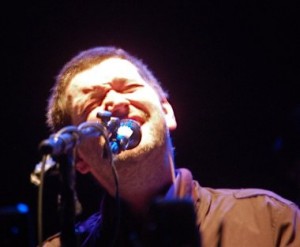
Fergus O'Farrell sings with passion during his Tower Theater performance.

Fergus O'Farrell sings with passion during his Tower Theater performance.

Opening acts don’t get much respect. Audiences who paid good money for the main course tend to linger in the lobby, taking advantage of the hour to suck back a few more Michelob Lites or house Chardonnays till the unknowns clear the stage and the “real” show begins.

All the lobby lizards who missed the band that opened for Glen Hansard and Marketa Irglova (stars of the little Irish jewel of a film, “Once,” performing as The Swell Season) on May 20 at Upper Darby’s Tower Theater will be adding that lapse to their “woulda coulda shoulda” list somewhere down the line.

The people who stayed were captivated, rapt, glued to their seats for the hour that Interference, one of Ireland’s most influential bands for the last two decades (say the musicians, like Hansard, whom they’ve influenced), commanded the stage. When I would occasionally glance down my row, I saw the ultimate compliment an audience can pay a performer. Not applause. Not a standing ovation. Smiles. A brightening of the eye. Body language that echoed the performers’—what experts call “kinesic communication.” Connection. These were the people who were out in the lobby at intermission, lined up at the Interference CD table like the band was selling $2-a-gallon gas.

Interference is that kind of band. In 1988, after they opened for The Hothouse Flowers, a reviewer at the Cork Tribune wrote, “The support act was so powerful you almost forgot who you were there for. . . .Interference positively bewitched the audience.”

At the center of the magic is Fergus O’Farrell, the 41-year-old singer-songwriter with a mesmerizing voice who founded the band with his schoolmate, James O’Leary, when they were at Clongowes College, a Jesuit boarding school in Kildare, from 1983 to 1986 (“James is a ludicrously tall guitar player with unfeasibly thick glasses so instead of sports we did music”). O’Farrell and O’Leary continue to be the mainstays of the band, though an astounding array of musicians cycle in and out. For example, these days on keyboard is Maurice Royscroft—known as Seezer—a Golden Globe-nominated arranger who has collaborated with Gavin Friday on scores for films such as Jim Sheridan’s “The Boxer,” starring Daniel Day-Lewis, and “In America.” Singing backup are Camilla Griehsel Vearncombe, a Swede trained in opera, her husband, Colin Vearncombe whose song, “Wonderful Life,” written when he was performing with the band, Black, was an international hit, and guitarist Paul Tiernan. Hansard, whom O’Farrell has known since their early hand-to-mouth days on the Dublin music scene, has recorded with the band, as have Maria Doyle Kennedy (of “The Commitments”) and her husband Keiran, a guitarist, songwriter, and producer, as well as many others.

If you were a statistician, you might be thinking that probability theory ought to be kicking in right about now. With all that talent, shouldn’t this band be better known? Better yet, shouldn’t they be, as they say in the music business, signed? They’re not. In fact, they’ve taken over the “best unsigned band in Ireland” award from The Hothouse Flowers, whose thunder they stole back in 1988.

Why this is, is complicated, which I discovered when I spent some time with Fergus O’Farrell. If you saw the movie, “Once,” you already know O’Farrell: He’s the dark-haired, bearded man with sky-blue eyes in the party scene, singing his haunting ballad, “Gold” with Hansard. What you really can’t see is that O’Farrell is in a wheelchair. He has a rare form of muscular dystrophy called Emery-Dreifuss, diagnosed when he was almost nine. Most people with MD are dead by the time they’re in their early 20s. O’Farrell’s condition is progressive. He’s been gradually losing the use of his body for 32 years.

Back in the 90s when the band was at the height of its cult popularity in Ireland, several record companies were interested, O’Farrell said. But the wheelchair was like water on a fire. “When they think you’re going to be dead in your 20s, record companies—they’re like venture capital banks. What venture capital bank is going to invest in a company with dodgy foundations?” he said. One friend reported that an enthusiastic executive, once he heard that O’Farrell was in a wheelchair, said, “Blindness works, a wheelchair don’t.”

“Another one told a friend of mine who signed a big deal was told they wouldn’t touch me with a 20-foot barge pole,” O’Farrell said. “Frankly, I think the wheelchair is my USP. My unique selling point. I’m the singing cripple.” He laughs—and it’s not bitterly. O’Farrell is, by his own description, “a half full” kind of guy. And the truth is, it wasn’t just the wheelchair.

“Anyone who has heard our stuff is blown away,” he said. “The problem is we don’t stick to one style. We do jazz, rock, classical. I do what I want to do. Having a limited range doesn’t make sense to me. The record companies want every song to sound similar.”

On the business side of music, eclectic apparently doesn’t work, no matter how great you sound and how slavishly devoted your little clique of fans is. Talent is good, but it’s size that matters. So O’Farrell was left with only a few choices. One was to set up his own recording studio, which he did. With money he got from his father, he created Interference Studio at his home in Schull in West Cork, where he lives with his wife, Li, a practitioner of traditional Chinese medicine.

It was there, in 1994, where Interference recorded its eponymous CD, which was produced and engineered by DanDan Fitzgerald (who does the same for Mary Black). The ten songs included “Gold” and a song he co-wrote with Hansard, “Vinegar Girl.” Critically well-received, it sold well locally. But by 1996, the band had broken up and O’Farrell, while still writing music, took a job at the reception desk of The Eldon Hotel in Skibbereen, which his father owned and was the place where Michael Collins had his last meal before his assassination.

It was O’Farrell’s seven-year dark night of the soul. He had taken a couple of bad hits over the years. Vocal nodules kept him from touring as much as he feels he should have. “When we were first doing gigs in Dublin, I got vocal nodules in both cords and told I couldn’t sing for at least a year and the doctor told me he couldn’t even guarantee I could sing after that,” he explained. “I was really afraid of destroying my voice so I didn’t gig regularly. I would do seven gigs a year. Glen would be doing 200 gigs that same year.”

The same week he was diagnosed with nodules, his MD specialist told him it was time to buy a wheelchair. “He said once you get in it you’ll never get out of it.” Up till then, O’Farrell had been able to walk; he even played football and biked as a child, rode a moped till he was 16, played trumpet, tin whistle, and guitar, until one by one, he had to put them down as he became too weak to play. “It was,” he admitted, “the worst week of my life.”

But by the mid-90s, the MD had also started robbing him of his breath. “My singing style required more air. I sang from my chest with a lot of vibrato, but because of the MD I was getting weaker. I lost confidence,” he said. “Then, oddly enough, something happened at a party at my father’s house.” Someone he met at the party was doing a little beer-soaked singing at 3 AM “and he would break into falsetto when he was going for the high notes he couldn’t reach. And it was lovely. Neil Young sings the same way, so I started developing that and it worked great.”

But he credits Hansard and his Interference band mates with helping him get back into music fulltime again. “They never let me forget I was great,” he said, even when he allowed himself an occasional wallow over how little money there is in greatness. An Interference reunion in Schull led to an invitation for the band to appear on the RTE TV series, “Other Voices,” featuring lesser known Irish talents, and hosted at a deconsecrated church in Dingle by Hansard. Then came the phone call from Hansard. “He usually texts me, so when he calls I know it’s something wonderful,” said O’Farrell. It was about that unforgettable love song that O’Farrell wrote called “Gold.” Hansard’s old bandmate, John Carney, was making a movie about an Irish busker (Hansard) who meets a young woman from the Czech Republic (Marketa Irglova) on Grafton Street and the ambiguous relationship they develop. Could O’Farrell perform “Gold” in the movie? It was one of Hansard’s favorites.

O’Farrell could. He was over the moon. Though it was a low budget film (they did it for about the price of a down payment on a McMansion) and no one was prophesying that it would win a Grammy and an Oscar (which it did), and O’Farrell wasn’t going to make any money from it, “Jesus thank Christ I said I’d do it,” he said. “For that scene we went to Glen’s house, had dinner then a sing-song and they filmed it, pure drop.”

The rest isn’t history. There’s really no telling what it will all mean to Interference and O’Farrell. The music business is a strange thing. People with little talent and lots of marketing can make millions (and get their own regular segment on Access Hollywood); others with enviable ability can slog along for years making so little they need a day job.

Hansard and Irglova brought the band to the US to open for them at sold-out shows at Radio City Music Hall and at the Tower. It was the first time the band has performed in the US. “Imagine, my debut was at Radio City,” O’Farrell marveled. In July, they’ll return to participate in a presentation of “Peter and the Wolf,” updated by Maurice Royscroft at Bard College in New York’s Hudson River Valley. O’Farrell will record the narration and Interference will perform. There’s talk of a gig at World Café. Another CD is in the works.

But there’s something about Interference you need to know. The band doesn’t rehearse. Not really. At one gig, O’Farrell told me, “I just told them what key it was in and they improvised. “

So whatever happens, O’Farrell will probably improvise. It would be a shame if the group didn’t gain a wider audience. Not so much for O’Farrell—he’d get by—but for the millions who are being robbed of the experience of hearing the kind of music you can’t get out of your mind because it takes a foothold in your soul. There are already a few hundred people I know of who were glad they weren’t out in the lobby waiting for the main event. They wisely knew that it had already started.

Columns, How to Be Irish in Philly

How To Be Irish In Philly This Week and Beyond

It is, dare we say it, a little quiet on the Celtic scene as May washes and blows out of here, leaving us shivering and longing for one of those humid Philly springs we’ve come to know and love. Or not.

But leave it to Blackthorn to leave it on the upbeat. This popular Celtic rock group is holding its annual Memorial Day bash at Canstatters’ German Club in Northeast Philadelphia on Monday. You can enjoy Irish music and German food and beer (appropriate, since we learned from CBS-3’s Larry Mendte that among immigrants in Pennsylvania, the Irish were most likely to marry Germans, creating people, well, like himself, and my cousins, the Costellos). Also on the bill—the Hooligans and some great weather, according to CBS-3’s Kathy Orr (we believe everything she tells us).

Looking ahead, the Irish stuff picks up in June and doesn’t stop. Sadly, this year, if you want to follow Philly’s Donegal Gaelic Football Club (AKA Four Provinces), you can only watch the action at Gaelic Park in the Bronx, New York. This is a great team, last year’s championship winners, and they’re going up against Down GFC on June 1. We’ll miss those Sundays at Cardinal Dougherty High School. But this is the big time for our guys.

On Friday, June 6, look for Scythian, those crazy guys from Washington, DC, at the Philadelphia Museum of Art. That’s also the day the AOH Div. #1 holds its annual Celtic Festival in Mont Clare, PA.

If you aren’t festivaled out, the Fourth Annual Celtic Festival is being held on June 7 at Historic Cold Spring Village in Cape May, NJ with the usual bagpipers, Celtic music, craft vendors, and an all-day Irish buffet.

Our Donegal footballers are going up against Derry that evening at Gaelic Park.

Closer to home, make plans to head down to Coatesville on June 7 for a remarkable pairing: concertina player Micheal O’Raghallaigh (pronounced ME-haul O’Riley) and uilleann piper Ivan Goff.

And, of course, the Frank McCourt musical, “The Irish and How They Got That Way,” will be at the Walnut Theater until the end of June.

You’ve got plenty of time to get rested up for the Rose of Tralee pageant on June 20 and the rocking Irish Festival on Penns Landing on June 21.

Check out these and other Celtic events on our calendar, soon to be a major motion picture.

People

Michelle Mack Crowned 2008 Mary from Dungloe

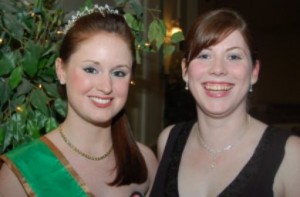
Meagan McGough, left, turned over her crown to Michelle Mack.

Meagan McGough, left, turned over her crown to Michelle Mack.

On Sunday, May 18, Michelle Mack was crowned the 2008 Mary from Dungloe at ceremonies sponsored by the Philadelphia Donegal Association at the Irish Center in Mt. Airy.

She takes over for the 2007 Mary, Meagan McGough, a pre-med and marketing student at Fordham, who is a competitive Irish step dancer.

Michelle, also an Irish dancer, is assistant director of residence life at Holy Family University. She will travel to Dungloe, County Donegal, Ireland, in August to compete in the international contest.

Music

Famed Piper Paddy Keenan Comes to the Irish Center

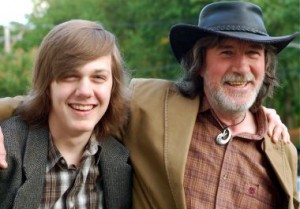
Local piping student Tim Hill with piper Paddy Keenan.

Local piping student Tim Hill with piper Paddy Keenan.

If you were an actor, it would be like taking drama lessons from Robert DeNiro. If you were a cyclist, it would be like getting some pointers from Lance Armstrong. If you’re a piper or whistle player, getting some tips from Paddy Keenan is learning from the best.

Keenan, fresh from a performance on Wednesday night, May 21, at the World Café in Philadelphia, spent several hours Thursday night at the Irish Center, where he taught two workshops to about a dozen—some awestruck—students.

Paddy Keenan, born into a Travelling (Pavee) family from County Meath, comes by his musical talent genetically. Both his father and grandfather were uilleann pipers and Keenan began piping when he was 10. He’s been called “the King of the Pipers,” and “the Jimi Hendrix of pipers.” A founding member of the famed Bothy Band, he plays like most virtuosos: seemingly effortlessly, as though his instrument has always been a natural part of him. When he lifts the flute to his mouth or fixes his long, thin fingers on the chanter of his pipes, he almost seems to be releasing the music rather than making it.

Tall and flute-like in build, the soft-spoken Keenan gently coaxed the neophyte whistle players and pipers at the Irish Center into solo performances of the tunes and techniques he taught them. When, at one point, he admitted that at least some of the vibrato he produces on his flute comes not from his fingers but his breath, one student gasped. “Oh!’ she said. “My flute teacher told me that you never do that!” Then she grinned. In fact, they all grinned, including Keenan. If the best tell you to break the rules, you break them.

Music

A Musical Two-Fer

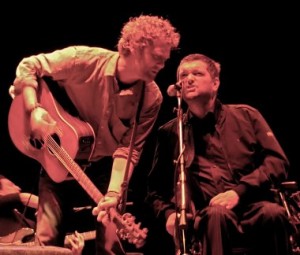
Glen Hansard and Fergus O'Farrell in a duet at the Tower Theater in Upper Darby.

Glen Hansard and Fergus O'Farrell in a duet at the Tower Theater in Upper Darby.

About a year ago, you could have seen Glen Hansard and Marketa Irglova at the Tin Angel, a tiny 100-seat venue upstairs from the Serrano Restaurant on Second Street in Philadelphia. You could have spoken to them after the show. Maybe bought Glen a drink. (At 19, Marketa is too young to drink here.)

That was before the two won an Oscar for their passionate ballad, “Falling Slowly,” from the low-budget Irish movie, “Once,” an almost-love story that, in the parlance of Hollywood, captured America’s heart. The fact that the two stars captured each other’s hearts hasn’t hurt either. They are the proverbial unlikely and cute couple.

In the last few months, as The Swell Season, Hansard and Irglova and their band played to sold-out crowds all across the country, including Radio City Music Hall and, this week, the Tower Theater in Upper Darby. This time, there was no mingling and when the two were out on the wet streets this Delco town, Hansard kept his hat pulled down low over his curly red hair so he wouldn’t be recognized. Fat chance.

Today, they not only attract attention, they inspire adulation. At the Tower, I met two young men who spent the last three weeks following the duo around the country, paying scalper prices for tickets and saving some bucks on lodging by couch surfing—flopping on the livingroom sofas of people who sign up to host visitors from far-off lands or the city next door. Kind of like what crashing was in the 60s and 70s, only incorporated.

The guys weren’t disappointed. Hansard, who hits notes only reachable by choir boys and eunuchs, is such an intense performer that he has strummed a giant ragged hole in the soundboard of his acoustic guitar. (At first, I thought it was a pick guard. Instead, it’s a testament to the importance of a pick guard.) The moment he walked out on stage—the very edge of the stage, alone, strumming that same guitar—he engaged the audience as if he were still a busker, playing for loose change. He’s charming and boyish, funny and passionate. After years of playing with the band, The Frames, his rocker’s wildness is tempered by Irglova, who has a calming presence and an angelic voice. Their duets are so poignant and sweet they almost hurt.

Hansard, a dues-paying, 20-year “overnight” sensation, did a little payback while giving fans in New York and Philly a bonus: A chance to hear a group called Interference, which opened for The Swell Season in the two cities. Presided over by Hansard’s friend, singer-songwriter Fergus O’Farrell, Interference is a collection of European musicians, many classically trained, who are virtually unknown in the US but enormously influential in Ireland and Europe, although they’ve never had a record contract. Hansard calls O’Farrell one of his major influences and once told an interviewer that “we used to go to the attic where they played and just watch in awe. We were always learning from them.”

O’Farrell’s haunting voice, unforgettable melodies, and poetic lyrics caught the crowd’s attention, especially when he reprised his performance of the song, “Gold,” from the movie, “Once,” with Hansard and Interference guitarist Paul Tiernan providing tight harmony.

I spent some time with O’Farrell this week—he’s a remarkable man as well as a major talent—and I’ll post that story next week, with photos from his performance.

Sports

Shamrock Hurlers Christen the Allentown Hibernians

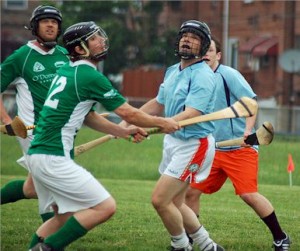
For the Hibernians, it was a baptism by fire.

For the Hibernians, it was a baptism by fire.

No one expected the Allentown Hibernians to win their first hurling match ever. But in the new team’s debut Sunday against the Philadelphia Shamrocks, they sure made it interesting.

The Shamrocks finally put the team from Lehigh away, 1 goal and 4 points to the Hibernians’ 1 goal and 1 point.

(In hurling, a goal equals three points. It is scored when the ball, or sliotar, sails into the net between two uprights. A single point is scored when the ball goes over the net but between the uprights. So another way of looking at the score is: 7-4.)

The Shamrocks’ team captain Frank O’Meara likes to win, but he was nonetheless pleased to see a new team come out on the field with such fire and give his players a real run for their money.

“They did very well,” he said. “I was very impressed with them.” More important, he added, they seemed impressed with themselves, and their fine performance ought to encourage them to keep learning and refining their game.

Not bad for a bunch of athletes who, not all that long ago, wouldn’t have known what a sliotar was if it smacked them in the head. (They know now, though, I bet.)

The Hibernians will get another chance at the Shamrocks on Sunday, June 1, part of a round-robin tournament that could include a team from D.C.

As for the team from Allentown, their first hurling match left its mark.

The Hibernians’ Chris Farrell, who was making something of a reputation for himself (albeit involuntarily) for injuring his teammates during practice, got a taste of his own medicine Sunday on the field at Cardinal Dougherty. “Before the game (teammate, no relation) Joe Farrell told me they had taken to calling me “the hatchet man” because of the injuries I’ve caused in practice,” Farrell said. “Ironically, I took the chop during the game when one of the Shamrock players chopped right on my knee joint with his hurl, following through on a shot that I was just a split second too late for (apparently). Hurts like hell and it’s pretty swollen today, but I don’t think any permanent damage was done and I will be back to fight another day.”

O’Meara, for one will be heartened to see them back out on the field. It’s tough keeping this native Irish sport going here in the States, but with the addition of an eager new team—and continuing dedication on the part of the 20 Americans on the Shamrocks’ team—”the thing is going to purr like a kitten. And we’re going to make sure that it does.”