Monthly Archives:

December 2009

Columns, How to Be Irish in Philly

How to Be Irish in Philly This Week

You can ring in the New Year with music and dancing at the Irish Center on Thursday night, then start the new year off right on January 2 with Barleyjuice at the Sellersville Theatre. And there are plenty of sessions all week to keep your Irish up.

But the real treat starts on Thursday with the return of “The Irish and How They Got That Way,” a play by Pulitzer Prize-winning author Frank McCourt, who also gave us “Angela’s Ashes.” “Tis,” and “Teacher Man,” before he died in 2009 from melanoma.

The play, at the Kimmel Center, mixes songs and stories, sentiment and humor, irony and sweetness, as only McCourt could do it.

Check our calendar for details.

Music

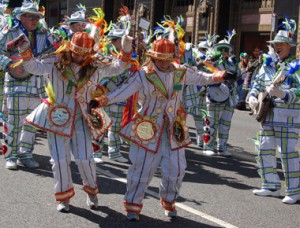
Mum’s the Word: The Irish Roots of Mummery

The Irish-American String Band struts its stuff in Philadelphia.

The Irish-American String Band struts its stuff in Philadelphia.

Mummery has been a tradition in Philadelphia since the late 17th century—in celebration if not in name.

Mummers’ historians say that the Swedes extended their tradition of “Second Day Christmas,” when they visited friends, into New Year’s Day, throwing in some masquerades and noisy revelry (which later erupted into musket fire, bells and noisemakers.)

But mummery, which some say dates back to ancient Egypt, is also a 2,500-year-old tradition in Ulster, the northernmost counties in Ireland and Northern Ireland, so Irish immigrants to the US found a little bit of home every New Year’s Day. And just a little bit. In medieval Ireland, mumming meant plays, both religious and secular, often presented by local trade unions. Even today, when the “mummers” appear in Ireland, it’s to tell a story.

In Wexford, for example, mummers take to the streets to perform original plays (since none of the play scripts from yore have actually survived) about heroic figures from the Celtic past, like S. Patrick, Brian Boru, Wolfe Tone, and Owen Roe O’Neill. (Originally, the play’s characters were British figures such as St. George and Cromwell, but clearly that didn’t play nearly as well.) The plays are always in verse and swordplay is inevitably involved, as is death and rebirth.

Wexford mummers are so well known there’s even a song called “Wexford Mummers Song,” once recorded by Mary O’Hara, which tells the sad story of two maids of Shroden, in Derry Town, Patty Grey and Nancy Hogan, who “lead an awful life, an awful life and dreary.” It involves pig mutilation, death, and some cheery fa la las.

Like Philadelphia’s Mummers Parade, the Irish mumming street plays are performed as part of an annual competition. However, there are no banjos, feathers, sequins, and golden slippers. But there are disguises (mummers are also called guisers, as in “disguise”), usually intricate masks, much like the tall, conical masks worn by the chief entertainers of King Conor, legendary king of Ulster, at his palace in Eamhain Macha. In rural areas, like one small town in County Fermanagh, the mummers traditionally wear costumes of straw (giving rise to the name, “straw men”), largely because it’s cheap and available. Another parallel to the Philadelphia Mummers: In Ireland, it’s also traditional for men to dress up as women.

While the Irish didn’t bring mumming to Philadelphia, they certainly supported it. In his book, “The Irish in Philadelphia,” the late historian Dennis Clarke wrote that the Irish took immediately to the “generally uninhibited frolic” of the Mummer’s Parade.” Such displays were compatible with the Irish propensity for enjoyment. The folksy pantomime, the jingling music, and the ardent defiance of freezing winter weather made the Mummers famous, and the Irish were an eager part of the tradition.”

Mummers factoid: The word “mummer” is thought to stem from a German word meaning “disguised person.”

News, People

Being Irish In 2009: The Year in Pictures

By now you’ve probably read a dozen stories that recounted who died last year and the highlights of the aught decade. This is not going to be the unlucky 13th.

I was doing a little photo housecleaning when it occurred to me that I recalled the Irish part of my year in pictures. Not the big events so much, but the small things—the babies, the smiles, the laughs, the photos I just thought were damned good.

So I put them all together in one slideshow to share with you on this last day of 2009 (or in first days of 2010, depending on when you’re finally getting around to reading this).

Many of them are from parades. We must see a good six or seven, most of them over a three-week period in March. Jeff and I can probably make it into the Guinness Book of World Records for most shamrock deely bobbers spotted in one year, were that a legitimate entry. In 2000, Jeff (who plays the bodhran, an Irish drum) participated in an international event in Killarney during which 2,000 pipers marched on to a field and played together (so, if you call to him and he doesn’t answer, you know the reason why: Chronic Pipe and Drum Band Hearing Loss. I’ve had it since he forced me to listen to the 25 bagpipers from Irish Thunder playing “Amazing Grace” inside). Since we started this Web site in 2006, we’ve probably heard three times that number and believe me, we have pictures to prove it. I didn’t include them all. You’ll thank me later.

But I could barely stop myself when it came to Irish dancers. And kids. And babies. We love them. We can’t help ourselves. We’re total suckers for cute. If you hate cute, just move along.

Some of the photos are there because they touched my heart. Gwyneth MacArthur’s shot of a photo of the late and great Frank Malley, for example. There were photos of Frank, longtime director of the Philadelphia Ceili Group’s annual festival, scattered everywhere at his standing-room-only wake at the Irish Center. In this one, he’s wearing one of his famous hats, on one of his famous trips, with his friend, Connie. Maybe it’s because I knew Frank and liked him, but this photo of a photo is the one that “got” me.

One of my all-time favorites is the picture I snapped of Angela Mohan, coach of the Mairead Farrell Ladies Junior Football Club with Sinn Fein MP Gerry Adams, who met with members of the team when he came to Philly this fall. Adams knew the late Mairead Farrell, an IRA member killed by British troops, and wanted to thank the team for remembering her. And, of course, he’s a football nut himself. He was warm and gracious, patiently posing with every team member for photos and talking unhurriedly with each of the footballers—and not, like many politicians, like he was running for something or playing it up for the press. We were the only media outlet that knew he was in town.

Football. Hurling. Cardinal Dougherty field in the blazing sun. Trash talking. These are a few of our favorite things. We love Gaelic sports. We don’t understand why more people aren’t out there with us on the sidelines, not comprehending the rules or scoring but enjoying the most exciting games in the world and the unrelenting but charming cursing. (The Irish invented trash talking—don’t let anyone tell you anything different.) Oh, and when it rains? Check out the photos. There is joy in mudville.

Well, enjoy the show, and as we say good riddance to the past year, let’s raise our glasses to toast the new one. Athbhlian faoi mhaise!

Columns, News

Guest Editorial: Immigration–Do the Math

By Stephen Dunne, Esq.

The United States is a nation of immigrants which historically always had a liberal U.S. immigration policy. During the seventeenth, eighteenth, and nineteenth centuries, immigration to the United States was essentially open, and, at times, immigrants were even recruited to come to America to help with the settlement of undeveloped areas of the country. Until the 1920’s, no numerical limits on immigration existed in America.

What happened? Racial theories based on junk science began to influence U.S. immigration policy. The U.S. House Judiciary Committee employed a eugenics consultant, Dr. Harry H. Laughlin, who asserted that certain races were inferior. Within a short time, the Immigration Act of 1924 set new numerical limits on immigration based on “national origin.” Taking effect in 1929, the law imposed annual immigration quotas for the first time, essentially closing the door to many immigrants.

The United States, a nation of immigrants, has continually been dependent on successive waves of immigration to grow it economy. It is in large part thanks to these immigrants that the United States has prospered over the past few centuries.

I am not an economist but I am an Irish immigrant who has owned and managed a landscaping company, a real estate company and presently, a law firm and it seems to me that this country needs a multifaceted solution to solve our current economic crisis and Immigration Reform could very well be part of that solution.

According to most calculations, twelve million illegal immigrants (12,000,000) reside in the United States. Assuming that a two thousand dollar ($2,000.00) application fee is charged to twelve million illegal immigrants (12,000,000) that would generate approximately twenty-four billion dollars from this one time application fee that could be used to stimulate the U.S. economy.

More importantly, the twelve million illegal immigrants would now be paying taxes for the first time and assuming that each individual is taxed in the 15% tax bracket and earning an annual income of $25,000.00, the Internal Revenue Service (IRS) would collect $3,750.00 per person which would amount to forty-five billion dollars per year in new taxes from these immigrants.

Immigration reform would stimulate the U.S. economy by generating sixty-nine billion dollars in application fees and taxes in the first year alone and forty-five billion dollars each year thereafter. Now that’s a stimulus package!

It goes without saying that Immigration Reform needs to be addressed immediately as an integral component of a strategic plan to resuscitate the stagnant US economy.

Bio: Attorney Stephen Dunne is originally from Dublin, Ireland. He has a Bachelor of Science in criminal justice and sociology from Pennsylvania State University, a Juris Doctor from New England Law in Boston. He also served in the U.S. Army as an Infantry Sergeant in the Pennsylvania Army National Guard. Dunne’s legal practice, which is based in Philadelphia, focuses on immigration, estate planning, family law, DUI’s and bankruptcy law. Mr. Dunne is actively involved in community service initiatives, volunteering weekly at the Philadelphia Irish Immigration Center, Philadelphia Senior Law Center, Pennsylvania Consumer Bankruptcy Assistance Project, Philadelphia Mortgage Foreclosure Diversion Program and the Immigrant Migration Service of Philadelphia.

Music

Irish Christmas in Philadelphia

If you missed either “Once Upon a Winter’s Night” or “An Irish Christmas in America…” well, you shouldn’t have. But you’re lucky—we were there and have some videos to prove it.

“Once Upon a Winter’s Night’s” Gabriel Donohue, Caitlin Warbelow and Marian Makins have developed a lovely chemistry among their trio, both musically and as they interact with the audience. Their selection of songs for the Christmas holiday included the sublime ( “Christmas in the Trenches”) and humorous (“Miss Fogerty’s Christmas Cake), and their December 6 concert at The Irish Center set the mood for the season beautifully.

And then pair that with Teada’s “Irish Christmas in America” at The Annenberg Center 5 days later, and you have a feast of riches. Oisin MacDiarmada returned with Tristan Rosenstock on the bodhran and performing the role of master of ceremonies to great audience delight; Tommy Martin on the pipes and whistle, Grainne Hambly on the harp, with special guest Seamus Begley on the accordion and vocals. The extra special guest was guitarist Sean Earnest, who hails from Bethlehem and has made the transition to the big time.

Oh, and lest we forget, sean nos dancer Brian Cunningham with some wicked dance steps. Not for nothing that among the comments overheard at intermission were: “Oh, my…the ENERGY!!!” and “the funniest concert ever” (that was a nod to Seamus Begley who could entertain an audience with stories and limericks alone).

Watch Brian Cunningham’s dancing feet.

Two great evenings, two great reasons to be Irish in Philly at Christmas time!

News, People

Fly to the Wren Party

OK, so St. Stephen is hiding in a bush, trying to elude early Christian haters. Suddenly, a tiny wren alights on the bush and immediately begins making an enormous birdy racket. Thanks to the wren, the Christian haters figure out where St. Stephen is hiding. They yank him out from the bush and stone him to death.

Fast forward hundreds of years to the Emerald Isle. Every year, on the feast of St. Stephen (the day after Christmas), local guys track down and kill a wren and mount him on a stick, parading his poor carcass about town. The wren boys, they’re called, and you can tell they’re wren boys because they’re dressed in funny costumes, and they sing and they dance. They beg for drinks, food and spare change. This becomes a happy little tradition.

The idea of the wren boys still exists in Ireland, although—thankfully—no one slaughters little birds any more. And a variation on the legend lives on locally in a fun-filled and completely avian-free evening at the Knights of Columbus Hall on Limekiln Pike in Glenside.

It’s the 10th annual Wren Party, and it is sponsored by the Delaware Valley chapter of Comhaltas Ceoltóirí Éireann (translation: Gathering of Musicians in Ireland). Comhaltas (pronounced coal-tuss) is dedicated to the perpetuation of Irish music, dance and culture. It’s a party worthy of the Comhaltas mission, featuring live traditional Irish music, set and ceili dance—even a contest for best wren boy hat.

“We’re asking people to put together a hat and join our wren boys parade,” says Jackie Kelly, the local Comhaltas public relations officer who, with Cass Tinney, runs the post-Christmas event. “Every child who enters the parade gets a prize.”

The hat parade is just one of the many activities geared for children. There’s also a puppet show.

But at its core, the Wren Party is about music and dance. Well-known local musician Kevin McGillian and friends set a lively pace, and they do it all for free. There will also be a performance by Haley Richardson, a young New Jersey fiddler who at 6 years old placed first in the 12-and-under category at the Mid-Atlantic Fleadh Cheoil (music festival) at Pearl River, N.Y., last spring. She’ll knock your socks off.

If you love dance, you’ll stay on your feet most of the night. Wear comfy shoes.

And if you like to watch dance, you’ll get to do that, too, as the Timoney and Gibson schools put on a great exhibition.

“Its a nice night of fun and good craic,” says Kelly. “It’s our biggest event all year. We get a great turnout. People just love it. We first started at the MacSwiney Club in Jenkintown, but we outgrew it. The Knights of Columbus Hall is a much larger venue.”

For Kelly (nee Marano), it’s a great way to pass tradition along to the younger generation. “My last name is Kelly, but I’m a hundred percent Italian. But I’ve become totally immersed in this culture. I’ve been to Ireland 19 times. We keep the old tradition alive and that’s a good thing for young kids to see.”

The party starts on Saturday night, December 26, at 7 p.m. The Knights of Columbus Hall is at 235 Limekiln Pike in Glenside. It costs $10 per person. Bring a dessert, too.

Columns, How to Be Irish in Philly

How To Be Irish in Philly This Week

Karan Casey will be at the Sellersville Theatre.

Karan Casey will be at the Sellersville Theatre.

This will be a double-stuffed “How to Be Irish” this week since the entire staff of the website voted to take Christmas off this year.

Lots of folks must be finished with their Christmas shopping because there are plenty of events this weekend. Don’t let a little snow stop you!

In Upper Darby, the Mairead Farrell Ladies Gaelic football club is holding its holiday party fundraiser at Cawley’s Pub in Upper Darby. The Mairead Farrells competed in the national championship games in Boston this fall, but the highlight of their year was meeting Sinn Fein MP Gerry Adams this fall—at his request.

The phenomenal Irish singer Karan Casey (late of Solas) will be performing at the Sellersville Theatre on Saturday night. Also on the bill: Buille, a boundary-pushing Irish trio.

In Allentown, the O’Grady Quinlan Academy of Irish Dance is presenting its Celtic Christmas show featuring the very funny Seamus Kennedy and the school’s championship dancers.

On Sunday, piper Scot Walker will perform with harpist Carole Thompson at Moravian College in Bethlehem, a show produced by the Celtic Cultural Alliabce and the Donegal Square Irish shop.

On Wedneaday, The Morrigan Traditional Irish Band featuring fiddler Mary Malone will be performing at the Mermaid Inn in Chestnut Hill, and a session will follow.

After Christmas, get ready for the Comhaltas annual Wren Party, New Year’s Eve at the Irish Center, followed by Barleyjuice at the Sellersville Theatre on January 2. That would be 2010.

And make your reservations for “The Irish and How They Got That Way,” the popular play by the late Frank McCourt, which opens at the Kimmel Center on January 7.

We appreciate that many of you have been doing some of your shopping on our Irish gift store guide (yes, we can tell). We hope you’ll continue to support the Irish community throughout the year.

And from Jeff, Lori, and myself, may we say, “Nollaig Shona agus Athbhliain faoi Mhaise Daoibh!” Well, none of us can actually say that, but we do wish you a very Merry Christmas and a Happy New Year.

Music

Cherish The Ladies’ Newest Lady: County Cork Singer Michelle Burke

Cherish the Ladies' Michelle Burke.

Cherish the Ladies' Michelle Burke.

Ahhh, timing…in the words attributed to that mighty poet of ancient Greece, Hesiod, “Observe due measure, for right timing is in all things the most important factor.”

Believe it, because Michelle Burke is living proof of the power of good timing.

I first stumbled across Michelle Burke quite by accident, while surfing MySpace about a year and a half ago. I stopped to listen to the tracks she had put up on her page, and stayed to replay her hauntingly haunting version of the traditional ballad “Molly Bawn.” And, so while I was sitting around waiting for what seemed an eternity for her debut solo CD, “Pulling Threads,” to be released, Michelle was keeping quite busy being the new girl singer with the Irish-American group, Cherish the Ladies.

“In early 2008, around the same time I was recording my CD, I heard that Cherish the Ladies was looking for a new singer. I knew Kathleen Boyle (the group’s piano player), and so I decided to submit some tracks. I sent [group leader] Joannie Madden ‘Where Are You Tonight?’ and ‘I Shall Be Released.'” The next thing were some trial concerts, and then the word that the job was hers.

Growing up in rural County Cork (the nearest village was 4 miles away), Michelle was surrounded by music. “My father, Michael, played weddings and dinner dances and I would go with him. I remember I sang in my first competition when I was 7. I sang the song ‘Foggy Dew’ and I was wearing a blue dress,” Michelle laughed. “The local secondary school I went to just happened to be a great one for music; it was just a coincidence. There was a big choir there, and it was great experience.”

From there, Michelle decided to go on to the music program at University College Cork, initially with the intent of studying piano. “I didn’t know what else I could do, besides music. My mother thought I was stone mad! I switched over to singing, and did everything from medieval singing to classical to sean-nos[old-time singing]. I realized that singing the classical music wasn’t for me, but then I was lucky to be able to study the sean nos tradition with Iarla Ó Lionaird and Eilis Ni Shuilleabhain. UCC has a big emphasis on traditional music, and I began to appreciate that I could focus on singing the type of songs that I enjoyed.”

Michelle followed that up with a year at The University of Limerick doing a new course on traditional music. She returned to Cork and started teaching music to young students. After a few years, the sense of “What am I doing?” hit, and Michelle decided to join some friends in a move to Edinburgh.

“There’s a big music scene there, but I still wasn’t sure what direction I was going to go. I became involved in community projects, working at drop-in centers with teens who might not have the opportunity to study music otherwise. There would be 10 weeks of workshops, and then they’d record a demo CD.”

Meanwhile, there were singing gigs, opportunities for Michelle to find her style and develop her voice. “I didn’t have a lot of confidence before that, so it became a big achievement personally. Singing became something I got a lot of satisfaction out of.”

And then the time was right to record that CD. The mix of songs showcases her diverse tastes and talents. From Bob Dylan’s “I Shall Be Released” to Tom Waits “Broken Bicycles.” From Sandy Wright’s “Hey Mama” to Chris Stuart’s “Springhill Mine.”

“I decided to record songs that I wanted to sing…I went for it. I knew I had to sing ‘I’ll Take You Home Again, Kathleen.’ It’s a song my granny used to sing to my Aunt Kathleen, and my granny passed away two years ago; she used to go to all the gigs. We recorded it in one take…I couldn’t stop crying.”

“I included the song ‘I Will be Stronger than That;” it’s been recorded by Faith Hill and Maura O’Connell. Maura has been one of my biggest influences.As a teenager I used to listen to her all the time. It was such an honor to actually get to sing with her…she’s such a great storyteller and, she’s just fantastic.”

So, back to this timing thing: In addition to having “Pulling Threads” out, Cherish the Ladies has just released its latest CD, “A Star in the East,” an album of Christmas songs. It’s Michelle’s debut recording with the group. They’re finishing up their latest tour on December 23, but it will pick up again in January. And come, March 4, 2010, they’ll be back in the area to play The Grand Opera House in Wilmington, DE.