Monthly Archives:

November 2008

Columns, How to Be Irish in Philly

How to Be Irish In Philly This Week

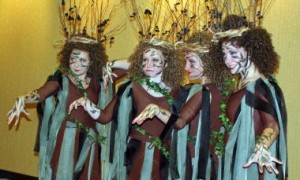
This is also Irish traditional dancing.

This is also Irish traditional dancing.

As you’re reading this, they’re already jigging their little hearts out at the Mid-Atlantic Oireachtas, the annual Thanksgiving weekend Irish dance competition held in Philadelphia. All the little boys and girls—and even grownups—will be movin’ and groovin’ at the Downtown Marriott all weekend, from 8 to 6 PM. Admission is only $15, though parking is another story.

This is actually a good week to be Irish in Philly, especially if you like Celtic-rock fusion. Enter the Haggis, the popular Celtic rockers from Canada, are playing Friday night at the World Café Live in town. The Broken Shillelaghs will be rocking out at The Auld Dubliner in Gloucester City, NJ on Saturday night. And on Sunday, some of the best local Irish bands will be playing at Finnigan’s Wake on Second Street in Philly for the Irish Winterfest 2008—that’s Paddy’s Well, the Bogside Rogues, the Sean Fleming Band, and the Hooligans, all under one great big roof. There will also be Irish dancers, vendors, and workshops at a venue where it always seems like there’s a party is going on.

The Boys of the Lough will be giving their tour of traditional Celtic music from wherever it’s played, from the Shetland Islands to Brittany, at the Sellersville Theatre on Sunday afternoon. It’s a great, comfy venue, with no bad seats–a terrific place to bring the entire clan. The Washington House Restaurant is right next door with its comfy bar and homey dining rooms—you can make a special family day of it.

If you’re in Wilmington, get into the spirit with Christmas with the Celtic Tenors at The Grand on Sunday night. If you mention “Green Willow” when ordering tickets, you get a discount.

In Bethlehem, the Celtic Cultural Alliance (those wonderful folks who bring you the Celtic Classic every year) will hold its first Celtic Music Night, featuring local faves, Barleyjuice, at the Bethlehem BrewWorks on Main Street in the Christmas City (and we do mean that—Bethlehem does it up bigtime during this season). Get a little shopping in at the Moravian Bookstore, then head over to the BrewWorks for a burger, artisan beer, and some music. There’s lots of parking and it doesn’t cost as much as it does in Philly. Then put it on your calendar for every first Monday. We’re going to.

If you want to really get outta town, The Church of the Holy Family in Sewell, NJ, is offering a bus trip on Thursday, December 4, to see the Celtic-flavored Magic of Christmas show at Carnegie Hall, featuring Andy Cooney, who is a dreamy looking as he sounds, with harpist Aileen O’Donnell, violinist Vladimir Tablokov (he’s not Irish), the Mark Miller Gospel Choir and the Children’s Festival Chorus.

Closer to home, the Shanachie Irish Pub in Ambler is hosting a dynamic trio on Thursday night: Guitarist and singer John Doyle, performer and folklorist Mick Moloney (who knows more about the Philly Irish music tradition than just about anyone), and amazing fiddler Athena Tergis. Not to be missed, and I’m planning to limp there myself.

On Friday, Irish singer John MacNally will be performing a fundraiser for St. Mary’s Parish at the Gloucester High School gym in Gloucester, NJ. And the Irish Rovers will be at the Keswick Theatre in Glenside. I’m humming “The Unicorn” song already.

And mark your calendars for Tuesday, December 9, for Teada’s Christmas Tour with former Solas singer Karen Casey, harpist Grainne Hambley, uillean piper Tommy Martin, and Teada’s own Sean McElwain and others at the Irish Center in Mount Airy. It’s sure to be a magical evening. And we could all use a little magic these days, couldn’t we?

Check out our calendar not just for this week, but for the next couple of months. We just added new events that you’re sure to want to put on your calendar (in fact, you can ask our calendar to do that for you!).

If you’re out Christmas shopping, remember to visit your friendly local Irish shop. See our listing for the address of a retail store near you. And check out our pub finder for a nice spot to rest your weary feet (and wet your thirsty whistle) during the Christmas shopping season. We all need to do our parts to keep the Irish community healthy and vibrant.

Music

Still Roving After All These Years

By the time you read this, the Irish Rovers will be doing what they have done, for over 40 years: Roving.

You’ll have a chance to hear and see them yourself Friday, December 5, at the Keswick Theatre in Glenside, as the Rovers present their Christmas show. (The show starts at 8.)

Just before the tour began, we caught up with the Rovers’ George Millar by phone from his home on Vancouver Island, a scenic outpost off Canada’s Pacific coast, about 75 north of Seattle. Millar had lived there for over 15 years.

It’s a short tour, thankfully. After 40-plus years in the business, touring is an exhausting business.

“It’s 12 cities in all,” he says, “starting with three in Canada, ending up in Florida on the 14th of December.” You wouldn’t think there’d be much call for winter holiday songs in Florida, but, Millar says, you’d think wrong. “Isn’t it crazy?” he says. “And yet we do it every year and they all show up with their red and their green on and it’s about 130 degrees out.”

The Christmas tour has proved a popular way for fans to get their annual dose of Irish Rover music. And, Millar says, the boys aim to please.

The Christmas show was the brainchild of the band’s agent, Millar says, perhaps in part due to the popularity of their version of “Grandma Got Run Over by a Reindeer,” originally recorded by an obscure duo, Elmo and Patsy. Of course, the Rovers are about so much more than holiday ditties, so fans will be treated to a crowd-pleasing mix of Christmas and traditional Irish music.

“The trouble with us and doing a Christmas show is we really can’t do the traditional Rudolph and things like that,” says Millar. “So we have to look for the more obscure English-y, Irish-y songs, or we wrote similar type songs. We always have to do “The Unicorn,” “The Black Velvet Band,” and of course “Grandma Got Run Over By a Reindeer.” That’s a must—you have to do that whether you like it or not.

“To keep the tours fresh, we have to keep changing songs. You have to keep so many of them (standards) in, of course. We’ll do the songs they expect to hear, that’s what they pay for. But we keep coming up with new songs to keep ourselves fresh and keep ourselves interested. We just keep it fast paced, and before you know it the two hours is up and we’re off having a Guinness somewhere.”

For the Rovers, there seems to be no slowing down. If it all seems a bit formulaic, well, maybe it is. But it’s a good formula, and one that fans truly appreciate, as they have done since the beginning.

Millar recalls how the Rovers started, by accident, at a weekend show in Toronto.

“It was like a charity show,” he says “At least twice a month in Toronto, where we had immigrated (from Ballymena, near Belfast) there was a big Scottish-English-Irish community, and they would put on these shows about twice a month. They were just like an amateur show. People would come and pay their two dollars and they would drink their rye and ginger ale, and their beer. My sister was quite the singer, and I was playing guitar behind her. I was about 14 or 15 when this all started.

“Well, one night, this fellow (Jimmy Ferguson) gets up and starts singing Lonnie Donegan songs. In those days, Lonnie Donegan was a huge British star. He was as big as the Beatles in his day. He used to sing folks songs, but to electric guitar. So Jimmy was playing this kind of song. Well, one time I went into the toilet to tune the guitar. We were just about to go on and it was so noisy in the place. And I’m sitting on the floor tuning my guitar and humming to my self the song, “The Irish Rover.” And this fella Jimmy comes into the bathroom and he starts singing it along with me. And we sort of looked at each other and I said, ‘Oh, I didn’t know you knew that song.’ He said, ‘Well I’m from Belfast, so of course I do. I learned it in school.’ Just then, the fella who was running the show comes in and overheard us singing “The Irish Rover,” and he says, “Somebody didn’t show up tonight. Can you do it in the show?”

At that point, the two weren’t sure they knew all the words but they tried it out—still in the bathroom. And, Millar recalls, the concert promoter said to them, “It’s perfect.”

“After I sang with my sister and Jimmy did his little bit, we did this one song together, we got up and sang it and the audience loved it. That’s all there was to it.” That’s how they got together, started learning songs and formed the core of what would grow to become the Irish Rovers.

Making a living in music as opposed to any old factory job seemed like a wise choice. In time, they found themselves touring, and they turned up with a gig at the legendary Purple Onion in San Francisco in the late ‘60s. They rubbed shoulders with some young performers, like Linda Ronstadt and Steve Martin, who would themselves go on to fame and fortune. For the Rovers, though, fame came in the form of a Shel Silverstein tune called “The Unicorn,” in 1968.

Two more hits—recorded under the shortened name, ”The Rovers,”—came in later years, including the Tom Paxton tune, “Wasn’t That a Party.” By all accounts, the Rovers’ parties were memorable indeed, and this was Paxton’s paean. A little while later came “Grandma,” a tune that reinvigorated the Rovers’ career, even as it rubbed some audiences the wrong way.

The Rovers acquired the Elmo and Patsy tune, which had been a regional hit, when they were looking for songs to fill a Christmas album.

“We re-recorded it about 30 years after they did it, and it became an underground hit,” says Millar. “You either like the song or you hate it. There’s no happy in between on that one. It’s just a comical, funny song. Even my own mother, before she passed on, said to me: ‘Shave your beard, cut your hair and don’t ever sing that horrible Grandma song again.’”

Of course, sons often do go their own way—and many fans are grateful that the Rovers have.

The fact is, Rovers fans are diehards. Long after “The Unicorn,” they keep on coming. Millar isn’t sure they’re about to stop.

“We’re never going to get retired at this point,” he says. “We’re blessed that we still have a built-in audience of people that wants to see us. When people ask us about retirement, I say, well … why? I can now see why George Burns kept going until he was almost 100 years old. It’s not like rock and roll. We don’t have to weigh 105 pounds and wear Spandex … luckily. With Celtic music, the hair can recede and the stomach can come out a wee bit, and it seems to fit the image.”

Music

Another Year of Joyful Noise

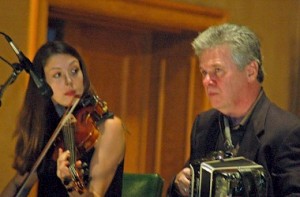
Athena Tergis and Billy McComiskey

Athena Tergis and Billy McComiskey

No one can recall quite when Mick Moloney started playing his annual benefit for St. Malachy School, the most recent of which was held a couple of Sundays ago in the church on North 11th Street.

The parish’s retired pastor Father John McNamee figures it’s at least 22 years since he bumped into Moloney at a presentation on ethnic music at the Balsch Institute. The two struck up an immediate friendship, and Moloney soon suggested a fund-raiser for the little school a few blocks from Temple University in North Philadelphia.

Since then, Moloney’s annual gathering of musical friends has become, McNamee says, “the longest and most successful benefit we have all year” for a school the American Ireland Fund has called “a preeminent symbol of ecumenism and outreach to poor and disadvantaged youth and their families.”

Without this concert and other fund-raisers, Father Mac told his audience, “We’d have closed down 15 years ago.” And he added: “I can’t imagine this neighborhood without this school.”

Neither can we.

Thanks to Moloney and a few of his fellow musicians—Athena Tergis, Brendan Dolan, Billy McComiskey, Brendan Callahan and Caitlin Finley—we won’t have to.

Here are a few photographic remembrances of the day.

News, People

Three New Inductees to the Delaware Valley Irish Hall of Fame

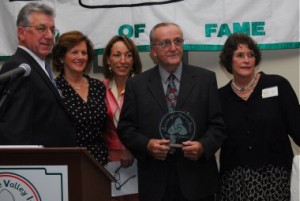
From left, the evening's emcee Tom Farrelly, Carmel Boyce, Ann Donofry's daughter, Jeannine, husband Frank, and Hall of Fame President Kathy McGee Burns.

From left, the evening's emcee Tom Farrelly, Carmel Boyce, Ann Donofry's daughter, Jeannine, husband Frank, and Hall of Fame President Kathy McGee Burns.

Librarian and amateur historian Billy Brennan, retired pastor and community activist Father John McNamee, and tireless volunteer, the late Ann Donofry, were inducted into the Delaware Valley Irish Hall of Fame at a dinner on Sunday at the Irish Center in Mt. Airy.

Mrs. Donofry’s husband,Frank, and her daughter, Jeannine, accepted the award on her behalf in front of an audience of more than 200 at the 8th annual event.

We were there and captured many of the memorable moments, which you can see in our photo essay.

Columns, How to Be Irish in Philly

How to Be Irish In Philly This Week

If I had the music in me, it would be fiddle tunes played in the Sligo style. For those of you who think all Irish music sounds alike (my husband is one of those), an evening listening to someone really talented playing in this highly ornamented, lively style will change your mind.

You have that chance on Saturday night at the Coatesville Cultural Society when the renowned Brian Conway will play, accompanied by Brendan Dolan on piano and flute. The Bronx-born Conway was encouraged by his musical parents, Jim and Rose, immigrants from County Tyrone. His first instructor was fiddler Martin Mulvihill of Limerick, one of the most acclaimed teachers of Irish music in America. His album, “First Through the Gate,” was named CD of the Year by The Irish Echo newspaper in 2002.

But you have to hear him—and you can, on his website. See if you don’t think that the Sligo style is something special.

Also on Saturday, the Celtic Cultural Alliance, those wonderful folks who bring you the Bethlehem Celtic Fest, will be holding their fundraising campaign kick-off at Bethlehem BrewWorks in the Christmas city.

You have plenty of sessions to attend right up to Thanksgiving, but save some room for next weekend’s Mid-Atlantic Oireachtas, the regional championships for Irish dance, which will be held in Philadelphia at the Downtown Marriott. See all of last year’s fun.

Enter the Haggis is also appearing at the World Café Live next weekend. They usually play to sellout crowds so make that call or go to the website today.

Next Friday is the official kickoff of the Christmas buying season. Consider gifting your loved ones with something Irish from one of the many Irish shops in the region. You can find them at our handy-dandy virtual mall. Support your local community! If you’re out at King of Prussia Mall on Black Friday, head over to Kildare’s where Blackthorn will be cheering up the crowd.

And you can get all the details on what’s happening, Irish style, on our kicking calendar. Today, tomorrow, and for who knows how far in the future.

Happy Thanksgiving from the staff of www.irishphiladelphia.com!

Music, People

An (Irish) Traditional Marriage

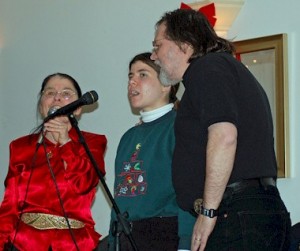
Kathy, Emma and Dennis harmonize at a recent Christmas Wren party.

Kathy, Emma and Dennis harmonize at a recent Christmas Wren party.

You’ll have a hard time finding two busier traditional Irish musicians than Kathy DeAngelo and Dennis Gormley.

Together, they perform as the trad duo McDermott’s Handy (named after the County Leitrim, and later Monmouth County, N.J., fiddler Ed McDermott). And they preside over a popular traditional Irish music session Thursday nights at Three Beans Coffeehouse in Haddonfield, N.J. With Mermaid Inn session leader Chris Brennan Hagy, they also moderate the Next Generation youth Irish music group.

With bodhran in hand, I’ve accompanied them in a few performances and a few more sessions. Turnabout being fair play, Dennis accompanied me on flute when I took a shot at Comhaltas Ceoltóirí Éireann’s Mid-Atlantic Fleadh Cheoil a couple of years back. I also took whistle lessons from Dennis—none of which quite “took,” through no fault of Dennis’s. (Apparently, you have to practice.)

Both talented multi-instrumentalists, Kathy and Dennis have been part of the Delaware Valley Irish music scene for decades. They’re as generous with their time and knowledge as they are talented.

As well as I think I know them, there’s still lots more I don’t know, So I posed a few questions.

Q. How did you two get together, personally and musically? And how big a role did the music play?

Kathy: We met at the Rutgers Saturday Folk Festival in July 1973 when Dennis was playing bass with Saul Broudy, and practically every other performer. I managed to “persuade,” in my own charming fashion, the festival organizer to let me perform with my band in a brief slot that afternoon using the argument that he didn’t have one single woman performing that day. Trouble was, the bass player in my band hadn’t lugged his bass to the student center, whereas all the guys had brought their guitars. So I very boldly approached Dennis and asked if we could borrow his bass. He was too nice, and I was too cute, for him to tell me to buzz off—and I’ll let him get a word in edgewise here.

Dennis: “Cute” is an understatement. I was stunned by her heart-stopping beauty and amazing talent. She could have asked me sign over all my worldly assets and I would would have used my own pen.

Anyway, I was up playing bass for Philadelphia folk music icon Saul Broudy. Saul was working in D.C. at the Smithsonian
Folk Life Festival and traveling up to New Brunswick by train. I drove up early to catch the music at the festival. Little did I know …

Kathy: So we started off playing everything but Irish music at the beginning. We played country music, bluegrass, swing, old-time and good old American folk songs. I was playing Irish music with Ed McDermott, my mentor, but that was a separate world.

Q. You both play multiple instruments First of all, thanks for making me realize just how much I have to learn, but, second, can you tell me how and when you learned those instruments, and how gravitated toward Irish traditional music?

Kathy: I started playing guitar in the 7th grade after being allowed to give up the accordion. My father thought every Italian girl should learn the accordion but in 1965 no right-minded teenager wanted to play the accordion. Everybody in my family played or sang. I just played chords and followed charts on pop music sheet music my brother bought. I got into folk music and by the time I got to college I opened the Mine Street coffeehouse in New Brunswick and got in with a whole crowd of people who played all kinds of music and went to folk festivals. The guys in my band thought I would look good playing a banjo so they gave me one for my birthday. My dad gave me his old mandolin. Other instruments followed and I had the time to learn them.

Two of the instruments I’m most associated with now, harp and fiddle, I didn’t take up till relatively late in life. I started teaching myself fiddle after Ed McDermott died in 1977—and I regret I didn’t take it up while he was living. I played guitar with him for years and he was the one that got me started down the path of the Irish dance music. Besides backing him up, I was flat-picking the tunes. When I moved to this area after Ed died I only knew two people down here and Dennis was one of them. I had a few Irish gigs and I asked him to play with me. He said “I don’t know anything about Irish music.” He insisted on coming over to learn a few tunes before this gig and I was amazed that he’d sit there and write the tunes down while I played them. Well, you know how one thing leads to another. Skip ahead to 1979 and Dennis and I get married. In 1984 I came home from work and Dennis had bought me a harp, which were hard to come by in those days. He had already worked out how to play “If I Only Had a Brain” so I figured I had to get to work to put some Irish music on it!

Dennis: The writing tunes down bit was always a way for me to learn and memorize the tunes.To this day, I’ll write down a tune I’m want to learn (see http://www.hslc.org/~gormley/tunes/giftunes.html), then very rarely refer back to the manuscript.

I started the obligitory piano lessons at about age 6 or 7. My father had rescued a piano from a bar; I remember it had the cartoon character Snuffy Smith on it. But once we learned to read, it got a new coat of paint; apparently, Snuffy was saying some rude things! One day, my parents heard mepicking out the melody for the “William Tell Overture” (you would know it as the theme from the Lone Ranger), and decided to send me for lessons. I never got as good as I probably could have, because I always wanted to learn by ear, and the teachers had this annoying habit of wanting me to read the music.

Anyway, my father Joe Gormley played the guitar as well, in a Freddie Green Big Band style of guitar. Apparently in his younger days he was a touring musician for a short while, which probably led to his advice, “Music is the best part-time job in the world.” My mother told a story of having to wire him money one time so he could get home, but I was never able to get any other details out of them. Up until the time he passed away, he was performing on a regular basis.

So when 1964 came around, there was already an electric guitar around the house. Of course, when I started playing it, I got a nylon-string classical guitar as a birthday present. I think there were thoughts of a classical guitarist in the family, but I immediately recognized it as the same sound heard on the Beatles “And I Love Her.”

I took up string bass in high school, coupling that with bass guitar in high school rock groups. Again, my father counseled, “There are thousands of guitar players, but not many good bass players.” Inspired by my high school band and orchestra director, James Maxwell, I went to Glassboro State College as a music education major and was exposed to all the instruments typically found in a school music program; for the purposes of this narrative, this is pretty much where I first picked up a violin and flute.

Fast forward to the early ‘70s and the folk music of the social activists. I missed the Kingston Trio folk music boom, but Peter Paul and Mary, Buffy St. Marie, Arlo Guthrie, and others were heard in my home. I was playing acoustic guitar and string bass, and working teaching folk music at the now-defunct Haddonfield Music House, giving lessons on guitar, bass, dulcimer, mandolin; they pretty much pushed any student wanting to learn folk music to me, whether I knew the instrument or not!

I started attending meetings of the Philadelphia Folk Song Society, where I met up with several musicians whom I performed with over the years, including Caryl P. Weiss and Saul Broudy. Through Saul, I got the opportunity to perform with many revivalist performers such as Winnie Winston, Steve Goodman, Vasser Clements, and John Prine.

So, toward the mid- and late ‘70s I was playing and performing folk music and traveling to venues throughout the Northeast and up into Canada. Attending and performing at folk festivals, I heard a great deal of Irish music, notably at the Philadelphia Folk Festival, where Kenny Goldstein regularly programmed and hosted a “Celtic Ceilidh” (Sunday afternoon at the Tank Stage). It was “hip” in the circles I traveled and performed in to deride the “diddly diddly,” but I was always drawn to it. Even though there was no Irish music played in my house, perhaps it was a sort of racial memory calling to me.

When I first started performing with Kathy, a short time after the death of Ed McDermott, I figured the mandolin, tuned like a fiddle, would be the most appropriate instrument I had to play the dance tunes. But I never really had the technical expertise to play tunes up to speed. Casting around, I picked up a tin whistle and worked on that, then much later (after a single but memorable lesson with Seamus Egan when he told me he was moving to New York to work with this new group), got a simple system wooden flute and started working on it. Still can’t get the notes for “Nights in White Satin” on it, though.

Like Kathy, I often wonder what it would have been like to be playing flute when Ed McDermott was still alive.

Q. How long have you been anchoring Three Beans?

Kathy: We started doing the session at the Three Beans not long after it opened in 1995, but the session actually started in a back room at the former Katie O’Brien’s, a restaurant in Haddon Township in 1992, I think. When the Three Beans expanded into the shop next door, there was room for us.

Dennis: My sister Lorraine Gormley had met a guitarist and singer from Kerry named Richard Browne, who told her of a session he was running at Katie O’Brien’s. With (daughter) Emma being an infant, it was easy to put her to bed and then get out to the session. (Oh, did I mention my mother was living with us then? Get of my back, DYFSS!) So we started going out. Eventually, having the session at Katie’s became untenable, with a trad session being low on their list of priorities. Harp and Dulcimer maker Dave Field was living in Haddonfield at the time, and he found the Three Bean location.

Q. How did McDermott’s Handy develop?

Kathy: I was the first music director at the New Jersey Folk Festival and Ed McDermott was one of our featured performers at the first festival in 1975, and then again in 1976. Everybody loved him. Here was this 80-year old fiddler who played with incredible energy with the college students who came to learn from him.

He died on New Years Day, 1977, and the festival asked me to put together a tribute to him for the 1977 festival. I asked a whole bunch of players from around the state who had learned tunes from Ed for years to come and play. It was a great night. I used the name McDermott’s Handy, after a track from Gordon Bok’s record of tunes he learned from Ed. So I just decided to keep it going. After that, it was mostly Dennis and me with an ever-changing roster of other musicians until 1984, when it was just the two of us. Now our daughter Emma, who plays fiddle and also sings, sits in with us occasionally.

Dennis: Aside from recordings and touring groups, Ed McDermott was the first practitioner of Irish music that I had met. His dedication to the music and patience in teaching what he had to a gaggle of young musicians with scant background in the music, was an inspiration. The opportunity to commemorate his contribution to Irish music is a continuation honor.

Q. I understand some fella named Seamus Egan once opened for McDermott’s Handy. When and where was that, about how old was he, and did you have an inkling of what a dynamic musical force he was going to turn out to be?

Kathy: Actually, it was the Egan family that opened for us at the old Perimeter coffeehouse in Collingswood, maybe that was in 1985 or so—Seamus and his sisters Siobhan and Rory. They were pretty young—not old enough to drive themselves there, I don’t think. There was lots of talent in them and passion for the music. They were awesome players even then. In fact, I arranged for them to play at the New Brunswick coffeehouse and have photos of all three of them on that stage.

Q. Your daughter Emma plays fiddle with you. Lots of kids might go off in a different direction–say, sports, or, musically, playing anything but the same music mom and dad play. How did that happen, and how did she get to be so good? (And to be such a sweet kid?)

Kathy: Emma has been listening to this music since before she was born. She was only 6 weeks old in the carriage parked stage left when we played at Bethlehem Musikfest in 1987. I’d practice the harp with this little baby laying on the floor at the foot of the harp so I could keep an eye on her. She loves it. She was about 2 years old when she started sing-songing melodies, in pitch. When it was feasible, we brought her to a lot of our concerts so it was not surprising to us that, when she was offered a chance to learn a musical instrument at school, she chose the violin. She’s got an encyclopedic knowledge of tunes. And she’s a big part of the reason why Dennis and I wanted to get those young musician sessions going.

Dennis: During one performance St. Patrick’s Day in 1987, Kathy was playing the bodhran; in utero, Emma started kicking back. So you could say she’s been PLAYING before she was born. Even today, when she goes up to her room, you can hear Irish songs and tunes wafting down from her CD player.

Q. What is there about this music that keeps you coming? You’re obviously both very passionate about what you do.

Kathy: I just love the infinite variety of this music, it’s simple and yet complex at the same time. There isn’t a day that goes by that I don’t think of the influence of that one man, Ed McDermott, and how knowing him shaped the course of my life. It’s a good part of what motivates me as a teacher to help pass this music along. I’m blessed to be able to sit down with wonderful players, like Dennis, all the time who keep that fire lit for me.

Dennis: I see all of us who play this wonderful music as links in a chain, that stretch back a long way. I was explaining to ZB Cummins, a 13-year-old whistle student: Kathy and I learned our first tunes from Ed McDermott, who came to this country in 1915, and was born at the end of the 19th century. He first got his music from his father, who would have been born in the mid-1800s. Now, there are people who get their first tunes from me or Kathy, and who will hopefully will pass them on as well.

News

Philadelphia Mayo Association 2008 Ball

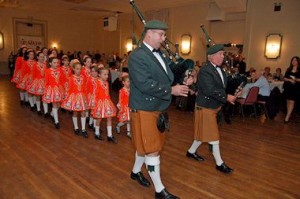
The Emerald Pipe Band ushers in the dancers.

The Emerald Pipe Band ushers in the dancers.

The Mayo Association knows how to celebrate. They started the evening at the Philadelphia Irish Center by honoring scholars, then moved on to salute one of their best and to crown their 2008 Miss Mayo.

This year’s winner of the Mayo President’s award was Thomas Staunton, a man praised by president Maureen Brett Saxon as ‘the one you can always depend on.”

Winner of the Miss Mayo contest—and that just had to be a tough contest to judge—was Colleen Mullarkey.

We have pictures to remember it all.

Columns, How to Be Irish in Philly

How to Be Irish In Philly This Week

Could this really be happening—a quiet week in the region’s Irish community? Or is our calendar not as smart as we think it is?

It’s true: While there are plenty of sessions around the region this week, the only big events are all on Sunday. And here they are:

At 1 PM, the Allentown Hibernians hurling team is holding a clinic for prospective new members. The Hibernians burst on the scene this past season at a great time: There are fewer players in the region because so many have returned to Ireland and only the Shamrocks remained and, like the Hibernians, many of the Shamrocks players are Irish-Americans who wanted to learn to play this rough-and-tumble game.

The Hibernians will be holding the event at the Lehigh Valley Velodrome.

If you’re in New Castle, DE, on Sunday, there’s a Celii-Set Dance Pot Luck Dinner sponsored by the New Castle County Irish Society. Delaware is the most Irish state in the US (the Irish are the number one ethnic group) so we’re going to guess they get a great turnout.

On Sunday evening, three people will be inducted into the Delaware Valley Hall of Fame in ceremonies at the Irish Center. Read the profile of Father John McNamee of St, Malachy’s parish and Billy Brennan, who runs the library at the Commodore Barry Club (The Irish Center), written by Hall of Fame President Kathy McGee Burns. The third honoree is the late Anne McFadden Donfry, a longtime volunteer in the Irish community.