Monthly Archives:

February 2008

News

Bring a Food Donation to the Conshy Parade

“Sharin’ the Green” is the theme of this years Saint Patrick’s Parade in Conshohocken. The parade will kick off at 2 p.m. on March 15.

The Saint Patrick’s Parade Committee of Montgomery County will be collecting food to feed the hungry. The committee asks that participants and onlookers bring a canned or dry good to the parade. These items will be collected, and there will also be drop-off points along the parade route.

Two organizations, the Swedesburg Fire Co. and the Cummings School of Irish Dance, have committed to bringing food. The Swedesburg Fire Co. has a barrel in the Social Room for its members and they also contacted Sacred Heart Church parishioners to help with the food drive.

Jim Gallagher, chairman of the parade committee and a member of the AOH Notre Dame Division, said the food drive is based from the Hibernian Food Project, the AOH project to help the hungry with food collections or working in kitchens making meals for the needy.

The Patricians Society and the Colonial Neighborhood Council will receive the donations collected in the parade. Both organizations help people in Norristown, Conshohocken, Whitemarsh, Plymouth and surrounding areas.

Food & Drink

No Potatoes Were Injured in the Making of this Candy

Despite the name, Irish potatoes aren’t Irish and they aren’t potatoes. They’re a candy made from cream cheese, butter, confectioners’ sugar, coconut, vanilla, a little milk or cream, rolled into potato shapes and covered in cinnamon. If you rolled them into egg shape, you’d have Easter candy. The taste is similar if not downright the same.

Some people think they were made to commemorate the Irish potato famine. The truth is, no one really knows. I’d like to think that a bunch of confectioners (maybe even my great-grandfather, who had a confectioners’ shop on Haines Street in Germantown in 1890) were goofing off one day, tossing some buttercream around, when someone accidently dropped it in a vat of cinnamon and uttered some Irish variant of “Eureka!” and noted, “This looks like a patayta!” (That’s the Irish Germantown way of saying spud.)

Asher’s Chocolates and Oh Ryan’s, both Philly companies, make most of the Irish potatoes available commercially in the city.

For those of you watching your waistline, one potato is about 60 calories. Betcha can’t eat just one.

If you’d like to make your own, check out our darling friend, Agnes McCafferty’s recipe.

  • 2 boxes 10-X powdered sugar
  • 8 ounces coconut
  • 8 ounces cream cheese
  • 1 tablespoon cream
  • Powder cinnamon
Use the cream cheese at room temperature, mash and slowly add the 10-X sugar, coconut and cream.  When well mixed, form into oval shaped balls.  Roll the balls in cinnamon.
Food & Drink

Okay Ladies, Let’s Roll

The ladies at my table, from left, Anne Marie Carr-Hanson, Dolores Stevenson, Mary Jane Haughley Hayes and Ellie Zimmerman.

The ladies at my table, from left, Anne Marie Carr-Hanson, Dolores Stevenson, Mary Jane Haughley Hayes and Ellie Zimmerman.

Every year, the women of the Ladies Ancient Order of Hibernians (LAOH) in Philly make a ton of Irish potatoes.

And in one case, we’re talking literally here. Two thousand pounds of sugary, cinnamon-dusted candy that’s so sweet it makes your teeth hurt and weighs enough to balance a giant scale with a VW Beetle on the other side.

And last weekend, I was rolling balls with the ladies of Divisions 1 (Daughters of Erin, Center City) and 87 (Our Lady of Knock, Port Richmond) at AOH Div. 87’s Hall in Port Richmond, trying to help them reach their appointed tonnage. Just so you know, I’m not trying to be cute—“rolling balls” is the official terminology of Irish potato production in Philadelphia, where the candies originated. At least, that’s what I garnered sitting at a table with six LAOHers whose hands were a blur of activity.

“You gotta keep your balls small,” advised Ellie Zimmerman as she took a pinch of “dough” and started rolling it in her palm. “Or else you’ll get in trouble.”

What kind of trouble I found out rather quickly, when Donna Donnelly of Bridesburg, apparently head of the LAOH Irish Potato Rolling Weights and Measures department, got into it playfully with my table mate, Anne Marie Carr-Hanson. “Ladies,” she announced, after Anne Marie turned in an Irish potato that Donna thought was the size of a Quarter-Pounder, “we’re making our balls too big here. Some people are only going to get six Irish potatoes to the pound.” She hoisted another one from the filled aluminum trays that half a dozen runners were carrying to her from the tables. “We could feed a family of four on this!”

Anne Marie stared at her deadpan, then quickly popped the offending Irish potato in her mouth. “That’s what we do with the big ones,” she explained. “Or else we hide them from Donna.”

“We call her the ‘ball Nazi,’” piped up Ellie Zimmerman with a laugh.

Not only is it all in good fun, but it’s all in a good cause. These women, who often take whole-day shifts, produced enough Irish potatoes last year to give away $5,000 to charity. This year, they hope to earn even more for their ton of candy, which they sell—and by now, have sold out—for only $5 a pound.

“We give money to places like Providence House, which is a shelter for abused families, and the Philadelphia Veteran’s Multi-Service Center,” explained Maria Gallagher, president of LAOH Div. 87. “The rest we give away in smaller amounts, $100 here, $100 there, usually to special projects that come from the ladies who spend so much time here. How can you say no to people who come out two or three days to do this?”

Gallagher herself has been in the seasonal Irish potato business for a decade. She and Donnelly purchase the raw materials from Shamrock Foods (yes, that confectioners’ sugar, coconut, and cream cheese are 100% Irish-American), then combine all the ingredients in an industrial mixer that was donated anonymously. It lives in a small shed, built specially for it by Home Depot, next to the AOH Hall. It’s not heated, so “fold in ingredients” is one of the more uncomfortable directions in the LAOH recipe.

Divisions 1 and 87 aren’t the only LAOHs in the Delaware Valley rolling candy for charity in the weeks leading up to March. So are Divisions 13, 39, 61, 33, and 88. Division 25 makes a scone mix, which doesn’t sound nearly as fun to do. I mean, how do you throw scone mix at someone who’s ticked you off? While I was there, Donna Donnelly dealt with harassment from one table by pitching an extra-large Irish potato at them. This is my kind of charity.

“There’s a lot of camaraderie here,” says Maria Gallagher with a smile. “This is not just a fundraiser. People are making new friends. It’s a lot of work,” she said, wiping her cheek with a cinnamon-dusted hand, ”but it’s a lot of fun.”

News

Philly’s Parade Celebrations Officially Start

Rince Ri Dancers

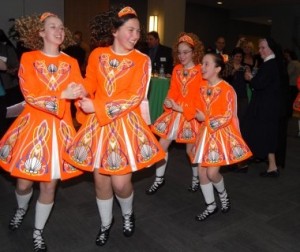
The Rince Ri dancers of Upper Southampton join Sister James Anne Feerick, a parade honoree and an Irish dance teacher, in a turn around the dance floor.

The event was a pre-St. Patrick’s Day Parade kick-off, mingling parade coordinators, this year’s honorees and their families, local Irish notables, and the staff of CBS3, which broadcasts the event every year. It was held at the new CBS3 studios on Spring Garden Street on Thursday night, February 21, and was lavish with food, drink, and music.

But what most people took away from the evening was a story told by the Irish Society’s Edward Costello, one of the 20 honorees of the 2008 parade. It was about “a kid from Fishtown” named George Costello, who was Grand Marshal of the parade in 1992. Ed’s father. And it was a poignant reminder that sometimes a parade isn’t just a raucous collection of marchers, floats, and music. Sometimes, it’s somebody’s dream.

“Two days before the parade, we were at Penn with him and the doctors told us he did not have much time to live,” Costello told the rapt crowd of more than 100. “George being George, he told me, Ed, take care of the family. And then he asked the doctor, ‘so how can I get out of here?’ The doctor said, ‘George, you’re a sick man, you can’t leave.’ And George being George, he said, ‘I’m just a kid from Fishtown, and all I ever wanted to do is be the Grand Marshal of the St. Patrick’s Day Parade. So I need to get out of here.’” Fortunately, his doctors were Irish “so we got George out.”

His father promised to take it easy, but George being George, he spent the entire parade “standing next to Cardinal Bevilaqua and tipping his hat to every organization that went by.” At the end of the parade, he turned to his son. “Ed,” he said, “it’s time to take me back. I promised the doctors I’d be back and I’m a man of my word. It’s been a grand day. I wish it would never end.’”

“Two weeks later, he died,” said Costello. “But there wasn’t a happier kid from Fishtown.”

Along with Costello, honorees this year include Donegal Association Chaplain Father Joseph McLoone, St. Malachy’s pastor and poet Father John McNamee, teacher Sister James Ann Feerick I.H.M., Justice Seamus McCaffery, the Donegal Association and parade committee’s Kathy McGee Burns, Perry Casciato of CBS3, The Irish Immigration Center’s Tom Conaghan, Finnigan’s Wake owner Mike Driscoll, Hibernian Hunger Project founder Bob Gessler, and three couples recognized for their many contributions to the Irish community, Barney and Carmel Boyce, Michael and Jeannie O’Neill, and James J. and Megan White IV.

Lifetime achievement awards are going to Edward Kelly and John Stanton, and special posthumous honors are being award to two Philadelphia police officers killed in the line of duty: Gary Skerski and Charles “Chuck” Cassidy.

Grand Marshal is Jack McNamee, a 30-year board member, past president and past treasurer of the Philadelphia St. Patrick’s Day Observance Association.

The parade is scheduled for Sunday, March 9. It will be aired from noon to 3:30 PM on CBS3 and live on the CBS3 home page at www.cbs3.com. It will be replayed on CW Philly 57 on March 17—the real St. Patrick’s Day—from 11 AM to 2:30 PM.

Food & Drink

Irish Coffee Rivalry Brewing at AOH Division 1

The 2007 judges: from left, Jack Brennan, Ed Halligan, Seamus Dougherty, and Verne Leedom.

The 2007 judges: from left, Jack Brennan, Ed Halligan, Seamus Dougherty, and Verne Leedom.

Who makes the most bracing brew of all?

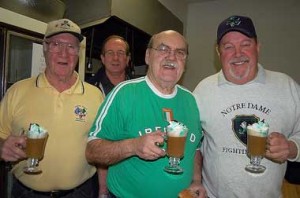
Our friends at AOH Notre Dame Division No. 1 will put it to the test Thursday, March 13, in the club’s Annual Irish Coffee contest. The event kicks off at 7 p.m. at the division hall at 342 Jefferson Street in Swedesburg, Upper Merion Township.

Nine candidates will be fighting for bragging rites for 2008. Last year’s winner, Bridgeport Rib House, will return to defend their title. Chick’s Tavern, the 2006 winner, is hoping for a comeback. Others contestants include: Screwballs, Spams, American Pub, Boathouse, Elks, Swedesburg Fire House and Guppy’s.

Five judges will decide on the best-tasting coffee. The judges are: Pete Hand, 2008 Grand Marshal of the Conshohocken St. Patrick’s parade; and Verne Leedom, Jim Murphy, Jim Cahill, and Jim Dougherty, all past grand marshals. Parade chairman Jim Gallagher will make any decisions on tie-breakers.

The tasting is only part of the judging. Contestants also will be vying for “best presentation.” In previous years, contestants have gone all out on presentations.

Winners will receive the first place plaque, plus a place in the line of march in the Conshohocken St. Patrick’s Parade that takes place on March 15. Second- and third-place finishers also will be honored.

History

Keepers of the Flame

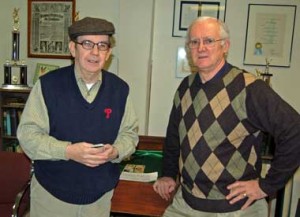
Bill Brennan and Sean McMenamin.

Bill Brennan and Sean McMenamin.

I don’t recall ever seeing a photo of Éamon de Valera in which he ever looked anything but forbidding. The photo I’m looking at now is no exception.

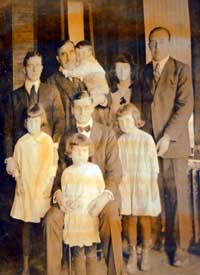
It’s a framed sepia-toned portrait of “Dev” in a visit to the Overbrook home of Joe McGarrity, Philadelphia wine and spirits merchant, the unrepentant physical-force Republican and major fund-raiser for the cause of Irish freedom. The photo was taken in the early part of the 20th Century. In it, the future first Taoiseach (prime minister) and two-term president of the Irish Republic is flanked by McGarrity and two associates, a woman (presumably McGarrity’s wife) and assorted children, at least two of them McGarrity’s. One of the children, a little girl with a page boy cut, stands in front of the seated de Valera. He is cradling her small hands.

A slight smile rests on the Long Fellow’s face. Still, it’s one of those smiles in which the mouth is disconcertingly out of synch with the eyes, which are framed by granny glasses and looking anything but warm. And the eyes tell the story. You can almost imagine the thought running through his head: “The things I have to do just to score a few hundred Tommy guns.”

This hidden treasure is part of a wide-ranging collection housed in the Commodore John Barry Memorial Library at the Philadelphia Irish Center. The library—for those who didn’t even know there was a library at the Irish Center—is in a room on the second floor of the rambling old structure at Carpenter and Emlen, in Philadelphia’s Mount Airy neighborhood.

Éamon de Valera, looking casual.

Éamon de Valera, looking casual.

You might be forgiven if you had assumed that there might be a closet behind the locked double doors. In fact, the library occupies a large room, about the size of the Fireside Room just below it, and it is packed to the rafters with old books containing the histories of the many Irish counties, posters advertising membership in Philadelphia’s Hibernia Fire Engine Company, a Donegal Society mural that once rode on a float in the city’s St. Patrick’s Day Parade, the Catholic Sons of Derry Honor Roll, a replica of the banner of the famed 69th Irish Regiment, a print of the Letterkenny Cathedral, a Hunger Strike exhibit, and an Irish-language bible contributed by Father Doyle from Old Saint Joseph’s Church.

It’s a fairly large collection for such a small library. “We just started collecting things,” says Sean McMenamin, one of the library’s longtime volunteers and a retired DuPont engineer. “It was just a book here and there, stuff from estates and donated things.”

The de Valera photo was among the donated “things.” It was part of a collection donated by the McGarrity family, says Bill Brennan, an amateur historian and the library’s guiding force since the earliest days. The collection turned out to be quite a find for a small library. Most of McGarrity’s papers now reside at the Falvey Memorial Library at Villanova University.

Those who work on the collection today recall only too well its humble beginnings.

McMenamin came to Philadelphia from County Mayo, by way of England, in 1966, just for a weekend. He liked what he saw in Philadelphia, and he set down roots. Like many new arrivals, he gravitated to the Irish Center, which this year celebrates its 50th anniversary. He learned about the library project, and it struck a chord. “I have a great interest in history and genealogy,” he says. “I knew Billy was up here with boxes of books. It was just going to be a little closet.”

Then, some timely fund-raising helped turn the “closet” into something rather more ambitious.

There was much work to be done. For one thing, the room wasn’t a room at all. It was actually a place where guests to the club once could stand and look down on the dance floor below. Volunteers installed a floor, and numerous other volunteer efforts have gradually turned the room into warm, welcoming place. “All the societies had somebody up here at one time or another,” says Brennan.

For Brennan, who is retired from the electric company, the library has always been a labor of love. “Maybe it’s my calling,” he says. “I always figured the Irish didn’t get the credit they deserve.”

Since those days, the library collection has grown steadily, continuing to reflect Brennan’s strongly held conviction that the Irish be recognized for their great contribution to Philadelphia and U.S. culture. It has also been there to save many an ill-prepared student from academic failure. “We get calls from panic-stricken parents,” Brennan says, “like the one whose child needed to see a painting of Brian Boru, or someone doing an assignment on the Great Hunger. We have the stuff.” Academics, too, recognize the little library’s great value, including one woman who was doing research on the subject of textiles.

The library staff also pieced together a very well-received historical exhibit for the 41st International Eucharistic Congress in Philadelphia back in the bicentennial year of 1976.

And if Bill Brennan and Sean McMenamin have anything to say about it, the library will just keep on growing to meet the needs of the next generation of Irish and Irish-Americans in Philadelphia. “We take everything,” says McMenamin, “political or non-political. History is history.”

The library is open Tuesday nights or by appointment. Contact John Nolan at the Irish Center for more information: (215) 843-8051.

Arts

The “Belles” Are Ringing Once Again

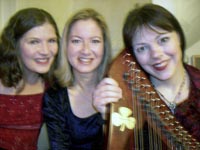
The Belles: Polly MacIntyre, Kim Robson and harper Evangeline Williams.

The Belles: Polly MacIntyre, Kim Robson and harper Evangeline Williams.

Center City actress Polly MacIntyre’s “Belles of Dublin” is returning for its third engagement at the Society Hill Playhouse. The night of songs and stories, adapted from the works of Irish author Edna O’Brien, is starting to seem like a Philadelphia St. Patrick’s Day weekend tradition. But the critically praised show might never have made it to the stage at all, were it not for one incredibly enthusiastic singer.

Back in 2006, MacIntyre was in a master acting class at Philly’s old Triangle Theater with George DiCenzo. As part of the class, MacIntyre was expected to bring in and perform a monologue.

“I had written some original monologues before, for the Philly Fringe Festival, and I was dying to do something with an Irish accent, because I could do it,” she says. “I had been listening to Edna O’Brien’s ‘Country Girls’ on tape, the trilogy. It had been banned in Ireland. She [O’Brien] reads them herself. I went back to them and I adapted the first of the four monologues just to do in class.”

The monologue was a “coming of age” piece in which her character Cathleen, as a teenager, meets a man she calls “Mr. Gentleman.” He wants to take her to Vienna. The relationship is doomed from the start—he’s married—still, she toddles off to bed, cherishing the orchid he gave her. And so the monologue ends.

Her reading, she says, made a huge impression—particularly with one woman in the class. “She was a wonderful singer,” she says. “She just went crazy. She wanted to do it as a show with me. She said, ‘I can sing, you can dance. And we can do fog.’”

MacIntyre laughs now when she recalls the bit about the fog—she was never keen on that idea. And though she would ultimately go on to perform the monologue—and three others based on O’Brien’s novels—she says, “The original singer dropped out before I ever did it, but I would never have thought of this if it hadn’t been for her.”

The show has undergone a gradual metamorphosis. MacIntyre’s success with the monologue encouraged her to write a second. “I call it ‘The Drummer.’ It’s an account of a married woman who meets a drummer at a dinner party and she tries to have an affair with him, but it’s a disaster,” she says. “He fools around with her all day, but nothing ever happens.

In 2005, MacIntyre performed the second monologue as part of the Triangle Theater’s Valentine Cabaret.

She soon created a third monologue. Given her character’s track record of unluckiness in love, it’s a fitting dénouement. “It’s a story of a woman who’s the other woman, it shows things from her side,” she says. “She’s in a terrible relationship (yet another married man) but she doesn’t have the guts to call it off. This one is called ‘The Plan.’ She has an idea to have a confrontation with the wife and raise suspicion with her. It’s very, very dark. It’s a lot of fun.”

With a singer and harper, MacIntyre performed the show at the Society Hill Playhouse in March 2006 (two performances) and again in March 2007 (three performances). She has also performed the show solo, in New York and elsewhere, as a one-act play, “She Moved through the Fair.”

MacIntyre recently added a fourth monologue. “I always had a sense that things were unresolved,” she says, describing the three-part show. “I kind of liked that. That was interesting in itself. At the end, the three of us would sing “The Parting Glass.” And that’s how the show closed, with us drinking Irish whiskey together.”

But an actor friend suggested that a fourth monologue might wrap things up, especially for the solo show—and possibly get more bookings as a longer show—so MacIntyre returned to O’Brien’s works for inspiration once again. “The last one came out of the story, ‘The High Road,’ a novella,” MacIntyre says. “It’s absolutely an adaptation. I was a lot freer with it. I brought in situations that didn’t exist in the book at all.”

MacIntyre’s heroine has gone to Provence, supposedly for the summer, to get over things. While she’s there, in a sidewalk café, she meets a middle-aged Irishman. She swears she doesn’t like him—but does she or doesn’t she? MacIntyre’s character finds out that her Irishman got married to someone else, but it turns out the woman he married has taken his money. “He comes back to her and she doesn’t know … does he just want sympathy? The act leaves her waiting for him in the café,” MacIntyre said. “The monologue ends on a note of hope. Whether he returns to her or not, it’s clear, she can live alone.”

Each year, MacIntyre says, the show changes in small ways, but it still remains true to her original vision, celebrating the creative genius of Edna O’Brien’s tales of several women and tying them together in the form of one character played by MacIntyre.

Given her heritage, MacIntyre says, the project remains near and dear to her heart. “I am part Irish myself and I’ve been to Ireland,” she says. “I suppose I had always had an affinity for this stuff. If I count up all the times I’ve done the whole show in front of an audience, it hasn’t really been that many times. But months can go by and I still remember all the lines.”

You can see MacIntyre’s vision come to life over the St. Patrick’s Day weekend as the Society Hill Playhouse presents “The Belles of Dublin.” MacIntyre’s show will be presented March 14-17 in the Playhouse’s Red Room. MacIntyre shares the stage with soprano Kim Robson and harper Evangeline Williams.

For tickets, show times and other details, visit the Society Hill Playhouse Web site. You can also find driving directions and other information on the irishphiladelphia.com events calendar.

(Polly will be a guest on Marianne MacDonald’s radio show on WTMR, “Come West Along the Road,” on Sunday, March 2, between noon and 1 p.m.)

Columns, How to Be Irish in Philly

How To Be Irish in Philly This Week

Are you getting excited? It’s less than two weeks till March madness starts, and while we’re all about resting up for big events, there are still plenty of do-not-miss Irish activities in February.

Like this weekend’s concert at the Irish Center by Matt and Shannon Heaton, once part of the critically acclaimed Irish band, Siucra. This multi-talented couple from Massachusetts blend traditional and original tunes, with Matt on guitar and Shannon on flute. Those of you who attend the Catskills Irish Arts Weekend know the Heatons and may even have sat in on their workshops. In fact, they’re offering workshops before the concert, which starts at 8 PM on Saturday.

If you’re in the Allentown area, stop by Jack Callaghan’s Ale House on Tilghman Street to help raise money for the city’s St. Patrick’s Day parade, scheduled for March 30. See our calendar for all the great events leading up to Allentown’s parade, including a Mass and pre-parade breakfast. They’re also promising a coronation. We’re not sure what that is, but the King of Prussia had better watch out.

On Sunday, the Celtic Fiddle Festival arrives at the Sellersville Theater. See our review of the remarkable new CD by these four amazing musicians, each representing a different take on Celtic music.

On Monday, the Ladies AOH Division 4 of Delaware County will attend a Mass in celebration of the feast of St. Brigid (a County Louth girl) at The Church of Notre Dame de Lourdes on Fairview Road in Swarthmore. For those not familiar with the lives of the saints, Brigid refused many offers of marriage to become a nun, founding the Convent of Cill-Dara, now Kildare. She was a good friend of St. Patrick.

Of course, Finnegan’s Wake is still playing at the Showboat Casino in Atlantic City (featuring The Barley Boys). On Thursday, you can hear the local group, The Shantys, at McKinley’s Tavern in Elkins Park, and the dynamic duo of Kathy DeAngelo and Dennis Gormley (McDermott’s Handy) at the Bridgeton Public Library in Bridgeton, NJ.

The first parade of the season is March 1. They’ll be stepping out on High Street in Mount Holly for the annual Burlington County event. That weekend is jam-packed with events, so check our calendar before checking yours.