Monthly Archives:

August 2008

Columns, How to Be Irish in Philly

How To Be Irish in Philly This Week

Want to know how lucky you are? You didn’t slide down a wet, grassy hill this week and break your leg and dislocate your ankle. That means you can be Irish all over the place this week—and especially next month when two great festivals take place. Me (I’m the one who took that tumble), I’ll just have to sit around and wait to get reports and pictures from those of you who have two working legs and know the joys of being Irish.

If I’m going to live vicariously through you, this is what I want you to do:

On Saturday, August 30,check out Beltaine’s Fire at the Barrington Coffee House and Café in Barrington, NJ. This California group marries an authentic Celtic sound with hip-hop. Really. Not kidding. And they’re good. This is not a fusion we ever expected to hear, but it works.

Genealogy buffs, take note: Starting on Wednesday, September 3, the Federation of Genealogical Societies is holding its annual national convention at the Pennsylvania Convention Center at11th and Arch. There’s lots to learn no matter what ethnic group you’re from, but the Irish offerings are plenty. Here’s a rundown:

September 4, 2:00 – 3:00 “Introduction to Irish Genealogy:  Where Do I Start?”by Eileen O’Duill

September 5, 8:00 – 9:00 “Matchmaking and Marriage Customs in 19th Century Ireland” by Sean O’Duill

September 5, 9:30 – 10:30 “An Overview of Genealogical Sources at the National Archives of Ireland” by Gregory O’Connor

September 5, 3:30 – 4:30 “Researching in Ireland:  Planning Is the Key to Success” by Eileen O’Duill

September 5, 5:00 – 6:00 “Tracing the Irish in the American Civil War” by Dennis J. Ahern

September 6, 8:00 – 9:00 “The Language Your Ancestors Spoke:  Appreciating Irish Gaelic” by Sean O’Duill

September 6, 11:00 – 12:00, “Lesser Known Genealogical Sources at the National Archives of Ireland” by Gregory O’Connor

There’s an Irish Quiz scheduled for Thursday, September 4 at 7:00 p.m. (no charge to registrants), with a focus on Irish immigration and history.There are also a number of Irish-themed exhibits, including Archive CD BooksIreland, Eneclann, FindMyPast — applicable for Irish living in England orWales, Irish Family History Foundation, Past Homes Limited, TIARA (TheIrish Ancestral Research Association), and Tourism Ireland.

This is a rare opportunity to jump-start your family history search, or pick up points for fine-tuning it. It’s taking a broken leg to keep me from attending.

Make some room on your calendar to hear the high-energy Glengarry Bhoys, appearing on Thursday at the Sellersville Theater.

And you absolutely have to go to Coatesville next Friday night. On the bill, Lunasa’s flute player Kevin Crawford, piper Cillian Vallely and guitarist Paul Meehan. This is a rare trio performance of three fabulous musicians. I saw them last year at thePhiladelphia Ceili Group Festival and they brought down the house. If they could make the lame walk – actually, I think they could make the lame dance—I’d be there.

There’s lots more to come on the horizon. Make your plans now for the Ceili Group’sannual traditional music and dance festival the weekend of September 12 and the AOH’s N. Wildwood Irish Festival the following weekend. I may be holding a pity party for myself in there somewhere, so I’ll keep you posted. And meanwhile, check out our calendar for all the important details. It’s able-bodied.

Send pictures and reports! I’m immobile for 6-8 weeks!

Music, News

Saved!

Pretty early on during the Sunday, August 24,  musical benefit to raise money for Irish radio, some people forgot they were at a charity event. “Isn’t this a great party?” one happy stranger asked me as I wove my way through the dancers in the Irish Center’s Fireside Room.

In fact, it was a great party and it raised about $3,000 to support The Vince Gallagher Irish Hour and Marianne MacDonald’s “Come West Along the Road” shows that air every Sunday,starting at 11 AM on WTMR 800AM. Along with pledges and sales of raffle tickets, it’s enough for MacDonald to say, “It saved my show—and Vince’s.”

Both radio hosts bear the entire financial burden of airing the shows. WTMR does not sell advertising for them, as other stations do, so they need to bring in the estimated $35,000 a year it takes to pay for the airtime. Hosts have always contributed their own funds, but this year, with the economic downturn, it’s been harder to find advertisers and sometimes harder to get advertisers to pay, One longtime large advertiser not only stopped placing ads, but also failed to pay for ads that already ran.

But Marianne MacDonald, who organized Sunday’s benefit, was heartened by the more than $26,000 in pledges the station received during its 8-week on-air drive, and the help from all quarters of the Irish community. “It was amazing to see such a cross-section of people,” she said. “Especially the older people who have been listening to the shows for years. They’ve been so nice.”

Most of the Irish societies, AOH divisions, and other Irish organizations not only made contributions, but some helped out as pledge-takers over the summer, including the St. Patrick’s Day Observance Committee, members of the Donegal, Cavan, and Mayo Associations,the Irish of Havertown, AOH divisions in Pennsylvania and New Jersey, the  NJ, Irish Memorial Committee, DelawareValley Irish Hall of Fame, Mayfair Community Development Corporation, Friendly Sons of St. Patrick, and the Comhaltas Ceoltóirí Éireann Delaware Valley Branch.

Door and raffle prizes were donated by Lisa Carbrey of Celtic Scenes, an online photo and gift shop; the Waterford Wedgewood Company Store in Limerick; artist Patrick Gallagher; Liam O’Riordan of Blarney, County Cork; the Eileen Motel in Wildwood Crest; the New Deck Tavern; Emmett’s Place in Philadelphia; Kelly’s Touch of Ireland in Pitman, NJ; Kathy McGee Burns; the Philadelphia Mayo Association; the DelawareValley Irish Hall of Fame; and www.irishphiladelphia.com.

Local musicians also donated their time and talents, including Kevin and Jimmy McGillian, Mary Malone, Den Vykopel, Patsy Ward, John Boyce, Tim Hill, the Gittlemans, The King Brothers, Round Tower, The McHughs, Fintan Malone, Terry Kane, and others. They’re who kept the dancers busy most of the night to help work off the calories from the buffet dinner provided by caterer Mickey Kavanaugh. 

The fundraising will continue for several months with a raffle—grand prize is atrip for two for a week to Ireland, free lodgings at Faha House, a home owned by local musician Fintan Malone, in County Clare; standard car rental for a week, and admission passes to various sites. The tickets cost $10, or three for $20, and are available from Robert Gessler. You can call him at 215-806-7298, email him at gesslervs@comcast.net or write to him at 2212 E. Norris Street, Philadelphia, PA 19125.

People

Nurturing the Sound of Traditional Music

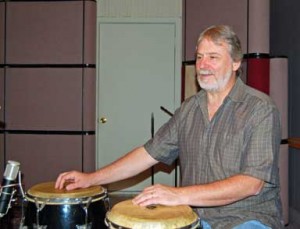
John Anthony in his studio.

John Anthony in his studio.

Here’s what soul crooner Gerald Levert, indie singer-songwriter Jim Boggia, jazz bass virtuoso Gerald Veasley and the inventive young Irish ensemble Solas have in common: John Anthony.

All are brilliant artists in their own right. But it is Anthony—audio engineer, producer and owner of Maja Audio Group in Society Hill—who helps give them their voice.

Anthony’s career path in music began one Sunday night in February, 1964, when a new band from England debuted on the Ed Sullivan Show. The drummer—a mop-haired guy with a memorable nose—made quite an impression on the kid from Newtown Square.

“It was Ringo,” says Anthony, a talented percussionist who lends a hand on many Solas recordings. “My dad had a big custom stereo that he built, and it had big speakers. The TV came through the stereo, which was revolutionary in those days. But I just watched that show with my head between the speakers. After that, that was pretty much it.”

Anthony went on to pound away in his fair share of bands, but his interest in just playing music always took a back seat to recording it. His early knack for extracting crisp, true sounds out of a performance eventually blossomed into a successful career.

How successful? In addition to the above, consider this eclectic artists’ roster: Grover Washington Jr., Omar Hakim, Karan Kasey, Dru Hill, Sara Hickman, Phil Lee, the Hangdogs, John Doyle, Liz Carroll, Sue Foley, Niall Vallely, Cathy Ryan, Susan McKeown, Jim Boggia, Eileen Ivers, Michael Manring, and the Dixie Hummingbirds. He has also worked on a number of films, including “The Brothers McMullen,” “Philadelphia,” “Beloved,” “Two Bits,” “The Siege,” “Barnyard,” “The Illusionist” and “Meteor Man.”

Anthony’s musical tastes are pretty clearly catholic, but his passion for Irish traditional music also is well-known. His skills have gained the attention of many Irish and Celtic recording artists, including piper Cillian Vallely, who is scheduled to begin recording at Maja in September.

We visited Anthony’s studios recently for a wide-ranging conversation about Irish music, and his long association with Solas, most recently on the new CD, “For Love and Laughter.” 

Oh, yeah … and a bit about John Coltrane.

Q. How did you become so popular with Irish artists?

A. It’s all because of Seamus (Egan). I first worked with Seamus on a solo album of his, “When Juniper Sleeps.” I think that was in 1994.

Seamus had done his first solo record with my former partner Michael Aharon, who’s a producer and arranger. He (Aharon) was renting space at Sigma Sound Studios, and I was a staff engineer at Sigma. Michael was going to see if he could do the next record at Sigma, with me engineering. Seamus and I just kind of hit it off.

“Juniper” was really a great musical experience. To me, that’s always the best part of the project. The technical stuff, I either take for granted or I learn what I have to learn. But the music part of it is what has always interested me. I mean, I’m a musician, so the band dynamic and the music are what motivate me.

That project was just a total gas. It was the beginnings of the Solas organization. I mean, it was (guitarist) John Doyle, (accordion player) John Williams and (fiddler) Win Horan and Seamus and some other people like (drummer) Steve Holloway, who all went on to play with Solas. It was just a ton of fun. Seamus and I have stayed connected ever since.

Q. You’ve worked with other Irish artists since then. What do you think appeals to them?

A. I worked with Cillian and Niall (Vallely) on a record of theirs, I think, and also with Niall on Karan Casey’s next-to-last record. It just seemed a natural thing. I have a lot of enthusiasm for the music. I’m pretty good at editing, and I know where I am in the tunes. That’s of value to people. They’re not dealing with someone who doesn’t understand the structure of the tunes. Or if they say, “That bit there, it isn’t very good,” I know why. If it’s an ornament that didn’t quite happen … it just makes it much easier to communicate.

Q. What appeals to you about Irish music? It’s probably unavoidable that you approach it from a percussionist’s perspective. You play bodhran on many of the Solas recordings, including the 10th anniversary performance.

A. It occurred to me, after a couple of years, that I was doing records where the acoustic guitar took the place of the drums. The tracks were really big-sounding. They weren’t necessarily big-sounding from a rhythmic point of view. But it just kind of developed that way. It’s a really great sound, particularly when you’re working with John Doyle or Éamon McElholm. They have a great sound and a lot of the rhythmic underpinnings of a song are in their part. I just have a fascination with percussion in that music.

Q. I think I’ve noticed.

A. (Laughs.) Seamus is a really great bodhran player. He has a natural “feel.” The first time he played on a track, way back when, I thought … wow, what a great sound. And we sat down and he played me maybe five things where the bodhran was a really cool part of the arrangement, like some Donal Lunny stuff where he was playing with his hand … all different approaches to playing the instrument.

It can have so many different functions—tonally, rhythmically. It can be this big pillowy, low-end sort of thing, or it can be really cracking, like the first set of tunes on the new record.

Q. It can be more melodic, too.

A. Seamus really does that. He’s really sensitive to the notes and tones that the drum is playing, and bending the notes and crafting a part to the melody.

Even “Juniper,” going back, has really great percussion arrangements on it. As far back as that first project, there’s a slow piece—”Mick O’Connor’s,” I think—and that’s got at least four percussion parts on it. There’s Daryl Burgee, Ron Crawford and me, and we’re all playing percussion parts. The first set of slip jigs has a really great percussion arrangement. It’s a really crazy arrangement that John Doyle came up with on guitar that people think is in a completely odd time. The pattern of accents is really long—it’s like a four-bar pattern. And it doesn’t repeat again. So if you just pick it up somewhere in the middle, you have no idea what’s going on.”

Q. So you never played bodhran before working with Seamus?

A. No, I hadn’t. I had a fascination with Irish music, but I didn’t understand it well. But back in the early ’90s, I went to Ireland for the first time and I stayed out on the Aran Islands. There’s a little pub in the harbor where they have music all the time. I was sitting next to a guy who was playing bodhran, and it totally blew me away. I thought—I really want to learn how to do that! I’m still learning.

I’m pretty much a journeyman drummer-percussionist. I feel pretty lucky to have gotten to play with these people and not embarrass myself.

Q. When you were a kid in garage bands, what did you play?

A. We played all the early Cream and Jimi Hendrix, all the ’60s music. The first bands I was in played covers of “In My Room”—Beach Boy songs and all that crazy stuff.

Toward the end of high school I got into jazz. I was listening to blues music, and someone said to me, “If you like that you should listen to some John Coltrane. I had no idea what they were talking about. So I went to the record store and bought a John Coltrane record. I think it was “Ascension.” (1965) If you listen to it, it sounds like the band is tuning up for the whole first side. It’s pretty free. They play this one figure over and over again. They pass it all around, everybody plays it, and it just builds to this craziness.

I kept moving the needle, waiting for them to start playing something. And eventually I put the needle down on Freddy Hubbard’s trumpet solo. And it was like: Oh, my.

I waited a little while and went back and listened to it from the beginning. And all of a sudden, I just got what they were doing. So then I was totally into every jazz record I could get my hands on—Miles and Monk, Newport ’58.

Q. And here you are today recording Irish music.

A. You might think this is a digression, but the thing that totally blows me away about Irish music is the nuance and power of the ensemble playing. It’s the same as a really great Blue Note front line.

When Solas is playing live and you’re in the audience, it’s like a freight train. When they’re all just on, it’s just unbelievable. It doesn’t matter if they have a drummer or not. It’s the strength of the melody and the way that they phrase. Great Irish players are like that and they always have been. Irish music has that sensitivity. It’s not completely freely improvised the way jazz is, but there is definitely an element of interplay. It’s subtle and you have to be tuned into it. But it’s there for sure, and it really keeps the music alive.”

Music

You Know How to Learn Irish Music, Don’t You?

You’ve gone to the local traditional Irish music sessions and you’ve watched all the musicians plucking away on guitar or tootling on a whistle or flute. And you’ve surely said to yourself: “I really wanna do that!” 

Hey … now you can!

The Delaware Valley Branch of Comhaltas Ceoltóirí Éireann will be sponsoring a 10-week series of classes in traditional Irish music at the Philadelphia Irish Center starting Wednesday, September 17.

Here’s the class schedule:

6:30 p.m. – Beginner/intermediate tin whistle and flute
7:15 p.m.- Intermediate/advanced tin whistle and flute
8:00 p.m.- DADGAD (a kind of tuning) guitar accompaniment of traditional Irish dance tunes

Don’t have a whistle? You can buy one at the first class.

The class costs $70 if you’re a member of CCE, and $110 if you aren’t. If two family members hold membership in CCE-DV and are taking classes, the cost is $60 each. If three or more family members are taking classes, the cost is $50 each.

If two or more classes are taken, the cost is $60 per class for CCE members.)

Please bring completed registration forms with you. Forms are available for printing at:

http://www.cce-dv.org/cce/registration.htm

Membership to Comhaltas (or renewal) will be accepted at time of registration. For additional information, please contact Dennis Gormley at (856) 795-7637, or e-mail: gormley@hslc.org

CCE-DV also will be sponsoring classes in the Irish language. Contact Poilin Ni Dhuill at (215) 233-2450. Also, Terry Kane will teach Irish singing. Contact Terry at (215) 541-0282).

News

Prayerfully Celebrating the Irish Center’s 50th

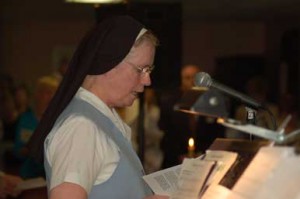
Sr. James Anne does a reading.

Sr. James Anne does a reading.

Father Joseph McLoone looked around the Philadelphia Irish Center’s Barry Room. Noting that the place was packed to the rafters for the Irish Center’s Lady of Knock Mass, he quipped: “Every pastor whose parish you belong to is probably mad at me today.”

The Knock Mass, commemorating the appearance of the Blessed Mother in a little town in County Mayo in August 1879, seemed an appropriate way to kick off an afternoon and evening of festivities in honor of the Irish Center’s 50th anniversary.

In his homily, Father McLoone touched on a theme near and dear to practically every heart in the room. Taking his cue from the Gospel reading—the story of the Canaanite woman, an outsider who persisted in her belief in Jesus even as he appeared to rebuff her—Father McLoone noted that, in American society, we mostly hail from immigrant stick and are, therefore, all outsiders.

“We are all foreigners in this country,” he said. “All of us, in one sense, are not native to this country. We should see no distinction in who comes early or who comes late.”

We took a few photos of the service.

News, People

A Virtual Community Rises to Meet a Real-Life Challenge: Breast Cancer

Courtney Malley, BethAnn Bailey, Rosaleen McGill and Anne McNiff—all residents of our cool little Irish community, BallyPhilly—are getting set to take a long walk with lots of their closest BallyPhilly friends and neighbors.

You can help make their journey a little easier. Come this October, they’ll set off on a three-day, 60-mile walk to raise money for breast cancer research. But before that, on September 7 at the Philadelphia Irish Center, they’ll host a benefit beef and beer with the great local band The Hooligans providing the night’s music.  

For more than one of the team members, this is personal.

For Courtney, the story starts with her mother, a nine-year survivor. More recently, friend and Full Frontal Folk band mate Jen Schonwald also was diagnosed with breast cancer.

“She was diagnosed at age 36,” Courtney says. “I thought to myself: I can watch her kids for her, I can bring her food. But in February, I said to her, ‘I m gonna walk this walk for you.’ She said screw it, ‘I’m gonna do it with you.’ We now have a team of 14.”

Three of the walkers—Anne, Courtney and Rosaleen—are members of the Philadelphia Ceili Group. But since they’re all members of BallyPhilly—an online community that embraces Irish folks from many walks of life, representing interests as diverse as Gaelic athletics, set dance, county associations, firefighting and law enforcement, Irish language and just plain freeform Irish pub crawling—the local breast cancer team thought that a benefit might also be a good way to bring this vibrant online village together for real, and in common cause.

“We’re really hoping to bring out, not only our own friends, but to get the word out to the greater Irish community,” says Anne. “It’s also a great opportunity to have a great afternoon with a great band.

“We were lucky enough to speak with (local musician) Fintan Malone about the bands he represents. One of those bands is The Hooligans. We asked whether they’d be willing to work with us, and they were very accommodating.”

The benefit should go a long way toward helping the team meet its goal of roughly $35,000. Each team member needs to pledge $2,200. Only a few of them have been able to do so thus far. As a group, they’re about half the way there.

You can help them get the rest of the way, and have a hell of a good time, too.

Once again, the details:

Sunday, September 7.
4 p.m. to 9 p.m.
Philadelphia Irish Center/Commodore Barry Club
6815 Emlen St
Philadelphia, PA 19119

Tickets: $25 in advance, $30 at the door.
For advance tickets: www.theirishcenter.com/ceili.php

Or call:
(215) 848-1657

The price of admission gets you food (including vegetarian options), soda, beer and an afternoon and evening of great music. (Might even be some special guests.) There’ll also be a basket of cheer, raffles and other personal fund-raising opportunities.

Columns, How to Be Irish in Philly

How to Be Irish in Philadelphia This Week

Think of Sunday, August 24, as benefit day.

Starting at 5 p.m., enjoy a terrific group of Irish performers who are donating their time to raise money to keep Irish radio alive at WTMR 800 FM. The show, to be held at the Irish Center in Mount Airy, will benefit The Vince Gallagher Radio Hour and “Come West Along the Road,” Marianne MacDonald’s traditional music show. Both air on Sundays from 11 to 1. On the bill are Blackthorn’s John Boyce (and friends—we’re anxious to see who he’s bringing); the King Brothers, singer Terry Kane, Round Tower, fiddler Mary Malone, piper Den Vykopel, banjo player Fintan Malone, singers Tom and Marian Gittelman, ceili dance specialists Kevin and Jimmy McGillian, and many others. Along with music and dancing, there’s a buffet dinner donated by caterer Mickey Kavanaugh and drinks are always available at my favorite bar.  Tickets are $20 and include the buffet, music, and a chance to win some terrific door prizes.

If you’ve already made a pledge and haven’t sent it in, mail your donation to WTMR Radio, C/O Sunday Irish Radio Shows, 2775 Mt. Ephraim Avenue, Camden, NJ 08104. If you haven’t made a pledge and would like to donate, do the same thing. Write “Irish Radio Shows” on your check. Thanks!

And yes, you can do both benefits if you really want to. The other one starts at on Sunday, at Maggie O’Neill’s Pub and Restaurant in Drexel Hill, will benefit Team Ratty Shoes. The name comes from a Blackthorn song, and is the wonderful crew assembled by Blackthorn fan Patti Byrd to participate in the annual fundraising walk for the Delaware Valley Multiple Sclerosis Foundation.  Random Blonde will be performing, and we hear that band member Seamus McGroary has become the newest member of Team Ratty Shoes. Yes, he’ll be hoofing it for charity this fall. You rock, Seamus! I mean, really.

We would be remiss if we didn’t remind you of the Berks Celtic Oyster Fest on Saturday, August 23, in Mohnton, near Reading. Along with the oyster-eating contest, you can enjoy music, more seafood, Celtic vendors, and just have a good old time. This festival is in its sixth year, so you know it has to be great.

And if you’re out back-to-school shopping this weekend, head over to Five Below for school supplies. Take this coupon  http://pae.nationalmssociety.org/site/DocServer/CHW_Team_Ratty_Shoes_5_Below.pdf?docID=31555 and Team Ratty Shoes will get a percentage of the sale for MS research. You’ll find a list of all the stores in the tri-state area on our calendar.

And speaking of our calendar, check it out for all the details of this week’s events. It misses you when you don’t.

Arts

“Stones in His Pockets” Coming to Ambler’s Act II Playhouse

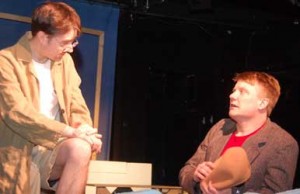
Tony Braithwaite and Chris Faith, during rehearsals at Act II.

Tony Braithwaite and Chris Faith, during rehearsals at Act II.

Marie Jones’ award-winning comedy, “Stones in His Pockets,” is classified as a two-hander. In theatre jargon, that means there are two main characters.

Maybe they call it that because to call it a 30-hander would seem physically impossible. And yet, here you have two veteran local actors, Chris Faith and Tony Braithwaite, intrepidly embodying 15 characters, with all of the action compressed into one tight, fast-moving little show.

(Editor’s note: There’s been a recent change in the cast. See below.)

“Stones in His Pockets” is about what happens when a Hollywood movie company descends upon a tiny town in County Kerry. The show, directed by William Roudebush, starts September 2 (press opening on the 5th) and runs through September 27 at the cozy Act II Playhouse in Ambler.

(And for those of you who just can’t wait to see this multiple award-winning comedy, stay tuned for news about a sneak preview that is also a benefit for the Hibernian Hunger Project.)

Braithwaite and Faith have worked together before, including their 2005 performance of “Good Evening,” by Peter Cook and Dudley Moore. That’s right—a two-hander. And, technically, yes, they’re two characters in “Stones”— Charlie Conlon and Jake Quinn, who hired on as extras for the film, a hyper-romantic view of the Emerald Isle. But the play also requires that they fill a whole lot of other shoes.

“Good Evening” posed a challenge, Braithwaite recalls. There were two characters on stage from beginning to end, and they assumed other characters. But, says Faith, “in this play there can be three or four characters on stage at the same time … or more, even.”

So as bad as it is to step on another actor’s lines in a play, Braithwaite and Faith have the potential to step on their own. Or worse, adds Braithwaite: “Showing up as the wrong character for a split second, and then realizing that you have to turn the hat around a little bit, or whatever that character’s little flair is.”

In rehearsals, Faith is wrestling wth similar issues: “I can hear when a voice from another character creeps into the voice I’m doing, and I pull back. For now, it’s fine-tuning all that stuff.”

Juggling the multiple personalities also poses a challenge for the director.

“Oftentimes when characters play multiple roles they go off and they come back on as another character, which makes immense sense,” says William Roudebush. “But sometimes the changes are instantaneous, right in front of your eyes. Part of what I’m trying to do as a director is to make that change very magical, to take advantage of the moment.”

Another challenge: Playing Irish, which Braithwaite has done before. He played the character Paddy O’Gratin in “The Big Bang,” described as a “madcap tour of history.”

“He sang to his potato, the last potato in Ireland,” he recalls. “It was a love song. That was the last and the only time I ever had to do Irish.”

For Faith, putting on an accent—something that sounds something other than “stage Irish”—is a new experience. “It’s challenging,” he says, “but I think there are three major sounds we’ve got to hit all the time. I think that, if we’re in the ballpark, we’ll be OK.”

Though “Stones” is a comedy, Roudebush says it’s his goal to treat all 15 of those characters, especially the Irish, with respect. “The soul of the play is Irish,” he says. “It’s a great honor and challenge to have to try and live up to that—and not make it a cliché, that’s for sure.”

All three describe themselves as journeymen—or, as Roudebush quips, “I like to say that my job is finding work.”

Roudebush has been “finding work” for over 30 years. His 2002 revival of “Equus” was nominated for eight Barrymore awards and won five, including Best Overall Production of a play, Best Ensemble and Best Director. He has taught at The American Academy of Dramatic Arts in New York, The University of Memphis, The University of the Arts, Virginia Commonwealth University, along with being Theatre School Director for the Walnut Street Theatre for four years. He is currently director of musical theatre for the Performing Arts Institute in Kingston, Pa.

Both the actors are well-known in Philadelphia theatre. Like most actors, they do—or have done—other things. But what they do all the time—because to do otherwise would be unthinkable—is act, and when they’re not doing that, looking for opportunities to act some more.

Braithwaite, a Barrymore award winner (for the role of Boyd in “The Big Bang”) used to teach theology, theatre—and sex education to freshmen—at St. Joe’s Prep: “I used to say—I teach theatre, theology and sex ed, so we do ‘Agnes of God’ every year.” (Cue the rim shot.) He still directs shows at St. Joe’s.

Faith has appeared Off-Broadway in “The Secret Garden” and “Like It Is” at the York Theatre. He is a three-time Barrymore Award nominee. He and his wife have a children’s performing arts studio in Plumsteadville.

Now, as to that sneak preview:

The final dress rehearsal of “Stones in His Pockets” will be open to the public on Sunday, August 31, at 2 p.m. The suggested donation is $10, and all contributions will be donated to the Hibernian Hunger Project, a community service program that feeds needy people in the Philadelphia/Camden area. (Hey, how can you call yourself a Hibernian and not go?)

Three preview performances will be held September 2-4, with tickets discounted at $20. Talkbacks will be held after the first two 8 p.m. previews, as well as on Thursday, September 11, at 8 p.m. and Sunday, September 21, at 2 p.m.

Opening night is September 5, followed by a reception. All evening performances are at 8 p.m., and matinees begin at 2 p.m. on Wednesdays and Sundays.

Tickets are $25 for all Wednesday-Thursday performances and $30 for Friday through Sunday shows, with discounts available for groups of 10 or more. Tickets are available by calling the Act II Box Office at (215) 654-0200 or online at www.act2.org.

Act II is at 56 East Butler Avenue, just a block from another venerable borough institution, The Shanachie Pub. Shanachie is also a show supporter. Look for an opening night appearance by the pub’s co-owner, singer Gerry Timlin.

P.S.: We’re supporters, too, even though it’s mostly moral support.

Editor’s note: Broadway and Irish actor Declan Mooney is stepping into the role of Charlie Conlon. Mooney, who joins Tony Braithwaite in rehearsal, replaces Chris Faith, who was forced to leave the show due to a family emergency.

Mooney will easily fill the shoes of Faith. He has performed the role of Charlie two other times, including as stand-in for Tony-nominated Conleth Hill in the Broadway production of the play. Dialect training will not be necessary for Mooney: He hails from Downpatrick in County Down, Ireland, and came to the States to attend college on a soccer scholarship.