Monthly Archives:

August 2007

Music, People

Tom Munnelly, Ireland’s Greatest Song Collector, Dies at Home in County Clare

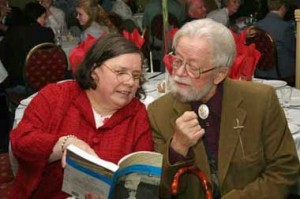
Tom Munnelly and his wife, Annette, peruse the book of essays written in his honor.

Tom Munnelly and his wife, Annette, peruse the book of essays written in his honor.

Tom Munnelly, called “Ireland’s greatest folksong and folklore collector,” died Thursday, August 30, after a long illness, in Miltown Malbay, County Clare. He was 63.Though a Dubliner by birth, Munnelly moved to this mecca of Irish music with his wife, Annette, in 1978, and became chairman of the Willie Clancy Summer School, the largest gathering of Irish traditional musicians in the world held annually the first week of July.

Referred to as “the last song collector” in a 2006 RTE Radio 1 documentary, Munnelly began collecting and recording traditional music in 1964 and had been a collector and archivist of Irish folk music at the University College of Dublin since 1975. He became well known for recording the music and stories of the travellers, Ireland’s itinerant ethnic minority. (One of the most familiar current traveler musicians is piper Paddy Keenan, who appeared several years ago at the Philadelphia Ceili Group’s annual music festival.)

 Munnelly co-founded The Folk Music Society of Ireland (Cuman Cheoil Tire Eireann) and was the first fulltime collector of the National Traditional Music Collecting Scheme, a project initiated by the Irish Department of Education, later folded into UCD’s Folklore Department.

After his move to Miltown Malbay, he started The Folklore and Folkmusic Society of Clare and was chairman and founder of the Clare Festival of Traditional Singing. He also recorded in excess of 1,500 tapes of folksong and folklore, which is the largest and most comprehensive collection of traditional song ever compiled by any one person. Not only that, he transcribed, indexed, and cataloged every note.

This May, many of the leading lights of Irish studies and music published a collection of essays celebrating in Munnelly, called “Dear Far-voiced Veteran: Essays in Honour of Tom Munnelly.” It was presented to the frail Munnelly at a ceremony, attended by his wife and family, at the Bellbridge House Hotel in Spanish Point, County Clare. This June, Munnelly received the honorary degree of Doctor of Literature (DLitt) from the National University of Ireland at Galway in recognition of his contribution to Irish traditional music.

“He is the best collector of folklore that ever existed,” said musician Fintan Malone of Cheltenham who anchors the Tuesday night session at The Shanachie Pub in Ambler and who is a native of Miltown Malbay. “Tom was a good friend of ours. He was a very witty man, with a dry sense of humor. Very gentle, generous, very intelligent and dedicated to collecting folklore. He was very well-liked.”

Malone, who was in Miltown last July for “Willie Week,” said that he saw Munnelly then at Tom Malone’s, the pub Malone owns with his brother,  and he looked very gaunt. “I was taken aback. He had been ailing for a while,” Malone said.

Paul Keating, artistic director of the Catskills Irish Arts Week  first met Munnelly at the 1976 Festival of American Folklife produced by the Smithsonian Institution for the Bicentennial.

“The world of Irish traditional music lost one of its most dedicated academic voices today when Tom Munnelly left us,” Keating told irishphiladelphia.com. “I was aware of the high regard he had for traditional musicians and they for him because of his work on their behalf.  As a song collector and folklorist, he had the personal touch that separated him from the ordinary collector who thinks their job is to put things down on tape or print and so he will be fondly remembered for years for touching so many lives and helping to keep the traditional way of life alive.  His battles weren’t always easy but he was a fiercely determined Dubliner who wasn’t easily deterred and that was his way until the end. “

Irish studies teacher and traditional Irish singer, Virginia Stevens Blankenhorn co-taught song seminars with Munnelly (an passionate advocate for sean nos singing) at the Willie Clancy School for two years in the mid-80s.

“These weeks are among my happiest memories. Tom was such fun to be with, always looking for a laugh, always ready to skewer silly ideas, but always (at least in class) with tact and kindness,” said the California native, who now lives in Ireland. “It was no mean achievement to win the trust and regard of both the traditional communities in which he worked and the academic world – especially the latter, given his intolerance for hot air. Irish traditional song has been uncommonly blessed in having Tom as its chief champion and advocate, and I am so sad that heaven claimed him before I could see him again.”

Funeral services for Munnelly will be at St. Joseph Church in Miltown Malbay at 1 pm Saturday,September 1, followed by burial at the Ballard Road Cemetery.
News

Top 10 Things NOT to Do at an Irish Music Event

As we approach the beginning of the 33rd Annual Philadelphia Ceili Group Irish Festival, we thought it might be helpful to explain some of the basic rules of Irish music etiquette for the uninitiated (with a tip of the hat to David Letterman).

From the home office in Horseleap, County Offaly, the official Irish Philadelphia Top 10 Things Not to Do at an Irish Music Event:

1. Flick your lighter and yell “Free Bird!”
2. Sing “di-dee-di-dee-di-dee-di” just like the guys on “Whose Line Is It, Anyway?”
3. Ask, “Is that a tin whistle in your pocket, or are you just glad to see me?
4. Yodel along to everything
5. The wave
6. To everyone you run into, say, “Top o’ the marnin’ to ye” just like Barry Fitzgerald
7. After every verse of “Si Bheag Si Mhor,” sigh loudly, look at your watch and ask: Is it over yet?”
8. The Electric Slide
9. When singing “She Moved through the Fair,” croon “ohhhhh, baby, baby” in a Barry White voice
10. Play the bodhran

Arts

“Trad,” the Play, Makes Its Philly Debut

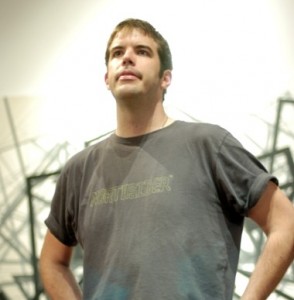
"Trad" director Tom Reing

"Trad" director Tom Reing

In the play, Trad, by Irish comedian Mark Doherty, which will open September 12 at Philadelphia’s Mum Puppettheater, the character, old Thomas, a 100-year-old Irish bachelor farmer, sets off with his ancient “Da” to find the son Thomas fathered many years before in a short-lived dalliance with Mary, whose last name he can’t recall but who “had a certain stare on her.”

In this comic take on the hero’s journey, Thomas is the reluctant Don Quixote (fill in your favorite literary quester) who sets out on the road because his father, on his death bed, has been lamenting his lack of an heir. To the old man (make that older man), that means “the end of the name,” the end of everything. When Thomas confesses his apparently singular indiscretion to his dying Da, his father makes a remarkable recovery. “Get me my leg,” he orders, and the two men hobble off into the countryside in search of the lad, who is 70 if he’s a day–or alive.

On their way, Thomas and his Da encounter the realities of modern Ireland, a country now wired on coffee and wireless with Bluetooth, where the waitress serving you tea might speak Polish and those nice folks who moved into the McLaughlin’s old cottage emigrated from Abuja, Nigeria. Director Tom Reing (it’s a Cork name, he says) experienced a little of that culture shock between 2002, when he lived in Ireland on an Independence Foundation fellowship, and just recently when he met with the author of “Trad” in Dublin.

“In 2002, I stayed in a hostel, and when I was in the area again, it had been completely transformed into a Chinatown. Even the signs were in Chinese,” says Reing, a Penn graduate who used his fellowship to work with the Rainbow Theater Company in Belfast, a cross-community group for Catholic and Protestant children and teens. (He founded a similar company in Philadelphia’s diverse Gray’s Ferry neighborhood.) “The old Irish pub on the block was the only thing still in existence from my previous visit.”

Playwright Doherty mocks not so much tradition as he does those who cling to it. He’s like the modern Irishman who snickers (or bristles) when American tourists are disappointed not to find thatched roofs, craggy farmers, and barefoot beauties in a farmyard, but a bustling, thriving economy and all–good and bad–that Ireland’s new prosperity entails. When Da praises the Irish tradition of never giving up, Thomas retranslates this cultural precept as, “standing still and facing backwards.”

“The father is into tradition–Ireland’s old ways are the best ways–so the play examines tradition versus modernity, what you need to keep of the past, yet at the same time with the knowledge that you can’t stop change,” says Reing. But Doherty is a comic actor, so the play doesn’t take its solemn side seriously. Not in the least.

“He uses the stereotype of old bachelor farmers and takes it over the top and subverts it,” explains Reing. Although the Abbey Theater, which commissioned the work, is meticulous about regional dialects, in “Trad,” even the accents are exaggerated. “Not quite ‘ Lucky Charms’ but definitely not realistic,” laughs the director, who is also an adjunct professor at LaSalle University, where he is the resident theater director, and the founder of the Inis Nua Theater Company in Philadelphia, which is producing the play.

“Trad” is a perfect play for this fledgling company which Reing founded three years ago to produce contemporary works from Ireland and the UK. Inis Nua is Gaelic for “new island,” and Reing’s choices reflect a leaning toward the modern; don’t hold your breath waiting for him to direct “Playboy of the Western World.” Nothing against Synge–but a new generation of playwrights has its own take on the changing human condition.

Unfortunately, Inis Nua doesn’t have its own theater, so the company has had to improvise. The first Inis Nua play Reing produced and directed, “A Play on Two Chairs,” was staged at an art gallery. Fortunately, the play is performed on, yes, two chairs, so the production wasn’t expensive. Last year’s Fringe Festival entry, “Crazy Gary’s Mobile Disco” by Welsh playwright Gary Owen (the story of three guys stuck in the same deadend small Welsh town) was staged outside the upstairs men’s bathroom at the Khyber, a rock club and bar on Second Street. That led to some interesting improv.

“In the middle of a performance, someone from the bar got incredibly sick in there. No one mopped it up–they just threw bleach in. The actor was almost nauseous,” Reing says.

You can see “Trad” at the much more comfortable Mum Puppettheatre at 115 Arch, where, normally, the actors are made of cloth or plastic. “Theater space is at a premium,” says Reing. “But it’s a legitimate theater, with 100 seats, and we won’t have to endure bleach or anything.”

That’s good to know.

“Trad,” starring Mike Dees, Jared Michael Delaney and Charlie DelMarcelle, will run from September 12 through 15 at the Mum Puppettheatre at 115 Arch Street. Curtain goes up at 7 PM. Call 267-474-8077 for tickets or go to the Live Arts Festival website to order online. Price: $15.

Columns, How to Be Irish in Philly

How To Be Irish In Philly This Weekend

The best place to be Irish in Philly is at a German club on Friday night, August 31. That’s when the Philadelphia Police and Fire Pipes and Drums will be holding its Second Annual Halfway to St. Patty’s Day Party at Canstatters, 9130 Academy Road, in northeast Philadelphia.

This is your chance to hear Philly’s finest and bravest play “Do You Think I’m Sexy?” on the highland pipes (only they would have the cojones to do that) and help them raise money to keep the band in clean kilts. It’s also your chance to hear Blackthorn, one of the hottest Celtic bands in the area, do their thing (it involves lots of great music, dancing, and laughing.) Last year, we actually saw some firefighters doing the lambada, which was worth the price of admission–a donation of $35 per person. That includes food, drink, and an opportunity to buy a raffle ticket for a trip to Ireland (or cash). Also on the bill: The Immortals.

The festivities get underway at 5 PM.

As for the rest of the week, read “See You In September” Part 1, below, for all the great goings-on planned for the annual Philadelphia Ceili Group Festival–lots of music, dancing, and frivolity. For all you word lovers, there’ll also be an evening of readings by local Irish poets and authors. We’ll see you there!

Sports

Shamrock Hurlers Off to the Windy City

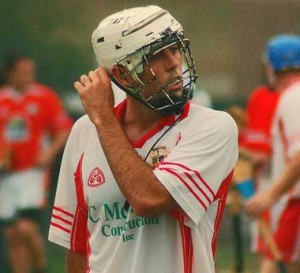
A stormy afternoon for Brian Boru.

A stormy afternoon for Brian Boru.

By Paul Schneider

OK, so there was a little bit of rain.  OK, make that a LOT of rain.  But for the Shamrocks and Brian Boru hurlers, that just didn’t seem to be enough reason to postpone last Sunday’s Joe Lyons Cup final.

One after another, Shamrocks coach and goalkeeper Eamonn Lyons dripped the reasons why:  “There was no lightning,” he said.  “The field was in good condition.”  And finally, “We’ve all played in worse conditions at home.”

This was Sunday afternoon, some time after the Shamrocks broke a 4-4 deadlock midway through the first half to romp to a 2-11 to 0-4 victory, and minutes after Philadelphia GAA chairman Eamonn Tohill had awarded them the Joe Lyons Cup.

On a day that seemed to favor slower, heavier teams, it was the fleet of foot who came through.  Bobby Rea, a whippet on the front line, alternately was picking himself up off the turf or scoring points.  He finished with the Shamrocks’ two goals and placed another four through the uprights.

Frank O’Meara added another three for the winners, who also got strong midfield play from Benny Landers, whom Lyons dubbed the day’s MVP.  Lyons himself provided key goalkeeping, particularly in the critical early going. 

When Landers, netminder on last year’s Shamrock squad, opted to play in the field this season, Lyons stepped in to fill the nets on a temporary basis.  “I kept waiting for someone to take the position, but nobody wanted to, so I stayed,” he said.

Next stop for the Shamrocks are the North American GAA Championships in Chicago over Labor Day weekend.  With any luck, maybe there’ll be a little rain?

History

Are You A Coal Miner’s Granddaughter?

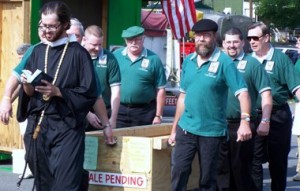
Members of the Cass Township AOH take Finnegan to his final resting place.

Members of the Cass Township AOH take Finnegan to his final resting place.

By Tom Slattery

If you’re like many Philadelphians, your  forefathers came from the coal regions of Schuylkill County to escape the mines. If you’re a descendant of a miner–or a Molly Maguire–I may have seen you a few weeks ago in Heckshersville for the 20th annual Clover Fire Company Irish Festival.  Every year at the end of July, descendants of Irish coal miners from the five-county Philly area come to this remote valley (where cell phones are useless unless they have an extendable antenna) to celebrate their heritage.

Heckshersville is a town so small (how small is it?) that it doesn’t have a post office and the name on the highway sign  is spelled one way entering from the east and another if you’re coming in from the west. Remote, yes. Small, yes. But one of the friendliest places to spend a weekend, whether camping out or staying in one of the nearby (10-15 miles) motels ($50 including continental breakfast).

The festival starts Friday night with a concert and runs from 1 PM both Saturday and Sunday. No matter who else is performing, you can always count on seeing the Irish Balladeers and the Irish Lads, local groups that have been playing Irish traditional music for over 25 years (actually the Balladeers are closing in on 40 years). This year, the Balladeers played to an overflow crowd, lounging in beach chairs under a huge canopy, and they kept it going from 1PM to 6PM on Saturday with breaks featuring Irish dancers, awards ceremonies, and a Finnegan’s Wake put on by the Cass Township AOH. What an afternoon! Hearing “The Sons of Molly Maguire” sung by the group that wrote it was worth the price of admission ($4).

Then there was the Wake! Jaysus, you never heard so much keenin’ and yowling in your life, and such accolades heaped on the well-dressed figure in the coffin. Actually he looked much better than he did in his life, bum that he was. All this and they were only able to collect $1.81 to help defray the funeral expenses, an amount so small that the “priest” pocketed it himself.
 Birnam Wood, a Celtic Rock group from New Jersey, closed out the evening. There was plenty of “picnic” food available  – hot dogs, hamburgers, French fries, colcannon, bleenies – water, sodas, a lots of sudsy stuff at $1.25 a glass and $6 a pitcher. A man has got to be very careful, ‘cause for less than $10 them mountain roads can become mighty curvy.  They’re that way even before you imbibe. Best to have a designated driver, a position well respected in this remote area.

On Sunday they serve an Irish breakfast from 7AM and then around 11AM there is a parade to the old St. Kiernan’s Church for an Irish Mass. Charlie Zahm, one of the Philadelphia area’s best known Celtic singers, entertained the crowd from 1PM until 4PM. Then another Wake! Somebody shoot the keeners, please.
 
Then, as they have since the Festival started 20 years ago, the Irish Lads closed out the entertainment. They were scheduled from 4 to 8, but about 5:15 the mighty rumbles started, and the weather Heckshersille had escaped all weekend announced its arrival in no uncertain terms – boom ditty boom boom. Of course, the Irish Lads said there was nothing to worry about, that is, until the third time lightning took out the sound system.

I just managed to load my car as the rains started. I pondered having a few with some friends. However, the idea of a fully loaded down Lincoln Town Car getting stuck in what quickly would become a swamp, unpondered me quickly, and wasn’t  I but two miles down the road when the torrents started. Boy, somebody must have really ticked Him off, because He must have had the whole holy crowd throwing down bucketsful. Ah, but I will be back there next year on the last weekend in July – back to one of the friendliest festivals around, listening to great music, eating food guaranteed to keep you from blowing away and hearing the stories of life in the mines.

Music

“Michael Black” (Compass)

To start with, Michael Black’s eponymous first CD is produced by the supremely gifted Celtic guitarist John Doyle. Doyle also plays on several tracks.

Add to Doyle, this supporting cast: Seamus Egan of Solas, Philadelphia bassist and veteran setman Chico Huff, fiddle master Liz Carroll, Kentucky Celtic fiddler Liz Knowles, Solas alum and accordion virtuoso John Williams, and Appalachian fiddler (think “Cold Mountain”) Dirk Powell. Oh, yes, and throw in a few members of the unnaturally gifted Black family, with backing vocals by Mary, Frances, Shay and Martin. Additional backing vocals are by Eoghan Scott, and Danny and Roisin O’Reilly.

So how is the album? Ummmm, OK, I guess … you know, if you like genius and an overabundance of talent and things of that sort.

At the center of it all, of course, is Michael Black. During a week in which we noted the passing of Tom Makem, I found myself listening to this CD and thinking that the tradition truly lives on in the form of so many younger traditional artists—but it is clearly alive and well on Black’s work on this album.

Black’s vocal style compares favorably to that of Makem and the Clancys. (There are times, too, when he sounds vaguely like Harry Chapin.) In any event, Black’s story-songs, a couple with anti-war undercurrents— “The Deserter,” and “When the Boys Are on Parade”—would have fit right in at the old Newport Folk Festival.

It’s not all serious, though. Take, for example, the loopy “My Father Loves Nikita Kruschev,” a tune performed by Makem himself on an old Polydor album, “In the Dark Green Woods.” “Billy O’Shea” is a great sing-along song—and I guarantee that you will sing along to this one in the car.

“Michael Black” might be the best ‘60s Irish folk album released in the early part of the 21st century. Tommy Makem can rest easy. The tradition is in able hands.

Music

“A Letter Home” – Athena Tergis (Compass)

Fiddler Athena Tergis approaches her task with the ease and delicacy of a glassblower.

It’s probably because of Tergis’s deceptively light style of play that, at first, I was not over the moon about her debut CD on the Compass label, “A Letter Home.”

Tergis, a San Francisco kid, was on track to become a classical violinist when, she says, she was “tricked” into attending Alasdair Fraser’s Valley of the Moon fiddle camp. One of the teachers that summer was Altan’s Mairead Ni Mhaonaigh. She went on to study with Ni Mhaonaigh, Alasdair Fraser and Cape Breton master fiddler Buddy MacMaster. She was the Junior National Scottish Fiddling champ three years running.

When it came time to attend college—she was slated to attend Berklee—she decided instead to live in Ireland for three years and soak up the music.

I can only imagine that there were some interesting conversations in the Tergis household at the time. Turning your back on Berklee? Yikes. But judging by her performance on “A Letter Home,” she made the right choice. It was time well spent.

The CD is produced by the gifted guitarist John Doyle, who also plays guitar and bouzouki on several tracks. Tergis is also accompanied by Liz Carroll on fiddle, the ubiquitous Chico Huff on bass, Natalie Haas on cello, Billy McComiskey and Sharon Shannon on accordion, and Ben Wittman on percussion.

My tastes generally run to the so-called “supergroups” like Solas, Flook and Lunasa. Performances by those bands are muscular, even a little macho. It eventually dawned on me that I was listening to Athena Tergis’s performance with the wrong ears. If Solas is Celtic stadium rock, Athena Tergis is cool jazz. Comparing Athena Tergis to Seamus Egan would be like comparing Diana Krall to Roger Daltrey.

There are no trombones or soprano saxophones on “A Letter Home.” No conga drums or timbales. Instead, there is Haas’s lush and luscious cello and some slick, whispery brushwork by Wittman. The accompaniment here never threatens to overwhelm or dominate. Instead, it gently, unobtrusively frames Tergis’s polished performance on a wide variety of traditional tunes, from “Johnny McGreevy’s” (a reel) to “Bi Falbh O’n Uinneig” (“Be Gone from the Window,” a slow air).

I particularly liked (as determined by the number of times I left my car CD player setting on “Repeat”) “In Memory of Coleman/Paddy Fahy’s)”, a lovely set of reels – not pounded out at the usual breakneck tempo but instead played at a leisurely pace. Tergis seems to be not so much playing the tunes as savoring them. (You will, too.) “Coleman” was written by Philly’s own Ed Reavy. (One other local tie: Many of the tracks were recorded at Morning Star Studios in Springhouse, outside of Philadelphia.)

I also gave the “Repeat” button a workout on another set, which began with a strathspey, “Miss Lyall”—I love the jerky percussiveness of strathspeys—which smoothly morphed into a set of reels, including “Paddy Ryan’s Dream,” “Con Cassidy’s Highland” and an unknown Donegal reel.

The concluding slow air, “Be Gone from the Window” is heartbreakingly lovely.

 I suspect “A Letter Home” will earn your own stamp of approval.