Monthly Archives:

May 2011

News, People

Honoring the Inspirational Irish Women of 2011

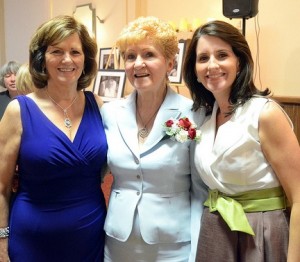
Honorees Carmel Boyce, Anne McDade Keyser Hill and Karen Boyce McCollum

Honorees Carmel Boyce, Anne McDade Keyser Hill and Karen Boyce McCollum

It’s not for nothing that they’ve earned the description, “inspirational.”

The 12 recipients of the 2011 Inspirational Irish Women awards are really quite remarkable, accomplished people, coming from all walks of life—the judiciary, law enforcement, music, religious orders, fire and rescue, nursing, business, broadcasting and more.

The honorees were:

  • Sister Christine McCann
  • Margaret Reyes
  • The Honorable Pamela Pryor Dembe
  • Kathy Fanning
  • Anne McDade Keyser Hill
  • Mary Ann McGinley, Ph.D., R.N.
  • Kathy O’Connell
  • Carmel Boyce
  • Karen Boyce McCollum
  • Christine M. Coulter
  • Liz Crehan Anderson
  • Sister Peg Hynes, S.S.J.

(To read more about them, click here.)

For all their accomplishments, they remain quite humble—and more, as they accepted their awards in a special ceremony Sunday afternoon at the Philadelphia Irish Center, all credited the key people in their lives who helped guide them along the paths they ultimately followed.

Speaking of her parents Barney and 2011 honoree Carmel Boyce, communications executive and singer Karen Boyce McCollum thanked her parents for “bringing us up in a household where growing up Irish was a blessing and the greatest gift they could give.”

Businesswoman Anne McDade Keyser Hill, her voice quavering just a bit, thanked her husband Joe for his loving support. (And he blew a kiss back at her.) But she also recalled the strong influence of her father in her life: “My dad, when I was 14 or 15 years old, took me aside and he said, ‘Sis’—he called me ‘Sis’—don’t let anyone ever tell you that you can’t do what you want in your life because you’re a girl.”

The highly regarded nurse leader Mary Ann McGinley spoke lovingly of her own parents and credited them for setting a good example: “My dad clearly inherited the Irish talent of telling stories. My mom was a ‘Type E’ personality—everything for everybody each and every day.”

And, finally, WXPN Kids Corner host Kathy O’Connell recalled one exceptional woman in her life: “I want to dedicate this award to my grandmother, who became a widow 10 seconds before the Depression hit.”

Attending the event were more than 400 family members, friends and co-workers who attended the ceremony, who cheered and applauded as each woman (and representatives of two women who were honored posthumously, social activist Sister Peg Hynes and musician Liz Crehan Anderson) accepted her award. They also had a chance to admire the striking black-and-white portraits of the honorees, created by photographer Brian Mengini and commissioned by the Inspirational Irish Women committee.

In addition to honoring women of high achievement, the awards program benefited the Philadelphia Irish Center.

We’ve assembled an extensive photo essay from the day. We also present video highlights.

Sports

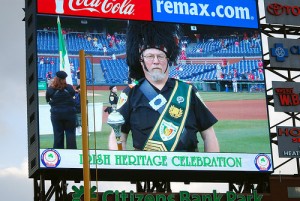
Play Ball! Irish Heritage Night at the Phillies 2011

Brian Boru's drum major on the largest Jumbotron in the National League.

Brian Boru's drum major on the largest Jumbotron in the National League.

It had to have been a thrill to be on the field at Citizens Bank Park. But what a kick it must have been to see Phillies third baseman Placido Polanco trot out onto the field to hang out with the Brian Boru pipe band, which had been playing in center field. (Polanco neglected to wear a kilt.)

All around the stadium, Phillies fans were treated to Irish music, from 5 Quid just outside the park to the Bogside Rogues and the Hooligans inside the park.

Just before the game, dancers from many of the area’s Irish dance schools lined up along the first and third base lines and out on the warning track to get jiggy. (And many proud dance parents got to see their kids displayed on the park’s super-size Jumbotron.)

But by far the biggest thrill of the night had to belong to John and Michael Boyce, the brothers of Blackthorn, who were tapped to sing the National Anthem.

Oh, yes, let’s not forget: Roy Halladay on the mound. Final score: Phillies 3, Rangers 2.

History

History’s Back Story: Douglass and O’Connell

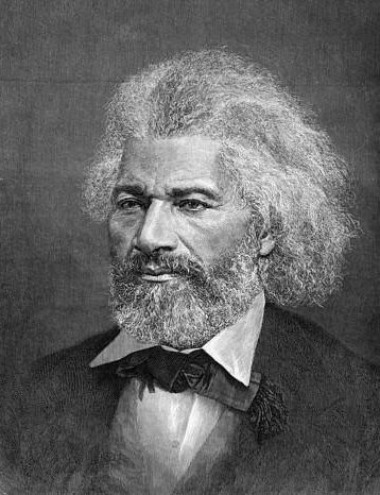
Frederick Douglass, a former slave and eloquent social reformer.

By Michael Carolan

The Dublin crowd last week was undoubtedly grateful to have once again—after Kennedy, Reagan, and Clinton to name a few—a U.S. President proclaim his Irish roots and with such precision.

Thanks to an internet genealogy service, the missing apostrophe in Obama has been located: his maternal great-great-great grandfather is Fulmuth Kearny, a Protestant bootmaker from Moneygall, County Offaly, who left Ireland during the Famine in 1850.

The President provided the throngs of well-wishers at College Green genealogical context by paying fitting tribute to a contemporary of his ancestor: Daniel O’Connell, the Irish patriot who profoundly influenced Mr. Obama’s own historical hero—the great black abolitionist Frederick Douglass.

It was, as Mr. Obama noted, an “unlikely friendship” forged between the two men. The Irishman peacefully worked for the self-rule of millions of Irish; the former slave pushed for the freedom of millions of African Americans in bondage.

What Mr. Obama failed to note was that 166 years ago the “Emancipator” Douglass and the “Liberator” O’Connell were not always so friendly. In fact, their respective peoples had a tumultuous relationship fraught with labor politics, hatred, and violence, and right here in Philadelphia.

It is true that Douglass, born into slavery himself, escaped to Ireland in 1845 where he met his hero O’Connell, then in his 70s. The two men were fond of one another, to sure, both hating the institution of slavery. But Douglass returned to a country soon besieged by nearly two million Irish Catholics fleeing centuries of religious persecution and more immediately, the horrors of the Famine.

What they wanted in America were jobs. But African Americans in mid-19th century Northern cities had the run on the economy’s low-paying menial jobs and hence, there was competition.

Douglass complained in a speech to a New York anti-slavery society nine years after he returned from Ireland: “Every hour sees us elbowed out of some employment to make room for some newly-arrived emigrant from the Emerald Isle, whose hunger and color entitle him to special favor.”

“These white men are becoming house servants, cooks, stewards, waiters, and flunkies,” Douglass told the audience. “…I see they adjust themselves to their stations with all proper humility. If they cannot rise to the dignity of white men, they show that they can fall to the degradation of black men.”

“In assuming our avocation,” the Irishman “has also assumed our degradation,” he added.

Indeed the Irish “laborers,” like Obama’s ancestor, were often called “white negroes” to denote the exploitative, backbreaking jobs at which only blacks were previously willing to work. It was not always clear on which side of the color line an immigrant like Fulmuth fell.

Was he black or white?

Sidney Fisher, a prominent Philadelphian of the time, wrote that the Irish did not get along with blacks “not merely because they compete with them in labor, but because they are near to them in social rank. Therefore, the Irish favor slavery in the South . . . it gratifies their pride by the existence of a class below them.”

Meanwhile, the newly arrived Famine Irish for whom Daniel O’Connell spoke had little sympathy for the anti-slavery cause itself. That’s because they mistrusted the Protestant majority of the same ilk that had persecuted them for centuries in Ireland.

The gulf between the average Irishman and the Yankee Abolitionist leader was too great to bridge: their link to antislavery circles there (Britain abolished slavery in 1833) further alienated the Irish. The sudden British moral reformers were, after all, hypocrites, blind to their own centuries old, slave-like oppressive practices in Ireland.

In Philadelphia, the African-Irish problem dated back to early 19th century when Ulster (Irish) Protestants and free blacks arrived in the city in great numbers. The firehouse was the social and political center of neighborhood life and African Americans were refused their own department. Then one night in August 1834, a group of young black men attacked the Fairmount Engine Company, running off with equipment. Three days later, the city’s first full-scale riot erupted.

What newspapers called a “lunatic fringe” attacked an amusement hall that housed a carousel called the “Flying Horse,” a popular entertainment for both blacks and whites living crowded together in the working-class boarding houses near 7th and South Streets.

Correspondents claimed that a mob threw a corpse from its coffin, cast a dead infant on the floor, “barbarously,” mistreating its mother. By the end, two were dead, many beaten, and 20 homes and two churches destroyed. Twelve out of the eighteen arrested had Irish names.

A committee assigned the cause to employers hiring blacks over whites, with many “white laborers out of work while people of color were employed and able to maintain their families.”

The labor, racial and economic strife continued periodically in Philadelphia’s urban immigrant enclaves—in places like Kensington and Southwark and Moyamensing—through the 19th century.

In 1842, mobs burned down the Second African Presbyterian Church and Smith’s Hall on Lombard Street—the site of abolition lectures since Pennsylvania Hall was destroyed in the riots of 1838. A plaque today commemorates the event.

But there was also the established nativists—English and Scotch-Irish Protestants and Quakers (who had their own political party for a time “the Know-Nothings”) who disliked the new Irish Catholic immigrants and associated them with the African Americans as well, exploding into the 1844 Nativist Riots in which 2 were killed and 23 wounded.

“The City of Brotherly Love” Frederick Douglass found not, proclaiming that one could not find anywhere “a city in which prejudice against color is more rampant than in Philadelphia.”

For Daniel O’Connell’s part, the Repeal movement for Irish freedom from England needed capital and Southern slave-backed money poured in. This had O’Connell waffling between speaking for the anti-slavery cause and alienating his Irish-American support and keeping the tainted donations.

At one point, anti-slavery advocates were furious with O’Connell. The prominent abolitionist Wendell Phillips called him “the Great Beggar man,” fuming that the O’Connell “would be pro-slavery this side of the pond. He won’t shake hands with slaveholders, no—but he will shake their gold.”

So when President Obama proclaimed in Dublin that “When we strove to blot out the stain of slavery and advance the rights of man, we found common cause with your struggles against oppression,” that common cause—both of them—was hard fought, and indeed eventually successful. African Americans and Ireland were eventually free.

And while the President’s words were profound at just the right moment in history—his Irish and African roots unified—they didn’t tell the whole history.

Michael Carolan teaches literature at Clark University in Worcester, Massachusetts. His father was born in Philadelphia, the great grandson of a Famine emigrant who arrived in 1847 from County Meath and lived in Feltonville. His story can be found here. Michael is the recipient earlier this year of the first annual Crossroads Irish-American Writing Prize. His website is michaelcharlescarolan.com

Music, People

Heading to the All-Irelands

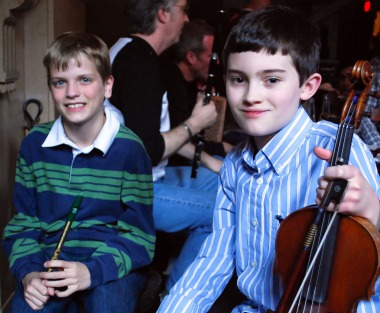
Keegan Loesel, left, and Alexander Weir: Headed to the Fleadh

The table in front of the musicians is crowded with pint glasses in various shades of beer and tenses of the word, “drink.” But the youngest musicians at the Sunday session at Philadelphia’s The Plough and the Stars pub aren’t imbibing. After all, fiddler Alex Weir is only 12, tin whistle player and piper, Keegan Loesel is 11, and little Emily Safko, barely bigger than her Irish harp, is 9.

Still, they spend so much time playing in bars, Emily’s mother Amy says that when her third grader assembled a poster for her “spotlight” day at Cranberry Pines Elementary School in Medford, NJ, “it was full of pictures of her in pubs.”

Of course, they’re Irish pubs which are usually family friendly and the weekly sessions–well, think of them as free music lessons. Sessions (seisiuns, in Irish) have long been a traditional way for Irish traditional players to jam informally and maybe learn a new technique or a tune or two, often in the dark corner of a pub or a cottage kitchen.

There’s little tolerance for the novice player at most sessions, and although one adult musician at the Sunday session refers to the three as “the leprechauns,” he says it respectfully. These “leprechauns” are solid trad musicians who are all going to Ireland in August—one for the second time—to compete in the All-Ireland Fleadh Cheoil na hÉireann in Cavan Town.

Alex Weir, of West Chester, is a  fleadh veteran. He got his start on the violin as many American children do—with Suzuki, a method developed in Japan that puts tiny violins in the hands of children as young as three and nurtures them in a positive environment where they’re expected to pick up music as naturally as they acquire language. Pretty soon, the violin became a fiddle–Alex wanted to learn some Irish tunes to play accompaniment  for his dance school friends at Do Cairde School of Irish Dance in West Chester.   “Once he started learning the fiddle there was no turning back,” says Alex’s father, Carl.

For several years, Alex has been part of Next Generation, a group of young players organized by veteran Irish musicians Dennis Gormley, Kathy DeAngelo, and Chris Brennan-Hagy. They meet the second Sunday of every month for a session at the Philadelphia Irish Center and have performed at the Garden State Discovery Museum, the Philadelphia Ceili Group Traditional Irish Music and Dance Festival, and the Celtic River Festival in Gloucester, NJ, among other venues. The group has produced another veteran fleadh competitor—9-year-old Haley Richardson from Pittsgrove, NJ, who has been playing fiddle since she was three.

Alex, who  continues to study classical violin, is an Irish music sophisticate: He doesn’t just play Irish tunes on the fiddle, he plays “Sligo-style,” like his teacher, Brian Conway of New York. Sligo style is brisk and elaborate—featuring what’s called ornamentation (trills, slides, and extra notes) with both left and right hands. It’s the lively, toe-tapping, uplifting style that most Americans associate with Irish music. “It picks you up,” says Alex, during a lull in the Sunday session. “I feel happy all the time when I play it.” Competing in this year’s Comhaltas Ceoltori Eireann Mid-Atlantic Fleadh, he came in first in fiddle slow airs under 12, first in duets with Emily Safko, and second in fiddle under 12 (Haley Richardson took first in that category).

Keegan Loesel was only three when a CD his mom had popped into the car changed his life. “I picked out this noise I heard on the CD. I found out later it was a uilleann pipe [pronounced ill-in, a small, Irish bagpipe],” explains Keegan, a fifth grader at Hillendale Elementary School in Chadds Ford, PA. At three, he was barely bigger than a set of pipes, but he told his mom, “I want to do that.”

“I thought that would go away, but it didn’t,” says Keegan’s mother, Lynette. “Two years later, I emailed a pipe maker to find out how to get him started and they told me to get him a whistle.”

It wasn’t long before Keegan was taking lessons on both the pipes and the tin whistle. He got his first set of pipes in January. This is his first year qualifying for the All-Irelands on whistle—not bad for a kid who was so shy about performing in public that his sister offered him money to play a tune at a session. “He did it and as we were going out the door he turned to us and said, ‘When are we coming back?’” says Lynette. That’s when she knew he was hooked.

Like Keegan, Emily Safko got off to an early start—and with an instrument that really was bigger than she was. She comes from a musical household—her father, Greg, is a classically trained pianist—that isn’t very Irish, “I think I’m Irish, but we don’t really know,” says Amy, her mom. “I don’t know exactly where it came from, but she started asking for a harp when she was four. I think she’d seen a harpist at Longwood Gardens.”

Emily begs to differ. She says she was bitten by the harp bug at 3. She got her first Irish harp at the age of 6 and at 9, travelled to the Mid-Atlantic Fleadh in Parsnippany, NJ, and came in first in harp slow air under 12, first in duets (with Alex) and second place in harp under 12. Kathy DeAngelo is her teacher. Emily says she takes every opportunity to play. “I got to play the harp at my school in first grade, second grade, and third grade,” she says, her child’s harp leaning against her shoulder. She’s even becoming a regular at the Irish session at the Treehouse Café in Audubon, NJ. “It’s like practice for the fleadh,” she says.

Like getting to Carnegie Hall, as the old joke has it, making it to the fleadh takes practice, practice, practice. But it also takes fundraising, fundraising, fundraising.

Keegan and Alex have taken to the streets of West Chester where they employed that age-old Irish musician money-making technique—busking–a couple of weeks ago to the accompaniment of passing cars. They also have some more official events coming up:

On Sunday, June 5, starting at 5 PM, Alex and Keegan will be playing with teacher/performer Mary Kay Mann at the BBC Tavern and Grill at 4019 Kennett Pike, Greenville, DE. If you write IRELAND on your bill, the BBC Tavern will donate 10 percent of those purchases to the boys’ travel fund.

On Friday, June 3 and Friday, July 1, you can see the boys outside the Longwood Art Gallery, 200 East State Street, Kennett Square, during the First Friday Kennett Square Art Strolls.

On Saturday, July 23, they’ll be performing at the West Chester Growers Market from 9:30 to 11:30 AM at the corner of North Church and West Chestnut streets in downtown West Chester.

If you’d like to hold a benefit for any of these talented young musicians, email lymabusi@yahoo.com.

See our photos of all of the children here.

Columns, How to Be Irish in Philly

How To Be Irish in Philly This Week

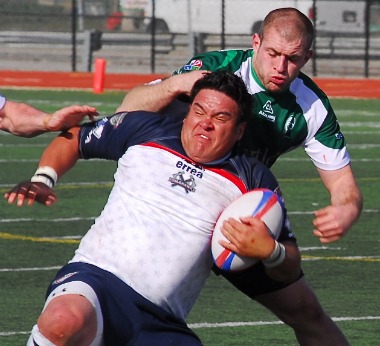
Rugby!

If the St. Patrick’s Day Irish Wolfhounds vs. the US Tomahawks rugby match whetted your appetite for this exciting blood sport, then you’re in for a treat. Coming next weekend: The 2011 USA Sevens Collegiate Rugby Championship to be held at Chester’s 18,500-seat soccer stadium on the waterfront, home of the Philadelphia Union.

NBC is televising the games, but don’t be a wuss: Get out there and see it live for yourself. Your ticket will entitle you to a free post-match concert on Saturday June 4 by the Dropkick Murphys, the Boston born and bred Celtic punk band who do a pretty cool version of one of our favorite songs, “The Fields of Athenry.” They’re better known for “Kiss Me, I’m —-faced,” but there you have it.

Why are we telling you about an event that’s actually not happening this week in Philly? Because you have a chance to mix and mingle with the Notre Dame team at a reception at Finnigan’s Wake this week–Wednesday, June 1, from 6:30 to 10:30 PM (and we wouldn’t be surprised if it went a little longer). If you pony up a sponsorship, you get to have a private dinner with the team. Think of it—dinner with a bunch of college-age rugby players. How can you pass that up?

If you’re a Blackthorn fan, you already know that your boys are celebrating Monday, Memorial Day, the same way they always do–at Canstatters German Club in Northeast Philly for a day-long feast of Irish music and German beer. The Hooligans are joining them as is Sparkle the Clown. Kids under 14 get to be scared for free. Um, we mean they get in for free. (Did we mention that we have a little problem with clowns? Mimes creep us out too.)

Also this week, an annual treat for young and old: The AOH Notre Dame Div. 1 is holding its Irish Festival at St. Michael’s Picnic Grounds in Mont Clare, PA. The three-day festival kicks off on June 3 and features entertainment by Jamison, the Bogside Rogues, Tom McHugh with Jim and Kevin McGillian, Misty Isle, and The Belfast Connection (which just released a fabulous new EP that we’re sure they’ll have on sale—buy it!). Of course, the Irish Thunder Pipes and Drums band will be there—that’s their home turf. And you can see the wonderful little dancers from the Coyle School with their curls bobbing as well. There’s food, vendors, and an outdoor Mass on Sunday. And recession friendly prices: A three-day pass is only $15. It’s all for a good cause: Everything the Hibernians raise goes to charity. They’re like that.

One big change in a regular event on our calendar: Radio host Vince Gallagher’s weekly Sunday Irish music show has moved to a new station, WNJC 1360 AM. Same time—11 AM—and same Vince. Marianne MacDonald’s “Come West Along the Road” show remains at WTMR 800 AM. Michael Concannon’s weekly show on WVCH 740 AM is also staying where it is. You can hear Mike (when he’s not playing with Round Tower) on Saturday starting at noon.

Taking a peek ahead on the calendar—mark the date, Sunday, June 12, from 4-8 PM—for a Evening at the Races fundraiser for the Kiely Family to be held at the Irish Center in Philadelphia. Lori Kiely, mother of four small children, died last August. A Cardinal Dougherty graduate, Lori was a tireless supporter of Gaelic athletics—she was an officer on the Philadelphia Youth Board of the Gaelic Athletic Association as well as being active in the Fox-Rok and Fox Chase Athletic Associations. “She made all children feel important,” a friend told us. A worthy woman and a worthwhile cause.

News

Phoenixville Celtic Street Fair 2011

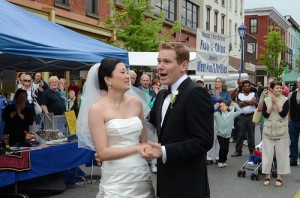
This year's fair featured an impromptu visit by a passing bride and groom.

This year's fair featured an impromptu visit by a passing bride and groom.

It drizzled, it rained, it poured.

A lot like the weather in Scotland and Ireland, come to think about it. But a bit of moisture from the skies did little to dampen the enthusiasm of festival-goers along Phoenixville’s main drag on Saturday.

It pretty much had everything.

There was great music, to start… Barleyjuice, Oliver McElhone, Charlie Zahm, The Brigade, Ted the Fiddler Band.

Irish Thunder Pipes & Drums performed throughout the day, as did the Pride of Erin dancers.

Vendors sold everything from Celtic jewelry to Guinness baseball caps to fish and chips.

One last thing … props to the bride and groom who stopped their limo and jumped out to share a quick dance in front of the stage. Every marriage should get off to such a good start.

News, People, Sports

Walking Softly, Carrying a Big Stick

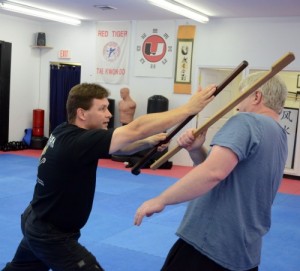
Jeff Cavanaugh demonstrates Irish stick fighting with partner John W. Hurley.

Jeff Cavanaugh demonstrates Irish stick fighting with partner John W. Hurley.

Sure, it’s not the same old shillelagh your father brought from Ireland.

Commonly crafted from blackthorn or oak, the shillelagh (from the Irish “sail éille” and pronounced: shuh-LEY-lee) is best known as a simple walking stick, about four feet long, with a large fist-sized knob at the top.

Well, take another look at that blackened, gnarly cane and picture it in the hands of a hard-nosed Irish peasant tasked with defending a moonshine still, or taking offense at a few poorly chosen words at a wake. You can see the potential for some highly creative violence.

Welcome to the world of “bataireacht,” also known as Irish stick fighting—or, more lyrically, whiskey stick dancing. It’s Ireland’s own martial art, hundreds of years old, the lethally balletic techniques passed down from father to son.

Nobody is whacking anyone else over the head with blackthorn sticks any more, but the tradition—in a milder form—lives on here in the Delaware Valley.

Jeff Cavanaugh of Upper Southampton, Bucks County—a multiple black-belt holder and longtime practitioner of the more commonly known martial arts—stumbled upon bataireacht (pronounced “BAHT-air-ahct” three years ago while surfing on the Internet for news and information about martial arts in general. He found a link to the Web site of Glen Doyle, a Milton, Ontario, martial arts instructor. What caught his attention was a reference to Irish stick fighting. It was the first he’d ever heard of it, and right away, he was hooked.

“I contacted Glen and he put me in touch with one of his students, a guy up in Boston named Rob Masson,” Cavanaugh recalls. “I drove up there for a four-hour class, and then back home again. it was Thanksgiving weekend, but the effort was worth it.”

His interest piqued, Cavanaugh asked Masson to come down to Philadelphia to teach a two-day total-immersion seminar for local martial arts aficionados. And after that, he traveled up to Ontario for a weekend workshop with the Celtic sensei himself, Glen Doyle.

Doyle teaches a two-handed style of stick fighting practiced only by his family, going back generations from one Doyle to the next. Until the Doyles came along, most stick fighting was one-handed, the shillelagh wielded like a sword. That style would have been popular among military men. But the Doyles had a different perspective.

“The first Doyles who originated this system were boxers, not people who were experts with swords,” Cavanaugh says. “Their style was developed to fight the single-hand stick fighter. They (the Doyles) just took stick fighting in a different direction.”

The two-handed system, using a shorter three-foot stick held horizontally across the body, allowed for some creative new defensive moves, but it also gave practitioners the flexibility to thrust the stick outward with one hand when needed, like throwing a punch—boxer-style.

Once developed, the Doyle approach became a closely guarded family secret. “It always stayed within the family,” Cavanaugh says. The techniques of Doyle stick fighting made their way to Canada in the 1800s when one of Glen Doyle’s ancestors, Eddy Doyle, migrated to Newfoundland. Over the years, the Doyles continued to maintain the ancient tradition—and their secrets.

That is, until Glen Doyle decided to share his knowledge with any and all interested newcomers.

Cavanaugh continued his relationship with Doyle after that first weekend of teaching and learning. He traveled up to Doyle’s training school several times.

“I was able to pick it up fairly quickly,” Cavanaugh says. “Stick fighting is fairly straightforward. It doesn’t require a lot of strength or flexibility. You have a three-foot stick in your hand, and that’s what makes it so powerful. You’re taking a very heavy stick, and moving it very fast.”

Eventually, Doyle judged Cavanaugh skilled enough to teach. (Cavanaugh, a longtime woodworker, also learned how to create his own fighting sticks.)

And so began Cead Bua Philadelphia, Cavanaugh’s school for Irish stick fighting housed at United Martial Arts in Oreland, Montgomery County. (Cead Bua means “100 victories.”)

For Cavanaugh, who continues to practice the martial arts he grew up with. Irish stick fighting has a very different appeal.

“Having spent years studying martial arts from other cultures, it was great to find something where I could understand the history,” Cavanaugh says. Also when compared to Eastern martial arts, Irish stick fighting was less flashy, more pragmatic.

“Stick fighting is 100 percent useful,” says Cavanaugh. “Stick fighters had a job to do. Anything that didn’t work, they threw away. It was serious business, something that could save your life. You have to accept it on your own terms. There are no high kicks or flashy moves to share with your friends.”

This distinctly Irish martial art does have one thing in common with its ancient Eastern cousins, says Cavanaugh—mental discipline. Also like judo, aikido, tae kwon do and all the rest, the goal of learning it is to never to have to use it. Odds are, no one is going to walk softly through the streets of Philadelphia carrying a big stick, anyway. “The whole idea of getting into an actual stick fight,” Cavanaugh readily concedes with a laugh, “ is pretty far out there.”

Interested in learning more? Cavanaugh is sponsoring an introductory class on Sunday from 1 to 2 p.m., at United Martial Arts, 109 Allison Road (nearest cross street: Bruce Road) in Oreland. Click here for details.

Sports

Footballers Raise Money on the Links

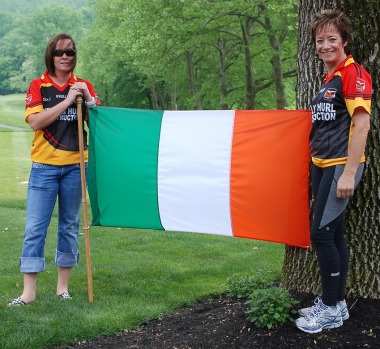
Ciara Moore, left, and Angela Mohan, right, of the Mairead Farrells Senior Ladies Football Club--preparing to defend their championship status.

To borrow from an old ‘60s song, if you’re going to San Francisco, you should start fundraising now. And that’s what the Mairead Farrell Ladies Gaelic Football Club is doing.

Last Sunday, 43 golfers ponied up $100 each—and more than 100 businesses and individuals kicked in donations—for a golf outing at the Edgmont Country Club, a bucolic private 18-hole club in Newtown Square. The money they contributed will help send the Mairead Farrells, the reigning national ladies champs, to the west coast this summer to defend the senior ladies title.

“This is the biggest fundraiser of the year for us,” said Angela Mohan, coach and manager of the team that she helped found in 2008 with players Siobhan Trainor and Orla Treacy. She estimated that it raised about $10,000, putting them about halfway to their target.

Last year, the Mairead Farrells tore up the fields at Cardinal Dougherty High School to earn a spot in the national championship, held at Gaelic Park in Chicago. They’ll be defending their title in San Francisco in August.

Unfortunately, their main opponent—the second ladies team from Philadelphia, the Notre Dames–is taking a breather this year. The Notre Dames are also national champs—they brought back the 2010 junior ladies title from Chicago. So the Mairead Farrells will be traveling to New York, Washington, and Boston to play teams there. It’s rumored that the home games in Philly will remain on the Cardinal Dougherty fields for the time being. The archdiocese closed the high school, but still hasn’t sold it. And the Philadelphia Gaelic Athletic Association fields in Limerick haven’t been completed.

Mohan says they need two more fundraisers—a beef-and-beer night and a raffle—to get the team on the plane to San Francisco. And, she says, “the lassies are coming in”—Irish players who spend the summer in the US, playing Gaelic football in the hot summer sun.

Check out our photos of the golf outing.