Monthly Archives:

January 2011

People

Kathy McGee Burns: Blazing Her Own Parade Route

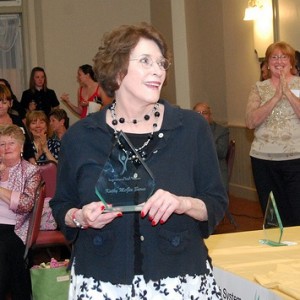
Kathy McGee Burns, receiving the Inspirational Irish Women award.

Kathy McGee Burns, receiving the Inspirational Irish Women award.

On Sunday, March 13, when Kathy McGee Burns officially presides over the Philadelphia St. Patrick’s Day Parade, as only the second female president since its 1771 debut, she is going to have some very special guests marching with her.

The little girl who grew up in the Philly suburbs with no knowledge of her Irish roots is now the woman leading the parade. And joining her will be her McGee cousins from Donegal.

That moment has been a lifetime in the making. Because the same father who instilled in McGee Burns the belief that she could be anything she wanted, do anything she put her mind to, was the equal to anyone … was the same father who, like so many of his generation, denied his own Irish-ness.

“It’s incredible to me,” McGee Burns marveled. “I see my whole life as a journey. I don’t know how I got here, but I did.

“I always had this draw to being Irish …. Wondering, where was I from, where could I claim as my heritage? But my father, Timothy McGee, never talked about his family.

“He grew up very poor. His father, Hugh McGee, was the black sheep of the family. He was an alcoholic who left the family. My grandmother, Mary Jo Callahan, raised my father and his brother with the help of her mother and sisters. She cleaned houses to put food on the table.

“My father was a very well-known high school athlete, but he couldn’t pursue any of the offers he got along those lines. He had to take care of his mother and her sisters. So, he started as a clerk in the Acme. He prided himself that you could come to his counter, and he would add up all the prices in his head–this was before there were machines to do it.

“He started making bouquets of flowers to sell in the store. And from that, he built up a business as a wholesaler florist. He became a successful businessman, and created a life for his own family that was far different from the one he grew up with. He had a house at the shore, was a member of country clubs. We were very comfortable.

But he wouldn’t talk about his Irish roots.

It wasn’t until he was on his deathbed that McGee Burns was able to get a tiny clue from him about how to go about finding her family. He told her that all the relatives lived in Bridgeport: “Kathleen, every McGee in Bridgeport is related to you.”

By this time, McGee Burns was married and raising nine children of her own. And her nagging desire to acknowledge and embrace her own Irish-ness had been heightened during the dark days of the 1981 hunger strikes.

“There I was, watching Bobby Sands starve to death while my own son, Tony, who was the same age, was going to college in Chicago. I kept thinking about Mrs. Sands, how heartbroken she must have been…and how my own son was just starting his life.”

“My country, the country of my ancestors, still wasn’t free.”

McGee Burns began her journey. And her first step was to get out the phonebook and look up every McGee in Bridgeport. She sent a letter to each one of them. And she got the response she was looking for.

“Once I had enough information to trace my roots back to Donegal, I decided to join the Donegal Society. The first time I went to a meeting, I literally walked in as a stranger. They asked me who my sponsor was,” McGee Burns laughed. “I didn’t even know I needed a sponsor!”

But from that inauspicious beginning, she went on to become the first female president of the Donegal Society. And she continued on her path to discover exactly where she came from.

On a trip to Donegal about 10 or 12 years ago, a friend had a surprise for her. He told her, “I found someone who can help you find your roots. We have an appointment with him at Gallagher’s Hotel in Letterkenny at 1:00.”

Kathy won’t forget that moment: “A man came walking towards me. He looked just like my brother. He said, ‘Hi, my name is Hughie McGee. Does that name sound familiar to you?’ Well, my brother, my uncle, my nephew, my grandfather and my great-grandfather were all Hughie McGees. We sat down and did a study of our families. We both had a great-great grandfather named Cornelius McGee. His Cornelius McGee married a Kate Cannon; mine married a Kate Brogan. We had all these similarities, but couldn’t pinpoint where our families intersected.”

It wasn’t until this past summer that DNA was able to accomplish what a paper trail had failed to do: prove beyond a doubt that these two McGee families are closely related. The McGees from Gweedore, County Donegal, donated their DNA for comparison with McGee Burns’ own brother Hughie, and with the results, a once lost heritage was reclaimed.

The circle will be made complete on March 13, when Hughie McGee, his brother Paul McGee and wife Noreen, and nephew Paul McCool and wife Roisin join Kathy McGee Burns and her family, including her brother Hughie, in the St. Patrick’s Day Parade.

“Someone has been directing this from somewhere–either from up above, or down below,” McGee Burns laughed. “But the feeling I will have as I march up that aisle to address the congregation at St. Patrick’s Church for the parade Mass will be for every McGee and every Callahan that came before me.

“I represent a culmination of all their dreams, hopes and wishes. We are all going to be in that Church together. And I’ll be saying ‘thank you’ to all my Donegal ancestors.”
News, People

Aon Sceal

John Byrne Band: Free tickets for the "unwaged."

When John Byrne was growing up in Ireland in the late 1980s and early 1990s, it was common to see two sets of ticket prices listed for a concert or play: regular and “unwaged.”

“That’s a nice way of describing Ireland’s half a million unemployed, and this in a country of only four and half million,” says Bryne, a Dublin transplant to Philadelphia whose “John Byrne Band” has gathered critical acclaim with the release of its first CD, “After the Wake,” in 2010.

When he returned home late last year, he was walking into the Abbey Theater and found that he had gone back in time—there, again, were the special ticket prices for the “unwaged.” The unemployed were also welcomed—for free—into Whelan’s a live music venue on Dublin’s south side.

“It made me sad, but at the same time I loved it,” says Byrne, who has been in the studio recording his second CD. “It’s a true example of people just doing what they can to help others. Giving folks who are struggling to make ends meet, living on unemployment or welfare, tickets to a show isn’t really solving anything—it’s just providing something pleasant, a comfort at a time when comfort has had to be sacrificed.”

So if you’re unemployed and looking for a little comfort, Byrne and friend Jay Januzzi from the group Citizen’s Band Radio have 50 tickets available to their February 26 show at World Café Live where Byrne will debut two tracks from his upcoming CD. All you have to do is contact Byrne through his website.

Music To Remember Tommy By

Musician, radio host, and beloved fixture of Philadelphia’s Irish community, Tommy Moffitt, gave a concert every January at the Holy Family Home in South Philadelphia. Moffitt died last May, but his memory—and the music—will live on this Saturday as a group of musicians, singers and dancers gather to continue the musical tradition.

On the bill: the Vince Gallagher Band (Gallagher played with Moffitt and hosts the WTMR 800 AM Sunday Irish radio show that preceded his), plus singers Mairead Conley, the reigning Mid-Atlantic and Philadelphia Rose of Tralee; Jocelyn McGillian, last year’s Rose; Tommy Curtis, and Mae Roney. The Cara-McDade Dancers will also perform. Tommy Moffitt’s daughters will be on hand with photos from their father’s life.

While the show is for residents, the Little Sisters of the Poor, who run the home, are opening the doors to the public. Holy Family Home is at 5300 Chester Avenue, in Philadelphia. “Anyone who wants to celebrate his legacy or spend some time with the residents is welcome to come,” says Conley, who organized the event, which begins at 2 PM.

And big news about our Rose: She was just selected one of the Irish Echo’s “40 Under 40,” which honors young people from the Irish community who have made significant contributions. In the past, other Philly-region folks have made the list, including attorney and musician Theresa Flanagan Murtagh, Rose of Tralee director Sarah Conaghan, and Irish Immigration Center Executive Director Siohban Lyons.

Stolen Car His Lifeline

His car wasn’t going to win any beauty prizes, but George Lees’s rusty, trusty two-door 1991 Buick Skylark was his lifeline. Lees’, a longtime member of AOH Division #87 and its 2008 Man of the Year, has cerebral palsy. His car was equipped with hand controls and a bench seat that made it easy for him to get in and out.

His “lifeline” was stolen this week from Belgrade Street near his home in Port Richmond and Lees, who is on permanent disability from his 24-year job at Sun Oil, doesn’t have the money to replace it.

If you have any information about the car, call the 24th police district at 215-686-3240.

Arts, Columns, How to Be Irish in Philly, Music, People

How to Be Irish in Philly This Week

Blackthorn once again puts its Celtic rock power behind a fundraiser, this Saturday for Archbishop Ryan’s Alumni Association. It’s normally a sell-out crowd, so check our calendar for contact info and make those calls now.

Also on Saturday, Enter the Haggis will be at the World Café Live. Extremely popular Celtic rock band from Canada, so again, make those calls now.

Spring Hill House Concerts is hosting multi-talented Grey Larsen (fiddle, tin whistle, concertina, and flute) and songwriter-guitarist Cindy Kallet in this intimate venue. You may have heard the duo on National Public Radio—now you can hear them in someone’s livingroom.

On Sunday, a real treat: piper Jerry O’Sullivan, one of the masters, will be performing at the Coatesville Cultural Society. He was recently in town with Mick Moloney for the annual concert to benefit St. Malachy’s School in North Philadelphia.

On Sunday afternoon, join Philadelphia’s Derry Society at a mass of remembrance for those who lost their lives on January 30, 1972, in Derry during the incident now called “Bloody Sunday” when British paratroopers fired on a largely peaceful crowd of protesters. The killings sparked years of violent conflict in Northern Ireland.

If you’re looking for a little music with your lunch on Wednesday, stop by the Irish Immigration Center in Upper Darby: the remarkable accordian player Kevin McGillian will be entertaining with his son John. You’ll have to RSVP because space is limited, so check our calendar for info.

On Friday, get ready to laugh your kilt off with The Irish Comedy Tour, coming to the Sellersville Theatre, and featuring Detroit native Derek Richards, Boston’s own Mike McCarthy, and Dubliner Keith Aherne. We saw another combination of comics when the tour came here last year and they were a hoot.

The Martin McDonagh play, “A Skull in Connemara,” continues its run this week at St. Stephen’s Theatre in Philadelphia. The run has been extended to February 13.

Arts, News, People

The Bogside Murals: Derry’s History in Art

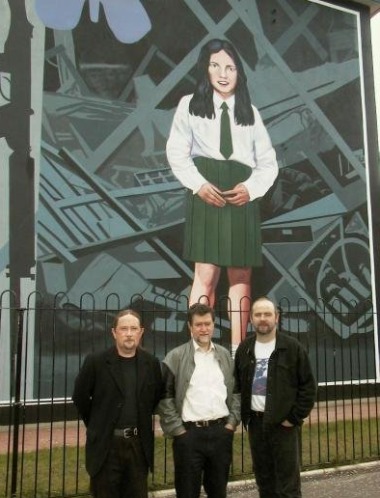
The Bogside artists, Tom and William Kelly, and Kevin Hasson, in front of the original "Death of Innocence" mural in Derry.

This year, Derry was named the first ever UK City of Culture for 2013, a “precious gift for the peacemakers,” in Northern Ireland, said British Prime Minister David Cameron when announcing the award last July .

Derry’s bid, of course, made note of its many cultural contributions to the world, from musician Phil Coulter to Nobel Prize-winning poet Seamus Heaney, but it also frankly acknowledged its tragic history as the birthplace of “the troubles” in the late 1960s.

Nearly 40 years ago this Sunday, simmering tensions boiled to the surface when British soldiers opened fire on a largely peaceful crowd of protestors marching through the city’s Roman Catholic Bogside section, killing 13 people, most of them teenaged boys, and wounding 13 others. The event, which came to be known as “Bloody Sunday,” marked the beginning of decades of armed conflict that largely ended after the so-called “Good Friday Agreement” in 1998 that dissolved direct London rule of Northern Ireland.

Last year, in releasing what is known as the Saville Report on the incident, Cameron became the first British government official to admit that the shootings were “unjustified and unjustifiable,” though none of the troops involved have ever been charged with any crime.

The Derry proposal opens with the lines from a Heaney poem that reflects both the city’s violent past and optimism for the future:

“So hope for a great sea change
On the far side of revenge
Believe that a farther shore is reachable from here.
Believe in miracles and cures and healing wells.”

And in one place—the walls that line the length of Rossville Street in the Bogside—violent history co-exists with a hope for peace in the murals of the three men known collectively as the Bogside artists. Called “the most prominent political murals in the world,” the 12 large scale paintings, all done on dwellings with the permission of the homeowners, are the work of brothers Tom and William Kelly, and friend, Kevin Hasson, all Bogside natives, who started the art project in 1993. The mural that greets you when you enter what the artists call “The People’s Gallery” is a black and white depiction of a boy in a gas mask called “The Petrol Bomber;” one of the last, the “peace mural” in color, featuring a Picasso-like dove on a backdrop of colored squares.

We recently talked to artist Tom Kelly by phone from the Bogside Artists Studio behind the Bogside Inn in Derry.

What was your purpose in painting the murals?

We were acutely aware that a lot of the artists in Ireland, both north and south, were not really dealing with the issues going on on our doorsteps. Most murals tend to be one side or the other. We wanted to bring something artistic into the whole mural arena and create a cathartic experience, a human document that would tell the story of the Bogside and Derry and 40 years of conflict. By looking at it and examining it, we thought that maybe we could move on from it. When you take something and put it into the light, it loses its power.

You all went to art school?

Yes. I spent a year in art college at Jordanstown University and was dissatisfied with the direction the tutors were trying to take us. . . .The idea that a pile of stones on the floor with a dead fish on top was supposed to be the meaning of life, that whole thing I just couldn’t take anymore. So I dropped out. Or maybe I dropped in.

Is that why the murals are done in such a realistic style?

Yes, it’s not about intellectualizing. We could easily have done all that, gone on the conceptual trip. But if good art is about communication, then why write a letter to your grandmother in Greek when you know she doesn’t speak it?

You painted the earliest ones like the Petrol bomber, the Bloody Sunday mural, Civil Rights, the Rioter —most of which are in black and white—while the conflict was still going on. Was that dangerous?

We were all listed for execution, put on a hit list of the UVF [Ulster Volunteer Force, a loyalist paramilitary group]. Most artists would have packed their bags and left. But once we knew we had the support of the people of the Bogside, we went back continually, year after year, to paint the story. We felt we were re-appropriating our story from the British media and telling it for ourselves. We felt very muc like we were commissioned by the community, and the people still support us and them today.

How did you get permission to paint on the walls—aren’t they’re people’s houses for the most part?

We painted them on 12 large gable walls there so we needed the support of the poople. Most murals in the North were put up by paramilitary groups—they would appear overnight on a gable wall and people who lived there were too afraid to pull it down. We went to people, showed them the image, and we were not funded by the government. The donations from local families are what enabled us to hire scaffolding and pay for paint. And we three artists painted them ourselves. And the truth is, it was quite a gas doing the murals. People would come by and talk about things they otherwise might not talk about. Sometimes they would bring tea and scone bread.

Why did you decide to do murals instead of regular-sized paintings?

We’re all small, under 5’7”, it might be a psychological thing. [laughter]

Do you actually conceive the ideas for the murals together?

We spend a lot of time prior to painting a mural getting the right questions together. It’s a bit of hard work really, design work. We like classical design, and it’s the simplicity of the images that’s important to us. We’ve seen murals everywhere and it might sound conceited but most of them suffer from clutteritis. They say too much with the wall space. They tend to be very colorful, but what it’s saying is less important. Though we’re three very different people there’s tremendous harmony among us. We sing from the same songsheet when it comes to murals, art and sculpture

Do you have a favorite of the murals?

That would have to be “Death of Innocence,” the mural of the young girl.

I read somewhere that you knew this young woman whom you’ve portrayed wearing her school uniform with a broken gun to her right and a butterfly above her head. And that you added the broken gun and butterfly much later.

She’s Annette McGavigan, a full cousin of Kevin’s and a good friend of mine. It was the only mural we did where we deliberately left it unfinished. At the time, we couldn’t see any possibility of reconciliation and peace. We said we would finish the mural, breaking the gun in half and showing the butterfly in all its color and energy, when guns no longer killed children.

Tell me about Annette.

She lived in my same street and was interested in art like myself. She was 14 years in 1971. She was sent out by her teacher to gather materials for a still life and there was a skirmish in the street. In the 1970s the soldiers fired plastic bullets. Annette was shot by a British soldier with two high velocity rounds to the back of the ear. She died in her school uniform, which we showed to represent all the kids who died, Irish, Protestant or Catholic. It made it clear—this beautiful child is juxtaposed with fragmentation and a crazy background reminiscent of a bomb explosion. There were these two young boys killed by the IRA in Warrington near London—Jonathan Ball and Tim Parry-and we contacted their parents to ask them if it would be okay if Annette McGavigan could represent them too and they sent us a lovely letter agreeing.

When did you finish the mural?

We went back in 1997, the whole community turned out, including this young girl’s family, to watch us break the gun in half and finish the butterfly in color. We had never forseen it. We thought it would be like the Middle East, there would never be any real peace here.

The Bogside murals have become quite a tourist attraction in Derry. I understand you sort of bring them around the world too.

We get invitations from all over to give lectures and presentations and we have a traveling exhibition. We were invited to China and spent three days in Shenzhen and we did a large mural there for the Dafen Museum—quite a brave step, since it points out that there’s a need for freedom in art, which we actually wrote on the mural. That caused a bit of a stir. We did a version of our peace mural at the Smithsonian Folk Life Festival on the mall in Washington, DC, and we did an exhibition a few years ago at Villanova University. We’ve also done a series of murals at Hanover College (in Indiana), Georgia Southern University, the University of Wisconsin at Madison, and may be coming back to the US to do two or three at DePaul University in Chicago.

You know that Philadelphia is well known worldwide for its murals. We have more than 3,000, probably more than any city. Would you be willing to take a shot at one here?

We just need someone to invite us and pay our way.

I know you’re involved in a campaign now to get the city of Derry to provide lighting for the murals so they can be seen at night.

For its big 2013 celebration, the city is lighting the city walls, St. Columb’s Cathedral, the Apprentice Boys Hall and other key heritage sites, but the murals are staying in the dark. We’re asking people to sign a petition asking the city to provide spotlights. You can do it online at the petition site.

To commemorate Bloody Sunday, the Sons and Daughters of Derry–Philadelphia’s Derry Society–is sponsoring a Mass at the Irish Center, 6815 Emlen Street, Philadelphia,  on Sunday, January 30, at 3 PM.

You can see more photographs of the murals at the Bogside Artists’ website.

Music

For Jerry O’Sullivan, Musical Success Is All Relative

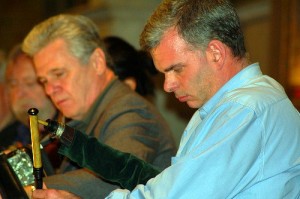
Jerry O'Sullivan, playing at a recent musical benefit at St. Malachy's Church.

Jerry O'Sullivan, playing at a recent musical benefit at St. Malachy's Church.

Maybe Jerry O’Sullivan would have grown up to be one of the world’s premier uilleann pipers, no matter what. Perhaps he would have popped up on more than 90 albums, played around the world in small spaces and symphonic halls alike, and performed with some of the best musicians on the planet propelled by nothing more than his native talent.

Still, you have to wonder whether O’Sullivan’s journey to the top of trad ever would have happened, were it not for the influence of one retiring but very important man—O’Sullivan’s maternal grandfather.

Andrew Duffy was born in 1899 in Killasser, County Mayo, a townland near Swinford, County Mayo. He emigrated to the New York area in the 1920s. He returned to Ireland only once in his life, in 1963.

Still, Ireland never left him. The traditions and music of Andrew Duffy’s homeland always figured prominently in his life, and he passed them along to Jerry O’Sullivan.

Because of the illness of his mother Frances, much of O’Sullivan’s childhood and early adolescence was spent under the roof of Andrew and Pauline Nolan Duffy in Yonkers. Every Sunday, after Mass, O’Sullivan and his grandfather settled in to listen to Irish music albums.

“He grew up with Irish music and and danced to it when he was a young man,” recalls O’Sullivan. “He had a good ear; his taste was my taste. I was the only member of the family who would sit and listen to it with him.

“I’m sure it meant a lot to him that I listened with him. He was a quiet type of man; he didn’t say too much. if he did say something, it was important. Listening to music was just something we did. I’m sure he liked having my company.”

O’Sullivan credits some of the LPs in his grandfather’s collection with starting him on his way. He recalls one album in particular, recorded in 1962, “The Traditional Dance Music of Ireland” with Peter Carberry and Sean Ryan, a bare-bones pairing of uilleann pipes chanter and fiddle. It made his ears perk up whenever he heard that LP—and he started hearing it at a young age, 4 or 5 years old. O’Sullivan has made a lifelong study of piping and players, but that recording, he admits, influences him still.

It wasn’t until a bit later in his young life that his interest became a full-blown passion. O’Sullivan spent time, off and on, summering and spending holidays with relatives in Ireland. It was during one stay in Dublin at his maternal great uncle Jack Nolan’s house that he became enmeshed in the local traditional music scene.

In this he was helped along by another relative, cousin Tom Dermody, who played button accordion. “He started taking me around to Irish music sessions, and at one a session in the North end I got to really see uilleann pipes up close for the first time, and to talk to the piper for a while.”

Around this time, he was also introduced to piper and renowned pipe maker Matt Kiernan, a retired Garda. O’Sullivan haunted Kiernan’s house at 19 Offaly Road, and ultimately Kiernan was persuaded to make O’Sullivan’ first set of pipes.

Later, after he acquired his pipes, he says, “I started playing with (cousin) Tom; he was somebody I felt comfortable with. Having the experience of playing with him made it more comfortable to play with other people.”

In his travels around Dublin, he also had the opportunity to hear or chat with many of the greats of uilleann piping. including Carberry, Fergus Finnegan and Gay McKeon. When you hear him play today, you might assume he took years of lessons. But that wasn’t the way it was. Most of what he learned came from hearing those pipers and many others, just soaking it all in. It was the old watch, listen and play approach.

“Going back 30-35 years ago, I did have a couple of lessons (with Peter McKenna), but it just wasn’t my experience,” O’Sullivan says. “It was osmosis. It was more listening to the pipes, and some of it was reading articles and books on the subject. There was no formal student-teacher relationship with any one individual.”

For O’Sullivan it was a natural way to learn. By the time he started playing, he had already listened to many recordings of uilleann pipers, he says, “so I knew in my head how it should sound, and that was a huge help.”

Back in New York, he learned more—”a little bit here and a little bit there”—from the great Bill Ochs. Still, he learned most by listening, just as he absorbed every note from his grandfather’s albums.

Actually, in retrospect, those LPs might inspired a very different musical career path. And once again, you have to wonder: What if?

“I always loved listening to the uilleann pipes, but the fiddle was my first choice. (Unfortunately) I didn’t have the contacts with any fiddle players in those days. I wasn’t successful at finding a fiddle instructor,” he recalls.

Once again, the timely intervention of a family member steered O’Sullivan in the direction of uilleann pipes. “My grandmother suggested I join a highland pipe band,” he says. “I did that for a year or two. It was fun for the camaraderie, but musically it was frustrating. The desire to learn uilleann pipes took hold after that. I just thought that as a really neat sounding instrument. There was always something beautiful about the sound. The mechanical end of things was, for a young guy, also appealing. There was a lot of hardware … but that was a secondary thing. The primary thing was just having that sound in my head.”

“I love the fiddle,” he says, looking back on his Irish traditional musical journey. “But I’m glad I picked the uilleann pipes.”

If you haven’t heard O’Sullivan, you can find out for yourself why he made the right choice. (He’s also a dazzling player of Irish wood flute, tin whistle, the low whistle, the highland pipes and the Scottish smallpipes.) O’Sullivan is playing in concert at the Coatesville Traditional Irish Music Series, Sunday, January 30 at 8 p.m. There’s also a preconcert piping workshop. For details, visit http://www.ctims.info/

News, People

Hundreds in Philadelphia Mourn Michaela Harte McAreavey

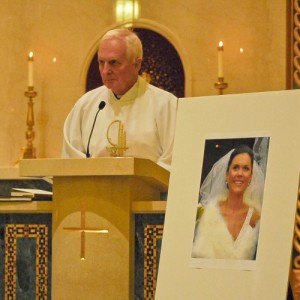
Father John McNamee offers a eulogy for Michaela Harte McAreavey, whose photo is in the foreground.

Ciara McGorman carefully set the large wedding photo on an easel at the front of the chapel at the Cathedral of Sts. Peter and Paul in Philadelphia. It showed her friend and neighbor, Michaela Harte McAreavey, from the little village of Ballygawley, County Tyrone, Ireland, beaming and radiant, as only a bride can be, in her wedding dress.

The dress in which the 27-year-old teacher was buried this week.

Friends, family members, and representatives from the organizations Michaela Harte McAreavey loved so much—the Gaelic Athletic Association, the Tyrone Society, and the Rose of Tralee—gathered at the Sunday evening Mass, concelebrated by poet-priest Father John McNamee of Philadelphia with Father Gerard Burns, formerly of St. Cyril of Alexandria Parish in East Lansdowne and now a parish priest in County Mayo, Ireland.

Michaela Harte McAreavy, married on December 30, 2010 to noted Down footballer John McAreavy, was found brutally murdered on January 10 while on her honeymoon in the Indian Ocean nation of Mauritius. She had been strangled in their hotel room, apparently after surprising hotel employees who used a key card to enter the room to burglarize it. Five men have been charged in connection with the killing of the only daughter of popular Tyrone senior football manager, Mickey Harte. Michaela McAreavy was buried on January 17th after a funeral mass at St. Malachy’s Church near Ballygawley.

Father MacNamee, pastor emeritus of St. Malachy’s Church in North Philadelphia, opened his remarks with a sigh. “This is the week that was,” he said, noting it was also the week the death toll from cholera was rising in Haiti and in which a 9-year-old girl, Christina Green, granddaughter of former Phillies Manager Dallas Green, was killed in Tucson, Arizona, along with five others in a shooting that wounded Arizona Congresswoman Gabrielle Giffords.

Christine Green had been featured in a book on babies born on September 11, 2001. “Her parents had her as a sign of hope to all us in time of sorrow,” said Father McNamee. She had been “as innocent and fragile and vulnerable as the beautiful Michaela,” he told the more than 200 mourners who lined the chapel pew. “Life is a terrible beauty, as Yeats called it.”

Michaela was also eulogized by Sean Breen, president of the Philadelphia Gaelic Athletic Association, Angela Mohan, coach of the Mairead Farrells Ladies Gaelic Football Club; Mairead Farrell footballer Orla Treacy, whose father, Mick, is a friend of the Hartes; and McGorman. Music—including a heartbreaking rendition of Sarah MacLachlan’s “In the Arms of an Angel”—was provided by Karen Boyce McCollum, who, like Michaela, was an International Rose of Tralee contestant, as well as Roisin McCormack and Raymond Coleman.

Father McNamee twice quoted Irish poet William Butler Yeats in his eulogy, reciting from “The Stolen Child””

“Come away, O human child!
To the waters and the wild
With a faery, hand in hand,
For the world’s more full of weeping than you can understand.”

“The world,” he said, “is both a beautiful place and a tragic place. . .and more full of weeping than we can understand.”

Click here to see photos from the mass.

Arts

Review: A Skull in Connemara

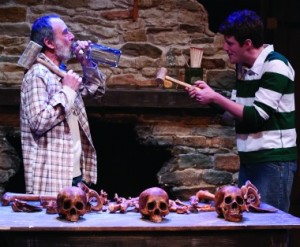
Stephen Novelli as Mick Dowd and Jake Blouch as Mairtin--and skulls. Photo by Mark Garvin.

The Lantern Theatre Company’s production of “A Skull in Connemara,” is, to quote one of its quirky main characters “a great oul night. Drinking and driving and skull batterin’. . .”

In fact, if you happen to be in the first row, you might want to bring some protection—a la watermelon-smashing comic Gallagher—from the flying bone shards during the hilarious scene as two drunken Irish gravediggers with wooden mallets make sure that two skeletons do indeed return to dust.

In the second part of Martin McDonagh’s Leenane trilogy (“Beauty Queen of Leenane” and “The Lonesome West” bracket it), “A Skull in Connemara” tells the story of Mick Dowd (Stephen Novelli), who picks up the odd piece of change from the parish priest by digging up bodies in the church graveyard and disposing of them so there’ll be room for the newly dead. We arrive as Mick is within distance of the lovely bones of his wife, Oona, who died, we learn, as the result of a “drink driving” accident seven years earlier with the poitin-addled Mick at the wheel. He paid his debt in prison, but returned home to be haunted by the rumor that he’d murdered her and used the accident to cover it up.

Assisting Mick is a local young miscreant and dimbulb, Mairtin (Jake Blouch), whose granny MaryJohnny (Ellen Mulroney), likes to saunter down to Mick’s cottage after a successful night of Bingo for a sip of the good stuff that Mick has aplenty, trade a little gossip, and nurse old resentments (she still has it in for the boys who, as five-year-olds, went “wee” on the concecrated ground of the graveyard. And for the children who called her names: “When I see them burned in hell, that’s when I let bygones be bygones,” she tells Mick). The fourth character is her other grandson, the local garda Tommy (Jered McLenigan) who makes Barney Fife look like a candidate for Mensa. At one point, when Mick makes a comment about Tommy’s having seen plenty of dead bodies, the copper admits that he hasn’t. “I would like there to be dead bodies flying about everywhere, but there never is,” he says wistfully.

As in many Irish plays, there are horrifying moments tempered by humor. In this one, it’s death that loses its sting to hilarity, much of it physical. The skull batterin’ is done to music—an insipid tune on a 45 record by a female Irish popstar whom Mairtin admits to fantasizing about.  And Mairtin’s other fantasies contribute to the laughs, as when he’s making two skulls kiss and one perform a sex act that we can’t describe here.

Jake Blouch as Mairtin occasionally loses his accent but never his comic timing. He brings such a wonderful childlike innocence to the character that it never occurs to you to wonder why you find this boy so adorable and funny even after he admits to cooking a live hamster in a microwave, wishing only that there had been a glass door so he actually could have seen what happened.

Stephen Novelli’s Mick is a finely nuanced character, acerbic as hell but nursing an inner turmoil that feeds the suspicion that his neighbors—particular the garda Tommy—are right about his wife’s death. Novelli hints at but doesn’t hit the audience over the head with the simmering violence inside him. Because he actually does hit someone else over the head, his guilt remains a question, but by the end you’re laughing so much it doesn’t really matter.

“A Skull in Connemara” is directed by M. Craig Getting and Kathryn MacMillan. The inventive set, which combines Mick’s home with the graveyard where he spends many minutes on stage digging into real dirt, is the work of scenic designer Dirk Durossette. And major props to the prop people on this production (Tim Martin is props designer). Every night, two plaster skeletons are smashed to smithereens and since the nearly sold-out play is extending its run through February 13, we figure that, including matinees, they’ve got more than 50 skeletons in their prop closet.

“A Skull in Connemara” is part of the Philadelphia Irish Theater Festival. Save 20 percent on tickets by ordering tickets to two or more plays at the Theatre Alliance of Greater Philadelphia website.

Columns, How to Be Irish in Philly

How to Be Irish in Philly This Week

Two thirds of the Clancys here--Aoife and Robbie O'Connell, far right--will be in Ambler this week. The extra Clancy is Donal.

Round up the usual suspects—there’s a Blackthorn concert this weekend! The popular local Celtic rock group is playing a benefit for AOH Black Jack Kehoe Division 4 on Saturday night at the Knights of Columbus Hall in Springfield.

And that’s just one of many enticing events this weekend. For example, they’ll be kicking up their heels at the AOH Notre Dame Hall in Swedesburg Saturday night at their annual ceili. And multi-talented trad performer Gabriel Donohue and singer Marian Makins will be performing the same night at the Shanachie Pub and Restaurant in Ambler.

On Sunday, fiddler Brian Conway will be holding a traditional fiddle workshop at West Chester University and you can catch him later that night at a special session at Kildare’s Pub in West Chester.

More big doings at Shanachie: Robbie O’Connell and his cousin, Aoife Clancy, will be celebrating the Clancy legacy (he’s a former Clancy Brother though his mom was a Clancy sister, and her dad was one of the Clancy Brothers) at the Ambler pub on Thursday, January 27.

On Friday, a freebie from Jamison—a thank-you show (they were voted best Irish band in the US in the Strangford Lough Brewing Company’s annual battle of the bands) at the AOH Div. 39 Hall on Tulip Street in Philadelphia.

And all this week—“Pumpgirl,” Abbie Spallen’s play about dark deeds in a Northern Irish border town and Martin McDonagh’s darkly funny “A Skull in Connemara” are on stage. “Pumpgirl” is produced by the Inis Nua Theatre Company and is at the Adrienne at Sansom and 20th, while “Skull” is at the Lantern Theater Company’s location at St. Stephen’s Church at 11th and Ludlow Streets in Philadelphia. We’ve reviewed them both.

Check out our calendar for all the details.