Monthly Archives:

March 2007

News

Cavan Society Gets Set to Celebrate Its 100th Anniversary

A century is a big deal, so the people of Philadelphia’s Cavan Society are planning a big bash.

The Cavan Society 100th Anniversary Dinner is planned for May 20 at the Philadelphia Irish Center (Commodore Barry Club), 6815 Emlen St., in the Mount Airy section of Philadelphia.

The observance begins at 3 p.m. with a commemorative Mass at the Irish Center. The social part of the evening follows at 4, with a cocktail party. Dinner is served at 5.

Providing the night’s entertainment is the Theresa Flanagan Band.

Admission is $50. For tickets, call Tom Farrelly at (610) 527-2406.

No tickets will be sold at the door.

For additional info, visit the Cavan Society Web site.

If you’re from Delaware County and you need a ride, you can catch a bus at 2:15 from St. Denis Church, Eagle Road and St. Denis Lane in Havertown. Space is limited. Call Rosie at (610) 623-1410.

Music

Hard Work Pays Off

Maeve Donnelly is that rarest of birds, an Irish musician whose parents are not players themselves. (Which would make them, um … kind of like the Muggles of the Irish traditional world.)  

Somehow, in spite of her inauspicious roots, she has managed to muddle along.

She won her first All-Ireland Fiddle Competition at age 9. She won two more All-Ireland fiddle titles after that. She also picked up the National Slogadh Competition for Solo Fiddle and The Stone Fiddle Competition in County Fermanagh.

This Saturday, Donnelly will bring her fiddle—and her winning ways—to the Coatesville Cultural Center for a concert with guitarist Tony McManus, starting at 8 p.m. The concert is sponsored by the Coatesville Traditional Irish Music Society. (There will be workshops from 5 p.m. to 7 p.m. in both guitar and fiddle: $25.00 for either one. Pre-registration IS required! Please call (610) 486-2220 to do so.)

In a recent phone conversation from her home in Quin, County Clare, Donnelly explained how she made the journey from the Galway of her childhood and a house somehow not filled with fiddle-playing parents, aunts, uncles and cousins to emerge as one of the preeminent traditional players of her generation.

Q. How did you start out? How old were you?
A.
 I started very young. I was probably about 6 or 7 or so when I started playing. The reason for starting was, my two older brothers had gone to music lessons. Their teacher taught specifically Irish music.

We had a fiddle hanging on the wall at home. My other brother Declan had played fiddle, and so he had advanced on to another fiddle. It was no great mystique toward learning fiddle.

I got the fiddle put in my hand and a bow, and off I went with my two brothers to learn music.

Q. Not everyone who starts out on an instrument stays with it. Why did you?
A.
 I didn’t ever exactly like music lessons. I don’t think there’s a child who does. It was no great treat. My lessons would have started on a Saturday. I still feel like I had a big black cloud over me until it was over. I wasn’t great at reading music and I picked it up as best I could, playing by ear.

The way it happened was, we used to go to fleadhs as a family. We in turn were part of a bigger unit, and we played at fleadh cheoils all over the country. It was a special group of maybe 30 people. Within that group, everybody would go to the fleadhs. We would combine in different ways to go in for competitions.

A big proportion of praise goes to my parents, who put in a great sacrifice and weren’t pressuring us to get first place in the fleadhs. It developed as a social outing.

That (playing in fleadhs) made a difference. I was playing in fleadhs and competing from about the age of 9. At the time we would have traveled up to three hours back in the late 1960s. It was quite a journey to go to these fleadhs.

Q. Your parents didn’t play. It seems like everyone else I’ve interviewed who plays an instrument comes with a pretty deep family background.
A. I often think, would it have been nice to have had parents who were musicians? Sometimes it can be more refreshing not to have parents playing musical instruments at home. It’s better doing your own thing, and a challenge.

Q. Was there a point at which you felt like your playing had progressed beyond the routine of lessons, to where you knew that there could be something more?
strong>A. I finished classes in my teenage years. At about that time, a whole new breed of festival started in Ireland. They were non-competitive workshops. The first one was Willy Clancy Week. That was my first introduction to learning music for a whole week, and having great fun and being immersed in it for a week. The first year I went there I was in a class taught by Sean Keane of the Chieftains. And I met a lot of pipers. I never met pipers. I met Seamus Ennis. It was an eye-opening experience. That was about 1974.

After that, I would go back annually.

Q. How has your approach to playing progressed since then? How did what you learn in workshops influence your playing? 
A.
 It sort of organically grew. I enjoyed what I was doing. I also felt that I worked at what I was doing. I’m not claiming that it dropped down or I was gifted in any way. It sort of spurred me on to studying the music, to working at the music, rather than sitting and playing at sessions. I spend a lot of the just sitting at home and playing.

I think session music is a great form of practice and a great form of picking up tunes and great form of fun. As an exercise in improving your playing, I’m not sure I would agree. It depends on the session. At that level you just play as an ensemble groups. The individual part of the playing doesn’t come. But playing in sessions also gives you motivation to keep playing. Every time I go to a session, I always hear a new tune. It’s like a lifeline in its own way.

Q. What do you do when you aren’t playing? 
A.
 My full-time job, and has been since I was 20, I’ve been a teacher. I teach in the area of learning support. I take children 7 to 12, children who have trouble with literacy and numeracy. Being a teacher means I have a long holiday time. I have more flexibility. I can take one week and I can tour.

Sports

The Irish Baseball Movie Comes to the Newtown Theatre

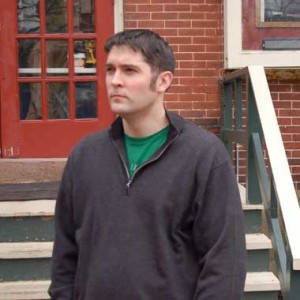
John Fitzgerald

John Fitzgerald

The Newtown Theatre has seen bigger crowds.

Unfortunately, fans filled only two or three rows of the historic red-brick movie house on State Street for the Saturday screening of “The Emerald Diamond,” filmmaker John Fitzgerald’s documentary homage to the Irish National Baseball team.

Small or not, it was an enthusiastic crowd—mostly Hibernians, based on the jacket logos.

Their enthiusiasm is justified. “The Emerald Diamond” traces the history of Irish baseball, from its humble, indistinguished origins to their silver medal appearance in the European championships last summer.

“What’s happening now is, they’re really getting ready for 2008,” Fitzgerald told his audience after the screening. The team had set its sights on eventual Olympic competition, he explained, but the decision by the International Olympic Committee to drop baseball from the games put the kibosh on those dreams. But a gold medal in the European championships would put the Irish National Team in contention for the World Baseball Classic. “The Classic is their only chance to get out there,” he said.

Happily, Saturday was not your only opportunity to see “The Emerald Diamond.” In fact, you can own it on DVD. The DVD, T-shirts and other goodies are available here.

Sports

A League of Their Own

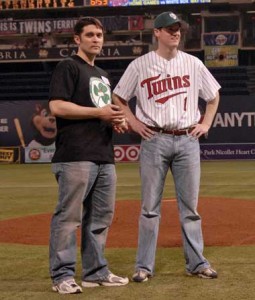
John Fitzgerald and Irish National Team first baseman Joe Kealty at a Minnesota Twins game.

John Fitzgerald and Irish National Team first baseman Joe Kealty at a Minnesota Twins game.

By Paul Schneider

Sometimes you find the answers when you’re not really looking for them. That was the case for John Fitzgerald, a New York-based independent film producer who stumbled upon the Irish National Baseball Team a few years ago. Fitzgerald, who initially hoped to play for the squad, instead became fascinated at the prospect of chronicling their adventures.

The result is “The Emerald Diamond,” which will have a Philadelphia area screening on Saturday, March 24, at 1 p.m. in Newtown, Bucks County.

The 90-minute film, which won the Critic’s Choice Award at the National Baseball Hall of Fame Film Festival in Cooperstown, N.Y., last year,will be shown at the historic Newtown Theater, at 120 N. State Street in Newtown (215-968-3859). Tickets are $20. Alternatively, DVDs and other “Emerald Diamond” merchandise are available at the film Web site, www.irishbaseballmovie.com.

For Fitzgerald – filmmaker, baseball fan and Irish-American – the project was a labor of love. In the Q&A below, he speaks a bit about how the project unfolded, and how the personal rewards that came with creating the film.

Q. What led you to the Irish baseball topic?
A.
I found the Irish National Team’s Web site during a Google search in early 2004. I don’t remember what I was looking for, but I couldn’t believe baseball was played in Ireland. As an Irish-American and a former high school/college player, my first instinct was to contact them to see if I could join the team.

At that point, I was 27 years old. I had stopped playing baseball a few years before and I had been working in TV and film – first as a production assistant (NYPD Blue, Ladder 49). I had also produced a couple of independent short and feature films. I had only directed one film – a short film called “Gorilla Gram.”

After speaking with the guys on the team by phone and e-mail, I was fascinated with the story and ready to play. It turned out that I am not eligible to claim Irish citizenship, as none of my parents or grandparents were born in Ireland. At that point, I was completely taken by the story and I figured if I couldn’t make a movie about two things I love – baseball and Ireland – I should just quit the movie business. So I called up my friend Bill Winters – a professional cinematographer who I’ve known since Little League – and we drove up to Rhode Island in May of 2004 to start shooting interviews with volunteer coaches who had been working with the Irish since 2001. The interviews went well, so we booked flights to meet the guys in Dublin in June of 2004.

Q. How much time did you spend with the Irish team?
A.
Shooting started in May of 2004 and ended in September of 2005. I made several trips to Dublin, one trip to Germany for the European Championships – Ireland placed third. Each trip lasted one or two weeks and then I’d head back to New York and edit and decide what else I needed when I went back again.

I also grabbed interviews anytime an Irish player or coach came to New York. One player had his wedding in New York, enabling me to get hours and hours of interviews without having to pay for airfare. As I said, there are several coaches who live in Rhode Island – they hosted the Irish National Team in 2001 for two weeks, and even got them an exhibition game at Fenway Park. The Rhode Island coaches were great in terms of doing interviews and digging up old photos and videos. The cooperation between Americans and Irish really helped keep the cost of the project down – I was financing the movie on credit cards and flying back and forth really pushed my credit cards to the limit. Thankfully, there was always someone passing through New York or within a few hours’ drive who was kind enough to give me a few hours out of their vacation or business trip to do an interview.

Q. What was the most surprising thing you found?
A.
The most surprising thing I found was that the Irish didn’t really know how to play at first. They knew that they could represent their country if they became the official National Baseball Team of Ireland. But most of the guys had never played a game and some didn’t even know the rules. The extent of their experience was that several of the guys had spent a summer or two in America and watched baseball – some had played pickup games, but that was it. These guys took on a tremendous risk by spending over a year of learning the game and traveling to the European Championships in 1996, but they did it because they wanted the honor of representing Ireland. It was surprising and refreshing to see that kind of dedication.

Q. Are there any particular incidents that stand out?
A.
The story of Irish baseball is really just one amusing anecdote after another, which is what led me to do the movie. As far as filming goes, there were a few times when a player would mention something during an interview that was just so incredibly funny that I couldn’t stop laughing. For instance, there is a segment about the horrible weather that they play in. The thing is, the guys in Ireland have to play through all sorts of weather – if they start canceling games or having rain delays, they would never get any games played. Many times it can be sunny and warm and it will become cold and rainy in minutes.

I was interviewing former National Team catcher and current head coach Sean Mitchell about the weather. Sean was very understated and matter-of-fact as he recounted different times that he had played in high winds, drenching rains, etc. I asked if he could remember a rain delay or game postponement… Sean replied that the week before he was up at bat and had been hit in the eye by a hailstone – the game was stopped for five minutes before he stepped back into the batter’s box. At that point, Bill (cameraman) and I started laughing uncontrollably at how nonchalant he had just told us this story. The understated, low key nature of the team turned out to be a source of a great deal of the film’s humor.

Q. Is there anything else you would like to add?
A.
The only other thing I would add is that over the course of filming, I became a huge fan of what these guys have accomplished. They are going to lose half their funding now that baseball is out of the Olympics, so I’ve started a charity to help them raise funds in the U.S. The charity is called Emerald Diamond USA and the Web site is www.SupportIrishBaseball.com. The funds raised go to the continued development of youth baseball programs in Ireland.

News

Still Friendly After All These Years

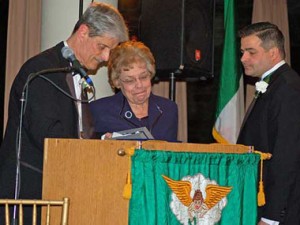
President Russell W. Wylie presents the Presidential Medal posthumously for Thomas O. Peterman, to Susan Peterman, his widow. At right is Todd R. Peterman, his son.

President Russell W. Wylie presents the Presidential Medal posthumously for Thomas O. Peterman, to Susan Peterman, his widow. At right is Todd R. Peterman, his son.

How old is the Society of the Friendly Sons of St. Patrick? Well, the group organized in Philadelphia in 1771. George Washington was an honorary member. This was the group’s 236th annual banquet.

Is that old enough for you?

The Friendly Sons—officially, “The Society of the Friendly Sons of St. Patrick for the Relief of Emigrants From Ireland”—celebrated in lavish style at Villanova’s Montrose Mansion.
The night featured performances by the University Glee Club, the McDade School dancers and the Philadelphia Emerald Society Pipe Band. The United States Navy Villanova University Naval Reserve Officers Training Corps presented the colors.

Larry Mendte, the CBS3 anchor, must have a clone walking around somewhere because he managed to attend every Irish event known to humankind on St. Patrick’s Day, including this one. He served as emcee.

The emotional highlight of the evening was the posthumous presentation of the society’s Presidential Medal to Thomas O. Peterman, the group’s former treasurer.

Peterman, who died of leukemia in December, also was active in many other local Irish causes, including the Philadelphia Irish Famine Memorial. He attended the University of Pennsylvania and the U.S. Naval Academy in Annapolis and was a Naval Reserve veteran. Accepting the award from president Russell W. Wylie was Peterman’s widow, Susan Brown Peterman and his son Todd R. Peterman, the new treasurer of the society.

Wylie noted that Peterman was proud of his involvement in the Friendly Sons. In a group with such deep roots in U.S. and Philadelphia Irish-American culture, it’s easy to see why.

Arts

The Man Behind the Quilt

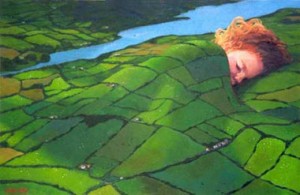
The most famous of Barry Maguire's paintings is this depiction of a child sleeping under a quilt of the Irish countryside.

The most famous of Barry Maguire's paintings is this depiction of a child sleeping under a quilt of the Irish countryside.

By Tim McLaughlin

Barrie Maguire stands in the center of the Celtic-Iberia Traders Shop in New Hope, reminiscing about his annual trips to Ireland. His white beard accentuates his smiling, freckled face. When he talks, his enthusiasm shows in his hand gestures, which start off small, but soon incorporate his entire upper body when he recalls his experiences in Ireland.

“I can never get used to driving on the left side of the road,” Maguire says, reenacting a drive through the countryside. “Whenever I see someone in front of me I freeze up and think ‘Oh no, he’s on my side!'” His body gets tense as he mimics swerving off the road, “We were going around a corner, and I panicked and swerved into a ditch! Then I heard Karen say ‘Holy Mother of God!’ I looked up, and sure enough, there was a statue of the Virgin Mary right in front of us!”

On St. Patrick’s Day, Maguire and his wife, Karen, were at the Celtic-Iberia Traders Shop for a show of Maguire’s work, including his most popular painting, Marin’s Quilt, which shows a young red-haired girl curled up under a green quilt made of the patchwork Irish countryside. This playful fantasy inspired a whole series of paintings titled the Irish Quilt series. Maguire says, “One of my friends calls (Marin’s Quilt) ‘Maguire’s one hit single.’ The first one sold right away at a gallery show, and I’ve been doing more with the idea ever since.” In fact, you can now buy an actual 33” X 44” baby quilt based on the painting, with a hedgerow, thatched cottage, peat pile, and medieval ruin carefully stitched on green sateen.

His second painting in the series featured his mother piecing together a quilt of an Irish landscape. Maguire, who lives in Narberth, says his mother, also an artist who is of French and German descent, was a bit resentful about posing for the painting. “She would always get upset that we considered ourselves Irish.” But in the painting, Mrs. Maguire’s face glows with a gentle smile while her hands carefully work over sections of farmland, crafting a beautiful patchwork of green fields, stone walls, and miniscule farmhouses.

Inspiration for Maguire’s paintings comes from his yearly trips to Ireland. “We go every year, and I take hundreds of photographs,” he says. He doesn’t paint from real life. “I don’t bring an easel with me,” he admits, “so I suppose it’s cheating.”

Maguire, who was once the creative director for Hallmark Cards, has also done a series of portraits of Irish writers including James Joyce, W.B. Yeats, and Oscar Wilde. He also paints horses, which are so much are part of Irish culture. One painting from the horse series, Piebald-Soul, was on display at the show. It features a horse rearing on its hind legs, drenched in moonlight and surrounded by stars. Alongside the painting hung a copy of Denise Blake’s poem “Wild Horses,” which was the inspiration for the piece. He also has a series of traditional Irish musicians, including Grafton Street buskers, a young girl in pigtails playing a bodhron, and fiddler Patsy Whelan, a New England-based pub owner who appeared recently at The Shanachie in Ambler.

Celtic-Iberia Trader Shop owner Mike Burns was thrilled to have Maguire on hand for the one-day show. “We’re always excited to show local talent,” Burns says, “Because most of our artists are Irish and Spanish, it’s very difficult to get them here for a gallery show.”

Barry Maguire certainly proves that you don’t have to live in Ireland to channel the Irish spirit. To learn more about Maguire’s work, or to purchase prints, visit www.MaguireGallery.com. Celt-Iberia Traders is at 15 W. Ferry Street, New Hope, PA 18938. It carries high quality gifts and art from Spain and Ireland, much of which is available for online purchase.

Music, News

Blackthorn’s St. Paddy’s Bash

John McGroary does his famous Chuck Berry move.

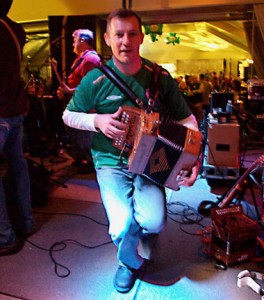
John McGroary does his famous Chuck Berry move. (Photo by Gwyneth MacArthur)

When Gwyneth asked whether she could lend her formidable skills (she didn’t use the word “formidable,” but we think it fits) to our St. Patrick’s Day effort, of course we said yes. We post just about all of our photos on Flickr, and Gwyneth is one of our contacts.

And so it happened that on St. Patrick’s Day, Gwyneth found herself with an assignment that could not, under any circumstances, be characterized as hardship duty. She had a ringside seat at the Blackthorn St. Patrick’s Day Party.

If you couldn’t be there, don’t worry. Gwyneth’s photos will put you there.

Food & Drink, News

St. Patrick’s Day at Dolan’s: A Family Tradition

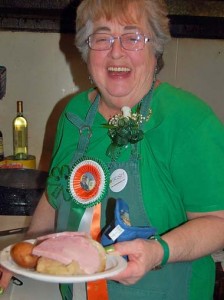
Mama Dolan serves up the ham and cabbage.

Mama Dolan serves up the ham and cabbage.

It’s a bar. A big, rectangular wooden bar with barely enough room to fit drinkers two deep around it. On St. Patrick’s Day, Dolan’s Bar, in the little borough of Ridley Park, is so crowded that if someone at the front of the bar orders one of Momma D’s buck-fifty cabbage and ham platters, the waitress has to go out the back door and come in the front to deliver it.

Oh, and Momma D’s cabbage and ham platters are worth the outdoor trek. She cooks the cabbage and the potatoes on a layer of cabbage leaves and ham rind that turns the cabbage dark and sweet and the potatoes moist and smoky. The aroma alone is transporting.

This is the place where you want to spend St. Patrick’s Day. Founded in the mid-40s by Irish immigrant Patrick Dolan, the bar, which moved to the small town (population 7,200) in 1954, passed down to his son Pat (Poppa D), and five years ago to Pat’s son Pat (called P.J.), who honed his cooking skills in Kinsale, Ireland.

But it’s Momma D—Irma—who still reigns in the kitchen on St. Patrick’s Day. “I’ve been making my ham and cabbage for more than 30 years,” she says, loading a plate with a quarter head of cabbage, three potatoes, and two thick slices of ham in the bar kitchen, which is so small that one person is a crowd.

At one time, Irma recalls, the bar didn’t have a kitchen. “They had one next door and when someone wanted food we would call over on an intercom,” she chuckles. Because Dolan’s operates on a state restaurant license, by law, the bar has to have enough food on hand for 32 people, she says. In the early days, her father-in-law kept to the letter by stocking 32 cans of soup. Then Irma began to cook. On St. Paddy’s, she may go through two crates of cabbage, 50 pounds of potatoes and 70 pounds of ham.

“This is really what it’s all about,” says Ridley Park Mayor Hank Ebersole, who came into the bar decorated like parade float with a glittery green hat and green crepe paper taped to his jacket. “This is a bar. I mean, a bar-bar, where people come to drink and talk.”

Like Tom Benson and Tim France. Benson is a Ridley Park lifer who inherited Dolan’s from his father. “My Dad used to drink here, then I did,” he says. “In fact, my whole family drinks here.” Tim France, a Ridley Parker who now lives in Yardley, Bucks County, also has Dolan’s in his genes. “This is where my Dad drank too,” he says. “We look at Dolan’s as something like ‘Cheers,’” says Benson. “When you come in here day or night, you’ll know someone.”

In fact, every time the front door swung open, sending a blast of sunlight into the dark, smoky bar, a cheer went up as though Norm was showing up every few minutes.

Dolan’s isn’t one of those mass-produced Irish pubs with Harp on draft and quaint Celtic antiques to remind you of the last time you hoisted a few in County Clare. You want draft and you’d better like Bud. If it weren’t in the middle of the block on Sellers Avenue, you could describe it as the “corner tappy.” But there’s that unmistakable hospitality and good cheer that says “Ireland.” Even the employees show up on their days off—like bartender Jay Whaley, who anchored a corner of the bar with his beer and led the patrons in singing and clapping to whatever Irish music was playing. “He does Blackthorn great,” says Poppa D. “We have a party the Friday before Christmas. He leads the singing and you don’t want to hear it.”

“We call ourselves Dolan’s Tavernacle Choir,” laughs Irma.

Then there are the Bag Parties. “The rule is ‘no bag, no beer,’” says Irma. “You have to come in with a bag on your head or you won’t be served.”

At the end of basketball season, the aromas wafting from the bar kitchen are decidedly not Irish. “We have Polish Day the last day of basketball,” explains Irma. “We have halupkies, Polish kielbasa, PJ makes pierogies, and the patrons bring food too. It all started when a bunch of old men had a bet and the loser had to bring in Jewish rye bread and pickles and Polish food. And every year it just grew and grew and grew. We’ve probably been doing it for 20 years.”

Twenty years ago, many of Dolan’s patrons would have been toddling around with their sippy cups full of apple juice. There’s a healthy crop of young regulars who have their favorite seats at the bar. Like Joseph Patrick Quinn. “I’m here four days a week,” says Quinn, who lives in Glenolden. “Whether it’s June 1 or March 17, I’ll be here. This is my place.”

And Anthony Handley of Ridley, who, like many of the younger regulars, was keeping up a family tradition: Spending St. Patrick’s Day at Dolan’s. But this time it was with his dad, Allen. “We really love this place,” he says. “We don’t have to worry about drinking too much because we can walk home.”

“But if it gets too bad,” adds his father with a grin, “we can always call Mom.”

Join in the virtual shenanigans at http://groups.myspace.com/dolansbar