Monthly Archives:

March 2015

News

Witness to Conflict, Advocate for Peace

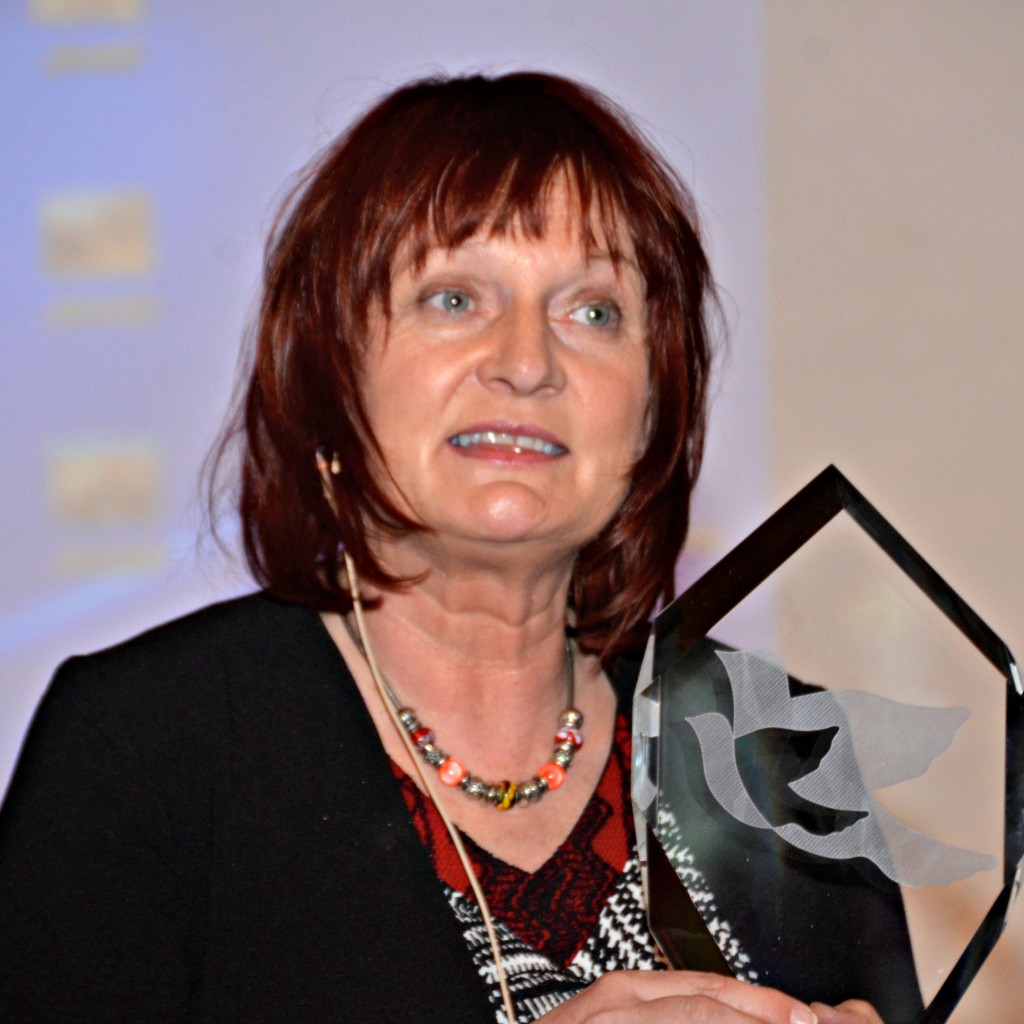
Patricia Campbell, with the Passion for Peace award

Patricia Campbell, with the Passion for Peace award

Patricia Campbell has seen it all. And you probably don’t want to see what she has seen.

As a community mental health nurse in Belfast, Campbell has witnessed the trauma resulting from years of conflict in Northern Ireland. In spite of the Good Friday Agreement, the wounds of many have failed to heal—on both sides—but certainly among those who were dragged off to prison, tortured or both, all at British hands. Suicide is not uncommon.

Within the communities divided during the Troubles, Campbell says, those divisions remain. In many cases, they are more pronounced now than they were in the days of open conflict.

Severe health care budget cuts will make it harder to deal with the community’s ills.

Campbell has also visited Palestine, where she sees parallels between Northern Ireland’s minority Catholic population and the government of the UK.

Regardless of where she bore witness to injustice, Campbell has dedicated herself to justice and peace.

Last Sunday, Campbell visited Philadelphia to receive the Passion for Peace Award at St. Paul’s Episcopal Church in the city’s Chestnut Hill neighborhood.

We took a few moments before presentation of the award for a conversation. Here’s what she had to say.

News

St. Patrick’s Day Isn’t Over: Two Parades This Weekend

It was chilly in Mount Holly last year, too. That didn't stop anybody.

It was chilly in Mount Holly last year, too. That didn’t stop anybody.

Horrible weather forced the postponement of two big St. Patrick’s Day parades—Conshohocken and Mount Holly. But the operative word here is “postponed”—not “canceled.” The weather Saturday is expected to be really cold—partly cloudy with a high of 38 degrees—and it’s not a whole lot better on Sunday—sunny and 40—but hey, there’s no snow or ice. So the parades must go on.

Conshy steps off at 2 p.m. on Saturday down Fayette Street. It’s always a big parade, and you can bet it’ll draw a crowd, regardless of the cold.

In Mount Holly, the parade begins at noon on Sunday, right through the heart of town. Also a big parade.

Here’s what you have to look forward to.

Mount Holly 2014

[flickr_set id=”72157641723086293″]

Conshohocken 2014

[flickr_set id=”72157642454991584″]


News

Adventures in Paradise, Part 1

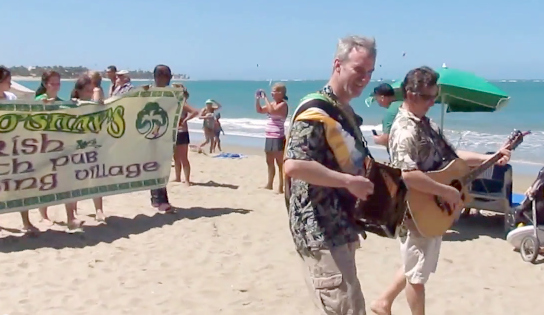
John McGillian and Dave Cohen in a small but warm St. Patrick's Day parade.

John McGillian and Dave Cohen in a small but warm St. Patrick’s Day parade.

Given the lion-or-lamb nature of March weather in Philadelphia—mostly lion—St. Patrick’s Day wasn’t bad: mostly sunny, with a 68.

But you can bet it was a lot better in the laid-back paradise village of Cabarete along the northern beaches of the Dominican Republic: sunny, with a high of 90.

It might not be traditional Irish weather, but Philadelphia accordion player John McGillian. In fact, he’s been heading to Cabarete to celebrate St. Patrick’s Day, with his guitar-playing partner Dave Cohen, for the past eight years. Recruited by Philly-area Irish music legend Cletus McBride, McGillian and Cohen—performing as Two Quid—perform most of the day at Jose O’Shay’s, an Irish pub owned by Frank Brittingham. If that name sounds familiar, it’s because he once owned the restaurant that still bears his last name in Lafayette Hill.

“I just got back,” McGillian said in an interview this week. “I was there from the 14th to the 21st. I was hired to play one day, but we give Frank a couple of nights acoustically as people walk by.”

Brittingham promises the tourists an authentic full day of Irish music and dance, and that’s what they get: McGillian and Cohen, McBride, Irish Thunder piper Cullen Kirkpatrick, and three dancers from the Henry School—Caitlin, Bridget and Molly Mahon. There’s even a parade on the beach.

As for the tourists, McGillian says, “most of them come from from Canada or Europe. It’s not a resort. You’re on your own. It is a zoo. But it’s beautiful—a tropical island. It’s a little piece of Spain because everyone is speaking Spanish.”

He confesses, “The only words I’ve learned so far are “Cerveza (beer), per favor” and “muchas gracias.”

McGillian and his partner landed the Celtic Caribbean gig when Brittingham asked McBride—who was then performing at Brittingham’s St. Thomas pub—who he’d recommend to play on St. Patrick’s Day at Jose O’Shay’s. “I used to play the odd gig here and there with Cletus,” McGillian recalls, “and Cletus said John McGillian because I was his fave.”

McBride called McGillian out of the blue. “It was a surprise. I had no idea. I went down the first time, and then Frank kept getting me back.” His partner from Five Quid went along as part of the deal. “Dave is one of the best musicians I’ve met. I’ve been playing with Dave. I’ve been playing with Dave the last 20 years all over Philadelphia, New Jersey, and through the Tristate area. No one touches us for a two-piece.”

Regardless of the locale, the music is pretty much the same as what you might hear in a local pub on St. Patrick’s Day, and they also play for the dancers. “We’ll do a couple of songs, and then the girls will come out with the hard shoes on and dance away.”

There’s also a dance floor so the tourists can step out. That’s when they’re not wind surfing or kite surfing—two activities for which Cabarete is well known.

As for McGillian, he’ll be happy to throw on the loud shirt and shorts and play “Whiskey in the Jar” at beachside pretty much forever.

“It’s a gift,” he says. “It’s gonna end one day, so I’m gonna accept as long as its being offered. It’s the best gig out of town.”

And when he returns to Philadelphia, he’s happy to share his stories with his fellow musicians—the ones who suffered through three or four gigs on St. Patrick’s Day, just possibly on a day when the Delaware Valley was blanketed in snow.

“I’ll rub it in whenever I can.”

Next week: Cullen Kirkpatrick.

News

Kathy McGee Burns: The Story of All Our Irish Families in Philadelphia

We’re still not quite finished with this year’s St. Patrick’s Day experience in Philadelphia.

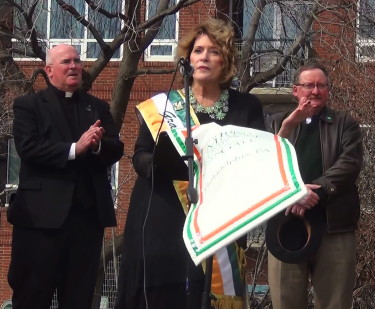
We’ve had many requests for the speech that Kathy McGee Burns, President of the Irish Memorial and Grand Marshal of this year’s St. Patrick’s Day Parade, gave at The Memorial (located at Front and Chestnut Streets) on March 17th. So here is the video, and the transcript, of her eloquent expression of not only the story of her Irish family’s experience, but the experience of so many who left their homeland for a better life. And found it.

Kathys speech


ST. PATRICK’S DAY SPEECH AT THE IRISH MEMORIAL, BY KATHY MCGEE BURNS, MARCH 17, 2015

“Good afternoon. As you know, I’m Kathy McGee Burns, President of the Irish Memorial, and I’m grateful to be giving this speech because as we all gaze upon this beautiful monument, it tells a story. The story I’m going to tell you is of my family; but it could be any one of your families.  That monument depicts many aspects of the Irish.

My great-great grandparents, Cornelius and Kate McGee had six children. Four of them were forced out of Ireland. They all lived in Gweedore, County Donegal, and the McGees were tenants on their own land, forced to pay high rents. That is because the landlord really wanted the land for the grazing of his high-bred English and Scottish lambs and sheep. We were in the way. They thought more of their sheep than our people. So their son, Thomas McGee, got on one of those ships and headed to the Port of Philadelphia. His people were miners and railroaders and servants, but the result of their tenacity and their Irish spirit is part of the fiber of Philadelphia.

They were the builders of St. Malachy’s in North Philadelphia. That’s where Irish children were educated by the Sisters of Mercy. One of those children was my grandmother, Mary Josephine Callahan. Religion was one of the stepping stones to Irish success in Philadelphia; through the nuns and priests who educated us, to the bishops and the cardinals and the parish system which was a powerful builder of Irish success.

Well, Mary Jo and her husband Hugh McGee had a son, Timothy, my father. He was brought up in Swampoodle and I bet if I took a chance, many of you here were from Swampoodle. He graduated from Roman Catholic High School, went to work for the ‘Ac-a-me’ and then started his own business. He was highly successful.

The Irish built these cities through their unions, their bricklayers, their builders, their electricians, the operating engineers, the McCloskeys and the Kellys.

Tim McGee, my father, had four children. He made sure we were educated. Each one of us have graduate degrees. And I am proudly married to an operating engineer. The Irish have gained power by their involvement in the law. They were firemen, policemen, attorneys, politicians and judges. Well, the great-great-great granddaughter of Cornelius McGee is none other than my own daughter, the Honorable Kelly Wall, who became a judge.

So this is what The Irish Memorial is to all of us, given an opportunity in this world, this city.  It represents the hardships, the ‘Irish Need Not Applies,’ the many avenues of Irish Philadelphia education—Villanova, St. Joe’s, my own school, Chestnut Hill College. It represents Boathouse Row and the lighting of Philadelphia by the electricians’ union. So we owe our love and respect to our ancestors, and a huge thank you to those who conceived the plan and raised the money and built what is known as the most beautiful monument in the world to honor ‘An Gorta Mor.’

And I salute my ancestors. Thank you”


News

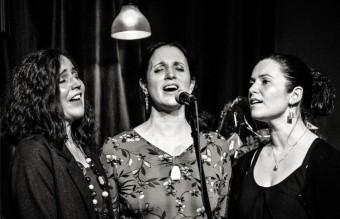
The Henry Girls Bring Inishowen to Philly

Henry girls

Denise has seen the sisters play in Inishowen, I’ve seen one of the sisters (Jolene) play in Buncrana; of course we were going to see the Henry Girls play when they came to us (although, frankly, we’d both rather be in Donegal seeing them play). So last Friday, when Karen, Lorna and Jolene performed at Burlap and Bean, in Newtown Square, along with musician Ry Cavanaugh, we were there.  Denise got a few photos, I got a few videos (the atmosphere was small, intimate and dark, so the visual quality isn’t that great; just listen to their magical, musical harmonies). And when they closed the evening with their a cappella version of “The Parting Glass,” they did indeed bring joy to us all.

The Henry Girls have three CDs they’ve recorded: “Dawn,” “December Moon,” and “Louder Than Words.” All three are unique, yet showcase the rare and particular unison in which the sisters play and sing.

Their recordings are available for purchase through their website, The Henry Girls, as well as for download on iTunes.

So, check out their music, and then add it to your collection; it’s music you’ll want to listen to on repeat.

“Sing My Sister Down”

“James Monroe”

“Watching the Detectives”


How to Be Irish in Philly

How to Be Irish in Philly This Week

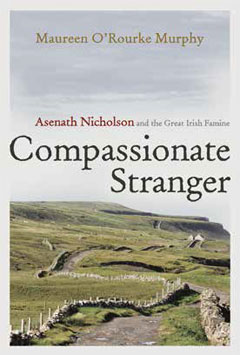
Dr. Maureen Murphy's book, Compassionate Stranger: at Villanova on Monday

Dr. Maureen Murphy’s book, Compassionate Stranger: at Villanova on Monday

Thanks to March’s terrible weather, the month is not only going out like a lamb, it’s going out with a parade. Two of them, in fact. The Mount Holly, NJ, St. Patrick’s Day Parade, usually the first of the season, will be the last, on Sunday, starting at noon. The Conshohocken parade will precede it on Saturday, starting at 2 PM.

Also on Saturday afternoon, the Theresa Flanagan Band will be playing a fundraiser for St. Lucy School, which is for children with visual impairments, at the gym of Holy Innocents Parish in Philadelphia.

The Plough and the Stars in Philadelphia is holding an organic vegan workshop at 6 PM. Restaurant professionals get a discount.

Lafferty’s Wake, an interactive comedy, continues its run at Society Hill Playhouse all weekend.

If you happen to be in Yonkers on Saturday night, catch local favorite Raymond Coleman at Moriarity’s. He’ll be at Behan’s Pub in the Bronx on Monday night.

On Monday afternoon, Dr. Maureen O’Rourke Murphy, author of Compassionate Stranger, will talk about Quaker Asenath Nicholson, the subject of her book, and his involvement in An Gorta Mor, the years of the Irish starvation, at Villanova University.

On Thursday, the Elders come to the Sellersville Theater with their mad combo of Irish jigs and American roots and rock.

Then on Friday, catch the local Paul Moore Band at First Friday at Brittingham’s in Lafayette Hill.

News, People

Lost and Found

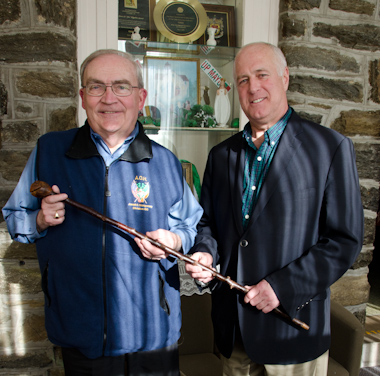
Pat Montgomery, left, with Michael Bradley, who found Joe Montgomery's blackthorn stick.

Pat Montgomery, left, with Michael Bradley, who found Joe Montgomery’s blackthorn stick.

Joe Montgomery’s future father-in-law, Patrick Joseph Collis, came over from Sligo to America in 1911 carrying one of his prized possessions, a blackthorn walking stick, what the Irish call a shillelagh.

It was, like all blackthorn sticks, thick and knotty with a large knob at the top. Traditionally, the knob served as a handle, or, when the situation called for it, as a cudgel to use against an opponent. Montgomery, who died in December 2014 at the age of 95, never used it that way. He was always a gentleman, those who knew him say. He saw it as a link to his Irish heritage, and he cherished it.

Collis had given the stick to Montgomery, who had married his daughter, Mary, shortly after Montgomery returned from the service in World War II, where he was in the US Army Air Corps. He carried it with him everywhere. In his later years, it provided added dash to the appearance of the former truck driver, member of Teamsters Local 500, and Ancient Order of Hibernians president, known for his dapper suits and rakishly tilted top hat.

But a few years ago, Montgomery, who served for 60 years on the board of the Philadelphia St. Patrick’s Day Association, slipped and fell on the muddy ground near the reviewing stand at the Philadelphia St. Patrick’s Day Parade which he attended faithfully every year. An ambulance took him to Hahnemann Hospital where he was treated and released—he made a grand entrance at the post-parade party none the worse for wear—but somehow, in the confusion, he got separated from the stick.

Montgomery was heartbroken. And desperate. He contacted parade director, Michael Bradley. “He must have called me 10 times and I called all the board members, the people at CBS3 who televise the parade, the caterers and no one found it,” Bradley said recently. “He kept calling over and over and my heart was just breaking for him.”

This year, Montgomery was named to the St. Patrick’s Ring of Honor posthumously. The members of the Joseph F. Montgomery AOH Div. 65—Michael Bradley’s division—honored their fallen president by tipping their caps at the reviewing stand. Bradley, who was then in full parade directors’ mode when they made their touching gesture, had a little secret. Though Joe Montgomery wasn’t going to march in another parade, his blackthorn stick might.

“It was the strangest thing,” said Bradley, sitting across the table from Montgomery’s son, Patrick, last weekend at the Irish Center. “I was doing a radio interview with Michael Concannon [host of WVCH 740AM’s Irish Hour, which is aired every Saturday] and, I don’t know why, I started talking about Joe Montgomery’s lost stick when Mike, who has been a parade judge for years, said, ‘Hey, wait a minute, is one of these it?”

Concannon showed him two sticks, one, dark, gnarled and split, the spitting image of Joe Montgomery’s shillelagh. “I knew as soon as I saw it that it was Joe’s. Mike said , ‘One year, someone found it and handed it to me.’ I couldn’t find out who it belonged to so I just kept it.’

“After he lost it, I talked to everyone. . .but I never thought to ask one of the judges,” Bradley said.

So on Sunday, Bradley put the long lost blackthorn stick in Pat Montgomery’s hands. “When Michael called me I felt fantastic,” said Pat Montgomery. “I sure wish he was still alive to see it, but at least it’s back.”

And it may be marching in the parade next year. “At the parade, I wore the pants from the suit he always wore, and my youngest son, Brian, wore his hat,” said Montgomery. “Now everything’s together.”

See photos below for a closer look at the stick and Joe Montgomery at past parades.

[flickr_set id=”72157651121960497″]

Arts, Music

Strumming a New Tune

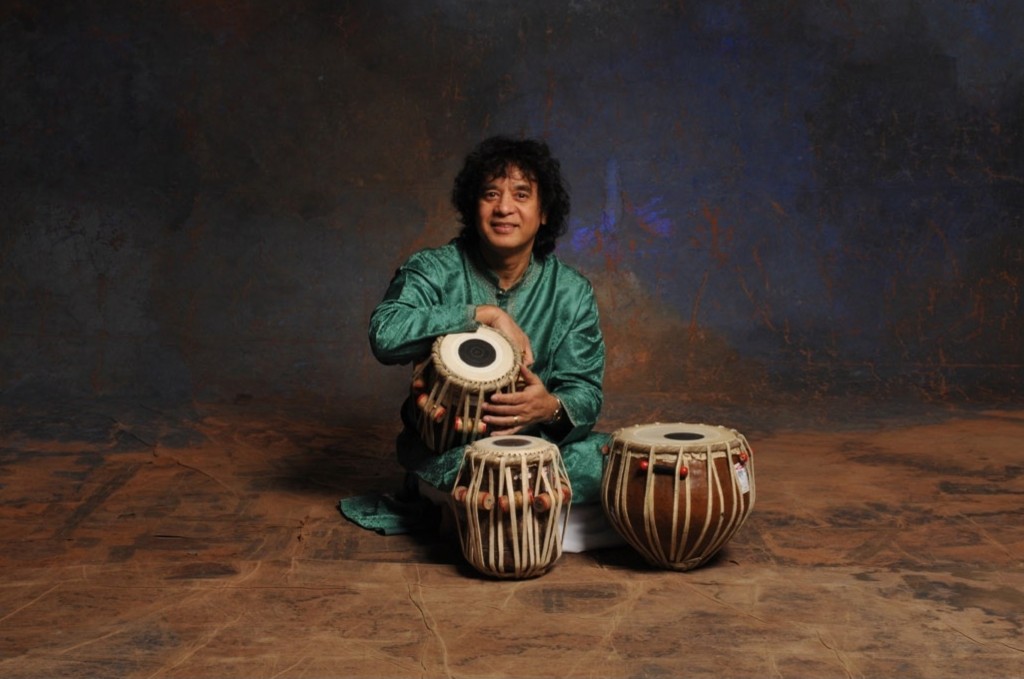
Zakir Hussain (photo by Jim McGuire)

Zakir Hussain (photo by Jim McGuire)

Back in December, premier Irish guitarist Tony Byrne got an unusual email. Would he be interested in going on tour with Indian tabla player Zakir Hussain and his troupe of Indian and Celtic musicians?

“Are you free, are you interested?” Byrne recalls. The answer was easy. “Being on a stage like that, I couldn’t say no.”

Speaking from his hotel room outside Washington, D.C., on the fourth night of the tour, Byrne has absolutely no regrets about playing in Hussain’s show “Pulse of the World: Celtic Connections.” He joins some of the world’s best Indian and Celtic musicians: Rakesh Chaurasia, bamboo flute; Fraser Fifield, flute and pipes; Jean-Michel Veillon, flute; Ganesh Rajagopalan, violin; Charlie McKerron, fiddle; Patsy Reid, fiddle; John Joe Kelly, bodhran—and Hussain himself, widely acknowledged as the master of the Indian tabla drums, one of the most devilishly complex percussion instruments on the planet.

Celtic Connections explores the surprising ties between the rhythms and melodies of two distinctly different genres of world music. Those connections can be close indeed.

“A lot of these styles of music are linked, especially through percussion instruments, and a lot of the wind instruments as well,” says Byrne.

Still, the instruments, the styles of playing them and the musicians themselves are different enough that the contrasts are also pretty clear—and if some of it sounds like experimentation, it’s because it often is, says Byrne.

“The Indian musicians who are playing with us will pick up on a motif in a small line we play, and then they can come back to you with a little four-note phrase. It’s like they’re echoing back to you, and call and answer. You have a match, and a mismatch at the same time.

“They can dip in and out. That’s really fun when that happens. The more concerts we do, the more that that happens. We have a blueprint, but we can all deviate from that. It’s great to see that developing. It’s almost like jam sessions. That’s really exciting.”
Earlier in his musical career, Byrne was a rock drummer, and when he learned to play guitar, he incorporated a lot of percussion into his right-hand technique. That’s good when it comes to rhythm, but Byrne has to hang in there with the melody as well, which can be complex.

“I’ll always lock into John Joe and Zakir’s playing but I also have to lock into the chords,” Byrne says. “You try and cover all the bases.”

Even though Byrne’s style of play is powerfully percussive, that’s no walk in the park, either. John Joe Kelly is most directly in Byrne’s sightline, he says, “so we naturally, almost instinctively think together what to do.”

Zakkir is a bit more challenging. “Zakkir can play in any time signature. The guy has never missed a beat in his life. Its mesmerizing to watch him do it.”

If you’re a musician, though, that kind of challenge is what you live for.

“You’re always striving and trying to making it better,” Byrne says. “You become more focused and you become really alert. It is a challenge but it’s an exciting challenge as well.”

Pulse of the World: Celtic Connections will roll into Philly on March 27 for a concert at Painted Bride Art Center, 230 Vine Street. The show starts at 7. Tickets and info here.