Monthly Archives:

October 2008

Columns, How to Be Irish in Philly

How To Be Irish in Philly This Week

Hey, Feile Samhain, everyone!

If you can get your hands out of that trick-or-treat bag for a few seconds this week, there are a number events that can help you feel Irish all over.

For example, the Mayo Ball, which is being held Saturday at the Irish Center. You don’t have to be from Mayo to go, either. I know, they invited me and I’m a Donegal gal. There’s guaranteed to be some great food and music. The Theresa Flanagan Band is playing (she’s a Donegal gal too—in fact, she’s president of the Philadelphia Donegal Association) and Tommy Flynn and the NY Show Band is also scheduled.

On Sunday, the not-to-be missed St. Malachy School Benefit concert kicks off at 4 PM with Mick Moloney and Friends. You never know who Mick is bringing with him—one year, Tommy Sands flew over from Ireland just for the evening. The concert takes place inside St. Malachy’s Church, which is stunningly beautiful and, like many churches, has seriously great acoustics. This is just one of the fundraisers that helps keep St. Malachy’s an independent school, not reliant on the Archdiocese, but it is by far the most exciting.

The only calendar snafu this week–and it happens every year–is that Sunday is also the Ceili for Kayleigh, the Blackthorn event to raise money for research into methylmalonic acidemia, or MMA, a rare disease that afflicts and local child, Kayleigh Moran.

If you’re up north, the all-guy singing group Celtic Thunder is playing at the Reading Eagle Theater on Wednesday.

And next Friday, November 7, the Ulster American Society is hosting the Northern Ireland Film Festival at the National Consitution Center in Philadelphia which will run through Saturday. Among the films: “A Dander with Drennan,” a documentary that follows folklore expert and trad musician Willie Drennan in search of local characters and history; an episode of Rick Steves’ Europe Through the Back Door, from PBS, exploring Northern Ireland; “Blood Ties,” about an American family in search of its Ulster roots; “Charlotte’s Red,” about a talented 7-year-old painter named Charlotte and her career-burglar father; and the Oscar-nominated short, “Dance, Lexie, Dance,” about a single parent struggling to balance night shifts with his lively 10-year-old daughter who dreams of being a Riverdancer.

Check our calendar for more details. Oh, except for Tuesday. It will be out voting. Hope you will too!

Arts, News

The Mysteries in the Bog

One April morning in the west of Ireland, a farmer cutting turf in his bog makes a gruesome discovery: the head of a woman, face tanned like leather, with long red hair. As two experts arrive to investigate—one an Irish archeologist named Cormac Maguire and the other an American pathologist called Nora Gavin—the mystery of the ancient “bog body” becomes entangled with the recent suspicious disappearance of another woman, the wife of a local landowner, and their toddler son.


That is the premise of the debut mystery novel, “Haunted Ground,” by American writer Erin Hart. Published in 2003, this complex and evocative book was nominated for two of the top literary prizes for mysteries, the Agatha and Anthony Awards, for best first novel. Hart masterfully crafts a satisfying mystery into which she has woven strands of history, archeology, Irish folklore, and music (Cormac plays the flute and Nora is, like Hart herself, a sean nos singer). The two characters reappear in Hart’s second novel, “The Lake of Sorrows,” which likewise melds ancient and current mysteries—two bodies, murdered centuries apart, discovered in a commercial bog in Ireland’s midland county of Offaly (where Hart’s husband, two-row button accordion player, Paddy O’Brien, was born).

I recently spent a delightful hour talking on the phone with Erin Hart from her home in Minnesota, where she co-founded the Irish Music and Dance Association. The conversation ranged from what first piqued her interest in bog bodies, her longtime passion for Irish music, and why it took her almost two decades to finally write her first mystery. That last bit of information should give renewed hope to aspiring novelists who’ve been toting a killer plot in their temporal lobes but haven’t actually gotten around to writing it down. There’s time!

How did you get the idea for your first novel?

I was always interested in words and reading, but the idea of writing a book was so completely out of my sphere of possibility, until I heard a true story about two farmers out cutting turf who found the head of a red-haired girl. I was in Donegal, staying with a friend [Altan’s Daithi Sproule, who now makes his home in Minnesota] and his mother told me that her son-in-law was a famous archeologist who studied artifiacts and people found in the bogs, and his father was also an archeologist. She told me about the red-haired girl. Later, I wrote him a letter to ask him about it, and he wrote back a beautiful letter about his memory of the event, which happened when he was 9 or 10 years old. He and his father went out to the farm of the men who found the head and they had it in a biscuit tin on their kitchen table. Hs father took the tin and put it in the back seat of the car and drove back to Dublin with it. He remembered exactly what it looked like: upper teeth biting through the lower lip, the clean cut through the neck, all those wonderful, gruesome details you could use to launch a story. He told me that it “still haunts me. Forty years later, she’s still with me.’ I thought, Wow, that woman deserves a story, even if I have to make it up.

So after hearing that story, did you immediately sit down to write about it?

Well, no. [Laughing] I was looking at my journal from that time and I had written, “What a great opening for a mystery. Someone ought to write that.” Of course, I didn’t do anything with it then. The other thing I wrote was “thinking of writing a story about a red-haired girl whose head was found in a bog.” The last entry was, “Must find out more about bogs.” [Laughing.]

How did you finally do it?

When I first heard about the red-haired girl, it was the ‘80s and I was working at the Minnesota State Arts Board. One day, when I was at the copier making a gabillion news releases to send out, I thought, “I have to take a class to keep my brain alive.” When I looked into it, I had two alternatives: Get my MBA or go into creative writing, so I chose creative writing, but I decided to stick to nonfiction because you don’t have to make stuff up. I started writing all these memoir pieces about my happy childhood, and it didn’t take too long before I realized that if you had a happy childhood, no one wants to read your memoir. So I took some journalism classes and started to do some freelance work. It was good experience learning how to meet deadlines. I was freelancing for newspapers and wound up as the theater critic for the Pioneer Press in St. Paul, writing reviews and art features. My teacher at the university was the on-air theater critic for NPR, and when he moved to San Francsico, I waltzed over to NPR and said, “You don’t have a theater critic anymore and you need one.” So for five years I was theater critic for NPR. And actually, seeing all those plays, hearing all that great dialogue, and seeing how story arcs were made really helped when I sat down to write.

Were you writing the novel all that time?

No [laughing]. Actually, 10 years went by while I went to grad school, worked fulltime, and had my freelance career as a theater critic. In grad school, I took a fiction writing class, which made me feel terrified because you have to make stuff up. Then I started writing a short story and realized, hey, you can make stuff up. But after 8 years of grad school, I only had one story. I submitted it to a magazine called Glimmertrain, which was offering a nice $1,200 cash prize for new fiction. That was around 1996. I was lying in bed one morning with pneumonia and I get a phone call: “Guess what, you won the award for new writers.” I was flabbergasted. I had been lying there in bed with pneumonia, reading all these mysteries and I started thinking, “Hey, I stepped across the creek, now I think I’ll swim the ocean.” What helped push me in that direction was after I won the prize, I got calls from several agents who had read the story and were looking for new clients. Two asked me send more of my fiction work and, as you recall, I didn’t have any. I wasn’t about to say, I have all these happy childhood memoirs, so I mentioned that I had an idea for a mystery novel set in Ireland. One said, “Sounds interesting. Let me know when you finish it.” I figured I’d never hear from her again, and I didn’t. One said, “Send me 50 pages.” It took me six years to write them. It didn’t hurt that “Angela’s Ashes’ had been published. The agent told me to hurry up and finish before “Irishness goes out of fashion.” [More laughing]

How did you choose Nora and Cormac as your lead characters?

Logic. You just ask yourself, who would be interacting with an event of this type, who comes to a bog when human remains are involved: the police, the pathologist who would decide whether it’s a modern or ancient crime, and of course, definitely, an archeologist should be the hero, and probably a pathologist interested in bog remains. Originally, my lead characters were two guys so there was no element of romance, but my agent and I and had similar ideas, that they should be a man and a woman and one Irish and one American, so they would know different things and be able to educate each other and the reader.

Did you have a good sense of who they were and where the plot would take them?

In order to find out about my characters, I have to write, I can’t just sit and plot. Playwright August Wilson said that he didn’t write plays, he took dictation. I used to think that was baloney, but it’s true. Once you’re writing, your characters do things you don’t expect, and there are plot turns you don’t expect. It’s a very intuitive process. And 90 percent of the mystery writers know say that’s their experience.  

Nearly all of your characters play some kind of instrument or, like Nora, sing, which makes sense given your involvement in Irish music.

I put a lot of music in it because everyone I know in Ireland is involved in music in some way. Devaney, the policeman in “Haunted Ground,” is a fiddle player, Cormac is a flute player, not an accordian player like Paddy, but Paddy is very partial to the flute. One of the farmers in the story, Fintan, plays the pipes. I was was half thinking of making Nora an unaccompanied singer and thought, nah, that would be too much. But Nora shares a job and interests with a woman who was a teacher at Trinity, Maura Delaney, a medical doctor. When I met her she mentioned something about going to a gig. I said, ‘Oh, what instrument do you play?’ and she said, ‘Oh, I don’t play, I’m a singer.’ So Nora became a singer because if it’s handed to you on a plate, you take it.

How did you meet your husband, Paddy?

He was traveling around the states and was playing in St. Paul. In 1981 I had gone to Ireland for a two-month language course in Connemara and had traveled around going to music festivals and things. The day I got home some friends said, “come down to this bar and hear this great band.” Halfway through the evening, I heard this booming voice saying, ‘And now well have a song from Erin Hart,’ and that was Paddy.  My friends had told him I was a singer. He would come to town every three or four months and we’d have a date. That went on for two years and then he went home to Ireland for a while. Then he came back and moved in with me. That was in 1983, and in 1987 we got married.

Has he been a source of information for you when you’re writing your mysteries?

Paddy actually used to work on big industrial bogs as a fitter. He repaired heavy machines. I wore him out with questions. He drew me diagrams about how everything works, gave me information on shifts, the weather. In “Lake of Sorrows,” there’s a scene where there’s a peat storm, where the wind picks up the peat and whirls it around. He told me about that and the “fairy wind,” a tiny tornado of peat, that gets taken across the bog. It’s spooky and is considered a premonition of something bad happening. Then there was a really odd coincidence. We were getting ready for the “Haunted Ground” launch in Ireland and guess what, they found a new body in the bog in Offaly. They thought the body might be 2,000 years old, which is exactly what I was considering for “Lake of Sorrows.” I thought, what were the chances of this turning up exactly when I needed it? I was reading the story to Paddy about how this farmer, Kevin Barry, was surprised when he climbed out of his digger to find this body, and Paddy said, “Did you say Kevin Barry?” I said, “Yes.” He said, “I think that fellow’s my cousin.” And he was. So I was freaking out. My response was, “So, do you have his phone number?” He did and we went there for two weeks and Kevin showed us all around.

You have a third book coming out, don’t you?

I just sent the manuscript in! And I’m glad I did. I couldn’t go out in the yard without one of my neighbors screeching up and asking, “When’s the book going to be done?” I was outside the other day painting some trim and my neighbor asked me, “Why aren’t you writing?” [Laughing]

Can you tell us a little bit about it? When we last leave Nora and Cormac, she’s heading home to see her parents who are still grieving over the disappearance of her sister—Nora’s back story from “Haunted Ground”–and Cormac is going to Donegal because his father has had a stroke.

It begins in St. Paul in a place called Hidden Falls Park, which is an excellent place to hide a body. Nora is coming home on plane, remembering the details sisters’ disappearance, and Cormac is in Donegal, so it kind of takes place in both places. They talk back and forth—there are still things they have not revealed to one another. He still hasn’t told her what’s happening to his father and she doesn’t tell him about coming home and meeting the policeman she was interested in before she went to Ireland and that she’s delving into her sister’s case.  

No bog bodies in this one?

Actually, that park has seepage marshes that are something like microsite bogs. Because we have freezings and thawings, extremes of temperature unlike Ireland, it’s likely people wouldn’t have remained intact. The working title of the book is “False Mermaid,” which is also the name of a plant that grows in the Mississippi and will be a botanical clue. And I think that’s all I’m going to say about it.

Music

All About The Morrigan

It’s a band named after the Celtic goddess of war, strife and fertility. (Or war, fate and death—your pick. Except for the fertility bit, she’s not a cheery chick, in any case.)

Of course, there’s so much more to The Morrigan, a circle of Irish musical friends, now anchoring the Molly Maguires traditional music session in Phoenixville. How about passion—and maybe throw in a bit of fun and occasional mischief?

Members include fiddler Mary Malone; uilleann piper, flutist and whistle whiz Den Vykopal; John LaValley on guitar, mandolin and concertina; bouzouki and button accordion player Bud Burroughs. They’re all Philly-area traditional Irish music session veterans.

Like many traditional Irish musicians, they came to the music sometimes by circuitous routes—but somehow or other, they came just the same.

We asked them to tell us a bit about themselves. Here’s what they had to say.

Q. You all seem to have come to Irish music by different routes. One or two of you have family ties. As for the rest, it seems a happy accident that you somehow found Irish music and were hooked. It also looks like, for some of you with musical inclinations, you were acquainted with some other form of music first. What drew you to Irish music? What keeps you?

Mary: I played mostly classical music until my friend and fellow Philadelphia Ceili Group member Susan Cavanaugh, a fine Irish dancer, persuaded me to take ceili, then set dancing classes. I was (am) a miserable dancer, but I loved the music, and, coming from a classical background where you learn tunes by reading music, I was intrigued when I would see the musicians in the sessions playing for hours at a time—and with no music. How do they do that???

I was advised to start going to the sessions at The Mermaid Inn (Chestnut Hill) where I met a lot of people from the Philly Irish community who helped me make the transition from classical violin to traditional Irish fiddle – Chris Brennan-Hagy, Kitty Kelly and Johnny Brennan got me started, then I started being coached by Den Vykopal—in the unique way that only a Slavic-Germanic, Irish-trad purist, musical savant can coach you.  And I became immersed in the music. My son Dave Palan, who is a professional musician often, hints that I am obsessed, and should diversify.

I stay, in part because it is great music, I am obsessed (there is always another tune to learn) and because of the people and the community—that extends around the world. No matter where you are there is likely to be a session, and you have instant friends. I was traveling on my job in Oslo, Norway, and happened upon The Oslo Irish Festival and the sessions there. It also happened to occur during the week of 9/11/2001 when I watched the planes fly into the world trade center from a European cable TV lab I was working in at the time. The musicians I met in the session there kept me sane during that crazy time when I was away from my family and friends and country. They saved seats at the concerts for me, played tunes with me, and they loved me—as I was part of the community of Irish trad musicians. And the Irish traditional music community is even better when you are at home with the people you have been playing tunes with for years. My mood can be off for an entire week if I don’t get out to play a tune with Kevin McGillian (what a great human being) at The Shanachie, for example.

Bud: I got into Irish music gradually. I heard a lot of bluegrass as a kid, then had classical piano and organ training, and then became a rock guitarist. A lot of the music I liked was influenced by Irish and English folk music (Jethro Tull, Fairport Convention, etc.). Sometime in my late 20s, I decided to get a mandolin, just to have something different to play. I started poking around on the internet for tunes to play and discovered that there were thousands of Irish tunes available, and they made a great learning resource. Eventually, I met Mary at work and she introduced me to Irish sessions. I started going, and learning more tunes, and eventually moved on to playing bouzouki and button accordion, and never stopped learning more tunes.

John: My musical memory came from my Irish and Irish-American parents and grandparents, some of them immigrants, coal miners, outlaws, policemen or the less savory sort who enjoyed the stories in country music and the romanticism embodied in popular and classical music. It reminded them of who they were.

I moved away from enjoying rock music in the early ‘70s and began to be drawn toward folk music—first the blues, then bluegrass, and finally Celtic music, which provided for me that same sense of cultural connection.

Q. Den, it seems like you came the longest, most roundabout route to Irish music. But given your background with Czech bagpipes, maybe it was not so much of a stretch. Was it? And I’m really curious to know how you first made that connection.
 
Den: Actually it wasn’t my piping that took me to Irish music. It was my flute playing. People forget that I was “just” a flute player not too long ago. I started on the pipes only about nine years ago.

As a classical flute player I was a huge fan of James Galway whom I consider the greatest soloist who ever lived. I never heard Paganini in person but I’d bet anyone Galway far surpassed him. The man is simply incredible. And since James Galway did two stints with the Chieftains I got to know Matt Molloy’s playing and I got hooked on the simple system wooden flute.

To me, playing Irish music is like playing anything. You have to have musical heart, ear and rhythm. In my life I played all kinds of music on the sax, flute, clarinet and guitar. I played on Norwegian cruise liners and in German clubs around Philly and the last fifteen years I’ve mostly frequented Irish bars where Irish trad is played. I’ll keep playing Irish and Celtic trad because I’ve become addicted to it.

Q. How did you decide to get together as a group? I know that you’ve all played together for some time.

Mary: We met playing at The Mermaid Inn. I gravitated towards John and Den and their playing. They had been playing together at the session for a couple of years by the time I met them, and they had such a great sound. John played guitar almost exclusively back then (1997) and it was before Den picked up the pipes, so he was playing flute mostly and sometimes whistle.

Den would give me transcriptions for tunes, and I would come back the next week and play the tunes with them. He gave me a Jerry Holland set of tunes to learn, and somehow, I ended up playing them at the Celtic Classic Fiddle Competition in Bethlehem with John accompanying me. And soon after that we started playing tunes at Den’s house.

Around the same time, I had recently started working with Bud Burroughs, and invited him to come to the session at The Mermaid – and it turned out that Buddy is a musical savant, then he started playing with Den, John and I.

Over the next year or so, I met Dave Hanson, another extremely talented musician, when he started coming out to the sessions with his kids—and his bodhran. Wow! And I asked Dave to join us—whenever we have a paying gig, he is the first guy we call.

Over the years we have played with various people—life gets crazy and people get pulled in different directions—but even if only sporadically, we have continued to play together. And other people have joined us, most recently, Judy Brennan.

Bud: Playing together happened gradually. All of us played at The Mermaid Inn and other sessions around the area and started getting together socially and to play music. Eventually, I think it was Mary who found us a gig somewhere, and we realized that people liked what we were playing, so we kept doing it!

Q. And why? Was there a sense that you could play things together as a group that you wouldn’t ordinarily be able to do as musicians in an Irish music session?

John: When you play in a session with like-minded friends, you always feel as thiough you are part of something greater, not playing music so much as participating in intangible emotions. That is the “mystic” that Van Morrison might cite if he were here. (He’s not!)

Mary: When you play in a band, especially if you are really proficient, it is much more satisfying in that you can choose what to play, get really good at some tunes and sets, arrange sets, play more difficult and challenging tunes—and you can also control the level of playing by the level of talent.

In a session, you don’t necessarily have to be proficient on an instrument in order to play. A lot of people come to learn, not just tunes, but instruments—because part of keeping the tradition alive is to have new people learn the tradition, the tunes and the traditional instruments. So as long as you know “Out on the Ocean,” and can scratch it out on your fiddle, and keep the beat—then you are in.

And I need to do it, because, as Den likes to point out (with respect, I might add) that I have my standards. (Hey, if Den gives you a compliment, you take it.)

Bud: By playing together as a group, we get to experiment with arrangements, and approaching things in a more disciplined way than the typical session free-for-all. Playing in a session and performing for an audience are both fun, but are completely different experiences.

Q. Does playing the session at Molly Maguires in Phoenixville seem like a good way for you guys to stay sharp as a group? Or to work on material? Or is that really a different kind of musical outlet for you?

Mary: Playing at Molly Maguire’s together once a month is about the only way we are able to keep playing together at this time in our lives—and my playing is at its very, very best when I am playing with these guys. Bud is playing with Boris Garcia and touring and doing gigs like the Philly Folk Fest and Sellersville Theatre on November 28, where they are releasing a phenomenally arranged and produced CD. (Den plays on it too.) Den and I both have new jobs that are taking up a lot of our time. And we love having Judy play with us, and the piano backup provides Bud and John the opportunity to both play melody instruments (concertina, pipes, button accordion, and banjo.)

Bud: Molly Maguires gives us a good excuse to get together and play on a regular basis. We can work on new tunes and practice the stuff we’ve played for years. Plus, it’s a lot of fun!

Food & Drink

Last Call

So who wasn’t there?

It seemed like everyone who had ever played music or danced to it in Emmett’s Place, the Northeast’s venerable Irish pub, was on hand for the big farewell bash. The joint was so crowded, people had to enter in shifts. At one point, an entire drum set needed to be assembled out on the sidewalk.

We could tell you more, but far better to show.

News, People

Slip on Your Dancing Shoes and Ceili for Kayleigh Sunday, November 2

As medical disorders go, methylmalonic acidemia—MMA—probably is one of the lesser known. There are no monster Labor Day telethons to fund research into this inherited metabolic disorder. MMA can cause a buildup of methylmalonic acid in the bloodstream, resulting in severe ketoacidosis and, often, death.

The boys of Blackthorn can’t single-handedly replicate the success of a Jerry Lewis telethon, but, hey, they’re going to give it their best.

You can help Blackthorn raise money for research into MMA by slipping into your dancing shoes and traipsing on down to the Knights of Columbus on Baltimore Pike in Springfield-Delco Sunday, November 2, for the 8th annual “Ceili for Kayleigh.” All proceeds benefit MMA research.  The event goes from 4 to 8 p.m.

The organization is named in honor of (soon to be) 9-year-old Kayleigh Moran. The Moran and Boyce families, together with her wide circle of friends, created the fund in her name to raise money for the research that is being conducted to find a cure for this disease.

“Ceili for Kayleigh” is dependent on continued and new support from individuals, clubs, organizations, and corporate sponsors to further its work. The organization is asking you to contribute to the cause in any way you can.

At the 8th annual benefit, organizers will be holding a “Pick-a-Prize” raffle table. Donors are welcome to give any type of “new” item that can be raffled off at this table during the benefit. (Examples: Gift certificates, sports items, signed memorabilia, crafts, electronics, business t-shirts.) You can also sponsor a table, enabling you to place your business cards, menus, coupons, and signs on the table that you sponsor. Because this event will be well attended by the local community—last year’s attendance reached 500 people—it is a great opportunity to advertise your business for the low cost of $50. Please make checks payable to “Ceili for Kayleigh.”

Tickets are $25. For tickets, call Marty Moran at (610) 356-6072.

Columns, How to Be Irish in Philly

How To Be Irish in Philly This Week

Perhaps the best way to be Irish this week is to attend the October Feis sponsored by the Dennis Kelly AOH Division 1 in Havertown, which benefits the “Heroes Homecoming Fund,” a charity that offers help to financially needy injured soliders from the wars in Iraq and Afghanistan. See our story about this wonderful benefit.

Also on tap this weekend, friends of Emmett Ruane will be holding a “wake” for Emmett’s Place, a small pub in Oxford Circle that has been a mainstay of Irish entertainment for 37 years. Emmett is retiring, and many of those friends are musicians who’ve played at his place over the years, who will be performing starting at 7 PM Saturday and going into the wee hours. If you enjoy Irish dancing, you can pretty much count on burning lots of calories doing sets.

On Sunday, at the Irish Center in Mt. Airy, there’s a benefit, with live music by Paddy’s Well, to raise money for a Havertown plumber named Tony McDermott who has been battling cancer since last year and unable to work. Your $25 will help support the family of this Creeslough, Donegal native: his wife Bernadette, and two daughters, ages 5 and 7. If you’re unable to attend, you can send donations to the McDermott Family Benefit, Box 823, Havertown PA, 19083.

One of Ireland’s finest traditional musicians, John Carty, will be performing on Sunday night at the Coatesville Cultural Society—a very comfy and intimate venue—with guitarist Donal Clancy, who is now actively touring with the group Danu. Singly, they are remarkable performers; together, wow.

On Monday, Irish novelist Tom Phelan will give a talk at Villanova University’s St. Augustine Center on Ireland’s “forgotten heroes,” its World War I soldiers who fought in the British army. Phelan, whose novel, The Canal Bridge, tells the story of these soldiers who were not welcomed home as heroes, will discuss the conditions these soldiers—and there a quarter of a million of them—faced in the trenches and the reception they got at home.

On Wednesday, the group, Crowfoot, will be appearing at the Blue Ball Barn at Alapocas Run State Park in Wilmington, DE. This group melds musical influences from England, Ireland, Quebec, and the Appalachian mountains into a distinctive style.

There are also several performances of the Brendan Behan play, “The Hostage,” at the Roselle Center for the Arts in Newark, DE, this coming week.

Of course, we all know that Samhain is coming (that would be Irish for Halloween, or, strictly translated, summer’s end), so be sure to have some goodies on hand to keep the wandering souls of the faithful departed at bay. Halloween is an Irish invention; the ancients used to leave gifts of food for the dead during this magical time when the laws of space and time were suspended. They carved out turnips to look like protective spirits and lit candles to help guide the spirits home. This was also the time when the “wee folk” pulled pranks on unsuspecting humans, though in those days, no toilet paper or soap were involved.

As always, check our calendar of events, and don’t be surprised to see it trick-or-treating at your door next week. It’s thinking of going out as CNN.

News, People

5 Questions For. . . Kevin Kane

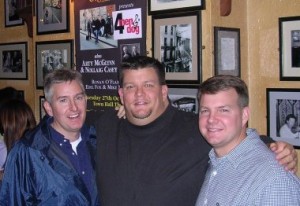
Kevin Kane, center, and his brothers, John, left, and Christian, during a recent trip to Galway, Ireland.

Kevin Kane, center, and his brothers, John, left, and Christian, during a recent trip to Galway, Ireland.

Every Ancient Order of Hibernians division across the US spends a good part of its time and effort raising money for local charities. In Havertown, the Dennis Kelly Div. 1 AOH is no different. But its focus has been on helping veterans, either on the battlefield or, as they’re doing this year, on the home front. We spoke to Div. 1 Vice President Kevin Kane about Saturday’s benefit at St. Denis Gym in Havertown—featuring live Irish music by The Shantys, comedy, TVs all around for watching the Phillies, and gourmet food and drink—that will raise money for The Hero’s Homecoming Fund, the division’s own charity.

What is the Hero’s Homecoming Fund?

The “Hero’s Homecoming Fund” is a name we gave to the monies that we will be raising at our October benefit.  The idea is to cut as many checks as possible directly to injured troops and their families for them to use as they see fit to improve their holiday season this year. We did not want to shower a family with $300 worth of Christmas gifts if what they really needed was help with their PECO bill, so it would seem actual checks cut directly to the troops would be the most effective way to help. Last year our fundraiser was “Treasures for our Troops” where we raised money, bought the care items for troops currently stationed in Iraq and Afghanistan, and sent over about 100 individual packages to them.  This year, we are going on the home front with returned soldiers.

What got you personally involved in this particular charity?

It’s a cause near and dear to my heart. On October 14, 2006,  Staff
Sergeant Joseph Kane, my cousin and friend, was killed by an IED (improvised explosive device) outside Baghdad.  He was a Monsignor Bonner graduate and from Darby. Because of my AOH Division’s work in the cause and also my obvious family attachments to the cause, I was put in touch with one of the heads of Operation First Response, Nick Constantino.  While it is a national organization that helps wounded troops, Nick is a local guy in Broomall who knows my aunt and uncle well (the parents of my cousin who was killed in action. After the final tally from our event we will sit down and figure out how many checks we can write, then Nick will give our division access to as many cases as we wish to review for donations.  We hope to be able to help local guys but will not hesitate to go outside of the area as well.

Your division has other personal links to the troops, isn’t that right?

Yes, one of our division members, Jim McCans, spent time
in Iraq last year with his cadaver dog “Stashe.” When Jim was working with the military there, they came across a land mine and two of the soldiers assigned to help and guard Jim were severely wounded, Sgt. Rob Laux and Sgt. Chris Payne.  Both soldiers are still recovering from their injuries at Walter Reed Hospital.  Our division is putting both of the up for the night at a
local hotel, and they will be the guests of honor at our event.

[Editor’s note: This week, Havertown paramedic Jim McCans and Stache will receive an ASPCA Presidential Service Award for their work in Iraq, searching for the remains of US troops. The incident Kane refers to resulted in Stache breaking his eardrum, leading to temporary hearing loss from which the four-year-old Police Academy-trained black lab has since recovered.]

Like the other AOHs in the region, your division is active in the Hibernian Hunger Project, which was launched in this area and is now a national AOH charity. You’ve linked your work with veterans to that too, haven’t you?
 
Our commitment to veterans is also evident by our selection of recipients for our recent Hibernian Hunger Drive, where local schools and parishes donated food stuffs that we delivered to The Philadelphia Comfort House, at 41st and Baltimore Avenue, a temporary residence operated for the benefit of financially needy veterans and family members who require temporary housing while being treated at the VA Hospital. Our division also supported the recent charity benefits for Corporal Matthew Sonderman, another local severely wounded vet.

Your division recently co-sponsored a charity basketball game at Msgr. Bonner High School involving a ball team from a Belfast School. Tell us about that.

Our division sponsors a group of Irish basketball players from St. Malachy’s in Belfast to come over and tour the area, and play some basketball against some local high school basketball teams.  In turn, we send a dozen or so local high school players once a year over to Belfast to do the same. We used part of the monies we raised at our “Bonner to Belfast and Back” basketball game this past Monday night to donate, along with the Bonner Fathers Association, a $500 check to the foundation set up for Officer Patrick McDonald, a Philadelphia cop of Irish descent shot and killed in the line of duty last month.

If you can’t make it to the benefit, you can still donate to help a returning injured vet. Send checks payable to “AOH Inc.” and mail them to division financial secretary Chuck Harrington at 715 Ardmore Ave, Ardmore, PA 19003.

Food & Drink

Say Goodbye to Emmett’s Place

Since 1971, Emmett’s Place in Oxford Circle has been the place to go for great Irish music and dancing every weekend. But now, after 37 years, owner Emmett Ruane is retiring. And in true Irish fashion, his friends are holding a “wake” for the place where they drank beer and danced sets even as the neighborhood became less and less Irish.

On Saturday, October 25, some of the musicians who played at Emmett’s—for some of them, one of their first gigs after arriving in the city from Ireland—will be providing the music one last time. (Update, October 27, 2008: Here’s a video sampler of the farewell party.)

Starting at 7 PM, you might catch Tommy Moffitt, the Vince Gallagher Band, the Malones and Their Cousin, Gerry TImlin, the King Brothers, Erins’ Heirs, Mike Brill, Paul Moore, Tom McHugh, Pat Campbell, Oliver McElhone, The Birmingham Six, The Brigade, Cletus McBride, The Celtic Connection, Tom Kelly, the Tara Gael Dancers, and more. (If you’re interested in being a part of the musical troupe, contact Fintan Malone at (215) 379-0424.)

Moore, lead singer of Paddy’s Well, previously of Blackthorn, says he knows the place and its owner “all too well.”

“He’s one of the finest people I know.” says Moore. “I am thrilled he can retire happily after all those years and that we can give him a nice farewell this weekend. All of the bands that I have ever played with got our first chance to play publicly there—Blarney Stones a/k/a Blarney, Blackthorn and Paddy’s Well. He was always true to keeping Irish music in the pub all through the years—’til the very end—through good years and bad.

“I love and respect the fact that he gave so many musicians a chance to succeed in the past 40 years so I am really looking forward to giving him a big farewell this weekend and saying thanks for everything.

“I have so many funny stories and happy memories from emmett’s place that it is hard to pick one. But I would say that my dad (Paul) and my grandfather (Will O’Donnell) only ever heard me perform in public in one place before they both passed away in 1990. It was Emmett’s Place and that’s something i’ll always remember.”

Dancers, too have their memories.

Marianne MacDonald, host of the radio show “Come West Along the Road,” has been going to Emmett’s since the early ’90s. She recalls her first visit. “I went to see Blarney (Fintan and Tom Brett). There was a full crowd, with several folks from New Jersey. On the way home, we realized that Levick Street was one way in the wrong direction and, not being sure what to do, we made a right and ended up doing a scenic tour of North Philly on the way home. The next time we made sure we followed someone who knew the way.

“There were many memorable times but probably one of my favorites was the night before Thanksgiving when Tommy Moffit would play and all of the folks would come in and catch up with each other. The place would be packed to the gills, you could hardly move, you were lucky if you got a seat and there would be three or four sets dancing on the tiny dance floor. It was always a great night, lots of fun and you’d see people you hadn’t seen in months.

“I think it’s sort of like the Northeast’s answer to Cheers, where everyone knows your name. You always felt very comfortable coming through that front door and you’d hear folks calling hello, waving to you and there would be Emmett at the back of the bar by the kitchen or at his table with the lamp.

“I know I will miss the place an awful lot. I hadn’t been getting there as much as I used to but I always tried to get there at least once a month. Emmett deserves a lot of credit for starting the Irish music and keeping it running all these years, through thick and thin. I feel like it’s the end of an era but Emmett certainly deserves a well-earned retirement! I hope everyone comes out next Saturday night for the send-off party.”

Hey, we’re going to be there! Hope to see you too! Emmett’s Place is at 925 Levick Street.