Monthly Archives:

April 2007

News

Mayos Get Spring Off to a Good Start

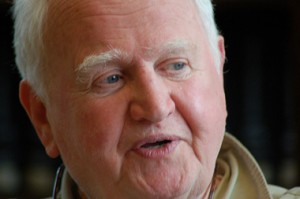
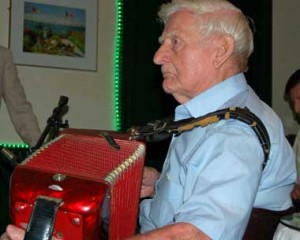
Michael Gallagher plays on.

Michael Gallagher plays on.

They told jokes. They sang “Lady of Knock” and “Danny Boy” and, for reasons having nothing to do with Mayo or Ireland, “My Way” and “On the Way to Cape May.” And they danced—oh, how they danced.

Sister James Anne Feerick, I.H.M., the association’s chaplain, was all alone out on the floor as she danced to “The Boys of Blue Hill” played on accordion by Michael Gallagher. Before too long, though, several members were up on their feet and giving Sister a run for her money.

Mostly, though, members of the Mayo Association of Philadelphia just tucked into their luncheon and caught up on the craic as they gathered on Sunday at C.J. McGee’s in Springfield, Delaware County, for their annual Spring Social.
Running the whole shindig was Maureen Brett Saxon.

Along with all the merry-making, the group took time to recognize past president Frank Cantwell with the Mayo crystal tulip bowl. Michael J. Bradley Jr. was honored with the “Cutting Edge” award for his work as chair of the Philadelphia St. Patrick’s Day Parade Committee.

The event was noteworthy, too, for its first annual Mayo Academy Awards, a strictly tongue-in-cheek version of the annual Hollywood love feast.

Here’s who won what:

Best Vocals

  • Rosaleen Megonegal
  • Tommy Moffit

Best Music

  • John Durkin
  • Michael Gallagher
  • James Feerick
  • Patricia Sweeney

Best Narration (for the association’s 100th-anniversary CD)

  • Frank Cantwell

Production (for the same)

  • Sean McMenamin
  • Joe Boyle

Director (also for the history CD)

  • Sister James Anne

Check out our party pics.

Sports

Local GAA Hosts Christine Corr Memorial Cup on May 6

The Christine Corr Memorial cup will be held on Sunday, May 6, at Neumann College in Aston, Delaware County.

The games begin at 10 a.m.

There will be at least three confirmed clubs from the Philadelphia area: Delco Gaels, Delco Harps and the Shamrocks, with Tyrone possibly being the fourth.

Two New York clubs, St Barnabas and Rockland, are coming down for the day.

Each team will be fielding four different age brackets under 8, under 10, under 12, and under 14. There will also be two girls-only games, under 10 and under 14.

The two under 14 teams are heading to Ireland this June to compete in a national competition.

There will also be an adult game with the Astoria Gaels from New York playing Donegal GFC from Philadelphia. There will also be an “Old Crocks” game for all who are interested.

There will be prizes for all age groups, and lots of good food and soft drinks.

Arts

This Weekend: Recommended

On April 11, 1986, English teacher Brian Keenan, a native of Northern Ireland, was abducted on his way to work at the American University of Beirut. The group Islamic Jihad held him in isolation and complete darkness in a cell infested with cockroaches and rats. All his clothes and personal belongings were taken from him and he was forced to wear a blindfold and a pair of shorts. One meal a day of rice, vegetables, and bread were shoved under the door. After that initial period, he was joined by British journalist John McCarthy, captured just a week after him.

Both men were eventually released–Keenan after 4 ½ years, McCarthy after 5– and wrote a book together, “Between Extremes. “ Their story so intrigued Donegal playwright Frank McGuinness that he met with Keenan. Those conversations inspired the much lauded McGuinness write the play “Someone Who’ll Watch Over Me,” the story–both funny and moving–of an American doctor, an English academic, and an Irish journalist who are held hostage in a Lebanese prison.

You can see the play, which debuted in Dublin in 1992, this weekend at Villanova University as part of Villanova’s “Springtime in Ireland” Irish Festival. It’s directed by the Rev. David Cregan, OSA, and stars Villanova theater grad Nick Falco and current graduate students Chris Braak and Andrew Smalley.

Rev. Cregan, who has studied McGuinness’s work extensively and published articles on the playwright, says “what I find so compelling about this play is its honesty. It examines a very difficult human experience without feeling the need to make over political statements. McGuinness simply presents three very real, very human characters who rely on each other to make an untenable situation livable. The result is a powerful and still-relevant play.”

Rev. Cregan is an assistant professor in the Villanova University theater department and spent four years as a professional actor in New York City, where he did three national tours, an off-Broadway production with the Light Opera of Manhattan, and various regional work. He earned his doctorate from the Samuel Beckett School of Drama at Trinity College in Ireland.

McGuinness, born in Buncrana, has been awarded the London Evening Standard’s Most Promising Playwright Award, the Irish-American Literary Prize, and a Fringe First Award. He was also nominated for a Tony for Best Play in 1993 for “Someone Who’ll Watch Over Me.”

The play runs Friday, April 27, and Saturday April 28, at 8 pm, and Sunday, April 29, at 2 pm in Vasey Hall on the Villanova University Campus. Tickets are $15 and may be ordered by calling the Villanova Theater Box Office at 610-519-7474.

Arts, People

Telling Tales Out of School

Malachy McCourt

Malachy McCourt

Actor, writer, raconteur, dishwasher, radio host, longshoreman, Green Party candidate for governor of New York—Malachy McCourt is, or has been, all of those things.

Add another title to McCourt’s resume: distinguished scholar.

Wednesday afternoon found McCourt waxing Socratic in the Henry Library at Chestnut Hill Academy. Earlier in the day, he had read Shakespeare, coached a drama practice, and spoken on the role of the Irish in U.S. history. But now, as the last bell rang, McCourt found himself at the center of a long wooden table—and the center of attention—at a gathering of the Upper School’s Multicultural Student Association.

Probably the most dominating feature of the room is an imposing Calder fireplace, with a bit of timely advice from Isaiah—“Kyndle Yr. Awne ffire—carved in stone over the hearth. Obligingly, McCourt was setting off sparks of his own.

For just under an hour, McCourt led a freewheeling discussion about everything from shock jock Don Imus’s brutish racial slur—“Does that solve the problem, somebody getting fired?”—to the proper uses (if there are any) of a particular profanity. (It sounds like poetry when he uses it.)

He seemed most delighted whenever one of the boys begged to differ with him, whether on the issue of rap music lyrics or gay marriage. He’d lean back in his chair and unleash one of his playful, gap-toothed grins, and those thick, frost-white eyebrows would twitch with unalloyed delight.

McCourt’s day at CHA came courtesy of the school’s Steele Guest Faculty program. The program was the brainchild of the late Franklin Steele, himself a man of many interests and pursuits—a lawyer by education, followed by 15 years on Wall Street and still more years after that as an investment management consultant. Steele also is remembered as an ardent collector of baseball memorabilia, and the publisher—with his wife Peggy and artist Dick Perez—of some of the finest baseball art in the world.

The purpose of the Steele Guest Faculty program is to increase awareness and understanding of the Celts’ unique contributions to the world.

“Frank very much identified with his Irish heritage,” explained Peggy Steele, who had spent the day shadowing McCourt. “His (Steele’s) grandfather was an Irish gypsy, or tinker. In fact, when Frank and I went to Ireland, he used to hang out with the tinkers.”

Peggy launched the program in 2000, shortly after her husband’s death. The program went to CHA because the Steeles had a grandson at CHA and Peggy serves on the board. “This was something he and I had talked about,” Peggy said. “He knew that there was a time when the Irish were not favorably looked upon. He said it was important that young people be exposed to current Irish culture.”

McCourt follows in the footsteps of several other distinguished guest faculty members, including Mick Moloney and Eamon Grennan. Peggy Steele contacted McCourt, who was the friend of a friend. “Malachy thought it was a great idea,” she said.

As he took a bit of a breather before the arrival of the multicultural student group, McCourt had time to reflect on the day and its meaning. He recalled with delight the students’ many questions about the roles and contributions of the Irish on both sides of the Civil War conflict. And he reveled in his brief classroom appearance that morning as the character Mercutio from “Romeo and Juliet.”

As for what an Irishman is doing teaching Shakespeare, McCourt had a ready explanation. “I love the language,” he said. ”I don’t think you could ever use too many words. You know that the Irish will never use one word when a hundred will do.”

All in all, not a bad gig for a man who describes his academic career as “very undistinguished.” Indeed, McCourt’s brief bio on IMDb.com notes that he “managed to fail every subject in school except English and recess.”

The irony of the situation wasn’t exactly lost on him. “They haven’t gotten wise to me yet,” he smiled conspiratorially. “If I stay much longer, they will.”

The CHA community looked like it was in no rush to see him leave, however. The students and faculty were clearly enjoying the contributions and insights of their faculty member for the day. As one enthusiastic Middle School student put it, “he was funny and talked about important things in a way we could understand.”

On a semi-serious note—with Malachy McCourt, it seems to be a well-worn note—he admitted that “It’s very odd to become considered an academic.” At the same time, he said, “I don’t mind sharing what I have. I have opinions about everything.”

Dance, Music

Dancing for Donncha

When Donncha O Muineachain died of a heart attack in 2005, he had, by all accounts, one of the biggest funerals ever seen in Portmarnock, Dublin. Hundreds and hundreds of people turned out to say goodbye to a man who was known more for his sideline than his profession. A career civil servant, O Muineachain helped rescue Irish ceili and set dancing from quaint obscurity.
In the 1970s and ‘80s, long before Riverdance triggered a resurgence of interest in Irish music, dancing, and culture, O Muineachain and his Coiste Rince Comhaltais dancers appeared on Irish television and did a successful US tour where they not only performed but taught local dancers the age-old steps to the Caledonian Two Hand, the Plain Break, and the Connemara–the Celtic equivalent of ballroom or barn dancing, depending on your perspective. One of those stops was the MacSwiney Club in Jenkintown, where ceili and set dancing continues regularly today.

In March many of the McSwiney and Irish Center regulars joined dancers around the world to honor O Muineachain by dancing for charity–in this case, the Samaritan Hospice in Marlton, NJ. O Muineachain regularly held charity dances for Irish organizations, including the Society of St. Vincent de Paul and St. Francis’ Hospice. They took over the dance floor at the Irish Center in Mt. Airy under the tutelage of local dance instructors Jim Ryan and Eileen Pyle.
“Donncha came here pretty regularly starting in the 80s,” says Ryan. “He was one of several teachers who came over to teach us the steps. I didn’t start dancing until the 90s and it was really a thrill to learn from a master.”

Along with having a few grin-producing whirls around the dance floor, the dancers raised $575 for the Samaritan Hospice. “We hope to make this an annual affair, donating the proceeds to various charities,” says Cass Tinney, who teaches set dancing at the Irish Center.

Arts

The Accidental Artist

Pat Gallagher’s first exposure to fine art was when he was a child. He was in a bathroom in one of the Main Line mansions his mother cleaned when he accidentally knocked a framed painting off the wall. “Thank God I caught it,” he says. “It was an original Picasso, right there in their crapper. Can you imagine that? A lot of people have told me I channel Picasso, but I don’t know about that.”

In the movies, the rest of the story would go something like this: Pat, the son of Irish immigrants who is growing up in what were servants’ quarters in the shadow of Ardmore’s mansions, scrimps and saves to buy his first set of oils and starts painting feverishly. At 18, his portfolio of canvases buys him passage to the Sorbonne and, from there, to New York where he becomes one of the art world’s glitterati.

But this isn’t the movies. And, although Pat is now an artist, until about a year ago, he was an executive recruiter in Louisville, KY, who doodled a lot.

“I was always a doodler,” he says. “My parents told me it was the only time I was quiet, when I was drawing my pictures.” Then, a year ago, while drinking and doodling in a bar on Times Square, he was approached by a man who offered to buy him a drink. “To be honest with you, I thought he was hitting on me so I said, ‘Sure! But let me tell you about my wife and kids first,” Gallagher jokes. But the man, Thomas Kennon, was an art collector and what he was interested in was Gallagher’s drawing. “He told me my style was like Henri Matisse, and I said ‘Who’s that?’ I had one art class in high school and I got a D. But he convinced me that I had a talent worth exploring.”

It hadn’t been the first time he’d been told he had artistic ability. His wife, Trisha, to prove to him that his artwork was good, handed him his first sketch book in 1995 and forced him to promise to stop throwing away everything he drew. Then a gallery owner in Louisville offered to help him put on a show. When he returned to Louisville from New York, he finally took her up on it.

Today, one of his most popular works, an oil pastel drawing called “Bryn Mawr Woman” hangs in the Speed Art Museum in Louisville. Or rather, it did until this week. On Friday, April 6, you can see the haunting figure and a number of Gallagher’s other works at Milk Boy Coffee, 2 E. Lancaster Avenue, in Ardmore, [www.milkboycoffee.com] the second of two shows he’s had in the Philadelphia area in the space of a month.

It’s been an amazing ride for a man who calls himself a “reluctant artist.” Accidental is more like it. “Someone asked me the other day what my style was and I said, ‘I use my fingers.’ I really don’t know what I’m doing,” he confesses. “It was the gallery owner who suggested that I try using oil pastels and I didn’t even know what they were. I got some and my seven-year-old son, Cole, taught me how to use them. The truth is I feel like Forrest Gump. Because all these wonderful things are happening to me and I’m just enjoying it.”

Growing up on the Main Line (“right near the railroad tracks, so technically, it was on the other side of the tracks”) Gallagher couldn’t have imagined that one day he would one day be rubbing shoulders with presidents, governors, lions of industry, and Penthouse girls, as he has this year. “I recently met Governor Rendell and gave him a painting of his wife Midge,” says Gallagher. “And I also met Barack Obama at a fundraiser in Louisville. I did a portrait of his wife, Michelle, which he wasn’t able to accept because of campaign funding laws. But the Obama event really was a big deal. I got a lot of positive feedback there.”

His humble beginnings never presaged anything like this. From the age of 10, Gallagher worked with his father and uncles, all of whom were gardeners. (One uncle is Vince Gallagher, a well-known local Irish musician and radio personality who is president of the Irish Center.) “Pretty much every male figure in my life was a gardener on the Main Line. I used to stand in the back of the truck, going from lawn to lawn, something I would never do with my kids today,” he laughs. “They would throw me in a bed of weeds and I’d be pulling and raking. I grew to hate it, but now I love gardening.” Every other summer, he spent in Ireland, in Creeslough and Ardara in County Donegal, where his parents grew up. “I’m really proud of everything they accomplished here,” he says. “They worked really hard to put me and my brother, John, through school.”

The ebullient Gallagher has put his recruiting business on hold while he explores the reach of his artistic endeavors. He’s been encouraged by his reception by gallery owners and collectors who haven’t blinked at his four-figure prices. But it’s the response of ordinary people that have left a lasting impression. At a show in early March at Liberties Restaurant and Bar [www.libertiesrestaurant.com] in the Northern Liberties section of the city, he recalls a man who was taken with one of his pastels, called “The Ghost Story.” “It’s about running into your past,” Gallagher explains. “The guy, a plumber, asked me what it meant and I asked him what he thought the story was and he nailed it. When I looked at him, he was crying. It hit me later that something I created made a grown man cry. It’s powerful.”

This new turn his life has taken, he says, “is a wave of some kind. I said to my wife, ‘Let’s ride this through this show in my hometown and see what happens.’ I’ll give it my best, honest shot. Whatever happens, I can always say I gave it my best swing at the ball. But I’ll always continue to paint. Since I started, I’ve gone off my blood pressure medicine and I’ve never been happier. It’s surreal that I’m coming home for an art show. I coming home and I keep expecting to get hit by a SEPTA bus,” he laughs. ”People say that’s the Irish in me.”

To see some of Pat Gallagher’s works, view our photo essay, pictures supplied by the artist himself. You can visit even more of his art at his Web site www.patgallagher.org.

Music

Maeve Donnelly and Tony McManus in Concert

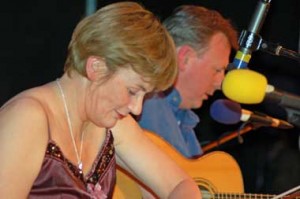
Maeve Donnelly and Tony McManus. (Photo by Jeff Meade)

Maeve Donnelly and Tony McManus. (Photo by Jeff Meade)

I’m pretty sure I smelled smoke. I think it was coming from the sizzling strings of Maeve Donnelly and Tony McManus.

The sprightly virtuoso fiddler from Quin, County Clare, accompanied by the guitar master from Paisley, Renfrewshire, Scotland, didn’t set off the sprinkler system at the Coatesville Cultural Society, but it was touch and go there for a while. They played Saturday night to a packed house (now, that’s what we like to see), bringing a big smile to the face of Frank Dalton of the Coatesville Traditional Irish Music Series, which sponsored the show.

Maeve and Tony treated the audience to close to two hours of light-speed reels and jet-powered jigs—and one or two non-traditional tunes. (One particular highlight was Tony’s solo performance of two lovely gavottes from Brittany.)

Maeve’s solo set was no less dazzling. She performed her set of tunes—including a Junior Crehan hornpipe, “Her Golden Hair Flowed down Her Back” —on a fiddle with a non-traditional tuning. (“Out of tuning,” she called it.)

There were times when I heard Maeve do things that I didn’t think you could do on a fiddle. I swear I saw her levitate.

Or maybe it was just me.

Judge for yourself. Check out our videos and Gwyneth MacArthur’s photos.