Monthly Archives:

June 2010

News

Up On The Roof

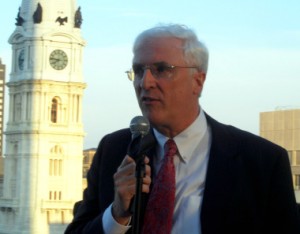
Ambassador Michael Collins joined in the celebration.

Ambassador Michael Collins joined in the celebration. So did Billy Penn. (Click on the photo to view a slideshow.)

In the late afternoon Thursday, severe storms swept through the Delaware Valley, threatening to put a damper on the planned launch party for Irish Network-Philly. IN-Philly is a brand-new organization designed to foster greater cultural, social and economic partnerships among its members and beyond.

The party was supposed to be held high atop The Phoenix at 16th and The Benjamin Franklin Parkway. But lightning and heavy rain kept the outcome in doubt until almost the very last minute.

The skies cleared around 5 p.m., and by 6, a large group of happy new IN-Philly members—business people, lawyers, judges, painters, theatre people, journalists, musicians, dancers and more—took the elevators to the roof for a night of connections (much business card exchanging), welcome cool drinks, superb Tir na nOg nibblies and fun. At the very top of the guest list: Irish Ambassador Michael Collins. (He almost didn’t make it: The storm held up his train from Washington.)

The idea was hatched around St. Patrick’s Day.

“Three months later, here we all are up on top of The Phoenix,” said Laurence Banville, a Center City attorney from County Wexford and president of the IN-Philly board. “We are rolling.”

IN-Philly is not intended to be a hard-core business network, but rather “a stoft type of network that leads to better things,” said Banville. He added that the network plans to reach out to the many existing Irish organizations to help bolster their efforts.

We have photos from the night. Click on the photo at upper right to view the slideshow.

Columns, How to Be Irish in Philly

How to Be Irish in Philly This Week

The Roses

The Roses

Yet another festival this weekend, this one Scottish (but hey, a Celt’s a Celt). The Celtic Fling and Highland Games goes on in Manheim, in Lancaster County, on Saturday with music, dancing, craftsmen and big, beefy athletes who toss things that look like telephone poles into the air to see who can heft them the farthest. Trust us, this is way fun.

Closer to home, you can watch a group of smart, talented, lovely young women compete for the coveted Mid-Atlantic Rose of Tralee crown. There are four Philly entries (good luck, girls!) plus young women from up and down the eastern seaboard vying for the chance to compete for the international title in Ireland. It all takes place at the Irish Center on Saturday night. The bargain price of $35 per tickets gets you dinner, dancing, and a chance to play along (come on, we know you pick the winners when you’re watching Miss Universe at home!).

AOH Black Jack Kehoe Division is holding its annual Night of Irish Music at the Briarcliffe American Legion Hall in Glenolden on Saturday night. The Shantys and other local groups are on the bill, and there’s food and drink as well.

Then, can you take another festival? Sure you can! On Sunday, Bristol Borough holds its annual Celtic Day on the waterfront, featuring the Irish American String Band, bagpiper Ian Ferrick, McHugh and Company, Paddy’s Well and the Fitzpatrick School of Irish Dance. BYO lawn chair, but there’ll be food and goodies to buy and entertainment for the kids.

Other than the sessions just about every night of the week, it’s a bit slow, probably because of the July 4 weekend coming up. We’ll peek a little ahead because there’s some fine stuff coming up, including a free concert with Barleyjuice in Galloway, NJ, on July 3.

Later in July, the incredible Don Stiffe, a singer-songwriter from County Galway, is coming to the Irish Center. You won’t believe this voice! You’ll probably be hearing it on Marianne MacDonald’s “Come West Along the Road” radio show on Sundays at noon on WTMR 800AM since she’s bringing this enormously talented musician to the area. Writing about Stiffe’s first release, “Start of a Dream,” Sean Laffey of Irish Music magazine said “the album is in the premier league… style, taste, pace and final execution are flawless and his choice of songs is inspired … a class act, with a class album.”

Later in the summer, the fiddle-playing Kane sisters, Liz and Yvonne, from Connemara, will be on stage at the Irish Center for a Philadelphia Ceili Group concert.

Dance, Music, People

A Flood of Generosity for Flood Victims

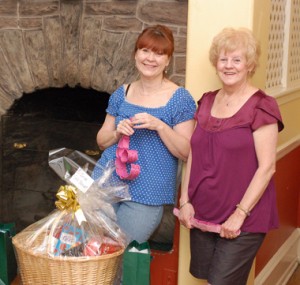
Rath deHouth and Ann McGee sold tickets for some beautiful baskets.

Rath deHouth and Ann McGee sold tickets for some beautiful baskets.

An evening of music and dancing at the Irish Center last week raised more than $2,000 for the people of Kingston Springs, Tennessee, who lost their local elementary school in the floods that wreaked havoc on Nashville and the entire Cumberland River area in May.

It was a gesture of thanks from a group of 52 Irish Philadelphians who found themselves in Kingston Springs after last May’s flooding turned back their tour bus which was taking them to Memphis for a visit to Graceland.

When the group holed up at a BP station, the tour band—local musicians Fintan Malone, Luke Jardel, and Pat Kildea—set up their instruments and started to play. Many of the Philly tourists were dancers, so an impromptu ceili went into full swing—and it was recorded for YouTube by a Texas tourist who was also stranded.

A nearby merchant sent sandwiches and cases of water to the dancers and some of the local residents joined in the fun, dancing and singing as the rain fell.

To repay the kindness, tour coordinator Marianne MacDonald and musician Luke Jardel planned a benefit (“The Gas Pump Ceili Benefit”) at last Thursday’s Rambling House event at the Irish Center.

The people of Kingston Springs responded when photos from the benefit were posted to the city’s Facebook page. Here are a few examples:

“Fabulous!! We heard so much about your visit, yet no one could really tell us who you were or where you came from! Thanks so much for your positive approach during the flood and leaving a positive memory behind. Thanks for entertaining the stranded.”—Laurie Cooper, City Manager

“Thank you… I wish the flood didn’t happen but it was wonderful for us all to come together. Seems like things stopped ( everyday worries) and people came together like they should. What beautiful hearts you have!”—Jennifer Baer Reese

“Thank you all so much for your generosity, kindness and those much needed smiles your created May 2!”—Marie Spafford

We have photos from the benefit. Click on the photo at upper right to view a photo essay.

People

Today Tralee, Tomorrow the World

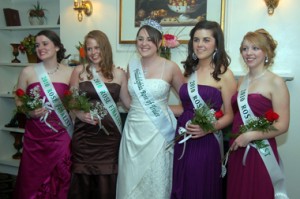
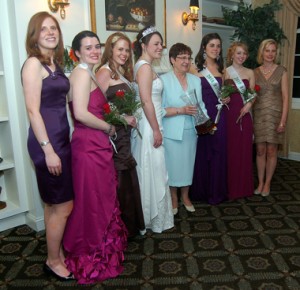
Karen Conaghan Race is at far left and her sister, Sarah Conaghan at far right, with Roses in between.

Karen Conaghan Race is at far left and her sister, Sarah Conaghan at far right, with Roses in between.

As you watch Saturday night’s Mid-Atlantic Rose of Tralee Final at the Philadelphia Irish Center—you are going, aren’t you?—know this: you’re catching a glimpse of the future of this long-running County Kerry Festival.

Since 1959, the festival has been selecting a young woman on a yearly basis to serve as its Rose of Tralee, with the candidates coming from around the world.

Anthony O’Gara, managing director of the festival, says the United States is about to gain many, many new Rose of Tralee Centres–groups of people responsible for running their own local and regional festivals.

“Our ambition is to build 250 centres in America in nine regions,” says O’Gara. “Sarah Conaghan and her sister Karen Conaghan Race have spearheaded the movement here in the United States. This [instead of running just one local festival], they’ll be running a regional festival pulling in six centres.”

This expansion is all part of the international festival’s mission to bring a bit of the Irish culture to the rest of the world. In 2004, the international festival had just 28 centres; today there are 80, only half of them in Ireland.

O’Gara acknowledges that there are many Rose of Tralee Centers in the States already–but they’re scattered. “There are pockets of Irish in cities and regions all over the united States,” he notes. “If you just have one centre for every state, you’re only reaching a tiny portion of the Irish and irish-Americans living in that state,” he says.

If the international committee has anything to say about it, the vast increase in local centres ought to capture a far bigger audience.

If you want to see how that ambitious plan is progressing, check out the Mid-Atlantic final at the Irish Center Saturday night.

[googleMap name=”Philadelphia Irish Center” width=”600″ height=”600″ directions_from=”true”]6815 Emlen Street, Philadelphia, PA 19118[/googleMap]

News, People

Philly’s “Good Guy” Set to Become Harrisburg’s 10th Bishop

Bishop Joseph McFadden

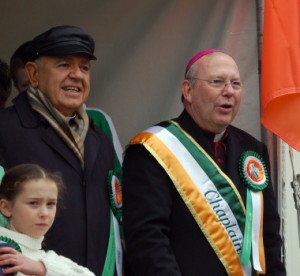
Bishop Joseph McFadden, chaplain emeritus of the Philadelphia St. Patrick's Day Parade, joined St. Thomas More alums in singing the school song.

An “average Joe” is about to helm the Harrisburg Diocese.

Of course, Philadelphia Auxiliary Bishop Joseph P. McFadden is really far from ordinary. In naming him this week to become the 10th bishop of Harrisburg, Pope Benedict XVI surely must have recognized Bishop McFadden’s solid record of accomplishment.

McFadden has been a priest for 29 years, but he was someone special right from the word go. After a brief stint as assistant pastor of Irish St. Laurence Parish in Highland Park, Delaware County, he become administrative secretary to then Cardinal Krol in 1982. Less than 10 years later, he was appointed honorary prelate to Pope John Paul II—as a monsignor.

He later served as president of Cardinal O’Hara High School, pastor of St. Joseph Parish in Downington and, in June 2004, auxiliary bishop under Cardinal Justin Rigali.

Not bad for a guy who grew up in St. Rose of Lima parish in West Philly, graduate of St. Thomas More, and high school basketball coach.

McFadden, contacted Friday just before he left to catch a flight to Rome, was characteristically humble when asked about his sure and steady rise. “For most priests the goal is to answer the call of God and to be of service to Jesus and the preaching of his gospel as a parish priest,” he said. “I don’t think a young man focuses on becoming a bishop. I didn’t. As bishop, a priest is still called to preach the gospel, but it means that you have responsibility of a larger flock, a larger group of people. when God gives you responsibility, you expect to have to answer to that responsiblilty. It’s one thing for an individual to open himself to the grace of God. It’s quite another thing to be responsible for shepherding other people in response to the same call.”

Throughout his rise to the top, Joseph McFadden apparently has not forgotten his humble roots, said Michael Bradley, director of the Philadelphia St. Patrick’s Day Parade, who has known him for a long time—including McFadden’s more recent service as parade chaplain and chaplain emeritus.

“He (McFadden) was president of Cardinal O’Hara when I was athletic director at Broomall,” said Bradley. “We knew of each each other for a long time. He went to Tommy Moore, and my dad went there. But we became close in the ’90s.”

Over the years, Bradley could see how much McFadden loved the Philly parade. The future bishop would march every year with the group from O’Hara. In 2007, when chaplain Father Kevin Trautner died, Bradley named him chaplain. That first year, McFadden spent some time providing commentary in the CBS3 booth. “They raved about him,” said Bradley.

What has appealed most to Bradley about this well-connected prelate, who in his time has tackled some nettlesome issues—including the closing of Cardinal Dougherty and Northeast Catholic high schools—is how down-to-earth he is. “I’ve always felt that he is a regular guy who became a bishop,” said Bradley. “He has an ability, when you’re talking to him, to make you feel like he’s your best friend.”

Bradley, for one, is not happy to see this best friend go. While acknowledging that McFadden’s promotion to preside over the Harrisburg Diocese is a great honor, Bradley wishes the Vatican had looked inside the Harrisburg Diocese to “hire from within. He asked, “Why can’t they get their own good guy?”

Philly’s “good guy” understands that his local friends might miss him. At the same time, he hopes he’ll be able to maintain at least some of his ties to the Philadelphia St. Patrick’s Day Parade while forging new ties with the Irish-Americans of Harrisburg. “I would like to hope I can,” he said. “I love the Philly parade.

My parents, as you know, were born in Ireland. I’m proud of my Irish heritage. the parade has been such a great experience the last several years. It really has become a wonderful event in Philadelphia.”

Arts

Celebrating “Ulysses”

“Mr. Leopold Bloom ate with relish the inner organs of beasts and fowls. He liked thick giblet soup, nutty gizzards, a stuffed roast heart, liver slices fried with crustcrumbs, fried hencod’s roes. Most of all he liked grilled mutton kidneys which gave to his palate a fine tang of faintly scented urine.”

~ James Joyce, “Ulysses”

His name is Hamlet, but his passion is “Ulysses.”

Bloomsday

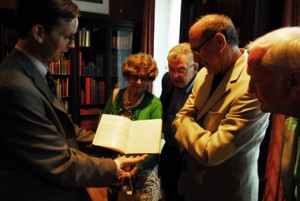
Lucky luncheon goers get up close and personal with Joyce's handwritten manuscript of "Ulysses," which is owned by the Rosenbach Museum. Director Derek Dreher holds the manuscript in the library, which remains dark to protect the books.

For the past seven years, Jim Hamlet, CPA, has served on the committee—two years as its chairman—that brings the marathon June 16 Bloomsday reading of James Joyce’s “Ulysses” to the Rosenbach Museum in Philadelphia.

“Ulysses,” considered one of the best English-language novels of the 20th century, chronicles one ordinary day—June 16—in the life of Joyce’s main protagonist, Leopold Bloom, a modern-day Odysseus who wanders the streets of Dublin, encountering character after character. Its 18 chapters each bear the title of one episode in the life and adventures of Homer’s epic hero, Ulysses, on which Joyce based his work.

While the National Library of Ireland is one of the major repositories in the world for all things Joyce, there’s a coveted, autographed, handwritten copy of the manuscript that calls the Rosenbach Museum home, making it particularly suited to hosting the yearly readings.

Hamlet, his late father, and his son, Michael, have been volunteer readers in past years. This year, he knew he was going to miss it because of an out-of-town work commitment.

So instead, the day before Bloomsday, he was tucking into steak and kidney pie—a tribute to the breakfast enjoyed by Bloom—and other Joycean-inspired dishes prepared by the chef at The Bards for a luncheon at the Rosenbach, sponsored by the John Henry Newman Foundation and Joyce’s alma mater, University College Dublin. Each year, the Rosenbach focuses on a theme related to the novel; this year’s was food, a logical choice for a book that’s a feast of words, many of them about food. Guest speaker for the luncheon was Professor Declan Kiberd, chair of Anglo Irish Literature and Drama at University College Dublin, who explores Joyce’s food themes in his book, “The Art of the Everyday in Joyce’s Masterpiece.”

Hamlet, who does audit work for the Rosenbach and several other museum clients, is keenly aware most people consider a CPA rubbing elbows with Joyce scholars as surprising as finding capers instead of raisins in your oatmeal.

“Most people ask me why I’m so dedicated to Ulysses because I’m a CPA and mostly English majors read the book, but I love Irish literature,” says Hamlet. He had read Joyce, but, he confessed, until he became involved with Bloomsday had never tackled the door-stop-sized “Ulysses” which is famously considered difficult to read, in part because of its stream-of-conscious form and the hundreds of puzzles and allusions that Joyce deliberately inserted “keep the professors busy for centuries arguing over what I meant,” guaranteeing his “immortality.”

But when Hamlet volunteered at the Rosenbach, he jokes, he felt he “had to” read the book, as daunting as it seemed. To make it a little less of the chore he thought it was going to be, he took a class with then University of Pennsylvania Joyce scholar, Vicki Mahaffey, PhD, author of “Reauthorizing Joyce” and “States of Desire: Wilde, Yeats, and Joyce and the Irish Experiment.”

“It took us eight months to read it, chapter after chapter, and Vicki helped us get the references and when we got to parts where we had no idea what was happening, she’d help us get over them. The best advice she gave us was ‘If you don’t understand it, keep going, keep going.’”

He was glad he did. Today he describes the novel that probably thwarts more than it impassions in the same way some people describe the latest Michael Connelly thriller. “It’s really a great yarn,” Hamlet says. “It has so many moving parts. Each chapter reflects the story of Odysseus, but what sets it apart is how he tied that story back to ordinary Irish life.”

And seven years of planning the Rosenbach’s Bloomsday festivities has altered how Hamlet looks at the book’s complexity. “In the past we’ve shown movies, had plays, and one year we had a dance troupe do an interpretive dance of the novel. If you think the book’s confusing,” he said with a laugh, “try looking at a modern dance interpretation.”

News

Local Reaction to “Bloody Sunday” Report

This week, the British government released a report on the 1972 Bloody Sunday shootings, placing the blame for the 14 deaths that day squarely on British soldiers.
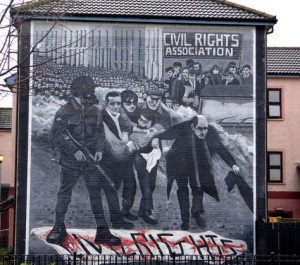
Bloody Sunday

A wall mural in Derry created by Bogside artists commemorating Bloody Sunday.

In an unequivocal apology, British Prime Minister David Cameron called the shootings “unjustified and unjustifiable,” noting that the demonstrators marching through Londonderry that day were unarmed and that the soldiers, who fired more than 100 rounds and killed some wounded marchers at point blank rage, acted in violation of their orders.

This one day of violence led to an escalation of “the troubles” in Northern Ireland which raged on for decades, leaving more than 3,000 dead.

In Derry, the release of the Saville report—which cost $280 million and involved more than a dozen years of testimony from thousands of witnesses—was greeted by cheers. Family members of the slain demonstrators, many of them teenaged boys, expressed relief that, as one said, “the truth has been brought home at last.”

In the Delaware Valley, many Irish-Americans, particularly those with a link to Northern Ireland, were also relieved—but with reservations. We asked some of them to share their feelings on this landmark event.

Seamus Boyle, Philadelphia, national president, Ancient Order of Hibernians

A native of County Armagh who emigrated to the U.S. in 1954 as a young boy, Boyle returns every year to march in the Bloody Sunday commemoration parade and has come to know some of the families of the slain protesters.

“[The Report] is great news but it’s about 38 years too late. It’s something that at least gives the families closure and now they can rest in peace. It’s good that it did come out, and great that we got an apology from the British government—the first ever—but at the same time they give you an apology they said that [former Provisional IRA leader and current Deputy First Minister of Northern Ireland] Martin McGuinness was there with a submachine gun. [The Saville Report, which raises the possibility that McGuinness was armed, said there was insufficient evidence to make any finding on the claim, other than McGuinness did nothing to justify the actions of the British soldiers that day.]

“While it will help give closure to the families, so much has happened over there in past 30 years during the Troubles, it’s hard just to give up and say this is fine. It’s hard to forgive and forget. A guy I know, TJ Carraher, his son was killed at a roadblock. For no reason at all, the soldiers opened fire and killed one son and wounded another. It’s hard for that man to forgive and forget. There was an awful lot of damage and hurt done by British soldiers that wouldn’t have been done if there hadn’t been British soldiers on Irish soil. I know that people say they were there to protect us, but they weren’t there to protect the people; they were there because the British government thought it was their country.

“I was over there in the late ’60s early ’70s. I got married over there in 1970 and built a house. It [the Irish civil rights movement] was just starting when I left to come back here in 1971. Every year, twice a year, my wife and I would go back and we’d be subject to harassment because, I believe, I was very active here and come from a big Republican family. One of the things that sticks out in my mind, is that every time I went home I would say to my mother-in-law, ‘When was the last time there were soldiers on the road,’ and she would say, ‘The last time you were here.’

“When you’d go out to Mass on Sunday they would stop you and hold you back so you would be late. Once, a soldier stopped me and asked for my license. I showed him my license and he didn’t look at it. He looked at me and said, ‘Well, Mr. Boyle, where were you headed for?’ Afterwards, my daughter, who was only five at the time, said, ‘Daddy, did you know him?’ I said, ‘No.’ And she said, ‘Well, he knew you. He didn’t look at your license and he knew your name.

“But the Saville Report is what we’ve been waiting for. The families have been waiting so long and the government kept putting it off, putting up, just hoping it would go away. But the families didn’t want it to go away. They wanted the world to know what happened. Now we do.”

Pearse Kerr, Jenkintown, Freedom for All Ireland officer, Pennsylvania Ancient Order of Hibernians

Pearse Kerr, who was born in the U.S. to Irish parents, was raised in Belfast. One morning around dawn when Kerr, then 17, was sleeping, British soldiers came to his home and dragged him away without explanation. He spent the next week in Castlerea Prison, unable to see family or an attorney, while he was interrogated and tortured.

“The only thing good about [the report] is that it brings some closure for the families. But there’s nothing new about it to the Irish people. They knew it was a murderous action. On both sides of the divide they knew. They were talking about the youths of Derry as though they were a bunch of hooligans when they were a group of young people who had enough of political turmoil. There was such a depth of bigotry and discrimantion, at that point they didn’t have an option except to protest.

“The fact that it took the British government so long to admit it shows what we’re dealing with. Think of how hard it’s going to be to make them hold up to the Good Friday agreement [the peace accord that calls for an eventual united Ireland]. It’s great that they admitted their problems, but at the same time they have nothing to be proud of. It went on for so long and those families suffered.

“When I was 17 I was taken out of my home, yanked out of my bed and they didn’t even let me put on my clothes. My mother was passing my clothes to me as they were taking me down the stairs. I got into a Jeep with just my boxers on. But that wasn’t anything out of the ordinary. There were probably six or seven taken from my neighborhood that morning. I was taken under Section 13 of the anti-terrorism act that allowed them to keep me for seven days for questioning without any legal representation or family visits. That was all part and parcel of the Separate Powers act, laws that they didn’t use anywhere else but in Ireland that allowed for internment without trial. In some cases they would release people and once they were outside the gate they would re-arrest them and hold them for another seven days. This was at the height of their torture program in 1977.

“I suffered a broken wrist, a dislocated neck, fractured ribs, multiple bruises. But in some cases they killed people. They’d be found hanging in their cells and they would claim it was suicide. In on case they threw a guy out of the window three stories up and said he tried to escape. He was beaten so bad his own mother couldn’t recognize him. My perspective of it is that it’s a day late and a dollar short.

“I’m glad it’s finally out in the open. But I don’t have any kudos for them—those families suffered way too long. It makes you wonder how long is going to take to heal the whole situation. After all, that’s just one incident.”

Liz Kerr, Jenkintown, Freedom for All Ireland officer, LAOH Brigid McCrory Division 25

“If you read the report, it’s almost hard to believe—how bad it was, how deep the cover-up was, the lengths that they went to lie for 38 years, while those families suffered for 38 years.

“The worst part was when the Queen gave Derek Wilford [commander of the 1st Battalion of the Parachute Regiment in Derry that day, whom the report says disobeyed direct orders not to send troops into Bogside that day] a knighthood within a year, and the parachute regiment were given medals. If there’s really going to be closure, they’re going to strip them of their honors. Those honors were given to them based on a lie. And the moment they got those awards was truly insult to injury to those families. It’s one more thing that will have to happen for them to be completely honest. The victims were mostly high school age boys, 17 years old, and probably looked younger. They were executing teenaged boys.”

“I was glad to see David Cameron’s coming out with the report, especially since he hasn’t been in office long. It’s a good sign. I’m hoping it’s a good sign. He was pretty harsh in his comments—that it was unjustified and unjustifiable—and I’m glad it took it to that level.

“Bloody Sunday really moved the civil rights movement into a war, and I’m hoping the release of this report can be another watershed moment, and that based on this we can move toward a united Ireland.”

Patricia Noone Bonner, Longtime Member of Irish Northern Aid and Clan na Gael

“I don’t care how long a time it’s been. They had to get it done.

“People were killed for no reason. They (the protesters) didn’t start it. They were not carrying weapons. They were just struggling for civil rights. I remember that time well. I’m sure I heard about it on television. We were all up in arms. In my opinion, I am sure that’s why the armed struggle started.

“From the point of view of the families, it (the report) may help move things forward. but still … how do you ever get over losing anybody, especially a child?

“Should there be prosecutions? I don’t know. I don’t think the soldiers should be. It’s the higher-ups who should be prosecuted. Those soldiers would not have fired if someone had not told them to.”

John Ragen, President of the Irish Club of Delaware County

“For my generation (he’s 32), we’re learning about it. It’s our history and definitely something we should all know. Why do I care? It’s’ something that was such a travesty, it should be made public. And if you don’t learn about it, history has a tendency to repeat itself.

“The report coming out shows that the British were not there for the people, they were there for the land. I’m sure it (the report) will bring people together. The Protestant ministers have already extended their hands out to the families of the people who were killed or injured. (Read the story in the Irish Times.)

“The prime minister’s apology was well-written. It may be enough for a lot of people, but the military who were involved should be held accountable. The soldiers should be brought up on perjury charges, at the very least.”

Jeff Meade also contributed to this report.

People

Hot Afternoon, Icy Lemonade, and a Good Cause

Alex's Lemonade Stand

Hey ... you get the idea, right? Click on the photo to see more.

Last Saturday afternoon, temperatures soared into the high 80s throughout the Delaware Valley, but it felt even hotter out on West Chester Pike in Upper Darby.

But the heat evidently didn’t bother many of the volunteers who turned out to help the Philadelphia Rose of Tralee Centre support pediatric cancer research with a spectacular (and very yellow) Alex’s Lemonade Stand at the Irish Immigration and Pastoral Center at West Chester Pike and Cedar Lane. Even Sarah Conaghan, managing director of the Mid-Atlantic Rose of Tralee Centre, was a study in bright lemony yellow, right down to her necklace—which looked like a string of miniature lemons.

The volunteers included many of the Delaware Valley’s best and brightest young Irish-American women—including 2009 Rose Jocelyn McGillian, the Donegal Association’s 2010 Mary from Dungloe Kiera McDonagh, 2009 Mary from Dungloe Emily Weideman, 2008 Miss Mayo and 2010 Mid-Atlantic Rose finalist Colleen Mullarkey , and Jessica Greene, also a Mid-Atlantic Rose finalist.

(And if I’ve left anyone out, one or more of these women will let us know.)

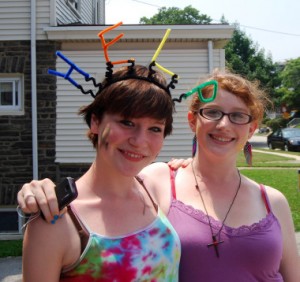
Also among the volunteers: a wildly enthusiastic collection of Rosebuds, the younger girls who serve as a kind of honor guard. While the rest of us, wilting, sought refuge in the immigration center’s air conditioning, they hung around outside and drew posters, poured cups of lemonade, blew bubbles, made multicolor pipe-cleaner crowns (my favorite: the one that spelled out “H E L P.”), applied little lemon tattoos to their faces, and ran up and down the block below the immigration center yelling at the very top of their lungs for passing drivers to pull over right that very moment (“I KNOW YOU SEEEEEEEEEEE MEEEEEEE!!!!!!”) and buy a big cup of lemonade for cancer research.

Not so surprisingly, this high-pressure salesmanship often worked. They are Rosebuds—hear them roar.

Between the lemonade stand and online donations, the Rose of Tralee raked in close to $700—not a bad little haul.

Click on the photo above to see the whole photo essay.