Monthly Archives:

May 2014

News

Hall of Fame Seeking Nominations

DVIHF-logo
Do you know someone who has contributed to the preservation of Irish culture and tradition in the Delaware Valley?

Nominations for the 14th Annual Delaware Valley Irish Hall of Fame are being accepted now through June 24. The awardees will be honored at a dinner on November 9 at The Irish Center in Philadelphia.

Nominations must be in the form of a letter highlighting the nominee’s contributions and background and sent or emailed to:

Kathy McGee Burns
2291 Mulberry Lane
Lafayette Hill, Pa. 19444
215 872 1305
Mcgeeburns@aol.com

News

How to Be Irish in Philly This Week

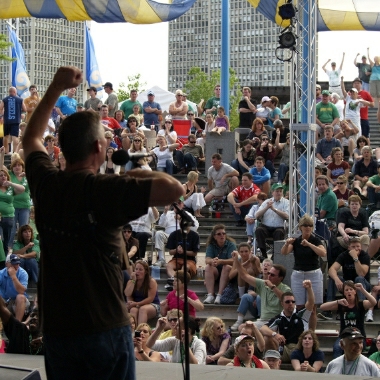
Blackthorn whoops up the crowd at Penn's Landing. Photo by Gwyneth MacArthur

Blackthorn whoops up the crowd at Penn’s Landing. Photo by Gwyneth MacArthur

The annual Penn’s Landing Irish Festival kicks off the month of June. What a nice start—with Blackthorn, the Hooligans, and Jamison on stage, kids’ activities in the kids’ tent, Irish dancers, Irish food and beer, vendors, and some nice weather. And it’s free!

A Mass will be celebrated before the festival at the Irish Memorial at Front and Chestnut Streets.

And it’s not the only Irish festival happening this coming week. AOH Notre Dame Div.1 is holding its Irish festival starting on Friday, June 6, at St. Michael’s PicnicGrove in Mont Clare. It’s not free, but it’s a bargain—only $15 for a three-day pass. Celtic Spirit, the Paul Moore Band, the McGillians, and Tom McHugh will be providing the music (for listening and dancing), and of course there will be food, drinks, and vendors. All proceeds from the three-day event go to support AOH charities, like the Hibernian Hunger Project, which helps provide food for the needy.

If your Irish is limited to “Slainte!” you may want to pick up a few more useful words, which you do at the full immersion Irish language event, Satharn na Gael, which is being held on Saturday, June 7, at the Philadelphia Irish Center. Lunch and dinner are included in the $45 fee. Go to the Daltai na Gaelige (students of the Irish language) website for more information and to register. There will be a session in the evening. http://www.daltai.com/events/732/

And no, I didn’t forget rugby. (I can hear all the grumbling from the scrum crowd out there.) The 2014 Collegiate Rugby Championships are being held at PPL Park in Chester on Saturday, May 31. Go out, cheer, but save some energy for this week’s Irish festivals.

Check our calendar for details on these events and others coming up.

Arts

The Surprising Secret of Philly’s Toughest Irish Mobster

K.O. DelMarcelle as Whistling Jack with paramour Lettie (Gina Martino).

K.O. DelMarcelle as Whistling Jack with paramour Lettie (Gina Martino).

Whistling Jack McConnell was one of the toughest gangsters in Philadelphia’s Irish mob in the 1920s. He got his nickname because of his habit of whistling when he was about to turn an enemy’s face into porridge with his tattooed right arm. He variously worked as a stable boy, an ash-cart driver, a professional boxer and was engaged to three women.

But it was a paternity suit was Jack’s undoing. The only way to win in court was to admit the truth.

Whistling Jack McConnell was a girl.

And he. . .she’s the subject of a new play by Villanova grad Andrea Kennedy Hart, “The Toughtest Boy in Philadelphia,” that will make its world premier on June 12 at the Luna Theater, 620 S. 8th Street in Philadelphia, produced by Iron Age Theatre, a Norristown-based theater company.

In the production, Michelle Pauls, who is managing artistic director of B. Someday Productions at Walking Fish Theatre in Kensington, plays a character based on another male impersonator, this one the English music hall actress and singer Vesta Tilley who dazzled audiences on the British stage in drag for more than four decades. In the Iron Age production, her character is known as Tessie Belle. (In real life, Tilley and Jack never met) But that’s not all Pauls does.

“In our production, five women play all the parts,” said Pauls, who is also onstage as Jack’s mother, a traveling entertainer who left her daughter behind for her grandfather to raise.

Whistling Jack was actually born Florence Gray in Ohio. Her gender-bending didn’t start until she moved to Philadelphia with her grandfather. (See a photo of the real Florence/Whistling Jack.)

“From the earliest age, she was the kind of girl who liked to beat up boys and do boy things, and get into a lot of trouble,” says Pauls. “Her grandfather, who was an academic, said, ‘Let’s move out of this small town in Ohio and go to Philadelphia where I can get work and start a new life.’ So that’s what they did. That’s when she became he.”

Her grandfather unwittingly provided Florence/Jack with a nickname that stuck. “He taught her to whistle to befuddle any opponents and Jack would whistle before he beat up street thugs,” says Pauls. “I read in actual newspaper clippings that he used to promote awe in all these other street thugs and mob members by his feats. He even swam the Delaware twice!”

Unlike Jack, her character, Tessie Belle, chose male impersonation as a profession rather than a lifestyle. “She dressed and acted like a man on stage, but sang like a woman and never gave up her womanhood, not like Jack McConnell. She ties all the scenes together, like a spirit guide for Jack. The play is all about artifice and performing. All of us in our daily lives take on many faces and many roles as we go about our business.”

The play also uses this century old true story to explore modern themes of women’s rights, human rights, love and acceptance.

And it’s also a bit of a musical. “I sing three songs that Vesta Tilley sang,” says Paul. “All the actresses also do the sound effects which adds to the vaudeville feel.” (You can hear the original Vesta Tilley sing on youtube.)

In the cast: K.O. DelMarcelle as Jack, with Gina Martino, Susan Giddings, and Colleen Hughes.

The play, which is directed by Iron Age founder John Doyle, will run through June 29. Tickets are $20 and available via ticketleap.


Music

The Sligo-Bound 6 Bring Out Their Sunday Best

Livia Safko, with Haley Richardson waiting in the wings.

Livia Safko, with Haley Richardson waiting in the wings.

“We’re always nervous. We just have to make sure that the worst we do is pretty good.”

It doesn’t seem like such a heavy burden for fiddler Alexander Weir, 15, of West Chester. It least it didn’t seem that way on Sunday when Alexander and five of his friends who are headed to the All-Ireland music championship this summer played at a big fund-raiser in their benefit at Molly Maguire’s in Downingtown, emceed by Terry Kane.

But playing at a fund-raiser is one thing. Standing in front of judges in Ireland, judges who are accustomed to hearing the best players in the world—most of them with the advantage of competing on their home turf—that’s another thing. But two of the Sligo-Bound 6 are world champs from last year—under-12 fiddler Haley Richardson, and Emily Safko, also in the under-12 category, on harp. These kids are used to competing, and they’re all dazzling players. You never know what might happen.

Alexander might be pretty typical of most of the kids. Competing in Ireland isn’t something he thought he’d be doing when he took up the Irish fiddle. He started playing violin at 3, and at 5 he took up Irish fiddle. He’d already been Irish dancing, and he thought it might be fun to play dance tunes. “I was just trying something out,” he says. “I thought it could be something to do in my spare time.”

It’s turned into something more than that, but Alexander’s parents are really just taking it all one day at a time. To qualify to go to Ireland, all of the kids—Emily, her sister Livia on fiddle, Alanna Griffin, a fiddler and concertina player, Haley, Alexander, and Keegan Loesel on whistle and uilleann pipes—had to place first or second in the Mid-Atlantic Fleadh Cheoil. It’s not clear who will still be playing at a competitive level years from now, so Alexander and his friends are just focusing on right now, and supporting each other—as they have for years, even though they got into Irish music at different stages, and even though there are age differences.

“Alanna is 18 and the younger ones are 10 or 11, but they’re all respectful of one another. It’s so fabulous that they have each other. They encourage each other. That’s one of the best things about Irish music,” says Alexander’s mom Katherine Ball-Weir.

And there is also this parental side benefit, she laughs: “When our friends are out on a cold, wet soccer field, we’re in a pub with a pint in front of us.”

You can find out how much fun it was, for parents and kids. Check out our photo gallery. And there’s a neat little video under that.

[flickr_set id=”72157644814598574″]

Music

Review: “Echoes of Home” by Phil Coulter

coulterhomeWe’ve just suffered through one of the worst winters in memory. I still have a 50-pound bag of rock salt standing by in the garage. I don’t believe it’s really over.

I’ve been listening to “Echoes of Home: The Most Glorious Celtic Melodies,” a relatively new release by the prolific Phil Coulter. It’s a collection of lush, tranquil and very thoughtful piano solos—with a little help from some heavy hitters like Moya Brennan, Billy Connolly, and one of our favorites, Finbar Furey. And I found myself thinking—this album would have been just the ticket on one of those cold, snowy nights. A splash of whiskey, the lights down low, a warm sweater—and Phil Coulter playing away quietly in the background.

Most people describe what Coulter does as New Age. It’s easy to dismiss the genre as just a bit of tinkly mood music. Sometimes, really, that’s all it is. Singularly unsatisfying. Anyway, it’s not my everyday, go-to genre, but—as on those blustery nights—nothing else that fills the bill quite as well.

“Echoes of Home” is understated. And it’s a recording of piano solos, so of course it’s not overly orchestrated. If you didn’t know what you were listening to, you’d think Phil Coulter wasn’t working very hard. But it takes a deft hand to take relatively complex musical themes and transform them into something light, airy, almost fragile—like spun sugar sculpture.

The album opens with “The Flower of Magherally,” and it sets the tone for everything that comes after it. (There are 15 tracks.) Coulter doesn’t get in the way of the tune. He sits back and lets the tune’s inherent sweetness stand on its own.

You might also appreciate Coulter’s take on “Minstrel Boy.” I play drums in an Irish pipe band, and if I never hear “Minstrel Boy” again, it will be too soon. I mostly liked Coulter’s version. “Minstrel Boy” is an anthem, one of the earliest patriotic songs. That approach has its place, but that’s about the only approach you ever hear. In Coulter’s case, “Minstrel Boy” becomes more of an air than an anthem. It’s a nice rendering, but ultimately manipulatively and obviously sentimental. Not so much spun sugar as saccharine.

Coulter redeems himself on several other tracks, including “David at the White Rock,” a traditional Welsh air. It’s a particularly evocative and inventive performance. There were moments where it was easy to believe you were listening to a Regency era piano sonata. (Think Jane Austen.) It’d the best, most fully realize piece on the album.

Now let’s talk about the second best—although, frankly, it could be a tie. Finbar Furey plays both low whistle and uilleann pipes (not at the same time), and in this moody little piece, Coulter takes a back seat and let’s Furey’s performance shine through.

Another collaboration didn’t work out as well. Moya Brennan’s performance on harp in “The Lass of Aughrim” seems like an afterthought. At the very end, she chimes in with a bit of gratuitous humming. She’s wasted on this track.

While we’re on the subject of tracks I didn’t much care for, let’s add “The First Time Ever I Saw Your Face.” I don’t care that it’s not Celtic. But it matters very much that it adds nothing new. It’s a plodding, straightforward—too straightforward—rendition of a tune that most of us already know too well. As performed by  Roberta Flack on her classic album “First Take,” it’s a classic. If you can’t do it better, don’t bother. (Michael Bolton, take note.)

Those are really the only false notes on what is otherwise, as the title suggests, a glorious collection.

The album ends with a spare and lovely “Farewell to Inishowen.” Coulter is accompanied by Paul Brady on low whistle. It’s a gentle, crystalline coda, more prayer than piano solo.

And if you’re not well and truly relaxed and completely at peace with the world by then, well, it might be time for another small whiskey.

How to Be Irish in Philly

How to Be Irish in Philly This Week

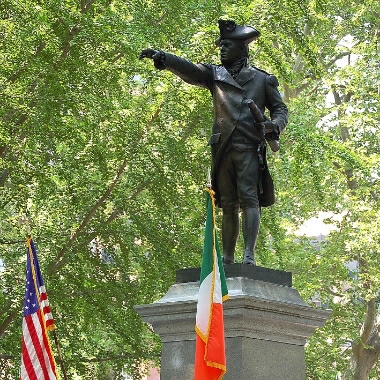
Commodore Barry's statute, located behind Independence Hall.

Commodore Barry’s statute, located behind Independence Hall.

It’s Memorial Day Weekend, the traditional joint celebration by the Commodore Barry Clubs of Philadelphia and New York of the life of Commodore John Barry, the Wexford-born, Philadelphia-based father of the American Navy. The Saturday event starts with a Mass and graveside ceremony at Olde St. Mary’s Church on Fourth Street in Philadelphia, concluding with a meal and music at the Irish Center, 6815 Emlen Street in Philadelphia’s Mt. Airy neighborhood.

Or, you could start your day earlier at the Irish Center watching pay-per-view Gaelic football at the bar, with a full Irish breakfast.

If you’re down the shore, you’ll find Blackthorn at LaCosta Lounge, 4000 Landis Avenue, in Sea Isle, starting at 5 PM–look outside, they’ll be under the tent. Catch them Sunday at Cattle ‘n Clover, 3817 Pacific Avenue in Wildwood, NJ.

On Wednesday, May 28, Tyrone-born singer-musician  Garry Gormley will be entertaining at AOH 61’s hall at Rhawn Street and Frankford Avenue in Philadelphia.

On Thursday, May 29, join Irish Network-Philadelphia for a whiskey-tasting dinner at Fado Irish Pub on Locust Street in Philadelphia. On the menu—get ready for your mouth to water—will be smoked salmon tartar with Connemara whiskey; strawberry goat cheese salad served with Tyrconnell; haddock glazed in a Kilbeggan butter on rice pilaf with Kilbeggan; Greenore whiskey marinated duck breast with garlic mash, served with Greenore; and  have  some Molly’s Irish Cream over ice for dessert. Sounds like you’ll need a designated driver or to take public transportation. Cost is $35 for members, $50 for non-members.

On Friday, May 30, Jamison Celtic Rock is helping AOH 22 save “Big Green,” its green firetruck, at the union Hall of the Philadelphia Firefighters and Paramedics Local 22 in Philadelphia. AOH 22 is named for Philadelphia Firefighter John J. Redmond, who was killed responding to a 5-alarm fire in South Philadelphia 20 years ago.

Rugby fans: an invitational tournament featuring 20 of the nation’s top college teams will be competing for the Pete Dawkins Trophy on May 31 at PPL Park in Chester. The reigning champs, University of California-Berkeley will be returning to defend their title. Six teams with strong Philly ties—Drexel, Kutztown, Penn State, St. Joe’s, Penn, and Temple—will be trying to take it away.

Then on Sunday, June 1, head down to Penns Landing for the annual–and free–Irish Festival featuring Blackthorn, the Hooligans, and Jamison on stage, Irish step dancers, food and vendors.

News

Ireland: A Great Place to Grow Your Company

Jane Kealy of Bank of Ireland describes the Irish mortgage market.

Jane Kealy of Bank of Ireland describes the Irish mortgage market.

If you’re ready to expand your business globally or looking for a smart investment, now may be the time to get in on the ground floor of the new Ireland—the elevator is going up.

That was the message from all five guest speakers at the Irish American Business Chamber and Network’s “Invest in Ireland: An Insider’s Perspective” breakfast workshop on Wednesday at the Union League in Philadelphia.

It wasn’t news to the nearly 70 people at the event that was co-sponsored by the Bank of Ireland which has its US branch in Stamford, CT. Ireland watchers know that the island, once the poster child for a wrecked economy, has been named “the best country to do business” by Forbes magazine and one of the top 10 in the World Bank Group’s list.

Through a punishing mix of taxes and austerity, the country was able to pay back its bailout loan from the International Monetary Fund and the European Union (the first in the Eurozone) and reduce its significant budget deficit, the result in part of a dramatic loss of tax revenue when its thriving housing market went belly-up.

“We’re still standing after all the knocks we’ve suffered over the past few years,” said Michael Crowley, senior economist in the economic research unit of the Bank of Ireland Global Markets.

Standing and climbing. “Our GDP [gross domestic product, the market value of the goods and services a country produces] per head is still significantly higher than it was in the 1990s,” said Crowley. “We’ve seen a fall in unemployment. . .and are expecting gains in that area. Foreign direct investment is still up significantly.”

During the “Celtic Tiger” boom, Crowley said, business costs and wages rose so that the country was no longer competitive. “We were out of line with our trading partners,” he said. “Since then we’ve had wage freezes and wage cuts and an improvement in productivity.”

And, perhaps most important, by lowering its budget deficit, Ireland borrowing costs, which had reached double digits, are down to about 2 ½ percent.

Many American companies, particularly those in the tech industry, already call Ireland their home away from home, including Microsoft, Ebay, Cisco, Amazon, Dropbox, PayPal, and Facebook, thanks to Ireland’s business-friendly tax structure. In fact, said Gerry Moan, managing general partner of Smart Invest, a burgeoning venture capital firm with offices in Philadelphia and County Meath, nine oout of 10 tech companies use Ireland as their gateway to the rest of the world. As do eight out of 10 online game firms and 50 percent of all worldwide financial companies.

Besides the attractive taxes, what lures these companies to Ireland is the fact that it’s”the only English speaking country in the Eurozone,” he said, and the first stop in Europe from the US. Ireland’s population is also young and well-educated. “We have the highest proportion of science and engineering graduates in the world,” he said, as he clicked through slide after slide featuring iconic images of Ireland, from shamrocks to the Titanic Museum in Belfast. “It’s not just the gorgeous scenery.”

Another big advantage to consider doing business on Irish soil: There are financial incentives for startups and their success rate is enviable, said Moan. “Seventy-eight percent have survived and thrived over the five year monitoring period.”

His company will help bridge a funding gap that exists for companies that want to grow their business in Europe, the only negative in an otherwise rosy picture for new companies. “When you want to expand, the next round of funding is tougher to get,” he said. “My company will be focusing on that.”

The next step—finding property to buy or rent, either as a company or an individual—poses some stumbling blocks, said Marian Finnegan, chief economist with the SherryFitzgerald Group, the largest real estate company in Ireland.

“The Irish recovery depends on what part of Ireland you’re standing in,” said Finnegan.

The Dublin residential market has rebounded, though property availability is tight which is driving up prices. Rural areas, places like Sligo, Waterford, Wexford, Leitrim, and Donegal, have not seen the same kind of recovery. There is also a dearth of large spaces—2,000 square feet and up—in Dublin and other urban areas which is also driving up prices for commercial spaces.

On the other hand, there’s been upward movement in the mortgage market, said Jane Kealy, senior manager in the mortgage business at Bank of Ireland, spurred mainly by “first-time buyers and movers,” many of whom have found that purchasing a house makes more economic sense—even on a monthly basis–than renting.

[flickr_set id=”72157644369416288″]

News, People

A New Brewery Comes to Town

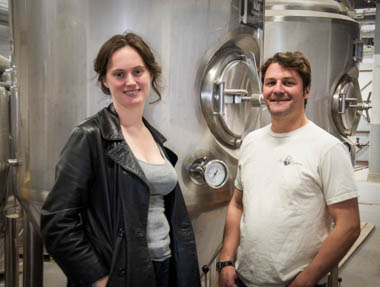
Tim Patton and Christina Burris at St. Benjamin's Brewery.

Tim Patton and Christina Burris at St. Benjamin’s Brewery.

There are an estimated 1.2 million homebrewers in the US, collectively producing more than 2 million barrels of beer a year. Most of them are content to cook up small batches in the basement to drink or share with friends.

Philadelphians Tim Patton and Christina Burris are not among them.

The two friends, dedicated homebrewers who met at a beer event several years ago, are a few weeks away from opening their own craft brewery, called St. Benjamin Brewery—after Philly’s best known beer lover–in what was, in the early 20th century, Finkenhauer Brewery on Fifth Street near Germantown and Cecil B. Moore Avenues in South Kensington.

With savings from an internet startup he founded with a college and a little crowdfunding, Patton bought the building which had been a German brewery more than once and, at various times, a sewing factory and a warehouse. Today, the heavily graffiti-ed neighborhood (not the usual tagging—it has the feel of at least a couple of years of art school), is on the same hipster path as Northern Liberties, which is just a few blocks away. Adjacent factories have been converted into luxury lofts and the sidewalk traffic is decidedly young professional.

Patton and Burris funneled some of their seed money into a complete utility retrofit. “Nothing was up to code,” says Patton, originally from Boothwyn, who left a job as a software engineer to become a brewmeister. (Burris, a native Texan, is an architectural conservator.)

A few weeks ago, there were four shiny stainless beer vats inside the building waiting to be readied for the first batch of beer, made from recipes Patton and Burris painstakingly developed over the last couple of years. “We haven’t used anyone else’s recipes since 2010,” says Burris.

In fact, they’ve been distributing their own brews for years—for free—just to test those recipes. The law restricts homebrewers to 200 gallons and year, and Patton estimates they hit that. “We’ve been giving it away at public events in the city which has gotten us a lot of good feedback,” says Patton.

They’ve settled on a few key beers, including an IPA, the Transcontinental—an amber beer that’s historically Californian–and the Liaison, a lavender saison, a French/Belgian-style beer made with lavender. And there’s no call for drinkers of Guinness or Bud Light to snort. “Everything with a Belgian influence is going to be good,” says Christina, laughing.

To keep close tabs on consumer preferences, Patton and Burris decided to buy a delivery truck and cart kegs to local bars themselves. “We’re making the kind of beer we enjoy,” says Burris, “but if we find that one particular beer takes off, we’ll know right away and we can focus on that.”

There won’t be any bottles right away, but down the line there will be growlers for sale and, ultimately, a brew pub, right where last century’s brewers stabled their cart horses.

Patton and Burris have no designs on becoming the next Anheuser Busch, with worldwide distribution. They think the key to their success will be to be in place when their chosen neighborhood takes off. “There’s a lot of new things come and we want to be part of it,” says Patton.