Monthly Archives:

May 2014

How to Be Irish in Philly

How to Be Irish in Philly This Week

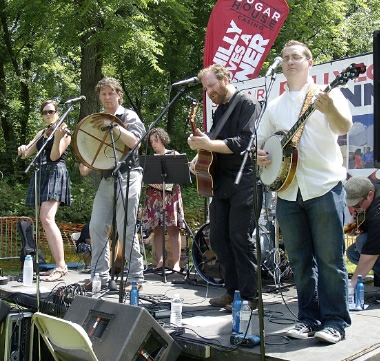
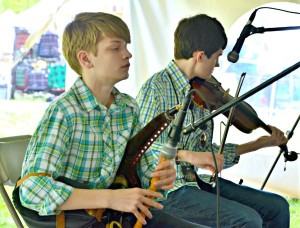
Keegan Loesel and Alexander Weir, two of the Sligo-Bound Six

Keegan Loesel and Alexander Weir, two of the Sligo-Bound Six

If you’re incredibly good at time management, you might be able to have a total immersion Irish experience on Sunday, but beware: there will be some overlap.

Here’s the Sunday rundown:

Help send the Sligo-Bound Six to Ireland for the annual Fleadh Cheoil—otherwise known as the All-Ireland Championships, or as we like to think of it, the world series of Irish music. A sextet of the area’s best best young Irish musicians are heading to Sligo August 10 through 17 to test their mettle against some of the world’s best players.

A fund-raiser for the Sligo-Bound Six takes place Sunday at Molly Maguire’s Pub in Downingtown. It’s the first of three fund-raisers. The kids will play a brunch concert from 1 to 3, followed by a traditional Irish session from 4 to 8. From 1 through 8, Molly Maguire’s will donate 15 percent of all food purchases to the kids, but you have to let your server know you’re their to support the cause.

Two of the competitors are tops in the world in their age group. Fiddler Haley Richardson was the under 12 fiddle champ last year, and harpist Emily Safko grabbed the trophy in under-12 harp.

Joining them in Ireland will be Livia Safko, concertina and fiddle; Alanna Griffin, concertina; Keegan Loesel, who plays uillean pipes and whistles; and fiddler Alexander Weir.

Next up: Summer starts on June 21 at 6:51 a.m. on the nose here in the States, but in Ireland it starts in May. You can celebrate at the Feile na Beltaine this Sunday from 2 to 6 at American Legion Noonan-Slook Post 38 at 2200 Grasslyn Avenue in Havertown. There’ll be a barbecue, Raymond Coleman will provide the tunes, and there will be fun for the kiddies—including face painting and a moon bounce. It’s all in support of a great cause, the Irish Immigration Center. By the way, it’s pronounced “bee-EL-tin-nuh.” If you’re gonna go, you oughta be able to pronounce it.

Later in the day, catch Cassie and Maggie MacDonald, two Celtic singers and multi-instrumentalists (with some step dancing mixed in) from Nova Scotia at Blue Ball Barn in Alapocas Run State Park in Delaware. The show starts at 7 p.m.

Good luck with all of that.

If you’re looking for a way to invest in Ireland, get an insider’s perspective as the Irish American Business Chamber & Network hosts an Investing in Ireland Seminar Wednesday morning, starting at 7:30, at the Union League of Philadelphia, 140 South Broad. You’ll hear presentations from leading professionals in residential and commercial property, venture capital, and the business and banking sectors. Some big firms are represented: Bank of Ireland, SmartInvest and DTS SherryFitzgerald. Load up on a great breakfast and great business insights at the same time. Details here: http://iabcn.org/event/invest-in-ireland-an-insiders-perspective/

One event to keep in mind for next weekend, because it’s never too soon to plan:

You can attend a Commodore Barry Memorial Mass next Sunday at Old St. Mary’s Church on 4th Street in Philly. The Mass begins at 11 a.m., followed by a memorial service.

And a little further out, on Friday, May 30, help AOH Division 22 raise cash to refurbish and maintain Big Green, an old pumper truck (did we mention it’s green?) that serves as the division’s PR vehicle. Jamison is providing the music, and there are more tunes from a band called Rita’s Fog. If you’re of a mind to march, the Philadelphia Police and Fire Pipes and Drums will also be on hand. The benefit starts runs from 7 to 11 p.m. at the Lounge at Local 22, 415 North 5th Street in Philly. Details here: http://aoh22philly.org/fundraiser.html
Dance, Music

Just Singing AFTER the Rain

Fiddler Maura Dwyer of the John Byrne Band ... surprise!

Fiddler Maura Dwyer of the John Byrne Band … surprise!

It was the Philadelphia Fleadh that almost didn’t happen.

Last Friday, Pennypack Park in the Northeast—the site of Philly’s huge festival of music, dance and culture, scheduled for the very next day—was a waterlogged mess. The Pennypack Creek, which winds through the park, had overflowed its banks after a week’s worth of heavy rain.

C.J. Mills is a partner, with Frank Daly, in American Paddy’s Productions, which put on the festival. It was the second. Mills summed up the situation in a nutshell:  “There was mud and water everywhere.

”At that point, Mills and Daly knew they had their work cut out for them.

“If this festival had been one day earlier,” said Daly, “I don’t know if we could have pulled it off.”

For one thing, he said, the stage surrounding the main stage—right on the banks of the Pennypack—was a sea of shoe-sucking mud. It’s hard to dance in mud.

City workers with heavy equipment—along with Mills, Daly, family and Fleadh volunteers—labored all day Friday in the muck, trying to get the park ready for the hundreds of visitors expected to flood into the festival, so to speak, on Saturday.

Through it all, Daly and Mills kept the faith.

“We put in a request about six months ago,” Mills said. “We had no doubt that it was going to be sunny and 73. Weather insurance is expensive, so we prayed a lot.”

All that praying worked. Saturday dawned sunny and clear, and you’d never have guessed that there’d ever been a problem. And the second Philadelphia Fleadh went on right on schedule. (Massive amount of photos, below.)

Walking down the winding path into the park, you could hear the music pounding out of the Ed Kelly Amphitheatre all day—The Mahones, The John Byrne Band, The Birmingham Six, Burning Bridget Cleary, The Shantys, and we could go on—14 bands in all, compared to nine last year.

And there were plenty of people strolling, and in some cases dancing, down that path. Daly and Mills weren’t sure precisely how many, but early afternoon they were certain that the second Fleadh was turning out to be a bigger draw than the first. “Attendance is definitely higher than last year at this time,” said Daly. “Last year, we had 3,000, and we think we’re going to do more this year. And we’re running on schedule—which is a shock.”

A new feature this year probably boosted attendance this year, Mills said. A Feis—an Irish dance competition hosted by the Celtic Flame School of Irish Dance—drew about 120 dancers, but also a host of family, friends and fans. Kids, mostly girls of all ages in curls and sparkly dresses, took to the stage in a sunlit meadow surrounded by tall trees. So much nicer than a musty hall somewhere.

More bands played in their very own sunlit meadow just across a wooden bridge from the Feis. No amphitheater in this case, just a stage, but that meadow was filled with folks in lawn chairs—and more than a few up on their feet, dancing away.

Traditional musicians churned out their own brand of Irish music in an overheated tent, but no one seemed to mind the temperature.

Ten vendors peddled their T-shirts, hats, jewelry, kilts, glassware, gifts and more throughout the grounds, and if you wanted great food or, say, a cold brew—no problem. There was plenty to go around.

The whole show ended with an 8 p.m. show featuring lead fiddler Mills’ and lead singer Daly’s own band, Jamison.

Getting a good cross-section of the Irish community in on the act was a priority this year, says Mills.

“You have the Philadelphia Ceili Group, you have punk rock,” he said. “Every aspect of Philly Irish, we tried to hit it. We wanted to get all of those groups in here today, including parts of the Philly Irish-American world that I’m not a part of.”

It was a lot to manage, but the whole operation went off with clockwork efficiency. Calls over their walkie-talkies kept them running, but Daly and Mills actually seemed relaxed.

“We have a ton of volunteers. By the second year, it’s become a machine, already wound up,” said Daly. We learned everything last year. We felt then like we were making something out of nothing. We learned every part of it—dealing with bands, dealing with volunteers, dealing with public relations. Other people saw what we did, and they wanted to jump at it this year.00

“This is bigger than C.J. and me now. This year, other people are running us.”

[flickr_set id=”72157644087691817″]

How to Be Irish in Philly

How To Be Irish in Philly This Week

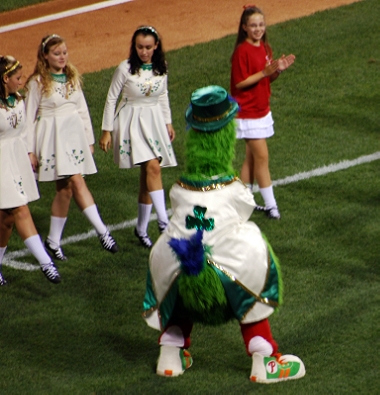
The Phanatic attempting to Irish dance.

The Phanatic attempting to Irish dance.

Celtic Thunder’s George Donaldson, a familiar face on Philadephia’s Celtic music scene, was only 46 when he died this year of a massive heart attack. On Saturday, his local friends are holding a fundraiser and tribute to Donaldson, who went from bus mechanic to superstart in his 30s, at The Plough and the Stars in Philadelphia, where he frequently performed.

Raymond Coleman will perform at the event, the proceeds from which will go to Donaldson’s teenaged daughter, Sarah, to pay for her education and other needs.

On Saturday evening, the Galway Society will swing and sway to the tunes of the Paul Moore Band at their annual dinner dance at the Irish Center in Mt. Airy.

On Monday, the popular seniors’ lunch takes place at the Irish Center. It’s gotten so popular that it’s moved to a bigger room and you need reservations. Check our calendar for who to contact.

On Monday night, the remarkable Luka Bloom will perform at the Sellersville Theater. John Byrne will be the opening act.

On Tuesday, dig up some old relatives at the Irish American Genealogical Society meeting at the Irish Immigration Center in Upper Darby.

Then on Friday, learn how to say “Batter up!” in Irish, because it’s Irish Heritage Night at the Phillies (and Irish Heritage Night at the Reading Phillies in Reading on Saturday!). There will be Irish dancers on the field, Irish music coming our of every orifice, and even Irish food. There’s always beer.

The Mayo Spring Social is also on Friday night at The Irish Center.

Next Saturday, some of the local traditional Irish musicians who qualified to compete in the All-Ireland Championships in Sligo in August will be holding a fundraiser at Molly Maguire’s Pub in Downingtown to raise money to defray their costs. There’s a concert, brunch, and a session afterward.

Also next Saturday, The Irish Immigration Center is sponsoring a Feile na Bealtaine—a welcome to summer—at the American Legion Hall in Havertown. There will be food (barbecue), a moonbounce, face-painting and, of course, music (this time by Raymond Coleman).

News, People

Rest in Peace, Wee Oscar

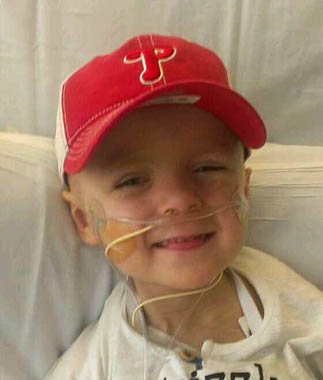
Oscar Knox wearing his Phillies hat when he was in Philadelphia.

Oscar Knox wearing his Phillies hat when he was in Philadelphia.

Wee Oscar Knox, the little Belfast boy who captivated Philadelphia’s Irish community when he came to Children’s Hospital for cancer treatment, died on Thursday.

On Friday, his family—father Stephen and mother Leona—tweeted: “Our beautiful, amazing and much loved son Oscar James Knox gained his angel wings yesterday afternoon. Sleep tight little man.”

His family had launched the Oscar Knox Appeal to raise money for his treatment for both neuroblastoma, an aggressive cancer affecting children, and Jacobsen’s Syndrome, a rare genetic condition that can affect motor skills and cause heart defects.

A fundraiser at Tir na Nog in Philadelphia in December 2012 raised $27,000 and a bake sale at Sacred Heart Parish in Havertown netted $8,000 for the Knox family. Unfortunately, during “Wee” Oscar’s stay at CHOP in October 2012, where he was to undergo immunotherapy for the cancer, doctors found that he had developed yet another potentially deadly problem, pulmonary hypertension, which made the cancer treatment impossible.

The Knoxes returned to Northern Ireland, but with the love and friendship of the Irish and Irish-Americans who live in the Philadelphia region and adopted them and their two children as their own.

In the past month, the Knoxes let supporters know that all of Oscar’s treatments were suspended and that the focus was going to be on pain relief, an indication that the five-year-old who loved wearing superhero costumes was near death.

The family has established another fund to raise money in Oscar’s name for the Northern Ireland Children’s Hospice and the Haematology Unit at The Royal Belfast Hospital for Sick Children through the JustGiving website.


News, People, Photo Essays

A Kid-Friendly Fundraiser for Kids

Kids pose for fun photos at the fundraiser.

Kids pose for fun photos at the fundraiser.

At a fundraiser last Sunday in Philadelphia for Amigos de Jesus Orphanage in Honduras, Meg Ryan was manning the table packed with brochures about the orphanage and artwork by the kids–and she came from Boston to do it.

That isn’t as far as she’ll go to help out the orphanage in the Santa Barbara region of this impoverished Central American country. In fact, the St. Anselm’s College graduate is just back from an 18-month stint there where she taught preschool, helped in the office, and found a new path in life. She’s planning to enroll in nursing school, “practice my Spanish and save money for more trips.”

Instead of looking for a job after college, Ryan, who grew up on Cape Cod, decided to volunteer at Amigos de Jesus, which was cofounded by a local Catholic priest, Father Dennis O’Donnell, the past rector at Malvern Retreat House, and Anthony and Christine Granese. “I did a lot of service in high school and really loved it,” she said. “After college, I wanted to do service, something that wasn’t all about me.”

That’s also what drew Aisling Travers, a 21-year-old Malvern resident and student at West Chester University, to Amigos de Jesus. Last year, she spent a week working with the children, most of whom aren’t orphans, but come from poor families who can’t care for them. Travers planned Sunday’s fundraiser, held at St. Declan’s Well Pub in Philadelphia, which is co-owned by her uncle, Aidan Travers.

Travers is returning in June and bringing her sister, Ciara, and boyfriend, Joe Smith to spend another week at the place where, she says, she left her heart.

View our photos of the fundraiser.

[flickr_set id=”72157644176843619″]

Music, News, People

Fleadh Winners Are Sligo-Bound

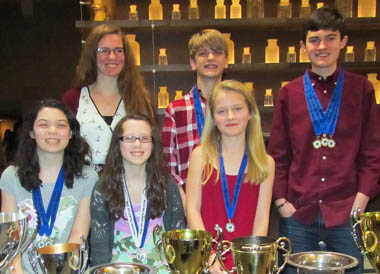
The Sligo-bound six: Bottom, Emily and Livia Safko and Haley Richardson; top, Alanna Griffin, Keegan Loesel, and Alexander Weir

The Sligo-bound six: Bottom, Emily and Livia Safko and Haley Richardson; top, Alanna Griffin, Keegan Loesel, and Alexander Weir

Eight young traditional Irish musicians from the Philadelphia are have qualified to compete in Sligo, Ireland, in August at the Fleadh Cheoil na nEireann—the All-Ireland music championships.

Two world champions from last year’s Fleadh in Derry, fiddler Haley Richardson of Pittsgrove, NJ, who was the under-12 fiddle champion, harpist Emily Safko of Medford, NJ, who placed first in under-12 in harp,  will be returning to compete against dozens of other qualifiers from around Ireland and the world August 11-17.  They earned their berths at the recent Mid-Atlantic Fleadh in Parsipanny, NJ, sponsored by the Comhaltas Ceoltoiri Eireann, an organization that supports Irish music, dance and culture worldwide.

Richardson placed first in under 12 fiddle, under 12 fiddle slow airs, and under 15 trio with two other solo qualifiers, Keegan Loesel and Alexander Weir. Emily placed 1st in both Under 15 Harp and Harp Slow Airs and her sister, Livia, placed first in under 12 concertina and second in under 12 fiddle slow airs.

Also Sligo-bound are Keegan Loesel, 14, of Kennett Square, who plays uillean pipes and whistles and walked away with a first in Under 15 Whistle slow airs, third in Under 15 Whistle, first in Under 15 uilleann pipes slow airs, second in under 15 uilleannn Pipes, first in under 15 duet with fiddler Alexander Weir, and first in Under 15 Trio with Haley Richardson & Alex Weir; Alexander Weir, 15, of West Chester, who brought home a  first in under 15 fiddle slow airs, first in under 15 duet with Keegan Loesel, and first in under 15 trio with Loesel and Richardson; and Alanna Griffin, 18, who also fiddle and concertina, placed second in under 18 concertina.

There will be a fundraising brunch on May 18 at  Molly Maguire’s Pub, 202 East Lancaster Avenue, in Downingtown to help defray the traveling costs of the “Sligo-bound Six,” as they’re calling themselves, with a concert and session. Plans are also underway for two other fundraisers, one in Sewell, NJ, and the other in Philadelphia.

Three other local harpists also won places in their divisions—Caroline Bouvier, 8, of Merchantville, NJ, placed third in the under 12s in her first year of competing; Kerry White, 16, of Vorhees, placed third in the 15-18 age group; and Katherine Highet, 27, placed second in the over 18 group.

The three are students of Kathy DeAngelo who, with her husband, Dennis Gormley, was inducted in the Mid-Atlantic Comhaltas division’s Hall of Fame  during the Fleadh. DeAngelo and Gormley have worked with the other qualifiers in The Next Generation, a program they started with Chris Brennan-Hagy to foster the skills of youngsters interested in performing Irish music. The group meets every second Sunday of the month at the Irish Center in Philadelphia.

“The Hall of Fame event was amazing,” said  DeAngelo this week. “We were so surprised and thrilled to see such a large turnout of friends, family, and supporters from the South Jersey and Philadelphia area.”

When they performed, they made sure it was Philly style. DeAngelo explains:

“We  first played a set of reels that we learned from the playing of Ed McDermott [a Leitrim-born Irish traditional musician who settled in New York and later, New Jersey; De Angelo was his student]. Next we had several members of the Next Generation (Alanna Griffin, Mike Glennan, Patrick Glennan) and our friend Bob Glennan join us for a set of jigs composed by Junior Crehan, in a nod to our late friend Liz Crehan Anderson who was a founding member of the Delaware Valley Comhaltas Ceoltoiri Eirann.

“For our third number, we had more Next Gen musicians (Kerry White and Alex Weir) join us and we acknowledged Kevin McGillian in the audience, another Hall of Famer from the Philadelphia area. We launched into a set of reels we taught the youngsters that we learned from Kevin, and which they performed on the “Ceili Drive” CD by irishphiladelphia.com, the Travers and Tinker’s Daughter set. It was awesome,” she said.

[flickr_set id=”72157644524844643″]


How to Be Irish in Philly

How to Be Irish in Philly This Week

The John Byrne Band at last years Philadelphia Fleadh--they're back this Saturday in the park.

The John Byrne Band at last years Philadelphia Fleadh–they’re back this Saturday in the park.

This Saturday, the Philadelphia Fleadh takes over Pennypack Park in Philadelphia with The Mahones and some of Philly’s finest Irish musicians, along with a feis—an Irish dance competition—sponsored by Celtic Flame School of Irish Dance. Gates open at 11 AM and the whole thing winds up around sundown.

Before you go, stop in at the American Catholic Historical Society on 4th Street in Philadelphia to see a one-off exhibit of items relating to James Connnolly the union activist who was involved in the Dublin Lockout of 1913 which set the stage for the 1916 Easter Uprising, one of the first steps towards Irish independence.

If you’re more the sea-faring type, set sail with McDermott’s Handy—that’s Dennis Gormley and Kathy DeAngelo– on the A. J. Meerwald, New Jersey’s only tall ship, at 1:30 when the ship leaves the Riverfront Promenade Dock near the Oneida Boat Club in Burlington.

Local music producer and performer, Gabriel Donohue, is being feted for his 25 years in the business at the New York Irish Center in Queens on Saturday night, with an all-star cast of well-wishers including Cherish the Ladies’ Joannie Madden, fiddler Eileen Ivers, Cathy Maguire, Brian Conway and many others.

On Sunday, St. Declan’s Well on Walnut Street in Philadelphia is hosting a fundraiser for the Malvern-based Amigos de Jesus organization, which runs an orphanage in Honduras co-founded by a local Irish-American priest, Father Dennis O’Donnell. There will be music, dancing, food, beer specials, and raffles.

Like barbecue? Like free barbecue? If you also like Irish music, come to the Commodore Barry Club (The Irish Center) at 6815 Emlen Street in Philadelphia on Thursday to hear a group of talented musicians from all over Ireland who call themselves Porterhead and enjoy a meal hot off the grill.

There are still a few seats available (as of Friday) for next Friday’s house concert with the legendary John Faulkner, who early in his career performed with Dolores Keane, then his wife. Contact barnstarconcerts@gmail.com to reserve your spot in the living room of Gabriel Donohue and Marian Makins to hear this concert up close and personal.

McDermott’s Handy will be playing on Friday night at Café 420 Coffee House in Bordentown, NJ.

If you’re a Celtic Thunder fan—specifically, a George Donaldson fan—his loal friends are holding a fundraiser for his daughter, Sarah, on Saturday, May 10, at The Plough and the Stars, where the late singer often did his solo act. Donaldson died several months ago of a heart attack at the age of 46.

Look for details for all these events on our calendar.

History

The Story of “Dynamite” Luke

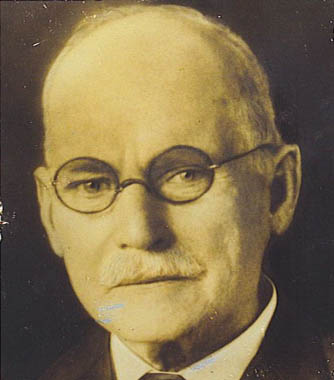
"Dynamite" Luke Dillon in his later years.

“Dynamite” Luke Dillon in his later years.

Luke Dillon, who was involved in what were called the Dynamite Wars of the late 1800s—an effort to secure Irish freedom by bombing quintessentially British targets such as Scotland Yard and Parliament–was the embodiment of the phrase, “one man’s terrorist is another man’s freedom fighter.” In fact, in the index of one book written about that campaign, he was listed as “Dillon, Luke (terrorist).”

An article about Dillon in an Irish newspaper was headlined: “The life story of a revolutionary who never saw his native land.” Technically though, Ireland wasn’t Luke Dillon’s native land. He was born in a poor, largely Irish section of Leeds, England in 1850, where his parents, Patrick and Bridget McDonald Dillon, emigrated from their Sligo home to escape the ravages of the starvation (an gorta mor).

Dillon didn’t even spend much time in England, except later, on “business.” His parents emigrated again, this time to Trenton, NJ, when Luke was six and where he lived until he was 18. Unable to find work, he joined the US Army and became a pony soldier out West—Wyoming and Montana—where by all accounts he took part in the Indian wars.

He was honorably discharged in 1870 and he moved to Philadelphia, where city directories say he was a shoemaker who specialized in slipper making. He married and had a large family.

While in Philadelphia, he met two men, James Gibbons, a printer, and William Carroll, a doctor, who were active in Clan na Gael, a leading Irish republican organization in the US He joined the organization and quickly became a leader.

At a 1881 Feinian convention in Chicago, another physician, Dr. Thomas Gallagher, asked members to support a dynamite campaign that would take the fight for Irish independence directly to Britain. Dr. Gallagher had been experimenting with making dynamite and volunteered to bring it to England, which he did with a small army of volunteers who made the explosives in Birmingham, which, because it was an industrial city, was the perfect place to order the ingredients without arousing suspicion.

And it almost worked. Bombers hit several targets before a clever chemist became suspicious and contacted police. Many of the dynamitards, as they were called, were arrested, including Dr. Gallagher.

But the bombing campaign did not end. While two of the dynamitards were awaiting trial, Luke Dillon and two other men sailed to England and took separate lodgings in London. They had Dr. Gallagher’s list of targets and some Atlas powder cakes, an explosive made in Philadelphia. Among their targets were the headquarters of the Intelligence Department of the War Office (Adair House), the Army and Navy Club in St. James Square, Scotland Yard , which also contained officers of the much hate special Irish Branch, Trafalagar Square, and more icons of British power. They planned to set off bombs at each of these places on one night, May 30, 1884.

Dillon may have been the most daring of the bombers. In fact, he was prepared to be a suicide bomber. He told friends he carried matches and a cigar to light the belt filled with dynamite he wore in case he was cornered. He was also reportedly the model for the character called “The Professor,” an anarchist, in the book, “The Secret Agent,” written by Joseph Conrad of “Heart of Darkness” fame.

On May 30, as bombs were going off at the Junior Carleton Club, an upper class political resort, Luke Dillon entered Scotland Yard and placed a bomb against the wall of a public urinal. No one was killed, but parts of the walls of the building were blown off. Collateral damage was a pub across the street where one customer was injured and had to be taken to the hospital. The police cordoned off the area but by then Dillon was long gone—headed back to New York with his two compatriots, one of whom returned not long after and bombed London Bridge.

But Dillon wasn’t done. He returned to London the following year with the intent to bomb Parliament. The Houses of Parliament and Royal Apartments of Westminster were open to the general public every Saturday but to get in, he needed a ticket. So Dillon went to the lord chamberlain’s office and requested two, which he received.

He and his partner walked up the grand staircase and turned right into the queen’s robing room, where a policeman was on duty. They proceeded to the royal gallery and then to the prince’s chamber, which also had a police guard. They wandered through a few other rooms, noting the guards, until they came to the House of Commons. There was a barrier there—but no guard—so Dillon coolly ducked underneath the barrier, went to a ventilating chamber and undid his belt, which was loaded with dynamite. He placed it by the side of a bench and lit the fuse. He checked his watch and then went back into the hall.

Instead of running, Dillon and his partner strolled through the halls to Westminster Hall, where Dillon’s partner placed his dynamite belt and lit it.

Then the two of them walked, again casually, toward an exit.
A few blocks away, another bomb was set at the tower of London. The two bombs at Westminster went off, and unfortunately a civilian was badly injured.

Dillon later attempted to bomb the Welland Canal in Canada, a vital part of the St. Lawrence Seaway, to paralyze the shipping lane while the British were embroiled in the Boer War. Canadian officials were on alert and nabbed the men, including Dillon, who was tried and sent to prison for life.

US politicians asked President William Howard Taft to intercede with the Canadian government to release Dillon, but Dillon himself was uncooperative. He refused appeals by Clan na Gael leaders and Joseph McGarrity to admit his guilt and petition the Canadian government for clemency. As he wrote to friend, he believed that if he did so, “the rest of my life would not be worth such a surrender of principle.”

Apparently, Dillon’s friends and family assumed he was dead until an article appeared in the New York Times on July 12, 1914 stating that “the Irish patriot Luke Dillon” was released from the Canadian prison and had sent a telegram to Joseph McGarrity, asking to meet with him in Atlantic City, NJ.
At the time of his release Dillon was 65. He remained active in the Clan na Gael organization and became a valued member of McGarrity’s inner circle. He lived to see his dream of taking the fight to England in the 1916 Easter Rising and the birth of the Republic of Ireland in the 1920s. He died in 1930 at the age of 81.

Those in our terror-torn world who prefer a peaceful solution to the world’s ills might have trouble reconciling the purity of Luke Dillon’s motives with the lethal means he chose to achieve his aims—and this was true even in Dillon’s day. In a letter written while Dillon was still imprisoned, John T. Keating, of Chicago, a former president of the AOH, said about the man he admired, that Dillon “loved Ireland not wisely but too well.”