Monthly Archives:

October 2010

Music, News

A Treat of a Halloween Party Does the Trick

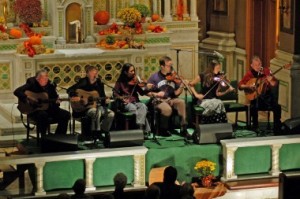
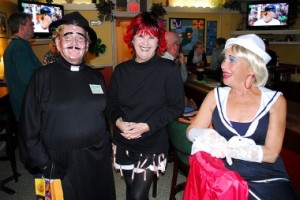
Father John and his fellow merry-makers.

Father John and his fellow merry-makers.

My Samhain party at the Philadelphia Irish Center began with a weird proposition. A very creepy “Father John” offered to hear my confession.

I respectfully declined. Maybe it had to do with the fact that Father’s face was clear and didn’t move. Eek.

Samhain (SOW-en) is an ancient Gaelic festival that led indirectly to Halloween. So the Samhain Rambling House party was mostly an excuse for some people to dress up—everything from a Goth witch to a Cleopatra to a little Debbie Reynolds-esque sailor girl. (And let’s not forget Father John. We can’t.) For others it was a reason to dance to the music of Fintan Malone and Bob McHugh, who had their own Halloween gremlins to cope with in the form of an uncooperative sound system.

For most of us, though, it was a great excuse to get together around the bar, swap gossip and laugh too much.

Whatever … what a swell party it was!

We have photos.

Columns, How to Be Irish in Philly

How to Be Irish In Philly This Week

Put Mick Moloney's annual St. Malachy's concert on your calendar. It's always a good one--with surprise guests.

Put Mick Moloney's annual St. Malachy's concert on your calendar. It's always a good one--with surprise guests.

We’re looking at one of those crazy Saturdays that make us wish we could be six places at once. 

Here’s the scoop: The Irish Immigration Center is holding its first ever gala at the Hyatt Regency at Penn’s Landing on Saturday night, honoring long-time immigration advocate Anne O’Callaghan, founder of the Welcoming Center for New Immigrants.
Barleyjuice, one of the most energetic bands we’ve ever seen, is at the Sellersville Theatre with the always amazing Shannon Ryan-Lambert and RUNA, while guitarist/singer/songwriter Sarah McQuaid is offering workshops and then a concert the The PSALM Salon in Philadephia.
For family fun, consider the Irish Variety Show featuring singers, dancers, performers and comics at Cardinal O’Hara High School Auditorium. It all benefits the Religious Sisters of Mercy—they’re an Irish order, you know—at the Annunciation BVM Convent in Havertown.
It gets quiet—except for all that great session music—until Wednesday when The Dirges, official band of “The Boondock Saints” (it’s a movie)—will be bringing their Celtic rock sound to the North Star Bar in Philadelphia.
For you genealogists or wannbes out there, The Irish American Family History Society is meeting at the Camden County Library, Vorhees branch, on Thursday morning.
Next Saturday brings us another bout of craziness: Burning Bridget Cleary at Daley’s Irish Pub and Restaurant, The 105th annual Mayo Ball, and evening with musician and folklorist Mick Moloney at Delaware Valley Community College, and the annual Ceili for Kayleigh—a benefit for a local child with methylmalonic academia, a rare disease—featuring Blackthorn at the Knights of Columbus Hall in Springfield, PA.
Don’t forget the annual fundraiser for St. Malachy’s School on Sunday, November 7, featuring Mick Moloney and Friends (he always brings his cool friends, like musicians Tommy Sands and Robbie O’Connell). The concert at the church is usually SRO, so get there early.
As usual, check our calendar for all the details.
News

Listening to the Voices

Professor Earl Schandelmeier directs the investigation at the Duffy's Cut site.

Professor Earl Schandelmeier directs the investigation at the Duffy's Cut site.

By S.E. Burns

 “What is the point?” was what I clearly heard when I asked if a spirit would pull my hair. I remember looking at Earl, who remained his usual calm, cool and collected self.

I was at the Duffy’s Cut archeological dig in Malvern with Professor Earl Schandelmeier III, one of the four authors of  “The Ghosts of Duffy’s Cut,” the remarkable story of how two local men discovered the remains of a group of early 19th century Irish immigrants who died—or were murdered—during a cholera epidemic. While the term “ghosts” was used loosely in the early days of the investigation, it takes on a more specific meaning now. Earl focuses on what are called EVP’s (Electronic Voice Phenomenon) at the site, recording an astounding number of voices that appear to be from another realm.  He has been one of the four primary researchers on the Duffy’s Cut project over the last eight years.

 In 2002, as an undergraduate history major at Immaculata University, he was invited by Dr. William Watson, and Professor John Ahtes to help with some primary research (very early source and facts checking). “Normally I am not one to volunteer, but for some reason, this one time, I immediately said that I would do it.” He set off the next day for the Chester County Historical Society, located two articles, and made one phone call back to Dr. Watson; and has not looked back since. In 2006 they applied for a non-profit status and the Duffy’s Cut Project was born. 

Intrigued by EVP’s myself, I found it very fitting to talk to Earl about “these spooky voices from beyond” this week as Halloween is quickly approaching.

Q. What are your religious beliefs?

A. Tibetan Buddhism with western influences. My entire life I was raised as a Presbyterian, (hardcore mother and grandmother while father was as equally atheistic) but I always knew, felt differently. From past lives, to divinity, the spirit world, to karma, I later learned that my intuitive beliefs were fully and completely encompassed within a religious philosophy that I had known  nothing about, had never been exposed to, and that were diametrically opposed to everything my family believed.

Essentially, the Dalai Lama teaches, (and this point is extremely important in my own life) that the Buddhist should not proselytize, but instead should work in guiding others to seek personal enlightenment in their own, personal way. We should act as an example to all people, of all religions, exemplifying the love and compassion necessary to reach Nirvana. Each person has their own path to walk, all I can do is attempt to personify the love and compassion I wish to see in the world which of course is much easier said than done. 

Q.  Are there any conflicting issues with what you are doing at Duffy’s Cut and your belief system?

A.  No, in fact just the opposite. I like to think that what we are doing, uncovering the mystery of what happened to the men who died at Duffy’s Cut, shedding light on potential murders of some of the men, telling their story to the world for the first time, actually personifies my belief system. I have worked in this project for so long because I feel a great compassion for the men; a need to help preserve their memories, but also in a spiritual sense, bring them peace and help them move on. 

Q. What is an EVP, and how does it work?

A.  EVP stands for Electronic Voice Phenomena – essentially the voice or communications believed to be coming from the spirit realm. Recently, I have been using a Franks Box, or specially designed radio frequency scanning device, that is thought to pick up and record these communications. The technology is relatively new, ten years old, and works on the following premise:  By taking a radio receiver and using it to continuously scan or sweep either AM or FM frequencies, and mixing in the white noise, the spirits can manipulate and use this energy as sort of a “telephone” to our world.

Of course as you scan the radio frequencies you expect to hear any number of assorted words, and sometimes even phrases coming through, however, what we look for is distinctly different than those radio interruptions. To be considered  EVP’s the communication must come through over top of the white noise and radio, or fall above or below the white noise and radio bands. In each case there is a clear and distinctive difference – the argument between skeptic and believer in this new technology lies in whether this distinction actually signifies contact with the spirit realm. 

Q.  Do the voices answer your questions? If so, are any of them not related to the deaths of Duffy’s Cut?

 A. Yes, during several sessions conducted near the site we have had some very strange answers recorded with the Franks Box EVP device. We have had answers seeming to come both from men who died there in the summer of 1832, but also from a number of other places and time periods as well. It is difficult to isolate any one particular entity, so we are often at the mercy of the entity that is the strongest (having the most energy to expend speaking with us) and is also willing to speak.

To get these EVP’s I like to compare it with deep sea fishing. You must troll with questions (often focused on emotion) until you get a lucid/sentient response. Then you ask follow up questions until you lose contact. When you do make contact it becomes like opening a door to a crowded dance club – you scream out questions, one or more people hear you, some respond, some seem to want to pass the message on to someone you may have asked for, while others  bully their way forward and won’t allow anyone else to speak. There are also EVP’s that seem to be less sentient, lost in the moment of their death, and can recall nothing but those final minutes of their life. All of their responses are narrowly focused and specific; they are also most easily enticed to come forward through emotion.

There can be very long periods of silence between the doors being opened (contact), sometimes five minutes, sometimes an hour. Contact can last for a few seconds, to as long as ten minutes in some cases – with specific individuals returning over multiple sessions (these sessions must be offset by at least three hours). Finally, there is almost always a distinct lifting and clearing feeling at the end of contact. 

Q. What are three of the most interesting words or messages you have recorded?

A.  In my experience with the Franks Box, we invited the Chester County Paranormal Society to investigate the site; they have some of the clearest EVP’s I have ever heard there.

For example:  When asked to curse – “F-ing whore.” Naming one of the Duffy’s Cut team members – “Dr. Watson.” Where are you? – “The Abyss.”

In addition, when asked what they thought of the contractor they worked for, Mr. Duffy, – “The devil.” 

Q. Has an EVP or anything else paranormal ever frightened you at the site?

A. I have never been frightened by anything paranormal at the Duffy’s Cut site. I have has other experiences that have left a deep- seated  sense of respect for what I am searching for, a bit of a healthy trepidation, if you will, but those stories are for another time. 

Q.  Is there a particular question that you are apprehensive about asking during an EVP session?

A.  No, although I think that one must be careful not to call forth anything that might have malicious intent, malevolent, something “evil”, or even “demonic” in nature. 

Q. What do your family and friends think of your involvement with the afterlife?

A. My wife is interested, she will listen to the final results, the EVP’s, video, but does not physically participate in my investigations. My son is 13, and as such, I keep him isolated from most of my work with the paranormal. I keep only a few close friends, and they are open minded and very interested. It would be extremely difficult to tolerate me with a closed mind!

People

A Virtual Session at McGrory’s Culdaff, County Donegal

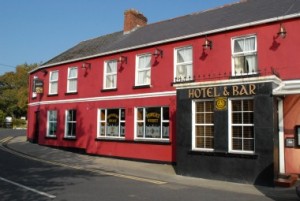
McGrory's, at the bend of the road in Culdaff.

McGrory's, at the bend of the road in Culdaff.

Ten years ago, when we first went to the Inishowen Peninsula in Donegal in search of my McDaid family, we stayed in a little town—in Ireland, that’s a redundancy—called Culdaff. Like many Irish towns, it had a couple of churches, a shop, and a handful of pubs, and the one you couldn’t miss was McGrory’s. Set at the bend of the road—sitting nearly on the verge it is the bend of the road—it was and continues to be painted bright barn red, so you couldn’t miss it if you tried. (Given its precarious location, it’s a good idea to try to miss it if you’re driving.)

 
Technically, McGrory’s is a pub, restaurant and hotel but it’s probably best known in Ireland for luring some of the best and brightest in music to its front bar or back room—from trad musicians Finbar Furey, Altan, Mary Black, Martin Hayes and Dennis Cahill to Richie Havens, Arlo Guthrie and J. D. Souther–since 1924.
We didn’t see anyone famous back then—just a great little trad session in the dark and cozy Front Bar. But we loved the place so much that we ate there every night.
When my husband Ed and I returned to Culdaff a few weeks ago, we popped into McGrory’s for a few meals and a very different kind of session, anchored by the McGrory brothers Neil and John, and a group of local musicians including the Henry Girls, an up-and-coming folk/trad trio of sisters named McLaughlin. 
Okay, you’re now thinking, why are they called the Henry Girls when their surname is McLaughlin? A little background: In Inishowen, which is still very wild and remote, certain family names are more common than sheep on a hillside. In fact, when we told a man we met in a Dublin pub that we were going to Inishowen to meet some cousins, he cocked his head and with a gleam in his eye asked, “They wouldn’t be named Doherty, would they?” (They are now, since the last of the McDaids had only one daughter who married a Doherty. It’s Inishowen’s version of “Smith” and the name of a famous and powerful family that traces its roots back to Niall of the Nine Hostages, a fifth century High King of Ireland. About 21 percent of men in Donegal carry Niall’s DNA, likely because he could also have been known as Niall of the Eight Sons. Right now, his DNA can only be traced through the Y chromosome, but many women are also probably Niall’s girls.) 
When a place is that small and that remote, the consanguinity factor can be a little disconcerting. My 21-year-old cousin, Maria, who happens to work at McGrory’s, joked that she was so taken aback when a local woman went over every child on her school bus and explained to her how they were related to her that she felt compelled to make sure her boyfriend wasn’t also a cousin.  
McLaughlin, likewise, is a very common name. To avoid confusion—or, if you’re an American, to help promote it–families with common names are given a nickname. My Dohertys are the “sean ban” Dohertys, or “old, white” Dohertys. And the McLaughlin sisters are the Henry McLaughlins, hence their name, the Henry girls. This becomes very important when you are sending Christmas cards and want them actually get to the recipient.
Local culture lesson over. On to the music. If you’ve attended an Irish seisun (session) at a local pub, you’ve probably only heard Irish traditional music played or sung. Our experience in Ireland was that there’s more to an Irish session than Irish music. We heard cabaret songs, rock, American country, American western, and even some politically incorrect ditties from a local songwriter.
At McGrory’s Thursday night session (Friday is for trad), we listened to songs from Richard Thompson, Johnny Cash, Blues Traveler, Sam Cook, The Band, John Martyn. . .not the expected fare in a pub with a peat fire blazing, but a warm, wonderful Irish experience nonetheless.
And you can be there since I brought back video. Just a warning—it was very dark in McGrory’s that night. You will not be able to pick the musicians out of a lineup after viewing, so just think of this as McGrory’s Session Radio.
 
Columns

Aon Sceal?

"Gas Pump Ceili"organizers Luke Jardel, Fintan Malone, and Marianne MacDonald.

"Gas Pump Ceili"organizers Luke Jardel, Fintan Malone, and Marianne MacDonald.

Tune in to NBC-10 Friday night, October 29,  at 7 PM to see the program “School Pride” to see the remarkable transformation of the Kingston Springs, TN, elementary school, devasted by last spring’s floods. Some of the money that went in to restoring the community’s only elementary school came from Irish-Americans in Philadelphia, some of whom were stranded for hours by the rising flood waters on an Irish Center trip to Nashville and Memphis.

Trip organizer, WTMR Irish radio host Marianne MacDonald, and musicians Luke Jardel and Fintan Malone (The Malones), raised $2,000 at a special ceili event at the Irish Center when they arrived home. They called it the “Gas Pump Ceili” because they and the more than 50 Philadelphia-area residents who had traveled to Tennessee threw an impromptu dance event at the BP station where they were waiting out the storm.
Local businesses and residents brought them food, water, and offered them shelter–and then joined in the dancing and singing after Jardel and Malone pulled out their instruments and began playing. 
A few weeks ago, MacDonald and Malone returned to Kingston Springs, TN, to present a check to School Principal Jill Bramble who turned the moment “teachable,” pointing out to her students that the Philly visitors—and their local benefactors—didn’t complain about their plights but helped one another.
Philly Company Expands to Northern Ireland
Philadelphia-based Market Resource Partners, which assists companies in finding new business opportunities, is establishing a beachhead in Newry, County Down, Northern Ireland, creating 100 new jobs with the aim of using the new facility as a center for its European operations. 
In published reports, MRP founder Kevin Cunningham said that Northern Ireland’s “well-educated workforce” was one of the reasons for the choice. Another, support from the industrial support agency, Invest NI, which gave the American firm around $1.1 million. 
Write a Review of Your Favorite Pub This Weekend
Didn’t you just love the essay questions when you were in school? Well, if you can write an essay—actually a review—of your favorite pub by Sunday at 7 PM, you can help your bar win the crown as best Irish Bar in North American and get yourself two flights to Las Vegas from anywhere in the States. Awards will be given to best bars in each state too. The contest is sponsored by the Strangford Lough Brewing Company and the website, irishbeerfinder.com. (Hey, why didn’t we think of that one?)
Overheard in Ireland: Philly’s Good Craic
While hanging at the bar in McGrory’s Pub in Culdaff, County Donegal, a couple of weeks ago, I met Billy Robinson, engineer and producer for famed Irish folk singer, Mary Black. He told me that Mary Black and company will be headed to the States for a number of gigs in November and, while none of them are in Philly, the crew is planning to stop here (at a riverfront hotel) just for the craic.
They’ve been here before, he told me, and they loved “the Japanese restaurant with the different colored seats”—apparently Morimoto at 723 Chestnut, owned by “Iron Chef” Masaharu Morimoto—and “all the little bars” in the neighborhood. 
They could stay anywhere, but they chose Philly. 
 
Irish Times Session on Hiatus 
 
The Thursday night session at the Irish Times, 629 S. Second Street, in the Queen Village section of Philadelphia, has been temporarily suspended, owner Eamonn Lyons tells us. If you’re a sports nut, check out the Irish TImes’ Down Below Bar which is cosy and has three giant plasma TVs so you won’t miss a thing. Plus the food is great and reasonably priced. And no, Eamonn did not pay us to say that.
Music

Review: “Three Colours Ginger” by Brongaene Griffin

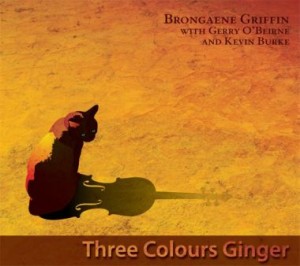
Three Colours GingerA sun-soaked illustration of a cat casting a long violin-shaped shadow adorns the cover of “Three Colours Ginger” by Oregon fiddler Brongaene (Bronnie) Griffin. Most of the sets of tunes on the CD bear a feline-derived title: “Black Cat,” “Calico,” “Copy Cat,” and “Tortoiseshelled Chesire.” Between the musical tracks, the superb Irish fiddler Kevin Burke recites such odes to kitties as “The Cat of Cats,” “The Cats of Kilkenny” and even “The Owl and the Pussycat,” delivered in a voice like honeyed whiskey.

Whimsically themed this new recording may be, but it is also seriously good. It could hardly be otherwise. Griffin cut her teeth on old-timey tunes, at which she excelled from an early age, but she is no less a whiz on Irish fiddle. She took instruction from Burke (which should say something), and he himself appears on two tracks. The master guitarist, singer and song-writer Gerry O’Beirne produced the CD, and he plays guitar and ukulele throughout.

Some of the very best moments are those in which Griffin and O’Beirne play unaccompanied. (Check out track 3, ”In the Tap Room” and “The Foxhunter Reel;” track 5, a collection of slides, “Where’s the Cat,” “Behind the Bush in the Garden” and “The Cat Rambles to the Child’s Saucepan;” and the 10th track, “Margaret’s Waltz,” dedicated to Griffin’s sister.)

Of course, there’s a lot to like about the sets in which Griffin has plenty of company. And good company it is. Griffin is joined by some high-powered traditional talent of the Pacific Northwest, including harper Elizabeth Nicholson, fiddler Bob Soper, Jim Chapman on bouzouki, guitarist Nancy Conescu and Johnny B. Connolly on button accordion. (Burke also resides in Portland, which apparently is knee-deep in world-class traditional Irish musicians.)

I was especially fond of Nicholson’s bell-like handiwork on the opening track, Colorpointe (“The Cat in the Fiddle Case” and “The Fisher’s Hornpipe);” the second track, a set of jigs including “The Orphan” and “The Stray Away Child;” and track 8, another set of jigs fitted onto the tail-end (so to speak) of Burke’s recitation of “The Cats of Kilkenny.” Connolly and Chapman contribute a good deal of color and depth on the tracks on which they appear.

Which brings up a minor point. All of the musicians appear in more places than the credits would indicate. The best example of that little oversight is Griffin’s sixth track, O’Carolan’s “Planxty Hewlett,” a lush waltz that reminds me a little of “Ashokan Farewell,” and even Pachelbel’s Canon in D. None of the accompanists is credited on this piece.

The tune begins with a sure-handed Griffin and O’Beirne proceeding alone, but it builds in delicate, lacy layers—a second fiddle (could be Burke, could be Soper), then Connolly, and finally Nicholson. It’s my favorite number on the album, and it will bring to mind all the happy-sad moments of your life and leave you to dissolve into a puddle of weepiness. It’s a lovely, tender performance by Griffin.

There are a few other faults in the credits but, really, it’s what’s inside that counts. You’re going to pay rather more attention to Griffin, who plays with confidence, poise and deep expression. (And she’s a musician with a conscience. The cat theme stems from her work in animal welfare, and a portion of the proceeds from the sale of this CD will benefit the Feral Cat Coalition of Oregon and Indigo Rescue, which rehabilitates rescued animals before they’re placed in adoptive homes.)

You’ll be impressed by the ensemble work as well. The performance of Griffin and company seems less like a recording session than the spontaneous collaboration of a group of good friends at a traditional Irish music session.

And that might be the highest compliment you can pay to any recording of Irish traditional music.

News, People

Bradley Accepts the Emerald Society’s Man of the Year Award

Michael Bradley Emerald Award

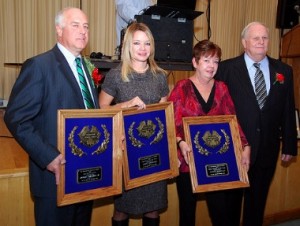
From left, Man of the Year Michael Bradley, Megan and Patsy McDonald, and Harry Marnie, president of the Philadelphia Emerald Society.

If he does nothing else in his life, Michael Bradley is always going to be known as the man who, in the midst of a budget crisis that threatened the future of the Philadelphia St. Patrick’s Day Parade, simply refused to believe the old adage, “You can’t fight City Hall.”

Last March, the city was demanding that the parade committee foot a hefty bill for parade-related municipal expenses. Either that, or no parade. Bradley, who directs the popular televised event, earned quite a rep for himself when, in return, he offered the city what amounted to a Hobson’s choice: a peaceful parade or an organized riot.

The peaceful parade went on.

The Philadelphia Emerald Society took note of Bradley’s gutsy accomplishment—and many other lifetime achievements—by naming him 2010 Man of the Year.

Bradley has two demanding jobs: he’s president of a commercial flooring company and also a commercial real estate firm. He’s also well-known as a coach of soccer and several other sports. Bradley  also organizes the Penn’s Landing Irish Festival.

Bradley accepted his honor last week on the same night Police Sgt. Patrick McDonald and his father Larry McDonald, a retired city fire department captain, received the group’s police and firefighter awards. Patrick McDonald was shot and killed in the line of duty in September 2008; Larry McDonald, a retired fire department captain, died of a heart attack April 7, 2010, while riding his bike in Northeast Philadelphia.

The presence of the McDonald family was not lost on Bradley, who paid tribute to the fallen heroes.

“It’s an honor to be in the same room with the McDonald family,” he said. “I can’t say enough about those two men (Patrick and Larry McDonald) and how lucky I am to be here tonight. It’s something I’ll never forget.”

A proud Penn State grad, Bradley closes his e-mails with a quote from Joe Paterno: “Believe deep down in your heart  that you’re destined to do great things.” In the eyes of the Emerald Society, that’s just what he’s done.

Columns, How to Be Irish in Philly

How To Be Irish in Philly This Week

You can catch Shannon Lambert-Ryan and Runa at two venues this week.

You can catch Shannon Lambert-Ryan and Runa at two venues this week.

Just back from 10 days in Ireland. Did you miss me? What, you didn’t notice that I was gone? Okay for you.

But you won’t want to miss any of the great events on our calendar this week. Good segue, eh?

“The Early Bird,” a play by Irish playwright Leo Butler, opens this Saturday at the Adrienne Theatre in Philadelphia. Produced by the Inis Nua Theatre Company—the city’s finest purveyor of new plays from Ireland and the UK—“The Early Bird” is, like many Irish plays, dark, disturbing and humorous. Hey, we know Irish people like that too. The story: Debbie and Jack blame one another for the disappearance of their child and their exchanges uncover the inner secrets of their relationship. I know it’s hard to imagine how that could be funny, but if past experience with Irish plays is any indication, you will be laughing—at least, some of the time.

If it’s some good music you’re after, RUNA, a Celtic fusion band based in Philly, will be playing at the Tinicum United Church of Christ in Pipersville on Friday, October 22. Tickets are only $10. RUNA will also be opening for Barleyjuice at the Sellersville Theatre on Saturday, October 30.

On Saturday, catch Burning Bridget Cleary at Chaplin’s Music Café in Spring City. This young band has been collecting fans and gigs like nobody’s business over the past couple of years.

Harper Robert Mouland returns to the tri-state area on Sunday with his one-man show, “Before the Dhoul Knows Yer Dead,” at the East Jersey Olde Towne Village in Piscataway, NJ. He plays Michael Keane, a harper who came to American in 1754. He’ll be playing a wirestrung harp and a variety of antique instruments.

Also on Sunday: Blackthorn appears at a fundraiser at the Palombaro Club in Ardmore for the Havertown Republicans. Do Celtic rock and politics make strange bedfellows? We’ll see.

Back for a second year: the (we hope) annual Samhain Rambling House at the Irish Center. Samhain is the Irish version of Halloween (since it started in Ireland, technically Halloween is the American version of Samhain). Last year, a coven of witches, some great performers, and even a Celtic tarot card reader made for a fun, spooky night at the Irish Center which, some folks say, is haunted. The Malones—Fintan Malone and Luke Jardel—will be providing the music (everything from Irish trad to reggae) for dancing, but they’ll surrender the mike to anyone who wants to perform their party piece. That includes stand-up comedy, story telling, singing or dancing. Your $5 admission fee covers all that and some eats too.

Looking ahead: The Irish Immigration Center is holding its first ever gala at the Hyatt Regency at Penn’s Landing on Saturday, October 30. The first ever Mathew Carey Hibernian Award is being given to Anne O’Callaghan, executive director of the Welcoming Center for New Pennsylvanians, a nonprofit serving the region’s immigrant community. In the 1700s, Mathew Carey was the driving force behind the organization of the Hibernian Society for the Relief of Emigrants from Ireland, one of the first societies of its kind in Philadelphia. A portrait of Carey hangs at historic St. Mary’s Church in Philadelphia, his burial spot (along with that of Commodore John Barry, one of the Revolutionary War’s most famous immigrants).

The John Byrne Band will be playing. For more information on the event, go to www.icphila.org.

Irish guitarist and singer/songwriter Sarah McQuaid will be appearing at the PSALM Salon in Philadelphia on Saturday, October 30. McQuaid will also be conducting a guitar workship before the show, which starts at 8 PM.

I’ve spent the past week updating the calendar, and there’s plenty of good craic coming, including “Irish Christmas in America,” with the band Teada and singer Seamus Begley, returning to the Irish Center on December 12.

But November is jam-packed with Balls (Donegal and Mayo) and the Mary from Dungloe Pageant, Mick Moloney’s return (to Delaware County Community College on November 6 and his always standing-room-only concert “with friends” at St. Malachy’s in Philadelphia on November 7, and at Wilmington Hall in Delaware on November 7); the Delaware Valley Irish Hall of Fame (November 14), the Philadelphia Gaelic Athletic Association All-Star Banquet on Nov. 21 (with two national championship teams, that’s a lot of all-stars), and, of course, the annual Oireachtas—top notch Irish dancers from the Mid-Atlantic competing to be the best—on the Thanksgiving Day weekend.