Browsing Category

News

News

Kathleen Kennedy Townsend Speaks on Church Reform

By Diane Dugan

On a cool October night when the Fightin’ Phils were facing down the Dodgers in the game that would clinch the National League title, members of Voice of the Faithful/Greater Philadelphia and interested members of the public gathered in the Church on the Mall in Plymouth Meeting to meet with Kathleen Kennedy Townsend, former Democratic lieutenant governor of Maryland.

Since leaving office in 2003, Kennedy Townsend has served on a number of non-profit boards and currently is an adjunct professor at Georgetown University’s School of Public Policy. Voice of the Faithful (VOTF), an international organization of 35,000 founded in 2002 in response to the clergy sexual abuse scandal, had invited Kennedy Townsend to discuss some of the issues in her 2007 book, “Failing America’s Faithful: How Today’s Churches Are Mixing God With Politics and Losing Their Way.”

The eldest daughter of Ethel and Robert F. Kennedy and a lifelong active Catholic, Kennedy Townsend began writing her book about seven years ago because, as she says, she had seen the relationship between church and politics change. Religion has come to be associated with the political right-wing, and by focusing so much on issues like abortion, same-sex marriage, and stem-cell research—which are “important, but not the only issues”—the Catholic Church has risked appearing “too partisan.”

She feels that the election of Barack Obama has helped the Catholic Church, explaining that the Vatican actually likes a lot of his positions (e.g., global poverty, climate change), and that he’s enormously popular in areas of the world where the Church wants to succeed. (A case in point is Africa, whose Catholic bishops just delivered a scathing denunciation of corrupt regimes in Angola and Uganda.)

“Reading the tea leaves” in her journeys around the world, Kennedy Townsend says, she perceives a shift going on in the Vatican, its recent aggressive bid for traditional Anglicans being what she calls a “desperate gasp.”

Kennedy Townsend was raised to believe in the importance of giving back, her parents often quoting St. Luke’s “To whom much has been given, much is expected.” She told of being taken to the Senate Rackets Committee hearings as a child when her father was investigating the corrupt Teamsters’ union, and the physical threats to her and her siblings as a result of his work. And she shared one of my favorite “Bobby” anecdotes: RFK speaking to a crowd of African-Americans in Indianapolis on the night of Martin Luther King’s murder, about the pain of losing a beloved brother to a violent death, and the necessity of meeting violence not with more of the same, but “with love, and wisdom, and compassion.” While many American cities erupted in riots that night, there were none in Indianapolis. These and other experiences taught her two things, she says: that doing good often comes at great personal cost; and that our God must be one of compassion and love.

Kennedy Townsend spoke movingly of the critical importance of the Church throughout her life, not just in terms of spiritual consolation but also its long, admirable record in support of human rights and social justice. She acknowledged that “the Roman Catholic Church has had problems with me” because of her stands on various issues, denying her speaking engagements at Catholic schools in her home diocese of Baltimore. Professing herself a big supporter of VOTF and their work (their mission is “Keep the Faith; Change the Church”), she feels reform-minded Catholics need to focus on positives, citing current Church involvement in issues like health care, climate change and immigration.

Internally, however, there’s much work to be done. Kennedy Townsend made a comparison between the role of Poland’s Solidarity movement, which laid the groundwork for the eventual collapse of communism in Eastern Europe, and that of the laity. The laity have a responsibility, she says, to create alternatives, such as the election of bishops and economic transparency. There are many ways to make a difference.

Two of the biggest mistakes the Church has made in recent times, Kennedy Townsend thinks, were the encyclical Humanae Vitae (banning the use of artificial contraceptives) and the clergy sexual abuse scandal. Both events had the unintended effect of making many faithful Catholics rebel. She closed by urging her audience to “write to the Pope! He’s been listening to the right wing; get him used to hearing from the left.”
News

Bring Your Legal Problems—Help is Free

Have an immigration problem? A landlord dispute? Any messy legal situation you don’t know how to deal with?

The Irish Immigration Center is offering a free Legal and Immigration Clinic with the help of the Brehon Law Society and Drexel Law School every fourth Tuesday of the month, starting on October 27, from 3 to 6 PM.

Criminal and family lawyers are also available on request.

You need an appointment for these confidential clinics. Call 610-789-6355 to make one. The Irish Immigration Center is at 7 South Cedar Lane in Upper Darby.

News

Irish Represented at This Week’s Immigration Rallies

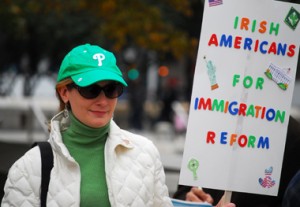
Sarah Conaghan at Monday's Philadelphia rally.

Sarah Conaghan at Monday's Philadelphia rally.

He was eight when his father left home, reluctantly leaving his family behind to travel thousands of miles across the ocean to America to earn money to support them. He was 16 when he next saw his father. It was, he says, the meeting of two strangers.

“When he left, I was little. When I next saw him, I was taller than my father. And he was not familiar to me. He was shocked when he saw me too.”

It could be any immigrant’s story, this old familiar tale of desperation and families torn apart. But in this case it belongs to Xu Lin, a young man born in China’s Fujian Province whose father is now trapped in America without a green card.

“My grandmother passed away two years ago and in our tradition, the oldest son should be there to send his parents away,” Lin told a crowd gathered for an immigration reform rally in the shadow of Philadelphia’s City Hall on Monday, October 12. “My father is the oldest son in the family, but he could not go because of his immigration status. I feel really sad for my dad and grandmother.”

The rally, organized by the group Reform Immigration for America, was a send-off for a handful of local people who were traveling to Washington, DC, the next day to attend a larger rally at the Capitol to demand action on immigration reform before the end of the year.

Nearly 8,000 people—including representatives from Philadelphia’s Irish Immigration Center—spent the day lobbying in congressional offices and massing on the Capitol lawn to show support for new programs that will make it easier for immigrants to become citizens and for the abolition of old programs that make them criminals.

One of those local representatives was Sarah Conaghan, a Delaware County woman whose father, Tom Conaghan, founded the Irish Immigration Center. She stressed the need to “put a different face” on immigration, one that reflects the true diversity of immigrants “who come from Ireland, Honduras, Poland, every country you can imagine.”

The Pennsylvania group met with aides for Bucks County Rep. Patrick Murphy, Delaware County Rep. Joe Sestak and Senators Bob Casey Jr. and Arlen Specter, though their lobbying was preaching to the converted. Those lawmakers are on record as supporting immigration reform.

Among the proposed laws immigration reformers would like to see passed is the Reuniting Families Act, set in play by New Jersey Senator Robert Menedez, New York Senators Charles Schumer and Kirsten Gillibrand, and the late Senator Edward Kennedy of Massachusetts. The bill would end lengthy wait times for foreign-born relatives of US citizens and permanent residents to be granted visas. There is currently an immigration processing backlog of 5.8 million people, or about 20,000 people a year. Supporters say that the US economy takes a hit as a result: Many of these people are at retirement age when they finally arrive so are unable to join the workforce or pay taxes.

While the rally was going on in Washington, Siobhan Lyons, executive director of the Philadelphia Irish Immigration Center, was in New York with a coalition of Irish groups meeting with Irish Foreign Minister Micheal Martin. Martin was doing the rounds of national lawmakers to take a read on the future of the reform bills now on the table. “He said that there’s a small window at the beginning of the year where we need to get comprehensive reform in,” says Lyons.

In past years, the Irish got a special pass. “The Irish have benefited from special visa programs and there has been a hope in the Irish community that we’ll get this again, but it’s not happening,” says Lyons. And, she says, it shouldn’t. There are an estimated 50,000 undocumented Irish in the US. There are millions of Hispanics.

“The whole coalition of Irish immigration organization is planning a push—it might be a postcard campaign—to make sure that the entire community gets behind comprehensive reform that applies to everyone, with no ethnic group singled out.”

She says she’s hoping the Irish have long memories. “Not long ago, the Irish were met with signs that said, ‘No Irish need apply.’ We were once the immigrants no one wanted. We know what it’s like to be the people everyone hates. It all turned out great for us. . .and everyone else.”

For Conaghan, the current immigration situation has a “there but for the grace of God go I” component. It’s personal.

“I’m the daughter of two immigrants and when they came here in the 1970s, there was a road to citizenship then and they took it,” says Conaghan. “Since 1996, our community been devastated something called the Illegal Immigration Reform Act, which removed every legal road and bridge for Irish immigrants to become citizens. It eliminated the path to legalization. Their punishment: Those who remain 180 days after their visas are up can be barred from returning to the US for up to 20 years. The result of all this is that people who remained because they had put down roots—they settled down and had kids—have been trapped here, living in the shadows for over 15 years. I know some of these families and they haven’t been able to go back to see grandparents who live in Ireland.”

Roughly 20 percent of Pennsylvania’s population has Irish roots, with a million Irish and Irish-Americans living in the Philadelphia metropolitan area.

“Yet our historic contribution to this country has been ignored,” says Conaghan. “This is such an important issue for our community locally, and every community. Our country was built by immigrants.”

News, People

“One of the Greatest Experiences of My Life”

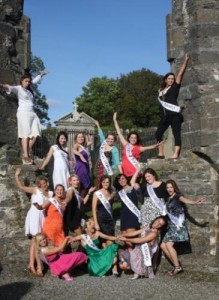
All the Marys in Dungloe--that's Philadelphia's Mary second from the right, second row.

All the Marys in Dungloe--that's Philadelphia's Mary second from the right, second row.

Emily Weideman didn’t expect to win when she entered the Mary from Dungloe competition last year. A program sponsored by the Philadelphia Donegal Association, Mary from Dungloe is a pageant open to young women of Irish descent who compete for the international crown in the town of Dungloe (pronounced Done-low) in County Donegal every summer.

But she entered, won the right to represent Philadelphia in Dungloe, and in the essay she shares below, apparently had the time of her life.

A little about Emily: The Montgomeryville native is an area coordinator for Holy Family University and holds a BA in political science from Arcadia University and an MA in global security from Keele University in Stoke-on-Trent, England. She studied in Dublin, Ireland while an undergrad and interned in Dail Eireann in 2004. She does volunteer work for the Irish Immigration Center.

By Emily Weideman

I was crowned the Philadelphia Mary from Dungloe back in November, 2008, so I thought I was more than ready to head off to Dungloe for the International Mary from Dungloe Festival in July. Nothing, however, could have prepared me for the experience of being a Mary. I can now say that I have fifteen amazing friends with whom I shared one of the greatest experiences of my life.

The Mary from Dungloe Festival in Dungloe, County, Donegal kicked off on Saturday, July 25, but it was the Introduction of the Marys on Wednesday, July 29 in the Main Street that started the week for fifteen young women representing many counties in Ireland, the six Northern counties, London, Edinburgh, Glasgow, Bayonne, and Philadelphia. At the head of the group was the 41st Mary from Dungloe, Una Rooney, from County Armagh.

The sixteen Marys spent five days together traveling throughout Donegal, with stops at Glenveagh National Park, Gweedore, Ballybofey, Donegal Town, and of course many appearances in Dungloe. The Marys also made a quick afternoon trip to County Fermanagh to visit the Belleek Pottery Factory. We greatly enjoyed it—each of us was presented with Belleek jewelry as a keepsake of the week in Dungloe after the crowning on Sunday night.

A favorite stop for all the Marys was a visit to the Angle Day Center in Dungloe, a day facility for the handicapped. One of the escorts (all the Marys have an escort), Mark Gallagher, provided the music and the Marys spent the morning dancing and singing with the Angle’s patients.

On Thursday night, the Saw Doctors had Dungloe and all the Marys dancing away at their concert on the Main Street in town. The music and weather were fantastic. The evening culminated with the Saw Doctors joining local band, The FlyBys, on stage at the Midway Pub after the show. On Friday, The Fureys had the Marys and escorts dancing to such songs as “One More for the Road” and “My Father’s House”. Amazing music was also provided by Gary Gamble, Philomena Baddeley, Georgette Jones, the Glasgow Mary, Lisa McHugh, Daniel O’Donnell, and many other amazing artists all week long.

The week seemed to fly by and before we knew it, we were on stage Sunday night giving our public interviews. Questions included ‘Where do you see yourself in five years?’, ‘What was your favorite moment from the week?’, and my personal favorite, “What exactly is a cheesesteak?” All of the Marys gave wonderful interviews and the party pieces were superb.

Finally, the Marys were on stage waiting for the 42nd International Mary to be announced. After a carefully designed pause by the Compare, Gerry Kelly from UTV, 25-year-old Kate Ferguson of Derry was named the winner. We were all overjoyed.

Kate is a trainee solicitor who lives in Dublin and just completed working with the Ryan Commission which was set up to investigate child abuse in Irish institutions. She is set to begin her final legal apprenticeship and once it is complete, will be a fully qualified lawyer. . .who plays a mean clarinet (she played the “Derry Air” as her party piece).

While all of the Marys were thrilled with Kate’s win, the true highlight of the week was sharing the experience and creating lasting relationships with one another. The group became very close and, along with Carol Kiernan, the Marys Coordinator, created lasting memories. We all plan to visit one another and we’re already talking about a reunion. I am sure that the 2009 Marys will remain great friends for a long time to come.

I would like to take this opportunity to thank the Philadelphia Donegal Association for the opportunity to represent them, as well as the City of Philadelphia, at this year’s Festival. It was an experience like no other and I will remember it fondly for the rest of my life. Thank you for all of the support throughout this year!

On November 28, 2009, the 2010 Philadelphia Mary from Dungloe will be selected at the Donegal Ball hosted by the Donegal Association of Philadelphia and held at the Commodore Barry Club. Young women of Irish descent and between the ages of 18 – 27 are invited to join in the evening by competing for the Philadelphia title and the trip to have the experience of a lifetime in Dungloe. For more information and the application, please visit the Donegal Association’s website, www.philadonegal.com.

News

A New Way to Help St. Malachy School

By Kathy McGee Burns

“I have faith in myself
I have faith in my teachers
I can learn if I study hard
I will learn because I will study hard
I respect others and seek their respect
I have self-respect
I have self-control
I love myself
And loving myself I will be myself
And know myself
I am the one who is talking.”

This is the creed said every morning, after prayers, by the students at St.Malachy School in North Philadelphia. Many of these students are from public housing, most are poor, and most aren’t Catholic. On Fridays, they go to the church for a weekly service, not for Mass, but to experience the splendor and richness of that lovely old church. Father John McNamee, the now retired pastor, often says that sometimes the students need beauty even more than they need bread.

St. Malachy School, named after the 12th century Irish Bishop from Armagh, was opened in 1860, in North Philadelphia, shortly after Irish immigrants and the Sisters of Mercy founded the church, once called “the church in the woods” because of its location outside the 19th century city limits. Its purpose was to educate working-class immigrant children and many Irish-Americans in the Philadelphia area can trace their roots back to St. Malachy’s. My own great-grandparents, Timothy and Bridget Clancy Callahan, were members of the parish and they baptized seven daughters at the church. My grandmother, Mary Josephine, along with her sisters, attended the school.

Among Philadelphia’s schools, Catholic and public, St. Malachy’s has been a remarkable success story. Of its approximately 200 students, 99% are African American and 1% are Latino. Twenty five students graduate in the class of 2009 and and are all going on to excellent schools, including LaSalle, Roman Catholic, Merion Mercy, Hallahan, Charter School for Architecture & Design, and Central. And there’s no selective admissions policy at the school.

St. Malachy’s manages this miracle without taking any money from the Archdiocese. The school runs strictly on donations, some of it from the descendants of those immigrants who founded the school more than a century ago.

This year, a number of local Irish organizations have formed a committee to help coordinate funding for the coming year. It intrigued me that so many busy people decided to take the time to ask their friends and associates to support a school in North Philadelphia. So I asked!

Jim McLaughlin, president of the Irish-American Business Chamber and Network said he is involved because he thinks its important to maintain a Catholic educational presence in the inner city. Keeping a beacon of light alive reflects the Church living its values to both students and neighbors.

Anne O’Callaghan, executive director of the Welcoming Center for New Pennsylvanians, an immigrant resource organization, told me that she thinks that the best gift we can give children is a good education. Inner-city Catholic schools that were once the salvation of Irish immigrants and are now providing a unique, faith-based education that breaks the cycle of poverty. She cited a study that found that 100 percent of St. Malachy’s graduates go on to graduate high school, compared to only 54 percent in the city’s public schools.

In the last 25 years, St. Malachy’s School has empowered thousands of students to realize their potential, forge brighter futures and allow them to enjoy the lifelong benefits of a holistic experience. Anne believes that it is a privilege to contribute to provide this opportunity to children who would otherwise be denied this advantage.

Theresa Flanagan Murtagh, immediate past president of the Donegal Association and member of many organizations, says she welcomes the opportunity to work together with these Irish leaders for a common goal, to support a very worthy cause, and help a parish which was initially founded by Irish Immigrants. She and her husband, Paul, are committed to supporting schools that not only produce academic excellence but also build Christian values and promote Catholic faith.

Rich Brennan, AOH Division #1(Dennis Kelly) credits the spirit of his late Great Aunt, Sister Mary Basil, who taught at St. Malachy’s, for inspiring him to volunteer. Rich attended St. Joseph’s University where he learned and now practices the teachings of the Jesuits: Cura Personalis (total care of the entire person) for the (greater good) Magis. He believes that there is a wonderful opportunity to work beside others who support its mission and assist with achieving its goals. Rich is a great example of the success of Catholic education and the desire to give back to others.

Ed Keenan was drawn to the committee by his experience as a longtime St. Malachy’s volunteer and his devotion to Father McNamee, who is known as Father Mac. Ed told me he loves St. Malachy’s because he feels at home there. It is a “welcoming” place, the most Catholic, that is, “universal” church that he has ever attended.

And me, well, I sense Mary Josephine Callahan there and I think she would want me to share the fruits of my education, success and upbringing—the same things St. Malachy’s provided for her when she was a student there in 1886.

So we, the Committee, are asking you to help support the work of St. Malachy’s School by becoming a sponsor of the major fundraiser of the year, a concert by “Mick Moloney and Friends,” which is usually a standing-room-only event scheduled this year for November 1.

There are several sponsorship levels:

The “Father Mac” Sponsorship: $5,000
Official underwriter of concert and reception
Full page recognition in event program
Name on inside cover of event program
On-site event signage recognition
Verbal recognition at the event
Reserved front row seating at the event

The Emerald Sponsorship: $2,500
Official underwriter of printing
Full page recognition in event program
Name on inside front cover of event program
On-site event signage recognition
Verbal recognition at the event

The Shamrock Sponsorship: $1,000
Official underwriter of event program
Half-page recognition in event program
Name on back cover of event program
On-site event signage recognition

The Claddagh Sponsorship: Up to $500 Level
Official friend
Business card logo in event program
Name on back cover of event program
On-site event signage recognition

To become a sponsor, contact Jim Martin at 215 850 4084 or jimart40@mac.com, or Kathy McGee Burns at 215 872-1305 or mcgeeburns@aol.com

News

Put the Green In Immigration Reform

You may not know if from the national controversy over immigration reform, but some illegal aliens have Irish accents. And with double-digit inflation in Ireland, the number of undocumented Irish in the US is bound to increase.Put on something green and head down to City Hall on Monday, October 12, at 11:15 AM for a rally to support immigration reform.

“It is vital that the Irish community plays a visible role in the campaign for immigration reform, and I would love to see a green bloc at the rally,” says Siobhan Lyons, executive director of the Irish Immigration Center of Philadelphia.

The rally is scheduled the day before a major rally and march on Washington, DC, where immigration reform groups from all over the country will converge.  The Irish Immigration Center is sending a delegation. For more information, contact the center at 610-789-6355.

News

Wildwood Daze 2009

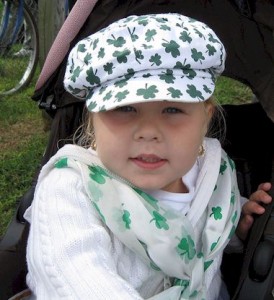
Her name is Erin (of course!). She was one of many festival-goers at the annual pipe band exhibition.

Her name is Erin (of course!). She was one of many festival-goers at the annual pipe band exhibition.

Sun and fluffy clouds. A cool breeze off the beach. A band, one of many Irish bands from the Delaware Valley, pounding out tunes in the music tent. Curly fries and pulled pork. Pitchers of beer. Bagpipe bands circling up and playing in the street. Kids (and not a few older folks) in silly hats and green Mardi Gras beads.

For many of us who have been to the North Wildwood Irish Fall Festival, it was groundhog day. We’d seen it all before, this exhuberant farewell to summer at the shore. Which is not to suggest that it was boring, or anything like it. If anything, this Fall Festival was as fun as ever. It might have been one of the better attended, best organized Fall Festivals the local Hibernians had ever put on. If you were there, you know what we’re talking about. (And you can take off the silly hat now.)

We have a pile of pictures and a video to help you remember the day. (You can remember something, can’t you?)

  • News

    The Celts Conquer Bethlehem

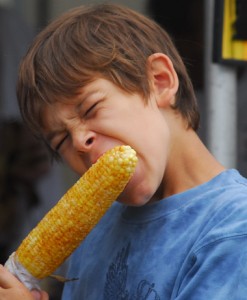
    This was the hands-down favorite festival meal.

    This was the hands-down favorite festival meal.

    Kilts, corn-on-the-cob, collies, haggis, fiddles, pipes, drums, beer, kids, guys with mountainous muscles. That’s the “tags” version of the the 22nd annual Celtic Classic in Bethlehem this weekend.

    After a disastrous 21st annual Celtic Classic—drowned last year by Hurricane Kyle—the Celtic Cultural Alliance did some cost-cutting (no bleachers at the Highland Games, for example) and squeezed the event into a smaller space to put some distance between festival goers and the Monocacy Creek which overflowed its banks in 2008. But it didn’t hurt this Celtic show piece of Bethlehem’s many full-city festivals. The crowds were big (except during a Sunday morning downpout), happy, and totally into it. We’ve never seen so many kilts in one place.
    We have pictures, video, and some nice memories.

    Watch our videos: