Browsing Category

News

News, People

Fly to the Wren Party

OK, so St. Stephen is hiding in a bush, trying to elude early Christian haters. Suddenly, a tiny wren alights on the bush and immediately begins making an enormous birdy racket. Thanks to the wren, the Christian haters figure out where St. Stephen is hiding. They yank him out from the bush and stone him to death.

Fast forward hundreds of years to the Emerald Isle. Every year, on the feast of St. Stephen (the day after Christmas), local guys track down and kill a wren and mount him on a stick, parading his poor carcass about town. The wren boys, they’re called, and you can tell they’re wren boys because they’re dressed in funny costumes, and they sing and they dance. They beg for drinks, food and spare change. This becomes a happy little tradition.

The idea of the wren boys still exists in Ireland, although—thankfully—no one slaughters little birds any more. And a variation on the legend lives on locally in a fun-filled and completely avian-free evening at the Knights of Columbus Hall on Limekiln Pike in Glenside.

It’s the 10th annual Wren Party, and it is sponsored by the Delaware Valley chapter of Comhaltas Ceoltóirí Éireann (translation: Gathering of Musicians in Ireland). Comhaltas (pronounced coal-tuss) is dedicated to the perpetuation of Irish music, dance and culture. It’s a party worthy of the Comhaltas mission, featuring live traditional Irish music, set and ceili dance—even a contest for best wren boy hat.

“We’re asking people to put together a hat and join our wren boys parade,” says Jackie Kelly, the local Comhaltas public relations officer who, with Cass Tinney, runs the post-Christmas event. “Every child who enters the parade gets a prize.”

The hat parade is just one of the many activities geared for children. There’s also a puppet show.

But at its core, the Wren Party is about music and dance. Well-known local musician Kevin McGillian and friends set a lively pace, and they do it all for free. There will also be a performance by Haley Richardson, a young New Jersey fiddler who at 6 years old placed first in the 12-and-under category at the Mid-Atlantic Fleadh Cheoil (music festival) at Pearl River, N.Y., last spring. She’ll knock your socks off.

If you love dance, you’ll stay on your feet most of the night. Wear comfy shoes.

And if you like to watch dance, you’ll get to do that, too, as the Timoney and Gibson schools put on a great exhibition.

“Its a nice night of fun and good craic,” says Kelly. “It’s our biggest event all year. We get a great turnout. People just love it. We first started at the MacSwiney Club in Jenkintown, but we outgrew it. The Knights of Columbus Hall is a much larger venue.”

For Kelly (nee Marano), it’s a great way to pass tradition along to the younger generation. “My last name is Kelly, but I’m a hundred percent Italian. But I’ve become totally immersed in this culture. I’ve been to Ireland 19 times. We keep the old tradition alive and that’s a good thing for young kids to see.”

The party starts on Saturday night, December 26, at 7 p.m. The Knights of Columbus Hall is at 235 Limekiln Pike in Glenside. It costs $10 per person. Bring a dessert, too.

Music, News, People

RIP Liam Clancy: “We Won’t See the Likes of Him Again”

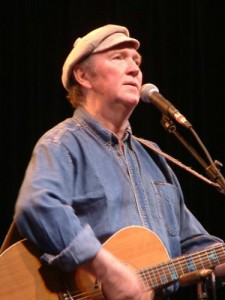
Liam Clancy at the Milwaukee Irish Fest. Photo courtesy of Sean Laffey, Irish Music Magazine

Liam Clancy at the Milwaukee Irish Fest. Photo courtesy of Sean Laffey, Irish Music Magazine

Liam Clancy, the last surviving member of The Clancy Brothers and Tommy Makem—possibly the best known of all the Irish folk groups—died on December 4 at the age of 74 in Cork, Ireland, of pulmonary fibrosis, a lung disease.

A celebrated balladeer—friend Bob Dylan called him the best he’d ever heard—Liam and older brothers, Paddy and Tom, a friend Tommy Makem appeared on the Ed Sullivan Show in March 1961, wearing their matching Aran sweaters (reportedly sent to them by the Clancys’ mother, Johanna), a performance that catapulted them to fame. By the following year, they had played Carnegie Hall and for President John F. Kennedy at the White House. The Clancys and Makem are widely credited with making traditional Irish music popular during the ‘60s folk revival both in the United States and in Ireland, and with influencing more than a generation of Irish musicians.

Liam Clancy was born on September 2, 1935, the youngest of 11 children in a musical family, in Carrick-on-Suir in County Tipperary. Along with music, the Clancy brothers loved acting. They immigated to the United States where they staged plays at the Cherry Lane Theatre in Greenwich Village, New York, raising money by holding midnight folk concerts after their productions. Liam even shared the stage with Walter Matthau and the young Robert Redford. Even though music called, Clancy always enjoyed reciting poetry as much as singing ballads.

We asked a number of Irish musicians and music lovers—some of whom knew Liam Clancy—to share their memories and their tributes with us. Here’s what they had to say:

Gerry Timlin, musician, Tyrone native, and co-owner of The Shanachie Irish Pub & Restaurant in Ambler

Liam Clancy, like his brothers and Tommy Makem, were my musical heroes, and like many a young folk music lover of the late 50’s and the early 60’s it was so refreshing to hear these new voices and songs coming from the wireless and records. The Clancy Brothers and Tommy Makem Live at Carnegie Hall is my favorite Irish album of all time. Liam Clancy’s versions of “The Patriot Game” and “The Parting Glass” will live on for ever, for me at least, as the best renditions of these two songs I’ve ever heard. Liam had a quality to his voice that was second to none and what struck me most was his diction and his unbelievable phrasing. The clarity of his voice was such that whether on not you’d heard the song before you could understand every word; his interpretation of songs and poems was impeccable. I know of no other singer, and I’ve worked with many, who could put a song across as well as Liam.

I had the pleasure of working with Liam on many occasions and I never knew him to be anything but the real deal when he stood under the lights. He was the consummate performer, the poet, the storyteller, the actor and the singer. He brought it all to the stage like no other performer I’d ever seen before in any genre. He knew his craft better than anyone and he loved his audience with a passion. He had that look in his eye and sincerity when singing a ballad that held you captivated and on the edge of your seat while he bought you to that place as only he could.

We have lost the last of a long line of great singers and entertainers. Tom, Paddy, Bobby, Tommy Makem and now Liam. The trailblazers who made the stage for all the rest of us. Now all gone. Who will carry the torch now? I’m not sure, but one thing is for sure—we’ll never see the likes of them again.

Onward and upward, Liam.

Paul Keating, director of the Catskills Irish Arts Week and a columnist for the Irish Voice newspaper

Liam Clancy described himself the last man standing among the Clancy Brothers and Tommy Makem, so amidst all the tributes to him are the declarations that it is the end of an era with them all gone now. I don’t share that view because what they did was release the great power of Irish music to the world and that can never be restrained now. They literally opened the doors for thousands of Irish musical artists including the Chieftains and inspired many careers and gave the Irish a confidence boost that predated the Celtic Tiger by thirty years. Liam Clancy continued to do that and encourage groups like Cherish the Ladies and Danu in the traditional realm for which he had great respect and appreciation for their talent.

A half century ago the Clancy Brothers and Tommy Makem were in the vanguard of the Greenwich Village Folk Music Boom that vied for attention with rock and roll and held their own. Even as he turned 70 some years ago, I was reminded when watching him at the Milwaukee Irish Fest that Liam Clancy still had magnetism and stage command. Celtic rock is the rage at most festivals these days and ironically its stage adjoined that of the Roots Stage where Liam’s solo act was slotted. With humor, poetry, prose and one of the greatest voices ever, Liam Clancy once again held his own that day, with a multigenerational crowd totally mesmerized by his charm and talent. His performance and many like it will never be forgotten by those who were fortunate to see him over the years and I am quite certain that I couldn’t say that about the other stage guests.

Sean Laffey, musician and editor of Irish Music Magazine

Liam was just the business, nobody ever like him, now then or in future, he just had it.

There is great sadness in the Laffey house today, but joy too that we got to know him personally and we had some time over our Saturday breakfast recalling the great times we had back in ’96 when we worked on his “Wild and Wasteful Ocean” album with him.

We had such fun in Helvic, singing into the rainy morning under an umbrella in front of Mooney’s pub, the table littered with pint bottles of stout and Liam egging me on to sing another verse and another verse of “Essequibo River,” which he really loved. Such generosity of spirit, the mark of a true gentleman.

Then there was a night in Dublin, at the Tall ships, when he and [nephew] Robbie O’Connell brought a dockside pub to life, the afternoon gig we had all done was by any standards mediocre, but that night’s music was beyond doubt special, and no one got it on tape or poked a camera phone in his face. It was singing for pleasure and right now it’s the best way I can think of
remembering him.

There will be much more written about Liam in the coming weeks, but for now we send our deepest condolences to his wife Kim and all his children. And thank God for the blessing that was Liam Clancy.

Judy Walsh, active on the Irish music scene in DC, now living in Milltown Malbay, County Clare

Years ago in Washington, DC, I was asked by a friend to chauffeur Liam and Tommy Makem to a concert he was putting on. I took them to The Dubliner Pub for an early supper. While we were eating, a man walked by, stopped suddenly and said to Liam, “I know who you are! Christy Moore! Can I have your autograph?” He grabbed a paper napkin from a nearby table and Liam signed it “Christy Moore”. Years later when I met Christy’s sister Anne here in Miltown Malbay she got a big kick out of the story, as did her brother when she told him.

Gabriel Donohue, Irish singer, musician, producer from Anthenry, County Galway, now of New Jersey

The first time I met Liam was in New York at Tramps Club in the village. I was playing with Eileen Ivers and Joanie Madden.We opened for him and when he walked in there was a very small crowd. He didn’t go on stage at all that night but got the small crowd to encircle him as he reigned over a world class session. Danny Quinn was there and Pat Kilbride (Battlefield band) also Martin Murray (Chieftains sound man and fiddler).

Liam was a very open individual who didn’t mind sharing his philosophy and his poetry to whomever would listen. He taught me more about Yeats, Shakespeare, Baudelaire and Tennyson than I ever learned in school. I went out and bought the poetry afterwards to get a little deeper, but he was the catalyst for me getting into those poets.

I was spellbound by his reading of Mary Hynes and suggested it to Joanie Madden for the CD I was then producing for her. I played piano on that track and he teased me about using a diminished chord on that which he thought was jarring and of course he was right. Those chords are rarely heard in traditional music or folk. Still he chose it for his collection Liam Clancy favorites. Needless to say I was delighted.

He and Paddy would often come to visit in New York city when I played at the South Street Seaport or Rosie O’Grady’s. Liam would sing a few songs and bring an otherwise indifferent audience to their senses. Afterwards we’d retreat to the Glocca Morrah on 23rd Street and more stories of Leadbelly or their tenure at the Playboy Club in Chicago would ensue.

They never took for granted the richness of their lives and the characters they met along their journey as evidenced by the stories they told over and over. I remember most of them. About passing a guitar around a circle in New York and singing songs but passing over this one young man all night. Finally Liam says “Do you sing at all? ” The young man says “a little” and sings a song he just wrote, “Mister Bojangles.” Jerry Jeff Walker was willing to sit silent and soak all the magic up in silent awe at the culture these Clancys carried with them.

Just this January I spent a week in Mexico with Liam and the Makem Brothers and a fine entourage of musicians. Liam was no longer willing to sit and recite poetry or sing songs until the dawn. Nevertheless, one night he called me over to a quiet corner in one of the lounges and began philosophizing on a few different topics. Words were the most precious thing to him. He said he loved them even more than music. He spoke of the closing scene of the movie, “The Night of the Iguana,” about a man at the end of his rope. I was saddened to hear him talk this way as he was as powerful performer as ever. Still I knew he was tired.
Thousands of performances had taken their toll as had the hardship of a less than ideal childhood in Carrick on Suir in Tipperary. His lungs were not able to power that godlike voice of his, though his shows were still brilliant. He was ready for a good long rest it seemed.

He was my hero, probably the greatest hero I ever had. A nice man too, who welcomed people into his circle with that great big Clancy heart that they all had. Their voices thundered out of our small record player we had back in Athenry with few discs except theirs to play on it. We learned of heroes like Roddy McCorley and the street songs like “Tell Me Ma” and “Finnegans Wake.”
Can we imagine a childhood without the sweater men? Inconceivable as a playground without the laughter of children.

Slán Liam and thanks for all you did for the music and us the purveyors of the ancient art of balladry.

Fil Campbell, Irish folk singer, of Rostrevor, County Down

I had the pleasure of meeting him on a couple of occasions at parties here in Rostrevor but sadly only as a passing acquaintance.

Liam had a huge influence on Irish music and on me personally—one of the first concerts I ever went to see was Liam Clancy and Tommy Makem as a duo in the Astoria Ballroom in Bundoran. I had been more into pop and rock music up until that time but they changed my focus—they sang so may songs that I knew and loved, songs that have stayed in my repertoire over the years. Ironically the guitarist who played with them that night was Brendan Emmett who now plays with Tom [McFarland, her husband and partner] and myself.

The Clancy brothers and Liam in particular had the flamboyance of superstars and an energy that made Irish music a force to be reckoned with on the world stage. They were fiercely proud of their heritage and the legacy of their recordings will be with us for a very long time to come. You’ll be sadly missed Liam—RIP.

Matt Keane, Irish singer, County Galway

I didnt know Liam, but without knowing it, he was the cause of me trying to learn to play guitar and sing. Sometime in the ‘60s, himself and Tommy came to play in my local town, Tuam, Co. Galway. He played and sang, “The Band Played Waltzing Matilda” to a spellbound audience in the Odeon Cinema. My sister Dolores [Keane] and brother Sean would have met Liam at various venues all over the place. I played Galway last night and sang ” Matilda” and “Will You Go Lassie Go.” All the audience joined in, which is an indication of the appreciation and respect in which he was held.

Carmel Gunning, composer and musician from County Sligo

I didn’t know Liam personally but I had great respect for his talent as a ballad singer and the way he put a song across to his audiences. He had a lovely sweet velvet voice, so easy on the ear and very tuneful. It’s the end of an era really. The group sang and jelled very well together simply because they knew each other so well and they were all equally as good as each other, be it on their instrument or voice. Rest in Peace.

News, People

A Worship Service With Celtic Atmosphere

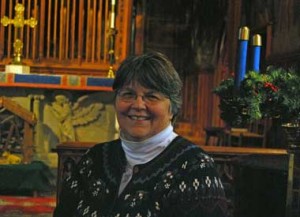
Cynthia DeDakis, minister of music at St. Thomas.

Cynthia DeDakis, minister of music at St. Thomas.

Scratch the surface of any one of us Celts, and underneath you might find a pagan.

Many of those who are card-carrying Christians now are descended from an ancient people who looked for the sacred in the natural world. They plumbed the depths of mysticism. Fire was their friend.

Of course, we’ve come a long way since then. Our beliefs have matured. But for those of us whose people came from Ireland, Scotland, Wales and Brittany, the old beliefs—or more likely, the trappings of the old beliefs—still hold some appeal.

If Celtic spirituality speaks to your inner Celt, you might find a comfortable home at St. Thomas’s Church in Whitemarsh, where Celtic worship services are held monthly through March.

Cynthia DeDakis, minister of music at the elegant old Episcopal church at Bethlehem Pike and Church Road, isn’t surprised that Celtic spirituality continues to appeal to many of us.

“The earliest flowering of Christianity in the Celtic countries was very much adapted,” she notes. “The Christians who came in to evangelize where there had been pagan religions before used a lot of the forms and sensibilities of the pagan religions. There’s a close connection with nature and seeing all nature as sacred. I think it appeals to people for a number of reasons, and that’s one. I think Celtic culture is attuned to feeling more connected to the earth. We do try to emphasize that to a certain amount.”

In all the liturgically important respects, the service is Christian. There’s an opening prayer, a reading from Scripture, a homily and a Eucharist. Where does the “Celtic” come in? Many of the prayers come from Celtic sources, some of them ancient, but it’s really more in the atmosphere.

First, there’s the music—near and dear to this classically trained musician, who also plays hammer dulcimer. “Last year, and the first two services this year, we’ve been using harp,” DeDakis says. “I try the best I can to use legitimate Celtic music in the services. People really appreciate and enjoy that style of music. I’ve been working on adapting it somewhat and trying to make it more truly Celtic. It’s a work in progress.”

There’s candlelight. And there are long stretches of silence and reflection. It’s an earthier, less structured occasion of prayer. That’s what the folks at St. Thomas are going for. They’ve been at it since 2005.

“There’s a kind of spirituality that moves into the mystic when you bring in the candles, silence and simple, quiet music,” DeDakis says. “It’s not as demanding in terms of participation. People tend to spread out. We are hoping to build the service and draw people who don’t come to St. Thomas on a regular basis but who are looking to find something like this that feeds them spiritually.”

There’s a Celtic worship service at St. Thomas this Sunday at 5:30—look for it to have a special Christmas theme—and once each month through March. (Consult our calendar.) And if you’d like to go beyond merely attending, DeDakis is on the lookout for traditional musicians who might want to help set the tone. Contact DeDakis by e-mail at cdedakis@stthomaswhitemarsh.org.

News, People

Donegal Association Chooses Its Mary from Dungloe for 2010

Kiera McDonagh

Kiera McDonagh

The newest Mary from Dungloe is a LaSalle University graduate working in the real estate field who loves sports and adventure travel.

On Sunday, November 28, Keira McDonagh of Philadelphia, an Archbishop Wood alum, was chosen from a field of 13 young women and crowned at the 121st Donegal Ball, which was held at the the Irish Center in Mt. Airy. Although the story of young woman for whom the pageant is named, celebrated in a 1936 song by stonemason Pádraig Mac Cumhaill, is one of tragic love, the pageant is sweet and tends to promote new friendships among the young women who participate. Witness: The following day, the former competitors were all friending each other on Facebook.

McDonagh will represent the Philadelphia Donegal Association at all major events over the coming year, including the St. Patrick’s Day Parade. This summer she’ll travel to Dungoe, County Donegal, to compete in the International Mary from Dungloe pageant. The reigning Mary is from County Derry and Philadelphia’s retiring Mary–a spitfire who is anything but retiring–is Emily Weideman.

When you’ve been throwing a ball for more than a century, you tend to do it right, and this one was no exception. Almost 500 people attended the more than six-hour event. There were dancers on the floor for hours, twirling to the tunes of the Sean Wilson Band and DJ John McDaid. Grand Marshal was Eileen McAleer and Ball Chairman, John Gallagher. There were even distinguished visitors from the Dublin Donegal Association.

But don’t just take our word for it.

Check out the photos.

News

Last Rambling House Till Next Year!

Karen Boyce McCollum, Mike Boyce and John Boyce were the house band for last week's Rambling House.

Karen Boyce McCollum, Mike Boyce and John Boyce were the house band for last week's Rambling House.

We confess: We’re addicted to the Rambling House events at the Irish Center. There won’t be another one until January and we’re looking at a month of withdrawal.

For those of you who just joined us, a Rambling House is a tradition of rural Ireland in which neighbors would gather together at someone’s house and entertain one another with their “party piece”—a song, story, recitation, something they did well. And the Irish Center’s Rambling House events, started last year by WTMR Irish radio hosts Vince Gallagher and Marianne MacDonald, are authentic. Audience members, occasionally fortified at the Center’s bar, have gotten up to sing, tell jokes, play an instrument, and, last week, to delve into local Irish history.
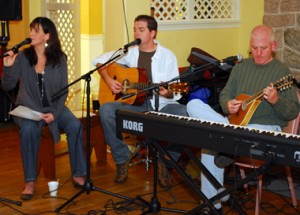
Part of last week’s excitement was hearing Karen Boyce McCollum sing, with her brothers Mike and John Boyce (of Blackthorn) accompanying. She was “due any minute,” and a few days later did deliver a boy, Daniel Terrence McCollum. Congratulations to Karen, Brian, and Sarah Carmel!
We were there, of course, and did the photo thing.
News, People

Crowning Glory: Inside the Miss Mayo Pageant

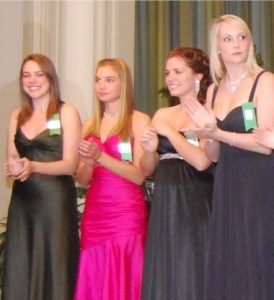
That's Kaitlyn, third from left.

That's Kaitlyn, third from left.

By Kaitlyn Linsner

Since I currently live in Philadelphia and am Irish-American, I would have to refer to myself as an Irish Philadelphian. And as an Irish Philadelphian, of course, I am interested in all things Irish in Philadelphia. I heard about a Miss Mayo pageant in the area and wanted to write about it, but instead I became a contestant.

The Mayo Association is a nonprofit Irish organization that consists of descendants from County Mayo. The group has been around for 104 years. Through different fundraising events, the Mayo Association has worked with other organizations to help in the construction of the Galway Cathedral in Ireland and the Irish Memorial at Penn’s Landing. They have also given donations to Philadelphia charities and assisted physically and mentally challenged children, both here in the states and across the pond in Ireland.

The Mayo Association’s main fundraising event is the Mayo Ball, held annually at the Irish Center located in Mount Airy. The Mayo Ball combines music, dancing, food, drink and the elegant Miss Mayo pageant. I decided to test my Irish heritage by attending this ball and also competing in the pageant, which resulted in a highly entertaining night.

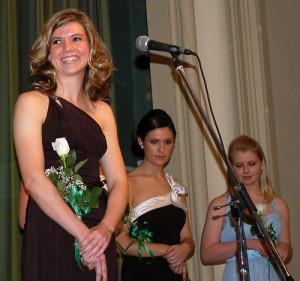
After sending in my Miss Mayo application, I had to buy a formal gown for the big event. On November 7, I was dropped off at the Irish Center. I was draped in black silk, my head covered with hair spray and bobby pins. There were 12 other contestants mainly from the Philadelphia area, ranging from ages 17 to 24, all of Irish ancestry and eager to compete for the grand prize: a round trip to Ireland. The new Miss Mayo has other duties, such as representing the association in the Philadelphia St. Patrick’s Day parade and also making appearances at other social events.

We all arrived around 5 p.m. in our pageant garb and anxiously sat around, waiting to be interviewed by the four mysterious judges waiting in a different room. We then attempted to make small talk with each other, but really this was a way to scope out the competition. Who was wearing the nicest dress? Who had the nicest earrings? And, of course, who has the most qualifying attributes? We talked about our high school endeavors, and I became witness to what low-key pageant girls like to emphasize.

“I don’t really like to give speeches although I was captain of the speech team in high school.”

“Oh, I just threw my hair up in like a half-hour and re-used a prom dress. Yeah, thanks, I know it looks really nice, but really I don’t put much effort into what I look like.”

As we all know, of course, the judges are really looking at what’s on the inside.

I was contestant number 10, and as each girl resurfaced after her interview, the others discretely preyed on her knowledge, wanting to know what kind of questions were asked in order to formulate some exceptional responses beforehand.

I didn’t quite care. I entered into the interview hoping to fully express my undying love for Ireland and service through my responses. The four judges sat on a panel, I sat awkwardly close in front of them and answered questions for about five minutes. They were, of course, on a time limit because the dancing, food and drinking was more important. I’d have to agree.

After the interviews, the 11 contestants and I ate some sandwiches and fruit (must keep the pageant girls skinny) and then took some solo and group photos. I guess this was my first shot at modeling; it took me 10 minutes to decide where to place my arms.

We then entered into the large ballroom where there was a large stage and many tables filled with guests of all ages dressed to the nines. The music started and soon the Irish were jiving, waltzing and smiling through set dances as the band played old Irish hits.

Around 9 p.m. we had to line up with our escorts to walk across the ballroom. Two bagpipers led a group of about 30 Irish dancers from the Rince Ri School of Irish Dance. As they danced, we lined up with our escorts. I did not have one and was assigned to walk with the president of the association’s husband. A large age gap, yes, but at least his tux matched my dress.

We walked across the ballroom, lined up onstage in front of the eager audience and then waved when we were introduced. I tried to stand like a pageant lady, which of course means I had no idea how to stand, and I believe my wave looked like a cross between Miss America’s delicate gesture and a raptor claw.

Then the festivities continued. Supposedly the judges were watching our every move, and this prompted me to talk to strangers and do the twist with a nun. I tried to learn dances and had to hold myself back from guzzling pints of Guinness. I was not completely sure if an Irish pageant condoned drinking.

11 p.m. rolls around. It’s decision time. We all congregate around the stage, and some girls giggled, trying to decide who they think the winner is. The dang photographer kept snapping photos, and since most of the girls knew I was writing a story on this, they began to ask me if I was a spy who actually knew the results from the get-go. Not true.
 
On stage we go, and sweating in the spotlight I stood waiting as the MC started to announce the winners. Second runner up, first runner up and the winner is… not me.  The new Miss Mayo is Caitlin Lotty, and she is all smiles and instantly congratulates all contestants with so much joy even I could not stop smiling.

“I am totally floored! I can’t believe this!” Caitlin said. And as she was crowned and given flowers, all the guests clapped and clapped as her mother jumped around with excitement.

Cue the music and dancing, and everyone continued to drink and be merry. I had a pint of Guinness, did some networking and left with a large grin.

I lost the pageant, yes, but I now know of an adorable Irish tradition located in a great Irish center in Philadelphia. Although this experience does not quite add up to a free trip to Ireland, I still had fun. Cheers, Mayo Association, thanks for a good night.

News

Help Save the Parade

Until a couple of weeks ago, the only communication the city of Philadelphia received urging the city to financially support the Philadelphia St. Patrick’s Day Parade and other ethnic parades in the city came from the organizers themselves.

That’s not enough, says St. Patrick’s Day Parade Director Michael Bradley, who will be testifying before City Council on December 8 along with members of Ethnic Americans United, the new group comprising representatives of all the ethnic parades that march the streets of Philadelphia every year.

So this week, on the heels of the city’s loss of the Dad Vail Regatta after more than 50 years because of money woes, he emailed 25,000 people, including all the major Irish organization in and around the city, asking them to contact the mayor and city council members. Here’s the text of his message:

“Please contact Philadelphia City Council and Mayor Nutter and tell them we need funding for our Irish Parade on March 14, 2010 or it will go the way of the other lost events and revenue in Philadelphia.

“We have been marching since 1771. Do they want to be the ones responsible for the worldwide negative publicity this will create if we don’t reach some kind of SHARING of costs? We are not asking for it all!

“Please be respectful and positive, but strong and effective with your comments. Please contact each member of City Council, you can copy all of them in your “EMAIL TO:” line and send one email to all at once and I will have a copy for our records . This must be done before December 5th as I have to testify on our behalf on December 8th in front of City Council:

anna.verna@phila.gov; bill.green@phila.gov; blondell.reynolds.brown@phila.gov; brian.o’neill@phila.gov; curtis.jones@phila.gov; darrell.clarke@phila.gov; donna.miller@phila.gov; frank.dicicco@phila.gov; frank.rizzo@phila.gov; jack.kelly@phila.gov; james.kenney@phila.gov; jannie.l.blackwell@phila.gov; joan.krajewski@phila.gov; maria.q.sanchez@phila.gov; marian.tasco@phila.gov; william.greenlee@phila.gov; wilson.goode@phila.gov; Michael.nutter@phila.gov; info@philadelphiastpatsparade.com

News

Irish Hall of Fame Dinner: A Focus on Families

Mom Bridey with the Egan clan.

Mom Bridey with the Egan clan.

While accepting the award acknowledging his late father Pat’s induction into the Delaware Valley Irish Hall of Fame on Sunday night, November 15, Fran Egan said he was surprised to hear his father described as “a quiet man.”

Pat Egan wasn’t quiet, but he hated being the center of attenion, said his son. “If he were alive today, he would be angry at all of us for doing this to him,” he said, his mother, Bridey, by his side. “He was not one for crowds and he would have found a way to deflect this honor. So this worked out well–he got his honor, he didn’t have to the center of attention, and Mr. Farrelly [master of ceremonies Tom Farrelly] got to sell a lot more tickets to the Egan family.”

There was a roar of laughter from one side of the ballroom of the Irish Center—many of Fran Egan’s 11 brothers and sisters were sitting there with their families.

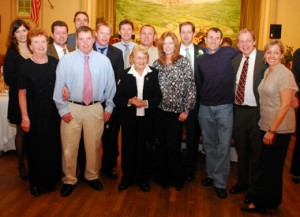
It was a big night for big families. The children and grandchildren—and a few aunts and uncles—of inductees Sean McMenamin and his wife, Johanna, took about another fifth of the room. And if an Ancient Order of Hibernians division can be considered a family—they call themselves brothers and sisters–then honoree Joseph E. Montgomery’s blood and bond families took up at least another fifth. Nearly 20 members of Division 65—the Joseph E. Montgomery Division—were on hand to honor the man who served as president for 42 and who is the only living person to have an AOH named after him.

A special award went to Irish Deputy Consul General Breandon O’Caollai, accompanied by his wife, Carmel, and daughter, Siobhan.
We were there and took lots of photos.