All Posts By

Jeff Meade

People

Local Boy Makes Good

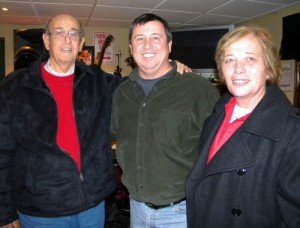
Jim Dougherty, parade chairman Jim Gallagher, and Doc's wife Jane.

Jim Dougherty, parade chairman Jim Gallagher, and Doc's wife Jane.

Conshohocken loves a parade, says this year’s Montgomery County St. Patrick’s Day grand marshal Jim Dougherty. And if anyone should know what they love in Conshy, Dougherty should.

Except for a two-year hitch in the Marine Corps, including a year in Vietnam, Dougherty has lived all his life within that Conshohocken ZIP code. He spent his early years on Hector Street. His dad Matthew was a Conshohocken police officer, later working for the Montgomery County sheriff’s department. After the young Dougherty returned from the service in 1981, he became a Conshohocken police officer, rising through the ranks to become a detective and, later, the department’s chief. (He retired in 1994.)

So six years ago, when the Ancient Order of Hibernians Notre Dame Division in Swedesburg went looking for a point man to help them move their annual parade from Norristown to the neighboring river borough of Conshohocken, they turned to their old friend “Doc” to help them gain all the necessary local approvals.

Says Dougherty, it was not a hard sell.

“I took it before the council. The vote was seven to nothing in favor,” he recalls. “That’s how tough it was. Most of the people on council were Irish, anyway.”

And with that, the first parade marched down Fayette Street on March 11, 2006. It’s been a popular event from one year to the next, with crowds lining the street from one end to the other. “It’s still wall to wall,” says Dougherty, and each year the crowd gets deeper.”

That the parade is now in his home town is gratifying to Jim Dougherty. He has never stopped loving and caring about that scrappy little borough, and the local attachments run deep.

“My family’s there and that’s where I’ve stayed,” he says. “It’s been redeveloped, but it’s still the same way it always was. It’s a quiet, quaint town. In Conshohocken (when he was a kid), everybody knew everybody. It was the kind of place where, if you got in trouble with the police department, your father and mother knew about it before you got home. And basically, it’s still the same way today—everybody still knows everybody.”

So when his friends in the AOH came calling with the idea to move the parade to Conshohocken, it wasn’t a tough sell for him, either. And he’s quick to add that it wasn’t all through his efforts that the parade came to town.

He recalls the event (AOH Notre Dame Appreciation Day on December 18) at which parade chairman Jim Gallagher read out all of his accomplishments and spent some time talking about his role in the move from Norristown to Conshy. “It was all true,” he says, “but there were other people in town who did a lot, too. We all brought the parade to Conshohocken.”

Dougherty will be honored and officially sashed as grand marshal at the Grand Marshal’s Ball on March 5 at the Jeffersonville Golf Club Ball Room. Any Irish organization that wishes to take part in the parade in Conshohocken please e-mail Pete Hand at hjerrylewis@comcast.net.

News

It’s … Aliiiiiive!

Mad scientist

BWA-ha-ha-ha-haaaaaa!

Ain’t it pretty?
 
We hope you’ll think so. The redesign of irishphiladelphia.com started way back in April–when, presumably, we had recovered from the rigors of St. Patrick’s Day.
 
Why’d we do it? Well, in part for the same reason people buy new living room furniture, paint the bedroom, or install a new granite kitchen countertop. After nearly five years of web wonderfulness–yes, five!–we kind of got tired of the old look and thought it might be nice to spruce things up a bit.
 
But we also did it for the same reason people clean out the hallway closet, get rid of all the old baby clothes, and sort out their file drawer. We wanted to get rid of clutter and organize things so they’d be easier to find.
 
We think we’ve done both.
 
So on the surface, of course, you’ll see a new look, including a snazzy logo and our stunning St. Patrick’s blue. (Bet you didn’t know there was such a color.) But under the slick new surface, you’ll find improved organization of all of our topic areas, better organized and more useful presentations of our pub finder and gift shop finder, easier ways to share our stories on social media like Facebook, more intuitive display of comments, and a spiffy new “carousel” at the top of the home page that lets you see our latest stories at a glance. There’s more than that, of course, but it’s almost too geeky for even us to go into.
 
We’ve also installed two stunning ways to–ahem–buy advertising on the site, with one big fat honkin’ ad space at the top of every page, and a really large ad space at right. If you want to know more (and we hope you will want to know more), check out our advertising page.
 
We’ve also improved how we look on smartphones. So anytime you want, you can yank out your Droid, plug “irishphiladelphia.com” into your browser, and–voila!–even more geeky coolness.
 
We sincerely hope you like what you see. And you can share your comments with us, below.
 
Thanks!

Music

Review: “A Galway Afternoon”

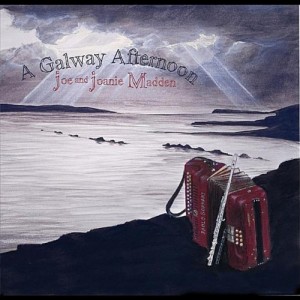
A Galway Afternoon“A Galway Afternoon” would be a priceless gift to Irish music listeners under any circumstances, filled as it is with tunes that encapsulate and preserve so many examples of box player Joe Madden’s boundless energy and the apparently limitless joy he took in playing.

Joined and supported by his famous daughter Joanie on flute and whistle on 13 of the 14 tracks, Joe Madden packs a sound that seems to well up from some deep place to expand and fill the room, sucking up every last ounce of oxygen. Joe Madden is a commanding presence, and “A Galway Afternoon” is very much his own.

What makes the release of this CD (at Catskills Irish Arts Week) so poignant and precious is the fact that Joe Madden is no longer with us. All the tracks on which he is featured are the result of Joanie’s crafty plan to pull him into Charlie Lennon’s Cuan Recording Studio in Spiddal, County Galway, in June, 2008. At the time, he was just shy of 70.

Like a lot of traditional players, Madden apparently was not the type to leap at an opportunity to record. That he was lured into the studio for such an all-encompassing exposition of his powerful skills was an act of providence. In November of that year, Madden fell down the stairs in his home, resulting in spinal cord damage and paralysis. Those mighty hands were stilled. Shortly thereafter, he died.

The Irish music community was left to cope with grief over Madden’s loss. But at the same time, it also was left with something wondrous to remember him by.

To be sure, Joanie Madden makes her presence known on “A Galway Afternoon,” setting her usual blistering pace on the reels and jigs and painting a lush, vibrant musical mural on the slow air “Sliabh geal gCua.”

But mostly, she seems content to play a supporting role, and the passion and energy of Joe Madden takes center stage. From one set of tunes to the next, it is Joe Madden’s playing that commands your attention. Maybe “demands” is a better word.

“A Galway Afternoon” is jammed with well-worn old tunes with colorful names like “Sault’s Own Hornpipe,” “The Little Thatched Cabin,” “Pussy Got the Measles” and “The Spike Island Lassies.” Madden obviously was one of those players who had forgotten more tunes than most of us will ever know.

There’s absolutely nothing fancy or fussy about how Madden plays. It’s just straight-ahead dance music, played with a sure hand. There’s a purity there, along with razor-sharp precision. 

Also joining the supporting cast are Charlie Lennon on piano, John Madden on drums (he’s flat-out wonderful) and Gabriel Donohue on guitar.

On the final track—a set of reels, including “Dinny O’Brien’s and “Sean Sa Che”—we’re treated to a glimpse of Joe Madden’s sparkling personality. After the music ends, we hear his laughing voice echoing in the recording studio: “The hell with the last couple of notes. That’s it.”

No, Joe. As long as we have this recording, that’ll never be it.

News

Hibernian Hunger Project Helps to Make the Season Bright

Making a list and checking it twice: Bob Gessler and Donna Donnelly.

Making a list and checking it twice: Bob Gessler and Donna Donnelly.

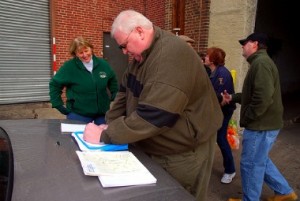
On a chilly Saturday morning, a small fleet of cars, minivans and trucks pulled up in front of Shamrock Food Distributors on Fraley Street near the Frankford Armory. Bob Gessler, founder of Philadelphia’s Hibernian Hunger Project, pulled up, and within minutes the huge loading dock doors rolled open. Volunteers wearing jackets and shirts from many local Ancient Order of Hibernian divisions poured from the vehicles, and within a short time a very smooth-running assembly line spontaneously took shape.

Boxes were loaded into truck beds and wedged into car trunks. Gessler handed envelopes neatly filled with addresses and street maps to drivers, and soon all those vehicles were headed out of the neighborhood in all directions.

This rarest of things—an Irish project run with Prussian efficiency—was the Hibernian Hunger Project’s first Christmas food basket operation. The local Hunger Project committee hatched the idea maybe three weeks before, not knowing how it might go or how many needy families would be provided with frozen turkeys with all the trimmings for their Christmas dinner.

In the end, the local committee raised funds for 70 boxes loaded with food, and easily found needy families to receive them.

“We had a committee meeting to propose the idea, and we all said, let’s just do it,” explains Gessler. “We sent the message out to as many people as we could, and we got a list of names. This year, so many people need it. What’s nice about this is, it really does some good. Everyone we talked to was appreciative.”

Helping the project get off the ground was Jimmy Tanghe, owner of Shamrock, who found a way to turn the many donations into boxes crammed to the lids with nutritious food. “I asked if he was up to the challenge,” Gessler says, “and he was.”

This year’s project was so successful, Gessler says, there are already plans to do it again. And Gessler and his gang are already thinking big: “I think 200 baskets is the minimum for next year.”

News

2010: The Year in Video

Fil Campbell

Fil Campbell stars in one of our vids.

This was the year we really got into video big-time.

Oh, we’d dabbled in years past, but in 2010 we suddenly discovered our inner Cecil B. DeMille. And the good news: all of Irish Philly was ready for their close-up.

We caught the finale of the Philadelphia Ceili Group Festival, the Coyle Irish Dancers at the Brittingham’s Irish Festival, pipers at the Easter Rising Commemoration, marchers in the Philadelphia St. Patrick’s Day Parade, Karen Boyce singing a song for Jim Kilgallen, and manic drumming by the memorable Celtic band Albannach at the Midwinter Scottish-Irish Festival.

Video really gives you a chance to relive the fun events of 2010. And if you weren’t there, you can see what all the fuss was about.

Tune in.

News

2010: The Year in Photos

One of our favorite photos from the Philadelphia St. patrick's Day Parade

One of our favorite photos from the Philadelphia St. patrick's Day Parade

If it was Irish, we were there: the Delaware Valley Irish Hall of Fame awards, the annual Irish music concert to benefit St. Malachy’s School, GAA games in their last summer at Cardinal Dougherty, the Philadelphia Ceili Group Festival and Irish Night at the Phillies.

Then there was the Mathew Carey Award, the Miss Mayo, Mary from Dungloe and Rose of Tralee pageants, Irish Network-Philly gatherings, the Penn’s Landing Irish Festival, the Inspirational Irish Women awards, the Irish Stew Cook-Off … and more parades than you can shake a shillelagh at.

Music

We Had Ourselves a Merry Little Time

Tommy Martin and Séamus Begley.

Tommy Martin and Séamus Begley.

“Irish Christmas in America,” Sunday night at the Philadelphia Irish Center, was a great show. So great that we wanted to share plenty of videos with you so that you could see precisely how great it was. Really, really great.

But a funny thing happened on the way to the Web site. Our camera walked—and with it went all our videos. We blame the wiki-hackers.

We can tell you about it, of course. With members of the Irish band Teada at its core and led by fiddler Oisín Mac Diarmada, the ensemble was aided and abetted by uilleann piper Tommy Martin, County Mayo harper Gráinne Hambly and singer-box player-part time comedian Séamus Begley. Sean-nos dancer Brian Cunningham took to the stage frequently throughout the night, threatening to slam through the Irish Center stage. (The crowd—and it was a pretty good crowd—loved him.)

Irish Christmas in America crosses an ocean and cultural boundaries to share the traditions of the Irish—both at home and in their adopted country. So there were stories of the Wren Boys, Little Christmas and the bittersweet “wake” that became the tradition of those who parted from friends and family as they departed for the distant shores of America.

These poignant stories were accompanied by brilliant slides that set the mood and served as a counterpoint to the reels, jigs, airs and songs served up all night by the band. When he wasn’t regaling the audience with off-topic but hilarious stories of his own, Begley held the audience in rapt attention as he sang tunes like “Silent Night”—first in Irish, then in English—and “The Parting Glass.” One minute, you were laughing so hard you almost fell out of your seat, the next moment you were a puddle of tears.

As we’ve pointed out: No videos. But we do have a few photos to help you get into a seasonal mood.

Music

From Michael Coleman to Riverdance

Patrick Mangan

Patrick Mangan

For years to come, two words inevitably will precede Patrick Mangan’s name: “Riverdance fiddler.”

Which is OK by him.

Although he is well-grounded in traditional Irish music—and you’ll hear plenty of it Saturday night when he plays a concert at the Philadelphia Irish Center with friend and singer-guitarist Ryan McGiver—Riverdance is a major part of his life, and has been for a decade.

Mangan, born in Brooklyn and trained in the ways of New York Sligo-style fiddling by the great Brian Conway, first came to the attention of the show’s producers in 2000, when he was just 15, By that point in his life, he had already won the Fleadh Cheoil na hÉireann (the world competition of Irish music, also known as the All-Irelands) twice, in 1994 and 1997. He was young, but he’d already had experience on the world stage.

Riverdance was quite another thing altogether.

He remembers when he first considered trying out for the show. “I saw something in one of the New York Irish papers. It was just a little listing saying Riverdance was looking for substitute fiddlers for the show on Broadway,” he says. “So I recorded a little four-track demo and sent it in. They invited me to audition, and I remember playing in front of the show’s composer Bill Whelan and the piper Declan Masterson. (After that) I didn’t hear anything for almost a year. Then they invited me to audition again.”

It turned out that one not-so-little factor gave the show’s producers pause. “They had never had a male fiddler before. It broke the mold. Eileen Ivers had made it an iconic role for a female fiddler, and they were a little on the fence about that, but they decided to give it a shot.”

That was in 2001. He was 16.

That shot turned into a fill-in gig that Mangan wound up squeezing into his high school and, later, college schedule.

The relationship with Riverdance evolved into something deeper and longer-lasting not long after his graduation from Tufts with a degree in English, with a minor in music. The degree seemed like the right thing to do, and it played to his strengths, but after graduation Mangan still hadn’t settled on a career path.

And then Riverdance came calling again. “I had maintained the connection with them throughout high school and college. Then, just after graduation, a full-time spot opened up with the American touring company. I’ve been touring with them full-time since college. I’ve been all over the world. It’s lucky Riverdance came along when it did.”

(His long relationship with Riverdance also changed his life in another significant way. It’s where he met his future wife, fellow cast member and Russian dancer Natia Rtveliashvili. They were married in June of this year. At last count, there have been over 30 marriages among Riverdance cast members.)

Mangan came to Riverdance already well-schooled in the traditional style of fiddle play. In fact, because he was taught by Brian Conway, and Conway was mentored in part by Andy McGann—and McGann himself was schooled by Coleman—Mangan has been described as a “direct artistic descendant of early 20th-century Irish-American fiddler Michael Coleman.” It’s worth noting that Mangan himself, when he was very young, also played with McGann, and McGann’s contemporary Paddy Reynolds.

“Just to have that influence and those older musicians being so gracious and generous when I was growing up, i was very lucky to be growing up at that time,” Mangan says.

And because his parents were devotees of traditional music, there was never a time in Mangan’s young life that he was not exposed to the old tunes of Ireland. He recalls listening to the music from his stroller at the Irish festival in Snug Harbor on Staten Island.

His love of that form of music has never gone away. As much as Riverdance has helped him gain in popularity and name recognition—and it has done that—he’s eager to play the old style with his partner McGiver.

Still, Mangan began his fiddle schooling with classical music taught in the Suzuki method, and he maintained his familiarity with the classical throughout his childhood and high school.

Between his deep familiarity with both styles—traditional Irish and classical—Mangan says he felt well qualified to play the Riverdance style of Irish music, which is nothing like the way Michael Coleman played it. In addition, Mangan himself relishes many styles and types of music.

“Riverdance at its core is based in Irish music,” he says, “but it’s good to have a grounding in classical music. You can play in different styles if you have the technique. And I always enjoyed improvising. I’ve never had too much of a problem with that. When I first learned the (Riverdance) music, it was a fun challenge. By now, I’ve played it so many times, I could do it in my sleep.”

For Mangan, playing in the blockbuster Irish show that laid the groundwork for all the Celtic women and Irish tenors who would follow still holds his deep interest. In fact, he’s soon going to go out on the road with Riverdance again.

And that’s just fine with him, too.

“As many times as I’ve heard that music,” he says, “certain musical moments in the show still get to me. There’s a reason why that show has gone on as long as it has. It’s just amazing how much my life has been touched by it, how one thing has led to another.”