All Posts By

Jeff Meade

Dance, Music, News

The 2011 Mid-Winter Scottish & Irish Festival in Pictures

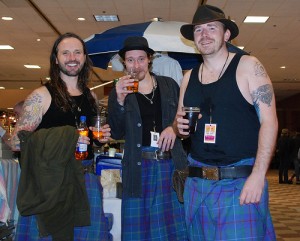
The lads of Albannach dropped by.

The lads of Albannach dropped by.

Yea, a mighty wind whipped through the land. In a flash and in the twinkling of an eye, darkness descended over the floor of the Valley Forge Convention Center.

Not the least bit put off by the gloom, the Celtic tribal band Albannach took to the stage and banged their drums. And it was good. Really loud, but still really good.

The good news about the annual Mid-Winter Scottish & Irish Festival: There was no snow or ice. The bad news: The massive windstorm that swept through Montgomery County on Saturday blew out all the power to the convention center. But even here, there was a silver lining. Celtic people kept on pouring through the gates. Bands continued to perform onstage. And with battery-powered lights marking the way, bargain hunters cruised the vendor floor in search of claddagh rings, thistle brooches, kilts and swords. They lined up for meat pies, Welsh cookies and Highland Creamery ice cream.

When the lights did finally come on, a roar went up from the crowd. And that’s the point: Even with a power-out, there was still a crowd, and it grew as the day went on. It was pretty sizeable on Sunday, too.

We captured memories of both days. To see what we saw, play the interactive photo essay up top. To see photos with captions, click here.

Dance, Music, News

Video Highlights: 2011 Mid-Winter Scottish & Irish Music Festival

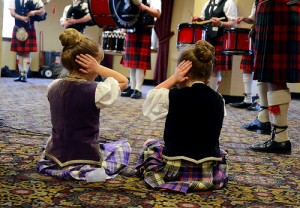
The pipes were calling

The pipes, the pipes were calling. And these two little Campbell School dancers were having none of it.

We were there for the whole weekend. We saw what you did. We know who you are.

Seriously, we tried to capture all of the essential elements of the 2011 Mid-Winter Scottish & Irish Music Festival in a video retrospective. Washington Memorial Pipe Band, the insane drummers of Albannach, our favorite juggler, and dancers of both the Scottish and Irish persuasions—we have it all.

For Saturday, we piled it all into one big honkin’ video; for Sunday, we broke things up a bit. If you were there, relive the experience. If you weren’t, well, let us fill you in on what you missed. (And make plans for next year.)

Thanks to Bill and Karen Reid for another great party.

Click on the arrows to right and left of the video frame to see all the videos.

News

Parade Fund-Raising Kicks into High Gear

Why is this man smiling?

Why is this man smiling? It's parade director Michael Bradley, and he's raising money for the parade and having fun at the same time!

You know that old saying about trying to stuff ten pounds of—well, stuff— into a five-pound bag?

That’s the situation the Philadelphia St. Patrick’s Day Observance Association faces between now and parade day, Sunday, March 13. The association needs to raise $70,000 to $80,000 between now and then, and they’re squeezing the lion’s share of their fund-raising into that really, really small window.

Attending to the logistical details of the parade—which float goes where, which dance school goes before the TV cameras and when—is relatively easy, says parade director Michael Bradley. The hard part is raising the money necessary to run the parade in the first place.

The most recent big fund-raiser was held at Ancient Order of Hibernians Division 39 last Sunday. Now, there are two more big cash-collecting events in the offing. The first one will be held Saturday, February 26, from 8 ’til midnight, at the Second Street Irish Society. “That’s a new group helping us out this year, and we’re very appreciative,” says Bradley.

The next event—and always a big boost—is the Blackthorn concert at Springfield (Delco) Country Club on Sunday, March 6, from 3 to 7 p.m.

Between those two events and our ad book, that’s the bulk of our fund-raising,” he says.

All of that fund-raising is serious business, but it can be a great time, too.

“We’re going to have a lot of fun, no matter what we do,” Bradley says. “There’s nothing worse than going to an event and feeling like they’re just taking your money. I’m not going to be involved if its not fun. That has a lot to do with our success.”

(We’ve gone to the Blackthorn event, and it was standing room only. Trust us, no one was too overly caught up worrying about raising thousands of dollars. They were too busy partying.)

That’s just how the folks organizing the parade want it. Says Bradley: “Theres no parade without the people, and if you don’t make the fund-raisers special, nobody is going to come.”

One last detail: The ad book. If you have a business or organization (or maybe it’s just you or your family), you can help out by buying an ad in the parade ad book. For details, contact Michael Bradley at (610) 308-8994.

News

They Danced All Afternoon at Division 39

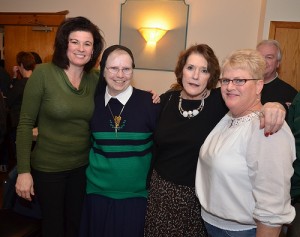
Sister James and court

This year's parade grand marshal, Sister James Anne Feerick, is second from left. She's joined by Mary Frances Fogg, left, parade committee president Kathy McGee Burns, right, and Mary Patrick, right.

The AOH Hall down on Tulip Street was jammed to the rafters Sunday as Division 39 hosted a big fund-raiser for the 2011 Philadelphia St. Patrick’s Day Parade.

Jamison provided the tunes, and both the girls of the Celtic Flame School and guests alike took to the dance floor often throughout the afternoon.

There was plenty to munch on (are meatballs Irish?) and the beer flowed liberally. (No, not too liberally.)

It won’t be the last fund-raiser for this year’s parade … but it will be remembered as one of the best.

Click here to see the photo essay with captions.

Music

Review: “A Moment of Madness,” by Brendan Begley and Caoimhín Ó Raghallaigh

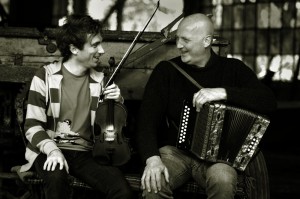
Caoimhín Ó Raghallaigh and Brendan Begley

Caoimhín Ó Raghallaigh and Brendan Begley

Button accordionist Brendan Begley and fiddler Caoimhín Ó Raghallaigh call their new CD “Le Gealaigh/A Moment of Madness.” If this be madness, there is method in it.

This 12-track recording is a bit of barely controlled wildness. I’m thinking in particular of one live track (“The Green Cottage,” “The Glin Cottage” and “Julia’s Norwegian Polka”) that brings to mind the image of a freight train roaring downhill, going faster and faster until the whole thing threatens to run off the rails.

It never does—but it’s a near thing.

There are a few moments like that on this recording, moments where musical expression could well be sacrificed on the altar of speed. In the hands of anyone less capable, that’s exactly what would happen. But wildness, Begley says, is a hallmark of the West Kerry style of accordion playing—and it’s Begley who seems to be leading this charge. You get the sense that wildness is exactly what these two musicians want to bring out in their tunes.

So yes, it is all a bit mad on occasion, but somehow they maintain their sanity.

We started out talking about a particular set of polkas. We could well talk a good deal more about them. There are six sets of polkas on this recording. As for the rest, it’s a neat little mix of jigs, a pair of laments and one set of hornpipes. Anyway, if you like polkas, you won’t be disappointed. With the exception of the aforementioned runaway train, most of them are well-suited to dancing. A particular favorite is track three—”Sean Keane’s” and “The Ardgroom Polka.” Begley plays the first tune, hitting all those deep, resonant chords, setting the pace. One of the interesting things about this CD is that you can hear the clicking of the accordion buttons on a few tracks. Maybe this isn’t what the musicians intended—it’s not the polished thing to do—but it gives the CD the ring of authenticity. It’s as if you were sitting next to Begley in the circle at a session. It’s almost visual. Ó Raghallaigh jumps in on the second tune, and the two together play with authority and great presence. They draw you in.

You’ll also be pulled in by the laments, “An Chéad Mháirt de Fhomhair” (The First Tuesday in Autumn) and “Na Gamhna Geala,” which Begley performs unaccompanied. Begley’s use of deep, droning chords is very pipe-like. There’s a stark beauty to both tunes.

Ó Raghallaigh gets his own chance to shine on a soaring set of polkas, “Tá Dhá Gabhairín Buí Agam,” “The Glen Cottage” and “I’ll Tell Me Ma.” It sounds like two fiddles playing.

With all the polkas, the jigs almost take a back seat. But not quite. The catchiest, most toe-tapping moments come on a set of jigs, “The Humors of Lisheen,” “The Munster Jig” and “Sean Coughlin’s.” You’re carried along by the rhythmic rising and falling of fiddle and box. It’s a perfect pairing.

With two players so well-matched and at the top of their game, “A Moment of Madness” is essential listening. It’s crazy good.

People

A Compelling Story, a Great Honor

Liz and Pearse Kerr

Liz and Pearse Kerr

As a Catholic and a nationalist living in the Cliftonville neighborhood of North Belfast in the late 1970s, young Pearse Kerr was accustomed to being treated with suspicion and contempt—and often brutality. Orangemen forced his family out of their first home, threatening to burn it down. Out on the streets, British soldiers frequently stopped, questioned and searched him, even though they knew him by name and had stopped and questioned him many times before. Once, on his first day of high school, a soldier struck him with a rifle butt, knocking him over a wall.

He wasn’t even surprised when, in the early morning hours of August 18, 1977, British soldiers smashed the door of his house at 233 Cliftonville Road, rousted him out of bed and hustled him off to Castlerea Interrogation Center. Nor was he surprised by his treatment once he got there. “It might sound bad, and it was,” he says. “”They broke my wrist, dislocated my neck, fractured a rib, choked me unconscious, and generally pushed me around… It was nothing out of the ordinary at the time. They beat me pretty good … but they didn’t kill me. It was well-known what was going on. It wasn’t shocking or anything. It was just part of life over there.”

Kerr spent three months in custody.  He was in Castlerea Interrogation Center for seven days, then transferred to Crumlin Road Prison.  All told, he was incarcerated from August 18 to November 26. Unlike many prisoners of the time, Pearse Kerr—named after the Irish nationalist and leader of the 1916 Easter Rising Pádraig Pearse—was an American. His parents Brendan and Betty Kerr, originally from the Falls Road in Belfast, had moved to Philadelphia in 1957. Pearse was born not long thereafter at Temple University Hospital. Given his status as a U.S. citizen, Kerr’s imprisonment triggered a huge backlash in the Philadelphia Irish community, and he was released thanks to the intervention of Daily News columnist Jack McKinney and Northeast Philadelphia Congressman Joshua Eilberg.

Kerr’s harrowing story, together with his continued activism here after his return to the States, rarely fails to move people who come to know him. Evidently, Kerr’s experience caught the attention of the committee organizing the 2011 Burlington County St. Patrick’s Day Parade. They recently named him their grand marshal.

Arguably, given that St. Patrick’s Day represents all things Irish, it was a good choice. Few local people could better symbolize Irish pride.

In Kerr’s household, that pride always came first. While living in the States, his father was one of the founding members of Irish Northern Aid and was active in Clan na Gael, another Irish republican organization.

“I was brought up with an Irish nationalist mindset, he says. “There’s no taking that away.” He also knew well that his first name stood for something. (It certainly meant something to the British in Belfast, he says. “When that’s your name, spelled like that, they know exactly who you are.”)

For Kerr, his time in prison left no lingering scars, but it did affect the way he looked at life: “It was maybe a solidification of what I was always taught.”

He also knows how lucky he was. Many prisoners were not nearly so fortunate. Even at the time of his release, he was uncertain what fate had in store for him. His jailers entered his cell, tossed a bag at him and ordered him to pack his clothes.

“Nobody said to me, you’re getting released,” he recalls. I thought I was being sent to Long Kesh (site of the 1981 Hunger Strike). They took me to a court in the city center. When I got to the courtroom, I was standing in the dock and, out in the foyer, I could see my father. And I knew I was going to be released.

“We got a taxi and we went to my grandmother’s house. The following day I flew to Philadelphia for a “Free Pearse Kerr” rally … which I had the pleasure to attend.”

Even though he has been in the States for years, the experience still resonates, and his Irish pride continues to make itself known through his many local activities, including Ancient Order of Hibernians Division 25.

That’s why the Burlington County honor means so much to him.

“I had no idea. I didn’t know I was in the running,” he says. “I was shocked, I really was. It’s such an honor to be chosen. I love Ireland and I love the AOH and I love the Irish republican movement. To be able to represent all that means the world to me.”

Music

For Jerry O’Sullivan, Musical Success Is All Relative

Jerry O'Sullivan, playing at a recent musical benefit at St. Malachy's Church.

Jerry O'Sullivan, playing at a recent musical benefit at St. Malachy's Church.

Maybe Jerry O’Sullivan would have grown up to be one of the world’s premier uilleann pipers, no matter what. Perhaps he would have popped up on more than 90 albums, played around the world in small spaces and symphonic halls alike, and performed with some of the best musicians on the planet propelled by nothing more than his native talent.

Still, you have to wonder whether O’Sullivan’s journey to the top of trad ever would have happened, were it not for the influence of one retiring but very important man—O’Sullivan’s maternal grandfather.

Andrew Duffy was born in 1899 in Killasser, County Mayo, a townland near Swinford, County Mayo. He emigrated to the New York area in the 1920s. He returned to Ireland only once in his life, in 1963.

Still, Ireland never left him. The traditions and music of Andrew Duffy’s homeland always figured prominently in his life, and he passed them along to Jerry O’Sullivan.

Because of the illness of his mother Frances, much of O’Sullivan’s childhood and early adolescence was spent under the roof of Andrew and Pauline Nolan Duffy in Yonkers. Every Sunday, after Mass, O’Sullivan and his grandfather settled in to listen to Irish music albums.

“He grew up with Irish music and and danced to it when he was a young man,” recalls O’Sullivan. “He had a good ear; his taste was my taste. I was the only member of the family who would sit and listen to it with him.

“I’m sure it meant a lot to him that I listened with him. He was a quiet type of man; he didn’t say too much. if he did say something, it was important. Listening to music was just something we did. I’m sure he liked having my company.”

O’Sullivan credits some of the LPs in his grandfather’s collection with starting him on his way. He recalls one album in particular, recorded in 1962, “The Traditional Dance Music of Ireland” with Peter Carberry and Sean Ryan, a bare-bones pairing of uilleann pipes chanter and fiddle. It made his ears perk up whenever he heard that LP—and he started hearing it at a young age, 4 or 5 years old. O’Sullivan has made a lifelong study of piping and players, but that recording, he admits, influences him still.

It wasn’t until a bit later in his young life that his interest became a full-blown passion. O’Sullivan spent time, off and on, summering and spending holidays with relatives in Ireland. It was during one stay in Dublin at his maternal great uncle Jack Nolan’s house that he became enmeshed in the local traditional music scene.

In this he was helped along by another relative, cousin Tom Dermody, who played button accordion. “He started taking me around to Irish music sessions, and at one a session in the North end I got to really see uilleann pipes up close for the first time, and to talk to the piper for a while.”

Around this time, he was also introduced to piper and renowned pipe maker Matt Kiernan, a retired Garda. O’Sullivan haunted Kiernan’s house at 19 Offaly Road, and ultimately Kiernan was persuaded to make O’Sullivan’ first set of pipes.

Later, after he acquired his pipes, he says, “I started playing with (cousin) Tom; he was somebody I felt comfortable with. Having the experience of playing with him made it more comfortable to play with other people.”

In his travels around Dublin, he also had the opportunity to hear or chat with many of the greats of uilleann piping. including Carberry, Fergus Finnegan and Gay McKeon. When you hear him play today, you might assume he took years of lessons. But that wasn’t the way it was. Most of what he learned came from hearing those pipers and many others, just soaking it all in. It was the old watch, listen and play approach.

“Going back 30-35 years ago, I did have a couple of lessons (with Peter McKenna), but it just wasn’t my experience,” O’Sullivan says. “It was osmosis. It was more listening to the pipes, and some of it was reading articles and books on the subject. There was no formal student-teacher relationship with any one individual.”

For O’Sullivan it was a natural way to learn. By the time he started playing, he had already listened to many recordings of uilleann pipers, he says, “so I knew in my head how it should sound, and that was a huge help.”

Back in New York, he learned more—”a little bit here and a little bit there”—from the great Bill Ochs. Still, he learned most by listening, just as he absorbed every note from his grandfather’s albums.

Actually, in retrospect, those LPs might inspired a very different musical career path. And once again, you have to wonder: What if?

“I always loved listening to the uilleann pipes, but the fiddle was my first choice. (Unfortunately) I didn’t have the contacts with any fiddle players in those days. I wasn’t successful at finding a fiddle instructor,” he recalls.

Once again, the timely intervention of a family member steered O’Sullivan in the direction of uilleann pipes. “My grandmother suggested I join a highland pipe band,” he says. “I did that for a year or two. It was fun for the camaraderie, but musically it was frustrating. The desire to learn uilleann pipes took hold after that. I just thought that as a really neat sounding instrument. There was always something beautiful about the sound. The mechanical end of things was, for a young guy, also appealing. There was a lot of hardware … but that was a secondary thing. The primary thing was just having that sound in my head.”

“I love the fiddle,” he says, looking back on his Irish traditional musical journey. “But I’m glad I picked the uilleann pipes.”

If you haven’t heard O’Sullivan, you can find out for yourself why he made the right choice. (He’s also a dazzling player of Irish wood flute, tin whistle, the low whistle, the highland pipes and the Scottish smallpipes.) O’Sullivan is playing in concert at the Coatesville Traditional Irish Music Series, Sunday, January 30 at 8 p.m. There’s also a preconcert piping workshop. For details, visit http://www.ctims.info/

News

Philadelphia St. Patrick’s Day Parade Hits the Ground Running

Kathy McGee Burns and Mike Callahan

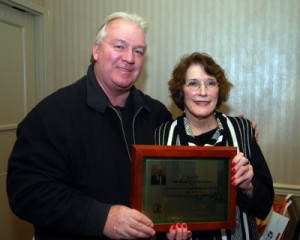
Kathy McGee Burns, making her debut as president of the St. Patrick's Day Observance Association, presents a plaque to outgoing president Mike Callahan.

Sunday, March 13, may seem like a long way off, but for the organizers of the Philadelphia St. Patrick’s Day Parade, it’s right around the corner. And that means the fund-raising is about to begin in earnest.

It’s going to cost $70,000 to put the parade on the street, said parade director Michael Bradley at the Thursday night meeting of the St. Patrick’s Day Observance Association. A group called the Greater Philadelphia Traditions Fund, with Congressman Bob Brady as the driving force, contributed $200,000 in October to help defray the city-related costs of Philadelphia’s ethnic parades, with another $100,000 pledged for this month. But that still leaves many other expenses that need to be covered—everything from transportation costs to port-a-potties.

The money earned through fund-raising will start to roll in “fast and furious” in the six weeks before the parade, Bradley said afterward, but it’s still an ambitious goal. “Everybody pitches in and helps, but it’s a stressful six weeks.”

Year-round fund-raising might help, but then it creates competition for the fund-raising efforts of other, sometimes smaller, Delaware Valley Irish organizations. “We want to get away from smaller events where we’re cannibalizing other organizations’ events,” he said. “We want to make sure other organizations make their money, too. Without them, we don’t have a parade.”

There is a golf outing in the fall, but aside from that virtually all of the major fund-raising occurs over the next several weeks leading up to the parade. One major fund-raiser is a big bash at the Springfield (Delco) Country Club on March 6 (from 3 to 7 p.m.), featuring Blackthorn. Several other fund-raising parties are in the works, including one in the Northeast, sponsored by the Ancient Order of Hibernians County Board and Division 39, with the date pending; a second on Saturday, February 26, from 8 to midnight, at the Second Street Irish Society, 1937 South 3rd St. in Philadelphia, and a third (date yet to be decided) at Kildare’s in Manayunk.

In addition to that, the parade committee raffles off a trip to Ireland, another good income source.

Kathy McGee Burns, who made her debut as president of the board, emphasized the importance of all these activities and noted that they have an important side benefit: they strengthens relationships.

“Number one, they help to raise the money so we can produce a first-class parade in the city,”  she said, “but number two, we get to meet all the Irish organizations that we may not really know until we get to spend some time with them. And it’s really fun.”

The upcoming Second Street fund-raiser is a good example of that, she said. “It’s a great organization, and they’ve been around a long time,” she noted. “We welcome those associations and organizations. They’re what will make the parade go on forever.”