All Posts By

Jeff Meade

News

Penn’s Landing Irish Festival, 2007

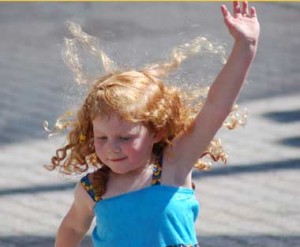
Dancing in the sun.

Dancing in the sun.

It was 84 degrees in the shade at Penn’s Landing—what little shade there is. The sun hammered down on all the happy Irish people in their floppy hats and slick with sweat and Celtic-strength sunblock. Sean Fleming was on stage, the drums and bass pounding, people clapping, cute little kids prancing like ponies in front of the big stage, pleasure boats bobbing like bathtub toys out on the Delaware.

In other words, it was a lot like June in Donegal or Sligo—well, it was like June in Donegal or Sligo will be after about 200 years of global warming.

It was Sunday, a perfect day, even better than the day before, and even though the event was winding down, the waterfront venue was still jammed with Irish-Americans, and lots of other people who might have been Indian, Italian, Japanese—anything but Irish. No matter. For this letter-perfect celebration of Irish culture, anyone who shared in the fun along the Delaware could claim to be as Irish as they wanted to be.

There were certainly plenty of ways to get into the spirit of things—from the cold beer to the lemon and cherry Irish Ice to the goofy shamrock hats and “Irish Princess” babydoll tees for sale 

And, of yes, there was music, and plenty of it: Blackthorn, Sean Fleming, 7 Nations, the Bogside Rogues, and so much more.

The whole shebang was hosted by Finnigan’s Wake and the Philadelphia St. Patrick’s Day Parade Association, and sponsored by PECO and Penn’s Landing Corporation.

Wanna see how much fun we had? Check out the photos.

Music

The First Fireworks of Summer

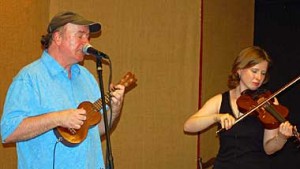
Gerry O'Beirne and Rosie Shipley

Gerry O'Beirne and Rosie Shipley

You know that old saying about “the elephant in the room,” and how it usually refers to the big, bad thing that no one wants to acknowledge?

Well, Gerry O’Beirne’s “Elephant”—his pet name for a gorgeous, one-of-a-kind guitar hand-crafted by Ithaca instrument artisan Dan Hoffman—truly is a big, bad beastie. In O’Beirne’s hands, you can’t help but acknowledge its powerful presence.

He manages to wring every last ounce of musical expression out of his smudged and well-worn Martin 12-string, too.

In concert with Baltimore fiddler Rosie Shipley Saturday night at the Coatesville Cultural Center, O’Beirne coaxed all manner of unearthly sounds from those two guitars—slithery slides, deep and resonant drones, and glittering harmonics. Throughout the night, O’Beirne at various times channeled blues man Robert Johnson, classical artist Andres Segovia, Dobro master Jerry Douglas, and even one-hit zitherist (“The Third Man”) Anton Karas—sometimes, all in the same tune.
With the Elephant, O’Beirne offered a delicately nuanced interpretation of his tune, “Western Highway,” previously recorded both by Maura O’Connell and DANÚ lead singer Muireann Nic Amhlaoibh (who was to have been the headliner before she was waylaid by laryngitis). Wielding the 12-string, O’Beirne’s dazzling performance of another tune, “Long Beating Wing,” left the audience practically breathless.

O’Beirne managed to top even those fireworks with virtuoso performances on, of all things, a ukulele. Don Ho must have been spinning in his grave. Tiny bubbles, my arse.

With all of this praise for Gerry O’Beirne, you might wonder whether Rosie Shipley was even in the room. No need to wonder. This one-time student of master fiddler Brendan Mulvilhill did her old teacher proud.

Shipley plays with power, poise and no small measure of daring. With O’Beirne at her side, she’s an unstoppable and potently creative force. One example: Shipley’s up-tempo interpretation of Carolan’s Concerto, traditionally performed in a pretty, subdued baroque style.

As a teen, Shipley studied at the Gaelic College of Celtic Arts and Crafts in Nova Scotia. (Where, she adds, she also wove tartans and made out with boys in kilts.) Thank goodness for the Scots influence, because she treated the audience to a couple of lovely strathspeys, which you don’t often hear in traditional Irish performances.

Likewise, Shipley and O’Beirne drew on non-Irish influences to close out the night with a set of tunes from the American South: “There Ain’t No Whiskey in This Town” and “Cluck Old Hen.” On the latter, the fiddle strings were smokin’. (And O’Beirne’s uke rang out like a banjo.)

Did we miss Muireann Nic Amhlaoibh? Of course, but in another way the loss was also our good fortune as these two superb musicians ably and satisfyingly filled the breach.

News

Hot Fun at the AOH Festival in Mont Clare

Reilly Ann and Poppy

Reilly Ann and Poppy

The first person I ran into at the Ancient Order of Hibernians Irish Festival along in St. Michael Park in Mont Clare was an old friend, Verne Leedom, former pipe major for Irish Thunder Pipes and Drums.

Possibly the very next person I ran into was Verne’s granddaughter Reilly Ann.

Not long after that, I bumped into Sean Leedom, Verne’s son, near the horseshoe pits.

I was beginning to think that everybody at the festival on Saturday was a member of the Leedom family.

Not true, though. A hundred or so sun-shy Celts hunkered down in the shade of the picnic pavilion or browsed for Irish jewelry, hats, bumper stickers and other Hibernian tchochkes in the vendors’ tents. Most of the festival-goers, it turned out, actually belonged to other families.

That was the coolest part of an otherwise sweltering day—that so many families turned out for a day along the banks of the Schuylkill, just across the river from Phoenixville. From where I sat—at a picnic table, munching a sausage-and-pepper sandwich on a crusty Conshohocken roll and sipping an ice-cold Coke—it looked like they were having a great time.

Earlier in the day, Irish Thunder Pipes and Drums had performed, and Oliver McElhone as well. By the time I arrived, at mid-afternoon, Fisher and Maher were tearing up the place with a performance of Irish traditional music that was as hot as the day.

Emma Hanson Not long after they left the stage, Burning Bridget Cleary—two fiddlers and a guitarist from the Lehigh Valley—jacked up the energy level even more. (They’d confessed to having consumed large cups of iced coffee before arriving on the Festival grounds. But I heard them at the Valley Forge Scottish-Irish Festival in February. If that performance was any indication, coffee has nothing to do with it. They chug along just fine on their own inexhaustible energy source.)

A little later on, a bevy of Coyle school dancers also entertained the crowd with some high stepping to match their spirits.

For those who weren’t up for high-octane Irish music or dance, there was plenty of lazy summertime slacking off to do. The horseshoe pit, for example, was a pretty popular destination. So were the picnic tables nestled among a nearby stand of trees, where people nursed icy beers and quietly chatted.

Irish weather? No. But still, a great start to the summer for Philadelphia’s Irish.

Dance

Dancing on Air

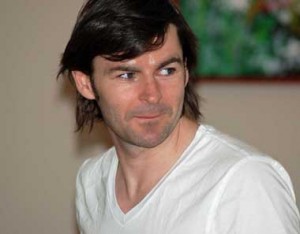
Riverdance lead Marty Dowds

Riverdance lead Marty Dowds

The great Riverdance finale—dancers strung across the stage, shoulder to shoulder in a single line, each one ramrod straight, heels hammering into hardwood, the whole line moving as one. If you have ever danced, it’s hard to attend a performance of the high-stepping spectacle and not imagine yourself in that line, filling the concert hall with that great noise.

For just under a dozen local dancers—some of them schooled in the Irish traditional form, a few of them students of tap—the fantasy came a bit closer to reality in a small church hall on Sansom Street in Philadelphia on Saturday. Marty Dowds, lead dancer of the Riverdance Boyne touring company, led them in a demanding hour-long master class sponsored by the Tapography dance school.

Dowds, dressed in a white t-shirt and drawstring jazz pants, showed up a bit late. His cab had gotten held up in traffic. He needed a shave, and his hair hadn’t been combed. Any normal human being would take a while to come up to full speed.

Dowds was raring to go in the time it took to change from his street kicks to his big, clunky hard shoes. And in less time in that, Dowds was putting two short lines of young women through their paces.

There were a couple of brief water breaks, and then on they went. It all came together in the end, as Marty urged the two short lines into one long one. Tapography’s Dave Pershica cued up the music to that big closing number.

With Dowds out in front, the students got a chance to live the Riverdance dream—if only for a few short moments. Was it perfect? No, far from it. But judging by all the smiles, it was close enough.

Music

Kevin Burke and Cal Scott in Concert

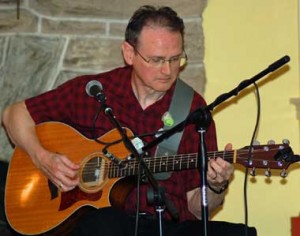
Cal Scott gave the guitarists in the audience lots to think about.

Cal Scott gave the guitarists in the audience lots to think about.

It was a concert. It was a master class.

It was both of those things, and more, as famed fiddler Kevin Burke and guitarist-composer Cal Scott brought many of the tunes from their new CD—and several others besides—to the Philadelphia Irish Center Friday night.

The Center’s Fireplace Room was filled near to bursting with enthusiastic fans, who evidently came prepared to be dazzled.

Scott and Burke didn’t disappoint. Their nearly two-hour concert was an uninterrupted display of smooth virtuosity.

The concert began with “The Surround” and “The Red Stockings,” both of which constitute the opening set on their just-released recording, “The Black River.” I wasn’t sure how well those tunes, and many other tunes from the CD, would hold up. Those two guys can easily fill a room with sound. However, on most of the tunes on the CD they’re accompanied by two or three other musicians. It’s an energetic, full sound.

I needn’t have been concerned. Even on “The Long Set,” which consists of five reels back to back, it held up just fine. The set includes quite a bit of accompaniment on the CD, including some rollicking Cajun-style accordion play, particularly toward the end, but Scott and Burke played with so much energy and passion, it sounded like there were more than two instruments on stage.

The night ended with a well-deserved standing ovation. Burke rewarded loyal fans with a solo performance of “Itzikel,” a haunting tune in the Yiddish “frailach” folk dance tradition. Then Cal rejoined him for a blast of reels that once again had fans on their feet.

We offer you a few photo memories of the night.

Dance

Reelin’ in the Years

Niamh O’Connor is the last dancer standing.

After a dozen years of Riverdance, starting at The Point in Dublin in 1995, O’Connor—dance captain for the show’s Boyne touring company—still laces up the hard shoes night after bone-jarring night.

You can see Niamh’s fancy footwork this week as the company pounds the boards Tuesday through Sunday at the Academy of Music.

Niamh, who first started taking lessons in Dublin at the age of 4, now holds the record for the most performances of any dancer in the show. “I’ve done over 3,000 performances all over the world,” she says. “I’m well above everybody else at this stage.”

She recalls when dancers first were being recruited for the show. As a champion dancer—the racked up medals in the Leinster, All-Ireland, and World competitions—she was an obvious prospect. Of course, virtually no one could have foreseen that Riverdance would go on to become a monster hit worldwide, but for an Irish dancer, the appeal was undeniable.

“Initially we were booked for three weeks in the Point, then to London for three more weeks, then back to Dublin,” she says. “We didn’t think it would take off on such a worldwide level at all. But for any Irish dancer, to be given the opportunity to perform in a show like Riverdance, of course they’d never turn it down.”

No one had ever seen Irish dance performed in such a new and daring way. In some ways, she explains, it wasn’t much of a departure. Still, there were things to learn—things a competitive Irish dancer might not have known or appreciated.

“The steps we do are still traditional Irish steps,” she says. “The thing that was new was the performance element. Irish dancing hadn’t been professional until this time. We started using hand and head movements that would not have been in traditional Irish dancing. That would have been a whole new experience for all of us. We were used to dancing on stage in competition, though. So basically all we had to learn was performance in front of a paying audience, with different music and different costumes.”

Niamh must have figured out how to meet the new challenges. Twelve years on, she’s still on her toes. In fact, she has performed all over the world, with performances in Scandinavia, Japan, New Zealand, Australia, China, and throughout Europe and North America. As dance captain, she is responsible for scheduling and running rehearsals and for breaking in new dancers.

Her responsibilities don’t end there. She’s on stage, too, for every performance. It’s nothing like easy, dancing well past the point where many would have the stamina to carry on. But, she explains, “I really do look after myself, taking a lot of rest when I should. We have a cardiovascular workout every night before the show. And after every show, I go into ice buckets up to my knees.”

So much for the glamour of the stage.

Now, as Riverdance once again sweeps into Philadelphia, Niamh remains very much engaged in the show. The show has evolved, of course—new costumes new numbers, new sets and lighting changes. But the show remains fundamentally the same exhausting and exhilarating experience it has always been. That killer finale remains, too—and, she says, it still draws a roaring standing ovation, show after show.

Not too hard to take, clearly. And Niamh is prepared to take it for a while longer still. She is studying advanced interior design with the Regency Academy of Fine Arts in the U.K. because she knows that, even for a marathoner like herself, Riverdance must someday end. But for now and for the foreseeable future, Riverdance is her life. “As long as I’m physically able to dance I will,” she says. “I love performing. It’s my job.”

Music

Making Music With a Smile In It

Fiddler Kevin Burke—veteran of the Bothy Band, the Celtic Fiddle Festival and Patrick Street—and guitarist-composer Cal Scott never set out to record a CD. Still, it probably was inevitable that these two creative musical minds eventually would crank out something like their new release, “Across the Black River.”

It all started when Burke—a London boy transplanted to Dublin, and now living in Portland, Oregon—paired up with Scott, a resident of the nearby town of Tigard, on a score for a PBS documentary.

“When I first met Cal, he was working on a documentary about the political strife in Northern Ireland,” Burke explains. “He asked me, could I give him some advice on what type of music might be suitable. He knew I was living in town, he knew about me from some other musicians, so he called me up and I said, “Sure,” and we worked on that for a while. When it was over, Cal said, ‘I’d love to learn a bit more about this kind of music and play a bit more. Would you be interested in getting together?’ I said, ‘Sure, I‘d love to.’”

And for a long time, that’s how the relationship went. Burke would drop his kids off at school, and then spend the day at Scott’s studio. The two hit it off, and before long they were swapping ideas the way some guys trade fish stories.

It was all very informal and unstructured.

“Cal says, ‘Maybe the best way for us to go about this is for you to just sit there and play something—anything—just play for five or 10 minutes, and I’ll record it,” Burke recalls, “so instead of you having to play over and over again, you can just go away and I’ll just listen to the recording and come up with a few ideas, and then you can come back and I can show you what I’ve done.’”
So Burke cranked out a few reels played by the late, great Sligo fiddler Michael Coleman—tunes like “The Wind That Shakes the Barley,” “Seán sa Cheo,” “The Boys of the Lough” and “Paddy Ryan’s Dream.”

“So I sat and played for five or 10 minutes,” Burke says, “and then I went away. When I came back he had all these great ideas. Some of them were fantastic, and some of them were less fantastic … and some of them were a bit odd. So we just kind of talked about it. I was responding to some of his ideas, and he was responding to some of mine. Before long we had this journey.”

The journey went on for a long time before either man conceived of the notion of releasing a CD. But when they did, those Coleman reels, and one other non-Coleman tune—“The Reel of Rio”—would occupy a place of prominence.

Only it doesn’t quite sound the same as it did when Burke played it the first time. There’s the start, for one. Scott’s introduction sounds a bit like Texas swing. It’s anything but.

“There’s been a kind of a flirtation with that style of guitar backup with Irish music from the ’20s and ‘30s,” Burke explains. “Some of the older recordings have accompanists that sometimes give you the idea, that’s what they’d be playing most of the time, that swing-jazz style. I was talking to Cal about how it might be suitable to start this set of reels because all the tunes in that set, except one, were recorded by Michael Coleman back in the ‘20s. What I wanted to do was play a bunch of classic tunes but give each of them a new twist and at the some time make reference to some of other people’s twists on Michael Coleman’s music. But, since he had such a big impact from the ‘20s on, it just seemed suitable to have the rhythm hark back to the ‘20s as well. With Cal’s background, it was very easy for him to say, ‘Oh, yeah, you mean something like this?’ and he’d just lay it out there. And I’d say, ‘Yeah, that’d be a great way to start.’ And it’s a bit nostalgic. It makes you smile. There’s a smile in it, you know? It’s not silly, though. It’s not supposed to be a comedy. It is slightly amusing, but hopefully there’s a lot of affection there, too, that comes across.”

Together, Burke and Scott were able to create a set that clearly hearkens back to its Irish traditional roots, but with a fresh new approach. “It was my idea,” Burke says, “but Cal’s execution that made it work.”

The two took some liberties with an American tune as well—bluegrass scion Bill Monroe’s famous “Evening Prayer Blues.” Burke had been playing is solo in his performances. Sometimes it worked; sometimes it came up short. He recorded it for Scott, but still wasn’t happy with the sound. So once again, Burke and Scott put their heads together and came up with a few new twists.

“The first time I heard it (the tune), it was Bill Monroe playing it with a band, and it felt very much like a bluegrass tune,” says Burke. “But it’s called ‘Evening Prayer Blues,’ and even though Monroe played it much faster than I played it, even though it was fairly fast in his original version, I really got this hymnal aspect from it. It struck me as a very gentle, private and almost spiritual piece of music. So I took that hymn idea and slowed it down and tried to make it more poignant and thoughtful—the idea of pondering about your spirituality. But I also wanted some reference to the fact that it was Bill Monroe and that it was a bluegrass tune without me trying to sound as if I’m a bluegrass player. So again, Cal’s execution of these ideas is great. He’s a great mandolin player so he made a little reference in there to the bluegrass sound, and he helped me put a second fiddle line on it that would be more typical of a bluegrass reference. And I asked him, what about playing bouzouki instead of guitar? That would still be in keeping with both genres, the Irish and the American, but it would move it slightly away from the bluegrass sound just a little more. That’s how it grew.”

Most of the rest of the tunes on the CD take a similar approach, with reverence for the source material, but tweaking here and there. The result is a CD with—much like the long set of reels—a bit of a smile in it.

You can share the smiles this Friday at 8 when Burke and Scott swing by the Irish Center for a concert, sponsored by the Philadelphia Ceili Group.

News

Mayos Get Spring Off to a Good Start

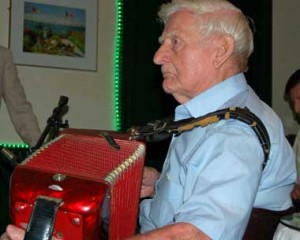
Michael Gallagher plays on.

Michael Gallagher plays on.

They told jokes. They sang “Lady of Knock” and “Danny Boy” and, for reasons having nothing to do with Mayo or Ireland, “My Way” and “On the Way to Cape May.” And they danced—oh, how they danced.

Sister James Anne Feerick, I.H.M., the association’s chaplain, was all alone out on the floor as she danced to “The Boys of Blue Hill” played on accordion by Michael Gallagher. Before too long, though, several members were up on their feet and giving Sister a run for her money.

Mostly, though, members of the Mayo Association of Philadelphia just tucked into their luncheon and caught up on the craic as they gathered on Sunday at C.J. McGee’s in Springfield, Delaware County, for their annual Spring Social.
Running the whole shindig was Maureen Brett Saxon.

Along with all the merry-making, the group took time to recognize past president Frank Cantwell with the Mayo crystal tulip bowl. Michael J. Bradley Jr. was honored with the “Cutting Edge” award for his work as chair of the Philadelphia St. Patrick’s Day Parade Committee.

The event was noteworthy, too, for its first annual Mayo Academy Awards, a strictly tongue-in-cheek version of the annual Hollywood love feast.

Here’s who won what:

Best Vocals

  • Rosaleen Megonegal
  • Tommy Moffit

Best Music

  • John Durkin
  • Michael Gallagher
  • James Feerick
  • Patricia Sweeney

Best Narration (for the association’s 100th-anniversary CD)

  • Frank Cantwell

Production (for the same)

  • Sean McMenamin
  • Joe Boyle

Director (also for the history CD)

  • Sister James Anne

Check out our party pics.