All Posts By

Jeff Meade

Music

“A Letter Home” – Athena Tergis (Compass)

Fiddler Athena Tergis approaches her task with the ease and delicacy of a glassblower.

It’s probably because of Tergis’s deceptively light style of play that, at first, I was not over the moon about her debut CD on the Compass label, “A Letter Home.”

Tergis, a San Francisco kid, was on track to become a classical violinist when, she says, she was “tricked” into attending Alasdair Fraser’s Valley of the Moon fiddle camp. One of the teachers that summer was Altan’s Mairead Ni Mhaonaigh. She went on to study with Ni Mhaonaigh, Alasdair Fraser and Cape Breton master fiddler Buddy MacMaster. She was the Junior National Scottish Fiddling champ three years running.

When it came time to attend college—she was slated to attend Berklee—she decided instead to live in Ireland for three years and soak up the music.

I can only imagine that there were some interesting conversations in the Tergis household at the time. Turning your back on Berklee? Yikes. But judging by her performance on “A Letter Home,” she made the right choice. It was time well spent.

The CD is produced by the gifted guitarist John Doyle, who also plays guitar and bouzouki on several tracks. Tergis is also accompanied by Liz Carroll on fiddle, the ubiquitous Chico Huff on bass, Natalie Haas on cello, Billy McComiskey and Sharon Shannon on accordion, and Ben Wittman on percussion.

My tastes generally run to the so-called “supergroups” like Solas, Flook and Lunasa. Performances by those bands are muscular, even a little macho. It eventually dawned on me that I was listening to Athena Tergis’s performance with the wrong ears. If Solas is Celtic stadium rock, Athena Tergis is cool jazz. Comparing Athena Tergis to Seamus Egan would be like comparing Diana Krall to Roger Daltrey.

There are no trombones or soprano saxophones on “A Letter Home.” No conga drums or timbales. Instead, there is Haas’s lush and luscious cello and some slick, whispery brushwork by Wittman. The accompaniment here never threatens to overwhelm or dominate. Instead, it gently, unobtrusively frames Tergis’s polished performance on a wide variety of traditional tunes, from “Johnny McGreevy’s” (a reel) to “Bi Falbh O’n Uinneig” (“Be Gone from the Window,” a slow air).

I particularly liked (as determined by the number of times I left my car CD player setting on “Repeat”) “In Memory of Coleman/Paddy Fahy’s)”, a lovely set of reels – not pounded out at the usual breakneck tempo but instead played at a leisurely pace. Tergis seems to be not so much playing the tunes as savoring them. (You will, too.) “Coleman” was written by Philly’s own Ed Reavy. (One other local tie: Many of the tracks were recorded at Morning Star Studios in Springhouse, outside of Philadelphia.)

I also gave the “Repeat” button a workout on another set, which began with a strathspey, “Miss Lyall”—I love the jerky percussiveness of strathspeys—which smoothly morphed into a set of reels, including “Paddy Ryan’s Dream,” “Con Cassidy’s Highland” and an unknown Donegal reel.

The concluding slow air, “Be Gone from the Window” is heartbreakingly lovely.

 I suspect “A Letter Home” will earn your own stamp of approval.

Music, People

Farewell to “The Bard of Armagh”

In Ireland in 2003. From the Makem Web site.

In Ireland in 2003. From the Makem Web site.

“Tommy Makem was my hero and the reason I wanted to perform,” says Tyrone-born musician Gerry Timlin, co-owner of Ambler’s Shanachie Pub and Restaurant, who in June visited the man known as “The Godfather of Irish Music” and “the Bard of Armagh” for the last time at his home in Dover, NH.  Makem, 74, died Wednesday, August 1 and, after a three-day wake, was buried August 9 in Dover. He had been diagnosed with lung cancer in May 2006.

Timlin has shared the stage with Makem and The Clancy Brothers many times and Makem became his mentor when Timlin arrived in the US with his guitar, a beautiful singing voice, and irreverent humor in the 1970s.

“I loved his wit, his commitment, and his bravery. He came to the US and made a path for the rest of us and with the Clancy’s carved out a course for us to follow,” says TImlin, who was in Ireland when Makem died. “He created new venues for us and helped us all make a living doing the one thing we all loved. Without him the world of music will never be the same.”

Makem was “the consummate performer,” says Timlin. In fact, Makem died with gigs on his schedule stretching into November.  Though a solo performer, for much of his career, this banjo-playing baritone performed with friends Liam, Tom, and Paddy Clancy. He’d come to New York from Ireland with Liam, and  they initially both embarked on acting careers until fate and their love for music drew them together for the magic that was the Clancy Brothers and Tommy Makem.

Many people were introduced to Irish music by Makem and the Clancys and, at least among the listening public, they are perhaps known best for what every Irish performer thinks of as the crowd-pleasers, the drinking songs like The Jug of Punch, Irish Rover, and Finnigan’s Wake. But Makem was a trad musician at heart. “He sang all kinds of folk music,” says Timlin. His mother, Sarah, was a renowned folk singer who collected traditional Irish folk tunes that might have otherwise been lost.

Traditional purists have tended to be dismissive of the way The Clancys and Tommy Makem popularized Irish roots tunes, but in recent years, many have come to recognize that their rise and that of the Chieftains–during the nascent folk era in the US–helped create a resurgence in popular interest in Ireland’s own musical history which, at the time, seemed to be heading the way of the thatched roof.

As one trad musician wrote on a message board after Makem’s death, “I listened to Tommy, and the Clancy Brothers — kinda hard to separate them, even though he hasn’t played with the band for years — for a lot of my childhood, dismissed them in my late teens as hokey and cliche, then ultimately realized how much they’ve all meant to the music.”

Makem meant everything to Timlin’s music–and his life. ” I was proud to say he was my friend and I will miss him sadly every day,” he says. ” ‘Onward and upward’ he would say and so ‘Onward and Upward Tommy.'”

Here’s what others have to say about Makem. First, Liam Clancy, who first made note of Tommy’s passing on his message board:

He was a friend and partner-in-song for over fifty years. We shared a great hunk of our lives together. We were a hell of a team. Tommy was a man of high integrity, honesty, and, at the end, courage. Our paths diverged at times but our friendship never waned. He was my brother every bit as much as my blood brothers.”

Irish President Mary McAleese:

‘In life, Tommy brought happiness and joy to hundreds of thousands of fans the world over. Always the consummate musician, he was also a superb ambassador for the country, and one of whom we will always be proud.”

Singer-songwriter Eugene Byrne, quoted in the Dover newspaper Foster’s Daily Democrat:

“Not one of us who play a note of Irish music on a guitar today would be playing if it wasn’t for Tommy Makem, along with the Clancys. He gave us pride in our country and our culture. Bono (U2’s lead singer) was influenced by him. Michael Flatley’s new show, Celtic Tiger, has Four Green Fields in it.”

From Marianne MacDonald, host of the local radio show, “Come West Along the Road” (Sundays from noon to 1 p.m. on WTMR-800 AM):

“One of the bright twinkling stars from the constellation of Irish music faded today.  We’ve lost the great Tommy Makem.  I was fortunate to have seen him at Appel Farms, the Guinness Fleadh and, years ago, at the Holmdel Arts Center when my mother dragged me to my first Irish Festival.”

From Ed Ward of the Milwaukee Irish Fest:

“I spoke to him about two weeks ago, the day after he returned from Ireland. We talked for about a half an hour about his trip, how wonderful it was to see the parade of people who came to visit him in the hotel, relatives, old friends, the archbishop. He said he was very sad when he boarded a plane to leave Ireland, clearly knowing he would not see it again.”

He desperately wanted to make it to Milwaukee this year so we discussed plans on what we would do as it was evident he would not be able to perform. But he planned to be there anyway. We are going ahead with these plans and Tommy’s slots will be billed as “Remembering Tommy Makem” and will be led by his nephews Tom and Jimmy Sweeney, Brian Doherty, Kevin Evans and Eugene Byrne and other close friends. The Makem and Spain Brothers will also be in Milwaukee so it should be a special celebration of Tommy’s life and love for the music of Ireland.”

From Ira Goldman, editor and publisher of the Trad Music News:

“Just about anything and everything that can, and should, be said about Tommy Makem’s music has been said since his death last Wednesday evening. The great and the not so great have been crowding the Tasker Funeral Home in Dover NH for his wake since yesterday and Thursday morning we will fill to overflowing St, Mary’s Church in that lovely New England village Tommy called home for decades.

Most people know Tommy as a balladeer and partner of the Clancy Brothers and especially of Liam Clancy. Many know him as the composer of fine songs, some of which have become standards of Irish music. Some of us have had the joy of knowing him as a fine ‘sean nos” singer and traditional musician on the banjo and whistle. His musicology as well as his music made him a true treasure of Irish Traditional Music.

Some of us have been blessed to have the invaluable, immeasurable, and lasting delight of knowing Tommy Makem as a person and as a friend. In the some 25 years I knew Tommy I never heard an unkind or angry word pass his lips. His countless acts of warmth and kindness will never be forgotten. For example, Tommy recorded a wonderful song, as delightful for “grownups” as for children, called “Waltzing with Bears.” When he was told two wee boys in Co. Carlow (aged 5 and 6) were learning the song from his cassette tape so they could entertain their Yank friend at Christmas, Tommy wrote each of them a note congratulating them for learning the song and thanking them for learning it from him.

And there was once a quiet, sunny afternoon in the empty bar of the hotel by the Sligo railroad station when Tommy played piano and let a Yank friend sing with him (much to the dismay of Liam Clancy who had to listen).

There are not enough tears to truly mark your passing, Tommy. There will always be the memories and the music and the love.

Slan, old friend.

Ar dheis De go raibh a anam uasal.”

Music

Love Songs Among the Stacks

Patrick Hughes introduces a tune.

Patrick Hughes introduces a tune.

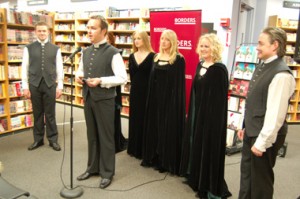
It’s a muggy Thursday afternoon in Center City. Inside the refrigerated Borders at Broad and Chestnut, some of the patrons are casually picking their way through the stacks and trying to pretend that an angel, crowned with blonde curls and dressed in long flowing robes, has not just stepped inside from the superheated sidewalk.

They go on pretending as she begins to sing. They are a study in “seen-it-all-before” coolness as the singer is joined by yet another striking singer in flowing robes, and then two more, and, finally, by three handsome men in high-collared green vests and bright, white turtlenecks.

Soon, the store echoes with delicate, crystalline harmonies as the singers weave in and out of the aisles and eventually make their way back to audiobooks, where a few chairs have been set up in front of a little stage area.

And soon, I start to wonder which is weirder: The fact that members of the world-class Irish choral group Anúna are singing in a bookstore, or that a few pointedly blasé patrons are still trying to pretend that nothing out of the usual is going on.

On second thought, maybe after a week of Harry Potter-mania and grown men dressing like Dumbledore and Hagrid, it’s easy to be jaded.

Believe it or not, this was Anúna’s Philadelphia debut. The seven singers—a smaller subset of the larger choir that has thrilled audiences worldwide since 1987—were in town to promote their new CD, “Sensations,” and a September special to be aired locally on WHYY. (They’re also going to appear Oct. 12 at Penn’s Annenberg Theatre.)

“This is our seventh (Borders appearance),” said singer Patrick Hughes. “We started out in Boston.” From now through August 21, the troupe will sing in 31 Borders stores across the country.

Although Anúna hasn’t made a career of bookstore appearances, Hughes said it really wasn’t so unusual. “It marries well with our performance style,” he said. “It’s about interacting with the audience. That’s when music can touch people.”

For about 20 minutes, in the frenzied heart of the city on a miserably sticky day, Anúna provided a few precious moments of peace and cool, ethereal beauty. There was time for just a few pieces, unfortunately. There were two standout performances, though: “I Dreamt I Dwelt in Marble Halls,” by founding member and chorus master Miriam Blennerhassett, and an old Bothy Band hit, the tongue-twisting “Fionnghuala,” by John McGlynn, leader of the touring group, featured soloist and production designer. (John’s brother Michael founded the group.)

If you couldn’t be there … no worries. We have a bit of video from the Center City Borders event. It will have to do until the September special (no firm date as yet) on WHYY.

Music

The Kane Sisters in Concert at the Philadelphia Irish Center

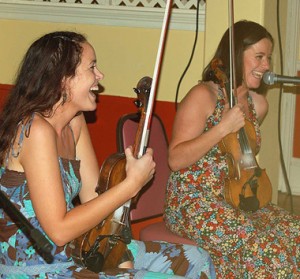
The sisters share a laugh.

The sisters share a laugh.

The first time somebody told me the Kane Sisters were coming to the Irish Center, my 56-year-old hearing failed me.

“You mean the Haynes Sisters, from ‘White Christmas?’ The ones with the brother known as ‘Freckle-Faced Haynes, the Dog-Faced Boy?”

I was incredulous. (I didn’t believe it, either.)

It didn’t take me long to sort things out. OK, maybe a day or two. And of course, I went to their recent concert at the Philadelphia Irish Center.  Why? Let’s just say I did it for an old friend in the Army.

Seriously? I went because Liz and Yvonne Kane are outstanding practitioners of the light, ornamented South Sligo style, and they were all but guaranteed to put on a superb show. I wasn’t disappointed.

Drummer that I am, I couldn’t help but love the light-speed reels. But I was more or less equally entranced by just about everything else they played.

What’s most notable about a Kane Sisters performance, though, is the smooth and seamless synchronicity of their playing. They race through complex triplets and rolls, bows sawing up and down the strings in precise, virtually identical patterns. One is the virtual mirror image of the other. To have one fiddler who plays so masterfully is one thing; to have two, side by side, so evenly matched in every respect, can be breath-taking.

The traditional music fans who weren’t down the Shore on the night of the show also received a pretty cool bonus. Jon and Nathan Pilatzke, the crazy-legged Ottawa Valley step dancers who have toured with the Chieftains, among others, made an unexpected guest appearance.

The concert took place in the Irish Center’s Fireside Room. There’s no stage there, as such, and therefore, no off-stage. So when it was time for them to make their appearance, the boys popped out of the nearby ladies room. They wasted no time or effort in pounding what I imagine were huge dents in the floor, drawing whoops and hollers from the appreciative fans in the room and at the bar.

If you didn’t make it, check out our photos.

Music

Old Blind Dogs Still Putting the Pedal to the Metal

The CD features three new live tracks.

The CD features three new live tracks.

The Old Blind Dogs have been around, in one form or another, since 1990. With “Four on the Floor” (Compass), the band loses nothing of the creative energy that has made it one of the most popular traditional ensembles.

Of course, no traditional band blessed with so much inventiveness can play it straight all the time. On “Four on the Floor,” probably the best example of this spirit of invention is the band’s updated treatment of the old Scottish standard “Braw Sailin’.” Lots of artists and bands have performed the tune—including Kris Drever, on his recent CD (also from Compass), “Black Water.”

The Dogs take the old tune (first recorded around 1930, according to the Traditional Ballad Index) and teach it some new tricks, sailing it a few thousand miles southwest of Scotland to Jamaica. It works, mon.

I’m also a big fan of the CD’s second track, “Harris Dance,” which features some finger-twisting playing by Rory Campbell on the Scottish border pipes, propelled along with some furious percussion by Fraser Stone.

The band also provides a rare treat in the form of three live tracks, featuring tunes and sets previously recorded by the Dogs in previous incarnations.

The hottest track of the three is Aird Tanters/Branle, a strathspey that gives way to a Middle Eastern-tinged Scots folks dance tune—again, a tightly contained (but only just) ball of energy.

You can catch the band at the Tin Angel on Sept. 27, and Sept. 28, 29 and 30 at the Bethlehem Celtic Classic.

Music

A Farewell to Col. Phil Townsend

Cutting the cake.

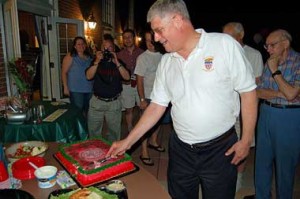
Cutting the cake.

Phil Townsend grew up in Gladwyne, next door to St. Christopher’s Church, where the old Main Line Pipe Band used to practice.

He first heard the band perform at the church’s Azalea Day Fair. From that moment, he was hopelessly addicted to the bagpipes. “I’ve loved them since the very first time I heard them play,” he says. With the sounds emanating from the church hall week after week, it was perhaps inevitable that Townsend would join the band—first, at age 8, as a drummer, and then, at 10, as a piper.

From that point on, almost nothing could keep him away, as one of Phil’s favorite stories will attest:

“One night I was struggling with mathematics, and there was the pipe band playing in the church building,” he says. “I was grounded until I had completed my homework assignment. But finally it was too much for me, and I jumped out the second-floor window, fell onto a trash can—amazingly, I was unhurt—and then ran off to band practice. That should tell you the effect bagpipes have on me.”

And if you’re still not persuaded that bagpipes have a singular hold on Phil Townsend, consider this: On his wedding day—he was living in Utah and playing with the Salt Lake Scots—he married his “infinitely understanding and tolerant” sweetheart Molly in the morning and piped in a parade that afternoon, he says, “with my new bride marching alongside the band.” 

Almost 50 years after he succumbed to the siren song of the drones, he’s still devoted to this finicky instrument. He has played in and led (as pipe major) several Delaware Valley bands, including the old Clan na Gael, Washington Memorial, Philadelphia Emerald and Ulster Scottish. He has performed with countless other bands, on pipes or drums—and sometimes both. He also instructed the Lia Fail Band in Hightstown, N.J.   

Somewhere along the line, Townsend also became acquainted with a competition pipe band in Killen, County Tyrone, just across the border from Donegal in the Republic. He has piped with that band for several years—unfortunately, not including 2002, when Killen won the World Championships in its grade level (4A).

Just a few days after Independence Day in the States, Phil and Molly took up residence in Castlederg, County Tyrone. Townsend once again will pipe with Killen, and he’ll compete in the Worlds on Glasgow Green. But this time, he hopes Ireland will become his and Molly’s year-round home. For, as great as Phil’s love for the pipes, it just might be exceeded by his love of Ireland.

*  *  *  *  *

Recently, Phil’s many friends in Washington Memorial Pipe Band gathered at the band’s practice hall at Valley Forge Military Academy to wish him a fond farewell. Old mates from other bands, including Main Line and Emerald, joined in the festivities. They all clustered around a big fold-out map of Ireland to get a sense of where he and Molly are setting up house. They shared memories. They shared cake—with a tartan frosting, of course. And at the end, the band circled up and blasted through “Scotland the Brave,” “The Rowan Tree” and many of the old tunes, with Phil tapping away on snare drum.

It was also a bittersweet leave-taking in another sense. For the past 33 years, Valley Forge Military Academy has been the focal point of Col. Phil Townsend’s professional life—first, as cadet and, subsequently, as tactical officer, teacher, librarian, director of student activities and, finally, dean of the academy.

The next step in Townsend’s career will be to take his degree in library science from Villanova and apply his skills as a cataloguer at the Omagh Center for Migration Studies, part of the Ulster American Folk Park, also in Tyrone.

It has taken a bit longer than he might have hoped, but Townsend has always known that his life would lead him to Ireland. There were too many profound influences early in life to leave any doubt of that.

“My earliest experiences were with teachers from the North of Ireland, including Hughie Stewart, who founded the Main Line Pipe Band,” Phil recalls. “There was also a woman who was like my second mother, Sarah McGlade, from Castlewellan in County Down, one of the strong influences in my life. She helped raise me, you might say. The first time I went to Ireland I stayed with Sarah’s sister, Agnes Gorman, in a little town called Ballyward in County Down. That was when I was in my early 20s.”

At the time, Townsend was enrolled in the Reserve Officers Training Corps as a result of classes he had taken at VFMC, so he had to return to the United States to fulfill that obligation.

”I had always intended to return to Ireland after I had fulfilled that next obligation,” he says.

Things didn’t work out that way, of course, but now, he says, seems like a good time.

““Certainly, my plan has always been to retire there. But my decision to pull up stakes here and make that move more permanently was of a recent origin,” he says. “I realized that, now, with the economy and developments in the North, now was as good a time as any to purchase some property and a house. We’ve been going back every summer to Castlederg. My intention is to spend at least a portion of every year in Castlederg with the eventual goal of spending year-round there.”

He has children all over the map, too, and visiting them is also part of the plan.

Not long ago, he notes, moving to Castlederg might have been very nearly unthinkable. Because of the town’s close proximity to the Republic on three sides, it was the scene of many violent incidents. IRA bombers and gunmen could sail into Castlederg, do their business, and beat a quick retreat back into Donegal. Townsend notes that Castlederg is reputed to be “the most bombed small town in Northern Ireland.”

But times are changing, as Townsend notes. “For so long, and certainly throughout the ‘80s, Ireland experienced a 14-15 percent unemployment rate. It was not a very promising place to be, notwithstanding ‘The Quiet Man’ and all the stories of going back to Ireland. Now, within the last 10 to15 years, especially with peace so close at hand, there’s a lot more reason for people to stay where they are, or to go back.”

A few years ago, Phil and Molly purchased a bit of land and a duplex near the town center.

Not surprisingly, he looks forward to his new beginning.  

“We have our own driveway and a little garden in the front, and there’s a patio and a wee yard in the back,” he says. “Go out the front door of the house walk two minutes and you’ll be at a library in the center of the village. You can sit and read the newspaper in the living room and have a pipe band arbitrarily marching through town—that’s a fairly common occurrence.”

Of course, Castlederg is very close to Killen. In fact, he says, the region is “lousy with pipe bands”—10 of them within a 20-mile radius.

Heaven? Well, not for everyone, he says. But for this passionate piper, life in Castlederg might be as close to heaven as it is likely to get.


Sports

More Philly GAA Photos Than You Can Shake a Hurley At

“Hot” doesn’t begin to describe it. It was flat-out steamy Sunday afternoon down at Cardinal Dougherty High School.

The football and hurling action was a bit on the steamy side, too. If you love Gaelic Athletic Association action, these pictures will make you feel like you were there. 

And if you haven’t seen these hard-playing athletes in action … all the action shots will show you what you’re missing. (And maybe you’ll head out some Sunday afternoon to see it all, up close and personal.)

Here are the scores, by the way:

Intermediate Football    

TYRONE 1-8  KEVIN BARRY’S       0-11 (Draw)

Junior C Football     

EIRE Og 2-9  SAINT PATRICK’S    0-8

Junior A Football     

YOUNG IRELAND  1-11   KEVIN BARRY’S  1-6

Junior A Hurling        

SHAMROCKS  3-7        BRIAN BORU   2-7

People

For He’s a Jolly Good Fellow

The birthday boy.

The birthday boy.

With a gentle shove from his son Jimmy, Kevin McGillian passed through the doorway curtains and into the Commodore Barry Club’s Fireside Room.

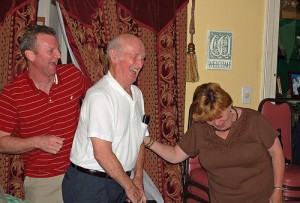
The few hundred friends and family members waiting inside burst into warm and enthusiastic applause. Kevin’s face lit up with a bright, broad grin. It was the kind of smile that looks like you have been saving up smiles from all of the happy things that have ever happened to you, and you unleash them all at once in one enormous outpouring of joy.

As Kevin began at last to wade into the throng of well-wishers, contemporaries and fresh-faced kids alike, the surprise 80th birthday celebration for this gentle, self-effacing accordion player from Legfordrum, County Tyrone began in earnest.

It was a party that seamlessly transitioned to a rollicking session, with many of Kevin’s friends—including his mononymous long-time ceili partner Pancho on piano accordion, Kathy DeAngelo and Dennis Gormley, Hollis Payer, Chris Brennan Hagy, Caitlin Finley, and so many others I can’t remember them all.

And after the session, the fiddlers and pipers and banjo pickers hurriedly collected their chairs and their beers, and the dancers took over. Soon the Fireside Room rocked to the sound of slamming heels, and a thumping great ceili broke out.

Soon Kevin McGillian himself joined the ceili band, picking up the two-row button accordion and getting down to business.

It was on the pretense of playing for a ceili that Kevin was lured to the Barry Club in the first place. (Teacher John Shields did his best to reel him in, leading a handful of dancers and calling out steps until just before Kevin entered the room.)

Several of Kevin’s longtime friends had hatched the scheme many weeks before.

“A few months back at the Shanachie (Pub) session, Judy Brennan asked me if I thought we should do something for Kevin’s 80th birthday,” says Marianne MacDonald, host of the local radio show “Come West along the Road” and set dancer. “After a lot of back and forth with the Irish Center being booked for the dates around his birthday (which was June 7th), we were able to settle on the last Friday of June. Lots of people had a hand in organizing it and getting the word out and trying to make sure Kevin wouldn’t hear about it. But I guess Jimmy (McGillian) and I were the main organizers. Kevin’s family made the arrangements for the food.”

When they first started to organize the party, Marianne says, she and her co-conspirators expected perhaps a hundred guests. Those expectations changed fast.

“Once the RSVP’s started coming in,” Marianne says, “we knew it would be at least 200. I don’t know what the actual count was, but judging by the number of seats that I know we put out and the people sitting and standing I would say it was about 250. I think it was a fine tribute that all of those people came out to wish Kevin a happy birthday.”

But perhaps it shouldn’t have been so surprising that so many people chose to honor Kevin McGillian. Marianne calls Kevin her “absolute favorite musician.” Anyone who watches him play would have to agree. He seems to have forgotten more tunes than most session musicians know. (And I wouldn’t really bet on him forgetting many, though I’ve seen him draw a blank on a few.)

But what most people remember about Kevin, other than being wowed by his talent, is how conspicuously unassuming he is about it all. He is a truly gentle and generous man. Marianne sums it up: “He is amazingly humble, modest and down-to-earth, and I think that’s why everyone loves him so much.”