All Posts By

Jeff Meade

Sports

Local GAA Hosts Christine Corr Memorial Cup on May 6

The Christine Corr Memorial cup will be held on Sunday, May 6, at Neumann College in Aston, Delaware County.

The games begin at 10 a.m.

There will be at least three confirmed clubs from the Philadelphia area: Delco Gaels, Delco Harps and the Shamrocks, with Tyrone possibly being the fourth.

Two New York clubs, St Barnabas and Rockland, are coming down for the day.

Each team will be fielding four different age brackets under 8, under 10, under 12, and under 14. There will also be two girls-only games, under 10 and under 14.

The two under 14 teams are heading to Ireland this June to compete in a national competition.

There will also be an adult game with the Astoria Gaels from New York playing Donegal GFC from Philadelphia. There will also be an “Old Crocks” game for all who are interested.

There will be prizes for all age groups, and lots of good food and soft drinks.

Arts, People

Telling Tales Out of School

Malachy McCourt

Malachy McCourt

Actor, writer, raconteur, dishwasher, radio host, longshoreman, Green Party candidate for governor of New York—Malachy McCourt is, or has been, all of those things.

Add another title to McCourt’s resume: distinguished scholar.

Wednesday afternoon found McCourt waxing Socratic in the Henry Library at Chestnut Hill Academy. Earlier in the day, he had read Shakespeare, coached a drama practice, and spoken on the role of the Irish in U.S. history. But now, as the last bell rang, McCourt found himself at the center of a long wooden table—and the center of attention—at a gathering of the Upper School’s Multicultural Student Association.

Probably the most dominating feature of the room is an imposing Calder fireplace, with a bit of timely advice from Isaiah—“Kyndle Yr. Awne ffire—carved in stone over the hearth. Obligingly, McCourt was setting off sparks of his own.

For just under an hour, McCourt led a freewheeling discussion about everything from shock jock Don Imus’s brutish racial slur—“Does that solve the problem, somebody getting fired?”—to the proper uses (if there are any) of a particular profanity. (It sounds like poetry when he uses it.)

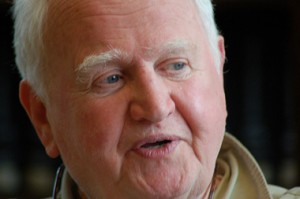
He seemed most delighted whenever one of the boys begged to differ with him, whether on the issue of rap music lyrics or gay marriage. He’d lean back in his chair and unleash one of his playful, gap-toothed grins, and those thick, frost-white eyebrows would twitch with unalloyed delight.

McCourt’s day at CHA came courtesy of the school’s Steele Guest Faculty program. The program was the brainchild of the late Franklin Steele, himself a man of many interests and pursuits—a lawyer by education, followed by 15 years on Wall Street and still more years after that as an investment management consultant. Steele also is remembered as an ardent collector of baseball memorabilia, and the publisher—with his wife Peggy and artist Dick Perez—of some of the finest baseball art in the world.

The purpose of the Steele Guest Faculty program is to increase awareness and understanding of the Celts’ unique contributions to the world.

“Frank very much identified with his Irish heritage,” explained Peggy Steele, who had spent the day shadowing McCourt. “His (Steele’s) grandfather was an Irish gypsy, or tinker. In fact, when Frank and I went to Ireland, he used to hang out with the tinkers.”

Peggy launched the program in 2000, shortly after her husband’s death. The program went to CHA because the Steeles had a grandson at CHA and Peggy serves on the board. “This was something he and I had talked about,” Peggy said. “He knew that there was a time when the Irish were not favorably looked upon. He said it was important that young people be exposed to current Irish culture.”

McCourt follows in the footsteps of several other distinguished guest faculty members, including Mick Moloney and Eamon Grennan. Peggy Steele contacted McCourt, who was the friend of a friend. “Malachy thought it was a great idea,” she said.

As he took a bit of a breather before the arrival of the multicultural student group, McCourt had time to reflect on the day and its meaning. He recalled with delight the students’ many questions about the roles and contributions of the Irish on both sides of the Civil War conflict. And he reveled in his brief classroom appearance that morning as the character Mercutio from “Romeo and Juliet.”

As for what an Irishman is doing teaching Shakespeare, McCourt had a ready explanation. “I love the language,” he said. ”I don’t think you could ever use too many words. You know that the Irish will never use one word when a hundred will do.”

All in all, not a bad gig for a man who describes his academic career as “very undistinguished.” Indeed, McCourt’s brief bio on IMDb.com notes that he “managed to fail every subject in school except English and recess.”

The irony of the situation wasn’t exactly lost on him. “They haven’t gotten wise to me yet,” he smiled conspiratorially. “If I stay much longer, they will.”

The CHA community looked like it was in no rush to see him leave, however. The students and faculty were clearly enjoying the contributions and insights of their faculty member for the day. As one enthusiastic Middle School student put it, “he was funny and talked about important things in a way we could understand.”

On a semi-serious note—with Malachy McCourt, it seems to be a well-worn note—he admitted that “It’s very odd to become considered an academic.” At the same time, he said, “I don’t mind sharing what I have. I have opinions about everything.”

Music

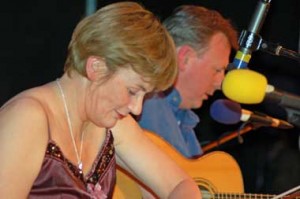
Maeve Donnelly and Tony McManus in Concert

Maeve Donnelly and Tony McManus. (Photo by Jeff Meade)

Maeve Donnelly and Tony McManus. (Photo by Jeff Meade)

I’m pretty sure I smelled smoke. I think it was coming from the sizzling strings of Maeve Donnelly and Tony McManus.

The sprightly virtuoso fiddler from Quin, County Clare, accompanied by the guitar master from Paisley, Renfrewshire, Scotland, didn’t set off the sprinkler system at the Coatesville Cultural Society, but it was touch and go there for a while. They played Saturday night to a packed house (now, that’s what we like to see), bringing a big smile to the face of Frank Dalton of the Coatesville Traditional Irish Music Series, which sponsored the show.

Maeve and Tony treated the audience to close to two hours of light-speed reels and jet-powered jigs—and one or two non-traditional tunes. (One particular highlight was Tony’s solo performance of two lovely gavottes from Brittany.)

Maeve’s solo set was no less dazzling. She performed her set of tunes—including a Junior Crehan hornpipe, “Her Golden Hair Flowed down Her Back” —on a fiddle with a non-traditional tuning. (“Out of tuning,” she called it.)

There were times when I heard Maeve do things that I didn’t think you could do on a fiddle. I swear I saw her levitate.

Or maybe it was just me.

Judge for yourself. Check out our videos and Gwyneth MacArthur’s photos.

News

Cavan Society Gets Set to Celebrate Its 100th Anniversary

A century is a big deal, so the people of Philadelphia’s Cavan Society are planning a big bash.

The Cavan Society 100th Anniversary Dinner is planned for May 20 at the Philadelphia Irish Center (Commodore Barry Club), 6815 Emlen St., in the Mount Airy section of Philadelphia.

The observance begins at 3 p.m. with a commemorative Mass at the Irish Center. The social part of the evening follows at 4, with a cocktail party. Dinner is served at 5.

Providing the night’s entertainment is the Theresa Flanagan Band.

Admission is $50. For tickets, call Tom Farrelly at (610) 527-2406.

No tickets will be sold at the door.

For additional info, visit the Cavan Society Web site.

If you’re from Delaware County and you need a ride, you can catch a bus at 2:15 from St. Denis Church, Eagle Road and St. Denis Lane in Havertown. Space is limited. Call Rosie at (610) 623-1410.

Music

Hard Work Pays Off

Maeve Donnelly is that rarest of birds, an Irish musician whose parents are not players themselves. (Which would make them, um … kind of like the Muggles of the Irish traditional world.)  

Somehow, in spite of her inauspicious roots, she has managed to muddle along.

She won her first All-Ireland Fiddle Competition at age 9. She won two more All-Ireland fiddle titles after that. She also picked up the National Slogadh Competition for Solo Fiddle and The Stone Fiddle Competition in County Fermanagh.

This Saturday, Donnelly will bring her fiddle—and her winning ways—to the Coatesville Cultural Center for a concert with guitarist Tony McManus, starting at 8 p.m. The concert is sponsored by the Coatesville Traditional Irish Music Society. (There will be workshops from 5 p.m. to 7 p.m. in both guitar and fiddle: $25.00 for either one. Pre-registration IS required! Please call (610) 486-2220 to do so.)

In a recent phone conversation from her home in Quin, County Clare, Donnelly explained how she made the journey from the Galway of her childhood and a house somehow not filled with fiddle-playing parents, aunts, uncles and cousins to emerge as one of the preeminent traditional players of her generation.

Q. How did you start out? How old were you?
A.
 I started very young. I was probably about 6 or 7 or so when I started playing. The reason for starting was, my two older brothers had gone to music lessons. Their teacher taught specifically Irish music.

We had a fiddle hanging on the wall at home. My other brother Declan had played fiddle, and so he had advanced on to another fiddle. It was no great mystique toward learning fiddle.

I got the fiddle put in my hand and a bow, and off I went with my two brothers to learn music.

Q. Not everyone who starts out on an instrument stays with it. Why did you?
A.
 I didn’t ever exactly like music lessons. I don’t think there’s a child who does. It was no great treat. My lessons would have started on a Saturday. I still feel like I had a big black cloud over me until it was over. I wasn’t great at reading music and I picked it up as best I could, playing by ear.

The way it happened was, we used to go to fleadhs as a family. We in turn were part of a bigger unit, and we played at fleadh cheoils all over the country. It was a special group of maybe 30 people. Within that group, everybody would go to the fleadhs. We would combine in different ways to go in for competitions.

A big proportion of praise goes to my parents, who put in a great sacrifice and weren’t pressuring us to get first place in the fleadhs. It developed as a social outing.

That (playing in fleadhs) made a difference. I was playing in fleadhs and competing from about the age of 9. At the time we would have traveled up to three hours back in the late 1960s. It was quite a journey to go to these fleadhs.

Q. Your parents didn’t play. It seems like everyone else I’ve interviewed who plays an instrument comes with a pretty deep family background.
A. I often think, would it have been nice to have had parents who were musicians? Sometimes it can be more refreshing not to have parents playing musical instruments at home. It’s better doing your own thing, and a challenge.

Q. Was there a point at which you felt like your playing had progressed beyond the routine of lessons, to where you knew that there could be something more?
strong>A. I finished classes in my teenage years. At about that time, a whole new breed of festival started in Ireland. They were non-competitive workshops. The first one was Willy Clancy Week. That was my first introduction to learning music for a whole week, and having great fun and being immersed in it for a week. The first year I went there I was in a class taught by Sean Keane of the Chieftains. And I met a lot of pipers. I never met pipers. I met Seamus Ennis. It was an eye-opening experience. That was about 1974.

After that, I would go back annually.

Q. How has your approach to playing progressed since then? How did what you learn in workshops influence your playing? 
A.
 It sort of organically grew. I enjoyed what I was doing. I also felt that I worked at what I was doing. I’m not claiming that it dropped down or I was gifted in any way. It sort of spurred me on to studying the music, to working at the music, rather than sitting and playing at sessions. I spend a lot of the just sitting at home and playing.

I think session music is a great form of practice and a great form of picking up tunes and great form of fun. As an exercise in improving your playing, I’m not sure I would agree. It depends on the session. At that level you just play as an ensemble groups. The individual part of the playing doesn’t come. But playing in sessions also gives you motivation to keep playing. Every time I go to a session, I always hear a new tune. It’s like a lifeline in its own way.

Q. What do you do when you aren’t playing? 
A.
 My full-time job, and has been since I was 20, I’ve been a teacher. I teach in the area of learning support. I take children 7 to 12, children who have trouble with literacy and numeracy. Being a teacher means I have a long holiday time. I have more flexibility. I can take one week and I can tour.

Sports

The Irish Baseball Movie Comes to the Newtown Theatre

John Fitzgerald

John Fitzgerald

The Newtown Theatre has seen bigger crowds.

Unfortunately, fans filled only two or three rows of the historic red-brick movie house on State Street for the Saturday screening of “The Emerald Diamond,” filmmaker John Fitzgerald’s documentary homage to the Irish National Baseball team.

Small or not, it was an enthusiastic crowd—mostly Hibernians, based on the jacket logos.

Their enthiusiasm is justified. “The Emerald Diamond” traces the history of Irish baseball, from its humble, indistinguished origins to their silver medal appearance in the European championships last summer.

“What’s happening now is, they’re really getting ready for 2008,” Fitzgerald told his audience after the screening. The team had set its sights on eventual Olympic competition, he explained, but the decision by the International Olympic Committee to drop baseball from the games put the kibosh on those dreams. But a gold medal in the European championships would put the Irish National Team in contention for the World Baseball Classic. “The Classic is their only chance to get out there,” he said.

Happily, Saturday was not your only opportunity to see “The Emerald Diamond.” In fact, you can own it on DVD. The DVD, T-shirts and other goodies are available here.

News

Still Friendly After All These Years

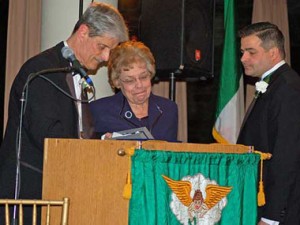
President Russell W. Wylie presents the Presidential Medal posthumously for Thomas O. Peterman, to Susan Peterman, his widow. At right is Todd R. Peterman, his son.

President Russell W. Wylie presents the Presidential Medal posthumously for Thomas O. Peterman, to Susan Peterman, his widow. At right is Todd R. Peterman, his son.

How old is the Society of the Friendly Sons of St. Patrick? Well, the group organized in Philadelphia in 1771. George Washington was an honorary member. This was the group’s 236th annual banquet.

Is that old enough for you?

The Friendly Sons—officially, “The Society of the Friendly Sons of St. Patrick for the Relief of Emigrants From Ireland”—celebrated in lavish style at Villanova’s Montrose Mansion.
The night featured performances by the University Glee Club, the McDade School dancers and the Philadelphia Emerald Society Pipe Band. The United States Navy Villanova University Naval Reserve Officers Training Corps presented the colors.

Larry Mendte, the CBS3 anchor, must have a clone walking around somewhere because he managed to attend every Irish event known to humankind on St. Patrick’s Day, including this one. He served as emcee.

The emotional highlight of the evening was the posthumous presentation of the society’s Presidential Medal to Thomas O. Peterman, the group’s former treasurer.

Peterman, who died of leukemia in December, also was active in many other local Irish causes, including the Philadelphia Irish Famine Memorial. He attended the University of Pennsylvania and the U.S. Naval Academy in Annapolis and was a Naval Reserve veteran. Accepting the award from president Russell W. Wylie was Peterman’s widow, Susan Brown Peterman and his son Todd R. Peterman, the new treasurer of the society.

Wylie noted that Peterman was proud of his involvement in the Friendly Sons. In a group with such deep roots in U.S. and Philadelphia Irish-American culture, it’s easy to see why.

News

The Ceremony Goes On

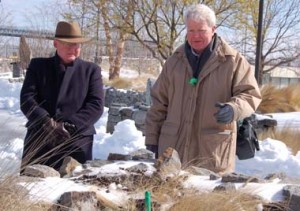
Planting shamrocks in the cold, hard ground.

Planting shamrocks in the cold, hard ground.

Larry Mendte stood at the podium in an icy wind, and he managed to put a positive spin on the annual 5K to benefit the Philadelphia Irish Famine Memorial.

“In a way, everybody won,” he said, “because there was no 5K this morning.”

The Delaware Valley woke up to frozen roads and windshields, so it was a wonder any annual St. Patrick’s Day observances took place.

But the annual ceremony at the Philadelphia Irish Famine Memorial down at Front and Chestnut did go on, as scheduled, though it was much shorter than usual.

Take a look (and be glad you are inside and warm).