All Posts By

Jeff Meade

Arts

Come to the Movies With Us!!

Visit “reel” Ireland starting on March 27 when the Irish Center, in cooperation with www.irishphiladelphia.com and WTMR radio host Marianne McDonald, presents a series of your favorite Irish films every Thursday night for six weeks.

The series, which will be shown at the Commodore Barry Club, Carpenter and Emlen Streets in Philadelphia, will open with the romantic comedy,The Boys and Girl from County Clare. The 2003 film from director John Irivn is the story of feuding brothers (Colm Meany and Bernard Hill) whose respective ceili bands go head-to-head at the All-Ireland music competition. Andrea Corr (of the Corrs) gives an outstanding performance as a young fiddler on whose questionable parentage the plot centers.

A discussion and a music session will follow the film, led by local musician Fintan Malone, a native of Miltown Malbay, County Clare, where the annual Willie Clancy Festival of traditional music is held every year, much of the action at his family’s pub, Tom Malone’s. Musicians are encouraged to bring their instruments.
Admission to the performances, which start at 7:30 PM, is free. Refreshments, including alcoholic beverages, soft drinks, and Barry Club Manager John Nolan’s famous fries (also known as Irish popcorn) will be available for sale.

Other films in the series will include:
April 3: The Secret of Roan Inish
April 10: Butcher Boy
April 17: The Snapper
April 24: Bloody Sunday
May 1:My Left Foot

News

A St. Patrick’s Day Present for the Philadelphia Irish Memorial

Philadelphia Mayor Michael Nutter joins in the wreath-laying ceremony at the Philadelphia Irish Memorial.

Philadelphia Mayor Michael Nutter joins in the wreath-laying ceremony at the Philadelphia Irish Memorial.

Last year, it snowed. This year, it was windy and vaguely arctic. However, the sun shone brightly as local irish, the great and the small, gathered to remember the Irish ancestors who overcame overwhelming odds and endured endless hardships to settle here in Philadelphia.

And the board members of the Irish Memorial, local dignitaries and just average Irish-American citizens gathered at the monument down at Penn’s Landing on a brisk St. Patrick’s Day morning had one other thing to warm their hearts: a three-year, $60,000 donation from the Board of City Trusts.

John J. Egan, chairman of the City Trusts board, said he got the idea from Irish Memorial board member Kathy McGee Burns over lunch one day. “You just can’t say no to that woman,” he told the crowd.

Irish Memorial Board President John F. Donovan note that “it was he fastest $60,000 we ever made.” The funds will be used to improve lighting and general maintenance and upkeep of the monument and its grounds, he said.

Philadelphia Mayor Michael Nutter—on that day going by the unwieldy moniker of “Michael O’Nutterman”—seemed genuinely delighted to attend the ceremony and take part in the wreath-laying. This is a man who apparently loves being mayor, and all the little ceremonies that go with the job.

And here’s another thing Mayor O’Nutterman said he loves: “We always love a generous contribution.” But he quickly added: “Just be sure to cash that check as soon as possible.”

No worries there, we’re sure.

Take a look at our photos from that day:

Arts

Irish Philadelphia Film Festival: Waking Ned Devine

Waking Ned Devine

Released: 1998

Genre: Comedy

Synopsis: Ned Devine, a bachelor farmer in the Irish town of Tullymore, wins the Irish National Lottery. His unbelievable luck is revealed to him one night as he sits in front of the telly, watching the numbered balls roll into place.

He’s thrilled. He’s shocked.

And, in moments, he’s dead.

Before long, word gets out that someone in the village has won the big prize—6.9 million pounds—but who is it? Ned’s not talking.

One of the elders of the village, Jackie O’Shea (Ian Bannen), sets about trying to find out. He enlists the aid of his wife Annie (the stunning Fionnula Flanagan) and his old chum Michael O’Sullivan (the diminutive David Kelly). In a campaign as cunning and subtle as the invasion of Poland (substitute a chicken dinner for the Stuka dive bombers) Jackie eventually rules out everyone in the village—everyone except one man.

Jackie and Michael go to visit Ned at his cottage—and there they discover the terrible truth. They find Ned in his comfy chair in front of the set, a smile frozen on his face, the winning ticket on the floor.

For a while, all seems lost. But then Jackie manages to convince himself that Ned would have wanted his two good friends in the village to share in his good fortune. He hatches a plot to persuade the lottery authorities that his pliant pal Michael is, in fact, the winner Ned Devine—but things rapidly spin out of control and, before long, the whole town is in on the action.

Will they be able to fool the lottery agent who comes to town in search of the winner? Will they persuade the town’s cantankerous, back-stabbing biddy to join the conspiracy—or will she turn them all in for the reward money?

Why It’s One of the Best: Written and directed by Kirk Jones, “Waking Ned” was one of the last films of veteran Scottish actor Ian Bannen. He died in 1999 in a traffic accident, just a year after this film was released. Let’s just say he saved his best for last. In the role of the conniving charmer Jackie O’Shea, Bannen is utterly convincing.

Then again, everyone in this fictional town seems real, from the grasping Lizzie Quinn (Eileen Dromey) to the tender-hearted but malodorous hog farmer “Pig” Finn (James Nesbitt, seen in “Bloody Sunday,” the first film we reviewed in this series). In a film that spans just an hour and a half, we somehow come to know everyone. It feels like we’ve always known them. Then again, if you grew up in a small town, as I did, then you probably have always known them.

Ultimately, “Ned Devine” is a charming confection of a film about friendship and the loving kindnesses of neighbors. It’s about the secrets we all know about each other, good and bad. It’s about community.

It’s also about lottery fraud, too, of course. Ah, but what harm is there in a bit of fraud among friends and neighbors? In the end, you’ll believe, as Jackie does, that Ned would have wanted it that way. So let’s all raise a glass to Ned Devine. And good night and joy be with you all.

News

We Celebrate St. Paddy’s Day

We don’t know how you celebrated St. Paddy’s Day, but our day ranged from the green beads/silly green hat/green beer experience to the richly moving remembrance of our courageous forebears whose struggles are carved in stone at the Irish Memorial in Philadelphia. From the wild Shamrockery of local group Blackthorn, to the old world fiddling of Danny Meehan of Donegal. From an Italian cook’s version of corned beef and cabbage (yum) to an Irish take on the traditional meal (your choice of beef, ham, or turkey, plus the cabbage).

However you did it, we hope you had as good a time as we did. Check out our photos:

An added treat: Celtic group Dervish appeared the Friday before St. Paddy’s Day at the Sellersville Theater. Photographer Gwyneth MacArthur was there. Here’s what she saw:

Arts

Irish Philadelphia Film Festival: Bloody Sunday

Bloody Sunday

Released: 2002

Genre: Drama

Synopsis: A brilliant—though, at times, painful to watch—dramatization of the January 30, 1972, civil rights march in Derry, Northern Ireland, led by activist-politician Ivan Cooper. The march began peacefully, but it ended in a hail of gunfire. In just 10 minutes, 14 civilians lay dead in the streets, shot by members of the 1st Battalion of the British Parachute Regiment; 12 others were wounded. Two more were struck down by British armored personnel carriers. (And the official whitewash virtually on the spot.)

Why it’s one of the best: Written and directed by the innovative filmmaker Paul Greengrass, “Bloody Sunday” is shot in a documentary style, with handheld cameras. It’s all blur and herky-jerky motion, like Vietnam battle footage.

The technique yields a film of compelling immediacy. We feel as if we are all on hand in the Bogside on that awful day, marching alongside Cooper, Bernadette Devlin, Father Edward Daly—and young protestor Gerald Donaghy, who, with so many others, took a fateful wrong turn on a day when the British troops assigned merely to stop the illegal march turned instead, all too easily, to indiscriminate slaughter.

Donaghy died that day, shot in the belly.

Two performances are particularly noteworthy. The Northern Ireland (Coleraine) actor James Nesbitt—if you watch BBC America, you may know him as Murphy of “Murphy’s Law”—turns in the finest performance of his career as Ivan Cooper. Cooper was then a member of the Northern Ireland Parliament who led the ill-fated march.

The film turns on Cooper’s actions on that day—from the morning, when he and others still dared to hope that they might be allowed to march in peace, to the news conference in the aftermath of the massacre in which he warned the British government that its actions had “given the IRA the biggest victory it will ever have. All over this city tonight, young men, boys, will be joining the IRA, and you will reap a whirlwind.” Watch Nesbitt’s face as the names of the dead are read out. You’ll see why he just might be Ireland’s best actor.

The veteran British actor Tim Pigott-Smith plays the cold, pitiless Major General Robert Ford, the British Army’s most senior officer in Derry on the day the Paras ran rampant. He played a similar character, in a way, in the BBC mini-series “The Jewel in the Crown,” about the last days of the British Raj. Pigott-Smith masterfully portrays that odd combination of bloodlessness and bloody-mindedness characteristic of so many British military men, particularly in colonial settings.

As I say, “Bloody Sunday” is not easy going. But if you want to understand and appreciate the history of Northern Ireland and the “Troubles,” this film is indispensible.

Arts

Irish Philadelphia Film Festival: The Snapper

The Snapper

Released: 1993

Genre: Comedy

Synopsis: This is a story about babies, alcohol, and the connection between the two.

“The Snapper” is based on the second installment of Roddy Doyle’s Barrytown trilogy. (We’ve already talked about the first movie: “The Commitments.” The third, “The Van,” has its moments and, although accomplished, ultimately collapses under its own weight.)

For my money, “The Snapper”—that’s the Dublin slang term for “baby”—is the best of Doyle’s three stories. It documents the trying but ultimately triumphant pregnancy of Sharon Rabbitte (Sharon Corley, in the film). The central question is: “Who’s the Da?” (Or, as the residents of Doyle’s fictional Barrytown might put it: “Who’re yis havin’ it for?”)

The prime suspect is revealed to readers early on—but to Sharon’s family and friends, his identity is veiled in mystery. (Was it really, as Sharon coyly suggests, a Spanish sailor?) Sharon was flying high at the moment of conception, but she was just barely sober enough to remember who did the deed. And it was no Spanish sailor.

Of course, a secret like this one is too big and embarrassing to keep. It’s only after Sharon’s father, the irascible Jimmy, gets wind of a bit of barroom braggadoccio—Sharon, evidently, being reported as “a great little ride”—that the answer is revealed to all of Barrytown. And, as they say in the movies, hilarity ensues.

Why it’s one of the best: First, it’s a Roddy Doyle story. It would be hard to make a better start. All the characters are engaging. Even minor characters, like Jimmy’s pals, the barflies Bertie and Bimbo, are fully realized. At the center of it all is the relationship between Jimmy and Sharon. Let’s just say it’s complicated, but it is clear that this daddy-daughter bond is unbreakable—even when Sharon’s great secret is revealed, to Jimmy’s everlasting horror.

The dialogue, as is always the case with a Roddy Doyle yarn, is spot on. It’s salty, peppery, and any other kind of spicy seasoning you care to add. Most of what turns up in the book survives, mostly intact, in Doyle’s screenplay.

The cast is first-rate. The ubiquitous Colm Meaney plays Jimmy; the role of Sharon is played by Tina Kellegher, who would go on to play the part of Niamh Egan in the BBC Northern Ireland series Ballykissangel. The brilliant Ruth McCabe plays Jimmy’s long-suffering spouse Kay. All of the kids—and there are many—are well cast.

But of course, the story revolves around Sharon, and Kelleher shows herself more than equal to the task of slipping into Sharon’s skin. She’s a tough kid, this Sharon, and she accepts her fate with grace and ballsy good humor. She has moments of doubt—but doubt, so often described as “nagging,” never really gains a foothold here.

Finally, there is the masterful direction of Stephen Frears (“The Queen,” “Dangerous Liaisons,” “My Beautiful Launderette”) who mostly tries not to get in the way of great material and talented actors. Frears keeps the whole enterprise moving along at a fast clip, and he never descends into gross Hollywood sentimentality.

Oh yes … and you’ll love the theme music in the opening and closing credits. Elvis, wherever you are (and I’m pretty sure I saw him working in one of the toll booths at the Ben Franklin Bridge), eat your heart out.

News, People

It Was Pete’s Day

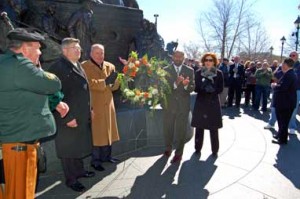
Tess, from the Caitrin dancers, is still learning all the steps.

Tess, from the Caitrin dancers, is still learning all the steps.

For Pete Hand, it was the ride of a lifetime. The president of the AOH Notre Dame Division and drum major for the division’s Irish Thunder Pipes & Drums has certainly marched down Fayette Street for the Conshohocken St. Patrick’s Day Parade.

But this was his first as grand marshal. He was joined on his journey by a few hundred of his nearest and dearest friends—pipe bands, high school bands, AOH and LAOH divisions, hordes of dancers … and one leprechaun.

Check out our photos, below.

And in the meantime, here are the winners:

  • Best Adult Band South Philadelphia String Band
  • Best Youth Band Cinnaminson High School Band
  • Best Pipe Band Delaware Pipes & Drums
  • Best Irish Dance School Coyle School of Irish Dance
  • Best AOH Presentation Girardville Jack Kehoe Div. 1
  • Best LAOH Presentation Girardville Daughters of Erin
  • Best Firemen Marching Springmill
  • Best Overall Unit Montgomery County Sheriff’s Dept.
  • Judge’s Award Elks Lodge 714

The Montgomery County Saint Patrick’s Parade Committee, the AOH and LAOH members of the Notre Dame Divisions thank all those who took part in this event to make it a success.

Music

Review: The Chieftains at the Kimmel Center

There are some who say the Kimmel Center’s Verizon Hall is shaped like a giant cello.

An untrained eye would make that kind of mistake. But anyone who attended the Chieftains concert at Philadelphia’s world-class concert hall could tell you: It’s a big Irish fiddle—obviously.

In a stellar Saturday afternoon show, the band managed to turn the city’s premier symphonic concert hall into an intimate Irish house party. Certainly, it had most of the required elements—whoops, foot stomping, sing-alongs and even, at the end, a bit of dancing. Indeed, our photographer Gwyneth MacArthur, in her first visit to the Kimmel, wound up—with a gaggle of other delighted audience members—dancing a kind of “hora” on stage with the show’s rubber-legged dancers Jon and Nathan Pilatzke, Cara Butler, and a whole troupe of Shirley Temple-wigged dancers from the Ryan School of Irish Dance. (Shyness was never Gwyneth’s problem.)

The show actually began on a bit of a disconcerting note. On their flight into Philly, the airline lost the band’s luggage—including the uilleann pipes played by Chieftain-in-chief Paddy Moloney. (Something similar happened fairly recently to a treasured banjo owned by Solas leader Seamus Egan, I believe. There are certain things you should just not check in.)

But this is a band of long experience and struggles, and they soldiered on, serving up a couple of hours of brilliant, often breath-taking, Irish music. All of it was clearly rooted in Irish musical tradition, but there were the usual departures, including such tunes as “Cotton-Eyed Joe,” from the Chieftains’ 10th album. Bluegrass star Ricky Skaggs did the vocal honors on the album, but the Chieftains’ bodhran player and singer Kevin Conneff filled in more than ably.

As promised, the Chieftains also dabbled a bit in music from Scotland. Alyth McCormack, from a little island called Lewis in the Outer Hebrides, has a high, clear voice (marred somewhat by intermittent feedback). She dazzled the crowd with a display of that peculiar act of Scottish lyrical tongue-twisting known as mouth music. “You’ll see why they call it that,” she said before she sang. And, yes, we did see.

Introducing McCormack was a piper who played a lovely, haunting version of the standard pipe band tune, “The Rowan Tree.” The Chieftains blended in along the way with Matt Molloy’s flute, Paddy’s chirping tin whistle and Seane Keane’s fiddle. It wasn’t the first or the last time that night that Gwyneth’s eyes misted over.

No Chieftains show is complete without some dancing pyrotechnics from the Pilatzkes. They joined with Cara Butler for one of the most peculiar—and, at the same time, inspired—dance routines you’ll ever see, performed entirely while seated on chairs. Most of us were falling out of our chairs at the end.

Harper Triona Marshall and Irish singer Carmel Conway also joined the show in Philly. Conway performed an achingly beautiful version of the “The Foggy Dew,” and Marshall pretty much set the stage on fire with her version of “Carolan’s Concerto.” Before the concert, Paddy mentioned that it was the best version of the piece he’d ever heard. I wouldn’t argue.

The Chieftains clearly relish playing in the Kimmel—and who could blame them? It’s not really St. Patrick’s Day in Philadelphia until the Chieftains play there, in that lovely place. I wish we didn’t have to wait ‘til next St. Patrick’s Day to hear them there again.