All Posts By

Jeff Meade

Music

Inside the Heart of a Dreamer

I would fly from the woods’ low rustle
And the meadows’ kindly page.
Let me dream as of old by the river,
And be loved for the dream alway;
For a dreamer lives forever,
And a toiler dies in a day.

—John Boyle O’Reilly

Sean Tyrrell, the singer-songwriter from the West of Ireland, has performed in Philadelphia twice—including a memorable set with fiddler Tommy Peoples at the 2001 Philadelphia Ceili Group Festival. (You can hear it on the group’s commemorative festival CD, “Toss the Fiddles.”)

I’ve missed his local appearances, but I ran into him a few years ago on a trip to Ballyvaughan, County Clare. He was playing his regular weekly session at Green’s, a pub roughly the size of a confessional booth in the center of town.

After a strong set of the traditional stuff, Sean started noodling around on the guitar, getting set to play something soft and slow. It took me a few notes before I recognized the tune: “South of the Border (Down Mexico Way),” the peppy 1939 standard written by Jimmy Kennedy and Michael Carr, and a big hit for singers as diverse as Gene Autry and Frank Sinatra.

Tyrrell’s version was a different tune altogether. Gone was the hokey Latin syncopation. And that mental image of Dorothy Lamour with a bowl of fruit on her head? Forget that. This was a far more wistful treatment than ever I’d ever heard.

Tyrell’s great gift lies in his ability to interpret songs—even those, and perhaps especially those, that have otherwise been done until you’re sick of hearing them.

“I have often said that I don’t regard myself as having the greatest voice,” Tyrrell said in a phone interview from Seattle, “but that (his interpretive skill) is something that I do have. There aren’t that many bad songs, really, but there are a lot of bad singers. What I mean by that is, people who just don’t care about the lyric. You can take a song like “The Black Velvet Band” or “The Wild Rover,” and if you really read those lyrics, you’ll find that they’re great songs, but they’ve just been done to death.”

One example is Tyrrell’s take on the standard “Coast of Malabar.” It could be a cheesy or sentimental tune, he admits. It has certainly been performed in that way. But, he said, “If you really look at the lyrics, it’s about a man who has fallen in love with a woman who’s a different color. And he can’t bring her back to England, because she’s the wrong color. I just wanted to get that across.”

Tyrrell’s other great passion, for some time, has been poetry, including the works of the well-known—Oscar Wilde, for example—as well as some other poets who are not as well known, such as Louis MacNeice.

The poet with whom Tyrrell is most closely identified is John Boyle O’Reilly. O’Reilly was a member of the Irish Republican Brotherhood, captured and jailed, and subsequently transported to Australia. He escaped to Boston, where he became editor of the Irish newspaper, The Pilot.

Tyrrell’s interest in setting poetry to music stems from a chance encounter in New York City with a book called “100 Years of Irish Poetry,” edited by Kathleen Hoagland. “It’s still available, actually,” he said. “About 50 percent of my repertoire for years has been from poems from that book that I set to music. One of the poems was was John Boyle O’Reilly, ‘Cry of a Dreamer.’ I recorded it on my first album, and gave it (the album) that title.”

Tyrrell now performs five of O’Reilly’s poems set to music in a one-man show, also entitled “Cry of a Dreamer.” The show also includes music and poetry from a number of other diverse sources, including Wilde, as well as Bob Dylan and John Lennon. The show is meant to document O’Boyle’s life.

“He was an amazing human being,” said Tyrrell. “The magnitude of his soul just amazes me.”

You’ll get a chance to see the show here in Philadelphia on Saturday, May 17, at 8 p.m. at the Philadelphia Irish Center. The show is sponsored by the Philadelphia Ceili Group. The show has earned standing ovations in just about every city on the current tour where Tyrrell has performed it.
Music

Review: Capercaillie’s “Roses and Tears”

Twenty years together, and Capercaillie is still solidly Celtic … and, yet, still defiantly hard to pigeonhole.

With “Roses and Tears,” the Scottish band’s latest release on the Compass label, it’s clear the band has lost none of its creative energy. On the contrary, they’ve continued to advance the strongly percussive, polyrhythmic approach that had landed them pretty squarely in the “World” section of the CD sale racks since, um … forever.

Karen Matheson is, well, Karen Matheson. I first heard her years ago, before I even knew what a Capercaillie was, on a 1995 Putamayo “Celtic Women of the World” compilation. She was singing Dark Alan (from “Rob Roy”). Even then, her voice reminded me of single malt. Smoky, velvety, sweet, with a bit of an edge. (Bonus: No hangover!)

On “Rose and Tears,” Matheson’s voice seems to have entered a new level of maturity. I’ll admit that my judgment in this regard is colored somewhat by her performance on one particular tune, John Martyn’s anti-war song “Don’t You Go.”

This is the second CD from Compass in a year to include in-your-face ant-war material—the last being Michael Black’s eponymous debut album. In the ’60s, the airwaves were full of the stuff. You don’t hear it now much, except in the folk genre.

But back to the point … “Don’t You Go” is just a lovely song to begin with. Anyone could sing it. But when Karen Matheson sings it, you can truly feel the mother’s heartbreak that underlies the lyrics, especially in the wrenching last line.

Matheson is clearly the band’s anchor, but even without her, you’d recognize the sound as distinctively Capercaillie: Michael McGoldrick on pipes and flute, Donald Shaw on accordion, Charlie McKerron on fiddle and Manus Lunny on bouzouki. Propelling the band along, of course, is Capercaillie’s very own version of the fabulous Funk Brothers, the rhythm section: Che Beresford on drums; David Robertson on just about anything else percussive, and Ewen Vernal on the bass. I judge rhythm sections by how much they make me want to bang on the steering wheel. Let’s just say I bang … a whole lot.

It all comes together in several places on the CD, but probably my favorite is the fourth track, entitled “Aphrodesiac,” a wild collection of jigs, with McGoldrick just wailing away like a, I don’t know, wild wailing kind of thing.

The album, all too short at just 12 tracks, features many newly discovered traditional songs culled from the Gaelic song archive at the School of Scottish Studies. Capercaillie applies the good old reliable Capercaillie touch, and suddenly even old tunes sound fresh and vibrant.

All of which sums up what you get on “Roses and Tears.” It’s more of the same.

Ain’t it great?

Columns, How to Be Irish in Philly

How To Be Irish in Philly This Week

The hit off-Broadway musical, “The Irish and How They Got That Way,” by Frank (“Angela’s Ashes”) McCourt is in Philly till the end of June at the Walnut Street Theater. It sounds “don’t miss” to us.

But you only have one chance to see “Celtic Spring,” winners of the “America’s Got Talent” show. Think the Osmonds—it’s a sibling group—but with Irish instruments. They’re appearing Sunday at the Sellersville Theater at a matinee performance at 3 PM.

Later that evening, AOH Division 65 will honor two stalwarts of the Irish community, Jim Kilgallen and Paul Phillips, both longtime members of the Philadelphia St. Patrick’s Day Parade Observance Association (Kilgallen does the color commentary on CBS-3 the day of the parade; Phillips is treasurer, so he makes sure there’s enough money to have a parade.” The event is being held at the Irish Center from 4 to 8 PM. Parade Director Michael Bradley calls the duo “two of a kind.

“They are always there whenever I need advice and usually give you sound unbiased thoughtful responses,” he told www.irishphiladelphia.com. “Their years of experience in the various Irish organizations in which they belong, is truly priceless for the Irish Community of the Delaware Valley. AOH 65 is honoring 2 of the best we have in the Irish community. I would like to congratulate them on this and the many honors they have received in their lifetime, I am proud to call them friends!”

Next Saturday, plan to head over to the Radisson in King of Prussia for a benefit for the Upper Merion Police Department featuring Blackthorn and the Irish Thunder Pipes and Drums – wow, what a combo! Guys, consider a duet!

Looking ahead, time to think about getting tickets to a Phillies game. For the second year in a row, the Phillies are sponsoring Irish Heritage Celebration at Citizens Bank Park on Friday, May 16 at 7:05 p.m. when the team hosts the Toronto Blue Jays. Come out and enjoy Irish delicacies, live music and learn how to Irish dance. Emcee will be Bob Kelly from KYW – CBS 3.

To help honor the Irish community, the event features a $4 ticket discount off $16 – $27.50 regularly priced tickets. When you click on the “Buy Tickets” button on the Phillies’ website and enter the promotion code IRISH, you’ll get the special ticket offer. We think this is a very cool thing. Just don’t eat any green hot dogs.

All the details are you know where—the only calendar that Senator John McCain calls “friend.” And he’s seen plenty of calendars.

News

Camden Catholic Gets Jersey’s Irish Jumping

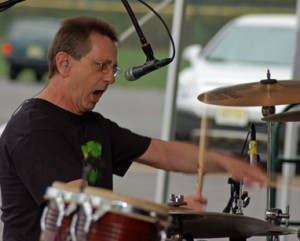
Mike O'Callaghan, banging the drum loudly.

Mike O'Callaghan, banging the drum loudly.

For the longest time, Jacob Griess was the only one on the dance floor. But he’s a toddler, and toddlers have no inhibitions.

But then Blackthorn took to the stage at the first Camden Catholic Irish Festival, and Jacob soon had plenty of company.

It was billed as a HUGE (all caps) Irish Festival, and,with more than 400 South Jersey Irish on hand, the description was apt.

Like most Irish festivals, it featured performances by Irish dancers and pipers, booths stocked with Irish hoodies and hats and such, and big steaming plates of ham and cabbage.

Of course, the big draw was Blackthorn. And even though it was a litle chilly in the big tent out behind the gym, the band soon hotted things up.

It was all music to the ears of Dennis “Archie” Archible, president of the school alumni association, class of ’74.

“This is going to be an annual event,” he said. “We have over 400 here today. We’re hoping to grow to over 1,000.”

Most if the revelers at Camden Catholic on Saturday are alumni, Archible said. A number of alumni also donated to the cause, he added, including beer and food. “It’s nice,” he said, “when it’s home-grown.”

The festival came together pretty quickly. Archible said it was first discussed following the school’s 120th anniversary in October. But the basic idea for the festival, he said, “has been inside my head for a long time.”

Proceeds of the event will help pay for bleachers and for improvements to the football field. As with most Catholic schools, tuition does not pay all of the school’s bills. Archible had no doubt that his fellow alumni would rise to the challenge. “We’re the oldest Catholic high school in South Jersey,” he said, “and the tradition is tremendous.”

News

Remembering Joe McGarrity and the Martyrs of 1916

Patricia Bonner and Patty Loomer.

Patricia Bonner and Patty Loomer.

The Easter Rising ended—after one bloody, tumultuous week—more than 90 years ago. The heroes of the failed insurrection are long dead. Ireland is a prosperous republic, a leader on the world stage, thanks to their vision and sacrifice. (Thanks, too, to the disastrous miscalculation on the part of the British government in turning those courageous but flawed human beings into martyrs.)

Northern Ireland, the scene of so much heartache for much of the 20th century, is not without its troubles—but now, perhaps, with a small “t.” Still, Ulster appears to be “set for a new course,” as Northern Ireland Deputy First Minister Martin McGuinness put it in a recent visit to the White House with First Minister Ian Paisley.

A casual observer of history might wonder, then, why so many people—members of Irish Northern Aid, Clan na Gael, the Ancient Order of Hibernians—are still bothering to commemorate that abortive, long-ago rising.

We’re standing at the Holy Cross Cemetery gravesite of Joe McGarrity, the one-time Philadelphia wine and spirits merchant, leader of Clan na Gael, and one of the one of the world’s great physical-force republicans. McGarrity, who came to the U.S. from County Tyrone in 1892, died in 1940. And still, here we are in this sprawling Delaware County burial ground, and we’re listening to Tom Conaghan, executive director of the Irish Cultural & Heritage House of Pennsylvania, read from the Proclamation of Independence, crafted by Padraig Pearse, leader of the 1916 rising. The words of that brief address, read out by Pearse himself from the steps of the Dublin GPO, still hold tremendous power:

Irishmen And Irishwomen: In the name of God and of the dead generations from which she receives her old tradition of nationhood, Ireland, through us, summons her children to her flag and strikes for her freedom.

So, why? Why dredge up that abortive, long-ago rising and all those troubled dead generations, now that Martin McGuinness and Ian Paisley are singing “Kumbaya” at the White House?

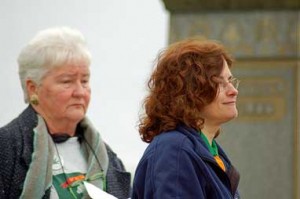
Patty Loomer, a member of most of the organizations toting banners on that cool, drizzly Sunday afternoon, offered a few remarks during the ceremony. With her interest in history, organizer Pat Bonner tapped her to review the life of Joe McGarrity. This was her third time. To her, one big reason to march every year to Joe McGarrity’s final resting place is the man himself.

“He borrowed money to get the ship to New York,” she recalls. “He had to borrow maney from a guy on the ship so he could get from New York to his aunt’s house in Philadelphia. Whatever he did, he was very determined.”

The other reason is simple remembrance of Pearse and all the others who took such monumental risks for Ireland. Loomer says: “It’s a commemoration. It’s a reminder of all the people who sacrificed so much.”   

We have photos from the day.

Dance

Tiny Dancers

Darrah and Niall field some, at times, humorous questions from the kindergarten.

Darrah and Niall field some, at times, humorous questions from the kindergarten.

Champion Irish dancers Niall O’Leary and Darrah Carr had just spent an entire class period in the Woodward Gym at Chestnut Hill Academy, teaching a group of kindergartners all about Irish dance and music. Applying their great powers of concentration and persuasion, they managed to herd all of those energetic little cats and keep them focused on the subject at hand. They even showed them how to dance a jig.

At the end of this exhausting but fun-filled period, there was just enough time for a few questions about Irish culture.

First question, from a little guy in the back:

“Did the Vikings invade Ireland?”

Darrah: Yes, they did, many times.

Brief pause. 

Second question, same kid:

“How many times did the Vikings invade Ireland?”

Darrah: Not sure, but many, many times.

Third question, same kid again:

“And what happened to you?”

Darrah: Happened to me when?

Same Scandinavian pirate-obsessed kid:

“When the Vikings invaded Ireland.”

Proof once again that, in the eyes of very small people, we older people can seem unbelievably old.

O’Leary and Carr were visiting CHA this week as part of the Steele Guest Faculty Program, designed to expose students to irish culture. The program is overseen by Peggy Steele and honors her late husband Franklin Steele. Past guests have included Malachy McCourt and Irish fiddle champion Seamus Connolly.

O’Leary is the director of the largest Irish dance school in New York City; Carr is artistic director of a New York-based modern dance company that blends Irish culture with contemporary dance.

The two guest faculty members for the day had a very busy day indeed, visiting classes from morning to late afternoon. They also returned later that evening for a special presentation … for adults.

Whether showing off their hard-shoe skills or playing the spoons, the grown-ups were no less charmed than were the kids.

News

Up The Tyrones!

With his master's degree in international relations from Northeastern, mild-mannered John Nolan is—just perhaps—overqualified for his job as manager of the Philadelphia Irish Center. But could there be anyone better?

With his master's degree in international relations from Northeastern, mild-mannered John Nolan is—just perhaps—overqualified for his job as manager of the Philadelphia Irish Center. But could there be anyone better?

With his master’s degree in international relations from Northeastern, mild-mannered John Nolan is—just perhaps—overqualified for his job as manager of the Philadelphia Irish Center. But could there be anyone better?

The members of the Tyrone Society of Philadelphia don’t think so. Not that they’re alone. John has lots of fans. (Including us.) But the Tyrones, at their recent ball to celebrate the organization’s 99th anniversary, conferred upon John the 2008 Red Hand Distinguished Service Award. (The Red Hand is an ancient Ulster heraldic symbol.)

The society’s Geraldine Trainor brought John and his wife Mary to the Irish Center stage and praised him for his “quiet, gentle unassuming way.” She noted also his family ties to Ireland. John is the youngest of five children born to Dan (the son of immigrants from Wicklow and Kildare) and Bridie (from Clare) Nolan of Bethlehem. John and Mary would go on to raise six of their own.

John attended Bethlehem Catholic, went on to attend LaSalle College as a political major and attended Northeastern for his master’s. He met Mary while he was working for the federal government in Washington.

After they moved to Mount Airy, Mary joined the Mayo Association (her father is from the county) and John occasionally tended bar. In 1993, he accepted the position as acting manager of the center.

It was never just an act, of course. He’s the real deal, and it didn’t take long for the Irish Center folks to realize it.

Fifteen years later, John says he still finds it hard to believe his good fortune. 

Nattily attired in a tux with a bright red bow tie, John unfolded a well-worn piece of paper with his remarks written on it and recalled thinking of the Irish Center gig as temporary. “I figured I could handle it for a while,” he told his audience. “I didn’t realize that, in accepting this job, Mary and I would be getting quite an education.”

He noted that his father’s people lost touch with Ireland, so there were gaps in his knowledge.

Hanging out on a quiet evening and chatting with some of the regulars did a lot to fill in the gaps. “Some of the best nights here were the nights when there weren’t a lot of people around,” he says.

Being on hand for many of the lectures and concerts and meeting the many celebrities who rolled through from time to time also did much to advance his Irish education. “I learned firsthand about the (1981 H-Block) hunger strike from Brendan Hurson (brother of hunger striker Martin Hurson, the sixth Republican to die in the strike),” he said. “It wasn’t just something you read about. I learned about these things, not from television, not from a book, but from the people who lived through it. I met (Irish republican politicians) Pat Doherty, Martin McGuinness and Gerry Adams.  And it wouldn’t have happened without the Irish Center.”

Like any good employee, he praised his boss Vince Gallagher and made note of all the improvements, overseen by Vince, that have transformed the Irish Center over the past several years. The Irish Center is quite the showplace now, he said, but even when it wasn’t, there was always something quite special about it. “It’s the one place in Philadelphia where everyone from Ireland feels welcome,” he said.

And one of the reasons for that, although he’s too humble to say it, is John himself.

Along with celebrating John, the Tyrones spent the evening celebrating something else pretty special: just being from Tyrone.

Arts

Irish Philadelphia Film Festival: The Commitments

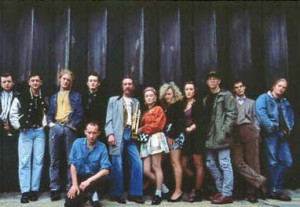
Ladies and gentlemen ... The Commitments.

Ladies and gentlemen ... The Commitments.

The Commitments

Released: 1991

Genre: Comedy

Synopsis: They’re out of work. They live in Dublin’s working-class Northside neighborhood. They have negligible musical ability. And they’re Irish, of course. Naturally, they want to start an American-style Motown band, complete with Funk Brothers horn section and babelicious backup singers.

Initially, this loopy premise made sense only in the mind of author Roddy Doyle, who self-published his rollicking book “The Commitments” in 1987. In very short order, the idea went on to make sense to Doyle’s wildly enthusiastic audience.

Of course, to Doyle’s creation Jimmy Rabbitte, Jr.—the young, charismatic manager of The Commitments—it made perfect sense that a group of Dubs would want to play American soul music. After all, as Jimmy put it in his irresistable recruiting pitch to potential band members: “The Irish are the blacks of Europe. And Dubliners are the blacks of Ireland. And the Northside Dubliners are the blacks of Dublin. So say it once, say it loud: I’m black and I’m proud.”

The lads (and the trio of “young wans” recruited to provide backup vocals and occasionally flash some leg) turn out to be blessed with talent. Guided by an old fella—horn player Joey “the Lips” Fagin, who claims to have backed up James Brown and most of the Motown masters—they live up to Jimmy’s expectations and quickly become Dublin’s “Saviours of Soul.” They’re a huge hit.

They are also disastrously dysfunctional.

Joey the Lips—a 40-ish, goggle-eyed, Jesus freak with a scraggly pony tail and bad teeth, and who still lives with his mother—quickly and unexpectedly claims the title of the band’s rakish Paddy. One by one, he woos the girls, sowing the seeds of jealousy and leaving the boys to puzzle over his mysterious appeal. But the source of most of the friction within the band is the lead singer Deco, who is blessed with a the perfect white soul voice—like a young Joe Cocker—and cursed with a toxic personality. Everyone in the band hates him—drummer Billy “The Animal” Mooney, most of all. Billy, who has already done time for assault, promises to kill him. (That is, when he’s not promising to assault Deco with a drumstick in a way that requires Vaseline.) For his part, Deco alternately hits on the girls in predictably seamy ways and despises them any time they get the chance to step out of his shadow.

Through it all, Jimmy sees The Commitments as the “band of destiny.” Sure, but destined for what? Will they a.) land that contract with the fella Dave from Eejit Records? Or b.) will they implode first? (If you don’t want to know, skip the rest.)

Why it’s one of the best: First off, it’s not just me who says so. Back in 2005, the good people who make Jameson’s Irish Whiskey (you may all bow your heads), together with The Dubliner Magazine, named “The Commitments” the best Irish movie of all time, based on votes from more than 10,000 movie fans.

And 10,000 rabid movie-goers can’t be wrong.

Alan Parker manages to capture all the grit and poverty of Doyle’s Northside, while at the same time revealing the brutal, profane honesty and desperate passion of the kids who form the band. He draws perfect, spot-on performances from his cast of unknowns.

And the music—well, The Commitments aren’t exactly the Funk Brothers, but they’ll do nicely in a pinch. What they lack in experience, they more than make up for in enthusiasm. These kids rock.

And, although The Commitments fall apart in spectacular fashion at the end, it’s hard to feel too disappointed. Because, regardless of the outcome, The Commitments is about the power of hope.

Jimmy Rabbitte, predictably, is crushed and angry when his dreams for The Commitments evaporate along with the band. But Joey the Lips sets him straight:

“You’re missin’ the point. The success of the band was irrelevant—you raised their expectations of life, you lifted their horizons. Sure, we could have been famous and made albums and stuff, but that would have been predictable. This way, it’s poetry.”

And it is.

P.S. for Parents: Massive F-bomb alert.