All Posts By

Jeff Meade

People

Five Questions for Caitlin Finley

Caitlin Finley, at last year's St. Malachy fund-raiser with Mick Moloney.

Caitlin Finley, at last year's St. Malachy fund-raiser with Mick Moloney.

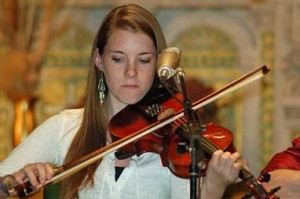
Caitlin Finley is getting set for another trip to the Fleadh Cheoil na hÉireann—otherwise known as the world championships of Irish music—in Tullamore, County Offaly, in late August.

Those who have heard Caitlin play usually are surprised at the level of skill in one so young. What’s more surprising, aside from her musical virtuosity, is her level of maturity. She’s a junior in high school, but, like so many of the kids who play in local traditional Irish music session, she seems more comfortable than most in the company of adults. 

Part of that is just Caitlin. But let’s also give credit to session musicians. Adult session musicians are generally welcoming to anyone with talent and interest, but they seem especially nurturing when it comes to kids. After all, it’s not a tradition if it isn’t handed down, and they seem to know that.

We recently posed five questions for Caitlin, who did exceptionally well for herself at the Mid-Atlantic Fleadh Cheoil in Pearl River, N.Y. Here’s what she had to say.

Q. You took third in fiddle and first in banjo. You’re in a trio that also took first place, and the Pearl River Ceili Band, which you’re also in, won the 15-18 competition. Tell me a bit about competing in so many categories. It doesn’t seem to have hurt you any, although I suppose that the third in fiddle means you wouldn’t be eligible to compete on that instrument at the Fleadh Cheoil na hÉireann in Tullamore in August.

Does competing in so many categories make you an overall sharper competitor, do you think, and maybe increase your competitive edge in all instruments? Or do you think there’s the possibility that maybe you consciously or unconsciously focus on one instrument over another?

A. Well, competing in so many competitions was certainly a challenge, especially because we had to arrange practices for the ceili band and trio, and the other kids all live in New York. I didn’t have much time to prepare because I’m a junior in high school, and AP Physics has taken over my life.

I think that because you have to concentrate on solely three tunes in preparation for the fleadh, competing on more than one instrument and in more than one category gives you a break sometimes.  For example, if I was practicing banjo and got tired of practicing my solo tunes, I’d just move on to the ceili band or trio tunes to play something different. And even though I wasn’t practicing my solo tunes, it was still preparing me for the solo competition just because I was constantly playing. 

At the same time, I had twelve tunes to really work up instead of only three.

As for switching back and forth between fiddle and banjo, I don’t know if it either benefited or hurt me. Although the technique for each instrument is completely different, I think that they complement each other. I don’t know if I focus on one more than the other.

I know that the fiddle is really my primary instrument and my favorite to play, but I still probably focused on each equally because when you’re tired and don’t feel like practicing, it’s possible to play the banjo on the sofa without much movement, whereas the fiddle’s a little more physically demanding. Oh, and for fiddle, even though I got 3rd, there’s a pretty good chance that I’ll still get to compete in Tullamore because the 2nd placer probably can’t make it, in which case I’ll be able to take his place.
 
Q. What tunes did you play in your competitions? And did you pick them yourself this time, or did you have a bit of help?

A. For the fiddle competition, I played the slip jig Gusty’s Frolics, a hornpipe called the Lass on the Strand, and a reel that I call Tom Steele’s (it’s also known as Hand Me Down the Tackle).  On banjo, I played a jig that I don’t know the name of, but I got from a recording of traditional Donegal style fiddling.  I also played a version of the Blackbird that actually doesn’t sound very much like the more common version that everyone knows, and a reel called Andy Davy’s, which is currently my favorite banjo tune.  I had some help from my fiddle teacher, Brian Conway, in deciding on the tunes for the fiddle competition, but he actually doesn’t play the jig or the hornpipe, which probably made it a little harder for him to help me out with variations.

For banjo, I picked the tunes myself, although I learned the hornpipe and the reel from my banjo teacher, Eamon O’Leary, and I had some help the night before the competition from my friend Dylan Foley with picking them out.

Q. I take it you’re planning to compete at the Fleadh Cheoil. You’ve done that before, so you know that this is not a trip to the beach. There are expenses and some crazy planning to do. How are you and your fellow musicians from the trio (Blaithin Loughran and Dylan Foley, it looks like) and the ceili band planning to get there? I know it’s early days yet, but are you thinking about fund-raising?

A. We actually are in the beginnings of starting to plan fundraisers. There’s going to be a big one up at Rory Dolan’s in Yonkers sometime during the summer, which is an annual fundraiser.  All the students of Rose Flanagan, Margie Mulvihill, Patty Furlong, and others who are competing at the Fleadh Cheoil will perform, as well as the teachers. Other folks from all over will donate their time to help us raise some money (last year Eileen Ivers and Jerry O’Sullivan performed).  Rory Dolan’s provides food and drinks and lets us keep the gate.  Also, each of the kids make a basket to be raffled off.

This year we’re also going to try a fundraiser in Philadelphia.  My parents and I will be organizing this. Currently it is scheduled for June 20th.  We’re going to try to bring down as many members of the ceili band as we can to play a ceili at the Irish Center and some of the parents, like Rose Flanagan and Margie Mulvihill, will play as well. It should be a lot of fun. I’ll keep everyone updated on both fundraisers.

Q. You’re in the 15-18 age group, which means that, by the standards of a lot of our local musicians, you have not been playing all that long. When did you start, and why? What inspired you? Why fiddle and banjo?

A. I’ve been playing for somewhere around eight and a half years.  I started playing the fiddle when I was eight.  I don’t really remember asking to learn the fiddle or my first lessons, but I’ve been told that I really wanted to play because I was an Irish dancer and saw a lot of fiddlers at feisanna.  There’s also the fact that all of us (my siblings and I) have to play some musical instrument, at least in a school program, until we graduate from high school.  I don’t think I’ll be quitting after high school, though.  I also went to every one of the Mick Moloney concerts at the IHouse at UPenn from the time I was born, my parents played old records of Irish music around the house, and I danced constantly, so I had music in my head. I originally started out playing classical but then moved to Irish almost immediately, both with my first fiddle teacher, Chris Brennan Hagy. 

I got my first banjo about two and a half years ago.  My fiddle teacher at the time, Brendan Callahan, encouraged me to get one because he said it would help with some of the technique involved with playing the fiddle, mainly being able to press down the strings all the way with my left hand.  Brendan actually gave me my first banjo lesson.  I’ve never stopped playing it since; it’s a pretty addicting instrument, actually.

I always enjoyed playing music, but practicing was like a chore and I didn’t like going to sessions. I remember the time, though, that I finally fell in love with the music. The summer before I went into 9th grade, my parents and I spent three weeks in Ireland.

We visited family and traveled around, and then we went to Willie Clancy Week in Miltown Malbay, County Clare (where local musician Fintan Malone is from).

I took fiddle classes for a week with Jesse Smith, who is one of my favorite fiddle players, and I met a bunch of kids from all over who played Irish music as well, including two from Italy, one of whom, almost three years later, is still my best friend. It was complete immersion in the music for a straight week.  After I came home, I went to as many sessions as I could. I’ve never slowed down and I love it more than ever.

Q. I imagine there are not all that many students in your school who would know one end of the Irish fiddle from the other. How does this interest of yours go over? Is it something you talk about? What’s the reception?

A. Irish musicians are definitely a rarity at my school.  My school’s probably around 70 percent Jewish, so most of my friends have never heard Irish music or, if they have, it’s only because they’ve seen Riverdance or Celtic Woman or something along those lines.  At school, I’m the Irish girl. 

Being Irish is so much a part of my identity, that I end up talking about it a lot, everything from history to music. At this point, most kids know I play Irish music; it’s a subject that comes up every time I’m asked what I did over the weekend. 

I think that in 9th grade, a lot of my friends thought it was really weird and just tolerated it, but at this point, most kids think it’s really cool.  I have kids asking me to burn them CDs of Irish music, my closer friends all know what a session and a fleadh are, and have seen numerous Comhaltas Live videos, and earlier this year in English class, when my teacher announced that we would be reading “A Modest Proposal” by Jonathan Swift, everyone turned around and looked at me. Just last week, I brought in my banjo to English class to play, to celebrate both a unit we had just finished on cultural identity, and one of my teachers favorite lines from The Great Gatsby: “the stiff, tinny drip of the banjos.” 

I’m glad that at this point in school people look at the fact that I play Irish music as something that makes me unique, but doesn’t change my personality.  It’s just a part of who I am and everyone seems to recognize and understand that.

Other local Pearl River winners include:

Harp

Jacqueline Hartley from Egg Harbor Township
1st
Under 15

Kathy DeAngelo student Reanna Barakat
3rd
15-18 age group.

Katherine Highet, another DeAngelo student
1st
Senior

Men’s Singing

Karl Jones
1st
Senior men’s singing in Irish as well as first in English

Josh Ely
1st
English singing ages 15-18 

Josh’s dad Jim Ely
3rd
Singing in English

Josh’s uncle Mike McElligott
2nd
Singing in English
News

Still Young at Heart

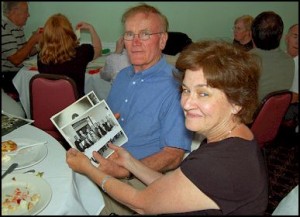
Checking out the photos: Mary Ann and Pat.

Checking out the photos: Mary Ann and Pat.

It was just a slim folder full of old black and white photos, yellowed menus and dog-eared bank statements. You wouldn’t have thought they would have made much of an impression.

Bernadette Coyle, for one, seemed surprised. She brought the photos to the Young at Heart luncheon on Sunday, a reunion of sorts held to celebrate the 50th anniversary of the city’s venerable Irish Center in Mount Airy. “My dad (Parker McGurk) was one of the original Irish Center shareholders,” said Bernadette. “He was the center’s treasurer, way back in the ’50s. These pictures were his. I’ve still got boxes of them. These are just a few. It’s something I put together on a whim.”

Within moments of Bernadette producing them, the pictures were making the rounds of the room, with folks like the Irish Center’s president Vince Gallagher and Ed Reavey Jr. poring over the fading images, trying to pick out old friends or figure out who was in the picture of the old football team or the band.

More than a few remembered the great meals served up in the old days, too, as they checked out the menus, like one from Tuesday, February 12, 1957, in which “braised turkey wings in jardiniere sauce” and “breaded deep sea scallops remoulade” were available for 85 cents. For an even buck, you could get the whole dinner, including mixed veggies, coffee, tea, Sanka or Postum, with Ross House cheese with crackers, butterscotch sundae or stewed prunes for dessert. (Yum.)

The photos evoked lots of great memories, including those of John King, who used to play piano at the Friday night ceilis with the great Eugene O’Donnell. “That was when my hair was still black,” he added. Still a handsome fella, though.

How much fun was the luncheon? Check out our photos. Maybe 50 years from now, someone will be passing them around the room.

People

Help the AOH Make a Stand for Children With Autism

As many of you are aware, several members of the Hibernian and Irish American community have been at the forefront of the cause to find a cure for autism. Speaker of the House Representative Dennis OBrien has been solidly leading the fight, and the folks at Autism Speaks donate time, funding and resources unselfishly time and time again.

They now need our help. We have done it before, we will do it again. Contact your local Senator and let him or her know of this bill and your support of it.

We all know we need more veterans programs, we all know we need a process for the undocumented Irish, and we all know we need to support these children. Please take a moment to drop your Senator an email or phone call and remind them that the Irish community stand united for veterans, for the undocumented Irish and for children with Autism.

HB 1150, which will end autism insurance discrimination by providing the children in the state of Pennsylvania with access to the medically necessary, evidence based treatments and therapies that they need, is once again in need of your attention. Following an extremely successful hearing in April, we hit a little road block and need your help to push through that!

Senator White still isn’t convinced that this issue should go to a vote. He needs some help. He needs to hear from YOU through YOUR Senator that this is an issue that is important to you. Please do not call him directly unless you live in his district! We are sending Don White’s constituents a separate alert.

The nation has its eyes on Pennsylvania to provide the community here with the most comprehensive autism insurance reform to date. As you know, other states such as Arizona and Florida passed similar legislation earlier this spring.

HB 1150 HAS BEEN HELD HOSTAGE IN DON WHITE’S COMMITTEE FOR NEARLY ONE YEAR! THIS IS UNACCEPTABLE for OUR COMMUNITY!

It is time for the Keystone State of Pennsylvania…to become the cornerstone and PASS THIS BILL!

WHAT CAN YOU DO TO HELP?

1. CALL YOUR OWN SENATOR! Ask your Senator to speak to Senator Don White and ask him to allow HB 1150 go to a vote in his committee. For information on how you can find out who your senator is, visit www.autismvotes.org and view the resources section.

2. CALL SENATE LEADERSHIP! Ask these Senators to speak to Senator Don White and ask him to allow HB 1150 to go to a vote in his committee. NOTE: If you are their constituents, please be sure to let them know how much you are counting on them to make this happen!

Senator Dominic Pileggi

717-787-4712 (Harrisburg Office) OR 610-565-9100 (For Constituents!)

Senator Joe Scarnatti

717-787-7084 (Harrisburg Office) or 814-726-7201 (For Constituents)

3. It is time for the state of Pennsylvania to make some noise! We are challenging everyone to involve family members, aunts, uncles, cousins, neighbors, friends, co-workers, therapists, physicians and anyone who lives in the state of Pennsylvania – that would take FIVE minutes to make these phone calls to THEIR Senator and the Senate leaders in # 2 above to end insurance discrimination and get your child(ren) the coverage they deserve.

Six other states have accomplished this! Pennsylvania can be next in line if we FOCUS!

Columns, How to Be Irish in Philly

How to Be Irish in Philly This Week

Like to spend a day speaking Irish? Then sign up for the 2009 Satharn na nGael to be held May 31 at the Miquon School in Conshohocken. You’ll also get a sampling of Irish music, poetry, customs and folklore. Language classes are held in the morning and afternoon, interspersed with informal workshops. Sessions are offered in tin whistle, concertina, uilleann pipes, and even Irish language on the Internet.

This year you can also see and hear two topnotch Irish traditional musicians , Micheál Ó Raghallaigh (concertina) and Ivan Goff (uillean pipes). Even if you don’t spend the day speaking Irish, you can pay $10 and hear them in an evening concert that starts at 6 PM at the school. The two will also be playing next Saturday, June 7, at the Coatesville Cultural Society.

If you knew the Irish Center “when,” you might want to consider having lunch there on Sunday. Billed as the “Young at Heart” event, the Center is offering a meal at 2 PM for those 55 and older (we resemble that) so you can see the new changes at the center (it’s looking gorgeous), reminisce, and dance. If you need a lift, contact Geraldine Quigg (215-884-4948) or Nancy Cantwell (215-483-7990).

There are a few sporting events ahead. On Sunday, the Philadelphia Donegal GFC (Four Provinces) is facing the Down GFC in Gaelic Park in the Bronx. The following Saturday, they’re taking on Derry.

Scythian is playing on Friday, June 6, at the Philadelphia Museum of Art. Also that day, the always-fun Celtic Festival that AOH Div. 1 holds in Mont Clare, PA.

The Fourth Annual Celtic Festival is being held on June 7 at Historic Cold Spring Village in Cape May, NJ with the usual bagpipers, Celtic music, craft vendors, and an all-day Irish buffet (and it’s way more than a six pack and a potato, trust us).

Not to be repetitive, but the Frank McCourt musical, “The Irish and How They Got That Way,” will be at the Walnut Theater until the end of June.

Coming up: Rose of Tralee pageant on June 20 and the rocking Irish Festival on Penns Landing on June 21.

Sports

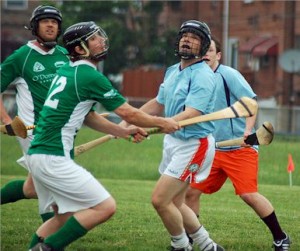
Shamrock Hurlers Christen the Allentown Hibernians

For the Hibernians, it was a baptism by fire.

For the Hibernians, it was a baptism by fire.

No one expected the Allentown Hibernians to win their first hurling match ever. But in the new team’s debut Sunday against the Philadelphia Shamrocks, they sure made it interesting.

The Shamrocks finally put the team from Lehigh away, 1 goal and 4 points to the Hibernians’ 1 goal and 1 point.

(In hurling, a goal equals three points. It is scored when the ball, or sliotar, sails into the net between two uprights. A single point is scored when the ball goes over the net but between the uprights. So another way of looking at the score is: 7-4.)

The Shamrocks’ team captain Frank O’Meara likes to win, but he was nonetheless pleased to see a new team come out on the field with such fire and give his players a real run for their money.

“They did very well,” he said. “I was very impressed with them.” More important, he added, they seemed impressed with themselves, and their fine performance ought to encourage them to keep learning and refining their game.

Not bad for a bunch of athletes who, not all that long ago, wouldn’t have known what a sliotar was if it smacked them in the head. (They know now, though, I bet.)

The Hibernians will get another chance at the Shamrocks on Sunday, June 1, part of a round-robin tournament that could include a team from D.C.

As for the team from Allentown, their first hurling match left its mark.

The Hibernians’ Chris Farrell, who was making something of a reputation for himself (albeit involuntarily) for injuring his teammates during practice, got a taste of his own medicine Sunday on the field at Cardinal Dougherty. “Before the game (teammate, no relation) Joe Farrell told me they had taken to calling me “the hatchet man” because of the injuries I’ve caused in practice,” Farrell said. “Ironically, I took the chop during the game when one of the Shamrock players chopped right on my knee joint with his hurl, following through on a shot that I was just a split second too late for (apparently). Hurts like hell and it’s pretty swollen today, but I don’t think any permanent damage was done and I will be back to fight another day.”

O’Meara, for one will be heartened to see them back out on the field. It’s tough keeping this native Irish sport going here in the States, but with the addition of an eager new team—and continuing dedication on the part of the 20 Americans on the Shamrocks’ team—”the thing is going to purr like a kitten. And we’re going to make sure that it does.”

News

Kilts, Ghillies and a Wee Hairy Coo

One of many wee Scotty-type dogs at the Games.

One of many wee Scotty-type dogs at the Games.

I went to the Colonial Highland Games near Elkton, Maryland, over the weekend to compete with my band in the pipe band competition.

We’ll dispense with the unhappy news first. My band, Philadelphia Emerald, placed 6th out of eight.

There was good news for one local band, though. Cameron Washington Memorial United came in second. And if this matters to you, an Irish band associated with an AOH division in East Islip, N.Y.—Roisin Dubh—came in first.

Congrats to Cameron Washington United.

Of course, this is an Irish Web site, and the Fair Hill Games are decidedly Scottish and a bit south of our normal coverage area. But Celtic is Celtic and, besides, lots of Irish pipe bands do compete (and, just as obviously, win).

If you have never attended Highland games, the experience is well worth it—for general, all-round Celtic cultural literacy, sure, but also because you’ll have a good time.

For me, of course, it is always about the food. And, yes, you can get bridies and meat pies and fish and chips—the lines for that heart-stopping stuff were lengthy at Fair Hill. But I also ran into a fella from a shop called the Highland Creamery in Oxford, Md. (on the Eastern Shore) who was dishing up Guinness and brown bread ice cream. I arrived at his stand too late in the day to snag some of that fabulous stuff. (I had some in Galway a few years back, and it’s pretty tasty.) But I was not too late for the raspberry and shortbread ice cream. That alone was worth the price of admission.

Highland games are also huge fun for kids. Most are thoroughly charmed by the border collies in the sheep dog trials. There’s Highland dancing as well which, while very different from Irish dance—no curly wigs, for one—is fascinating to watch. And if you’re into watching big dudes heaving telephone poles, there’s plenty of that to watch as well. (And a “wee hairy coo”—or “cow,” if you’re not Scottish—to pet as well.)

There are a bunch more Highland games throughout the summer, most no more than a couple of hours’ drive away. Here’s a list:
http://www.euspba.org/events.aspx

We captured some of the spirit of Fair Hill in the accompanying photo essay.

News

A Look Back at the 2008 Phoenixville Celtic Street Fair

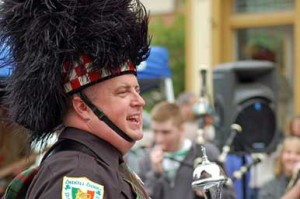
Brian Boru drum major shows off his natty chapeau.

Brian Boru drum major shows off his natty chapeau.

Phoenixville went to the dogs this past Saturday.

It also went to the pipers and drummers, didgeridoo players, Irish dancers, merchants of meat pies and purveyors of claddagh rings, soft-sculpture Guinness hats and plastic Claymores.

The 2nd annual Celtic Street Fair brought ’em all out to this little town along the banks of the Schuylkill. And on a somewhat cool and cloudy day, this wonderfully old-fashioned town (a real town, not a bedroom berg with a superhighway running up the middle of it) with its quaint shops and the smell of fish and chips and the skirl of the pipes in the air could almost make you feel like you were somewhere else. Somewhere like, oh, Ennis or Ballynahinch or Westport or any old Irish market town you care to think of.

We’ve assembled a neat little pile of photos from the day.

Music

CD Review: Lunasa’s “The Story So Far”

The Lunasa retrospective “The Story So Far” showed up in the mail the other day, and I thought: Great … what can I say about a compilation? How do you review tunes that already have been released and reviewed years before?

The answer is: You mostly don’t.

I say “mostly” because, even though all the tunes have been previously released on Lunasa’s previous six CDs, there are, as it happens, two brand-new recordings to reflect the band’s current lineup.

“Morning Nightcap” and “Aibreann” have been dusted off and given not remarkably new treatments—but they are still lovely to hear again, anyway. all the same.

“Aibreann” actually sounded better, I think, the first time I heard it, on the band’s 1998 debut album. The new version, produced at Compass Records in Nashville, does sound much cleaner—you can really hear guitarist Paul Meehan’s lush chordwork, and that’s unquestionably a good thing—but the more recent effort lacks the energy of the original.

“Morning Nightcap,” on the other hand, definitely sounds fresher and crisper, and, if anything, tighter than the already pretty fantastic version recorded in 2002 on “The Merry Sisters of Fate” (Green Linnet). Again, it’s not remarkably different from the original, but it’s a fuller, more complete and more vibrant performance.

As for all the rest, if you are a Lunasa fan, you’ll be happy to note that most of your favorites are there—”Eanair,” “The Miller of Drohan,” “Casu,” “Punch,” “The Floating Crowbar” (I just love that title) and more. (There are 16 tracks in all.)

If, like me, you already have all of the previous recordings, is there any reason to have this new CD? I would say yes, if only to have the benefit of a much more polished sound. And if, also like me, you keep your CDs in the car, they are caked with french fry grease and Coke syrup. It’s about time for a new one, anyway.

I’d recommend “The Story So Far” for newbies. If you haven’t heard Lunasa—and weren’t they great at the 2007 Ceili Group Festival?—this is surely a terrific introduction.

And it’s not as if all the rest of their stuff is merely passable. It’s all pretty phenomenal. So let this new CD be your first, and you’ll see what all the rest of their fans are raving about.