All Posts By

Jeff Meade

Food & Drink

Big Night for Fishtown and Port Richmond at Irish Stew Cook-Off

Amateur winner Dan Hazley and second place finisher Phil Bowdren.

Amateur winner Dan Hazley and second place finisher Phil Bowdren.

Dan Hazley has been making his Irish stew for years. “I got the recipe from my aunt Mary, my dad’s sister,” said Hazley. “It’s made with beef. I only get to make it a couple of times a year. I always knew it was pretty good. I just didn’t know whether anyone else would think so.”

So do they? You bet they do. Hazley’s Irish stew was this year’s winner, in the amateur category, of the Irish Stew Cook-Off at Finnigan’s Wake. The savory cook-off is sponsored annually by the Hibernian Hunger Project.

Better yet, Hazley—who represented Ancient Order of Hibernians Division 87 of Port Richmond in the all-you-can-eat event—shared honors with a good friend, chef Mary Kate McCaughey of Fishtown’s great little Irish eaterie called Ida Mae’s (2302 E. Norris St.). Mary Kate picked up a first in the professional category.

Dan may have his aunt Mary to thank, but Mary Kate credits her mother-in-law Veronica. “It’s her recipe,” she said. And it’s as authentic as Irish stew gets. Her husband Feargus, co-owner of Ida Mae’s, is from just outside of Belfast. He’s one of 11 children—the only one to have left Ireland. So when Mary Kate decided to enter the cook-off, she called her mother-in-law. “I said, ‘I need your beef stew recipe.’ She said, ‘Honey, it’s lamb. You don’t make Irish stew with beef.'”

So, like any good daughter-in-law, she listened. Good thing. Her savory concoction was top drawer—and the judges clearly agreed.

Mary Kate can also thank the winner on the amateur side. “I did the air conditioning in their restaurant,” said Hazley. “Their food is just phenomenal. (The Inquirer’s Craig LaBan agreed.) Their chowder is really great. So I suggested that she enter. She’s a neighborhood girl, so it’s nice to see her do well.”

Of course, lots of other folks did well, too. Here are the 2nd and 3rd place finishers:

Professional

2. Finnigan’s Wake
3. Tir na Nog

Amateur

2. Phil Bowdren, AOH Division 51 (Fishtown)
3. Denny Gaw, AOH Division 2 (Horsham, Montgomery County)

Regardless of the objections of Mary Kate’s mother-in-law, more than a few of those stews (including the amateur winner, of course) contained beef.

Probably the most unusual stew was Denny Gaw’s. Denny, the AOH board president, went traditional … but only to an extent. His stew contained lamb as its main ingredient, but his was the only one not gravy-based. “Mine is cream-based,” he said. “I got the recipe 10 years ago. We were in Ireland, doing the Ring of Kerry. We stopped at a restaurant … it was up on a mountaintop, a mom-and-pop place. I ordered this stew, and it was great, so I asked them for the recipe … and they gave it to me! I make it all the time.”

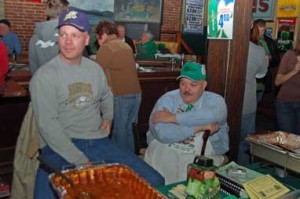
This year’s contestants—six in each category—had quite an appreciative audience. For five bucks, they could sample all the stews in the place. (And a lot of the contestants included a good-sized slab of soda or brown bread.) The place was jammed.

Among the guests sopping up brown gravy out of little plastic bowls was Rowan Fealy, a lecturer in the department of geography at the National University of Ireland, Maynooth. He and partner Dr. Laura McElwain, who works for the Ireland meteorological service Met Eireann, had arrived at Finnigan’s earlier in the evening to delivery a presentation on climate change and its impact on Ireland. Happily, they were able to take in the stew cook-off as well. “This is just an added bonus,” Rowan said. “It’s great. It’s got everything an Irish male looks for … beer and food. It’s perfect!”

Another guest was Geralyn Keating, director of the Irish American Cultural Institute in Morristown, N.J. “We came for the lecture, and then we got all this, too,” she said. “It was a winner.”

Of course, the big winner was the Hibernian Hunger Project, which takes the evening’s proceeds and funnels them back into the group’s many local activities, including Aid for Friends. “We do an annual ‘cook-in’ for about 200 shut-ins through Aid for Friends,” said Ed Dougherty the national and Philadelphia county chairman. “Their cooks go away in the sumer, so we go up and do bulk meals for them.”

The ninth annual cook-in takes place at the Aid for Friends facility in Northeast Philadelphia on Saturday, March 29, starting at 9 a.m. and ending … whenever they’re finished. To volunter, contact Donna Donnelly at KDDFAM@aol.com.

News

Philly Gets Its Irish On!

We rock!

We rock!

The weather was sunny and bright, not a cloud in the sky—an auspicious day for Philadelphia’s 238th Annual St. Patrick’s Day Parade. Oh, except for one thing. On Sunday, March 9, someone mistakenly sent us the weather meant for Fargo, North Dakota. 

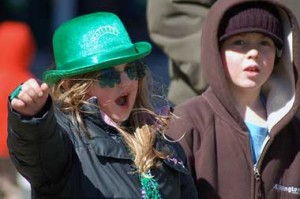
It was cold, cold, cold. How cold was it? It was so cold that the skyscraper canyon on the Parkway became an icy wind tunnel that had the crowds on the sidewalk scurrying off in search of a patch of sun or, better yet, a steam grate. So cold that the tiniest little step dancers were cranky and whiney before they’d even gotten to midpoint ofthe four-hour event, the oldest parade of any kind in the US.  So cold that hundreds of fine-looking Irish men were rethinking that kilt thing.  And some, that under-the-kilt thing.

But there wasn’t a soul there who wasn’t having a good time. Even those little dancers got their groove back every time the music cranked up, and especially when they hit the reviewing stand.  

Don’t believe us? Check out the pictures! We’ve divided them into six files so the slideshow doesn’t take all day.

 Philly Parade photos

The Mass 

Want more? Check out these photos from our flickr friend, Chris Woods.

And these from self-proclaimed “frozen long-marcher” Margaret King.

Music

Top 10 Things Not to Do During the Singing of “Danny Boy”

A New York bar owner made headlines (and not a few enemies) recently when he banned the singing of “Danny Boy” in his midtown boozerie during the month of March.

Nothing against “Danny Boy,” Shaun Casey, owner of Foley’s, told ABC News. It’s just that a.) in March, everyone wants to sing it, and b.) they do it very, very badly. Karaoke nights, in particular, can be a real drag, Clancy said.

 “Everybody thinks—whatever race, creed or color—that after three pints of Guinness, you’re entitled to get up there and butcher the song,” Clancy said.

With St. Patrick’s Day just around the corner, of course, that can mean only one thing. It means that you probably won’t have to wait for someone to die to hear someone sing “Danny Boy.” In fact, during the month of March, genuine scientific studies prove that the average Irish person in a pub suffers through a painful rendition of “Danny Boy” precisely every 7 minutes and 23 seconds.

In the interest of Total “Danny Boy” Preparedness (TDPP), we now respectfully offer you, from the home office in Horseleap, County Offaly, the official Irish Philadelphia Top 10 Things Not to Do During the Singing of “Danny Boy”:

  1. Offer to perform the Heimlich maneuver on the singer. (He’s not choking on a live barn owl; it only sounds that way.)
  2. Suck helium and harmonize in a chipmunk voice.
  3. Dance the Hora.
  4. Clap on the downbeat.
  5. Clap on the upbeat.
  6. Pretend to sing the song in reverse, slowly and in a deep voice, and at the end drone, “Paul is dead. I buried Paul.”
  7. Bay like a beagle with a bellyache.
  8. Threaten the singer in a way that demonstrates pride in your Irish heritage, but at the same time cements your reputation as a gangsta: “Stop that racket or I’ll be after beating you with me shillelegh, fo’ shizzle dizzle!”
  9. When he hits the high note, throw your panties onto the stage. (Optional for gentlemen.)
  10. Yell, “One more time!!!!”
People

There’s a New Marshal In Town

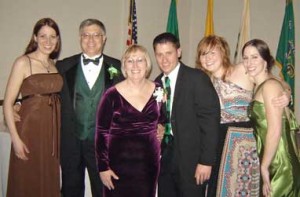
The grand marshal and his family.

The grand marshal and his family.

The Grand Marshal’s Ball for the 2008 Saint Patrick’s Parade in Conshohocken took place on Saturday Night (March 8) at the Jeffersonville Banquet Hall with 230 family, friends and fellow members of the AOH, LAOH and Philadelphia Emerald Society.

The night opened up with Father Bier leading the opening prayer. Sara Agnew sang the Soldier’s Song and led the pledge of allegiance. Pete Hand was then escorted into the hall by Irish Thunder Pipes & Drums.

Once in the hall, after a couple of tunes, Pete was given the honors of Grand Marshal. The 2007 Grand Marshal Ed Halligan turned over the Sash and shillellagh to Pete.

Attending the event were several AOH officers, including Ed Halligan, Jim Murphy, Tom Couglin Sr. and Tom Jr., Kenny Young, LAOH officers Rae DiSpaldo. and Eileen Kaufman. President Harry Marnie and board of directors of the Philadelphia were also present.

The Saint Patrick’s Parade in Conshohocken will take place this Saturday March 15th beginning at 2 p.m., starting at 11th and Fayette.

News

Partying at Finnigan’s Wake

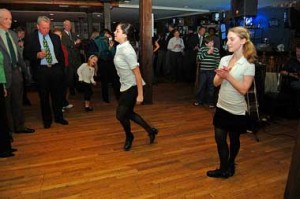
Campbell School dancers Stephanie Miller and Alison Silverman step lively.

Campbell School dancers Stephanie Miller and Alison Silverman step lively.

Local supporters of Hillary Clinton were gathering downstairs at Finnigan’s Wake to await the outcome of the primaries. They probably had a happy night.

Meanwhile, local Irish were up on the third floor with the primary purpose of celebrating their own special month. And was there ever really any question that they would have a great night?

The Philadelphia St. Patrick’s Day Parade Observance Association, under the leadership of director Michael Bradley, gathered with their partners from CBS3, for one last big blowout. (There’ll be a luncheon later, too, of course.)

There was, as always, some fabulous Irish music and some great dancing. (The food and the drink were pretty good, too.)

Music

The Chieftains Go Caledonian

The Chieftains, from left: Matt Molloy, Paddy Moloney, Kevin Conneff and Sean Keane.

The Chieftains, from left: Matt Molloy, Paddy Moloney, Kevin Conneff and Sean Keane.

For all of you who have had to make the painful choice between the Philadelphia St. Patrick’s Day Parade and the Chieftains concert at the Kimmel—they seem always to happen on the same day—this year there’s no pain at all. The parade has been pushed back to Sunday, March 9, to avoid a conflict with Palm Sunday, and the Chieftains are in town on Saturday, March 15.

Paddy Moloney, leader of Ireland’s pioneering Irish traditional band, couldn’t be more delighted. For one, Philadelphia is a hotbed of Irish traditional music. For another, the Kimmel is just a great place to perform.

“It’s very warm. You look up [from the stage], and the hall is shaped like an egg. It’s almost like the people are with you in your parlor back home—a very expensive parlor, let me tell you.”

Moloney, who is on the board of directors for a new national concert hall auditorium in Dublin, says he hopes that performance venue will take a few lessons from the Kimmel, where the sound is phenomenal, yet the space seems so intimate. “I’ve shown them photographs,” he says.

Moloney and the Chieftains are always mining other genres for concert and recording material—a fact that drives some hard-core traditionalists a little crazy and bothers Moloney not at all. But this time, the Chieftains are not straying too far from Ireland.

“I’m going down the Scottish route,” he says. “I call it the Chieftains Scottish-Celtic connection.”

It’s a logical choice for Moloney, who in 2005 was inducted into the Scots Traditional Music Hall of Fame. He was the first non-Scot so honored.

Joining the Chieftains—Moloney (tin whistle, uilleann pipes), Sean Keane (fiddle), Matt Molloy (flute), Kevin Conneff (bodhran and vocals)—will be Alyth McCormack, from the small Scottish island of Lewis in the Outer Hebrides. “Her singing is just fantastic,” he says. “She’ll come on in the last section of the second half, blending our Irish with her Scottish style.”

Also on stage will be the brilliant Irish harper Triona Marshall. “She’ll do a version of Carolan’s concerto,” says Moloney. “It’s the best I’ve ever heard.” Marshall fills a gap in the Chieftains’ legendary sound left by the death of Derek Bell in October 2002.

Carmel Conway, a superb singer from Limerick with both classical and contemporary influences, will also join the show, as will Cuban-born Philadelphia percussionist Juan Castellanos, also known simply as “Cuco.” Look for the longtime Chieftains players, dancer Cara Butler and those crazy-legs Pilatske brothers, Jon and Nathan, from Canada’s Ottawa Valley, who were such a hit at the Kane Sisters’ Irish Center concert in July. Singer-dancer Maureen Fahey also rounds out the ensemble. (Look for an appearance by some local pipers, too.)

Quite the international cast—but that, too, is just fine with Moloney, who confesses, “I find the world now a very small place.”

It was quite another world when, back in 1963, the one-time accountant laid the groundwork for what would become the Chieftains.

It was a journey that began in 1938 in the northside Dublin suburb of Donnycarney, where Moloney was born and raised—and before then, really. Like so many traditional Irish musicians, Moloney was born into the music. House parties were common. Indeed, he says, “Music was the main source of entertainment in the family.” Moloney’s grandfather played the flute, and an uncle played in the Ballyfin Pipe Band. “He was a great pipe player,” says Moloney. “I grew up with this madness in me head.”

At age 6, his mother presented him with a whistle, purchased for a shilling and ninepence. He began to pick it up right away.

The uilleann pipes soon followed. “Every Saturday night [the world-famous piper] Leo Rowsome used to have a show on the radio. I listened to it all the time,” Moloney says. “When I was 8 or 9 I met his son in my school. The first time I saw them [the pipes] in reality, I was just blown away.”

Moloney implored his mother to secure a set of pipes for him. “Those pipes cost my mother a week’s wages,” he recalls. “She stuck it out and saved the money for them. Fortunately, I had the God-given gift.”

You bet he did. Not long after he started taking lessons from Rowsome (who also built his pipes), Moloney scored a first in the Dublin Feis. Next, came All-Ireland championships.

It was quite the time. “I was very lucky in Donnycarney,” he recalls. “There were five pipers there, including Leo, Danny O’Dowd, and myself. We went to one anothers houses. There was also lots of open-air music playing and ceili dancing, and various traditional concerts. There were a few good music clubs.”

Through it all, he was sustained and inspired by the more experienced pipers in the crowd. “I got tremendous help from the older people,” he says. “They saw in me the continuation of good piping.”

You can see for yourself why the old ones were so encouraging when the Chieftains return to the Kimmel March 15 at 3 p.m. A dinner with the Chieftains follows the concert.

Columns, How to Be Irish in Philly

How to Be Irish in Philly This Week

There’s a parade this weekend in Philly. There’ll be music, dancing girls, and more green than they see at the Mint in a year. And the best part of all—everybody there is your friend.

Philly’s St. Patrick’s Day Parade is a lot like those hometown events where the bands and floats are interspersed with kids riding bikes with streamers on them. Okay, there are no kids on bikes (there will be a women’s rollerblade team and they dress pretty funky), but it has a small town feel even when you see it marching from Broad Street to the Parkway. People are laughing, cheering, singing and dancing and—hold on to your hats—actually chatting with complete strangers. Last year, I talked to two guys who were sharing a beer together outside Tir na Nog. When I asked them how long they’d known each other, they looked at one another. “Oh,” said one, “I think about 20 minutes.” It kinda goes like that.

The shenanigans start on Friday night, March 7:

  • Celtic beer tasting at the Washington House restaurant in Sellersville
  • The Hothouse Flowers at World Café Live
  • Phil Coulter and the Irish Pops Orchestra at the Keswick in Glenside
  • The Chieftains at Princeton’s McCarter Theater
  • Derek Warfield and the Young Wolfetones at the Irish Center
  • Irish Beef and Beer Night with Celtic Spirit at The Arts Scene in West Chester

Then, on Saturday:

The Erin Express leaves the station. Eight busses will be available to take revelers from one Irish pub to another. No driving, no cost, no need for the family to see a bail bondsman to spring you from jail after your drunk driving arrest. If you do drink too much, stay in town. That’s what credit cards are for. Here are the participating saloons:

  • Mill Creek Tavern, 42nd & Chester
  • Smokey Joe’s, 40th & Walnut
  • The Blarney Stone , 3929 Sansom Street
  • O’Hara’s Fish House, 39th & Chestnut
  • Cavanuagh’s, 39th & Sansom
  • Bridgewater Pub, 30th Street Station
  • Mace’s Crossing, 17th & Benjamin Franklin Parkway
  • Green Room,1940 Green Street
  • Kelliann’s, 16th & Spring Garden
  • Parkway Bar & Grille, 22nd & Spring Garden
  • Westy’s, 1440 Callowhill Street
  • T.A. Flannery’s, 11 South 21st Street
  • Bonner’s Irish Pub, 23rd & Sansom
  • Callahan’s Grille, 26th & South
  • Tom Hagan’s Tavern, 20th & Arch

Teetotaller? Here’s some fun events on Saturday for you too:

  • Grainne Hambly and William Jackson, masters of the Celtic Harp, at the Cultural Center of Chester County
  • Mick Moloney at the Appel Farm Arts and Music Center in Elmer, NJ
  • Jamison at the Dover Elks Lodge in Dover, DE

And on Sunday? The parade! It starts at 11AM (and we don’t mean 11 Irish time) at Broad and Washington Streets and heads down to the reviewing stands on the Parkway, near the Irish flag. And afterwards, you could just go home and look at your digital pictures, or you could go to one of the post parade parties (at Slainte, New Deck Tavern, the Irish Center, or the Kensington String Band HQ, where they’ll have the tireless Jamison and a group of Irish dancers).

But that’s not all. If you have the energy, you can see:

  • The Irish Rovers at the Grand Opera House in Dover, DE
  • Grainne Hambly and William Jackson at the Perkins Center for the Arts in Moorestown, NJ
  • Tommy Fleming at Penn
  • Dervish at the Sellersville theater

And it won’t even be St. Patrick’s Day yet!

One event next week to put on your calendar: The Ancient Order of Hibernians Div. 1 of Swedesburg is holding its third annual Irish Coffee contest on Thursday, March 13. Come for a free taste. Or two. Or three. Definitely worth coming out for on a school night.

As always, check our soon-to-be-canonized calendar for all the whiskey-laced details.

People

For 10 Years, the Hope of the Irish Immigrant Community in Philadelphia

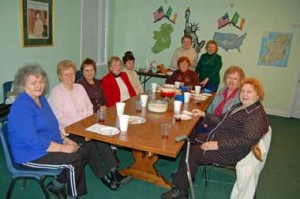
The Wednesday lunch bunch at the Irish Immigration and Pastoral Center.

The Wednesday lunch bunch at the Irish Immigration and Pastoral Center.

When Tom Conaghan came to the United States from Doorin, County Donegal, in 1972, the path to the coveted Green Card—the legal document that permits immigrants lawful permanent residence in the U.S.—was amazingly short. “I arrived in July,” he says, “and I had my Green Card by October.”

Today, he says, the same process can be arduously long—12 years or longer, and with nothing like a guarantee of a Green Card at the end.

Conaghan is executive director of the Irish Immigration and Pastoral Center, a small but vibrant organization headquartered in a welcoming, home-like property at 7 South Cedar Lane in Upper Darby, just off West Chester Pike. Since 1998, the center has provided counseling—and often a shoulder to lean or cry on—to immigrants who want nothing more than to set down roots in the Delaware Valley and make an honest living.

The center is also a central gathering place for the Irish who’ve been in the Delaware Valley for years. On the day I dropped by, a gaggle of local ladies had assembled for their weekly luncheon. Close your eyes, listen to all the accents, and you could be in Donegal or Antrim.

The sideboard threatens to collapse under the weight of all the cakes and sweets, some of them store-bought, but others deliciously homemade. There’s also a large bowl of trifle—and a little bottle of something the ladies refer to as “altar wine” is making the rounds. They offer some in a paper cup. It would be impolite to refuse.

One of the ladies—Annabelle Manly, with curly red hair—is from a town called Dunamanagh, in County Tyrone. It sounds like she just got off the boat, but she has actually been in the Delaware Valley since 1950. Her story is typical of so many who came to the United States.

“I came here in 1950, December 6, through Ellis Island before it closed, on the S.S. America,” she says. “My name is on that wall (at Ellis Island). I’m a very historic person.”

Like so many Irish newcomers, Manly’s transition into American society was eased by the presence of a large and welcoming Irish community, a good many of them from the North. She roomed with other Irish girls in a place at 48th & Baltimore. She met the man who would become her husband, William, at the Horn & Hardart’s where she worked. “He had just come out of the Air Force,” she recalls. “He had dropped by to meet his buddy, who was the manager. He was in his uniform.”

They were married in 1953 at St. Francis de Sales Church at 46th and Springfield. In due course, Manly became a citizen. “Back then,” she says, “you had to wait three years to become one.”

Today, that sounds like an immigrant’s dream come true. But that was a different time—and a different America.

The mission of the Immigration Center began with the passage of the Illegal Immigration Reform and Immigrant Responsibility Act of 1996. From Conaghan’s perspective, “the Illegal Immigration Act literally took away every bridge and road the Irish had once crossed into legal residence in the United States.”

Conaghan and colleagues were also deeply motivated by the May 18, 1998, raid by agents of the Immigration and Naturalization Service on the Irish Coffee Shop on West Chester Pike in Upper Darby. News reports at the time (Irish Voice, June 2, 1998) suggest that INS agents rounded up two, and possibly three, undocumented Irish citizens.

Conaghan’s recollection is different. The entire event had been shrouded in secrecy, but the Federation of Irish American Societies learned through overseas sources that the agents had actually picked up, jailed and deported five Irish young people—including one young woman from his home town.

“Those five young people were deported and were missing and the established Irish community in Philadelphia didn’t even know what had happened, except for a few people who were directly involved, like the guy who owned the coffee shop,” Conaghan says. “He suffered fines, as well.

“The young girl, who was 17, from my home town, was deported two and half weeks later in the same clothes she was wearing when she was arrested. She was terrified and still suffers anxiety.”

Years later, Conaghan and the employees and 40 volunteers of the Immigration and Pastoral Center continue to draw inspiration from this incident. To them, the question is not whether undocumented immigrants overstay their welcome (up to six years on a work visa). They don’t dispute that many Irish citizens have, in effect, broken the rules. However, they argue that the undocumented are victims of a system that has grown to be so muddled, complicated and expensive as to make the path to legal residence nearly impossible for all but the most determined.

Immigrants often are victims of a double whammy, he adds. That is, their work visas, which allow them temporary residence in the U.S., expire long before their applications for a Green Card are approved. (Nearly half of all those the INS regards as illegal are what are called “visa overstays,” according to the Washington-based Pew Hispanic Center.) “And maybe, in the meantime, that person has started a family and there are children involved,” Conaghan says. “It’s a condition created by a bureaucracy, and it shouldn’t happen.”

Many Irish caught up in this bind exist in a kind of shadow world—often gainfully employed, even paying federal income taxes, but always living in fear of being picked up and deported. And there’s worse—they’re trapped here, unable to return to Ireland even to attend the funeral of a loved one, for fear of betraying their status and being barred re-entry to the United States.

“I know of one woman whose father died,” Conaghan says. “She was the only sister of the family, with seven brothers. She didn’t go home for her father’s funeral. Four years later, she walked in here one day, and she told me her mother was sick. She started to cry, and I cried with her. Her mother died, and she couldn’t go back.

“That woman has teen-age children now. Her husband is also undocumented. Unless there’s an immigration bill passed or some kind of comprehensive reform, the only hope that she has is that her oldest child, when he becomes 21, can sponsor her—but that’s three years away. In the meantime, she and her husband could be picked up and deported.”

The shame of it all, he says, is that so many young Irish citizens want to come to the United States. In his day, he says, leaving Ireland was a decision borne of necessity. Now it’s a matter of choice. So the Irish people who want to take up legal residence here are well-educated, potential assets to the United States. But they won’t come, he says, “because they’re afraid they’re going to be arrested.”

This, he says, is tragic on many levels, but especially because the Irish community in the United States, which has contributed so substantially to the life of this country, could be endangered. “Given our historic contribution to this country, the number of Irish who are let in here is a disgrace.”

To address these issues, the Immigration and Pastoral Center offers a wide range of services, including assisting those who are eligible for Green Cards, as well as rendering aid and comfort to those who live in the shadows. There are many other ancillary services. For example, Center staffers and volunteers visit prisoners. They run workshops. They assist with work authorization renewals and they provide a wide range of social services. (On a lighter note, the center also sponsors the local Rose of Tralee festival.)

Although mostly Irish immigrants avail themselves of the center’s services, Conaghan says the Immigration and Pastoral Center maintains good relations with other immigrant groups, including a local Spanish mission. Additionally, the center provides its services to any immigrant who needs it, regardless of national origin. (On the day I visited, one staff member took a phone call from an Indian woman who had just moved from New York City to Philadelphia.)

Those services are provided, he says, courtesy of donations from the Delaware Valley Irish community and from the Irish government. The center accepts no government support. That level of independence is important, Conaghan says. “Money is not our God. We do have a God, but the God that we believe in is the God that will deliver the freedom our people deserve in the desert,” Conaghan says. “We’ve been wandering in the desert for too long.”

Over the years, the Irish Immigration and Pastoral Center has helped thousands of Irish immigrants. The center has also become a cozy gathering place for those long established in the Delaware Valley.

On Sunday, March 16, the center will celebrate its 10th anniversary of service to the Irish community with an Immigrant Reunion at the Philadelphia Irish Center, Carpenter and Emlen Streets, in the Mount Airy section of Philadelphia. Magician and balloon artist John Cassidy will be on hand to entertain the kids. Music will be provided by Mary Beth Ryan and Friends and D.J. Seamus McGroary. Food will be available from Mickey Kavanaugh Caters.

The fee is $25 for adults; there is no charge for kids. For details, contact the center at (610) 789-6355.