All Posts By

Jeff Meade

Music, People

An (Irish) Traditional Marriage

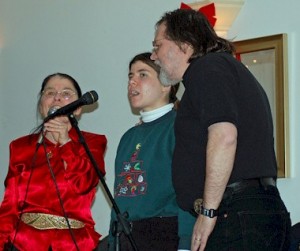
Kathy, Emma and Dennis harmonize at a recent Christmas Wren party.

Kathy, Emma and Dennis harmonize at a recent Christmas Wren party.

You’ll have a hard time finding two busier traditional Irish musicians than Kathy DeAngelo and Dennis Gormley.

Together, they perform as the trad duo McDermott’s Handy (named after the County Leitrim, and later Monmouth County, N.J., fiddler Ed McDermott). And they preside over a popular traditional Irish music session Thursday nights at Three Beans Coffeehouse in Haddonfield, N.J. With Mermaid Inn session leader Chris Brennan Hagy, they also moderate the Next Generation youth Irish music group.

With bodhran in hand, I’ve accompanied them in a few performances and a few more sessions. Turnabout being fair play, Dennis accompanied me on flute when I took a shot at Comhaltas Ceoltóirí Éireann’s Mid-Atlantic Fleadh Cheoil a couple of years back. I also took whistle lessons from Dennis—none of which quite “took,” through no fault of Dennis’s. (Apparently, you have to practice.)

Both talented multi-instrumentalists, Kathy and Dennis have been part of the Delaware Valley Irish music scene for decades. They’re as generous with their time and knowledge as they are talented.

As well as I think I know them, there’s still lots more I don’t know, So I posed a few questions.

Q. How did you two get together, personally and musically? And how big a role did the music play?

Kathy: We met at the Rutgers Saturday Folk Festival in July 1973 when Dennis was playing bass with Saul Broudy, and practically every other performer. I managed to “persuade,” in my own charming fashion, the festival organizer to let me perform with my band in a brief slot that afternoon using the argument that he didn’t have one single woman performing that day. Trouble was, the bass player in my band hadn’t lugged his bass to the student center, whereas all the guys had brought their guitars. So I very boldly approached Dennis and asked if we could borrow his bass. He was too nice, and I was too cute, for him to tell me to buzz off—and I’ll let him get a word in edgewise here.

Dennis: “Cute” is an understatement. I was stunned by her heart-stopping beauty and amazing talent. She could have asked me sign over all my worldly assets and I would would have used my own pen.

Anyway, I was up playing bass for Philadelphia folk music icon Saul Broudy. Saul was working in D.C. at the Smithsonian
Folk Life Festival and traveling up to New Brunswick by train. I drove up early to catch the music at the festival. Little did I know …

Kathy: So we started off playing everything but Irish music at the beginning. We played country music, bluegrass, swing, old-time and good old American folk songs. I was playing Irish music with Ed McDermott, my mentor, but that was a separate world.

Q. You both play multiple instruments First of all, thanks for making me realize just how much I have to learn, but, second, can you tell me how and when you learned those instruments, and how gravitated toward Irish traditional music?

Kathy: I started playing guitar in the 7th grade after being allowed to give up the accordion. My father thought every Italian girl should learn the accordion but in 1965 no right-minded teenager wanted to play the accordion. Everybody in my family played or sang. I just played chords and followed charts on pop music sheet music my brother bought. I got into folk music and by the time I got to college I opened the Mine Street coffeehouse in New Brunswick and got in with a whole crowd of people who played all kinds of music and went to folk festivals. The guys in my band thought I would look good playing a banjo so they gave me one for my birthday. My dad gave me his old mandolin. Other instruments followed and I had the time to learn them.

Two of the instruments I’m most associated with now, harp and fiddle, I didn’t take up till relatively late in life. I started teaching myself fiddle after Ed McDermott died in 1977—and I regret I didn’t take it up while he was living. I played guitar with him for years and he was the one that got me started down the path of the Irish dance music. Besides backing him up, I was flat-picking the tunes. When I moved to this area after Ed died I only knew two people down here and Dennis was one of them. I had a few Irish gigs and I asked him to play with me. He said “I don’t know anything about Irish music.” He insisted on coming over to learn a few tunes before this gig and I was amazed that he’d sit there and write the tunes down while I played them. Well, you know how one thing leads to another. Skip ahead to 1979 and Dennis and I get married. In 1984 I came home from work and Dennis had bought me a harp, which were hard to come by in those days. He had already worked out how to play “If I Only Had a Brain” so I figured I had to get to work to put some Irish music on it!

Dennis: The writing tunes down bit was always a way for me to learn and memorize the tunes.To this day, I’ll write down a tune I’m want to learn (see http://www.hslc.org/~gormley/tunes/giftunes.html), then very rarely refer back to the manuscript.

I started the obligitory piano lessons at about age 6 or 7. My father had rescued a piano from a bar; I remember it had the cartoon character Snuffy Smith on it. But once we learned to read, it got a new coat of paint; apparently, Snuffy was saying some rude things! One day, my parents heard mepicking out the melody for the “William Tell Overture” (you would know it as the theme from the Lone Ranger), and decided to send me for lessons. I never got as good as I probably could have, because I always wanted to learn by ear, and the teachers had this annoying habit of wanting me to read the music.

Anyway, my father Joe Gormley played the guitar as well, in a Freddie Green Big Band style of guitar. Apparently in his younger days he was a touring musician for a short while, which probably led to his advice, “Music is the best part-time job in the world.” My mother told a story of having to wire him money one time so he could get home, but I was never able to get any other details out of them. Up until the time he passed away, he was performing on a regular basis.

So when 1964 came around, there was already an electric guitar around the house. Of course, when I started playing it, I got a nylon-string classical guitar as a birthday present. I think there were thoughts of a classical guitarist in the family, but I immediately recognized it as the same sound heard on the Beatles “And I Love Her.”

I took up string bass in high school, coupling that with bass guitar in high school rock groups. Again, my father counseled, “There are thousands of guitar players, but not many good bass players.” Inspired by my high school band and orchestra director, James Maxwell, I went to Glassboro State College as a music education major and was exposed to all the instruments typically found in a school music program; for the purposes of this narrative, this is pretty much where I first picked up a violin and flute.

Fast forward to the early ‘70s and the folk music of the social activists. I missed the Kingston Trio folk music boom, but Peter Paul and Mary, Buffy St. Marie, Arlo Guthrie, and others were heard in my home. I was playing acoustic guitar and string bass, and working teaching folk music at the now-defunct Haddonfield Music House, giving lessons on guitar, bass, dulcimer, mandolin; they pretty much pushed any student wanting to learn folk music to me, whether I knew the instrument or not!

I started attending meetings of the Philadelphia Folk Song Society, where I met up with several musicians whom I performed with over the years, including Caryl P. Weiss and Saul Broudy. Through Saul, I got the opportunity to perform with many revivalist performers such as Winnie Winston, Steve Goodman, Vasser Clements, and John Prine.

So, toward the mid- and late ‘70s I was playing and performing folk music and traveling to venues throughout the Northeast and up into Canada. Attending and performing at folk festivals, I heard a great deal of Irish music, notably at the Philadelphia Folk Festival, where Kenny Goldstein regularly programmed and hosted a “Celtic Ceilidh” (Sunday afternoon at the Tank Stage). It was “hip” in the circles I traveled and performed in to deride the “diddly diddly,” but I was always drawn to it. Even though there was no Irish music played in my house, perhaps it was a sort of racial memory calling to me.

When I first started performing with Kathy, a short time after the death of Ed McDermott, I figured the mandolin, tuned like a fiddle, would be the most appropriate instrument I had to play the dance tunes. But I never really had the technical expertise to play tunes up to speed. Casting around, I picked up a tin whistle and worked on that, then much later (after a single but memorable lesson with Seamus Egan when he told me he was moving to New York to work with this new group), got a simple system wooden flute and started working on it. Still can’t get the notes for “Nights in White Satin” on it, though.

Like Kathy, I often wonder what it would have been like to be playing flute when Ed McDermott was still alive.

Q. How long have you been anchoring Three Beans?

Kathy: We started doing the session at the Three Beans not long after it opened in 1995, but the session actually started in a back room at the former Katie O’Brien’s, a restaurant in Haddon Township in 1992, I think. When the Three Beans expanded into the shop next door, there was room for us.

Dennis: My sister Lorraine Gormley had met a guitarist and singer from Kerry named Richard Browne, who told her of a session he was running at Katie O’Brien’s. With (daughter) Emma being an infant, it was easy to put her to bed and then get out to the session. (Oh, did I mention my mother was living with us then? Get of my back, DYFSS!) So we started going out. Eventually, having the session at Katie’s became untenable, with a trad session being low on their list of priorities. Harp and Dulcimer maker Dave Field was living in Haddonfield at the time, and he found the Three Bean location.

Q. How did McDermott’s Handy develop?

Kathy: I was the first music director at the New Jersey Folk Festival and Ed McDermott was one of our featured performers at the first festival in 1975, and then again in 1976. Everybody loved him. Here was this 80-year old fiddler who played with incredible energy with the college students who came to learn from him.

He died on New Years Day, 1977, and the festival asked me to put together a tribute to him for the 1977 festival. I asked a whole bunch of players from around the state who had learned tunes from Ed for years to come and play. It was a great night. I used the name McDermott’s Handy, after a track from Gordon Bok’s record of tunes he learned from Ed. So I just decided to keep it going. After that, it was mostly Dennis and me with an ever-changing roster of other musicians until 1984, when it was just the two of us. Now our daughter Emma, who plays fiddle and also sings, sits in with us occasionally.

Dennis: Aside from recordings and touring groups, Ed McDermott was the first practitioner of Irish music that I had met. His dedication to the music and patience in teaching what he had to a gaggle of young musicians with scant background in the music, was an inspiration. The opportunity to commemorate his contribution to Irish music is a continuation honor.

Q. I understand some fella named Seamus Egan once opened for McDermott’s Handy. When and where was that, about how old was he, and did you have an inkling of what a dynamic musical force he was going to turn out to be?

Kathy: Actually, it was the Egan family that opened for us at the old Perimeter coffeehouse in Collingswood, maybe that was in 1985 or so—Seamus and his sisters Siobhan and Rory. They were pretty young—not old enough to drive themselves there, I don’t think. There was lots of talent in them and passion for the music. They were awesome players even then. In fact, I arranged for them to play at the New Brunswick coffeehouse and have photos of all three of them on that stage.

Q. Your daughter Emma plays fiddle with you. Lots of kids might go off in a different direction–say, sports, or, musically, playing anything but the same music mom and dad play. How did that happen, and how did she get to be so good? (And to be such a sweet kid?)

Kathy: Emma has been listening to this music since before she was born. She was only 6 weeks old in the carriage parked stage left when we played at Bethlehem Musikfest in 1987. I’d practice the harp with this little baby laying on the floor at the foot of the harp so I could keep an eye on her. She loves it. She was about 2 years old when she started sing-songing melodies, in pitch. When it was feasible, we brought her to a lot of our concerts so it was not surprising to us that, when she was offered a chance to learn a musical instrument at school, she chose the violin. She’s got an encyclopedic knowledge of tunes. And she’s a big part of the reason why Dennis and I wanted to get those young musician sessions going.

Dennis: During one performance St. Patrick’s Day in 1987, Kathy was playing the bodhran; in utero, Emma started kicking back. So you could say she’s been PLAYING before she was born. Even today, when she goes up to her room, you can hear Irish songs and tunes wafting down from her CD player.

Q. What is there about this music that keeps you coming? You’re obviously both very passionate about what you do.

Kathy: I just love the infinite variety of this music, it’s simple and yet complex at the same time. There isn’t a day that goes by that I don’t think of the influence of that one man, Ed McDermott, and how knowing him shaped the course of my life. It’s a good part of what motivates me as a teacher to help pass this music along. I’m blessed to be able to sit down with wonderful players, like Dennis, all the time who keep that fire lit for me.

Dennis: I see all of us who play this wonderful music as links in a chain, that stretch back a long way. I was explaining to ZB Cummins, a 13-year-old whistle student: Kathy and I learned our first tunes from Ed McDermott, who came to this country in 1915, and was born at the end of the 19th century. He first got his music from his father, who would have been born in the mid-1800s. Now, there are people who get their first tunes from me or Kathy, and who will hopefully will pass them on as well.
News

Philadelphia Mayo Association 2008 Ball

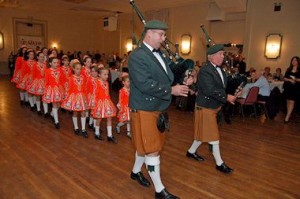
The Emerald Pipe Band ushers in the dancers.

The Emerald Pipe Band ushers in the dancers.

The Mayo Association knows how to celebrate. They started the evening at the Philadelphia Irish Center by honoring scholars, then moved on to salute one of their best and to crown their 2008 Miss Mayo.

This year’s winner of the Mayo President’s award was Thomas Staunton, a man praised by president Maureen Brett Saxon as ‘the one you can always depend on.”

Winner of the Miss Mayo contest—and that just had to be a tough contest to judge—was Colleen Mullarkey.

We have pictures to remember it all.

Music

All About The Morrigan

It’s a band named after the Celtic goddess of war, strife and fertility. (Or war, fate and death—your pick. Except for the fertility bit, she’s not a cheery chick, in any case.)

Of course, there’s so much more to The Morrigan, a circle of Irish musical friends, now anchoring the Molly Maguires traditional music session in Phoenixville. How about passion—and maybe throw in a bit of fun and occasional mischief?

Members include fiddler Mary Malone; uilleann piper, flutist and whistle whiz Den Vykopal; John LaValley on guitar, mandolin and concertina; bouzouki and button accordion player Bud Burroughs. They’re all Philly-area traditional Irish music session veterans.

Like many traditional Irish musicians, they came to the music sometimes by circuitous routes—but somehow or other, they came just the same.

We asked them to tell us a bit about themselves. Here’s what they had to say.

Q. You all seem to have come to Irish music by different routes. One or two of you have family ties. As for the rest, it seems a happy accident that you somehow found Irish music and were hooked. It also looks like, for some of you with musical inclinations, you were acquainted with some other form of music first. What drew you to Irish music? What keeps you?

Mary: I played mostly classical music until my friend and fellow Philadelphia Ceili Group member Susan Cavanaugh, a fine Irish dancer, persuaded me to take ceili, then set dancing classes. I was (am) a miserable dancer, but I loved the music, and, coming from a classical background where you learn tunes by reading music, I was intrigued when I would see the musicians in the sessions playing for hours at a time—and with no music. How do they do that???

I was advised to start going to the sessions at The Mermaid Inn (Chestnut Hill) where I met a lot of people from the Philly Irish community who helped me make the transition from classical violin to traditional Irish fiddle – Chris Brennan-Hagy, Kitty Kelly and Johnny Brennan got me started, then I started being coached by Den Vykopal—in the unique way that only a Slavic-Germanic, Irish-trad purist, musical savant can coach you.  And I became immersed in the music. My son Dave Palan, who is a professional musician often, hints that I am obsessed, and should diversify.

I stay, in part because it is great music, I am obsessed (there is always another tune to learn) and because of the people and the community—that extends around the world. No matter where you are there is likely to be a session, and you have instant friends. I was traveling on my job in Oslo, Norway, and happened upon The Oslo Irish Festival and the sessions there. It also happened to occur during the week of 9/11/2001 when I watched the planes fly into the world trade center from a European cable TV lab I was working in at the time. The musicians I met in the session there kept me sane during that crazy time when I was away from my family and friends and country. They saved seats at the concerts for me, played tunes with me, and they loved me—as I was part of the community of Irish trad musicians. And the Irish traditional music community is even better when you are at home with the people you have been playing tunes with for years. My mood can be off for an entire week if I don’t get out to play a tune with Kevin McGillian (what a great human being) at The Shanachie, for example.

Bud: I got into Irish music gradually. I heard a lot of bluegrass as a kid, then had classical piano and organ training, and then became a rock guitarist. A lot of the music I liked was influenced by Irish and English folk music (Jethro Tull, Fairport Convention, etc.). Sometime in my late 20s, I decided to get a mandolin, just to have something different to play. I started poking around on the internet for tunes to play and discovered that there were thousands of Irish tunes available, and they made a great learning resource. Eventually, I met Mary at work and she introduced me to Irish sessions. I started going, and learning more tunes, and eventually moved on to playing bouzouki and button accordion, and never stopped learning more tunes.

John: My musical memory came from my Irish and Irish-American parents and grandparents, some of them immigrants, coal miners, outlaws, policemen or the less savory sort who enjoyed the stories in country music and the romanticism embodied in popular and classical music. It reminded them of who they were.

I moved away from enjoying rock music in the early ‘70s and began to be drawn toward folk music—first the blues, then bluegrass, and finally Celtic music, which provided for me that same sense of cultural connection.

Q. Den, it seems like you came the longest, most roundabout route to Irish music. But given your background with Czech bagpipes, maybe it was not so much of a stretch. Was it? And I’m really curious to know how you first made that connection.
 
Den: Actually it wasn’t my piping that took me to Irish music. It was my flute playing. People forget that I was “just” a flute player not too long ago. I started on the pipes only about nine years ago.

As a classical flute player I was a huge fan of James Galway whom I consider the greatest soloist who ever lived. I never heard Paganini in person but I’d bet anyone Galway far surpassed him. The man is simply incredible. And since James Galway did two stints with the Chieftains I got to know Matt Molloy’s playing and I got hooked on the simple system wooden flute.

To me, playing Irish music is like playing anything. You have to have musical heart, ear and rhythm. In my life I played all kinds of music on the sax, flute, clarinet and guitar. I played on Norwegian cruise liners and in German clubs around Philly and the last fifteen years I’ve mostly frequented Irish bars where Irish trad is played. I’ll keep playing Irish and Celtic trad because I’ve become addicted to it.

Q. How did you decide to get together as a group? I know that you’ve all played together for some time.

Mary: We met playing at The Mermaid Inn. I gravitated towards John and Den and their playing. They had been playing together at the session for a couple of years by the time I met them, and they had such a great sound. John played guitar almost exclusively back then (1997) and it was before Den picked up the pipes, so he was playing flute mostly and sometimes whistle.

Den would give me transcriptions for tunes, and I would come back the next week and play the tunes with them. He gave me a Jerry Holland set of tunes to learn, and somehow, I ended up playing them at the Celtic Classic Fiddle Competition in Bethlehem with John accompanying me. And soon after that we started playing tunes at Den’s house.

Around the same time, I had recently started working with Bud Burroughs, and invited him to come to the session at The Mermaid – and it turned out that Buddy is a musical savant, then he started playing with Den, John and I.

Over the next year or so, I met Dave Hanson, another extremely talented musician, when he started coming out to the sessions with his kids—and his bodhran. Wow! And I asked Dave to join us—whenever we have a paying gig, he is the first guy we call.

Over the years we have played with various people—life gets crazy and people get pulled in different directions—but even if only sporadically, we have continued to play together. And other people have joined us, most recently, Judy Brennan.

Bud: Playing together happened gradually. All of us played at The Mermaid Inn and other sessions around the area and started getting together socially and to play music. Eventually, I think it was Mary who found us a gig somewhere, and we realized that people liked what we were playing, so we kept doing it!

Q. And why? Was there a sense that you could play things together as a group that you wouldn’t ordinarily be able to do as musicians in an Irish music session?

John: When you play in a session with like-minded friends, you always feel as thiough you are part of something greater, not playing music so much as participating in intangible emotions. That is the “mystic” that Van Morrison might cite if he were here. (He’s not!)

Mary: When you play in a band, especially if you are really proficient, it is much more satisfying in that you can choose what to play, get really good at some tunes and sets, arrange sets, play more difficult and challenging tunes—and you can also control the level of playing by the level of talent.

In a session, you don’t necessarily have to be proficient on an instrument in order to play. A lot of people come to learn, not just tunes, but instruments—because part of keeping the tradition alive is to have new people learn the tradition, the tunes and the traditional instruments. So as long as you know “Out on the Ocean,” and can scratch it out on your fiddle, and keep the beat—then you are in.

And I need to do it, because, as Den likes to point out (with respect, I might add) that I have my standards. (Hey, if Den gives you a compliment, you take it.)

Bud: By playing together as a group, we get to experiment with arrangements, and approaching things in a more disciplined way than the typical session free-for-all. Playing in a session and performing for an audience are both fun, but are completely different experiences.

Q. Does playing the session at Molly Maguires in Phoenixville seem like a good way for you guys to stay sharp as a group? Or to work on material? Or is that really a different kind of musical outlet for you?

Mary: Playing at Molly Maguire’s together once a month is about the only way we are able to keep playing together at this time in our lives—and my playing is at its very, very best when I am playing with these guys. Bud is playing with Boris Garcia and touring and doing gigs like the Philly Folk Fest and Sellersville Theatre on November 28, where they are releasing a phenomenally arranged and produced CD. (Den plays on it too.) Den and I both have new jobs that are taking up a lot of our time. And we love having Judy play with us, and the piano backup provides Bud and John the opportunity to both play melody instruments (concertina, pipes, button accordion, and banjo.)

Bud: Molly Maguires gives us a good excuse to get together and play on a regular basis. We can work on new tunes and practice the stuff we’ve played for years. Plus, it’s a lot of fun!

Food & Drink

Last Call

So who wasn’t there?

It seemed like everyone who had ever played music or danced to it in Emmett’s Place, the Northeast’s venerable Irish pub, was on hand for the big farewell bash. The joint was so crowded, people had to enter in shifts. At one point, an entire drum set needed to be assembled out on the sidewalk.

We could tell you more, but far better to show.

Music

Review: “Absolutely Irish”

If you just can’t wait for Mick Moloney’s big musical fund-raiser at St. Malachy’s Church in North Philly—a benefit for the parish’s vibrant and indispensible school on November 2—you can get yourself a great little preview.

Compass has recently released “Absolutely Irish,” the CD version of the April 2007 Public Television show of the same name.

It’s Moloney’s magic that he can bring together many of your favorite artists—you never know quite who will show up for the St. Malachy show, and you’ll kick yourself for sure if you miss it. On this CD, producer Moloney has assembled quite the stellar cast, including guitarist John Doyle, Séamus Egan of Solas, the irrepressible Joanie Madden of Cherish the Ladies, the brilliant singers Karan Casey and Robbie O’Connell, and fiddlers Liz Carroll, Athena Tergis and Eileen Ivers. Also appearing: Susan McKeown, Niall O’Leary, Darrah Carr, Jerry O’Sullivan, Billy McComiskey, Brendan Dolan, Rhys Jones, Tim Collins, Mac Benford, Mike Rafferty and Jo McNamara.

Yikes.

O’Connell and Tergis were part of last year’s lineup at St. Malachy’s. (Read our story.)

It’s hard to pick a bad tune off this CD, though there were a couple of “off” notes.

For example, I didn’t particularly care for Susan McKeown’s interpretation of “Fair London Town.” It just seemed slightly out of her range, and she was noticeably flat on many of the higher notes. She’s a wondrous singer, so figure it was an off night. And I’m a nut for bluegrass, which has deep ties to traditional Scottish and Irish music, but “June Apple,” with Mac Benford and Rhys Jones, was not my cup of tea. It might be yours, though.

As for all the rest, there are few tunes that are now enjoying heavy rotation on my car CD player. Particular favorites were several songs, including “Flower of Kilkenny,” featuring Robbie O’Connell, “The King’s Shilling,” with Karan Casey doing the honors, and “McNally’s Row of Flats,” a great little ensemble tune that Mick and friends performed last year at St. Malachy.

All of the stars get a chance to shine, including Liz Carroll and John Doyle first, then Doyle and Joanie on a blazing set, “Before the Storm/The Black Rogue/The Lass of Ballintra/The (Other) High.” Many of the gang—John Doyle, Séamus Egan, Liz Carroll, Joanie Madden, Tim Collins, Eileen Ivers, Billy McComiskey and Jerry O’Sullivan—get together on a gorgeous set of jigs, “Lark in the Morning/Cannabhan Ban/Humours of Ballyloughlin.”

Listen to the fireworks, too, on a fiddle extravaganza “Never Was Piping So Gay/The Chandelier/Paddy Fahey,” with Liz Carroll, Eileen Ivers, Athena Tergis each taking a turn, accompanied by the inimitable John Doyle on guitar. The three ladies bow at breakneck speed to start, but when Ivers comes in, the whole things slips into overdrive. (At least it seems noticeable to a drummer.) If anyone but John Doyle was playing accompaniment, his arm would be falling off at the end.

Sports

Notre Dame “Fighting Irish 5K” Concludes Another Good Run

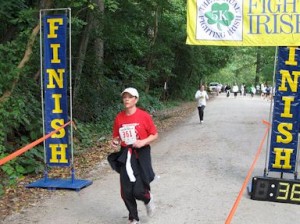
The big sign says: Finish. A welcome sight, no doubt, to runner Shauna Frye.

The big sign says: Finish. A welcome sight, no doubt, to runner Shauna Frye.

A new date and a new location brought good luck and good weather to the 2008 Fighting Irish 5K, sponsored by the Notre Dame alumni of Philadelphia.

More than 300 runners finished this year’s 5K down on Forbidden Drive in the Valley Green area of Philadelphia’s Fairmount Park last Saturday morning, and the alumni raised $21,000, for a total of $121,000 raised for St. Malachy’s School in North Philadelphia over the six years of the race, according to race organizer Frank McGuire.

Michael Kerrigan, 23, ran the course in 15:17, and Liz Haglund, 24, finished not far behind at 17:51, to win top honors. Runners up were Ryan Fennelly, 26, just 3 seconds behind the leader, and Kathryn Bowser, 22, at 19:07.

New pastor, Rev. Kevin C. Lawrence, took over the reins from Father John McNamee, who recently retired. And even though Father Mac graciously took morning Mass so Father Lawrence could be at the race, both were present at the finish, along with a delegation of St. Malachy students.

Providing the soundtrack for the morning was the Philadelphia Emerald Society Pipe Band.

In previous years, the race was scheduled for mid-March, for the obvious St. Patrick’s Day tie-in, at Chestnut Hill Academy. Last year, bitter cold caused a cancellation.

This year’s weather was brighter, sunnier, and a lot less cold.

Music

Bristol AOH Is Alive to the Sound of Music

Jim Fowler grew up with Irish music. As a kid, he used to listen to the Wolfe Tones, and the Clancy Brothers and Tommy Makem, along with his grandparents James S. Fowler and Margaret (nee Hagerty).

Not surprisingly, all his life Fowler wanted to do more than just listen to the music—he wanted to play it, too. Although he only recently started picking up on tin whistle, bodhran and a bit of banjo, that part of his life never turned out quite the way he had hoped.

So Fowler, the entertainment chairman at Bristol Borough’s Division of the Ancient Order of Hibernians, came up with the next best thing—a project that would blend his love of the music with his love for the nation’s oldest continuing AOH clubhouse, founded in 1883.

It’s a benefit CD called “Hibernian Sessions No. 1,” and it featured live music recorded at the AOH hall and performed by some of the region’s top Irish bands: The Birmingham Six, Bogside Rogues, Jamison and the Shantys.

You can pick up a copy and listen to still more live performances by the very same hot bands on Saturday, starting at 1 p.m. at the AOH Hall on Corson Street in the borough.

“The CD is something I raised with the division about a year ago,” Fowler says. “It does a couple of things. It promotes our heritage and culture through music, and it makes some coin for Irish charities, such as the Hibernian Hunger Project, Project Children, Project St. Patrick and the division itself. It’s something I always wanted to do. Once I become involved with Division 1 in Bristol, this was the way to go, and we’re really proud of it.”

The CD also tied in with the division’s interest in boosting the level of entertainment at the hall. “Friday nights, it’s rockin’ there,” says Fowler. What the CD tries to do is capture the ambience of those rockin’ Friday nights.

The sessions were recorded throughout 2007 and 2008. All of the bands agreed to have their performances recorded, and Fowler, with recording engineer Chad Palmer chose the three performances they liked the best for the CD. “The bands had the final say on the mix,” he adds.

Fowler, who knows members of all the bands, can’t say enough about them: “The bands basically did this for free. They’re getting 20 CDs to sell at their shows. They dedicated their time and gave us the approval to do it.”

Of course, the CD is called “Hibernian Sessions No. 1,” which begs the question … will there be a Hibernian Sessions No. 2?”

In Fowler’s mind, there’s no question. “I want to keep this going,” he says. “In the end, once we get all the CDs sold, the division’s going to have to make the decision whether to do it again. If they don’t, I’ll put up my own money.”

Learn more at: http://hiberniansessions.com/Home.html

News

What Happens in Wildwood Stays in Wildwood?

How can she keep from dancing? (Photo by Lisa Carberry)

How can she keep from dancing? (Photo by Lisa Carberry)

At 11 in the morning on Sunday, the vendors along New Jersey Avenue were doing brisk business in Guinness hats, Irish drinking team T-shirts, and shiny shamrock beads. The guys who shred spuds for butterfly fries were spinning out mountains of the things—and through the magic of boiling fat, turning them into thin, salty, crunchy chips for the masses. The Wawa at 4th Avenue was peddling plenty of hoagies, coffee and sun block.

A bar with wide-open windows provided the soundtrack: “Blow My Whistle (Bitch)” by DJ Alligator—a thoroughly unlovely, unsubtle, misogynistic sentiment for a Sunday morning down at the Shore, but really the only discordant note as the last day of the Wildwood Irish Fall Festival otherwise dawned bright and clear. It was a quiet morning down in Anglesey, with the promise of unrestrained, Irish-accented fun in the sun yet to come.

In a few hours, Paddy’s Well and a whole host of other bands were playing in the music tent. The beer taps were stuck in the open position more or less continuously.

And the parade finally kicked off down at 24th and Surf, bringing with it pipe bands from every corner of the Delaware Valley and beyond, the Irish American String Band, Reilly Raiders drum and bugle corps, dancers from everywhere, and Ancient Order of Hibernians divisions from Philly and the Shore. A short-sleeved Rev. Rev. William T. McCandless, the grand marshal, led the long procession up to the business end of the festival. The crowds seemed thinner this year than last, particularly at 1st and Central, the dogleg just before the parade turns up Anglesea Drive and into the festival grounds.

No matter—for all the folks who flock to Wildwood year after year, it was still the best way to end summer.

We have more photos than we count (thanks to pal Lisa Carberry for all her help) and some videos—including a little treat for Eagles fans.