All Posts By

Jeff Meade

News

32 County Ball Rings in the New Year

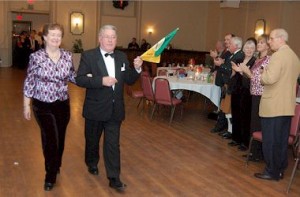
Jimmy Meehan and Nora Campbell carry the banner for County Donegal.

Jimmy Meehan and Nora Campbell carry the banner for County Donegal.

The closing event celebrating the Philadelphia Irish Center/Commodore Barry Club’s 50th year, this New Year’s Eve ball was a roaring success.

The 32 County Ball culminated in a grand march at just after 10 p.m., with attendees representing the counties of Ireland.

People

2008 Wren Party

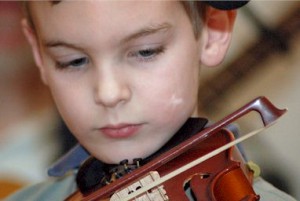
Patrick Glennan, 8, concentrates intently on his fiddle playing.

Patrick Glennan, 8, concentrates intently on his fiddle playing.

Some of you probably already know how the Irish traditionally celebrated the feast of St. Stephen—December 26. Roving groups of boys would chase and kill a wren, said to be symbolic of the old year, and parade its tiny feathery corpse through the streets on a stick. They’d stop at houses along the way and beg for “a penny to bury the wren.” (A bit of food and drink, too? Sure, they wouldn’t turn that down, either.)

This was thought to be great fun. No one asked the wren.

Well, thankfully, this bloodthirsty little tradition today is observed only symbolically—as with the annual Wren Party sponsored by the local branch of Comhaltas Ceoltóirí Éireann, an Irish music and cultural organization, The event was held at the Glenside Knights of Columbus Hall, with much music, dance, food and fellowship.

People

Marching To a Different Drummer

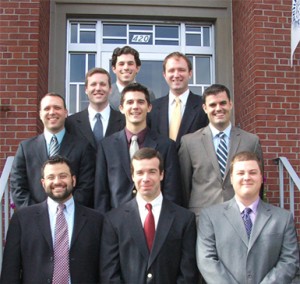
Kevin Hughes, lower right, with fellow seminarians.

Kevin Hughes, lower right, with fellow seminarians.

There was a time when it seemed like every Irish family sent a boy into the seminary. It was a point of pride within families and within the Irish-American community, which once sent more of its sons into the Catholic priesthood than any other nationality.

That was then. Now, people perhaps are more mystified than proud when a young man they know wants to take that momentous step. Why would anyone commit to such a life?

I’m thinking now of Kevin Hughes, my friend. I first came to know Kevin when he joined the Philadelphia Emerald Society Pipe Band. I was a drummer. Kevin was a student at LaSalle and a piper with lungs of steel and fingers that moved in a blur. No one could keep up with him.

When you belong to a competition pipe band, you get to know people pretty well. Competitions usually are not close, so you have to share long rides out to Long Island, Southern Maryland and the like, and back again. (It’s an even longer ride home if you’ve lost.)

That’s how I got to know Kevin. I can still remember him sacking out in the passenger seat of my car on our way back from a competition venue, maybe the Long Island Scottish Games at Old Westbury Gardens. He snored.

It’s been clear for years that Kevin was bound for the priesthood—the Jesuits in particular, thanks to four years of exposure at St. Joe’s Prep. A lot of us probably have a fixed idea of what a young man with his sights set on the priesthood is supposed to be like. You might picture the holy card poster boy, eyes permanently fixed on the heavens. You might not picture the husky dude with lungs of steel, sitting on the Irish Center bar stool next to you, trading wise cracks after band practice.

That’s our Kevin—bright, hugely talented, and, in my estimation, a pretty good match for an order known for intellectual rigor and spiritual integrity.

St. Ignatius of Loyola, the founder, was a knight before he became a priest. Today, I’d like to think he might have been a piper.

We tracked Kevin down by e-mail at the Novitiate of St. Andrew Hall in Syracuse, N.Y. Here’s what he had to say.

Q. How old are you? What was your degree at LaSalle?

A. I am 23 years old and my degree from La Salle University is in biology, Bachelors of Arts. I am the third youngest man in the novitiate.

Q. I want to go back to a question I asked you before: Why? Why the priesthood? Why the Jesuits?

A. Why does anyone fall in love? You just know, it’s like being called to something. That is how I feel, like I am being called by God to something larger than myself. I feel like the Jesuit charism is compatible with my own desires to serve the people of God, specifically to see God in all things and to be a man for others.

Q. I’ll also note that no one asks incredulous-sounding questions when someone says they’re going to med school or law school. I wonder what goes through your head when someone asks that question, as if you’ve just announced that you’re planning to be the first astronaut to walk on the surface of Mercury or you’re hoping to open a chain of cat-waxing facilities.

A. I certainly realize that a lot fewer people, especially young people, are desiring to enter religious life, so I don’t mind at all when people ask me what I am thinking. In fact, I welcome the questions because it gives me a chance to tell people that someone can be happy with a life devoted to the love and service of God and His people.

Another thing I tell people, when they ask about why I have to take vows of poverty, chastity, and obedience, is that I don’t have to take them, I don’t have to be a member of a religious order, no one is forcing me: I could go to med or grad school, but I am choosing to take these vows and to live a life in a religious order to study for the priesthood.

Q. Tell us a bit about your everyday life. How has the reality of the novitiate compared to your expectations?

A. Well, getting up at 5:30 a.m. has taken some getting used to, as well as going to bed around 9:30 p.m.

My day begins with an hour of private prayer, followed by communal Morning Prayer, and then some classes about church and Jesuit history, then about the Gospel. We have Mass every day and communal dinner and night prayer.

On Tuesdays and Thursdays I work at an Apostolate volunteer job from 8:30 to 2:30. I work in Cathedral Emergency Services, a local Syracuse food pantry. IT IS GREAT, I love it. The other novices there are really good guys and they are easy to get along with.

Q. What’s the career path beyond the novitiate? How long before you’re ordained? Tell me again what you hope to do as a Jesuit?

A. The career path beyond the novitiate is still unknown. God willing, after taking vows we are sent to first studies. This can be one of four places: Toronto, St. Louis, Chicago or Manhattan. We really don’t know where we will be sent until right before we go; they like to keep us in suspense.

Again, God willing, I will be ordained after the 11-year program—two years novitiate, three years first studies, three years Regency, three years theology studies.

As a Jesuit I don’t really want to limit myself to any “career” within the Society, but at some point I would certainly like to do some teaching.

Q. Do you think you’ll get the chance to play pipes any time soon? Or is your schedule and your training just that demanding?

A. I do still have a chance to play the pipes, however not nearly as much time as I had before joining. My playing is limited to practicing and occasionally playing the pipes for the guys.

I had the opportunity to go to McQuaid Jesuit High School in Rochester, N.Y., and played my pipes there, while the superior of the Jesuit community did some Irish step dancing. He’s very good, he used to teach Irish Step.

Music

Christmas Comes Early to the Shanachie

Guitarist John Doyle in a pensive moment.

Guitarist John Doyle in a pensive moment.

It was billed as a Christmas show. Think of it as a Christmas present.

Mick Moloney, with fiddler Athena Tergis and guitar great John Doyle, headlined at the Shanachie Pub in Ambler Thursday night. They were joined onstage, from time to time, by special guests, local fiddler Caitlin Finley and old-timey fiddle whiz Rafe Stefanini.  

There were just enough Christmas tunes along the lines of “The Holly and the Ivy,” to satisfy those who were looking for an early dose of holiday merriment. Mixed in were some of the vintage tunes Mick Moloney typically champions—including a great little song about some fairly lethal Christmas cake—and, between Tergis and Doyle, there were enough musical pyrotechnics to rouse the denizens of the jammed dining room and bar.

We’ve posted some photos from this wonderful concert, which Shanachie co-owner Gerry Timlin suggested might become a tradition.

Check them out.

Columns, How to Be Irish in Philly

How to Be Irish in Philly This Week

It’s “kick up your heels” Saturday as the Martin Family Band plays Celtic tunes at the Willow Creek Orchard’s 5th annual open house in Collegeville and Canadian fiddler and singer April Verch performs at Calvary Church in Philadelphia.

But save some toe-tapping strength for Tuesday’s “Irish Christmas in America” at the Irish Center in Mt. Airy, featuring Karan Casey and Teada and some incredible musicians and dancers. And get your tickets now. In many cities where this show is touring, it’s playing to sold-out crowds. This year you can purchase performance CDs or you can win a copy in our “help irishphiladelphia.com hit 1,000 subscribers to its newsletter” contest. All you have to do to be entered is to subscribe to our weekly informative email newsletter (we call it Mickmail) or, if you’re already a subscriber, forward your issue on to someone else who you think might subscribe. We’re only about 13 people away from achieving our goal for the year. Next year: world domination.

On Wednesday, our friends Dennis Gormley and Kathy DeAngelo, otherwise known as McDermott’s Handy, will be performing their own Christmas special at the Fox Chase Library in Philadelphia. Not only are they fine musicians, Dennis never fails to crack us up, so expect some great fun.

And if you’re not too Christmased out, Leahy—an astonishing family of eight talented brothers and sisters from Canada—will present their Christmas show at the Annenberg Center for the Performing Arts at the University of Pennsylvania on Friday, December 12. You may have seen their PBS special or heard their award-winning albums. They even stole some thunder from Shania Twain when they opened for her in her inaugural world tour.

If our calendar isn’t out Christmas shopping, you can check it for all the details.

Dance

A Look Back at the 2008 Oireachtas

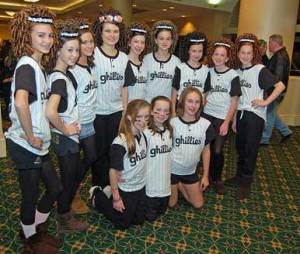
Here they are, the McAleer "Ghillies."

Here they are, the McAleer "Ghillies."

Many of the dance schools that competed in the Mid-Atlantic Oireachtas down at the Center City Marriott created custom T-shirts for their teams. One set of tees stood out above the rest—those worn by the McAleer School out of Claymont, Delaware.

You might have to be a dancer to get the joke, but emblazoned in baseball script across the McAleer pinstriped jerseys was the word “Ghillies.” (Ghillies, for you non-dancers, are dance shoes.)

To Tricia Beichner, who designed the shirt, it was a no-brainer: “”The Phillies won the World Series, and that’s why we did it.”

The shirts proved so popular that not only the bewigged dancers were wearing them. (And that’s a look, let me tell you.) “It’s beyond the team,” said Beichner. “The dads and the moms bought the shirt, too.”

You’ll find more pictures from this year’s Oireachtas, a huge competition for Irish dancers throughout the mid-Atlantic states, in our photo essay.

  • Music

    Still Roving After All These Years

    By the time you read this, the Irish Rovers will be doing what they have done, for over 40 years: Roving.

    You’ll have a chance to hear and see them yourself Friday, December 5, at the Keswick Theatre in Glenside, as the Rovers present their Christmas show. (The show starts at 8.)

    Just before the tour began, we caught up with the Rovers’ George Millar by phone from his home on Vancouver Island, a scenic outpost off Canada’s Pacific coast, about 75 north of Seattle. Millar had lived there for over 15 years.

    It’s a short tour, thankfully. After 40-plus years in the business, touring is an exhausting business.

    “It’s 12 cities in all,” he says, “starting with three in Canada, ending up in Florida on the 14th of December.” You wouldn’t think there’d be much call for winter holiday songs in Florida, but, Millar says, you’d think wrong. “Isn’t it crazy?” he says. “And yet we do it every year and they all show up with their red and their green on and it’s about 130 degrees out.”

    The Christmas tour has proved a popular way for fans to get their annual dose of Irish Rover music. And, Millar says, the boys aim to please.

    The Christmas show was the brainchild of the band’s agent, Millar says, perhaps in part due to the popularity of their version of “Grandma Got Run Over by a Reindeer,” originally recorded by an obscure duo, Elmo and Patsy. Of course, the Rovers are about so much more than holiday ditties, so fans will be treated to a crowd-pleasing mix of Christmas and traditional Irish music.

    “The trouble with us and doing a Christmas show is we really can’t do the traditional Rudolph and things like that,” says Millar. “So we have to look for the more obscure English-y, Irish-y songs, or we wrote similar type songs. We always have to do “The Unicorn,” “The Black Velvet Band,” and of course “Grandma Got Run Over By a Reindeer.” That’s a must—you have to do that whether you like it or not.

    “To keep the tours fresh, we have to keep changing songs. You have to keep so many of them (standards) in, of course. We’ll do the songs they expect to hear, that’s what they pay for. But we keep coming up with new songs to keep ourselves fresh and keep ourselves interested. We just keep it fast paced, and before you know it the two hours is up and we’re off having a Guinness somewhere.”

    For the Rovers, there seems to be no slowing down. If it all seems a bit formulaic, well, maybe it is. But it’s a good formula, and one that fans truly appreciate, as they have done since the beginning.

    Millar recalls how the Rovers started, by accident, at a weekend show in Toronto.

    “It was like a charity show,” he says “At least twice a month in Toronto, where we had immigrated (from Ballymena, near Belfast) there was a big Scottish-English-Irish community, and they would put on these shows about twice a month. They were just like an amateur show. People would come and pay their two dollars and they would drink their rye and ginger ale, and their beer. My sister was quite the singer, and I was playing guitar behind her. I was about 14 or 15 when this all started.

    “Well, one night, this fellow (Jimmy Ferguson) gets up and starts singing Lonnie Donegan songs. In those days, Lonnie Donegan was a huge British star. He was as big as the Beatles in his day. He used to sing folks songs, but to electric guitar. So Jimmy was playing this kind of song. Well, one time I went into the toilet to tune the guitar. We were just about to go on and it was so noisy in the place. And I’m sitting on the floor tuning my guitar and humming to my self the song, “The Irish Rover.” And this fella Jimmy comes into the bathroom and he starts singing it along with me. And we sort of looked at each other and I said, ‘Oh, I didn’t know you knew that song.’ He said, ‘Well I’m from Belfast, so of course I do. I learned it in school.’ Just then, the fella who was running the show comes in and overheard us singing “The Irish Rover,” and he says, “Somebody didn’t show up tonight. Can you do it in the show?”

    At that point, the two weren’t sure they knew all the words but they tried it out—still in the bathroom. And, Millar recalls, the concert promoter said to them, “It’s perfect.”

    “After I sang with my sister and Jimmy did his little bit, we did this one song together, we got up and sang it and the audience loved it. That’s all there was to it.” That’s how they got together, started learning songs and formed the core of what would grow to become the Irish Rovers.

    Making a living in music as opposed to any old factory job seemed like a wise choice. In time, they found themselves touring, and they turned up with a gig at the legendary Purple Onion in San Francisco in the late ‘60s. They rubbed shoulders with some young performers, like Linda Ronstadt and Steve Martin, who would themselves go on to fame and fortune. For the Rovers, though, fame came in the form of a Shel Silverstein tune called “The Unicorn,” in 1968.

    Two more hits—recorded under the shortened name, ”The Rovers,”—came in later years, including the Tom Paxton tune, “Wasn’t That a Party.” By all accounts, the Rovers’ parties were memorable indeed, and this was Paxton’s paean. A little while later came “Grandma,” a tune that reinvigorated the Rovers’ career, even as it rubbed some audiences the wrong way.

    The Rovers acquired the Elmo and Patsy tune, which had been a regional hit, when they were looking for songs to fill a Christmas album.

    “We re-recorded it about 30 years after they did it, and it became an underground hit,” says Millar. “You either like the song or you hate it. There’s no happy in between on that one. It’s just a comical, funny song. Even my own mother, before she passed on, said to me: ‘Shave your beard, cut your hair and don’t ever sing that horrible Grandma song again.’”

    Of course, sons often do go their own way—and many fans are grateful that the Rovers have.

    The fact is, Rovers fans are diehards. Long after “The Unicorn,” they keep on coming. Millar isn’t sure they’re about to stop.

    “We’re never going to get retired at this point,” he says. “We’re blessed that we still have a built-in audience of people that wants to see us. When people ask us about retirement, I say, well … why? I can now see why George Burns kept going until he was almost 100 years old. It’s not like rock and roll. We don’t have to weigh 105 pounds and wear Spandex … luckily. With Celtic music, the hair can recede and the stomach can come out a wee bit, and it seems to fit the image.”

    Music

    Another Year of Joyful Noise

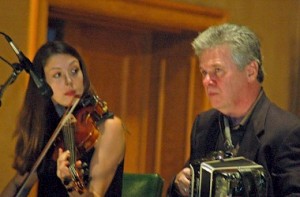
    Athena Tergis and Billy McComiskey

    Athena Tergis and Billy McComiskey

    No one can recall quite when Mick Moloney started playing his annual benefit for St. Malachy School, the most recent of which was held a couple of Sundays ago in the church on North 11th Street.

    The parish’s retired pastor Father John McNamee figures it’s at least 22 years since he bumped into Moloney at a presentation on ethnic music at the Balsch Institute. The two struck up an immediate friendship, and Moloney soon suggested a fund-raiser for the little school a few blocks from Temple University in North Philadelphia.

    Since then, Moloney’s annual gathering of musical friends has become, McNamee says, “the longest and most successful benefit we have all year” for a school the American Ireland Fund has called “a preeminent symbol of ecumenism and outreach to poor and disadvantaged youth and their families.”

    Without this concert and other fund-raisers, Father Mac told his audience, “We’d have closed down 15 years ago.” And he added: “I can’t imagine this neighborhood without this school.”

    Neither can we.

    Thanks to Moloney and a few of his fellow musicians—Athena Tergis, Brendan Dolan, Billy McComiskey, Brendan Callahan and Caitlin Finley—we won’t have to.

    Here are a few photographic remembrances of the day.