All Posts By

Jeff Meade

Columns, How to Be Irish in Philly

How to Be Irish in Philly This Week

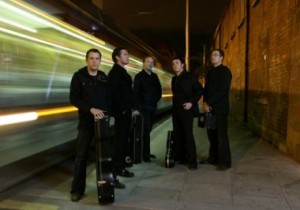
The acclaimed Irish group, Slide, is coming to town.

The acclaimed Irish group, Slide, is coming to town.

“They can sing, they can write, they can dance across fingerboards and piano keys, buttons and bows, and by crikey can they play.” Wish we’d written that, but it was reviewer Alex Monahan on the 2003 Slide release, Harmonic Motion. The five young Irishmen (who are waaaaay cuter than the Jonas Brothers) will be appearing on Saturday night at 8 PM at the Philadelphia Irish Center. In Ireland, they’ve been called “the next big thing” in traditional music. Listen for yourself.

Slide will be ringing in the month of March. Take your vitamins and get plenty of sleep, sweeties. There’s going to be plenty of ways to be Irish this month. (In fact, you can sneak a peek at our special 2009 St. Patrick’s Celebration calendar to make your plans now.)

The AOH Division 22 is holding a Celtic tea on Sunday at the Firefighters Union Hall in Philadelphia. We don’t expect lace napkins, but we could be surprised.

Derek Warfield and the Young Wolfe Tones will be bringing their great sound to the Springfield Country Club late Sunday afternoon too.

You can support the Philadelphia St. Patrick’s Day Parade on Sunday by attending a fundraiser at Finnigan’s Wake on Third and Spring Garden in the city. Philly’s budget deficit is infectious—it’s left parade organizers about $40,000 short for this year’s abbreviated event (another cost-cutting measure). Philadelphia Newspapers CEO Brian Tierney has vowed to match dollar-for-dollar the first $20,000 raised for the parade. Paddy’s Well provides the entertainment. Next week, Blackthorn raises the roof and some money for the parade at the Springfield Country Club.

And, on the same night (get used to this), the Three Irish Tenors will be performing at the Colonial Theater in Phoenixville. Lovely voices, nice lads.

Mid-week, Irish singer Tony Kenny, star of Jury’s Irish Cabaret in Dublin for years, brings his show to the Sellersville Theatre (it includes Irish comic Joe Cuddy, fiddler Sarah Rogers, and some great Irish dancers).

Thursday, the Celtic Tenors are coming to the Keswick, and Kildare’s in Manayunk is beginning the first of four weeks of Theology on Tap, an evening with guest speakers on many aspects of religion, with a free buffet.

If you missed the legendary Finbar Furey when he appeared at The Shanachie Pub and Restaurant in Ambler on October, you have your chance to see him on Thursday, when he makes a return visit with The Boatmen. It was an amazing night, not to be missed—don’t make the same mistake twice.

And Friday marks the return of the hit Broadway show, “The Irish and How They Got That Way” at the Kimmel Center in Philadelphia. The Frank McCourt (“Angela’s Ashes”) play is an irreverent but affectionate history of the Irish in America told in song and story. We’ll have a review in the next couple of weeks.

Also, next Friday, Shanachie owner and entertainer Gerry Timlin will play your favorite Irish tunes and keep you in stitches at a special concert to benefit the Courage to Create Capital Campaign for the Montgomery County Community College’s Fine Arts Center in Blue Bell.

The first of the many parades is next weekend (Mt. Holly kicks the marching season off) and the activities start to ramp up and they don’t stop even at the end of March. Check our calendar and start making your plans now. Pace yourselves!

And remember to buy Irish!

Music

A Chat With The Chieftains’ Kevin Conneff

“In 1976 I got a phone call from Paddy Moloney. I was working in a print shop, doing layout design and lithographic plates. The phone rang in the darkroom and he asked me if I’d consider doing bodhrán on a couple of tracks.”

So began Kevin Conneff’s long career recording and touring with the Chieftains. Conneff took a week off from the job, traveled from Dublin to London, laid down those “couple of tracks” on what would become the Chieftains’ sixth album, “Bonaparte’s Retreat.” And he figured, well, that’s that.

But Moloney had other plans. Conneff didn’t know it, but Peadar Mercier, the Chieftains’ second bodhrán player, was retiring. “Toward the end of the week, he (Moloney) asked me if I’d consider making it full time,” said Conneff in a call from Birmingham, Ala., halfway through the Chieftains’ latest tour—a tour that will bring them back to Philadelphia’s Kimmel Center Sunday, March 15, for a show in Verizon Hall at 3 p.m.

Conneff, secure and happy in his print shop job, had to think about it. “I remember thinking I’d do it a couple of years and I’d go back to the print shop, maybe start up my own” Conneff said with a laugh.

With each new Chieftains success—and there were many—it seemed less and less likely that Kevin Conneff would ever again lay hands on a lithographic plate. What followed instead was a remarkable career as the Chieftains’ singer and drummer.

For most of the Chieftains, some kind of lifelong involvement with traditional music was preordained. Not so for Conneff, who first became enamored of it when he was in his teens.

“I’m not really like Sean (Keane) and Matt (Molloy) and Paddy,” Conneff said. “They heard the music from the womb. My parents had a mild interest in Irish music and dance, but I just barely happened on it. Some of the lads I was working with were into Irish music.”

Conneff, a Dublin kid whose musical interests up to that point ran more to jazz and popular music, suddenly found himself criss-crossing the countryside in search of fleadhs and sessions on weekends.

“The first place I really encountered the music was in Mullingar in the midlands of Ireland when I heard these people playing, farmers really. I was absolutely knocked out,” he said. “I remember thinking; these guys are as good as the (jazz) musicians like Charlie Parker I’d been listening to on records.”

Getting to work on Monday morning in anything like decent shape was sometimes a challenge. “I went back the job very often still smelling of hay barn and Guinness,” he said.

As much as Conneff appreciated the instrumentalists, it was the singers who stole his heart. He started picking up the words to the old ballads and gradually, tentatively tried them out in sessions.
“I was always interested in singing,” he said. “I used to sing pop songs and whatever. I was into Ella Fitzgerald singing ‘How High the Moon,’ which bowled me over … and still does. The very fact that it (singing traditional songs) was just an interest, a hobby made it easy. I was just doing it for my own sake and to be a part of these sessions and not be peripheral to it.”

“If it became known that you sang a couple of ballads you had to sing them really well to be accepted in a session. It was quite a thing when one of the older players would say, ‘Let’s have a song.’”

Much later, Conneff learned to play the bodhrán, the traditional goatskin frame drum. And he also learned to practice restraint, to patiently wait to be invited to play.

“if you’ve respect for the musicians and the music, you hold your fire,” he said. “In those days, particularly a lot of the older players would frown at a bodhrán coming into a session. The last thing they wanted was some obnoxious, thundering, banging bodhrán to cover up all their talent. You just have to learn to be humble.

“Unfortunately, the bodhrán attracts a type that comes in, and very often they’re flamboyant in their dress or have bits of fur hanging off the drum and they just hammer away. They just have no sensitivity to the music.”

Conneff’s respect for the music led to his involvement in a pioneering venture called the Tradition Club, a gathering place for local Irish musicians at Slattery’s at 129 Capel Street in Dublin. It was while helping to run that club that Conneff rubbed shoulders with Moloney and other local stars of the traditional scene.

Conneff and the other organizers saw the Tradition Club as an alternative to the guitar-and-ballad style that was popular in folk music in the late ‘60s. The club was also a warm and welcoming venue for many of the country musicians—the ones who so impressed Conneff in his earlier days—who would be brought in to share their gifts.

“The guitar and ballad thing was more prominent in Dublin than the real thing, so to speak,” said Conneff, “so myself and some friends started the Tradition Club where the emphasis was on the traditional player and singer. We’d bring in people from rural areas to play for a night. That was a great education for those of us running the club. We hosted people like Willie Clancy and Seamus Ennis—the greats of the Irish music scene in those days.”

Conneff was still helping run the Tradition Club when he joined the Chieftains. The club continued on for a number of years.

Some would say the Chieftains have taken a few detours away from the tradition over the years. Probably a different way of looking at it is that they’ve helped to popularize the music by showing what it has in common with other forms of music. For example, the Chieftains are currently at work on a recording drawing on the story of the San Patricios Battalion, a group of largely Irish ex-pats who fought against the United States on the side of Mexico. “A lot of them were executed on the outskirts of Mexico City,” said Conneff. “To this day there is a pipe band called the San Patricios. Every Sunday they march out to this memorial at a convent where the soldiers were executed. Paddy has been working with this connection. He’s put together some wonderful music with a Mexican Irish theme. We’ll be doing some of that in the concert. We’re doing an album of the music. It should be completed by September.”

Conneff has also been pursuing a non-Chieftains project with three other phenomenal musicians. Fittingly, it’s called The Tradition Club. Along with Conneff, the band features Gerry O Connor of Dundalk on fiddle, Dubliner Paul McGrattan on flute and the Breton Giles Le Bigot on guitar.

With luck, you’ll get a chance to hear the results of the quartet’s handiwork. “We put down a few tracks and will try to put together an album toward the end of this year,” said Conneff. With one member of the band on the Continent, recording and playing concerts can be challenging, Conneff said. “The logistics of it are a bit difficult. Any time we do gigs he (Le Bigot) has to come over to Ireland. Very often the fees go to pay his expenses. It’s very enjoyable to be doing something like that.”

While you’re waiting for that musical experiment, you’ll just have to content yourself with Conneff’s other band, which arrives in Philadelphia for a concert (unfortunately) the same day as the Philadelphia St. Patrick’s Day parade. The Chieftains’ annual visit to Verizon Hall usually coincides with that event. After so many concerts and so many years on the road, many venues tend to blur together. Not so, Verizon Hall. For the Chieftains, it’s one of the best places to play.

“That’s a fantastic venue,” Conneff said. “Any time we’ve played there, it’s been an afternoon show. A lot of the times, we’ve had to detour going to the theatre because of the parade. Sometimes the older venues are the best from an acoustic point of view. But of the newer venues the Kimmel Center sound is wonderful.”

Music

Martin Hayes and Dennis Cahill In Concert

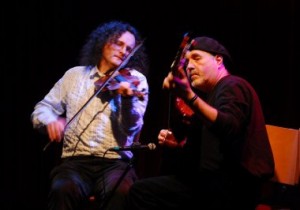
Martin Hayes and guitarist Dennis Cahill

Martin Hayes and guitarist Dennis Cahill

Even though what they play is Irish music, fiddler Martin Hayes and guitarist Dennis Cahill coax the sound of gypsy tunes, classical violins, and a little bit of quiet jazz from their instruments while producing luscious slow airs and raucous reels and jigs.

Don’t believe me? Watch these videos from their February 17 performance at the World Café Live in Philadelphia.

Their latest album, the first in 10 years, is “Welcome Here Again.”

News

Festival Warms Up the Midwinter

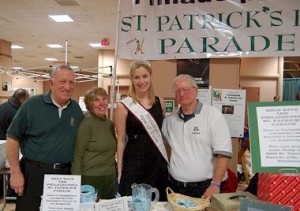
The St. Patrick's parade booth did brisk business.

The St. Patrick's parade booth did brisk business.

Our ears are still ringing from the big barbarian percussion troupe Albannach. Our feet ache from all the walking from one booth of Irish and Scottish tchochkes to the next.

In other words, the 2009 Valley Forge Midwinter Scottish-Irish Festival was its usual amazingly good time, and just the perfect warmup act for all the madness that is March.

Hibernian or Caledonian, there was plenty of fun for everyone, from Rosemarie Timoney’s dance classes to the stacks of meat pies and bridies to the tunes of the Hooligans. For the kids, there were sand bottles to fill and a juggler to exclaim over.

We have total photo and video coverage from Denise Foley, Jeff Meade, and Lori Lander Murphy.

Sports

Taking Their Game On The Road

When it comes to football, these guys are all business.

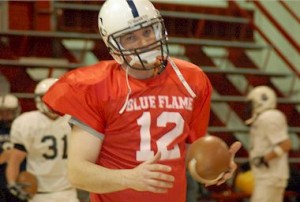
When it comes to football, these guys are all business.

One day not long after the 2001 attacks, Joe Getter and his wife’s cousin Joe Hansbury had the television on; just flipping through the channels and looking for something to watch. They stopped dead in their remote-clicking tracks at ESPN.

“It was a special on New York City police and fire football teams,” Getter remembers. “It was right after 9/11. They played a game and got a big crowd, and ESPN did it up nice for them.”

Hansbury, who’s a cop in the Northeast, said to Getter, who’s not: “We should do this.” And so, says Getter, “we did.”

In the spring of 2002, the Philadelphia Blue Flame, a semi-pro football team made up of cops and firefighters from Philadelphia and surrounding areas, made its debut. Getter can’t forget: “That first year, when they lined up and looked like a team, there was a lot of pride in that.”

In their time, members of the team have played more than a few away games against their brothers in the National Public Safety Football League—as far away as California, Texas, Illinois and Florida. Come February 28, they’ll make their longest trip ever. They’ll be on a field in Dingle, County Kerry, suiting up against the University of Limerick Vikings as part of the Páidi Ó Sé Festival. (Ó Sé is well known in Ireland law enforcement and athletic circles. A former member of the Garda Síochána (the police), he also is remembered as a GAA champion footballer. Serendipitously, Páidi also owns a pub.)

American football, it turns out, is gaining a following in Ireland. (As if Irish football and hurling aren’t punishing enough.) Though the Americans are likely to give them a run for their money, the Vikings aren’t going to be pushovers. “Limerick won their league last year,” says Getter, who serves as treasurer of the Blue Flame. On the other hand, he adds, the boys from Philly grew up with the game. “Everybody on our team played high school and some played college. They all played youth football.”

The story of how the Blue Flame wound up going to Ireland starts with Páidi Ó Sé. Ó Sé had long wanted to bring American football into the mix at his festival, Getter says.

“Originally, Páidi approached the New York football teams,” says Getter. “They reached out and started talking to NYPD about a game over there against us.” Joe Hansbury, who’s a vice president of the team, said yes right away.
“Unfortunately, the New York team bailed out of the game,” says Getter. “By the time all the details got worked out, the New York guys basically got through Christmas and decided they didn’t have the money to make the trip.”

Hence, the match-up against the University of Limerick.

The Blue Flame expects to begin its season—they play in the spring—with about 50 guys. Of these, perhaps 34 players are expected to make the Ireland trip. Add in coaches and staff, and the trip is likely to cost about $32,000. The players are going into their own pockets for that.

For most of the players, many of whom are of Irish ancestry—and more than a few are associated with the Ancient Order of Hibernians—this will mark their first trip to Ireland. Understandably, they’re quite excited.

“Our hosts have a nice itinerary lined up for us,” says Getter. “They’re going to teach the whole team set dancing at Páidi‘s bar. He’s hired an instructor, and it should be fun just watching the guys do this.”

One of the highlights of the trip will be a special Mass for law enforcement officers in Ireland and the United States—and particularly slain Philadelphia Officer Patrick McDonald, former star athlete at Archbishop Ryan High School and a dedicated member of the Blue Flame. “Patrick played for us three years,” says Getter. “His mother, father and sister are making the trip with us as our guests.”

Getter still remembers McDonald—number 34—scoring a touchdown against a Chicago team in a league game at Soldier Field.

After the team returns, the real hard work of the team begins with the beginning of the season. While most of the team members come from the Philadelphia departments, there are a few other members from the suburbs, including Newtown, Lower Makefield, Warrington and Gloucester County, South Jersey. There’s also a SEPTA officer and a school cop. The youngest player is 21; the oldest, 47. Most games are played at Northeast High School.

On top of being able to pay their own way—and it costs about $65,000 a year to field the team—league rules require that the team raise funds for local charities. Members of the Blue Flame more than do their bit. “Our team, finishing up 2008, has donated more than $115,000 in cash to local charities since our inception,” says Getter. “It’s pretty cool stuff.” Organizations as varied as the Police Athletic League, the Hero Thrill Show, Pegasus Riding Academy for Disabled Children and Susan G. Komen for the Cure have benefited from the Blue Flame’s largesse.

Fund-raising activities include a police and fire boxing tournament at the National Guard Armory President’s Day Weekend.

Of course, the team also raises funds for the families of officers killed in the line of duty. On April 25, they’ll honor one of their own. “We’re going to have a Pat McDonald memorial game and retire his jersey,” says Getter. “Proceeds go to his family’s memorial fund for scholarships.”

For more information about the Blue Flame, visit their Web site at http://www.blueflamefootball.com

Music

How to Be Irish in Philly This Week

When Beoga plays, the joint is jumpin'.

When Beoga plays, the joint is jumpin'.

Beoga is endowed with massive musical talent. Much of “The Incident” is simply thrilling, an auditory high-wire act without a net. Button accordionist Damian McKee, in particular, is consistently acrobatic in his play, and bodhran player Eamon Murray is one high-flying goat whacker. I’m convinced that pianist Liam Bradley hasn’t encountered a sound or style he can’t play brilliantly. Let’s not forget the world-class Seán Óg Graham, who plays button accordion, guitar, bouzouki, banjo and low whistle on the recording. Finally, we have Niamh Dunne, the classically trained fiddler who also is blessed with a lush, luxurious voice.

With so many gifts, a band like Beoga simply has to push the boundaries. They can do anything—and they do. At times, the result is dazzling. At other times, it’s distracting. You find yourself scratching your head and asking yourself, “Why did they do that?”

Case in point: “Mister Molly’s,” a delicate set consisting of a slip jig and a jig, both masterfully executed. I very much liked some of the band’s artsy touches, including a few bell-like dings and even the cute whistling and hand claps on the exit. But in the midst of the set, right at the transition from the slip jig to the jig, we’re treated to a low whooshing sound effect that sounds like either a sink draining or a toilet flushing. Or maybe a jet taking off—it’s hard to be sure.

On the opening number, a rollicking set entitled “Lamped”—a set that gets progressively more rollicking as it goes on—the transition from a tune called “The Pandoolin Dumpling” into the reel “Silly Batteries” is marked (or marred) by a fire siren. We know the set is getting hot; we don’t need the clues.

There are more examples of gratuitous little excesses—musical nervous tics—but not worth dwelling on. Beoga is a fusion band, perhaps the purist and fullest expression of Celtic fusion I’ve heard. And if it seems like the lads (and one lass) of Beoga didn’t quite know how, when and where to curb their creative impulses, that’s both the blessing and curse of fusion. A pioneering band like Beoga takes risks, and there are far worse faults.

To adopt too purist a pose would be to miss out, for example, on the performance of Niamh Dunne on a Paul Kennerly tune, “Mary Danced with Soldiers.” The liner notes say Beoga became familiar with the tune from the Nitty Gritty Dirt Band and Emmylou Harris. Dunne’s voice is perfectly lovely on this heartbreak song. Her spare singing style also well suits the closing tune, “The Best is Yet to Come” and the soulful “Strange Things.”

Nor would you want to miss Murray’s creative bodhran pyrotechnics, which reminds me of John Joe Kelly.

Several sets, grounded in tradition but taking some creative liberties, are memorable. My favorite is called “The Flying Golf Club,” which starts out with something quirky that sounds like a horah, and moves into a seriously stellar set of reels, including “The Gooseberry Bush.”

“The Bellevue Waltz” is also particularly lovely.

So bring on the Hammond organ sounds and the kitschy Klezmer clarinet, and park your traditionalist expectations at the door. Here’s a band that will challenge those expectations and take you on quite a ride. It’s a bumpy ride at times, but a kick nonetheless.

Music

Got a Song in Your Heart?

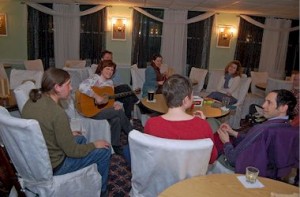
A cozy crowd gathers in a circle to pass around tunes.

A cozy crowd gathers in a circle to pass around tunes.

There was still snow on the ground at the Irish Center and it was wicked cold, but winter weather wasn’t enough to deter the 10 hardy souls who huddled inside the place for one reason: to celebrate their heritage in song.

Apparently, a song can keep you warm—with a little help from whiskey and beer, along with mini-éclairs and Trader Joe’s seedy little currant cookies.

The singers’ session—which takes place on the first Wednesday night of each month at the Mount Airy epicenter of all things Irish—is one of the newest additions to the traditional music scene in the Delaware Valley. Most sessions focus primarily on instrumental music, often with no vocalizing at all.

Sponsored by the Philadelphia Ceili Group, the session had an informal start in local homes some time ago, including that of local performer Courtney Malley’s. In October, the session became more formalized. “Now they give us a home at the Irish Center,” says singer Terry Kane, who leads the session.

The session typically attracts about 10 local singers, at all talent levels. “Last month,” Terry says, “we had a 10-year-old sit in. Tonight, we had a lot of very talented people. In the beginning, we go around the circle, and everyone gets a chance to sing. After that, it’s whatever people think of.”

Such a diverse group results in a lot of variety. On this night, the singers start out with traditional Irish, in the native tongue, but as they go around the room, practically every appropriate folk genre seems to find a place, from English country airs to old-timey tunes. (And for some reason, many of the songs, like “Three Jolly Fishermen,” revolved around the theme of fish—herring, in particular.)

Kathleen Warren, who often sings with Terry, says she has been singing her whole life. “I’ve been singing in Irish for probably 15 years,” she says. “I sing with Terry when she plays gigs, and I play Friday nights in Bethlehem. That’s where I’m from. I’m just getting back to doing my own stuff.” For her, the session is an indispensable outlet. “I don’t think I’ve missed a session yet.”

For Jerry Sweeney (who started going to the session after he discovered it on our events calendar), the session is an opportunity that less experienced singers highly value. “The singers who come are different every time,” he says. “There are some who come as regulars. It’s not any specific level, but it tends to be the good singers who draw the weak ones out.”

If you’d like to give your vocal chords a workout—or even if you’d like to just sit and listen—Terry invites who to attend. The session starts at 7:30. And don’t be shy. “We want to be sure everyone gets a chance,” Terry says. “You can bring music, if you want to sing with it. Most singers are unaccompanied, but sometimes people bring instruments.”

View videos:

News, People

Walking in Friendly and Historical Footsteps

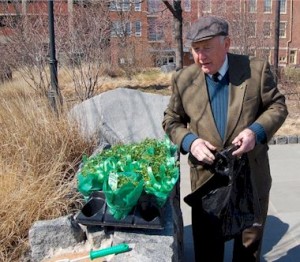
Ed Last, helping with St. Patrick's Day plantings at the Irish Famine Memorial.

Ed Last, helping with St. Patrick's Day plantings at the Irish Famine Memorial.

What does Ed Last have in common with George Washington’s bodyguard, Stephen Moylan? Moylan was the very first president of the Society of the Friendly Sons of St. Patrick, back in 1771. Ed Last is the latest in this long line of presidents that began with Moylan.

As a member of The Friendly Sons for 45 years, Last is in some very historic company. Founding fathers and signers of the Declaration of Independence John Dickinson and Robert Morris were members of the Friendly Sons; so were General Anthony Wayne (Scots Irish) and Commodore John Barry. (Washington was a member, too, though honorary.) Presidents John F. Kennedy and Ronald Reagan were among modern-day members.

The Friendly Sons—the oldest such organization in the United States—have their roots in the immigrant movement of the late 18th century. In fact, the full proper name of this group is The Society of the Friendly Sons of St. Patrick for the Relief of Emigrants from Ireland.

Leading the Emerald Pipe Band.
“Ireland was in great turmoil during the 1700s,” says Ed Last (also the drum major for the Philadelphia Emerald Society Pipe Band. From Cromwell on (in the mid-1600s), a lot of the Irish lands were forfeited to English noblemen resulting in a lot of Catholic and Protestant immigration to the New World by people displaced from their land. The uprising of the United Irishmen in 1798 caused more to flee to the new world. For all these Irish ex-pats, The Friendly Sons was a welcoming committee at the dock.”

The Friendly Sons later became heavily involved in relief for the suffering victims of the Great Hunger (An Gorta Mor), as depicted in the monument at Front and Chestnut Streets, and have continued their involvement in many charitable causes to this day.

More recently the organization has expanded its efforts to include the promotion of Irish scholarship (including establishment of a scholarship fund at St. Joseph’s University). The Friendly Sons has also become involved in special projects, including the Commodore Barry Statue at Independence Hall and the Fitzsimons statue at the Cathedral. The organization also commissioned a reproduction of the Book of Kells for the library at Gwynedd Mercy College. (The original is in the Long Room at Trinity College in Dublin.) In addition, The Friendly Sons make contributions to many local charities and hospices, and to charitable organizations in Ireland, such as The 174 Trust in Belfast, a non-denominational charity, and Croi in the west of Ireland, a cardiology foundation. They also support Irish teachers visiting the U.S. in the summer).

Last, of Havertown, a retired executive, had worked for Unisys and Amtrak, among others. He started out in the Donegal Society in the late 1950s: “I had uncles and other relatives involved in the Donegal Society.” He joined the society and held various offices including treasurer and secretary in the late ‘50s and ‘60s. His parents are from Counties Tyrone and Donegal. “That’s when I also became interested in the Clan na Gael Pipe Band (which later morphed into the Emerald band). The band played for The Friendly Sons dinner every year, which is how I first became acquainted with it.” (He has attended every Friendly Sons dinner except four years, with the pipe bands or at the dinner.)

Then, after a stint in the Navy, Last decided he wanted to join The Friendly Sons. “I guess the friendship and the camaraderie appealed to me and a very good friend invited me to join,” he recalls. ”I liked that it crossed all religious backgrounds. And a lot of people who were very influential in the city, state and federal government were members as were many business leaders. It was a great group who was proud of their Irish heritage and joined to celebrate the feast day of their patron saint (who was not Irish).”

About 12 years ago. Last became a member of the Friendly Sons’ board. He served as secretary for four years, and vice president for two and will serve as president until March 2010.

One of the most appealing aspects for Last is the continuing ecumenical nature of the Friendly Sons, a tradition that has continued even during some religiously tumultuous times in Ireland. Catholics and Protestants take turns in leadership posts. Last is a Catholic. His predecessor Russ Wylie is a Quaker.

“The presidency rotates back and forth between the two groups,” says Last. “The organization tries to keep clear of nationalist things”

The Friendly Sons seeks members from all backgrounds—the only essential requirement being Irish descent and come from all backgrounds.

Contact Ed Last at edwardlast@comcast.net or call 610.853.1155 or the office of the society located in Dublin (PA) on the internet at friendlysons.com for membership information.

The organization will be celebrating their 238th dinner on Saturday evening March 14. This black tie event is being held at the Union League in Philadelphia and all are welcome to attend. Entertainment by the Theresa Flanagan Band, the Emerald Pipe Band and The McDaid Stepdancers, and join in the toasts with The University Glee Club.

Then think spring and the golf outing planned for June 8, 2009, at Sandy Run Country Club.