We confess: We’re addicted to the Rambling House events at the Irish Center. There won’t be another one until January and we’re looking at a month of withdrawal.
Jeff Meade
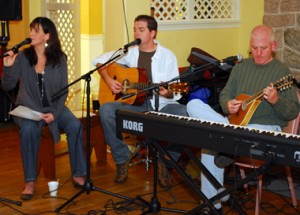
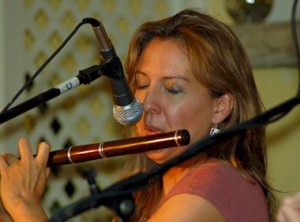
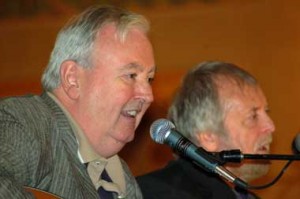
“Hunter’s House,” “Munster Grass” … and the Ed Reavy tunes just flowed in a recent Irish Center concert by singer-guitarist Pat Egan, flutist Laura Byrne Egan and fiddler Jim Eagan.
Ed Reavy Jr. introduced the trio (and occasionally chipped in some editorial comments and stories during the performance). It was all a fitting tribute to Philly’s prolific “plumber of hornpipes.”
It wasn’t all Reavy, of course, and the three Baltimore musicians tossed in some lovely instrumentals and songs like “So Do I.”
We have some photos and a bunch of videos from the concert. Check ’em out.
“The Orchard”
http://www.irishphiladelphia.com/video/orchard
“So Do I”
http://www.irishphiladelphia.com/video/sodoi
A Set of Reels
http://www.irishphiladelphia.com/eganeganeaganreels
The Wounded Hussar
http://www.irishphiladelphia.com/video/woundedhussar
Another Set of Reels
http://www.irishphiladelphia.com/eganeganeaganmorereels
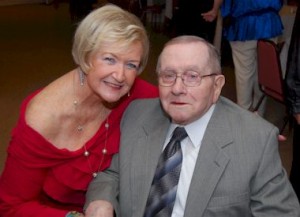
The most electrifying moment in the Mayo Association banquet came toward the end, when the new Miss Mayo was announced. When Caitlin Lotty’s name was called out, she looked startled, surprised, pleased, thrilled, blown away, shocked,stunned, gobsmacked—everything all in one.
The second-year nursing student at Neumann University calmed down fairly quickly (although the smile never faded), and she accepted her crown and sash with grace, thanking the association and saying that the honor would show just how much nurses could accomplish.
The Mayos also conferred the president’s award upon Kathleen Gavin Murtaugh. The Sweetheart of Mayo—and she really fits the name—was Agnes McCafferty.
Aside from the awards, the Mayo banquet was a night of music, dance and fun. The Philadelphia Irish Center ballroom was filled nearly to capacity.
We have some photos and a bit of video from the night.
Sister Briege McKenna, O.S.C., believes in miracles. And she should know.
Born in County Armagh, Sister Briege joined the Sisters of St. Clare when she was 15. In 1970, at age 24, and by then a teacher in Tampa, Florida, she says she was healed of crippling rheumatoid arthritis during the celebration of the Eucharist. More, she says she was given the gift of healing.
The experience, not surprisingly, changed her life. She believes God told her to take her newfound gift and use it to minister to priests. And that she has been doing for nearly 40 years, taking her message of healing to priests throughout the world.
Recognizing her great contribution, the Catholic Leadership Institute of Exton selected her to receive its 2009 Award for Outstanding Catholic Leadership. (She was slated to be recognized Friday, November 13.)
We caught up with Sister Briege just a day after her return from one of her many whirlwind tours. Jet-lagged but somehow still full of energy, she talked with us about her life and ministry.
Q. How do you define a miracle? It sometimes seems that we’re surrounded by them all the time, but don’t recognize them as such.
A. The title of my book is “Miracles do Happen.” (But) I dont believe physical healing is the most important. Many people have perfect health and they’re miserable; others are ill but filled with joy. But a miracle is something that cannot be explained through medical terms. An example: Around last Christmas, a friend of mine brought me a doctor who was very critically ill with leukemia. I think he was a Methodist. I talked with him and prayed with him. (Since then,) he’s been cured. His doctors say there’s no evidence he ever had the disease. That’s a miracle.
Q. What do you think about Christ’s admonition to Thomas, to believe what he can’t see. I sometimes think that, if you need miracles to believe, then that’s not faith. Or is that asking too much of people?
A. Thomas was wonderful. If you think about it, you can see how it would be hard for Thomas to believe. You cannot understand mysteries with your head. I don’t have to see a miracle to believe in the Eucharist. People who believe don’t need miracles. And many people who see miracles still don’t believe them.
Q. Why minister to priests?
A. In 1972, the Lord gave me a five-hour vision in the chapel. He said I was to speak to people about the priesthood as God’s gift to us. He said I want you to speak to priests and bishops (and say that) the priesthood is not a gift just tothem. I remember saying to the Lord, “I can’t do this, I’m a teacher.” And the Lord said, just be obedient. I’ll speak through you.
People say priests are skeptical of a nun, but if something is a gift from God, you don’t have to prove yourself. It’s about them and bringing them to the realization of what the priesthood is.
Q. You’re from Ireland. How much of a change do you see in the Catholic church in Ireland?
A. I see a very big change since I left Ireland 42 years ago. Throughout society, I see a great falling away. Ireland became more prosperous, that’s what’s happening. But there’s great faith still in Ireland. There’s still a lot of beautiful faith in Ireland.
Q. Irish religious have had a big impact on Catholicism in the United States and elsewhere. Do you feel like you’re part of a great tradition?
A. When I came here 42 years ago, practically every sister and priest around here (Florida) was Irish. Ireland is one of the greatest missionary countries. That was up until 20 years ago; now we don’t have vocations. Seminaries have closed down. Worldwide, every place we go, the Irish have left a powerful impact and have sowed the seeds of the Catholic Church. Please God, it’ll come back.
NOTE TO READERS
Sister Briege McKenna does not read the comments on this page. To contact Sister Briege, please click on this link:
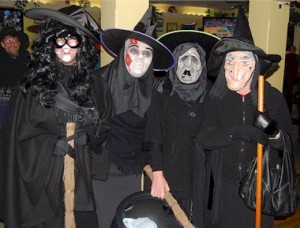
The witches didn’t both waiting for the witching hour. In fact, the whole darn coven—four altogether ugly hags—showed up for the start of a special Rambling House party at the Philadelphia Irish Center Friday night.
And they weren’t the only creepy crawlies at the bar that night. There was an especially strange looking thing in a dashiki, for one.
But of course, it was all in good fun, and host Marianne MacDonald kept the fun rolling all night long. There was music, for sure, as there always is. And there was dance, as there always is, but with monsters on the Irish Center floor this time around.
A ghastly time was had by all.
Father John McNamee, the former pastor of St. Malachy Church, looked out onto the audience gathered for Sunday’s annual Irish music concert with Mick Moloney and friends, and marveled at how the tradition has helped keep the parish school open and thriving.
“The only way we can keep this school open,” he said, “is through our own effort. Thanks to you, we cost the archdiocese nothing.”
Keeping the school in business is a costly proposition, but it apparently pays big dividends to the kids who attend. Roughly 50 percent of students attending city public schools drop out before they finish high school—but St. Malachy’s kids determinedly swim against that discouraging tide. Ninety-five percent of the school’s students finish high school, Father Mac said.
Thanks to Mick Moloney and a small group of immensely talented fellow musicians—including fiddler Dana Lyn, uilleann piper Jerry Sullivan, accordion player Billy McComiskey, and singer Robbie O’Connell—the school acquired a healthy infusion of cash from the fans who nearly filled all the pews. It’s a tradition Moloney has carried on for over two decades. “Here it is 25 years, and here it is Mick’s still coming,” said Father Mac.
We have photos from the concert, and several videos. Check them out.
The videos:
Mick Moloney and Friends Play a Medley of Reavy Tunes
http://www.irishphiladelphia.com/video/mickreavey
The Emigrant and Lough Derg
http://www.irishphiladelphia.com/video/sullivanjigs
Yesterday’s Men
http://www.irishphiladelphia.com/video/yesterdaysmen
The First Half Closer
http://www.irishphiladelphia.com/video/firsthalf
An O’Carolan Tune
http://www.irishphiladelphia.com/video/mickocarolan
The House In The Glen/The Bohola Jig/Josie McDermott’s/Free And Easy
http://www.irishphiladelphia.com/video/mickopeningset
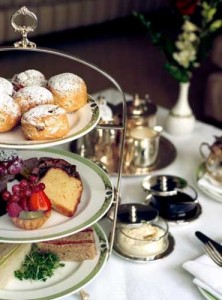
You could just drink a cup of Tetley with a packet of Krimpets on the side. Or … you could settle down to a steaming china cup of oolong, accompanied by dainty sandwiches, lemon curd tartlettes and sweet, crumbly scones and strawberry jam.
Which sounds more relaxing to you?
Clearly, there’s more to the civilized repast called “tea” than just tea. Having tea, the meal, is an opportunity to sit and quietly exchange gossip with friends and to nosh on all the neat little treats at a leisurely pace.
All of which makes tea so very appealing, according to well-known cookbook author Margaret M. Johnson, whose latest offering, “Tea & Crumpets” (Chronicle Books, $13.57 on Amazon) documents the history and customs associated with the meal. She also serves up a treasure trove of recipes for tarts, breads, cakes, scones, sandwiches and savories, from many of Europe’s finest tea rooms.
There are recipes from England, of course, which claims to have invented tea. (As witness Johnson’s story about Anna Maria, seventh duchess of Bedford, who is said to have originated the custom in the 18th century.) But there are recipes, too, from France, Scotland, and, of course, Ireland. (Including a delicious recipe for Teatime Fruitcake, which she has generously consented to share.)
In her travels for “Tea & Crumpets,” Johnson visited many of the better-known spots, including London’s Savoy, the Merrion Hotel in Dublin, Le Jardin d’Hiver in Paris and Edinburgh’s Balmoral Hotel. (Where do we get a job like that?) A few of them stand out as favorites.
“The Shelbourne Hotel in Dublin has always served lovely tea in the Lord Mayor’s Lounge,” she says. The Merrion in Dublin is also quite lovely. (The hotel ‘lobby’ is really a series of three drawing rooms, so it’s quite special.) In London, Brown’s Hotel was just named ‘top tea spot’ for 2009.”
No matter where you have it, to share a tea is to indulge in a bit of quiet refinement that often is missing from other meals. “Participants share the food from the tea stand, so there’s a social aspect to that,” says Johnson. “And because everything is dainty, there’s lots of room for conversation—no cutting meat or asking people to pass the salt.”
No doubt, tea is a departure from our fast-food ways. It can also be something of a mystery, what with cream tea, high tea, afternoon tea and more. Maybe not knowing what to expect has kept you from enjoying one of the great gustatory pleasures.
Let Margaret unravel the mysteries for you.
“Afternoon tea is simply what we all know of as a formal tea, with the three-tiered stand, a selection of sandwiches, pastries, and, of course, tea,” she says. “In many hotel rooms in London, Dublin and elsewhere (Philly, too), you can add a glass of champagne for even more elegance. It comes with an additional cost, naturally! High tea is often confused with afternoon tea and because of the word “high,” is usually thought of as even more elegant. Not so. (High tea is actually more sunstantial, like an early dinner, with savory pies and sausages. It’s also called “meat tea.”) Cream tea is usually simply tea and scones.”
For special occasions, like bridal and baby showers, you can also have it at home. (Which is where “Tea & Crumpets” comes in handy.) And don’t feel, Johnson says, like you need your best silver (assuming you have any). Even the three-tiered stand can be bought on the cheap at a store like Marshalls. Use your own dishes on it, she says—these stands usually are designed to take seven- or nine-inch plates.
Of course, tea is truly special when you have it out. Happily, the Philadelphia area is filled with places where you can indulge. See our tea guide.
It’s beginning to look a lot like Christmas.
Yes, I know we haven’t even gotten past Halloween yet. The Reese’s cups are still unopened in the cabinet. (Unopened so far, anyway.)
But, still, when “The Irish Tenors Christmas” CD arrived in the mail from the Tenors’ promoter, I just had to plug it into the player and start the Season of Joy a couple of months early. A weird sort of thing to do when the daytime temperature still occasionally bumps up into the 70s, but there it is.
If you have an Irish Christmas music collection—we certainly do, and feel free to tell us what’s in your collection—you might want to add this one to your play mix. There’s much to like about this collection of standards, sung by one of the best classically-trained ensembles—and thoroughly Irish.
I have to say that not all of the tunes are a complete success. Classically-trained tenors can do a superb job on most of the standards—as witness the opening track, “Hark the Herald Angels Sing,” and later tracks “Mary Did You Know” and “Silent Night.” These are particularly listenable—tailor-made to show off the superb voices of Finbar Wright, Anthony Kearns and Karl Scully.
And there’s an interesting surprise in the mix: Shane McGowan’s great and heart-breakingly beautiful “Fairytale of New York.” I didn’t expect to like this at all. It just didn’t seem to be a good choice for guys who sing in tuxedoes.
And yet, somehow it succeeds beautifully, lush orchestration and all—and cleansed of some of the darkness. Perhaps it is a testament to the strength of the song. Maybe you just can’t hurt it. (Unless the Jingle Bell dogs do it.) But I have to say, the Tenors’ approach to the tune is respectful and restrained. I’m a believer.
Still, two of the selections just don’t work at all: The “Feliz Navidad Medley” and “Jingle Bell Rock.” All of those trilled R’s just sound silly in the old Bill Haley standard. (“That’s the Jingle Bell r-r-r-r-r-r-rock.”)
But on balance, I think you’ll be happy to add it to your stack of holiday CDs—when we get closer to the holidays, that is.