All Posts By

Jeff Meade

People

Marching Since 1955, Seamus Boyle Gets to Wear the Top Hat in The 2010 St. Patrick’s Day Parade

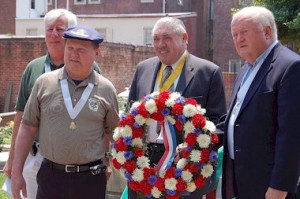
Seamus Boyle, center, at a Commodore Barry commemoration.

Seamus Boyle, center, at a Commodore Barry commemoration.

Seamus Boyle arrived in Philadelphia from County Armagh in 1954. In 1955, with his father Terence, he marched in his first Philadelphia St. Patrick’s Day parade. Boyle has marched in the Philly parade almost every year ever since.

This year is no exception. But this year’s parade is going to be extra-special for the burly, low-key Boyle, a resident of the Academy Gardens neighborhood in the Northeast. He’ll be marching at the head of the parade as grand marshal.

Boyle is no stranger to honors. A longtime member of the Ancient Order of Hibernians Division 39 in Tacony, Boyle last year was elected AOH national president—the first national president from Philadelphia since 1927 and a three-to-one favorite.

Still, he says, “I was humbled and shocked that I was even considered for it. I was told maybe a month or so before the election that my name was put in. Then when I was told I won, that was unbelievable. It’s a great honor, especially when I look at some of the people who came before me. There’re some very serious high-class people there.”

It’s an especially great honor when he thinks how far the parade has come. Back when he was first starting his annual St. Patrick’s Day parade tradition, it was much smaller. “It was not anywhere as big as it is today,” he says. “It’s grown even over the past 20 years.”

AOH representation in the parade is pretty much taken for granted. About 20 Philadelphia-area divisions march in the parade now. But back in 1955, only three or divisions took part—but of course, there weren’t that many AOH divisions in Philadelphia then, either. The AOH, too, has grown.

“It’s a privilege for me to represent the AOH in the parade,” he says. “The AOH is probably the largest Catholic fraternal organization in the country, and it’s known all over. In Philadelphia, it has grown tremendously. I think this is great for the AOH. We do a lot to bring out the culture and heritage of Ireland. This helps our cause.”

Boyle is also pleased to represent the Irish immigrant population. As a member of the AOH, he has been very involved in promoting peace in Northern Ireland and Irish unity. He hasn’t forgotten his roots in the North. The fact that the parade committee selected an immigrant, he says, makes it “all the more impressive.”

Parade Director Michael Bradley says Boyle’s Northern Ireland efforts were one of the main reasons he was recognized to head the March 14 parade. “He’s been going over the Belfast for years,” Bradley says. “He represents Philadelphia very well over there in all the good things he does.”

The fact that Boyle is national president of the AOH also probably played a role, but that was not the principal reason for his selection. Boyle has been very active in the Philadelphia Irish community for quite some time, including his activities at Division 39. Boyle’s national AOH leadership, Bradley says, is “just icing on the cake. But he’s being honored for a lifetime of service. He was long overdue for grand marshal. There’s five or six people who are so deserving and its so hard to select one person every year.”

Boyle is obviously excited to have been picked, and that too is gratifying, says Bradley. “When they see a grand marshal who is thrilled and very happy to be honored, it makes us feel like we did a good job,” he says. “Then our marshals get excited and it transfers to everyone involved in the parade. It just seems to spread.”

One reason for Boyle’s clear excitement is simply this: his memories of his father’s own involvement in the parade. That’s who he’ll be thinking about as he marches up the Parkway. His father Terence passed away in 1992, but the parade was always close to his heart. “My father brought me to my first parade in ’55. While he was alive, I don’t think he missed too many parades, either. He was always there. It would be nice if he was still around to march with me up at the head of the
News

Help Build Support for Immigration Reform

With the introduction of a new bill in the U.S. House, immigration is back on the table again. Siobhán Lyons, executive director of the Irish Immigration Center of Philadelphia, wants you to forget past setbacks and help rally support for legislation to bring 50,000 undocumented Irish out of the cold.

“We need to get people talking again and to feel that this is something we could possibly do,” she says. “Sitting around and saying ‘we tried it before and it didn’t work’ will guarantee that nothing will happen.”

You can get involved and learn more about the Comprehensive Immigration Reform for America’s Security and Prosperity (CIR ASAP) Act at a special “happy hour” meeting hosted by the Irish Immigration Center Tuesday night at 5:30 at Tír na nÓg, 1600 Arch Street in Philadelphia.

“Our goals are modest,” Lyons says. “We just want to start a conversation about immigration in the Irish community. There won’t be a lot of ‘speeching.’ The main goal is to get people together and spread the word that immigration reform is back in the House.”

Aside from desperately needed visa reform, Lyons says, the new legislation would set forth a path to legal residency and perhaps full-fledged citizenship. Under the provisions of CIR ASAP, undocumented immigrants could apply for conditional residence. After six years, they’d be able to apply for green cards. “At some point, then, the 50,000 Irish who are undocumented would have a solution,” Lyons says.

Lyons would also like to see House lawmakers consider negotiation of a bilateral treaty between Ireland and the United States to establish E3 visas along the lines of a similar agreement between the Republic and Australia. E3 visas would permit skilled Irish workers to come to the U.S. to work for a period of two years, and allow them to renew those visas indefinitely.

Given the current state of the U.S. economy, some might say it’s a bad time to be making it easier for undocumented immigrants to compete for jobs. But, Lyons says, a lot of undocumented immigrants are here already. “These people have jobs,” she says. “This (legislation) would free them to earn more and spend more and to negotiate for higher wages across the board.”

Tír na nÓg is donating the space for free, with happy hour specials, Lyons notes. She hopes that this meeting will trigger still more meetings on the subject. “If this meeting is successful, we’ll try for more,” she says. “If we all work together we can absolutely make this happen.”

Food & Drink

The Spirits Move Him

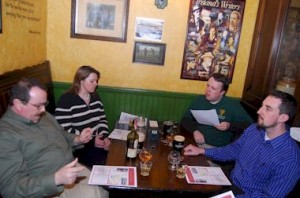
A recent whiskey tasting at Maggie O'Neill's. From left: Steve and Carol Pester, Shaun Griffin and Eastern Pennsylvania Whiskey Society presider Kevin Quinn.

A recent whiskey tasting at Maggie O'Neill's. From left: Steve and Carol Pester, Shaun Griffin and Eastern Pennsylvania Whiskey Society presider Kevin Quinn.

Kevin Quinn does not claim to be “a professor of whiskey-ology,” but he does know a fair bit more than the average imbiber about the aromatic amber spirit revered by kings and commoners alike as “the water of life.”

As a professed “enthusiast,” this private school teacher of physics and computer science and former part-time bartender at Maggie O’Neill’s in Drexel Hill collects obscure and intricate details about the process of Irish whiskey making, from the distilling process to the casks in which the whiskeys are aged. He can quote chapter and verse on the history of whiskey in Ireland. He speaks about Irish whiskey with the reverence and erudition more commonly associated with lovers of great wines.

Actually, some experience with wine helped him along on the path to whiskey appreciation. When Quinn was a senior at Bucknell, the president of the university hosted wine tastings. Quinn attended them, and learned the ropes. At about the same time, he came under the influence of two uncles who know and love Irish whiskey, and he discovered that tasting whiskey requires many of the same sensory skills.

“The production of whiskey and wine is similar,” he says. “The way you grade them and drink them is similar. You judge things like color, viscosity, finish, and nose. As with wine, there are things on the label that tell you what to expect. The only real difference is in some of the stages of production. Wine ages in the bottle; whiskey doesn’t. Once it gets bottled, it is what it is.”

Like many, Quinn was not overly enamored of the taste of whiskey when he first tried it. But at some point, something about Irish whiskey began to appeal to him. Now he loves Irish whiskey in the way gearheads adore Lambos. “The thing I like most about Irish whiskey is how smooth it is,” he says. “Often, people take a whole shot of whiskey and toss it back, but Irish whiskey is meant to be sipped. If you really sip it, you get a smooth finish. (“Finish” refers to how long the taste lingers on your taste buds after you sip it.) I like them to have a long finish. I can take a glass of whiskey and sip it over an hour, and not even finish it, and yet still taste it the entire time. A better whiskey should stick with you.”

Along with its finish, Quinn also takes time to appreciate a whiskey’s aroma, or nose, which can be very different from one whiskey to the next. Whiskies can be complex: malty, fruity, sweet like cake, honey or sherry, spicy, nutty, even peppery. It takes time to appreciate all of the subtle notes, but Quinn says it’s worth the effort. “When you nose whiskey, you don’t take a big, deep inhale and you don’t stick your nose in the glass, like with wine. With whiskey, you keep your nose above the glass and take a short, sustained sniff. Then you take another one. Then, on the third one, you can pick up the subtle notes. You really taste with your nose a lot. It gives you a preview of what you’re in for.”

At this point in Quinn’s whiskey tasting career, he’s nosed quite a few varieties, probably more than 20 whiskeys. Getting to that level can be hard. First, you have to cope with Pennsylvania’s antiquated liquor sales establishment. Usually, the state stores stock are no more than four or five whiskeys—the usual suspects like Jameson’s, Bushmills and Tullamore Dew, all very good but really just a fraction of the Irish whiskeys available. And more than a few whiskeys, he says, are not available in the United States at all.

His favorite is Redbreast Pure Pot Still Irish Whiskey, described by the Web site Epicurious as the “ne plus ultra of spirits.” Says Quinn, “It is the most characteristically Irish whiskey you can get. It’s very rich, and incredibly smooth.

Jameson 12 year is another good Irish whiskey. It’s very good, but it’s also affordable. I also have a bottle of Black Bushmills. It’s not super expensive but it’s very good.”

There are many more Irish whiskies, though, many of them quite costly.

“Bushmills 16 year old is a fantastic Irish whiskey; so is Jameson 18 year,” Quinn says. “Midleton Very Rare is about $140 a bottle, so I don’t get to drink that very much. Connemara is a single malt Irish whiskey. This is from the Cooley Distillery, the only Irish distillery (the other two are owned by Pernod Ricard). The nice thing about Connemara is that it’s peated, one of the steps in making Scotch whiskey. Usually, with Irish whiskey they put the malt in a closed kiln and heat it with coal. With Connemara, they put it in a kiln and leave it open and they heat it with peat. The smoky flavor gets into the grain and into the whiskey. Connemara tastes like Scotch because it’s very peaty, but it finishes like Irish whiskey. It’s very smooth.”

Most people who appreciate Irish whiskey nonetheless tend to stop at one or two brands that they prefer. But Quinn thinks they might be missing out: “There might be something better.”

Quinn hopes to open whiskey lovers’ eyes (and noses and taste buds) to something better through the Eastern Pennsylvania Whiskey Society—a new project sponsored by Maggie O’Neill’s. Maggie’s has held whiskey tastings before on about a quarterly basis, says owner Mike O’Kane. These are much more formal affairs usually paired with food. But the whiskey society will meet more frequently, and focus on tasting just one variety at a time. Quinn is the master of ceremonies. The next meeting is Tuesday, January 12, at 7 p.m., at the well-known Delaware County eatery. (Maggie O’Neill’s is in the Pilgrim Gardens Shopping Center, 1062 Pontiac Road, in Drexel Hill.)

“It’s pretty informal,” says O’Kane. “We shoot out an e-mail blast just to get a sense of who’s coming. They’re welcome to bring friends. We encourage that.”

O’Kane says the whiskey society was Quinn’s brainstorm: “We just thought it was a cool idea to sample some good whiskey and enjoy each other’s company.” For Maggie O’Neill’s, which stocks about 20 Irish whiskeys, the scheme seemed like a natural.

If you want to join in the good company and learn a thing or two about Irish whiskey, contact Maggie O’Neill’s at (610) 449-9889.

News

Re-Celebrate the New Year!

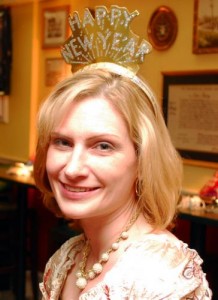
Sarah Conaghan rings in the New Year.

Sarah Conaghan rings in the New Year.

A roaring fire, a table laden with goodies, and live Irish music–it was enough to make you think that 2010 was going to be a mighty fine year, no matter what economists were saying.

That was the scene at the Philadelphia Irish Center on New Year’s Eve 2009. We were there and have the photos to prove it.

News, People

Fly to the Wren Party

OK, so St. Stephen is hiding in a bush, trying to elude early Christian haters. Suddenly, a tiny wren alights on the bush and immediately begins making an enormous birdy racket. Thanks to the wren, the Christian haters figure out where St. Stephen is hiding. They yank him out from the bush and stone him to death.

Fast forward hundreds of years to the Emerald Isle. Every year, on the feast of St. Stephen (the day after Christmas), local guys track down and kill a wren and mount him on a stick, parading his poor carcass about town. The wren boys, they’re called, and you can tell they’re wren boys because they’re dressed in funny costumes, and they sing and they dance. They beg for drinks, food and spare change. This becomes a happy little tradition.

The idea of the wren boys still exists in Ireland, although—thankfully—no one slaughters little birds any more. And a variation on the legend lives on locally in a fun-filled and completely avian-free evening at the Knights of Columbus Hall on Limekiln Pike in Glenside.

It’s the 10th annual Wren Party, and it is sponsored by the Delaware Valley chapter of Comhaltas Ceoltóirí Éireann (translation: Gathering of Musicians in Ireland). Comhaltas (pronounced coal-tuss) is dedicated to the perpetuation of Irish music, dance and culture. It’s a party worthy of the Comhaltas mission, featuring live traditional Irish music, set and ceili dance—even a contest for best wren boy hat.

“We’re asking people to put together a hat and join our wren boys parade,” says Jackie Kelly, the local Comhaltas public relations officer who, with Cass Tinney, runs the post-Christmas event. “Every child who enters the parade gets a prize.”

The hat parade is just one of the many activities geared for children. There’s also a puppet show.

But at its core, the Wren Party is about music and dance. Well-known local musician Kevin McGillian and friends set a lively pace, and they do it all for free. There will also be a performance by Haley Richardson, a young New Jersey fiddler who at 6 years old placed first in the 12-and-under category at the Mid-Atlantic Fleadh Cheoil (music festival) at Pearl River, N.Y., last spring. She’ll knock your socks off.

If you love dance, you’ll stay on your feet most of the night. Wear comfy shoes.

And if you like to watch dance, you’ll get to do that, too, as the Timoney and Gibson schools put on a great exhibition.

“Its a nice night of fun and good craic,” says Kelly. “It’s our biggest event all year. We get a great turnout. People just love it. We first started at the MacSwiney Club in Jenkintown, but we outgrew it. The Knights of Columbus Hall is a much larger venue.”

For Kelly (nee Marano), it’s a great way to pass tradition along to the younger generation. “My last name is Kelly, but I’m a hundred percent Italian. But I’ve become totally immersed in this culture. I’ve been to Ireland 19 times. We keep the old tradition alive and that’s a good thing for young kids to see.”

The party starts on Saturday night, December 26, at 7 p.m. The Knights of Columbus Hall is at 235 Limekiln Pike in Glenside. It costs $10 per person. Bring a dessert, too.

News, People

A Worship Service With Celtic Atmosphere

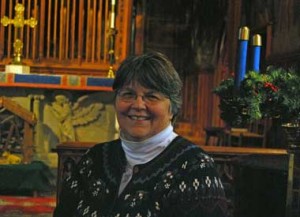
Cynthia DeDakis, minister of music at St. Thomas.

Cynthia DeDakis, minister of music at St. Thomas.

Scratch the surface of any one of us Celts, and underneath you might find a pagan.

Many of those who are card-carrying Christians now are descended from an ancient people who looked for the sacred in the natural world. They plumbed the depths of mysticism. Fire was their friend.

Of course, we’ve come a long way since then. Our beliefs have matured. But for those of us whose people came from Ireland, Scotland, Wales and Brittany, the old beliefs—or more likely, the trappings of the old beliefs—still hold some appeal.

If Celtic spirituality speaks to your inner Celt, you might find a comfortable home at St. Thomas’s Church in Whitemarsh, where Celtic worship services are held monthly through March.

Cynthia DeDakis, minister of music at the elegant old Episcopal church at Bethlehem Pike and Church Road, isn’t surprised that Celtic spirituality continues to appeal to many of us.

“The earliest flowering of Christianity in the Celtic countries was very much adapted,” she notes. “The Christians who came in to evangelize where there had been pagan religions before used a lot of the forms and sensibilities of the pagan religions. There’s a close connection with nature and seeing all nature as sacred. I think it appeals to people for a number of reasons, and that’s one. I think Celtic culture is attuned to feeling more connected to the earth. We do try to emphasize that to a certain amount.”

In all the liturgically important respects, the service is Christian. There’s an opening prayer, a reading from Scripture, a homily and a Eucharist. Where does the “Celtic” come in? Many of the prayers come from Celtic sources, some of them ancient, but it’s really more in the atmosphere.

First, there’s the music—near and dear to this classically trained musician, who also plays hammer dulcimer. “Last year, and the first two services this year, we’ve been using harp,” DeDakis says. “I try the best I can to use legitimate Celtic music in the services. People really appreciate and enjoy that style of music. I’ve been working on adapting it somewhat and trying to make it more truly Celtic. It’s a work in progress.”

There’s candlelight. And there are long stretches of silence and reflection. It’s an earthier, less structured occasion of prayer. That’s what the folks at St. Thomas are going for. They’ve been at it since 2005.

“There’s a kind of spirituality that moves into the mystic when you bring in the candles, silence and simple, quiet music,” DeDakis says. “It’s not as demanding in terms of participation. People tend to spread out. We are hoping to build the service and draw people who don’t come to St. Thomas on a regular basis but who are looking to find something like this that feeds them spiritually.”

There’s a Celtic worship service at St. Thomas this Sunday at 5:30—look for it to have a special Christmas theme—and once each month through March. (Consult our calendar.) And if you’d like to go beyond merely attending, DeDakis is on the lookout for traditional musicians who might want to help set the tone. Contact DeDakis by e-mail at cdedakis@stthomaswhitemarsh.org.

Music

Five Questions for Seamus Begley

Perhaps the first thing you should know about Kerry accordion player Seamus Begley, featured performer in the Irish Christmas in America show coming to Penn’s Annenberg Center, is that he was never a truck driver in Chicago. It’s all a load of bull, he says. He’s not sure where the false factoid got its start, but it is often repeated and reprinted, and it’s always wrong.

Yes, he was in Chicago in 1976, but he played music with the likes of Liz Carroll and never once got behind the wheel of a semi.

Many other things about Begley are true. He’s one of the most acclaimed box players on the planet, he’s a well-known story teller, he grew up in West Kerry. He’s been a frequent musical collaborator with the likes of Aussie guitarist Stephen Cooney and West Cork guitarist Jim Murray.

His latest collaboration is with the lads of the great Irish traditional group Teada, currently touring the United States with the Christmas show. (Karan Casey and Muireann Nic Amhlaoibh previously were featured performers in memorable shows at the Philadelphia Irish Center.)

This year, Irish Christmas in America touches down at Annenberg Friday, December 11, at 8 p.m. (Click here for tickets.) With Begley at center stage, you’re bound to get your Christmas season off to a merry start. We caught up with Begley a few days ago, for a few minutes of rushed conversation over a terrible connection (like someone crunching corn flakes next to your ear) before the show was about to open in Las Cruces, New Mexico. Here’s what he had to say.

Q. Is this your first tour with Teada?

A. It’s my first tour with this gang, yeah. I never played a serious gig like this before.

Q. You’ve done a lot of collaborating. Is it something you like to do, or is it the nature of the beast that a single instrumentalist must seek out collaborators?

A. I like doing different things, playing with different talent. It’s different from playing the good old Kerry slide, you know. I like learning new songs and new ways to do things.

Q. Did you need to add to your repertoire much for this show? Christmas tunes?

A. Most of the things I already knew. We’ll be playing reels, jigs, slides, all of them, all these tunes we know. A lot of them are Christmas titles.

Q. Why did you take up accordion? With your father a player, it seems like you perhaps had no choice, or that it was somehow preordained.

A. Everyone in the house had to learn accordion and play for the ceilis. We loved it anyway, there was nothing else to do. It was probably pissing down rain outside.

Q. You’re from Dingle, West Kerry. How does being from there influence the way you play? More polkas and slides? How else?

A. I learned to play for dancers. Most of my music would be for dancing. It’s a bit odd for me to be playing for people who are sitting down. It’s easier for me to play for dancers. It’s simple music played by simple people.

Editor’s happy little note: We have two pairs of tickets to give away. Want to try to win them? Do one of two things by midnight on Friday: Sign up to receive Irish Philly Mickmail or forward Mickmail to a friend. Good luck!

Music

Guitar Hero

It’s been said that John Doyle is the busiest man in Irish music. Given that he’s just come off a tour with Joan Baez, we’ll have to amend that description and just say he might be the busiest man in music of any kind—period.

Watch Doyle when he’s playing his guitar—even when he’s sitting down—and what you see is a man incapable of inertia, his head and shoulders rocking like a metronome needle.

Doyle rocketed to fame as one of the founders of the super group Solas, and his driving rhythms and helped give the band its signature sound.

Since Solas, Doyle has formed many artistic alliances, including his brilliant pairing with Liz Carroll. He’s much in demand as producer as well, his influence felt on Heidi Talbot’s “Distant Future,” Michael Black’s brilliant eponymous debut recording and many others. (He also produced his father Sean Doyle’s CD, “The Light and the Half Light.”) He’s become everybody’s first string.

That very busy and talented man is about to visit the Philadelphia area, performing in a special Christmas show with headliner Mick Moloney and fiddler Athena Tergis at the Shanachie Pub, 111 E. Butler Ave. in Ambler, Thursday, December 4. The show starts at 9 p.m.

When I caught up with him—or maybe he caught up with me—he was on his cell phone in an airport bookstore somewhere in America, with minutes to go before boarding. I was in my car in Center City and running late for the curly wig-a-thon that is the Mid-Atlantic Oireachtas. I pulled over on Spring Garden Street, yanked out the laptop and discovered that I had just 22 minutes left on the battery. We’d been playing phone and e-mail tag for a few days. It was now or never. With traffic whizzing by me and John occasionally stopping to chat with the bookstore clerk, we squeezed in a few questions.

Q. Tell us first about the performance. I believe it’s being recorded. How did this particular gig, and the three of you, come together?

A. Mick and I have been playing together since ‘91 or ‘92. He’s been a force [in Irish music] for years. Mick and Athena have played together for four or five years. We wanted to do a kind of small gig for a different kind of a kind of feel. These actual particular gigs are Christmas gigs—we’re doing a whole weekend of them in New York and one in Philly. Of course, well be doing some Christmas stuff, like “The Wexford Carol” and “The Holly and The Ivy.” I’ve got a few tunes I wrote. We’ll do [John McCutcheon ‘s] “Christmas in the Trenches” and “The Bushes of Jerusalem” by Tommy Sands.

But it’ll be a mix between Christmas, my songs and Mick’s—a bunch of Mick’s songs from an earlier tradition, when he was still in London—and Athena’s. It’ll include some tunes that he and I and Athena have written over the last couple of years.

Q. Why is this one being recorded?
A.
We’re going to try and make a CD out of this. Were just doing it to see how it works.

Q. You’ve played with both before, including “Absolutely Irish.” On the CD, it seemed like that booming bass line was on every track. Not everyone played nearly as much. Why was that?

A. Every person on that concert and I had played with together. I knew everyone’s material. [Laughs.] So it was kind of a no-brainer at the time.

Q. Talk to me about your playing style. You seem to have found that sweet spot between the rhythmic and the melodic. How did it develop?

A. You can’t learn in a vacuum. [I was influenced by] Arty McGlynn, Daithi Sproule, Paul Brady and others. All of these great players affected me. They have a kind of half-melody half-rhythmic feel to their songs. But the rhythm is the most important thing at the end of the day.

Q. A lot of kids, if you gave them a guitar, would have wanted to be Eric Clapton. You went with Irish, Why?

A. All my family on one side or the other were involved in traditional music, it just seems like the thing to do I was drawn in that direction, my father and grandfather played accordion.

Q. I like what [the Philadelphia bass player] Chico Huff as said about you, that you never play the same thing twice through. I’m just curious as to why that is.

A. You have to make it interesting, not only for other people, but for yourself. If you don’t challenge yourself all the time, you’re going to get in a rut. [Also,] there’s a tone and a mood in tunes. If you’re playing the tunes, you want to do variations in them. And if someone does a variation, you should do a variation with them. You should emphasize emotions rather than just going with the flow.”

Q. You went the route of super groups for several years with Solas. Now, aside from your gig with Liz Carroll, it seems like you’ve accompanied everyone. What do you get out of that that you don’t being in a big group like Solas?

A. Well, I love playing with the bands and it’s really fun. I miss that sometimes. [But, when playing with others] you can be more interesting, and you can do more variations, you don’t have to be hooked up to a particular arrangement. It’s also easier to travel with.

With Liz, she’s one of the best players and writers in the world so it’s really easy to come up with stuff.

Q. And you’ve produced a lot as well. What does that do for you?

A. A lot of it is to give back to people your experience over the years; how you would do things. As a person in a band you can get bogged down in your own stuff. You need someone to weed out what’s unnecessary and to get to the core of the stuff. It’s all of that stuff together. I love it.