All Posts By

Jeff Meade

News

Fund-Raising in Full Swing

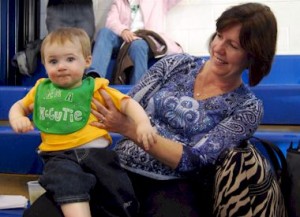
Sean Harbison Jr. and his aunt Gina Hiller.

Sean Harbison Jr. and his aunt Gina Hiller.

They were very nearly spilling out onto St. Vincent Street on Sunday afternoon as a fund-raising party for the Philadelphia St. Patrick’s Day Parade attracted a huge crowd to the Mayfair Community Center in the Northeast.

This year’s grand marshal Seamus Boyle, national president of the Ancient Order of Hibernians, held court as his hard-working brothers and sisters at the Philadelphia County Board and AOH and LAOH Division 39 kept the whole thing rolling.

Guests were well-fed and watered (or beered, depending on how you look at these things), and the stage was occupied by a hard-charging band. The party also featured the toe-tapping girls of the Celtic Flame Irish dance school.

A few nights later, at the great little pub at 17th and the Parkway, Con Murphy’s, yet another fund-raising party took place. Guests noshed on hors d’oeuvres, chatted with friends and clapped to the music of Slainte.

Yes, folks, the St. Patrick’s craziness is starting in style.

Arts, Music, News, People

The 2010 Mid-Winter Scottish & Irish Festival & Fair

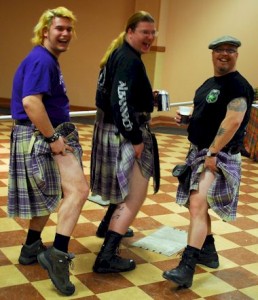
Showing a little leg.

Showing a little leg.

Kilts.

Everywhere you looked at the 2010 Mid-Winter Scottish & Irish Festival, kilts. The Washington Memorial Pipe Band performed jigs, reels and strathspeys there at the Valley Forge Scanticon all weekend, and of course, you know what they wore. Hanging about the concert stage, beers at the ready, fans of the rowdy band Albannach were decked out in their own colorful tartans—with Doc Martens, which was a nice touch. On Saturday, one young woman paraded about in the shortest kilt I’ve ever seen—not that I looked. We also bumped into a dude named Tweak with a multicolor mohawk, and he was modeling the rugged, no-nonsense Utilikilt. Yessir, we were up to our keisters in kilts.

Of course, Highland apparel wasn’t the only attraction. Organizers Bill and Karen Reid made sure there was plenty to keep festival-goers occupied. The Celts who crowded onto the convention hall floor, starting Friday night and on into late Sunday afternoon, rocked out to great bands like Searson, Paddy’s Well, the Tartan Terrors, Screaming Orphans, Rathkeltair and Brother. (And the aforementioned Albannoch.)

Noshers had their pick of snacks, from meat pies to shortbread to Bailey’s and brown bread ice cream served up by the sweet folks at the Scottish Highland Creamery from Maryland’s Eastern Shore. For tipplers, there were whisky tastings and pints (sadly, small pints) of Smithwick’s.

If you wanted to, you could take Irish language lessons or break out your fiddle and play in a traditional music session. Kids from the Campbell School of Highland Dance and Fitzpatrick School of Irish Dance were up on their toes all weekend. Vendors sold everything from miniature whiskey barrels to personalized pub paintings to Claddagh rings. The Philadelphia St. Patrick’s Day parade had a table. So did the Sunday morning Irish radio shows. (And, for the first time, us too.)

In the midst of a dreary winter, in the wake of a bone-chilling midweek blizzard, the 2010 festival was just what the doctor ordered. And you’d better believe the Reids were keeping an eye on the weather forecasts.

Says a relieved Bill Reid, “We were sweating bullets the week before and were more than happy when we missed the previous weekend but when Wednesday happened … well, need I say more?”

The cold and the snow—not to mention the ice-coated Scanticon parking lot—evidently didn’t deter festival fans, especially on the first full day of the event. “Saturday is always the bigger day and this year was slightly better than last,” says Reid, “and that was our record setter.”

The Reids are already thinking about how to make next year’s event even better, with an eye toward boosting Sunday attendance and drawing in more locals.

We’ve been going for years, and wouldn’t miss it. The Mid-Winter Festival is a great warm-up for the St. Patrick’s craziness that is to come.

Couldn’t make it? Check out our videos.

Washington Memorial Pipe Band With Campbell School of Highland Dance Part 1
http://www.irishphiladelphia.com/video/washingtoncampbell2010

Washington Memorial Pipe Band With Campbell School of Highland Dance Part 2
http://www.irishphiladelphia.com/video/washingtoncampbell2010-02 

Albannach in Concert at the 2010 Mid-Winter Scottish & Irish Festival
http://www.irishphiladelphia.com/video/albannoch2010

Brother in Concert at the 2010 Mid-Winter Scottish & Irish Festival
http://www.irishphiladelphia.com/video/brother2010

Paddy’s Well at the 2010 Mid-Winter Scottish & Irish Festival
http://www.irishphiladelphia.com/video/paddyswell2010

Fitzpatrick Irish Dancers Step Out
http://www.irishphiladelphia.com/video/fitzpatrick2010-01

The Little Ones
http://www.irishphiladelphia.com/video/littleones

Amazing Grace
http://www.irishphiladelphia.com/video/amazinggrace

Fitzpatrick Irish Dancers
http://www.irishphiladelphia.com/video/fitzpatrick2010-02

Music

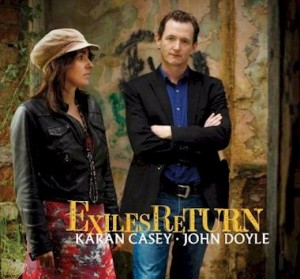
Review: “Exiles Return”

Exiles ReturnImmigration, whether now or in the 1840s, has always been a wrenching story. You can read all about it in the history books—or in today’s New York Times. But no medium has ever told the story better than a song.

The new instant classic by Karan Casey and John Doyle, “Exiles Return,” is full of them. Not every tune, certainly, but more than half of the 12 tracks are sensitively rendered tales of loving, longing and leaving. We’re not talking about overexposed, overproduced tunes like “Isle of Hope, Isle of Tears,” either. It’s easy to trivialize the experience of leaving a land, and a lot of artists can’t resist the temptation. These are not the kinds of tunes that can easily be summed up, as Seamus Egan of Solas has put it, as “a story about a man, a woman and some farm animals, ending in disaster.”

“Exiles Return” is an altogether different type of album. It features traditional tunes like “Sally Grier,” “The Bay of Biscay,” “The Nightingale” and “The Flower of Finae,” along with a couple of more recent tunes, “The Shipyard Slips” by David Wilde and the title tune, “Exiles Return,” by Doyle himself. What makes the CD different is not so much the songs, although they’re all choice. Casey and Doyle, with some help from Michael McGoldrick on flute and whistle and producer Dirk Powell on banjo and double bass, have created an unembellished recording in which the pure emotion of the songs can be allowed to shine through. Probably the best example of that approach is Casey’s riveting unaccompanied performance of the tender love song “Out of the Window.”

“Unembellished” doesn’t mean “Exiles Return” is completely devoid of instrumentality. How disappointing that would be for fans of the great John Doyle! There’s probably no guitarist on the planet more consistently inventive and adventurous. Longtime Solas bassist Chico Huff, talking about accompanying Doyle, notes that he never plays the same thing twice. Every verse brings new layers and textures, new chord progressions, phrasing and licks. If you’re a Doyle devotee, you won’t be disappointed. His muscular strumming on the opening track, “The False Lady” and on “Madam I’m a Darlin'” show why Doyle is the standard against which all others are judged.

Karan Casey, who previously performed with Doyle in the Irish-American supergroup Solas, was simply born to sing these songs. Like Doyle, she’s one of a kind. No one sounds quite like her. Whether taking the lead or joining Doyle in harmonies—and there are many delicious harmonies on “Exiles Return”—she has the talent for infusing every tune, including some that might be hundreds of years old, with fresh new energy and deep layers of meaning.

Lovers of songs will also appreciate that many of the tunes invite audience participation—even if you’re in the car alone, driving to work. They’re just very singable, with catchy refrains. Don’t be surprised if you find yourself wandering down the fruit and veggie aisle at the Giant, singing sotto voce, “Madam I’m a darlin’, a die row dither-o, madam I’m a darlin’ a die row day.”

“Exiles Return” finds two great traditional artists at the top of their game. Don’t wait to join them in song.

People

Everyone’s Favorite Leprechaun Gets a Big Honor as He Retires

Ed Slivak at the Penn's Landing Irish Festival.

Ed Slivak at the Penn's Landing Irish Festival.

The 2009 Conshohocken St. Patrick’s Day Parade was over. Ed Slivak had spent the afternoon traipsing up and down Fayette Street dressed up as Swedesburg AOH Division 1’s leprechaun—bent pipe, pointy ears, green top hat, orange beard and all. It had been a great parade, and Slivak was on top of the world.

“I was happy as hell,” he recalls. “I’d been waving to everybody. At the end of the parade, I stopped at a tavern for a beer, but I suddenly didn’t feel so good. I bumped into a friend, Jimmy Gallagher (the district justice in Bridgeport), and he got someone to drive me to my car. So I drove home, and I got out of my car. And that’s all I remember. The next thing I know, I was in Montgomery Hospital. I didn’t remember anything.”

Slivak, a member of the vibrant Montgomery County division of the Ancient Order of Hibernians since 2001, had suffered a debilitating stroke. What followed were five long, often discouraging months of hospitalization and rehabilitation. He’s back home now in Swedesburg with his wife Gi (short for Virginia) and their little pug General Patton, and slowly getting back on his feet again, seeing a physical therapist twice a week. Still, there’s no question that it’s been a long road.

“It scared the hell out of me—I’m lucky to be alive,” says Slivak, 68, who credits his wife for nursing him back from the brink. “If you met me today you wouldn’t believe how I’m getting around. You can hear I’m talking pretty good. Sometimes it takes me time to think a little more. At one point, I dropped down to 114 pounds; I had been up to 210. I’m back to 145 now. I think the Lord was calling me for judgment day, but St. Patrick, St. Brendan and St. Bridget all went to the Lord, and they gave me a little extra time on earth.”

Slivak’s abiding faith—he’s a member of Sacred Heart Parish near his home—gives him the courage to keep on going, to take what probably seem like giant steps toward recovery, like moving from a walker to the use of a cane. He treasures the loving support of his wife and children, which gives him additional strength. Without them, he confesses, “I would have given up.”

But Slivak has one other powerful incentive to get better. He is the grand marshal of the 2010 Conshohocken parade.

He’s known about the honor for quite some time. “Judge Gallagher told me about it while I was still in the hospital,” he says. Now he’s counting the days until March 6—the Grand Marshal’s Ball—and, finally, March 13, when he, his wife, grandchild Michael and great-grandchild Clare will hop into a convertible and slowly drive down Fayette Street at the head of the parade.

You might be wondering how a guy with the last name of Slivak gets to be grand marshal of a St. Patrick’s Day parade. Slivak, he explains, is his stepfather’s name. “He took care of me,” says Slivak, who was raised in Philadelphia’s Fishtown neighborhood and attended Immaculate Conception Church. “He was a good man.”

The Irish heritage is all on his mother Clare’s side. She was a Ward, and her father Bernard, a one-time boxer who fought under the name Joe Dougherty, was from Donegal. Slivak’s grandmother Marie was a Murphy, who came to the United States from Cork. He remembers spending a lot of time with her—and he fondly recalls her as a colorful, if plain-spoken character.

“Nana was born in 1875,” he says. “She just loved St. Joseph. She had an icon of him, and she said the rosary a lot. Nana often liked to have a cup of tea with me. One day when we were drinking our tea, I asked her: Do you hate the English? She said to me, you can’t get into heaven hating anybody—I just don’t like them. Nana had a great influence on me in life.”

So there was never really any question about Ed Slivak’s pedigree. But his Irish heritage never truly resonated with him until he retired from his job at the Philadelphia Inquirer—he was a tearsheets clerk—and moved to Swedesburg in 2001. That’s the same year he joined AOH Division 1 on Jefferson Street.

“It’s a big Irish family when you join the AOH,” Slivak says. “I remember, I didn’t know what the initials stood for. But in the past 10 years I’ve learned a lot more about being a Catholic and Irish.”

It was Slivak’s membership in the AOH that led to his star turn as a leprechaun. Pete Hand, president of the division, approached Slivak one day about six years ago and suggested that he dress up as a leprechaun. (Hand insists Slivak looks like a leprechaun even without the get-up.) That first year, Slivak recalls, his costume wasn’t very good: “I looked like an immigrant, just off the boat.”

He also wasn’t very comfortable in the role. “The first time,” he says, “it was for a St. Paddy’s parade. I felt a little goofy. I thought, here I am a grown man dressing up as a leprechaun.”

The next year, Hand and Slivak resolved to do better, and they purchased a costume on eBay for about $225. “After that I started hamming it up,” he says. “The next thing I know, people are coming up and wanting their picture taken with me.” (One of those leprechaun fans was former President Bill Clinton, who was in Girardville, Schuylkill County, for the St. Patrick’s Day parade in 2007.)

Slivak has settled into the part with great enthusiasm. He’s especially fond of kids, who are always astonished to find a real, live leprechaun in their midst—and a big one at that. “I tell them in a brogue that I’m from Donegal, and that leprechauns are bigger there,” he says. “They ask me how old I am. I tell them I’m 386 years old. I give them a lot of blarney.”

The self-proclaimed “Polish leprechaun” has also used his celebrity status to do a lot of good for kids. He takes up collections wherever he goes in his costume and raises money for St. Christopher’s Hospital and Ronald McDonald House. Every year, he manages to collect a couple of thousand dollars.

With all that has happened to him in the past year, though, Ed Slivak’s leprechaun days soon will be over. He’ll be handing over the duties to an apprentice—an 11-year-old boy.

On March 13, Division 1’s celebrated leprechaun will make one last appearance in full regalia, in the 2010 Conshohocken parade. After all, Slivak says, “That’s what got me there. I’m like a Santa Claus when there’s a parade.”

News

For Local Filmmaker, Haiti’s Earthquake is Personal

A still from Maitre's film, "Fishing for Haiti."

A still from Maitre's film, "Fishing for Haiti."

Like most people, Philadelphia filmmaker Deirdre Maitre and her husband, Roosevelt, were glued to the television to watch the earliest reports of the devastating earthquake in Haiti two weeks ago.
But their interest was more personal than it was for most of us. They were scanning the screen for familiar places, familiar faces: Roosevelt’s family lives in Port-au-Prince, and Deirdre’s family founded a sustainable fish farming project on the property where the Daughters of Mary Queen Immaculate, a Haitian teaching order of nuns, operate several schools.

“It was horrendous not to know what had happened to our family and friends,” says Deirdre. “It was like walking around with a bowling ball in my stomach. We did not actually make contact with them on the phone until Friday, three days after the quake, and even then we were getting information little by little, various pieces of news from different people including my husband’s aunts, uncles and cousins here. He has a really close friend who was able to drive down via motorcycle to his mother’s neighborhood and check on them. They had a really close call. Some of their neighbors died.”

Dierdre and her husband are dealing with their grief by throwing themselves into the relief effort. Deirdre will be screening selections from two of the films she did as part of her master’s program at Temple University on Friday, January 29, at 7 PM, at the Irish Center, 6815 Emlen Street, in the Mt. Airy section of Philadelphia. “Fishing for the Future” documents the development of the Martha’s Vineyard Fish Farm for Haiti Project, founded by her aunt, Margaret Penicaud, whose family fishes on the island off the coast of Massachusetts. “Is God Sleeping?”, focuses on a young Haitian artist who is an illegal US immigrant.

She’ll be joined by Jean Marc Phanor, brother of Gilg Phanor, one of the first five Americans rescued from the rubble of the Hotel Montana in Petionville, who will tell his family’s story.

“What I want to do is highlight the organizations in my film and talk about their status to help personalize the situation,” says Deirdre. “Some of the NGOs in my film suffered significant damage. I’m hoping to help people learn about the various work people are doing there and hopefully give them some resources to help them decide where they want to help.”

Deirdre, who grew up in Massachusetts and is the granddaughter of Irish immigrants from County Cork, first traveled to Haiti in 1998 with her aunt, Margaret Penicaud. “She lived in France for many years and married a Frenchman,” Deirdre explains. “In her church, because she spoke French, she was introduced to a nun from Haiti, the mother superior of a teaching order of nuns. The Daughters of Mary Queen Immaculate invited her to Haiti to see their schools and she invited me to come along.”

From that visit grew the Martha’s Vineyard Fish Farm for Haiti Project, which, miraculously, survived the quake. Some of the schools and the nuns’ mother house were not so lucky. The buildings collapsed, and there was loss of life: one sister, one novice, a driver and his two children and 10 children living with the sisters. The nuns are sleeping in a tent in the courtyard. “My aunt has already started raising money for them,” says Deirdre, who fell in love with Haiti and its people during her first visit there.

“They are very authentic and vibrant,” she says. “They have a strong sense of community there. They are incredibly, deeply, profoundly spiritual. Not on an institutional level, not compartmentalized to church, but in their daily lives, in their dealings with one another. They’re very friendly, humanistic, and welcoming people. And with a profound sense of powerlessness, a complete loss of control of their destiny, in God’s hands completely.”

She met Roosevelt Maitre on that first trip and they became friends. Then, they became more than friends. The two were married in 2006. “Haiti has been very good to me,” she says with a smile. Roosevelt, now a buyer at Whole Foods, is a student at Community College of Philadelphia, studying management and business administration.

Like many who know Haiti well, Deirdre has been disappointed in the focus solely on the nation’s poverty, which, though real and vast, tells only part of Haiti’s story. The rest of the story is what she’s trying to relay through her films. “The NGOs I’ve been focused on aren’t relief efforts, they’re genuine partnerships with genuine leadership among Haitians,” she says.

Among them are Fonkoze, from a Creole phrase meaning “shoulder to shoulder,” that is Haiti’s largest microfinance institution offering financial services to the rural-based poor. Founded by a Catholic priest, Father Joseph Phillipe, and 34 other grassroots leaders and working with Peace Corps volunteer Anne Hastings, the little bank that could grew with fund supplied by investors from the US, the Netherlands, and elsewhere and now has millions of dollars—in part as the result of thousands of savings accounts established by Haitians.

Dr. Paul Farmer’s program, Partners In Health, has been bringing medical care to the poor for more than 20 years and is now in four countries. Farmer, a Harvard physician, is United Nations deputy special envoy to Haiti though he currently lives in Rwanda. After the quake, PIH set up field hospitals in Port-au-Prince and has 20 operating rooms up and running. Twenty-two planeloads of medical volunteers and thousands of pounds of medical supplies to support the more than 4,500 PIH medical personnel already on the ground. PIH medical personnel at the sister facility in Rwanda donated a percentage of their salaries to help.

The fourth NGO Deirdre plans to film is Cine Institute, Haiti’s first film school founded in the port city of Jacmel by filmmaker David Belle and supported by Hollywood money (director Francis Ford Coppola is on the board). “We were just in the process of setting up a time for me to visit when the quake hit,” she says. Cine Institute’s building was seriously damaged, but students dug through the rubble for their equipment and began roaming the streets to record the chaos. You can see their video reports and make a donation on their website.

“This has been a horrible, horrible tragedy,” says Deirdre, “but the focus on Haiti because of the earthquake could be a new beginning in so many ways. Time will certainly tell. Americans can play a big part in that.”

Learn what you can do to help Haiti on 7 PM Friday, January 29, at the Irish Center, 6815 Emlen Street, Philadelphia.

Music

Review: “The Turning Tide” by Solas

Solas keeps reinventing itself and yet somehow manages the trick of always staying the same: reliably, predictably brilliant.

This kind of success is all the more remarkable considering the number of personnel changes since the band burst upon the scene in 1994. Only multi-instrumentalist Seamus Egan and fiddler Winifred Horan are original members of the band. Over the years, though, the rest of the lineup has changed: three guitarists, two button accordion players and three singers. That’s not to suggest tumult is the inevitable result. On the contrary, every new musician has brought fresh perspectives to the party, and so the band and its sound have evolved. You can hear subtle changes in each of the nine albums Solas released between 1996 and 2008.

Now, along comes album No. 10, “The Turning Tide,” the second featuring singer Mairead Phelan. All of the essential elements you’ve come to expect from Solas are there. Start with mind-blowing, high-energy arrangements from Seamus Egan (“Hugo’s Big Reel”) and guitarist Éamon McElholm (“The Crows of Killimer”/Box Reel #2″/”Boys of Malin”/”The Opera House”). When the band performs at the World Cafe this St. Patrick’s Day, you can predict that those will inspire enthusiastic “whoops.” The band has been cranking out bread and butter numbers like that from day one. Add in a clever confection from Winifred Horan—”A Waltz for Mairead,” which reminds me a bit of “The Highlands of Holland” from the 2003 album, “Another Day.” Now tack on the happily tangled rhythms of box player Mick McCauley’s “Trip to Kareol” (which reminds me vaguely of “Who’s in the What Now” from “Edge of Silence”).

It could all seem formulaic, but if it is, it’s a formula for sure-fire success. At its core, regardless of who is playing the guitar or accordion—and Solas attracts the best—the band remains consistently excellent. And even if some of the selections seem familiar, Solas infuses fresh new energy and excitement into them.

Into this dependable mix steps Mairead Phelan, who joined Solas in 2008, replacing Deirdre Scanlan (who replaced Karan Casey). Phelan made her debut on the last CD, “For Love and Laughter.” Her first outing provided a tantalyzing clue as to what was to come. On “The Turning Tide,” she really comes into her own, and adds her own special imprint on the band.

It helps that she has great material to work with. I’d love to know the process Solas follows for picking tunes. On “The Turning Tide,” as always, the band has discriminating taste—for example, “A Sailor’s Life,” the old English folk song popularized by Sandy Denny and Fairport Convention; Bruce Springsteen’s “Ghost of Tom Joad”; and “Girl in the War” by Josh Ritter, whose writing invites comparisons to Springsteen and to the young Dylan.

But great tune selection can only take you so far. The singer has to be up to the task.

Mairead Phelan is there.

I was prepared to like “Ghost of Tom Joad”—it’s a great song to begin with—but Solas adds its own intriguing interpretation. Seamus Egan opens on banjo, and what follows is an arrangement that sounds more like a slow march than a folk tune. Phelan’s soft, sweet voice lends a plaintive quality to the Springsteen lyrics. The Boss would be pleased.

“A Girl in the War” was an interesting choice. Posters on the lyrics boards seem hopelessly divided on the song’s meaning. Does it have religious overtones, or is it an explicit anti-war tune? I’ll side with the latter. Check out to the lyrics and draw your own conclusions: “Peter said to Paul/You know all those words that we wrote/Are just the rules of the game and the rules are the first to go/But now talkin’ to God is Laurel beggin’ Hardy for a gun/I got a girl in the war, man I wonder what it is we done.”

Phelan’s reading of the song is spot on. She draws you in and makes you feel every note of this gorgeous, haunting song. And, again, it helps that she has a superb band behind her—on this tune, including the Philly dobro player Mike “Slo-Mo” Brenner—and the advantage of a lovely, restrained arrangement to match her delivery.

So what’s new about this version of Solas is clear in the form of a talented singer whose talents are really still just emerging.

Along with Brenner, “The Turning Tide” features contributions by long-time members of the Solas extended family—drummer Ben Wittman (he blows the doors off in “Hugo’s Big Reel”) and bassman Chico Huff, with percussion by John Anthony, who also recorded, mixed and mastered the CD.

Take a listen to “The Turning Tide.” (You’ll hear tracks on Marianne MacDonald’s radio show “Come West Along the Road” on WTMR AM 800 Sunday at noon.) I promise you’ll hear something new. And yet the same.

News

Compromise in the Works For St. Paddy’s Day Parade Costs

On Monday, St. Patrick’s Day Parade Director Michael Bradley finally had his oft-postponed meeting with Philadelphia’s city council and top representatives of the mayor’s office to discuss the $112,000 costs for this year’s ethnic parades.

The word for the day was “compromise.”

“I’m very optimistic we’re going to reach a fair settlement,” said Bradley, who is part of a new organization encompassing the diverse group of annual city marchers—Poles, Puerto Ricans, Greeks, Germans, Italians, and the Irish. Estimated total costs for all six parades is $112,000, with the St. Patrick’s Day parade the city’s highest ticket item.

A good part of that price tag will be slashed because the city agreed it wasn’t fair to charge the groups for police officers who are already on duty but reassigned to a parade. Bradley says that the St. Patrick’s Day Observance Association may also arrange for its own portable toilets and possibly other parade essentials because it can get them at a lower price than the city charges.

Though the parade will march on as scheduled on Sunday, March 14, there will still be several fundraisers leading up to it. The association hasn’t paid last year’s bill—roughly $30,000—because it’s still being negotiated and it may need to ante up the same amount this year. “We still need to raise about $60,000,” says Bradley.

The first benefit is February 7, a Super Bowl party at the Irish Center, 6815 Emlen Street, Philadelphia, where the game will be on all three flat-screen TVs at the bar. For $20, there’s a full buffet and a live half-time performance by the Vince Gallagher Band. On February 21, a fundraiser that also honors Parade Grand Marshall Seamus Boyle, national president of the Ancient Order of Hibernians, is being held at the Mayfair Community Center in Philadelphia. A $25 charge covers beer, wine, soda, and a buffet along with music by the Shantys, Ballina, The Gallagher Brothers and the Irish dance group, Celtic Flame. A third benefit is in the works for the Springfield Country Club in Delaware County, says Bradley.

Much of the credit for the new parade détente, says Bradley, goes to City Councilwoman Maria Quinones Sanchez, who is one of the organizers of the Puerto Rican Day Parade, and Councilman Bill Green, who worked behind the scenes to bring the administration and the parade groups to the table.

“They listened to us, gave us time to talk, and the representatives from the managing director’s office were wonderful to work with,” Bradley said.

Another good thing to come out of the meeting was a renewed call to determine just how much revenue the parades bring into the city to fill in that so far elusive profit column. “Bill Green was very helpful in that,” says Bradley, who estimates the St. Patrick’s Day Parade brings as many as 100,000 people to city where they “eat, drink, pay for parking, and pay taxes. Plus we meet downtown all year and support city businesses. We’re a boon to the economy of Philadelphia.”

The Philadelphia Inquirer quotes Green, who suggested the city launch and economic impact study, as telling the administration, “Start using data to make these decisions, rather than guessing.”

Bradley brought up one cost to the city that hasn’t been factored in: the resultant bad publicity that could hurt Philadelphia’s bid to host World Cup Soccer, the Olympics, and the 2012 Democratic National Convention. “How do you attract world class events by nickel and diming people?” he asked.

News, People

After More Than 40 Years, The Philadelphia Parade Committee’s Money Man Hands In His Ledger

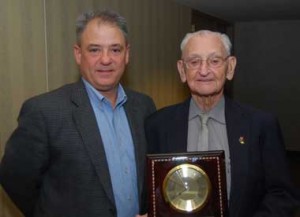
Paul J. Phillips Jr., right, with son Chris.

Paul J. Phillips Jr., right, with son Chris.

How long has Paul J. Phillips Jr. been involved in the Philadelphia St. Patrick’s Day Parade?

“Longer than I’ve been alive,” says son Chris Phillips, current recording secretary of the St. Patrick’s Day Obervance Association. Chris was born in 1963. His dad became treasurer of the association in 1962. Aside from a couple of years when he served as president (1989-1990), Paul Phillips has been treasurer ever since.

Phillips recently retired from the position, handing over the reins to Leonard Armstrong.

He wasn’t expecting to be treasurer for quite so long. “They asked me to do it on a temporary basis, and I did,” he says. But the Philadelphia parade is the sort of thing that stirs passions and inspires deep loyalty. So for more than 40 years, the 86-year-old Gray’s Ferry native and Southeast Catholic alum diligently watched over the finances of the nation’s second-oldest parade of any kind.

It was never an easy job, his son says—and over the years, it got harder. But Paul Phillips was equal to the task.

“He’s always been a man who kept good records,” says Chris, who recalls his father showing up at his last meeting as treasurer with the same leather-bound ledger he inherited upon becoming the association treasurer. In the early going, the parade was relatively small. But, says Chris, “over the year’s it’s grown, and he’s had to deal with managing large amounts of money every year. Keeeping all of that together has been a stretch sometimes.”

Though the job was difficult, the unflappable treasurer apparently took it all in stride. For that, he says he owes a debt of gratitude to current and past colleagues on the board. “I’ve always had a great deal of cooperation from the other board members,” Phillips says. He remembers many of them with great fondness, and he counts himself lucky for all the friendships he made on and off the board, including such notables as former mayors James Tate and Bill Green.

For his partners on the board, the feeling is mutual. They honored him Thursday night for his many years of service. (Happily for everyone involved, he’ll remain on the executive committee.)

As he accepted a large plaque from association President Michael F. Callahan, Phillips took a moment to reflect on all those years of service. “I thought it was the greatest thing that ever happened to me,” he said. “I loved it.”