All Posts By

Jeff Meade

People

All Local Parades Washed Out on Saturday

(Editor’s note: Updated at 4:40 p.m. Friday to reflect cancellation of the Springfield parade.)

With two to four inches of rain, small stream and street flooding, and high winds predicted, all of the area’s St. Patrick’s parades that were scheduled for Saturday are now postponed or canceled.

(This is not to be confused with Sunday’s Philadelphia parade, which will go on as scheduled no matter what. Rain, wind, snow, drought, locusts, disease, pestilence, rivers of blood… no problem, Philadelphians will absolutely march on Sunday.)

Of course, even though all Saturday parades are canceled, many traditional post-parade festivities will go on. So you can still strap on your green plastic leprechaun hat and party hearty.

Here’s the current status of the Saturday parades:

Conshohocken (Montgomery County)
Postponed. Originally scheduled for Saturday, the parade is officially re-scheduled for Saturday, March 27, at 2 p.m. So you’ll have to wait a couple of weeks, but—look on the bright side—it gives you a reason to stretch out the month’s celebration.

Levittown (Bucks County)
Canceled. However, two other events are going on as planned, according to the parade committee’s Theresa Gallagher. There’s a special Mass at 8 a.m. at St. Joseph the Worker Church, 9172 New Falls Road in Levittown. Later in the day, there’s a big hoolie (the after-parade party) from 12 noon to 5 p.m. at Falls Banquet Hall, 80 MY Lane in Morrisville (previously known as Trease Catering). Music by Jamison … and it’s free! Food and fun for everyone.

Springfield (Delaware County)
Canceled. It will not be rescheduled, says parade director Steve Burns. “Historically, we’ve never had a rain date,” he says, adding that it’s usually difficult to re-book bands and other marching units. “The consensus has been that, if it’s done, it’s done.”

However, the parade after-party will still go on as advertised. Ancient Order of Hibernians Black Jack Kehoe Division 4 will get the festivities rolling at 2 p.m. at the Knights of Columbus De LaSalle Hall, Baltimore Pike and Bishop Avenue in Springfield. The party goes on ’til 6 p.m., with music by the great Irish band The Shantys. The price is $15, which includes music, food and draft beer.

There’s also a party going on at Duke’s Tavern at Saxer Avenue in Springfield, starting nice and early—about 10 a.m.—and going until whenever.

And over at St. Kevin’s at 200 West Sproul Road, the McDade and Cara Irish dance schools are hosting a ceili from 2-6. To be sure, there will be lots of music and dancing. Ten bucks gets you in the door, including food, dessert, coffee and tea. Ten dollars more buys you a bottomless cup of beer. Listen to live Irish music by Steven Moran.

(Editor’s note: Updated at 4:40 p.m. Friday to reflect cancellation of the Springfield parade.)

With two to four inches of rain, small stream and street flooding, and high winds predicted, all of the area’s St. Patrick’s parades that were scheduled for Saturday are now postponed or canceled.

(This is not to be confused with Sunday’s Philadelphia parade, which will go on as scheduled no matter what. Rain, wind, snow, drought, locusts, disease, pestilence, rivers of blood… no problem, Philadelphians will absolutely march on Sunday.)

Of course, even though all Saturday parades are canceled, many traditional post-parade festivities will go on. So you can still strap on your green plastic leprechaun hat and party hearty.

Here’s the current status of the Saturday parades:

Conshohocken (Montgomery County)
Postponed. Originally scheduled for Saturday, the parade is officially re-scheduled for Saturday, March 27, at 2 p.m. So you’ll have to wait a couple of weeks, but—look on the bright side—it gives you a reason to stretch out the month’s celebration.

Levittown (Bucks County)
Canceled. However, two other events are going on as planned, according to the parade committee’s Theresa Gallagher. There’s a special Mass at 8 a.m. at St. Joseph the Worker Church, 9172 New Falls Road in Levittown. Later in the day, there’s a big hoolie (the after-parade party) from 12 noon to 5 p.m. at Falls Banquet Hall, 80 MY Lane in Morrisville (previously known as Trease Catering). Music by Jamison … and it’s free! Food and fun for everyone.

Springfield (Delaware County)
Canceled.  It will not be rescheduled, says parade director Steve Burns. “Historically, we’ve never had a rain date,” he says, adding that it’s usually difficult to re-book bands and other marching units. “The consensus has been that, if it’s done, it’s done.”

However, the parade after-party will still go on as advertised. Ancient Order of Hibernians Black Jack Kehoe Division 4 will get the festivities rolling at 2 p.m. at the Knights of Columbus De LaSalle Hall, Baltimore Pike and Bishop Avenue in Springfield. The party goes on ’til 6 p.m., with music by the great Irish band The Shantys. The price is $15, which includes music, food and draft beer.

There’s also a party going on at Duke’s Tavern at Saxer Avenue in Springfield, starting nice and early—about 10 a.m.—and going until whenever.

And over at St. Kevin’s at 200 West Sproul Road, the McDade and Cara Irish dance schools are hosting a ceili from 2-6. To be sure, there will be lots of music and dancing. Ten bucks gets you in the door, including food, dessert, coffee and tea. Ten dollars more buys you a bottomless cup of beer. Listen to live Irish music by Steven Moran.

Trenton (N.J.)
Postponed until Saturday, March 20.

Wilmington (Del.)
Canceled. But all is not lost. Far from it! The Irish Culture Club of Delaware will be hosting a hoolie at St. Patrick’s Church (normally, the end of the parade route), 14th and King Streets in Wilmington, from 12:30 to 3 p.m. Ten dollars gets you a commemorative mug and endless beer.

York (Pa.)
Canceled. However, the city is still celebrating indoors, and big-time. Click here for a detailed schedule.
Trenton (N.J.)
Postponed until Saturday, March 20.

Wilmington (Del.)
Canceled. But all is not lost. Far from it! The Irish Culture Club of Delaware will be hosting a hoolie at St. Patrick’s Church (normally, the end of the parade route), 14th and King Streets in Wilmington, from 12:30 to 3 p.m. Ten dollars gets you a commemorative mug and endless beer.

York (Pa.)
Canceled. However, the city is still celebrating indoors, and big-time. Click here for a detailed schedule.
Music

Five Questions for Eamon Murray

Beoga

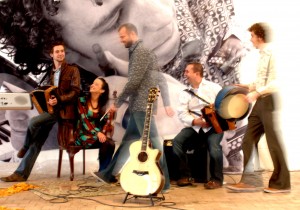
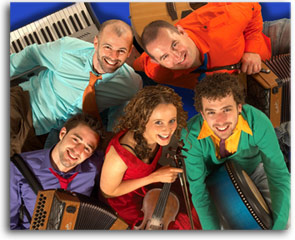
The supergroup Beoga. Eamon Murray is at lower right.

Beoga takes Irish traditional music and turns it on its head, flips it sideways, yanks it inside out, tosses it up in the air, twists it like a pretzel, pounds on it with a meat tenderizer, and crams it into a wood chipper just for good measure.

Don’t worry. What comes out in the end might not be anything like a straightforward rendering of “Drowsy Maggie”—they’d probably pump poor Maggie full of Red Bull and tell her to wake the hell up. What it will be, instead, is a breathtaking (no, I mean it—you’ll literally be out of breath) and massively entertaining re-imagining of Irish traditional music.

All of which you can find out for yourself Saturday when the County Antrim-based band pulls into Reading for a 7:30 p.m. concert (and an afternoon workshop) at Albright College’s MPK Chapel.

All of the band’s musicians have deep traditional roots. You can’t re-imagine the genre if you are not already intimately familiar with it in the first place.

One member of the five-piece band is Eamon Murray, the frenetic, four-time All-Ireland bodhrán champion and possessor of a head full of curls and wild ideas. We caught up with him by phone as the band made its way by van from Baltimore to Ohio. Here’s what he had to say.

Q. The one thing I want to talk about is how different your performances are from your recordings. On your recordings, there are a lot of interesting little sound effects, and you’re accompanied by trumpet, saxophone, and electric guitar—and on at least one occasion by the Prague Philharmonic Orchestra. You’re not bringing the Prague Philharmonic Orchestra along with you, are you? You don’t have a kettle drum in your bodhrán bag?

A. I would love to be able to afford to bring all those people! You have to mix it up live. You’re never going to make it sound like it does in the studio. It’s a challenge—we really enjoy doing it. The guys all take extra lines. You compensate and make it sound the best you can. It’s not necessarily a bad thing.

Q. I’m always interested in how bands got together. What’s your story?

A. We got together seven years ago; myself and Seán Óg (Graham, button accordion and guitar) were playing together. But we all knew each other and had played together. The four boys, we all grew up in roughly the same area. Myself and Sean, since we were kids, were inspired by a lot of bands, like Dervish. It was just kind of around that time, when we were 16 and 17, that we decided it was time to get a band together. A few years after that, Niamh (Dunne, on fiddle) joined us.

Q. The band’s musical tastes are, in a word, eclectic. For example, I think “Please Don’t Talk About Me When I’m Gone” was your idea. This is a song that was a big hit … in 1930. And of course, there are so many apparent influences, not just traditional Irish music, but rock and jazz and klezmer. Where does all this come from?

A. We collectively have vast influences, some a bit classical and some on the jazzy end of things. I play drum kit, so I’m influenced by pop and more mainstream music. I can’t get over Bruce Springsteen—he’s awesome. We were listening to Michael Jackson yesterday. There’s a lot of pop mainstream stuff in the van. Nobody gets too taxed listening to it.

We (also) all come from musical families. We were all surrounded by a lot of stuff when we were young. Niamh comes from a family with deep roots in traditional music, as so many young Irish musicians do. Niamh’s father is a fantastic piper, so she’d have more knowledge of old pipers’ tunes. The rest of us have very musical siblings and have music in the family somewhere. We started going to the music festivals when we were 7 or 8 years old.

Everybody comes to the table with different ideas for songs or sets. So many bands get boxed into whatever genre they’re supposed to be in. Fortunately, that hasn’t happened to us yet. It’s interesting to just be able to mix things up and take license.

Q. Your music is so different—which is a good thing—that you’ve been described in many different ways. My personal favorite comes from an Irish music magazine: “Deranged Darlings.” What’s your favorite?

A. (Laughs.) I like that one! “Deranged darlings,” at least people understand what you’re trying to do. People don’t knock it because it’s not a purist approach.

Q. You’re one of the best bodhrán players in the world. (Are you blushing now?) How did you come to it?

A. I’m not blushing! Keep it coming! I started on the bodhrán when I was 7 or 8. That was after trying lots of other instruments in which I had no interest. From there it just kind of took legs. I progressed quickly as a child. I didn’t care about practicing—I just kind of hammered on. It was all taking shape by the time I was 11 or 12.

—–

The band will host an Irish music workshop from 5 to 6 p.m. It’s free and open to the public.

Ken Gehret & Irish Mist will play in the lobby from 6:15-7:15 p.m.

Tickets at Albright College Box Office 10 a.m. – 2 p.m.: (610) 921-7547 or at the door. $25, $35, 50% student discount with valid ID, 10% group discount for 10+ tickets

Visit www.starseries.org for full event details.

People

Another Day in the Sun for the Mount Holly Parade

Mount Holly Parade 2010

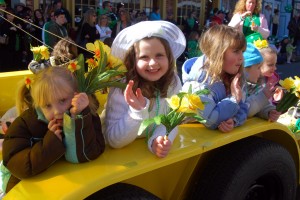
These young ladies enjoyed the spring-like weather from the back of a float. (Click on the photo to view more.)

Well, they did it again. All the other Delaware Valley St. Patrick’s Day parades seem to step off in rain, sleet and/or snow, with Arctic temperatures and cloudy skies.

In Burlington County, New Jersey, they appear to live a charmed life. It was cool, yes, but not cold. Bright sunshine. Not a cloud in sight. No wind. What’s more, I’m not sure they’ve ever had a bad day. Call it the luck of the Mount Holly Irish.

Check out the slideshow by clicking on the photo, above.

News

You Say Potatoes, We Say Poor Taste

Did you hear the one about the major fast food chain that ran a TV ad offering  unlimited fries and pancakes to celebrate the 150th anniversary of the end of the Irish famine?

Did you hear the one about the major fast food chain that ran a TV ad offering unlimited fries and pancakes to celebrate the 150th anniversary of the end of the Irish famine?

Did you hear the one about the major fast food chain that ran a TV ad offering unlimited fries and pancakes to celebrate the 150th anniversary of the end of the Irish famine?

Not funny? A lot of people agree with you—among them, the national president of the Ancient Order of Hibernians, Seamus Boyle, who fired off an angry letter to Denny’s over last weekend, and Philadephia Rose of Tralee Centre Managing Director Sarah Conaghan who quickly organized a protest and a Facebook boycott campaign. They made it clear to the South Carolina-based fast food chain: No one in the Irish community was laughing about a promotion making fun of a time in human history that led to the deaths of more than 1 million people. The ad was pulled from the airwaves on Tuesday.

But the protest wasn’t the Grand Slam it should have been.

Those who contacted Denny’s got this response via email:

“Denny’s has a history of using humor in its television advertising. It is certainly not the intention of the company to offend anyone or any group and we apologize if this spot has in any way. As a result of the feedback we have received from our customers the spot will no longer be on the air after Tuesday. We thank those who took the time to contact us.”

It was signed, “Denny’s Call Center.”

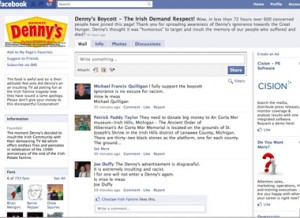
“It wasn’t even signed by a real person,” griped Conaghan, of Villanova, who called off her protest and turned it into a boycott of Denny’s on Facebook. So far, in less than a week, nearly 800 have joined the page. On it, one woman echoes many other protesters who wondered whether Denny’s would follow up with other offensive offers: “What’s next- Auschwitz Liberation pancake fest? Ethiopean Egg deal? References to any catastrophe- no matter how long ago is bad taste.”

The agency responsible for the ad, Goodby Silverstein and Partners in San Francisco, doesn’t answer the phone or provide an opportunity to leave a message, says Conaghan. Her Facebook boycott page provides the agency’s number for supporters to call.

Conaghan saw the ad while watching TV with her father, Tom, founder of the Irish Immigration Center in Philadelphia. “We were in shock,” she says. “My father grew up in Donegal, which was very hard hit, and he remembers walking with his father among the ruins of little cottages and fields where people had been evicted or died and his father could name family names. These were real people and there’s nothing humorous about it. Many of the survivors came to America so the history of the Great Hunger is linked forever to the history of Irish Americans.”

In Ireland, it’s called An Gorta Mor, the Great Hunger, because it was a man-made famine, a point AOH National President Seamus Boyle made in his letter to Denny’s, which he shared with www.irishphiladelphia.com.

“The ‘Potato Famine’, as it is sometimes called, was actually a forced hunger which took place in Ireland between 1845 and 1852, which killed over one and a half million of its people,” Boyle wrote. “This starvation. . . . was man made by the English absentee landlords who refused to let the Irish peasants eat anything other than the potato. This is well documented in history that while the Irish people starved for lack of one crop which happened to be their staple, the potato crop, meat, vegetables, corn and other foods were raised and harvested in Ireland and exported to England under guard to be sold for profit.”

“You have the audacity to make fun of the these people who died of starvation much worse than any genocide ever recorded in history, so that you can sell your product on the back of our dead ancestors. I have already contacted our members throughout the United States where Denny’s has a franchise to be ready to mobilize when needed,” Boyle wrote.

Like Conaghan, the AOH leader, a native of County Armagh who lives in northeast Philadelphia, isn’t satisfied with Denny’s apology. “It was a form letter that anyone could have put out,” he says. “It’s not appropriate. They got caught and they tried to get out of it.”

Many are calling for Denny’s to make a contribution to an Irish cause, like the Hibernian Hunger Project, an AOH national program that started in Philadelphia to provide food to the needy. But Boyle disagrees. “A few years ago a beer company did something similar and offered the Irish money, but I think that was a buyout. Instead of giving it to us as an ‘apology,’ I would rather see Denny’s give $800,000 to Haiti relief because that’s where the money is really needed today,” he said.

People

Remembering Jim Kilgallen

Jim Kilgallen

CBS3's Susan Barnett, Kathy Orr, and parade commentator Jim Kilgallen.

There are many stories about Jim Kilgallen, the larger-than-life founder of the Irish of Havertown, 2004 grand marshal of the Philadelphia St. Patrick’s Day Parade and owner of Kilgallen’s Tavern, who passed away on Saturday. Michael Bradley, director of the parade, has a favorite, which Kilgallen used to tell on himself.

“Once, when he was in his twenties, he went up to New York City with a bunch of guys from Philadelphia,” Bradley says. “They ran into a group of fellas from Ireland, and they all wound up in a pub. There was a lot of singing going on, and at one point, Jim himself got up to sing. Understand, he was always a big man. Anyway, he started to sing ‘If I had the wings of a swallow …’ when one of the Irish guys yelled out, ‘You’d never get your fat ass off the ground!'”

Jim Kilgallen never had a problem seeing the humor in life, Bradley says, even if it came at his own expense. An inveterate needler, he usually gave as good as he got. Even at the saddest times, Kilgallen had a talent for making his many friends smile. “At every funeral luncheon, he would get up and say, ‘Nobody wants anything sad. You had to sing a song or tell a story,” Bradley recalls. “He’d have everyone laughing by the time they were leaving.”

Now it falls upon Kilgallen’s family and many friends to find a way to smile through the tears.

James J. Kilgallen, Jr., was born in West Philadelphia in 1931—on St. Patrick’s Day, appropriately enough. He was first-generation Irish; his parents Bridget and James Kilgallen hailed from Castlebar, County Mayo. He was a longtime member of the Mayo Association of Philadelphia and a member of Ancient Order of Hibernians Division 65, now named after Joseph E. Montgomery. Since 1990, he served on the executive board of the St. Patrick’s Day Observance Association. He led the association as president in 1999 and 2000. In 2002, the Haverford Township Commissioners honored him as the Honorary Mayor of the 33rd County of Ireland-Havertown.

Tributes like that came Jim Kilgallen’s way in his life, though he never sought them out. Far from it, says Bradley: “He didn’t have a big ego.”

Bradley first came to know Kilgallen well in 1990. That was the year Bradley joined AOH 65. Through his parents, Bradley was already familiar with the older man. Bradley’s mother Bernie went to St. Rose of Lima School with Kilgallen, and his father Mickey attended St. Thomas More High School at about the same time he did.

Still, the friendship didn’t really kick in until Bradley became a Hibernian member of AOH Joseph E. Montgomery Division 65. Kilgallen and two other division members, Jack McNamee (the 2008 grand marshal, who died in late August) and Paul J. Phillips, took Bradley under their wing. All of them knew of Bradley’s interest in the parade—he was then a relatively wet-behind-the-ears volunteer marshal. Within a couple of years, Bradley had moved up to head marshal, and in time his mentors were backing him as a prospective member of the board. Kilgallen, he says, spearheaded the move.

(Bradley lost that year to the famous Johnny Doc of Local 98 fame, who has since become a close friend and trusted adviser, but moved onto the board—with the strong backing of the three men he calls his “posse”—in a subsequent election.)

The older gentlemen, Bradley says, were able to see what others might not have—that great institutions like the St. Patrick’s Day Observance Association need a periodic infusion of new blood. None of which suggests that they themselves were ready to be put out to pasture. On the contrary, says Bradley, “Those three guys, they just worked and worked and worked.”

Bradley has never been a stranger to hard work, but he learned much from his mentors. Kilgallen in particular “taught me more about people than anything I’ve ever learned in my life. He taught me to look past factions, to include everyone and make them all your friends.”

Kilgallen also impressed upon Bradley (and anyone else who would listen) the importance of not being an Irish snob. “He used to say, the people who come out on only one day a year and wear green plastic hats, they’re also Irish,” says Bradley. “We need them all. We’re much stronger together.”

Wise, to be sure—but also wickedly funny. Kilgallen the publican used to enjoy verbal jousting with his pal McNamee, who owned the popular Springfield restaurant C.J. McGee’s. “They used to tease each other unmercifully,” says Bradley. “Jack used to call Jim ‘the saloon tycoon.’ Jim would call Jack ‘the restaurateur.’”

Over the years, as the parade came to dominate Bradley’s life—particularly as March closed in—both men would show up at his door to help. “They would come over to my house and help put badges together, whatever needed doing” he says, “and tell Linda (Bradley’s wife) what an idiot I was. They’d drive over here and help me—and tease.”

Friends like that, Bradley says, are simply irreplaceable, and he and his colleagues on the parade committee will do their best to make sure they’re remembered as the St. Patrick’s Day Parade heads up the Benjamin Franklin Parkway on Sunday, March 14, bigger and better than ever.

Bradley, for his part, will hang on tight to the happy memories. The memories, he says, keep him going when the pressures of parade planning close in, when the living room is full of badges and raffle tickets, and the phone never stops ringing.

Still, Bradley says, the sense of loss is inescapable. “It’s like I lost two dads in six months,” he says. “Jim’s death hit me doubly hard. It’s like I lost a father, my mentor and one of my best friends.”

Funeral details are as follows: Beloved husband of Margaret (nee Philbin) Kilgallen. Loving father of James M. Kilgallen, Maureen A. (Michael) Keeney, Theresa M. (Scott) McPherson, and Kevin F. (Joanne) Kilgallen. Brother of Nora Heiss. Also survived by 11 grandchildren and 1 great grandchild. Relatives and friends are invited to his views Friday from 6 to 9 p.m. and Saturday from 9:30 to 10:30 a.m. in the funeral home of John Stretch, E. Eagle & St. Denis Roads, Havertown, and to his Mass of Christian Burial following Saturday at 11 a.m. in St. Denis Church Havertown. Interment in Ss. Peter & Paul Cemetery. In lieu of flowers an offering in Mr. Kilgallen’s name to the American Heart Assn. Memorial Fulfillment Center 5455 N. High St. Columbus, Ohio 43214.

People

The Thrill of a Lifetime for this Year’s Burlington County Grand Marshal

Paul Kennedy

This year's grand marshal, Paul Kennedy, showed up with family in tow. (Click on the photo to see more.)

Community parades often hand out prizes for the strangest things, like fire engines traveling the longest distance to participate in the celebration. If they were awarding prizes like that in the Burlington County St. Patrick’s parade, they’d have to give one to the grand marshal, Paul Kennedy.

This enthusiastic grand marshal flew, oh, roughly 6,000 miles just for that celebratory ride down High Street in Mount Holly Saturday at 1 p.m.

Kennedy, who works for the Office of the Special Inspector General for Iraq Reconstruction (SIGIR), has been based at the sprawling U.S. embassy in Baghdad’s Green Zone for several months. It’s his first tour of Iraq for the agency, which, according to the agency Web site, serves as “a watchdog for fraud, waste, and abuse of funds intended for Iraq reconstruction programs.”

“We identify areas of concern such as fraud, waste, abuse and mismanagement,” says Kennedy, who, when he’s not on the job in Iraq, lives in Mount Holly with his wife Lynn. “We are comprised of auditors, inspectors and investigators. Some of our work has been instrumental in assisting the Department of Justice in recovering stolen money and prosecuting criminals.”

Kennedy is a senior analyst.

One look at Kennedy gives you a hint, at least, that he is cut out for work in hostile territory. With his closely-cropped hair, stocky build and military bearing, Kennedy betrays his background. Kennedy is Army—all Army. Kennedy was born in 1953, the son of a career Army Officer. He enlisted in the U.S. Army in June of 1974 and went on to serve in a number of infantry units, including the 2nd Battalion, 75th Ranger Regiment. After that, he attended flight school and became a helicopter pilot. He retired from the Army as an aviation officer and maintenance test pilot, to become the Director of Internal Review at the Defense Supply Center in Philadelphia. Now, he’s serving SIGIR.

Kennedy’s Army roots go deep. What’s more, several of his children have gone on to serve, including Staff Sergeant Sean P. Kennedy, U.S. Army; SPC Margaret A. (Kennedy) Vargas, U.S. Army; Sergeant James Kennedy, U.S Army; and Sergeant Matthew T. Kennedy, U.S. Army. Paul, Jr., is a conductor with CSX Railroad.

Three of Kennedy’s children were in Iraq during a good portion of his tour there. “Fortunately, they have all returned back home,” he says. “My youngest (Matthew) is in Afghanistan serving with the 173rd Airborne Brigade. This is his second tour.  Both of his older brothers (Sean and James, members of the 82nd Airborne Division), have also completed multiple combat tours, Sean in both Iraq and Afghanistan.  My daughter (SPC Margaret A. Vargas) has decided to hang up her boots in favor of becoming a full-time mom. She returned from Iraq in August last year.”

All of his children are expected to join him in the parade.

Despite his service background, Kennedy is no stranger to the worry that dogs all parents of children serving in combat zones.

“It is never easy for a parent to have a child in a war zone,” he says. At one time we had four all in combat areas. We worry constantly, and pray unceasingly. When my wife Lynn heard of my opportunity to work in Iraq, she thought it was a great idea. She trusted me to keep an eye out on the kids. In reality however, she not only had to worry about our children, but now she had to worry about me as well. She got the worst part of the deal. I don’t know how she does it.”

For his part, Kennedy says, service in Iraq has been gratifying. And he’s far from roughing it.

“I am very fortunate to be housed in the diplomatic apartments,” he says. “They are fully furnished, with a kitchen, full bath, and common area (Two persons to an apartment). We have two gyms, an indoor pool, tennis courts, and plenty of activities. The food is excellent (thanks to the great folks who work at the Defense Supply Center Philadelphia). Our rooms are very comfortable… plenty of reading material, music, and TV with about 70 channels. I am never bored.”

While in Iraq, Kennedy also had the good fortune to meet and befriend Mount Holly’s chaplain. Father Tim Hirten, a major in the U.S. Air Force, said Masses at the embassy. Kennedy, a pretty fair musician, led the music group at the Masses.

With a name like Kennedy, this year’s grand marshal has a strong Irish pedigree, and his heritage has always been important to him. He and his son Paul, he says, are “huge supporters of Irish music.” Paul, a multi-instrumentalist, started playing at the High Street Grill in Mount Holly several years ago.

“When Paul, Jr., first started playing there, there was no Irish music at all in town.  I began sitting in with him and we developed a bit of a following,” he says. “Now, more and more events are springing up in town that highlight the Irish or Celtic culture including, what hopefully will become an annual event: the Mount Holly Celtic Festival. We also support other Celtic cultural events such the Annual Mount Holly Burns’ Supper, an idea my good friend Tom MacIver, Paul, Jr., and I put together with the help and support of our great friends at the High Street Grill, John and Nancy McDevitt, who host the event. No matter what the event however, we always end up back at the High Street Grill playing Irish music.  I think the biggest connection (to Irish heritage) for me is with the music… and pretty much any event that provides an opportunity to play Irish music.”

Kennedy has been involved in the parade committee since its inception. Still, he was surprised and honored to be selected as this year’s grand marshal. When  parade director Jim Logue broke the news to him, he says, he though Jim was joking. The shock wore off, though, and now he just has an opportunity to sit back and enjoy the thrill. “Serving this year as the grand marshal is a tremendous honor for me, and my family,” he says. “It is anexperience I will remember for the rest of my life.”

Music

Beoga Plays Albright College March 13

Beoga

Beoga goes to college.

A band hailed for its “Madcap genius” and described as “the most exciting band to emerge from Ireland this century”—pretty high praise—is coming to the Philadelphia area on Saturday, March 13.

Beoga will play in MPK Chapel on the Albright College campus. Show time is 7:30 p.m.

And local Irish musicians and devoted fans, take note (music joke): the band will host an Irish music workshop from 5 to 6 p.m. It’s free and open to the public.

Ken Gehret & Irish Mist will play in the lobby from 6:15-7:15 p.m.

Tickets at Albright College Box Office 10 a.m. – 2 p.m.: (610) 921-7547 or at the door. $25, $35, 50% student discount with valid ID, 10% group discount for 10+ tickets

Visit www.starseries.org for full event details.

Uncategorized

Ronan Tynan’s Tale of Triumph

Ronan Tynan

Ronan Tynan

Some might say that it was one of the worst possible times to start a career in music. Ronan Tynan was in the midst of his residency as a physician—not the most idle or stress-free of times—when he decided to pursue his lifelong passion. At 33, the young doctor in training followed the advice of his father Edmund and began formal voice training at the College of Music in Dublin under the renowned Veronica Dunne.

Tynan, for his part, has no problems with having embarked upon his musical journey when he did. “Some would say my timing was just perfect,” says Tynan, now arguably one of the most famous singers in the world and a founding member of the celebrated Irish Tenors. “I may have been in just the right place at just the right time and caught the right train.”

A lot of people might not have predicted he would have caught that train, or any train—but Tynan’s parents never doubted that he was destined to do great things, and their confidence in him has inspired the singer all his life.

That he has accomplished so much is all the more remarkable considering the formidable obstacles that might have stood in his way.

Ronan Tynan came into the world in 1960 and grew up on a farm at the foot of Spa Mountain, near the village of Nass, County Kilkenny. Tynan was born with phocomelia, a defect that in his case caused a deformity of the lower limbs. For the first few years of his life, he couldn’t stand or walk.

When he was 3, his mother Therese and his father took him to a prosthetics clinic in Dublin, where he was fitted with a specially designed pair of boots. For the first time in his life, Ronan Tynan stood. He took his first steps. And he has never, not for a moment, stood still since—even when, at 20, a serious car accident so badly injured his legs that he elected to have both of them amputated below the knee. Once again, prosthetics came to the rescue. In weeks, he was up and walking again on his artifical limbs. And soon after that, competing in the paralympics and winning medals in track and field events.

Some people might have been daunted by so many challenges, but not Tynan. “I didn’t look at myself as disabled or physically changed. I was never brought up with that kind of image. My father used to say, ‘There’s no reverse gear in life. There’s just forward motion.’ So you can’t wear your disabilities on your sleeve. People really respect that I get on with my life. I don’t look for anything special. I just get on with it.”

Tynan’s father and mother are gone, but it’s clear their words remain a guiding force. “They were the yin and the yang of my life,” he says quietly. “They believed in me 100 percent and they gave me so much in my life. I always think of them. There’s not a day when I forget them. I owe everything to them.”

By the time Tynan decided to pursue medical studies, probably no one was surprised by anything this doggedly determined and confident young man might do, once he set his mind to it.

And then, finally, came music.

For as long as he can remember, Ronan Tynan sang. “I had a wonderful relationship with my dad, and we used to sing at home,” he says. Later on in life, he adds, he’d entertain friends—and anyone else who happened along—in local pubs. “I was the benefactor of many a pint of Guinness,” he says. “I knew I was onto a good thing.”

For the longest time, singing was much more than just an enjoyable diversion but far short of a profession. Still, he says, he lacked the formal training that might turn his amateur talents into something more polished and professional. “I just loved singing,” he says. “It was just one of those things. Still, I knew nothing about the rudiments of singing at all. So one day my dad said, why don’t you take lessons? I did, and I became passionate about it.”

Once again, Tynan’s talent and drive came to the fore. His studies with “Ronnie” Dunne served him well. It took him less than a year of studies to win the John McCormack Cup for Tenor Voice and the BBC talent show “Go For It.”

One of the judges of that contest was television producer Bill Hughes. Inspired by the success of the Three Tenors (Pavarotti, Carreras and Domingo), Hughes in 1998 dreamed up the idea of a trio of Irish tenors. Hughes remembered the thrilling young tenor from “Go For It” from just a few years before.

“I was the first Irish guy to be asked,” recalls Tynan. (Initially a Canadian John McDermott was also a member, as was Anthony Kearns. Finbar Wright signed on when McDermott elected to leave.) As for what happened after that, you probably know. The Irish Tenors became quite the franchise (and remained so, with Karl Scully, after Tynan left in 2006 to pursue a solo career). They seemed to be on PBS every time you turned on the channel.

There was never really any question in Tynan’s mind that the Irish Tenors would be huge. “I knew America would love it because there’s such a huge Irish heritage there. I knew we would be a big hit. Irish Americans love the old Irish songs.”

Tynan’s solo career has been equally successful, and he shows every sign of enjoying being on his own in front of an audience. “I have my own band as well,” he says.

“You control your own destiny (as a solo performer). I work very hard at it because I believe people have paid good money to see you and you want to give people the best concert they can experience. If youre passionate about it, it’s not work. You can’t phone it in.”

Of course, Tynan still sings the money songs—Fields of Athenry, Raglan Road, and the ubiquitous Danny Boy. But he also mixes genres with ease. The approach is often described as Classic Crossover—and that means different things to different people. Tynan doesn’t think much about the label. “I sing songs,” he says. “It doesn’t matter if they’re contemporary ballads, opera, Springsteen… whatever. I don’t like to brand or classify what I do. I do everything. Let the purists call it classical crossover. In my book, I’m a singer.”

Asked if he ever wants to just break loose and sing a rebel song like “Men Behind the Wire,” Tynan bursts out laughing. “I know that song! ‘Armored cars and tanks and guns came to take away our sons!’ I used to sing that song in pubs,” he says. Ah, but a song like that isn’t going to make it into his repertoire any time soon. “You have to think of your audience, and some songs are more appropriate than others.”

Tynan will bring his act to just such an appreciative audience at the Keswick Theatre in Glenside Saturday, March 6, at 8 p.m. Ticket phone: (215) 572-7650.