Monthly Archives:

March 2008

Columns, How to Be Irish in Philly

How To Be Irish in Philly This Week

Okay, let’s cut to the chase—we have a lot to cover.

It’s a big weekend for parades. There’s one in Levittown, another in Conshohocken, and yet another in Springfield, Delco, on Saturday. Since the staff of www.irishphiladelphia.com consists of two and a half people, you do the math. So if you take some good digital pictures of the parades, can you hit us with your best shot? We can’t be everywhere, though it sometimes seems like we are. Just e-mail us (hit the “contact us” button) and we’ll tell you where to send them.

But before the parades hit the streets, you have some decisions to make for Friday night. Because here’s what’s going on:

Fiddler Danny Meehan is making a rare stateside appearance at the Irish Center in Mount Airy. Exuberant, spontaneous, he rarely plays a tune the same way twice, says Frank Dalton, who organizes those wonderful Irish performances in Coatesville. Tom O’Malley from the Philadelphia Ceili Group, which is bringing Meehan to town, says “the last time Danny was here we actually started the concert 15 minutes early. He just kept on going after the soundcheck. He kept on going for hours in the Fireside Room after the concert. The lame were dancing and the dumb were singing.”

We don’t know about that last part, but it promises to be a mighty good time. Irish in a “no Mardi gras beads and green beer” kind of way. You know, the real thing. If you ask us, going to hear Danny Meehan is the best way to get in touch with your roots.

That said, here’s the rest of Friday’s agenda:

  • The 7th Annual Chester County Emerald Society Paddy’s Day Celebration at the Coatesville Moose Lodge—Irish dancers and DJ
  • The St. Patrick’s Coronation Celebration at the Fearless Fire Company (we like the sound of that) ballroom in Allentown, where the 2008 King and Queen of the Allentown St. Paddy’s parade (which happens March 31) will be crowned.
  • Singer Carmel Conway will be at the World Café Live
  • The Belles of Dublin show will be making another appearance at the Red Room at Society Hill Playhouse
  • Singer Andy Cooney will be bringing an entire Irish extravaganza to St. Mary’s Church Hall in Cherry Hill. We interviewed Andy last year–he’s a sweetheart. Voice of an angel. Face of an angel too. Oops, we’re gushing now. Time to stop.
  • Finnegan’s Wake with The Barley Boys will be making its farewell appearances this weekend
    When Saturday rolls around, there will be the aforementioned parades. But if you have the energy, check out the Leprechaun 5-Mile Run starting at Philly’s Art Museum in the morning. It benefits the Special Olympics. There’s also a two-mile walk.

And then:

  • If you’re in Bucks County, check out the Crossing Vineyards in Washington Crossing for its all day (starts at noon) Irish celebration, featuring the Boys from County Bucks.
  • The Chieftains are appearing at the Kimmel Center—a Philadelphia tradition
  • The 237th annual Friendly Sons of St. Patrick dinner-dance is being held at the Montrose Mansion in Radnor. Did you know that group pre-dates the Declaration of Independence?
  • Chestnut Hill College is holding its Emerald Evening Casino Night and Auction as a fundraiser with an Irish theme
  • Sacred Heart Church in Camden is holding its own St. Patrick’s celebration with music, poetry, “and good Irish soda bread.” Since Pastor Michael Doyle is a poet from Ireland, we suspect that it will be quite authentic.
  • The Boys from County Bucks will be quite busy today—they’re also on tap for a fundraiser for multiple sclerosis research at the Gardenville Inn in Pipersville.
  • The Doylestown Moose Lodge is holding its second St. Patrick’s Day Party.
  • Scythian, that crazy Balkan-Celtic band from Washington, DC, will be live at the World Café.
  • The Philadelphia Celtic Currach Club (they race in Irish boats) is having its annual beef and beer fundraiser at Fran Lee Caterers in Philadelphia.
  • McDermott’s Handy will be at the Higher Grounds Coffee House in Bridgeton, NJ, and Catch It Grog ‘N Grill in Oaklyn, NJ on Sunday.
  • The Cara Irish Society will hold its St. Paddy’s Day do at the VFW in Williamstown, NJ.
  • The Erin Express leaves from various bars in Philadelphia, the safest way to drink beer to your heart’s content this season. There are eight buses to take imbibers from place to place. Again, we encourage you not to drive home if you’ve overdone it. See the list of participating saloons here.
  • And fresh from their stint at Showboat Casino, The Barley Boys will be mixing it up at the House of Blues on the Boardwalk in Atlantic City.

Is it Sunday yet? Oh yeah, it is, and here’s what’s going on:

  • Learn how to research your Irish and Scots ancestry at the Bucks County Visitors and Convention Center in Bensalem.
  • Incredible Irish-American fiddler Liz Carroll and her partner in music John Doyle will be doing two shows at lovely Longwood Gardens in Kennett Square.
  • The Crossing Vineyards will continue its St. Patrick’s Day Celebration with the Boys of County Bucks today.
  • A few of the Barley Boys are taking the afternoon off but the Barley Boys Duo will be performing at the Masque Bar at the Showboat in Atlantic City. Listen to Irish music while you lose your shirt!
  • The Philadelphia Immigration and Pastoral Center is holding an Immigrant Reunion for all those who were born in Ireland but now make their homes here. It’s at the Irish Center.
  • You can still see The Belles of Dublin Show at Society Hill Playhouse.
  • OMG, the Barley Boys are back together for yet another showing of Finnigans Wake at the Showboat. How do they do it?
  • Speaking of which, The Boys from County Bucks will be performing (how many times this weekend, guys?) at Newtown Presbyterian Church’s Palm Sunday services.
  • Black 47, an amazing Celtic rock group, is booked at the World Café Live. This would be a great way to rock out the weekend in Irish style.

Happy St. Patrick’s Day! It’s Monday. Hope you took the day off. If you did, start it with:

  • Breakfast for charity, AOH style, at Fado in Philadelphia. (Breakfast starts at 7 AM, for those of you who have to go to work.)
  • Lots of pubs and restaurants are having St. Patty’s Day celebrations, including Casey’s Tavern in Quakertown; Slainte, New Deck Tavern, The Irish Times, McGillins in Philly; Brittingham’s and Shanachie in Montgomery County, the Erin Pub in Norwood. . . and those are just the ones we either know about or who put their events on our calendar (anyone can do it!).
  • Blackthorn will be performing at Brownie’s Pub in Ardmore. They’re always a good time!
  • Solas at the World Cafe Live!
  • The Barley Boys (do they never rest?) will be at Maloneys in Atlantic City and doing Finnigan’s Wake. Not sure how that’s happening, but we’re hoping someone will clue us in. We frequently need to be two places at once.
  • The Belles of Dublin is still at Society Hill Playhouse.
  • Crossing Vineyards in Washington Crossing is offering a St. Patrick’s Day dinner with all the appropriate wines, of course.
  • The amazing duo, McDermott’s Handy, will be at the Porch Club at Riverton, NJ, as well as at Murphy’s Market.
  • And you can see Bill Monaghan and Celtic Pride with Irene Molloy at the Sellersville Theater, one of our favorite music venues.

We’re going to stop here, not because this is when the fun stops, but because we are coming down with repetitive strain injury from typing. As always, you can get more details from the calendar all the Hollywood Stars are talking about.
News

Philly Gets Its Irish On!

We rock!

We rock!

The weather was sunny and bright, not a cloud in the sky—an auspicious day for Philadelphia’s 238th Annual St. Patrick’s Day Parade. Oh, except for one thing. On Sunday, March 9, someone mistakenly sent us the weather meant for Fargo, North Dakota. 

It was cold, cold, cold. How cold was it? It was so cold that the skyscraper canyon on the Parkway became an icy wind tunnel that had the crowds on the sidewalk scurrying off in search of a patch of sun or, better yet, a steam grate. So cold that the tiniest little step dancers were cranky and whiney before they’d even gotten to midpoint ofthe four-hour event, the oldest parade of any kind in the US.  So cold that hundreds of fine-looking Irish men were rethinking that kilt thing.  And some, that under-the-kilt thing.

But there wasn’t a soul there who wasn’t having a good time. Even those little dancers got their groove back every time the music cranked up, and especially when they hit the reviewing stand.  

Don’t believe us? Check out the pictures! We’ve divided them into six files so the slideshow doesn’t take all day.

 Philly Parade photos

The Mass 

Want more? Check out these photos from our flickr friend, Chris Woods.

And these from self-proclaimed “frozen long-marcher” Margaret King.

Food & Drink

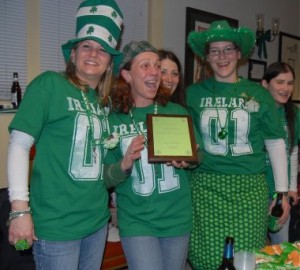
Bridgeport Rib House Wins AOH Irish Coffee Contest—Again

Bridgeport Rib House winners, from left, Kim Loncher, Lisa Van Fosse, Jeanine Hand, and Barb Brown.

Bridgeport Rib House winners, from left, Kim Loncher, Lisa Van Fosse, Jeanine Hand, and Barb Brown.

Kim Loncher of the Bridgeport Rib House was going to enter a brand new recipe in this year’s AOH Div. 1 Irish Coffee Contest. “I made up a new one and tried it on our patrons,” she explained. “Only two people liked it. So went back to our old recipe.”

Turned out to be good thinking. The Rib House entry took home first place for the second year running in this relatively new annual event which was held at the AOH Hall in Swedesboro on Thursday night, March 13. And there are no “secret” ingredients. Kim shared the recipe with us last year and you can see it here.

It must have been tough for the judges (a collective “awwwwww” here). I sampled all of the coffees and I would have had a hard time choosing. For example, the entry from The Elks Lodge 714, which came in second, is just the drink you want after a cold day outside (like this year’s St. Paddy’s Day parade in Philadelphia). Light on the coffee, heavy on the Jamesons.

Clarissa Morales, bartender at Screwballs Sports Bar and Grill, said she and fellow barkeeps concocted their Guinness-looking entry by talking to “people in the area of Irish descent.” And she had some very explicit instructions for drinking her brew. “Don’t stir it up!” she told me. “Just drink it. You don’t stir Guinness.”

One of the more intriguing entries came from Anthony’s Tavern and Restaurant in Bridgeport. Anthony Pasceri made his entry with espresso (very good), brown sugar (excellent), Irish whiskey (nice), a little fire (what?). The fire, he explained, helped meld all the flavors. Okay. But what he added next had me wondering why he didn’t even place. He called it “nada.” He pulled out a pastry bag and squirted a little on my finger. Oh my. I’m not a big fan of whipped cream, but I could have asked for a cup of this. In fact, the woman standing next to me did ask for one. It was, he explained, just sugar, heavy cream, and a little Bailey’s. Just!

Other participants this year included Chick’s Tavern and Guppy’s whose entries were also delicious. You could tell: By the end of the competition, the only drops of Irish coffee left were in front of the judges.

Food & Drink

9 Recipes to Make Your St. Paddy’s Party a Hit

We asked for recipes to feed a party, and that’s what we got. Lots of traditional stews and chowders, a great recipe for fish and chips, and some delicious desserts came in from local restaurants and Irish cooks all over the Delaware Valley.

We’re adding these to our growing list of recipes that will keeping you eating great Irish food every St. Paddy’s Day–and all year long.

Lamb Stew

This recipe developed by Chef Geoff Hutton at C.J. McGee’s Restaurant and Pub was contributed by former proprietor Jack McNamee, the 2008 St. Patrick’s Day Parade Grand Marshal.

2 lbs cubed lamb
3 cups of lamb stock
2 medium onions, ½ onion minced, 1 ½ onion generously cut
6 medium carrots, inch round cuts
1 lb of baby potatoes
½ cup of flour
3 tbsp. oil
2 minced garlic cloves
1 bay leaf
1 sprig of fresh thyme, stems removed and minced
2 sprigs of fresh parsley, stems removed and minced
Salt
Pepper

Generously salt and pepper cubed lamb, then lightly coat with some of the flour (approx. 3 tbsp).  Heat up the oil in a heavy pot or saucepan.  Brown the cubed lamb in the oil, and then remove the lamb from the pot.  Add a half an onion (finely chopped) and the two minced garlic cloves to the pot, stir until onions and garlic are tender.  Add approx. 2 tbsp. of flour to the onions, garlic, and juices of the lamb.  Stir until smooth.  Add the bay leaf, fresh thyme, and lamb stock slowly to the pot, stirring constantly.  Put the lamb back into the pot, bring to a boil, reduce heat, and simmer for about forty-five minutes to an hour (until lamb is just about tender).  Add remaining onions (generously cut), carrots, and baby potatoes to the stew.  Simmer for another half hour or until your vegetables are tender.  Taste to see if any more seasoning is necessary, if so, add salt and pepper to taste.  Add fresh parsley to the finished stew, remove bay leaf.  If the stew is not as thick as you would like it, whisk some room temperature stock and the remaining flour together.  Whisk the blend into the simmering stew slowly, until you reach your desired thickness.     

McGillin’s Corned Beef & Cabbage Recipe

This traditional Irish-American recipe comes from our friends at McGillin’s Olde Ale House on Drury Street in Philadelphia. We stopped in there the last couple of parade days and had some great beer, but couldn’t make our way to the food (what a crowd!). Looks like we should have tried harder. McGillin’s has been contributing to the IrishPhiladelphia Virtual St. Paddy’s Day Cookbook since it began three years ago. Thanks, guys!

12-15 lb corned beef
3 cups     water
6 Tbsp pickling spices
½ cup    white wine vinegar

Place corned beef in roasting pan, pour water and vinegar into pan, sprinkle pickling spices over corned beef.  Roast for 3 hours at 300?F.  Strain juice, save on side

1  white cabbage, wedged into 1/8’s
2 lb carrots, cut into chunks
1 tsp    salt and pepper
1 cup    water

Skewer each wedge of cabbage with a toothpick to retain shape during cooking.  Line pan with cabbage wedges, chunks of carrots, salt & pepper and water.
cook 1 hour at 250?F (makes cabbage & carrots sweeter).  Retain juices.

5 lbs red bliss potato, halved
5 tsp     butter
3 tbsp    olive oil
4 garlic cloves, chopped
4 tsp    rosemary, chopped
3 tsp salt & pepper

Bake in single layer, 1 hour, at  350?F

Mix corned beef juices & cabbage juices

On your dish place cabbage wedge, carrots and corned beef.  Place potatoes around the sides and pour small amount of mixed juices over the whole platter

Seafood Chowder
The Beach Bar B&B in Templeboy, County Sligo

Contributed by Tom O’Malley, who plays guitar in the Pat The Budgie Ceili Band.  Tom told us that he got this recipe from the owner after a night of music and other craic. We don’t doubt it.

1 large onion
1 head celery
4 to 6 medium potatoes
3 to 5 cloves garlic
1 quart milk
1/2 pint heavy cream
glass of white wine (more or less)
2 lbs mixed seafood
1/4 lb. butter for roux

In large pot, Dice onion, celery, potatoes and cook in a little butter about 15 mins.  Add wine and simmer until spuds are tender.  Add milk and cream and cook another 10-15 mins.  Add roux to desired thickness.  Makes about 10 portions.

Salmon adds a great taste and texture.  Also, a little liquid smoke is nice.

CORKTOWN IRISH STEW WITH HERB DUMPLINGS

This recipe won retired police officer Phil Bowdren the First Prize Award / Amateur Class in the 2006 Hibernian Hunger Project Great Irish Stew Cook-Off held at Finnegan’s Wake.

Serves: 6 to 8

2 – 3 lb  lamb, cut into pieces (depends on how meaty you want it)
3 tbsp olive / vegetable oil
2  onions, chopped
2-3 carrots, cut into 2” pieces
4-5 potatoes, cut into quarters or 2” pieces
2  tomatoes, peeled and chopped
1/2 tsp garlic powder
1 large bunch – fresh mixed herbs, tied with a string
2 cups lamb broth (get lamb bones from butcher)
1/2 cup Irish whiskey
Salt and pepper to taste

Brown meat in oil in a skillet, along with onions. (I usually do this in small batches) Add 1 shot-glass of Irish Whiskey to skillet, light to burn off alcohol (imparts flavor of whiskey to meat) Place browned meat, onions and vegetables in large cooking pot. Add garlic powder. Place herbs in middle of mixture. Cover with broth; cook approx. 2 – 2 1/2 hours over low heat. While stew is cooking, make dumplings. During last 30 minutes of cooking, bring temperature up until stew starts to bubble, and then add dumplings. Salt and pepper to taste.

Dumplings make a stew or casserole more interesting and wholesome. They should be light and not sticky. To make sure of this:

4 oz. – self raising flour
1 pinch – salt
2 oz. – fat / soft margarine
Warm water to mix
2 – 3 tsp. of fresh herbs or 1 tsp. of dried herbs. (parsley, chives or mixed herbs)
 
Sieve the flour and salt into a large bowl. Blend the herbs into dry mix (flour & Salt). Add the fat / margarine and blend with a knife. Stir in just enough water to bind the mixture, which should be just soft enough to roll into balls. Divide dough into 4 portions and roll into balls with floured hands. Make sure that the mixture is firm enough to roll in balls but is not too stiff. Once stew begins to bubble, add dumplings on top of stew and allow to cook with stew.

NOTE from Phil: Beware of “Stewies”, those people who somehow always knew when stew is on the stove and show up with their bowl or container in hand.

Easy Beef Stew

This no-hassle stew comes to you by way of Slainte Pub and Grille, a new pub at 3000 Market Street from those wonderful folks who brought you New Deck Tavern. Thank Chef Stephanie Gray and General Manager Kathleen Doyle for this delicious recipe.

5 lbs 1″x1″ cubed beef (shin meat is really tender)
1 large white onion, medium dice
2 large carrots, medium dice
2 cups peas
2 T chopped garlic
1 cup white wine
2 gallons beef stock
2 T tomato paste
To taste: salt and pepper
As needed : corn starch and water mixed to thicken
 
In a large pot saute the beef until browned and then add in the vegetables.  Once vegetables are translucent add the white wine and reduce and then add in the beef stock.  Simmer until meat and vegetables are tender.  Stir in tomato paste.  Whisk in corn starch and water mixture and boil until desired thickness is achieved.  Serve on top of mashed potatoes or boiled potatoes!


Slainte’s Fish and Chips

Another delicious entrée from Slainte.

4 8-oz. cod filets (one per person)

Beer Batter
2 c. flour
 2 T corn starch
1 egg
2 c Harp lager
1 tsp salt
1 tsp pepper

Combine ingredients in large bowl. The batter should be thick
enough to coat the back of a spoon but can be evened out by
adding more flour if too thin or more Harp if too thick.

Heat canola oil over a shallow frying pan to medium-high heat.
Coat each filet in a thin layer of flour and place deep in the beer
batter.

Place filet in shallow frying pan by dragging the tip around so the frying adhers to fish and then place in oil completely and fry each side until
golden brown.

For tartar sauce:
• 2 c. mayonnaise
• 1 small white onion, minced
• 2 T parsley, chopped
• 2 T relish
• 1 small lemon, juiced
• 1 tsp. salt
• 1 tsp. pepper
Combine all ingredients until smooth.
Recipe serves 4 people.
For chips steak fries that your local grocery store carries are perfect and bake until crispy or fry in oil until golden brown as well.

Irish Whiskey Cake

We suspect this recipe from Carmel Boyce will make you get up and sing. How else can you explain that musical family? Sons Mike and John Boyce play in the Celtic rock group, Blackthorn, and her daughter Karen is singer with the group Causeway. Carmel and her husband, Barney, are tireless fundraisers for the Irish community and were recently named to the Ring of Honor for the 2008 St. Patrick’s Day Parade. Apparently this cake also makes you generous.
            
1 box Duncan Hines yellow cake mix                                 
1 box instant vanilla pudding                               
2 oz Irish whiskey                                                                                    
4 eggs
1 cup milk
1/2 cup oil
1 cup walnuts

Glaze
½ cup whisky
¼ lb butter
¾ cups sugar
 
Mix first 7 ingredients. Grease and flour tube pan.  Bake at 325 degrees for approx 55-60 minutes.

Boil glaze ingredients and pour over cake.

Sprinkle with castor (superfine) sugar  (optional).

Irish Short Breads with Cherries

Bernadette Truhlar, treasurer of the Irish Center, shared several recipes with us from her mother’s file. We’re putting a few aside to print on other holidays, but couldn’t wait to try these easy cookies.

1 1/2 cups sugar

1 cup butter or margarine

4 eggs

1 tsp vanilla

1 can cherry pie filling

In a mixer, beat softened butter or margarine with sugar and beat well. Add the eggs, well-beaten, and the vanilla. Slowly add the flour. Spread batter on a large ungreased cookie sheet with a rim. Add a teaspoon of the cherry mixture 1 1/2 inches apart. Bake at 325 degrees for 40 minutes. Cut into bars when cooled.

Maggie O’Neill’s Irish Whiskey Cake

When Chef Norm Staley from Maggie O’Neill’s Irish Pub and Restaurant in Drexel Hill first uttered the words, “18 two-pound loaf pans,” we thought we’d never be able to use this restaurant-sized recipe in our annual cookbook. But then we joined the Ladies Ancient Order of Hibernians annual Irish potato-making event (they sell the candies and give the money to charity) and we remembered:  There are plenty of kind folks out there who are saving the world one bake sale at a time. Ladies and Gents, this one is for you! Thanks, Norm!

18  2 lb loafs pans

6 ¾ lbs of yellow cake mix
3 lbs vanilla pudding mix
5 cups Irish whiskey Jameson or Powers
4 cups milk
3 c vegetable oil
30 eggs
6 cups chopped walnuts

Whip eggs in a blender until they’re almost coming out of bowl–about15 minutes. You want them to be nice and airy.

While the eggs are whipping, combine the whiskey, milk, and oil together and whisk. 
 
Mix  the dry ingredients–cake mix, pudding and walnuts—in another bowl.

Add dry and the wet together, mix with spoon.

When eggs done, fold them into the mixture gently. 

Pour the batter into 18 2 lbs loaves (or 20 1 lb loaf pans). Fill to almost half.

Bake in oven 35 minutes at 350 degrees.

Glaze

1 ½ butter
3 cups sugar
3 cups of whiskey

Bring whiskey and sugar to almost q boil, whisking the whole time. Add the butter in cubes,  and whisk on low flame till it boils.

Pour or brush over loaves when they’ve cooled on a wire rack and are back in the loaf pan.

Music

Top 10 Things Not to Do During the Singing of “Danny Boy”

A New York bar owner made headlines (and not a few enemies) recently when he banned the singing of “Danny Boy” in his midtown boozerie during the month of March.

Nothing against “Danny Boy,” Shaun Casey, owner of Foley’s, told ABC News. It’s just that a.) in March, everyone wants to sing it, and b.) they do it very, very badly. Karaoke nights, in particular, can be a real drag, Clancy said.

 “Everybody thinks—whatever race, creed or color—that after three pints of Guinness, you’re entitled to get up there and butcher the song,” Clancy said.

With St. Patrick’s Day just around the corner, of course, that can mean only one thing. It means that you probably won’t have to wait for someone to die to hear someone sing “Danny Boy.” In fact, during the month of March, genuine scientific studies prove that the average Irish person in a pub suffers through a painful rendition of “Danny Boy” precisely every 7 minutes and 23 seconds.

In the interest of Total “Danny Boy” Preparedness (TDPP), we now respectfully offer you, from the home office in Horseleap, County Offaly, the official Irish Philadelphia Top 10 Things Not to Do During the Singing of “Danny Boy”:

  1. Offer to perform the Heimlich maneuver on the singer. (He’s not choking on a live barn owl; it only sounds that way.)
  2. Suck helium and harmonize in a chipmunk voice.
  3. Dance the Hora.
  4. Clap on the downbeat.
  5. Clap on the upbeat.
  6. Pretend to sing the song in reverse, slowly and in a deep voice, and at the end drone, “Paul is dead. I buried Paul.”
  7. Bay like a beagle with a bellyache.
  8. Threaten the singer in a way that demonstrates pride in your Irish heritage, but at the same time cements your reputation as a gangsta: “Stop that racket or I’ll be after beating you with me shillelegh, fo’ shizzle dizzle!”
  9. When he hits the high note, throw your panties onto the stage. (Optional for gentlemen.)
  10. Yell, “One more time!!!!”
News

Holy Moly! I’m Speaking Irish!

Daniel Cassidy, author of "How the Irish Invented Slang."

Daniel Cassidy, author of "How the Irish Invented Slang."

More than 1.6 million people in the world speak Irish, and if you’re not one of them, there’s a guy named Daniel Cassidy who begs to differ.

If you’ve ever called someone “dude,” said “holy moly,” told a “babe” you were going to plant a “smack” on her lips, or taken a “slug” of whiskey, you were speaking Irish, says Cassidy, co-director and founder of the Irish Studies Program at New College of California, a filmmaker, folk singer, and now famous around the world for writing the American Book Award-winning ”How the Irish Invented Slang: the Secret Language of the Crossroads.” The book, from the tiny publisher CounterPunch, is in its fifth printing.

Americans speak Irish all the time without even knowing it, says Cassidy, just the way any Italian-American who calls his buddies “goomba” (from the Italian word meaning “friend”) speaks Italian, or a Jew who liberally uses the words ‘chutzpah” (both Hebrew and Yiddish for “nerve”) or “mensch” (meaning “a good person”) speaks Yiddish.

I talked by phone to Danny Cassidy—that’s how he identifies himself—a week ago from his home in San Francisco. A native of the Irishtown neighborhood of Brooklyn, he hasn’t let a few years on the west coast steal his accent nor mellow out his attitude. “I’m hyper,” he says, and proceeds to give me his spiel (that’s from an Irish word speal, meaning to mow down with words) like a carnival barker in overdrive.

“Dude (spelled dud or duid) means a foolish-looking fellow,” he explains. “Dude” was a name New York’s Five Points Irish gave the dapper, wealthy young men of the 1880s who went slumming (another Irish word, from ‘s lom, meaning “an exposed, vulnerable place”) in their neighborhood where there was plenty of poteen and gambling to be had. The word first appeared in 1883 in the Brooklyn Eagle newspaper as a “new word” to refer to these well-dressed sons of New York’s elite.

It may have been a new word to Americans, but it was a familiar one to the recent immigrant Irish speakers who populated so much of the city. And yet, all of those words and hundreds more than have slipped into the American lexicon are often grouped under the umbrella of “origins unknown,” Cassidy claims.

“H. L. Mencken said that the Irish were the only ethnic group that had no influence on American English, except for smithereens, speakeasy, and shillalegh,” he says. “When I read that it seemed to me that that would be an anomaly, a serious irregularity. I know my people can talk the paint off a wall, as well as write the paint off a wall. It doesn’t make sense that there are no Irish words in our language.”

How Cassidy discovered the Irish contribution to American slang involves a book—which he didn’t really want–left to him by a Philadelphia friend. “A dear dear young friend, Kevin O’Dowd, from Philadelphia died suddenly at the age of 37 in 2000,” Cassidy explains. “He left me a box of Irish books in his will. One of the books was a pocket Irish dictionary, a focloir poca. I was in Ireland making a film at the time and thought ‘I’m too old to learn Irish, it’s too hard.’ But I told my wife, Clare, ‘I can’t throw that away. It was a sacred gift from Kevin.’”

So Cassidy put the focloir poca by his bedside and read a little every night. “I found the word ‘snazzy’ in three days. It was the word snasach, pronounced snaseh, which means glossy, polished, neat, elegant, wealthy. Look it up ‘snazzy’ in the dictionary and what does it mean? Glossy, polished, neat, elegant. . . “ And there were more, many more. Cassidy was even able to divine for the first time why his family called him “Glom.”

“I once asked my mother why they called me ‘Glom’ and she said ‘it’s because you’re always glomming on to other kids’ stuff.’ I asked her where the word came from and she said, ‘I don’t know. Maybe it’s Yiddish.’ I said, ‘Mom, we’re not Jewish.”

But there it was, right there in Kevin O’Dowd’s gift folcloir poca: Glam, to grab, snatch. And in the American dictionary: glom, to grab, to snatch. Cassidy nearly cried “Eureka!” which isn’t Irish at all. He might have shouted “Gee Whillikers,” which is Irish, from the word Dia thoilleachas, prounounced jia hoill’ah’cas, meaning God’s will. Or Holy Gee, from Holy Dia, meaning Holy God. Or Holy Mackerel, from Holy Mac riuil, meaning Holy Noble Son.

It took Cassidy seven years, but he managed to track down Irish sources for hundreds of slang words Americans use every single day, from jazzy (teasai, pronounced j’asi or chassi, meaning passionate and exciting) to yellow, as in cowardly. That comes from the Irish word ealu, meaning “sneaking away. “

Cassidy’s book is filled with the language of gambling. Faro itself comes from an Irish word Fiar araon, meaning to turn two together. In Faro, the main move is called “the turn” and happens when the faro dealer turns two card together in the card shoe and places them face up on the faro layout. Even the words scam, gimmick, and baloney (beal onna, silky talk) are derived from the “secret brotherhood of gamblers,” many of whom were Irish, says Cassidy.

So, the question remains, if so many words in the American dictionary have Irish origins, why didn’t anyone else discover it before now?

“There are a couple of reasons,” Cassidy says. “Let me first contextualize it. The Oxford English Dictionary began in 1870 at the highest point of British, let me use the word, imperialism. And over here, even though Webster was trying create a new, more democratic dictionary, Mr. Webster had no Irish. When he was writing his dictionary, how were the Irish people regarded? They were the maids, the laborers, the people of the slums. They were not looked at as a people who had a classic literate language of the Atlantic world. Yet, Irish was the first literate language in Europe after Latin and Greek. In his book, ‘How the Irish Saved Civilization,’ Thomas Cahill recounts how the Irish monks of the 6th century translated hundreds of ancient texts—not just the Bible, but ancient epics of many cultures, including pagan—and recorded them during the Dark Ages.”

The language was nearly lost, Cassidy says, when the British conquered Ireland and set out to destroy the culture. “To destroy the Irish nation, they had to destroy the Irish language,” he says. It became illegal for the Irish to speak their own native tongue.

Eventually, Irish became the language of peasants, the poor, the rebels and the immigrants. “In the 17th and 18th centuries, you could go into the fields of Ireland and hear peasants who couldn’t read or write reciting beautiful passages of poetry that they’d memorized,” says Cassidy. “It’s such a great irony that the language of the great scholars of Ireland was saved by the poorest of the poor in the Gaeltacht (the Irish-speaking areas of Ireland). When the Irish came to America, as early as the 17th century, they could speak it but most couldn’t write it. But it’s there in the air. In the 19th century, more than 7 million poured into the greatest crossroads cities in the US and that language was scattered across America.”

Buckaroos in Montana were Gaelic bocai rua, Irish and Scottish Gaelic-speaking cowboys who called themselves “wild rogues” in their own language. Political ward heelers in New York derived their handle from the Irish word eilitheoir, meaning one who demands or charges. Chicago gangsters took monikers—nicknames, like Bugsy—from an Irish traveler word, munik, meaning name. “Irish was slowly absorbed into the vernacular speech of American language but it’s absorbed anonymously, much like much of our music is absorbed anonymously,” says Cassidy.

And speaking of music, Cassidy’s second book will unravel the mystery of some of the supposed nonsense words in many Irish traditional tunes. Like the oft-sung tune, “Pat (or Paddy) Works on the Erie,” that begins:

“In eighteen hundred and forty one,
I put my corduroy breeches on
To work upon the railway.”

It’s followed by a chorus that goes, “Fil-i-me-oo-re-i-re-ay, Fil-i-me-oo-re-i-re-ay, Fil-i-me-oo-re-i-re-ay, To work upon the railway.”

It sounded silly to Cassidy too, until he started learning Irish.

“I was about three and a half years into the project, and I’m not a fluent Irish speaker, but I am a folk singer and I’d been singing that song since I was a boy,” Cassidy says. “One day it hits me: This is a song about a guy who’s putting his pants on to go to work, and the words he sings, as it turns out, are an Irish phrase that means ‘I’ll go back.’ He’s putting his pants on to go back to work! ‘Filimeooreireay. . .to work upon the railroad.’”

You can almost hear the “eureka” in his voice. So, I asked, “What about tooralooraloora? What’s that mean?”

He laughed. “I’m getting close to figuring that one out. It will be in the next book, I promise.”

People

There’s a New Marshal In Town

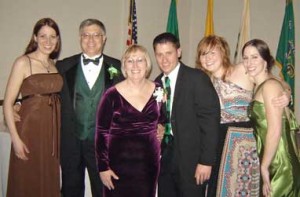
The grand marshal and his family.

The grand marshal and his family.

The Grand Marshal’s Ball for the 2008 Saint Patrick’s Parade in Conshohocken took place on Saturday Night (March 8) at the Jeffersonville Banquet Hall with 230 family, friends and fellow members of the AOH, LAOH and Philadelphia Emerald Society.

The night opened up with Father Bier leading the opening prayer. Sara Agnew sang the Soldier’s Song and led the pledge of allegiance. Pete Hand was then escorted into the hall by Irish Thunder Pipes & Drums.

Once in the hall, after a couple of tunes, Pete was given the honors of Grand Marshal. The 2007 Grand Marshal Ed Halligan turned over the Sash and shillellagh to Pete.

Attending the event were several AOH officers, including Ed Halligan, Jim Murphy, Tom Couglin Sr. and Tom Jr., Kenny Young, LAOH officers Rae DiSpaldo. and Eileen Kaufman. President Harry Marnie and board of directors of the Philadelphia were also present.

The Saint Patrick’s Parade in Conshohocken will take place this Saturday March 15th beginning at 2 p.m., starting at 11th and Fayette.

News

A Day of Ceremonies

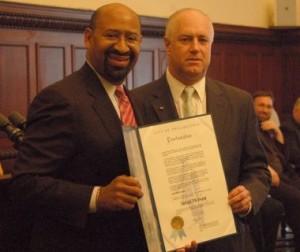
Mayor Michael Nutter and Parade Director Michael Bradley.

Mayor Michael Nutter and Parade Director Michael Bradley.

For the day, said Philadelphia’s mayor of less than two months, he would be known as “Micheal (pronounced Mee-hawl) O’Nutter.” He got an appreciative laugh from the nearly 100 people who filled the richly decorated meeting room at City Hall after the annual wreath-laying ceremony by the Friendly Sons of St. Patrick on Thursday, March 6.

The Friendly Sons—an organization that pre-dates the signing of the Declaration of Independence by 5 years—honors Philadelphia’s Irish past where Philadelphia itself honors it: beneath a plaque erected on the west side of City Hall that contains the names of prominent Irish Philadelphians of the past.

Mayor Michael Nutter seemed to enjoy the event, which brought pipers and Irish dancers to the heart of city government for an hour. He grinned broadly as Rosemarie Timoney’s step dancers jigged across the navy and gold carpet in front of him, and later singled out the one young boy in the troupe. He didn’t say it, but it sounded like it was for his bravery. Irish Center President Vince Gallagher sang the national anthem, and Karen Boyce, whose parents, Barney and Carmel, are part of the St. Patrick’s Day parade’s Ring of Honor, sang the Irish national anthem in both English and Irish. The events at City Hall were followed by a luncheon at the DoubleTree Hotel on Broad Street to recognize the parade’s 2008 Grand Marshal, former restaurateur Jack McNamee, and those named to this year’s Ring of Honor.