News

Green Lane Scottish – Irish Festival 2007

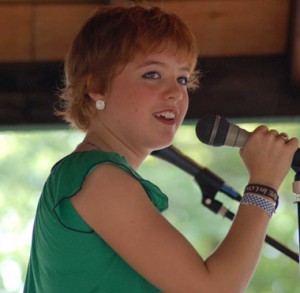
Genna Gillespie of Burning Bridget Cleary

Genna Gillespie of Burning Bridget Cleary

There was Nessie, or an apparently benign and far less camera-shy version of the legendary Loch Ness Monster, afloat on the appropriately greenish Green Lane Reservoir. In a grove just off the lake, Highland dancers and Irish dancers took turns on a makeshift stage. In a nearby field, kilt-clad athletes risked sunstroke and hernias as they attempted to toss the caber—something like a telephone pole. And from across the reservoir rose the sound of the pipes and, farther off, fiddles. (Oh yes, and the heavy, oily tang of frying fish and chips.)

This was the last day of the Green Lane Scottish-Irish Festival, a perfect sun-drenched finish to three days of Celtic merry-making in Upper Montgomery County. It’s hard to imagine a better end to the annual gathering of the area’s many clans.

If you missed it, no worries. We’ve got the photos:

Sports

Irish Heritage Day at the Phillies

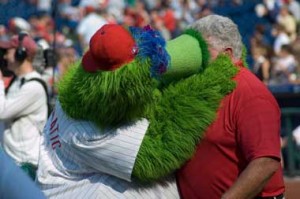
Vince Gallagher gets a Phanatic smooch.

Vince Gallagher gets a Phanatic smooch.

There were no wardrobe malfunctions. No American Idol-esque vocal calisthenics. No tortured operatics.

What there was, was Vince Gallagher, the well-known Philadelphia Irish musician, radio host and president of the Philadelphia Irish Center, standing at home plate at Citizens Bank Park and belting out the National Anthem in his Donegal lilt, singing it straight out, and doing it nearly flawlessly. (There was one little flub early on, but who doesn’t mix up the lines of the National Anthem?)

And with that, as the saying goes: Play ball!

Vince’s performance capped off the pregame activities at Irish Heritage Day at the Phillies, a Saturday promotion that included performances by the Bogside Rogues, along with the Cummins and Lynn Irish dance schools. Brian Morris, former pitcher for the Irish National Baseball Team, tossed the first pitch, and John Fitzgerald, the film-maker who documented the team’s rocky road to success in “The Emerald Diamond,” caught it. (With the Philly Phanatic serving as umpire.)

And, amazingly, the Phillies won. (Gallagher friend Jim McGill later suggested that the Phils adopt Vince as their Kate Smith.) Anyway, maybe there really is something to this hokey “luck of the Irish” business.

It was all great fun. See for yourself.

History

Are You Getting Off at the Sacred Hill of Tara Interchange?

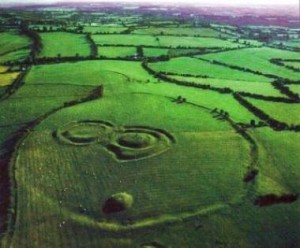
The beauty of Tara.

The beauty of Tara.

Two years ago, the Irish government approved a plan for a 37-mile stretch of highway to ease commuting to and from Dublin that will cut a swath through the landscape only a mile from Tara, the traditional seat of the Irish high kings. Since then the road-building has been delayed by protests–from archeologists, historians, cultural critics, and local citizens–as well as the discovery of a major prehistoric site in May that may date back to the Stone Age.

But the delays were temporary. In August, Irish planning authorities gave the okay for work to continue right through the recently uncovered ruins, once they were excavated and recorded.

Many opponents are calling this new stretch of the M3 “the road to ruin,” and fear that important historical artifacts–not to mention the panoramic face of the landscape–will be lost in the march of progress so close to the spot where St. Patrick reputedly began his conversion of the Irish to Christianity.

For more information on the project and how you can help stop it, visit www.tarawatch.org. Look for the “Save Tara” button on this site which will take you there.

Other things you can do:

Sign an online petition at www.petitiononline.com/hilltara/
Send a letter to a newspaper. Instructions at: www.hilloftara.info
Write to politicians. Instructions at: www.hilloftara.info
Join the discussion group at http://groups.yahoo.com/group/hilloftara/

To read about a planned protest by a group of Irish harpers (the harp is part of Ireland’s coat of arms) on September 22, go to www.myspace.com/TaraHarpers

Columns, How to Be Irish in Philly

How To Be Irish in Philly This Week

The best way to be Irish this week is to start making those last-minute plans to head down to Wildwood on September 21 for the North Wildwood Fall Irish Festival sponsored by the Ancient Order of Hibernians and the 16th Annual Irish Weekend with Blackthorn in Wildwood (the next town over).

It might be impossible to find a place to stay at this late date, but it’s worth calling around (or planning a day trip). Just about every local Irish band, from Paddy’s Well, the Bogside Rogues and, of course Blackthorn, to your favorite pipe and drum unit will be there for the weekend, shamrocking the shore like nobody’s business. Check out our calendar for contact information about tickets to both events and accommodations packages for Blackthorn.

Otherwise, consider taking in an Irish play or two. “Trad,” by Mark Doherty is playing at the Mumm Puppettheatre on Arch Street and “The Lonesome West,” by Martin McDonagh is at St. Stephen’s Theater at 10th and Ludlow.

If golf is your thing, the AOH Division 1 is holding its annual golf outing on Saturday, September 15, at the Skippack Golf Course at Stump Hall and Cedars Roads in Skippack. All proceeds from the event–which is open to all–goes to AOH charities.

Also open to the public is the Friendly Sons of St. Patrick’s Halfway to St. Patrick’s Day party at the Llanarch Country Club, 950 W. Chester Pike in Havertown, on Saturday. The cost is $50 per person and includes cocktails, dinner, and dancing to the wonderful Theresa Flanagan Band (it’s worth the price just to hear her lovely voice, trust us).

Will there also be a Three-Quarters of the Way to St. Patrick’s Day party? Only time will tell.

Music

The House I Was Reared In – Christy McNamara

By Frank Dalton

Christy McNamara’s new CD, “The House I Was Reared In,” took me by surprise. I’d known of his evocative photography since reading “The Living Note: the Heartbeat of Irish Music.” This 1996 book was a fictional narrative of a young traditional musician and his family. Accompanying and complementing the text by Peter Woods, your man Christy’s striking black-and-white images captured and displayed the essence of what Irish traditional music is all about—in session at the pub, at weddings and wakes, and in sundry other real-life circumstances. It’s great stuff and you should read the book if you can.

But I wasn’t hip to McNamara’s considerable prowess on the button accordion. Yes, Christy’s a musician, too. In the sleeve notes we read that “It’s always the music … sometimes it seems as if life happens between the notes of tunes”. Well, yeah, that’s true for you, Christy, I’m sure! Hailing from the parish of Crusheen in County Clare, as a kid he heard his grandfather Jim play the concertina. His father Joe and uncle Paddy played the accordion, while another uncle was the great fiddler P.J. Hayes, a founding member of the legendary and long-lived Tulla Ceili Band.

This collection of 17 reels, jigs, waltzes, and slow airs showcases these and many other musical influences. Joined by fiddler Martin Hayes (also a cousin), guitarist Denis Cahill, flute player Eamonn Cotter, and fiddlers Liam Lewis and Peadar O’Loughlin, Christy expertly renders a selection of familiar tunes like the reels “My Love is in America,” “The Copperplates” and “Toss the Feathers,” and jigs like “Scatter the Mud,” “The Kesh” and “Old Man Dillon.” A few less familiar pieces stand out: “I Ne’er Shall Win Her” is a lovely jig I’d never heard before, from Mrs. Murphy of Ballydesmond in County Kerry; “John Naughton’s Reel” is from a Kilclaran concertina player (sure it’s about halfway between Gortnamearacaun and Cloonusker); while “John McHugh’s” was learned from that tune’s namesake who learned it from his grandfather in County Mayo. Christy also treats us to a pair of his own compositions, the waltz “Tae Pot Wood” and a reel, “The Maid’s Lake.”

I forgot to mention that as well as knowing his way around the two-row button accordion Christy is a fine concertina player too (on “The Bunch of Roses,” and “Molly Put The Kettle On”). To top it all off, he sings on the slow air “May Morning Dew,” a moving song of emigration, sorrow and loss.

The CD comes in one of those environmentally conscious ‘digi-packs’ (no plastic jewel box to drop and break and toss into the trash) and contains a 24 page booklet filled mostly with some lovely photographs from the McNamara family archives and some of Christy’s own shots of other musicians, young and old. This is a very worthwhile addition to your collection, especially if you have a fondness for the lovely and unhurried music of County Clare, as I myself do.

Frank Dalton is the organizer of the Coatesville Traditional Irish Music Series.

Music

How Lúnasa Makes Music

There’s an old saying attributed to that funny old German dude Otto Von Bismarck which he used as a way of explaining the often ugly process of governing: “Laws are like sausages. It’s better not to see them being made.” (The “Iron Chancellor” was always coming out with knee-slappers like that.)

Unless you are unnaturally patient (or musically masochistic), you might say much the same thing about how the top Irish band Lúnasa makes music. It’s a painstaking process indeed, according to Lúnasa flutist Kevin Crawford.

Speaking by phone from his home outside the town of Ennis in County Clare, Crawford says that, before the band began recording their most recent CD, , they began with what he calls a “short list” of tunes. By “short,” Crawford means about 90 or so.

“We brought that list to the table a good six to eight months before we even went in to record the tunes,” Crawford says. “We offered the list to (guitarist) Paul (Meehan) and to (bass player) Trevor (Hutchinson). Generally, Paul and Trevor troll through the tunes we give them, keeping the ones that work and throwing out the rest. They come back with at least half of them. From there we just start whittling it down. We get that list down to about 30 tunes and before you know it you have an album.”

If you’ve heard —pronounced “shay,” it’s Irish for “six”—or any of the five other Lúnasa recordings, you’d have to agree that all the fuss is worth it. The music of Lúnasa is brilliantly melodic, but what really sets it apart is its boundless rhythmic adventurousness. Crawford and colleagues have an affinity for mind-bending time signatures. They have a rare talent for bending and blending tunes together in ways that they really weren’t meant to go.

Developing that unique sound was always the plan, says Crawford: “It was always the case that we wanted it to be slightly different. We had all done different things. We decided that, when we came together, we wanted to try out a new approach. It was to give an equal share to both melody and rhythm.”

Maintaining that balance translates into an awful lot of work.

“We do spend an awful lot of time sourcing tunes and trying to figure out whether they’re going to fit the jigsaw,” Crawford says. “A lot gets discarded. We do actually drive ourselves crazy looking for the correct tunes. We’ve gotten more skilled at it over the last 10 years we’ve been working.”

“Skilled” doesn’t half describe Lúnasa’s virtuosity.

Find out yourself at the 33rd Annual Philadelphia Ceili Group Festival Friday, Sept. 7, starting at 7:30 p.m., at the Philadelphia Irish Center, Carpenter and Emlen Streets, in the Mount Airy neighborhood of Philadelphia. Tim Britton will open. Tickets are $25 ($27 at the door).

Music, People

Tom Munnelly, Ireland’s Greatest Song Collector, Dies at Home in County Clare

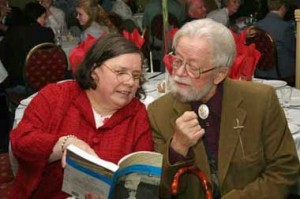
Tom Munnelly and his wife, Annette, peruse the book of essays written in his honor.

Tom Munnelly and his wife, Annette, peruse the book of essays written in his honor.

Tom Munnelly, called “Ireland’s greatest folksong and folklore collector,” died Thursday, August 30, after a long illness, in Miltown Malbay, County Clare. He was 63.Though a Dubliner by birth, Munnelly moved to this mecca of Irish music with his wife, Annette, in 1978, and became chairman of the Willie Clancy Summer School, the largest gathering of Irish traditional musicians in the world held annually the first week of July.

Referred to as “the last song collector” in a 2006 RTE Radio 1 documentary, Munnelly began collecting and recording traditional music in 1964 and had been a collector and archivist of Irish folk music at the University College of Dublin since 1975. He became well known for recording the music and stories of the travellers, Ireland’s itinerant ethnic minority. (One of the most familiar current traveler musicians is piper Paddy Keenan, who appeared several years ago at the Philadelphia Ceili Group’s annual music festival.)

 Munnelly co-founded The Folk Music Society of Ireland (Cuman Cheoil Tire Eireann) and was the first fulltime collector of the National Traditional Music Collecting Scheme, a project initiated by the Irish Department of Education, later folded into UCD’s Folklore Department.

After his move to Miltown Malbay, he started The Folklore and Folkmusic Society of Clare and was chairman and founder of the Clare Festival of Traditional Singing. He also recorded in excess of 1,500 tapes of folksong and folklore, which is the largest and most comprehensive collection of traditional song ever compiled by any one person. Not only that, he transcribed, indexed, and cataloged every note.

This May, many of the leading lights of Irish studies and music published a collection of essays celebrating in Munnelly, called “Dear Far-voiced Veteran: Essays in Honour of Tom Munnelly.” It was presented to the frail Munnelly at a ceremony, attended by his wife and family, at the Bellbridge House Hotel in Spanish Point, County Clare. This June, Munnelly received the honorary degree of Doctor of Literature (DLitt) from the National University of Ireland at Galway in recognition of his contribution to Irish traditional music.

“He is the best collector of folklore that ever existed,” said musician Fintan Malone of Cheltenham who anchors the Tuesday night session at The Shanachie Pub in Ambler and who is a native of Miltown Malbay. “Tom was a good friend of ours. He was a very witty man, with a dry sense of humor. Very gentle, generous, very intelligent and dedicated to collecting folklore. He was very well-liked.”

Malone, who was in Miltown last July for “Willie Week,” said that he saw Munnelly then at Tom Malone’s, the pub Malone owns with his brother,  and he looked very gaunt. “I was taken aback. He had been ailing for a while,” Malone said.

Paul Keating, artistic director of the Catskills Irish Arts Week  first met Munnelly at the 1976 Festival of American Folklife produced by the Smithsonian Institution for the Bicentennial.

“The world of Irish traditional music lost one of its most dedicated academic voices today when Tom Munnelly left us,” Keating told irishphiladelphia.com. “I was aware of the high regard he had for traditional musicians and they for him because of his work on their behalf.  As a song collector and folklorist, he had the personal touch that separated him from the ordinary collector who thinks their job is to put things down on tape or print and so he will be fondly remembered for years for touching so many lives and helping to keep the traditional way of life alive.  His battles weren’t always easy but he was a fiercely determined Dubliner who wasn’t easily deterred and that was his way until the end. “

Irish studies teacher and traditional Irish singer, Virginia Stevens Blankenhorn co-taught song seminars with Munnelly (an passionate advocate for sean nos singing) at the Willie Clancy School for two years in the mid-80s.

“These weeks are among my happiest memories. Tom was such fun to be with, always looking for a laugh, always ready to skewer silly ideas, but always (at least in class) with tact and kindness,” said the California native, who now lives in Ireland. “It was no mean achievement to win the trust and regard of both the traditional communities in which he worked and the academic world – especially the latter, given his intolerance for hot air. Irish traditional song has been uncommonly blessed in having Tom as its chief champion and advocate, and I am so sad that heaven claimed him before I could see him again.”

Funeral services for Munnelly will be at St. Joseph Church in Miltown Malbay at 1 pm Saturday,September 1, followed by burial at the Ballard Road Cemetery.

News

Top 10 Things NOT to Do at an Irish Music Event

As we approach the beginning of the 33rd Annual Philadelphia Ceili Group Irish Festival, we thought it might be helpful to explain some of the basic rules of Irish music etiquette for the uninitiated (with a tip of the hat to David Letterman).

From the home office in Horseleap, County Offaly, the official Irish Philadelphia Top 10 Things Not to Do at an Irish Music Event:

1. Flick your lighter and yell “Free Bird!”
2. Sing “di-dee-di-dee-di-dee-di” just like the guys on “Whose Line Is It, Anyway?”
3. Ask, “Is that a tin whistle in your pocket, or are you just glad to see me?
4. Yodel along to everything
5. The wave
6. To everyone you run into, say, “Top o’ the marnin’ to ye” just like Barry Fitzgerald
7. After every verse of “Si Bheag Si Mhor,” sigh loudly, look at your watch and ask: Is it over yet?”
8. The Electric Slide
9. When singing “She Moved through the Fair,” croon “ohhhhh, baby, baby” in a Barry White voice
10. Play the bodhran