People

From the FOP to the Irish Memorial

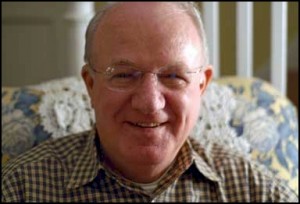
Bob Hurst

Bob Hurst

You might think being president of the Irish Memorial, Inc., is a tough job. After all, you’re heading a board that oversees the largest, most visible presence of the Irish in the city other than the crowd that comes downtown for the St. Patrick’s Day parade. The Irish Memorial is a 24-foot long bronze sculpture depicting the spirit of immigrants taking on the challenges of the new world, set in a 1.75-acre park at Penn’s Landing.

But former Philadelphia Police Sergeant Bob Hurst Sr. spent his childhood in an orphanage, was hospitalized 50 times in the line of duty, mugged 278 times, stabbed eight times (once in the neck, leaving him paralyzed for more than five hours), once walked the streets of the city dressed as a nun and—in what might have been the most harrowing adventure of his life—served as the president of the Philadelphia Fraternal Order of Police for four terms. In that last role, he had to deal on a daily basis with politicians. When he served in the police stakeout unit, he says, at least he “knew who the enemy was. With politicians, the bugger’s behind you.”

So, president of the Irish Memorial? Piece of cake.

Of course, that’s not really how the 70-year-old Hurst sees it. Despite his 16 years on the street, Hurst is far from cocky. If anything, he’s got the market cornered on humility. Hurst, says his friend Bob Gessler, who has been on the Memorial board since its inception, feels such a “personal connection to the Memorial” that he goes down a few times a month just to pick up the trash. “This St. Patrick’s Day, I saw Bob with a bag in his hand going through the site, picking up trash, cigarette butts and cans,” Gessler says. “I was impressed that he wanted to make the site look better for this very public event. I told Bob so and he indicated that he did this monthly. He would come down early Saturday mornings and take an hour or so just to clean the site. This is the sort of dedication that he brings to the board.”

But Gessler left something out. “I might also chase a few bums off,” concedes Hurst. Though he’s been retired from the Philadelphia police department since 1987, Hurst is still in touch with his inner cop. That’s understandable. For a decade, Hurst was a member of the force’s so-called “Granny squad,” whose members dressed up as the mugging target group du jour, whether it was insurance salesmen or grandmothers or even nuns. “I did pose as a nun but we got out of that business real fast because we got letter from Cardinal,” recalls Hurst, barely stifling his rich, infectious laugh. “He took umbrage with the idea of using a shotgun from underneath the habit to blow people through windows. We were not the little sisters of mercy.” That last quip was almost smothered by laughter—his and mine.

Hurst has that essential quality—a great sense of humor—that allowed him to survive not only life on the street, but his early tragedies and the tough world of city politics. His mother, a native of Swinford, County Mayo, who had nine children, died at the age of 37 of breast cancer. Hurst’s father, a PTC motorman who was born in County Sligo, wasn’t able to care for his entire brood. He kept five and the other four, including Hurst, were sent to the now closed St. John’s Orphanage at 49th and Wyalusing Avenue, which was run by the Sisters of St. Joseph. His father and siblings visited every Sunday. Later, he attended St. Francis Vocational School in Eddington where he spent half the day on academics and half in woodworking shop, making church pews.

But don’t expect Hurst to moan about his tough childhood. He has only good memories of his time at both institutions. “The nuns—those women did a tremendous job under the circumstances,” he says. “They really raised us. At St. Francis we were taught by Christian Brothers and I take my hat off to them. It was a good experience. For guy who had to leave home and go to an orphanage, it could have been a lot worse.”

After graduation, Hurst went into the service, returning to start a career in insurance. He had never considered joining the police force. Didn’t even know a cop until, one night, when he ran afoul of the law. While having dinner with an old school friend who had become a doctor, the two got into an altercation with another man who, as Hurst recalls, was smart-mouthing them to impress a girl.

“Well, one thing led to another,” recalls Hurst. “I got up, slipped, fell flat on my back, but he was coming at me so I put my feet on his belly and right over he went, right through the plate window, $638 worth. I thought, well this is a fine how do you do. So I take off one way, doc takes off the other way. I must have run for two blocks, and came out to Germantown Avenue near the library, and when I did, who’s standing in front of me but a cop, Tony Kane. I looked at him and asked, ‘My only question is how did you know I was coming out here?’ He said, ‘Just a hunch.’”

Kane and his partner, Michael Chitwood (now police chief of Upper Darby), decided not to arrest the two men, but made them split the cost of the window they’d broken. About a month later, Hurst ran into the two in their unmarked car and started chatting. “They asked if I’d ever thought about becoming a cop and I said no,” Hurst says. “But I started to think about it and where it could take me.” So he enrolled in the police academy. (He credits his decision to Kane, who is now dead, and Chitwood, both of whom he still speaks of with admiration. “They could find a criminal in heaven,” he says.)

His first beat was in Roxborough, where he made the acquaintance of a young bank teller named Kathy Durning. “I always had my eyeball on her, but I couldn’t bring myself to talk to her,” he says. “You know that old saying about the Irish wedding proposal: ‘How would you like to be buried with my people?’ Well, I just didn’t have the brass to ask her out.”

One Friday night, when she was working late, she asked him to stick another dime in the meter where she’d parked her car so she wouldn’t get a ticket. “I took the dime from her and walked out to her car thinking, ‘Why the hell did I take that dime?’ and when I got to the meter, there I’d written the darn ticket already. I’d seen her car thousands of times but I didn’t recognize it. So I took the ticket and put it in my pocket and went home and wrote a $3 check and sent it in.”

So, was that how they started dating? No. “I didn’t tell her about it till we were married,” says Hurst, the infectious laugh starting to bubble up. They didn’t actually become a couple until the evening he ran into her in a bar where she was sitting with friends, there to comfort her on the breakup of her engagement. “I asked if I could sit with them, we had a very nice time, and from then on, that was it,” Hurst says.

This year. Bob and Kathy Hurst, parents of four grown children and grandparents of 12, will be celebrating their 40th wedding anniversary on a 16-day tour of Europe, though not to Ireland. “We’ve been there many times,” says Hurst, who has headed so many local Irish organizations—the Mayo Association, the Delaware Valley Irish Hall of Fame, the Danny Brown Division of the AOH—as well as serving on the boards of the Irish Center and the Friendly Sons of St. Patrick, that the top job at the Irish Memorial might be the only gavel-banging job he hasn’t had.

You have to ask others why Bob Hurst has been tapped so often to chair boards. “Bob always has his feet planted firmly on the ground, he’s always positive and optimistic,” says Kathy McGee Burns, who succeeded Hurst as president of the Delaware Valley Hall of Fame and now serves with him on the Irish Memorial board. “Whenever I have a problem, it’s Bob I go to for guidance, and he always gives it.”

If you ask Bob Hurst, the answer is much different. “A lot of people don’t know how to run a meeting with parliamentary rules,” he says by way of explanation. “When I was president of the FOP, we had a parliamentarian come in and give us some schooling on it. When you have 300 people a week at a union meeting, I found that a good chair has one blind eye and one deaf ear. I think people just think, he can run a strict, decent meeting, let’s put him in there. People think I know a lot, but I don’t know any more than the man in the moon. I just know how to run a meeting.”

But his love for the Irish community is palpable as is his deep humility, and it’s likely that that’s what people see when they’re casting around for someone to run their meetings. Roberts Rules of Order may help motions get passed smoothly, but respect for someone who isn’t above picking up trash—without wanting thanks or a pat on the back—is what makes Hurst a sought-after leader.

He’s a doer who admires other doers. When he returned from the service, Hurst started going to the newly built Irish Center where he met so many people he felt a special kinship with. Later, he became part of the core group dedicated to rebuilding it when it fell into disrepair. “Guys like Vince Gallagher, Barney Boyce, Mike Burns, Sean McMenamin, Tom Farley—these aren’t just guys you belly up to the bar with. They are people who want to do something, and I like that,” says Hurst.

“There’s an old saying that I’ve always subscribed to,” he says. “‘You can do whatever you want if you don’t care who gets the credit,’ and that’s the kind of people they are. I love being around the Irish. I love being at the Irish Center. You feel like you come as a stranger and you leave as a friend.”

A lot like you feel when you’ve spent a little time with Bob Hurst.
People

How We Can Save Irish Radio

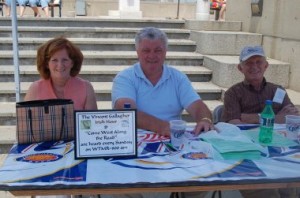
At the Irish Festival on Penns Landing, radio host Vince Gallagher, flanked by Carmel and Barney Boyce, collected donations.

At the Irish Festival on Penns Landing, radio host Vince Gallagher, flanked by Carmel and Barney Boyce, collected donations.

There have been Irish radio shows in Philadelphia since there’s been radio. Today, there are at least five reaching to all parts of the Delaware Valley. But two of the oldest shows have been experiencing financial trouble in recent years. Along with hosting their shows—choosing the songs, inviting the guests, reading the announcements—WTMR hosts Vince Gallagher (The Vince Gallagher Irish Music Hour, Sunday at 11 AM) and Marianne MacDonald (Come West Along the Road, Sunday at noon) have had to sell their own ads to pay for the studio time.

“In the two years that I’ve had the show, I’ve spend thousands of dollars of my own money to keep it on the air. Vince is in the same boat,” says MacDonald. “We have advertisers that don’t pay, we have too few ads to meet the costs, and we are both shelling out money at an alarming rate to keep the shows going. The previous hosts (Tommy Moffit and Mary O’Kane) went through the exact same thing. We have both spoken of giving the shows up, but we don’t want to.”

And they’re hoping that their many fans don’t want that either. Starting on Sunday, June 29, and running through August 17, between your favorite songs, you’ll hear the hosts and their special guests asking for pledges a la PBS. This Sunday, St. Patrick’s Day Parade Director Michael Bradley (whom we like to think of as “he who must be obeyed”) will appear on both shows to encourage listeners to contribute. Members of the Shantys, a local Irish band, will be taking phone pledges. On July 6, members of the Philadelphia Donegal Association will man the phones. On July 13, local musician Tommy Moffit will be back at the mike with members of the Ancient Order of Hibernians from around the city collecting donations.

In August, a number of local musicians will be holding a benefit to raise money for the shows. “We’ve had promises from people like John Boyce (of Blackthorn), John McGillian (of Five Quid and Pat the Budgie), Round Tower and lots of trad musicians to play at the benefit,” says MacDonald.

If you want to make a donation, you can send a check made out to “WTMR Radio,” with “Sunday Irish Radio Shows” in the memo line and a note inside the envelope indicating that you’re making a donation to the shows. Send it to:

WTMR Radio
C/o Vince Gallagher and Marianne MacDonald
2775 Mt. Ephraim Ave.
Camden, NJ 08104

We’ll be keeping you updated on the progress of this campaign. And we encourage you to contribute—supporting your peeps is one of the best ways we know of to be Irish in Philadelphia.

People

A Remarkable Year for the 2007 Rose of Tralee

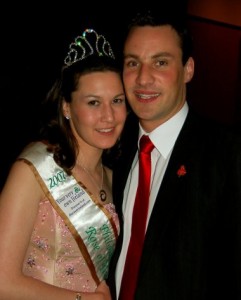
Colleen Gallagher and her Irish souvenir, Derek Reilly.

Colleen Gallagher and her Irish souvenir, Derek Reilly.

It’s been an amazing 12 months for Colleen Gallagher.

It started with a tragedy—the loss of her best friend in a drowning accident. And for this 23-year actor and singer—and the 2007 Rose of Tralee—it’s ironically coming to a close with many new beginnings.

“This year has been life-altering,” says Colleen, the eldest of seven girls, who turned over her crown on July 20 to another Colleen, Colleen Tully of Downingtown. “So many doors have opened for me.”

I sat down with Colleen Gallagher at the Rose event at the Hyatt Regency on Friday night and she talked about the year she’ll never forget.

She entered the Rose of Tralee competition last June still deep in mourning for her friend, Alex, who died on May 6. “We were best friends since we were six,” she says. “His death left me in a really tough place. My Dad always said that Alex and I were soulmates. Not in a boyfriend-girlfriend way, but meant to be best friends. I missed him so much. But I knew he was with me all the way.”

When she arrived in Ireland last August for the International Rose of Tralee Festival, it was storming and one of their hosts assured her that it was “just a gentle breeze.” Colleen’s heart did a flip.

“That was how his mother described Alex—he was a breath of fresh air, a gentle breeze,” she says, smiling. “That’s how I knew he was there with me.”

And then there was that nice young man who started chatting with her as she got off the bus at Bunratty Castle. Derek Reilly, a Remax realtor from County Mayo, was one of the escorts who traditionally accompany the Roses during the weeklong festival. “They were pairing up with each girl as she got off the bus. I was sitting in the wrong seat so I wound up with Derek,” recalls Colleen. “He found out I was an actor from Philadelphia and he started talking about the Vince Papale movie (“Invincible”). And we just kept talking.”

Even though he was eventually assigned to the Rose from Dubai, Derek and Colleen grabbed every chance to talk. “After the Tuesday night crowning, we went back to the hotel and talked for six hours straight,” Colleen recalls. Since then, the two have traveled back and forth several times. She’s met his family; Derek has spent Thanksgiving with hers. He was with her at Friday night’s event. “He’s around talking to people—he says he’s networking,” she laughs, looking around for Derek, who, at 28, is the youngest Chamber of Commerce president in Ireland. Not a prince, per se, though Colleen says her friends all kid her that she “met him at a castle.”

When she returned from Ireland, she took an acting role in the Pennsylvania Shakespeare Festival, traveling with a troupe that performed the Scottish play (“Macbeth”) at schools around the state, many of them in the inner city. “Here we were telling these children that the play had some dark elements, murder, betrayal, and so on, and many of them lived with these same things,” she says. That got her thinking. “I love acting, I love being on stage,” she says. “But that’s a very self-serving thing: Look at me up here. I became interested in dramatherapy, which is a way to use what I’ve learned (she has a degree in acting and directing from DeSales University) to help someone else.”

Dramatherapy combines theater techniques with elements of psychotherapy to help people in crisis learn to work through their problems and live happier lives. She’s about to pursue her master’s degree. “I’ve been shortlisted for a spot at the National College of Ireland in Maynooth,” says Colleen. “I have a guaranteed spot in 2010. I’ve looked at NYU and UCLA and a school in England, but they’re all very heavily feared toward psychology, whole school in Maynooth is more focused on drama with psychology courses added.”

Though she had to hand over her crown this week, Colleen didn’t see it as a loss. “Over this past year I’ve gained so much self-confidence. I’ve learned not to take no for an answer. I’ve learned that life will take you where it wants you to go,” she said. “I’m never going to lose when I learned about myself. I’ll always be grateful for that.”

Columns, How to Be Irish in Philly

How to Be Irish in Philly This Week

Want a little Amish with your Irish? On Saturday, June 28, consider heading to Lancaster where you can not only get your fill of Amish treats (help me out here—what are they?) you can enjoy a weekend of caber tossing, highland flinging, border collie sheepherding, and oh, lots of Irish stuff too. There will be more than 50 musical sets at the annual Celtic Fling and Highland Games, at the Mt. Hope Estate and Winery in Manheim. It’s not as far away as you think!

This weekend is also a great opportunity for kids 8 to 17 to brush up on their Irish language and culture at the Gaelscoil in Lawrenceville, NJ, a two-day program sponsored by the AOH Mercer County Division 10.

For some real excitement, on Saturday our winning footballers, the Donegal GFC (Four Provinces) go up against Sligo in New York’s Gaelic Park. Since Seamus Sweeney’s team has knocked down all the rest of their opponents so far, we have every hope the shut-out will continue.

Bristol Borough’s Celtic Day is in its twelfth year and the festivities are all on Sunday in Lions Park off Radcliffe Street in this little town on the Delaware. The Bogside Rogues and the Malones (including our pal, Fintan Malone) are on the bill, along with Irish dancers and vendors.

Ahead: On July 17, The Three Irish Tenors will be appearing at The Colonial Theatre in Phoenixville. Look for an interview with Dublin tenor Ciaran Nagle next week, right here at www.irishphiladelphia.com.

News, People

2008 Philadelphia Rose of Tralee Crowned

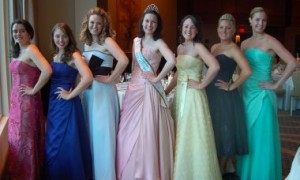
How DID the judges choose? That's Colleen Tully, their choice, at the far right. Colleen Gallagher, the 2007 Rose, is in the center.

How DID the judges choose? That's Colleen Tully, their choice, at the far right. Colleen Gallagher, the 2007 Rose, is in the center.

A 25-year-old Loyola University business grad and commodities trader is the 2008 Philadelphia Rose of Tralee. Colleen Frances Tully of Downingtown was crowned on Friday, June 20, at the event, sponsored by the Philadelphia Immigration and Pastoral Center, held at the Hyatt Regency on Columbus Boulevard in the city. This year there were six contestants, ranging in age from 18 to 25.

Tully has studied ballet since the age of four and is an accomplished ballerina who is also a student of Irish dance. She will go to Ireland in August to compete in the international Rose of Tralee Festival in Tralee, County Kerry. The 2007 International Rose is Lisa Murtagh of New York. Typically, there are more than 30 Rose contestants from around the world—even from as far away as Dubai, United Arab Emirates. The Rose selection—in its 49th year—is televised in Ireland.

History

History Lessons

On Monday, June 30, The Foxford Admiral William Brown Society of County Mayo will be meeting in Philadelphia’s City Hall at 3 PM with city officials, representatives of the Argentine Embassy to the US, the Argentine Naval attache to the US, representatives of the Irish Government from New York’s Consul General’s Office and the Mayo Association of Philadelphia.

Thanks to two local Irish historians, the Society recently discovered the missing links in the saga of Brown, who is considered the “father” of Argentina.

As a 10-year-old from County Mayo, Brown arrived in the new world in Philadelphia in 1787. Within three weeks of his arrival, both his father and his brother suddenly died. Brown accepted a job from an American captain and received his early naval training on the Delaware River. “He rose to unbelievable heights, helping the Argentinean Government fight off their aggressors and became the Admiral of the Argentine Navy,” says Maureen Brett Saxon, president of the Philadelphia Mayo Association.

Monuments to Brown have been erected to the Admiral in Foxford, Dublin and Buenos Aires. “The Admiral Brown Society believe such a tribute also belongs in Philadelphia,” says Saxon. “ They would like a monument which would be made in Argentina to be shipped to Philadelphia by the Argentine tall ship, Fragata Libertad, in the near future.” The Philadelphia visit will also be part of a documentary on Brown’s life and illustrious career,

But there had always been a page missing from Brown’s journeys. “The missing link to Admiral Brown’s life was his initial entry into America,” explains Saxon. “Our own Sean McMenamin [of the Mayo Association], as well as Billy Brennan [of the Irish Center’s Library}, researched Brown’s life, knowing that indeed he did come into Philadelphia” and filled in the blanks for Society president J.J. O’Hara, who has been corresponding with the Mayo Association for months.

After the meeting, The Mayo Society will host a cocktail party at The Irish Center.

News

Luck of the Irish Holds Out for Penn’s Landing Festival

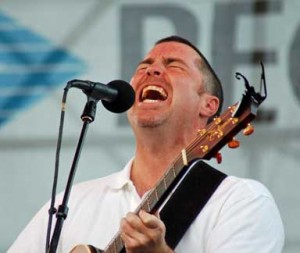
Paul Moore of Paddy's Well.

Paul Moore of Paddy's Well.

The weather forecast on Sunday, the day of the Penn’s Landing Irish Festival, looked chancy. Early in the day, as Mass was celebrated for the first time at the Irish Famine Memorial a few blocks away, a sudden shower forced congregants at the open-air service to pop their umbrellas … and for a group of middle-aged “altar boys” to hastily move a canopy over the altar.

Turns out, that was pretty much it. Though there were moments when the skies threatened to open up again and give us all a sampling of true Irish weather, mostly we got a sampling of Irish luck—from the moment Paul Moore and Paddy’s Well hit the stage down on the Great Plaza along the Delaware to the big finale featuring Blackthorn.

“Not a drop,” remarked organizer and Philadelphia St. Patrick’s Day Parade Director Michael Bradley. “Rain slid just north, so bad that parts of I-95 in the city were closed, but we were blessed.”

Like most of the festivals in the PECO Multicultural Series, the Irish fest offered up a wide-ranging display of music, dance, food and drink, and other aspects of this particular culture. Festival-goers do seem to be seriously drawn to the Paddy rock bands—and Philly has some of the very best of that breed—but for the first time, they also heard some of the unplugged traditional music in the form of the Pat the Budgie Ceili Band.

As always, just about every Irish dance school you could think of was on hand to perform between the musical acts—and, sometimes, during the musical acts, as Michael Bradley coaxed the Celtic Flame dancers up onto their feet to prance about as Paddy’s Well played. (Not that Irish dancers ever need much coaxing.)

Vendors sold the usual shirts, hats and other tchochkes, volunteers painted many little faces, and the people selling beer and other liquid refreshments did land-office business on what turned out to be a hot, hot early summer Philly day.

If you couldn’t be there, no worries. We were on hand to take lots and lots of photos.

The first Mass ever was celebrated at the Irish Memorial at Penns Landing before the festival began.

News

Get Ready for Your Day in the Sun

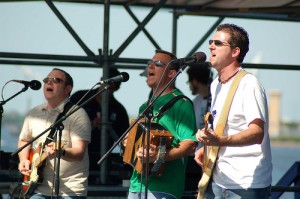
Blackthorn closes out the festival.

Blackthorn closes out the festival.

Maybe it’s that our people come from a place where a “warm” summer day tops out at 70 degrees. (And don’t even talk to me about the surf temperature.) Still, there’s just something about 80- and 90-degree Philadelphia weather that brings out the best in an Irishman. (And an Irishwoman, too, of course.)

You can find out for yourself on Sunday, June 22, from noon ‘til 9 p.m. as the annual Philadelphia Penn’s Landing Irish Festival kicks off on the waterfront at Chestnut Street and Columbus Boulevard.

Unlike previous festivals, this one just lasts a day instead of the whole weekend. So if ya snooze, ya loose. And to hear Michael Bradley tell it, you’d be missing a whole lot.

Bradley, who directs the Philadelphia St. Patrick’s Day Parade, also runs this event. He sees it as a way to continue to provide needed exposure for the many groups, organizations and traditions of Irish Philadelphia. Too, he’s so well-connected because of his Parade activities, he’s just the man for the job.

“I think it’s a natural for the parade director,” he says. “I have so many contacts in the Irish community. I’m able to promote it much better.”

This year, the great local Irish band Paddy’s Well starts the day with a concert on the main stage at 12:15. Closing out the day will be the inimitable Blackthorn.

“Paddy’s Well will draw people who want to be there early, and Blackthorn will close from 6 to 9,” he Bradley says. “So we’ve got a strong beginning and a strong ending.”

Everything in the middle is pretty strong, too—including a first-ever appearance by a group of local traditional Irish musicians who go by the name Pat the Budgie. They perform from 4:15 to 6.

“I just wanted to try something different,” he says. “These musicians play a lot up at the Irish Center, it’s part of the culture and it was being ignored.”

If you love Irish dance, you can expect to be surrounded by a sea of curly wigs. Eight of the area’s Irish dance schools will be performing throughout the day.

Of course, festival-going is thirsty work. So you can expect some nice cooling drinks—including, for the first time, Guinness. (Hard to believe, ain’t it?) There’ll be lots of terrific food and tables full of Irish beads and trinkets to buy. The number of vendors is double last year’s, Bradley says: “Each year it just gets better and better.”

If you attended the festival before, we direct your rapt attention to our photo essay from 2007.