Sports

Hurlers Play Fiercely to a Tie

I don’t know what Frank O’Meara said to his Shamrock hurlers at half-time on Sunday, July 13, at Cardinal Dougherty field, but they came roaring back from a scoreless first half to tie the match against the against the Allentown Hibernians. Final score: 3-4 Shamrocks, 4-1 Hibernians.

These two new teams—some of whose members had never heard of hurling until this spring—are improving by literal leaps and bounds. Allentown had come off of two losses for the tie. “We’re happy with a tie game,” says team member Jeff Purtell who, a PGA golf pro, might see a little of the “good walk spoiled” in hurling, in which the ball, called a sliotar or sliothar, is often walloped at 90 miles an hour more than a 100 yards down the field.

But there’s no leisurely putting in hurling. In fact, there’s no leisurely anything. “It’s a full 60 minutes,” says Purtell.

There are two more local games on the roster—August 3 and August 10—then both hurling teams will go to the North American Champsionship near Boston August 29-31.

People

Sail On, Billy

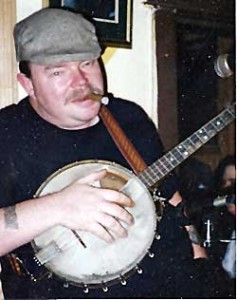
Billy Briggs

Billy Briggs

By Tom Slattery

I tried but could not come up with a more appropriate title than Tommy McCloskey’s e-mail title of a recent conversation between himself and long-time friend, singing companion and fellow sufferer, Billy Briggs.

I guess I could have used, “Yo, Bro,” Billy’s greeting to his friends. But that doesn’t say as much.

On June 15, 56-year-old “Irish Billy” Briggs, who grew up in Bordentown, New Jersey, but who is better known as the owner of Trenton’s legendary Tir na nOg Pub, died after a year-long battle with colon and liver cancer. His death has cast a palpable pall over the New Jersey Irish and Irish-American communities.

Billy’s wake and funeral were testimonials to his popularity and to the esteem in which people held him. He was waked at his pub for 12 hours (2 p.m. to 2 a.m.), during which hundreds upon hundreds of people passed through. His closed coffin was guarded, IRA-like, for the 12 hours. During the entire 12-hour period, the bar was open and yet, out of respect, there were no incidents.

At 6 p.m. a solitary piper walked through the pub playing “Irish Soldier Boy.” He was followed by a priest, a blessing and a decade of the rosary. Musicians queued up to perform at his funeral Mass the next day. On Sunday, June 22, Billy’s remains were shipped to Tipperary, Ireland, where he was buried in the hometown of his wife, Margaret O’Donnell. Margaret, who came to St. Francis many years ago, started visiting the pub, and eventually fell in love with the big fella, who had recreated Ireland in America and a place for the lonely immigrants to call “home.” In addition to Margaret, Billy is survived by their 6-year old twin daughters, Ellen and Mairead, as well as many family members.

Billy was not only a pub owner, but a singer, an actor, a quiet philanthropist, a man dedicated to a free and united Ireland, and a funny guy when the occasion called for it. His banjo now stands silently on the high chair on which he perched himself these past 17 years to bring his brand of Irish music and political commentary to his eclectic followers. Oh, yeah, the crowds on any given evening might include the Irish nurses from St. Francis, the young Irish contractors (of course, it’s where the nurses hung out), couples in formal wear going to or coming from some posh affair, local politicians, many senior Irish-Americans, and on and on—you get the idea. And in the midst of this happy crowd, and Billy’s presence guaranteed that mood, sat the king in his sartorial splendor—jeff cap, a clean black bowling shirt, dark pants which could hardly remember a crease, black sneakers not normally laced, with one foot carefully balanced on the spittoon (which I hope is bronzed)—knocking out song after song in a clear tenor voice through the cigar firmly ensconced in the corner of his mouth. The spittoon’s main job was to catch the ashes, which on rare occasion it did.

Billy usually was not the sole entertainer. Over the years, his bandstand (a platform capable of holding no more than four musicians—three, if any were Guinness drinkers) hosted so many talented musical performers, from the late Sligo Anne to the latest, Tom Glover. In the in-between years the crowd was treated to the likes of Billy J. O’Neal, Dr. Nancy Ferguson, Tommy McCloskey and many others, including visiting musicians who dropped in and amateurs who volunteered and who heard about it unmercifully if they did not meet the audience’s approval—especially from Billy, who had that special capability to put the dagger in, twist it around, and never lose your friendship.

One of Billy’s favorites was Mary Courtney from the Irish traditional group Morning Star. As a writer for a paper many years ago, I once asked Billy how he would like to spend St. Patrick’s Day if, of course, he was not tied to his pub. He replied, “I’d like to be lying on my back on top of Dun Aengus (a fort on the Aran Islands) with a bottle of Jameson and a cigar, listening to Mary Courtney sing.”

Tir na nOg was usually crowded, but St. Patrick’s week was always elbow to elbow (this is a family publication). At the start of the week, all seats, tables and barstools were removed to allow 20 to 30 more patrons to squeeze in. Trenton Irish could make the Japanese train “fillers” look like rank amateurs.

But Billy will be remembered for much more than his singing. His generosity and hospitality were almost legendary. Many a young Irish person, or family, arrived in the Trenton area not exactly flush, only to end up with some needed cash or furniture from Billy, who was a firm believer that if you hung up an Irish sign, you sure as heck better take care of anyone Irish. Many years ago Trenton had its first St. Patrick’s Day Ball at a New Jersey State Building, which even back then did not allow smoking and so there was a continuous line to have a few puffs outside—and only a few puffs, because of the freezing March weather.

Needless to say, at the following Ball, there was a huge “smokers” tent outside, donated by Billy. Never a man to be impressed with what he perceived as “high society,” he once emphasized the point when one of his closest friends ran the St. Patrick’s Day Parade Grand Marshal announcement with a wine and cheese party at the elegant Grounds for Sculpture (by the way, the announced Grand Marshal was also a close friend) by taking out a full page ad in their ad book saying, “Wine and Cheese, Boo.” He believed the real Irishman drank only beer or whiskey neat.

At a young age, Billy became interested in Ireland, and when his high school in Bordentown offered another ethnic history class, he requested an Irish history class. Told there were not enough students to justify such a class, Billy replied that such a class was his right. And so, once a week Billy Briggs studied Irish history in the school library.

He was a founder of Irish Northern Aid, as well as a co-founder of the Trenton St. Patrick’s Day Parade Committee. Billy worked tirelessly for a united Ireland. He was a Provo and Sinn Fein supporter long before it was popular to be, and a quick look around his pub, once voted one of the Top 50 Pubs in America, confirms this. Just this past March he was awarded the Irish Patriots Award by Pat Doherty, Sinn Fein Vice President.

In his old pub, one very similar to Cosey Morley’s (“there will never be another like it, because authorities would not allow it to be built”), late on a July 3 the crowd had dwindled to a hearty few as July 4 arrived. “We have to celebrate our freedom” said one. And Billy agreed. From behind the bar, he produced a picture of Maggie Thatcher, which he pasted on a bare spot on the cinder-block wall and then disappeared into the back room. “He’s gone to get the darts,” exclaimed one. However, a moment later Billy appeared with a 12-gauge with which he altered Maggie’s appearance and brought momentary deafness to those in the room. One claims that even thinking about it still causes his ears to ring.

I said he was an actor and he was—in one Bronx Irish Theater production, he played an English lawyer! Needless to say we filled a bus to travel up to see that performance. And he supported the arts. Tir na nOg held not only annual Bloomsday readings, but for several years had monthly “literature” evenings, which included readings and poetry.

Oh, grant me one more story. One of Billy’s patrons came in after suffering a very close loss in an AOH election. As Billy served him a pint, our friend bemoaned the fact that he had lost the election by a single vote. To which Billy replied, “Aren’t you glad I wasn’t there, you would have lost by two!!” Like the man, the stories about him are becoming legends as they are dug up and retold during this period of mourning but mostly, remembrance. Long-time friend, Billy J. O’Neal has set up a site to collect them.

That, my friends, is vintage Billy Briggs, a man who embraced life with a zest and passion that few ever attain—a man who will be remembered by many as the years go by—a man who was a giant in the Irish community—a man who can not be replaced, but one who set a standard for friendship, loyalty and love that hopefully others will follow.

Rest in peace, dear friend. I feel privileged to have been one of yours.

Slán

Columns, How to Be Irish in Philly

How To Be Irish in Philly This Week and Beyond

“You—oo-oo, my brown-eyed girl. . .”

What? Oh, sorry, we just couldn’t help ourselves. Van Morrison is in town—Friday night at the Tower Theater, Saturday night at the Borgata in Atlantic City. Whenever we hear his name, we can’t help humming one of his biggest hits. Ticket prices to see the Belfast cowboy top out at $300 at the Tower and $500 at the Borgata. All we can say is “Sha la la la la la la la la la la te da.”

The good news is, there are cheaper ways to be Irish this week. Like heading over to Cardinal Dougherty High School in Philly on Sunday for the hurling championships. We’ve said it before and yet we see so few of you there—this is one action-packed game that is way more fun to watch than baseball. You can bring your beach umbrella, a couple of lawn chairs, and your picnic cooler and have a great old time—all for free. So head out to the field for the 2:30 PM match—and wear your Celtic-strength sunscreen. Read all about it here.

There’s still time to get tickets to hear the Three Irish Tenors at the Colonial Theatre in Phoenixville on Thursday, July 17. See our interview with the witty and talented Ciaran Nagle, a founding member of the group.

Then, on Friday, July 18, the inimitable Ceili Rain will be performing at the Tin Angel in Philly.

Check our calendar to plan your calendar for the next few weeks, which are jam-packed with Irish events. Coming up:

The 2008 Continental Gaelic Youth Championships come to West Chester, kicking off (literally) with a parade on Gay Street on Thursday, July 24. Young Gaelic sports players will be coming from around the country for this event to be held at the Greater Chester Valley Soccer Association Arena all weekend. It’s an honor for our area to be hosting the national finals for youth Gaelic games, so get out and support them! If you have the time, they’re looking for field marshals to make sure the games start on time, the teams are in place, and the referees are on the field (sounds like a job for a CEO, shift supervisor, or any Mom). If you can help, please contact Tommy Higgins at 215-275-0591 or email: tom_higgins2000@yahoo.com or John McDaid @ 267-226-8581, or email: johnbmcdaid@msn.com

On Saturday, July 26, you can hear Angelina Carberry (on banjo) and her husband, Martin Quinn (on button box) at the Coatesville Cultural Society. Trad music lovers alert: This a must-see!

On Sunday, July 27, do your good deed for the day by supporting Team Ratty Shoes (it’s a Blackthorn reference) in their quest to raise money for research into multiple sclerosis, a crippling disease affecting mainly young adults. Random Blonde will perform (yes, they’re Irish and they’re rocking) and for your $30 per person donation, you get free eats and draft Miller Light. All the fun will be at Brittingham’s Irish Pub and Restaurant in Lafayette Hill (which is now smoke-free!). Hang around till after dinner and hear Oliver McElhone at 7:30.

While you’re perusing the calendar, check out the month of September. We’ve posted the dates but not all the details for two major annual Irish events in the area—the Philadelphia Ceili Group’s Irish Traditional Music and Dance Festival and the North Wildwood Irish Festival. And check out our photos of all the fun you could be having if you got off your duff and went.

News, People

The Little Society That Could

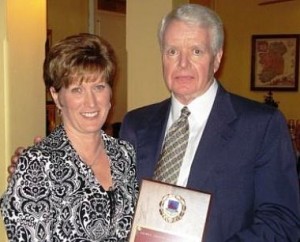
Virginia Coyne Brett, president of the Philadelphia Galway Society, presents the 2008 Person of the Year Award to Drew Monaghan.

Virginia Coyne Brett, president of the Philadelphia Galway Society, presents the 2008 Person of the Year Award to Drew Monaghan.

By Kathy McGee Burns

The Galway Society Dinner Dance was held on a Saturday evening, May 10. I have been to many of these events but this night there was something different. This night had a magical feel to it, so much so that I wanted to capture that feeling and put it to words.

I’ve been to County Galway many times. It is one of my favorite places in Ireland. Each county has its own flavor, but I think Galway has a little of all the flavors of Ireland. I think that’s why it’s known as Ireland’s cultural heart. It’s the home of Kylemore Abbey, The Twelve Bens, and Connemara. It is Joyce country and through it runs the Corrib, the largest lake in the republic. When Galwegians (as people from Galway are known) immigrated to America, most of them went to Boston, but Philadelphia was lucky enough to get some of the special ones.

The Galway Society, in the Philadelphia area, was started 99 years ago. It welcomed the newly arrived and helped to ease the pain of leaving home. The members reached out to aid in employment and it became a social center, a place not unlike home.

My story starts with John Egan. He was from Head Ford, the youngest of seven children, unmarried and with nothing happening at home. He arrived in Philadelphia in 1955. His brother, Pat, immediately introduced him to the Galway Society and the Irish Center. He joined a month later. The Society was never very large, not like Donegal or Mayo. There was a core group, “the glue that kept it together:” the Egans, Jack Gilmore, Billy Brennan, and Dan Raftery. In the last fifty years, membership dwindled, kept alive by very few families.

Now, suddenly, it has had a resurgence. It has become a force with a new direction. The ingredient added was the Coyne Family. Jim and Ginny entered the Galway Society with determination, loyalty, and resources. Those resources were friends, and family…lots of family. The dye was now cast.

One of those friends was Drew Monaghan. Drew and his wife, Mary Lynn, had been attending the dinner dances with the Coynes for quite a while and Jim was able to twist Drew’s arm into following him as President. Drew became that shot of youth and new vision.

Drew said they encouraged their small membership to talk up the Society. They first went to their families and when they showed interest, they approached their friends. He said that at first, the younger people were taken aback by “all that gray hair”. Drew, in his wisdom, decided to let the young people make some decisions. His advice was, “If you don’t like it, make it in your own image….but you can’t chase the elders away”

Under Drew’s tutelage there was been a resurgence of young members. They turn ran the dinner dance, dressed up the Society window, and produced a lovely dance booklet. Drew Monaghan was named “Person of the Year, 2008,” an honor bestowed on him for service to the Society.

Drew passed the baton to Virginia Brett (Jim Coyne’s daughter) who is the new president and I believe only the second woman ever to hold that title. Virginia, a four-year member, also attended those dances, mainly as an obligation to Mom and Dad, but later really enjoying them.

She’s now “dragging” her kids. Brendan Brett, age 21, is the newest and youngest member who has taken to all things Irish. Drew Monaghan said that Virginia represents a real visible change in the Galway Society.

Virginia’s goal is to look for meaningful activities for the Society to pursue, things that will help their own members in difficult times and always make things fun.
So, what are some of these innovated changes?

The officers of the Society are spread over generations. There’s a 50-year span of ages among the board of directors. Two young women, Eileen Brett and Kathleen Sweeney, will be Co- Chair of Galway’s 100th Annual Dinner Dance.

And speaking of Eileen Brett, she’s one of the newer links in those 100 years. She is an upbeat young woman with a clear vision. She also was involved with this year’s dance. She was very nervous the morning of the affair. She had set the bar high and wanted to show them (the elders) what the young set could do and that they could have faith for the future. Eileen also says that none of them could have done it without John Egan who sold the most tickets and ads. Therein lies the success of that generational span. The glue is still intact. Eileen Brett is still basking in the glow of that special night.

That’s what I felt! All the energy, devotion, respect and aspirations of the Galway people came together that night in May. The struggle to fill the hall was abated. The room was packed. The young and the old mingled. We all felt that special magic. I just know there will be another 100 years for the Galway Society.

News, Sports

A Little Bit of Ireland at Philadelphia Park

By Kyle Kroszner

Joanne McDaid heard a familiar accent in the Cathal Lynch stable on the backside of the Philadelphia Park’s Racetrack. It was Peter Meehan. Joanne from Donegal and Peter from Derry grew up fifteen minutes from each other, and they both think they might have brushed elbows at a local bar. Now Joanne is a jockey splitting time between Philadelphia Park and Penn National in Harrisburg, and Pete is a racing official, outrider, and competes in some amateur races as a jockey.

Joanne grew up watching horse races on TV, but didn’t actually hop on her first horse until her late teens. “Female jockeys are not very popular in Ireland,” McDaid said. But that did not discourage her from getting into this grueling sport. In 2006, she was given the Leading Apprentice Award, of which she is very proud. She enjoys being a jockey for many reasons—it keeps her fit, every race gives her an adrenaline rush during a race, and the most important “you’re not sitting in an office, right?” she laughs.

On the other hand, Peter will spend a couple days in the office as a racing official. He admits he didn’t get into horse racing until his cousin James Graham (another Irish-born jockey) convinced him to get on a horse. “Basically the only sport in Ireland is soccer,” said Meehan, who likes it enough to catch some games at Fadó in Center City. Even though his first love was soccer, his ambition now is to be a steward, which is essentially a referee for horse racing. Peter has also recently joined the AOH in Bristol.

There are some significant differences between horse racing in Ireland and the U.S. Ireland’s horses are bred to run on turf and not dirt tracks. Consequently, many Americans buy thoroughbreds from Ireland to be used on the turf tracks here in America. “In Ireland horse racing is a sport, but in America it’s for money,” says Peter. “In Ireland you can have a horse that loses, but you will keep racing because it’s ‘your’ horse.”

Both Joanne and Peter have a healthy respect for the dangers of racing. They both admit that when they mount up, it’s never without making the sign of the cross and uttering a little prayer. Joanne says she’s also grateful for the opportunity she has to ride. “Even in the winter it can get tough out there, but I’m not complaining,” she says with a smile. And when asked if she could name a horse herself, right away she said, “Dhún na nGall! In Irish, you know?” [It’s Irish for Donegal.]

Although the Triple Crown races have passed, and Big Brown might have came up short, there are still many opportunities to enjoy watching the ponies run. As for Ireland, the Irish Derby and the Oaks are the major races, which usually take place in late June and early July. And of course, if you want to cheer for Joanne McDaid, she rides at Philadelphia Park year round.

Music

A Little Traveling Music

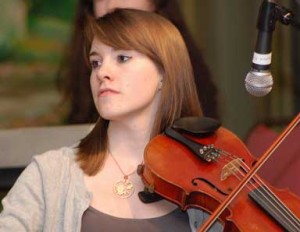
Will fiddle for airfare. Caitlin Finley, playing at the Philly benefit.

Will fiddle for airfare. Caitlin Finley, playing at the Philly benefit.

Tullamore, County Offaly, is 3,200 miles from Philly. It’s a long way to go, and a lot of money.

If you’ve flown to Ireland recently, you know the drill. Now imagine trying to arrange passage for 10 young Irish musicians–in this case, the Pearl River Ceili Band, winners of the Mid-Atlantic Fleadh Cheoil, and contenders in the Fleadh Cheoil na hÉireann in Tullamore later this summer. (http://www.fleadh2008.com/)

Now, thanks to two big fund-raisers, Tullamore is a lot closer for the 15- to- 18-year-old band, which features Philadelphia’s own Caitlin Finley on fiddle and banjo.

First, there was the June 20 ceili at the Philadelphia Irish Center. Then, a couple of days later, an all-star blowout at Rory Dolan’s in Yonkers, featuring Joanie Madden, Eileen Ivers, Brian Conway, Gabriel Donohue and Brendan Dolan.

You can always count on Philly’s Irish traditional crowd to support the cause—and they sure did, to the tune of $2,600.

Rose Conway Flanagan, fiddler, teacher and an original member of Cherish the Ladies, played a leading role in the group’s Philadelphia appearance, and she passes along her thanks for the local support: “What a great time the kids had playing for such an enthusiastic crowd of people.”

The $2,600 raised here, she says, was quite helpful, especially given the $600 to $800 cost, per student, of just the airfare alone. “Add to that the cost of housing (figure another 500 Euros) and food,” she says, “and you have quite the bill (especially if you have more than one child going).”

The fund-raiser at Rory Dolan’s added even more to the kitty. How much more isn’t certain, but it’s clear that it will put the group in a good position to compete in Tullamore. “This (Rory Dolan’s) was a great sucess and we do have some money still forthcoming,” says Flanagan. “I believe we will have enough to cover the cost of most of the airline tickets for these kids. They will still have to foot the bill for the rest of the trip but it’s a great help!”

Those of us who were down at Penn’s Landing for the annual Irish Festival along the Delaware missed the amazing outdoor benefit at Rory Dolan’s in Yonkers. Caitlin Finley, the local fiddler and banjo player and member of the Pearl River group, says we missed quite the show. “Some of the musicians included a group who they called the New York All-Stars, made up of Joanie Madden, Eileen Ivers, Brian Conway, Gabe Donohue, and Brendan Dolan. There was also Jameson’s Revenge.”

Flanagan sums up the all-star lineup in one word: “Wow!”

“We had quite the crowd for Jameson’s revenge with Issac Alderson, the McCarthy brothers, Keith O’Neil, and many others and we had a Rockland county band that took the house down—DD Royal,” she says. “Our under-18 band got up to play and then Girsa, an all girl band from this area (which includes some of the band members) got up and also brought the house down—they were having so much fun onstage that Joanie and Eileen jumped up to join them for a few sets! (double WOW!) We had the Ruffians up on stage then and the senior ceili band (which was made up of the teachers) we had a few extra musicians join us for that as well, including Joanie and Eileen !”

Next big stop for the band: Tullamore, County Offaly, for the Fleadh, which take place August 17-24.

Sports

Hibernians Get Ready for Next Match-Up Against the Shamrocks

Figure you’re the ’62 Mets. Your record is 40-120. Now imagine that, through some amazing disruption in the space-time continuum, you somehow wind up in the World Series.

Well, the Allentown Hibernians are hardly in the same league as the ’62 Mets, universally regarded as the worst team in Major League history. Still, they’re the closest thing to an expansion team the Irish sport of hurling has to offer—in that, not all that many months ago, many of the team members had never even played the game before. They’ve played only two games, both against the Junior “C” Philadelphia Shamrocks, and they’ve lost both. And yet, because there are so few teams playing the sport in the U.S., they’ll get a shot at a local championship—and maybe something even bigger down the road.

Pretty cool, huh?

Allentown’s Jeff Purtell is looking forward to the next match-up against the Shamrocks, scheduled for a 2:30 p.m. start at Cardinal Dougherty High School, 6301 N. 2nd Street, in the city’s Olney section.

“We’ve only played two games so far but we have practicing and scrimmaging two-three days a week,” says Purtell. “Our record is 0-2 but we’re steadily improving our skills. We’ll have portable Gaelic games goalposts in a few weeks and are making tentative plans to play Pittsburgh—possibly in a neutral location. They are another newly-formed hurling club in Pennsylvania.”

The Shamrocks’ Frank O’Meara likewise eagerly anticipates the weekend pairing. “We can never take them for granted as they have a fine team and are very competitive,” he says. “Our next game will be very close and only the gods can predict who will win.”

Despite the Shamrocks’ two victories, O’Meara notes that his team is also pretty new to hurling. “The Shamrocks Hurling club is made up of two teams: one, largely experienced, and the other, new players that are from the Philly area. While the Shamrocks (as an organization) have been around for a while, the Shamrocks team that plays against Allentown are all-American lads and, for the majority, this is the first year for them to play hurling.”

The upshot? The Hibos could surprise you. (In a way that the ’62 Mets never could have.)

Regardless of who wins this Sunday, August 3 and in the local championship game August 10, both teams will go on to play in the Boston suburb of Canton at the North American Championship August 29-31. “The Philly 1 and Philly 2 teams (Hibernians and Shamrocks) in the schedule will be determined after the outcome of the championship game. Including preliminary games in Canton, we could be playing Chicago, St. Louis, or Indianapolis in our first game at NACB (North American County Board) Championships.

“The championship game will be a great experience as we prepare for the NACB GAA Championships. It should prepare us for a higher level of competion against other teams across the U.S.”

Also playing this Sunday will be the Shamrocks Junior A team (mostly Irish-born). They’ll be up against the the D.C. Gaels Junior “A” team for the Joe Lyons Cup Championship.

Music

A Pre-Concert Tune-Up From One of the Three Irish Tenors

There is nothing that warms my sentimental heart more than hearing an Irish tenor sing “Danny Boy.” I know it’s old-fashioned and maybe syrupy enough to have diabetics reaching for their insulin, but I say this as someone who divided her teenage devotion between the Beatles and the Rolling Stones, loved Judy Collins and Pink Floyd, and blames the perpetual ringing in her ears on a Grateful Dead concert and the Clancy Brothers’ tape that circled endlessly in her Walkman. Eclectic is my middle name. And hearing an Irish tenor (or even Sinead O’Connor) sing “Danny Boy” always makes me cry.

So when I recently talked to Ciaran Nagle, one of the “Three Irish Tenors,” who will be performing on July 17 at the Colonial Theatre in Phoenixville, I had to know what songs these three classically trained singers would be performing.

It’s in there. The Three Irish Tenors sing “Danny Boy” along with many old tunes such as John McCormack’s “Macushla” (a poignant song with such staying power that Rufus Wainright performs it in live performances); the fast-paced 19th century traveling song, “The Rocky Road to Dublin; “When Irish Eyes are Smiling;” “The Donkey Serenade”; and even some of homeboy Mario Lanza’s standards.

The Mario Lanza-John McCormack songs are part of a medley the Three Irish Tenors commissioned several years ago when they performed at a Fourth of July event with singer Neil Diamond in Dublin’s Phoenix Park. “We allowed him to come on and support us,” jokes Nagle, who is one of the founding members of this group which should not be confused with The Irish Tenors (its most famous member being Ronan Tynan).

“So,” I said, “this means there are actually six Irish tenors.”

“Six?” he retorted. “There are about 6 million Irish tenors. There are two, arguably three principal groups out of Ireland. Each has had great success in the States and Canada, all have had shows on PBS, all have survived and been successful at selling out houses, and we all know each other pretty well. There’s room for everybody. Fortunately.”

The Irish tenor biz is a small one, says Nagle, so when one tenor drops out, there’s always another to take his place. The Three Irish Tenors started in 2000 when a promoter called and asked if he’d be interested in doing “tenor gigs.”

“I’d come straight from performing in Riverdance and I was delighted with the idea,” says Nagle. “The original group were all friends of mine, people I’d sung with in the National Chamber [National Chamber Choir, Ireland’s only professional chorus] and Opera Ireland. Originally, we only had a handful of dates for particular occasions. The first was the opening of a new theater in Armagh. We thought there wasn’t going to be any future in it. The Irish Tenors already existed. We didn’t believe it was going to take off and, lo and behold, it did.”

At their first gig in Armagh, they got a standing ovation at intermission. “That was quite outstanding,” said Nagle. “We were having a great laugh up there, here we were doing this and it didn’t feel like work, we’d decided on the program the week before, so we were over the moon. Then it snowballed. We were touring the country for a period of time then six weeks after our incarnation we got a call from a U.S. producer who said, ‘We have a tour lined up. Do you want to perform in it.’ Well, what were we going to say: ‘The Guinness isn’t as good over in America and, unless it’s better, we’re not going?’”

They went and have been coming back once or twice a year ever since selling to packed houses.

The current incarnation of The Three Irish Tenors includes Kenneth O’Regan and Des Willoughby. “Kenneth has one of the biggest, most beautiful voices I’ve ever heard,” says Nagle. “I knew him from Riverdance and we would meet up more on a social basis. When an opening came up and I said, ‘Kenneth, would you be interested,’ he said, ‘Absolutely, it sounds like a lot of fun.’ We don’t do open auditions and then try to make the person fit. The personalities have to work. Des Willoughby has a gorgeous, gorgeous voice, and the chemistry between the three of us is smashing. “

And, as you can probably tell, despite their classical training, their performing style bears no relation to a concert hall recital. There are no white shirts and tails, and there’s plenty of onstage—and offstage—banter.

“The more clapping and shouting and jeering and comment, whatever, we welcome that,” says Nagle. “We interact with our audience. God help you if you’re sitting anywhere near the front, and I will say no more!”

And that, he says, is the key to the Three Irish Tenors’ success. “The audience will always say, ‘you guys look like you’re having an absolutely fantastic time up there, ‘ and we are. The day it becomes a job to me, the day I don’t enjoy it, that’s it, I’ll close the door, and it’s over.”

The Three Irish Tenors will be performing on July 17, at 8 p.m., at the Colonial Theater in Phoenixville. Tickets start at $29.95.

On Friday, July 18, starting at 6 p.m., the group will entertain at a benefit for the Drexel Neuman Academy and LaSalle Academy, both independent Catholic schools, at the home of Theresa and Paul Murtagh in Media. The $150 individual ticket price includes cocktails, dinner, and a concert. For more information about the benefit, contact irishconcert@yahoo.com or call (610) 496-7390.