Columns, How to Be Irish in Philly

How to Be Irish in Philly This Week

Ellen Hughes Cromwick

Ford Motor Company chief economist Ellen Hughes-Cromwick will speak at the Irish-American Business Chamber this week.

When the recession looked like it was going to kick the American auto industry to the curb, the Ford Motor Company emerged as the only one of the big three in a position to survive. Not only did it survive, it’s thriving. In April, Ford reported a net profit of $2.2 billion or 50 cents a share—its largest pretax profit in six years, and all due to higher sales, not a bailout.

You have a unique opportunity to find out how Ford did it on Wednesday when Ellen Hughes-Cromwick, the company’s chief economist and global director of strategy, speaks to the Irish American Business Chamber and Network at a lunch meeting at the Union League in Philadelphia. The event is open to non-members, but you’ll have to act fast to save a seat. Contact Alanna Barry McCloskey at abarry@iabcn.org.

This weekend will give you ample opportunity to flex your Irish. On Saturday, Bill and Karen Reid will roll out their fourth annual Phoenixille Celtic Street Fair. Those wonderful folks who bring you the Mid-Winter Scottish-Irish Festival and the new Brittingham’s summer Scottish-Irish Festival and more are stocking the 200 block of Bridge Street with the best in local Irish entertainment, including the always good Bogside Rogues, Charlie Zahm, Olier McElhone, Na’Bodach, Irish Thunder, and the New York Celtic Dancers. As always, there will be dozens of vendors and lots to eat and drink. Even without the festival, Phoenixville has a lot to offer, but with it, wow.

If you stay in Phoenixville for dinner, head over to Molly Maguire’s to hear the remarkable local group, Burning Bridget Cleary, performing starting at 6 p.m.

If your Irish ancestors came to America to work as servants in the homes of the wealthy, you will enjoy a talk by Margaret Lynch-Brennan, author of “The Irish Bridget,” the story of Irish immigrant servants from 1840 to 1930, at the Ebenezer Maxwell Mansion in Philadelphia on Saturday afternoon.

On Saturday night, The Galway Society is holding its annual dinner dance at the Irish Center, with music provided by the Vince Gallagher Band.

On Thursday, Villanova University librarians Darren Poley and Michael Foight will speak at the Independence Seaport Museum about the digitization of the Commodore Barry papers, a joint project that brings together materials owned by Independence Seaport Museum and other family-related papers. Included are items that feature nautical related themes with content from Commodore John Barry (1745-1803), a Wexford native who lived and is buried in Philadelphia. The event includes a tour of the museum and its archives by Matt Herbison, director of the J. Welles Henderson Archives and Library, Independence Seaport Museum. Light refreshments will be served.

And for all you Saw Doctors fans, your guys will be performing at The Note, an intimate venue in West Chester on Thursday night.

Friday is “choose your own Celtic treat” day. Here’s what’s going on:

AOH Division 3 is holding its annual golf outing and dinner at the Pine Crest Country Club in Lansdale, a fundraiser for AOH charities.

Two of our favorites, Matt and Shannon Heaton, are performing at Immanuel Episcopal Church in Wilmington, DE. (They’re heading back our way on May 26 for a special show at the Shanachie Pub and Restaurant.)

Michael Flately’s “Lord of the Dance” extravaganza starts its weekend run at the Merriam Theater on South Broad Street in Philadelphia. (We talked to one of the leads, Adam McSharry, who plays Don Dorcha, the dark lord.)

Seven Nations, the Celtic heavy metal rockers, will be playing at Brittingham’s in Lafayette Hill (kilts, bagpipes, and nonstop guitar riffs—trust me, it works).

Coming up: On May 22, there will be a musical benefit at the Irish Center to raise money for the Philadelphia Ceili Group’s annual traditional music festival (that happens in September), featuring Paddy O’Neill with traditional Northern Ireland tunes on wooden flute, traditional and original music by John Brennan on fiddle and guitar; John McGillian on accordian; Caitlyn Finley playing fiddle tunes from the late Andy McGann and others; and Paraic Keane uses his fiddle to show how musical virtuosity is genetic (his father, Sean, is with the Chieftains, and uncle, James Keane, is such an accomplished button accordian player he has an instrument named after him). An open session will follow the concert, so bring your instruments. Tickets are only $15.

On May 23, the Irish Center and the Irish Immigration Center of Greater Philadelphia will honor 11 “Inspirational Irish Women” at a cocktail reception which will also open an exhibit of portraits done by Pat Gallagher, the son of Irish immigrants who grew up on Philadelphia’s Main Line. Tickets to the event are $35 and include hot and cold hors d’oeuvres, wine and beer. You can order tickets online or by calling 215-884-1936 or 215-779-1466. Proceeds from the event benefit the Irish Center and Project H.O.M.E., a charity founded by one of the honorees, Sister Mary Scullion.

The other honorees are Princess Grace of Monaco; Emily Riley, executive vice president of the Connelly Foundation; Sister Kathleen Marie Keenan, senior vice president of Mercy Health; Rosemarie Timoney, founder of the Timoney School of Irish Dance; Kathy Orr, CBS3 meterologist; Denise Sullivan Morrison, president of a major division of the Campbell’s Soup Company; Liz Kerr of LAOH Brigid McCrory Division 25; Siobhan Reardon, first woman president of the Free Library of Philadelphia; Rosabelle Gifford, first recipient of the Rose of Tralee Mary O’Connor Spirit Award for her courageous spirit; and Kathy McGee Burns, first woman president of the Donegal Association, president of the Delaware Valley Hall of Fame, and first vice president of the Philadelphia St. Patrick’s Day Observance Association.
People

Ghost Story


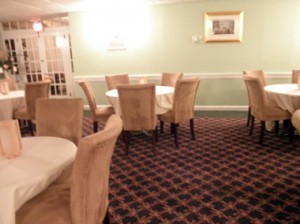
The Irish Center's dining room: Site of a ghostly experience.

The Irish Center's dining room: Site of a ghostly experience.

By Susan Spellman Burns

You may not believe in ghosts, but 22 percent of Americans assured CBS news pollsters that they’ve been up close and personal with the dead.

Paul Gallagher is one of them. It has been several months since the Irish Center bartender’s startling experience that Friday night as he closed up the Center, which included cleaning up the Texas hold-em game in the front dining room. At the time, Paul felt a cold breeze pass through his chest, though he had just closed and latched all the windows. Then he heard someone say. “What are you going to do now, Paul?”

I sat down with Paul, and we talked about the ghost he encountered, who he is fairly sure was the spirit of a late customer who made a very heartfelt gesture to Paul before his death.

Paul told me that he has been teased often by patrons and his friends after his previous interview about the ghost with irishphiladelphia‘s Denise Foley so he was hesitant to talk about it again. But we both agreed that his visitation was a gift, and a gift that can be shared to perhaps give others new insight on such a personal experience.

Q. Has your “secret admirer”contacted you in any way since that memorable night?
A.
No. I really don’t look for it, or try to think about it. Yes it happened. I have moved on.

Q. Do you have a better understanding of who may have visited you?
A.
I feel it was a patron that passed away last fall. My gut tells me it was him. I know it was him.

Q. Why do you feel this spirit chose you to contact?
A.
It was probably just his way of saying good-bye. I feel honored.

Q. The ghost asked “What are you going to do now Paul?” Did this have anything to do with your own personal struggles?
A.
No, definitely not. I have thought about this several times. I have my own personal struggles like everybody. It was again, just his way of saying good-bye.

Q. Has this experience sparked a greater interest in the paranormal?
A.
Not really. Sometimes I watch one of the ghost hunter shows on television, but when it comes to choosing that or sports shows, I prefer watching sports.

Q. I know you mentioned that you think the ghost has moved on since that night, do you feel there maybe other spirits in the Irish Center?
A.
I have not sensed this in any way myself, but there is certainly talk that there are other ghosts here.

The Burning Question:

As I stood in the front dining room after my interview with Paul, did I experience anything paranormal?

Nope. However, I did feel something quite normal. I could feel that this building was filled with dear memories, dreams, happy times, and that magical Irish love.

Do you have a true ghost story to tell? Contact Susan Spellman Burns via the “contact us” link on the home page. She’s on the trail of Irish spirits—of the other-worldly kind—and will be taking us on ghost tours periodically.

Arts, History, People

How the Irish Maid Saved Civilization

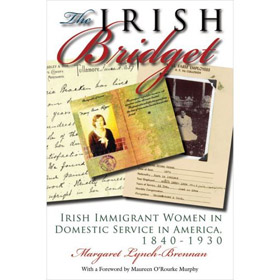
The cover of Margaret Lynch-Brennan's landmark book on Irish domestic servants.

The cover of Margaret Lynch-Brennan's landmark book on Irish domestic servants.

A footnote in a book she was reading while studying history and gender led Margaret Lynch-Brennan to a hidden trove of information about the group of Irish immigrants she now believes finally brought the Irish into the American melting pot: the Irish domestic servant.

She calls these young women who emigrated from Ireland between 1840 and 1930 “The Irish Bridgets.” She’ll be talking about them, the subject of her 2009 book, “The Irish Bridget: Irish Immigrant Women in Domestic Service in America, 1840-1930,” at the Ebenezer Maxwell Mansion in Philadelphia on Saturday, May 8, from 2-4 p.m.

The book grew out of her 2002 American History Ph.D. dissertation.

“I was reading a lot of books,” she explained, “and one of the books mentioned that most Irish women started work as domestics.”

Lynch-Brennan wondered why there wasn’t more written on the topic. “The importance of Irish women generally has been underlooked, not overlooked,” she says. “Most of the history that’s been written about the Irish focuses on the men, but unlike other immigrant groups, the women who immigrated actually outnumbered the men…that’s very different.”

She began digging, and what she found convinced her that it was these Irish women, some as young as 13, who helped bring the Irish acceptance in American society where “No Irish Need Apply” was a familiar sign in many urban areas.

“The typical middle class WASP wouldn’t know any Irish men on a first name basis, but they would know Irish women because they lived in the house. Most Americans during that time period only employed one servant, and that was a ‘maid of all work.’ She worked 10-12 hours a day, 7 days a week, taking care of their homes and their children.”

It wasn’t an easy life, but these women found ways to have a good time.

“Going to church was a big part of their social lives. They could see people from their hometowns. The women who worked in domestic service didn’t live with other Irish people, so meeting and talking to others at church presented a way to keep up with the Irish community.”

Irish dances were another social outlet for the young Bridget. “The Irish counties associations were concerned with finding ways for the girls and boys to meet, so Irish set dancing was arranged. Most Irish women eventually married. It was an aspect of Irish culture in Ireland that one was not considered an adult until one married, and most wanted to get married.”

The name Bridget, or Biddy, became so associated with the Irish domestic servants that women actually changed their names to distance themselves from that stereotype. “For a long time, the name Bridget wasn’t used. There’s a period where you won’t find any girls being named Bridget. Irish-Americans today have forgotten that association,” and the name has become popular once again.

Lynch-Brennan’s book contains many personal letters, never before published, as well as photos. I was curious as to how she tracked down such hard-to-find treasures.

“It wasn’t easy,” she said. “They didn’t have time and leisure to leave important documents behind, plus so many of them changed their names. It was a challenge.”

Two historians in particular, Kerby Miller and Arnold Schrier, provided Lynch-Brennan with invaluable assistance.

“Both had gone to Ireland [Miller in the 70’s and Schrier in the 50’s] and put in a call for letters from Irish-Americans sent home to Ireland. They put ads in newspapers.”

Lynch-Brennan spent a week poring over Miller’s collection of letters, and he generously allowed her to quote from the ones that were relevant to her work.

Her husband told her she should advertise. “I had a card made up, and I would pass it around at talks I gave. I posted on genealogical websites, and found a treasure trove. One woman had her grandmother’s letters, and let me have them for the book.”

“Another historian, Hofstra professor Maureen Murphy, has written the most on the topic; she’s written all the articles. She’s known to all the historians, in America and Ireland. She’s a lovely person, and was very generous.” Murphy wrote the foreward to Lynch-Brennan’s book.

I had to know one final thing: Were any of Lynch-Brennan’s own ancestors an Irish Bridget?

“I have one,” she told me. “My mother’s great-grandmother’s sister, Jane Shalboy. She came over during the famine. She worked as a domestic. The family was from the village of Summerhill, in County Meath. Owen Shalboy left Ireland in the 1850s and brought his mother with him. There isn’t anyone left today in Ireland with that name, but a few years ago I went back there, and it was the first time in 150 years that descendants of two branches of the family had met. There was a memorial service in the parish while I was there, to honor all those relatives who had died. People came from all over Ireland to the home parish to remember their ancestors. I felt like the circle was complete.”

For information on Margaret Lynch-Brennan’s talk at the Ebenezer Maxwell Mansion, go to the Mansion Web site. Reservations are required.

For information on the book, “The Irish Bridget: Irish Immigrant Women in Domestic Service in America, 1840-1930,” go to the Syracuse University Press Web site.

Dance

Local Dancers Hit the World Stage

Rince Ri dancers

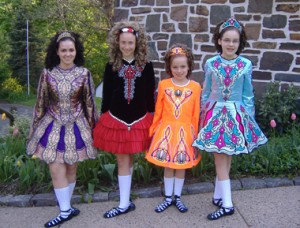
Rince Ri champions, from left, Marielle Baird (she's seventh in the world) of Upper Southampton; Kerry Freas of Warrington, and sisters Tara and Emily Schmidt of Newtown.

Marielle Baird, who dances with the Rince Ri Dance School in Southampton placed seventh in the in the Cumann Rince Naisiunta (CRN) 2010 Irish Open Championships in Dublin last week, a competition open only to the best dancers in the world.

The standard of dancing was sky high so this was great,” says Rince Ri founder and instructor Olivia Hilpl who accompanied four of her qualifying dancers to the City West Hotel, where the international contest was held.

The Rince Ri dancers qualified at a regional competition in Harrisburg in January.

Cumann Rince Naisiunta is a major Irish dancing organization founded in 1982 by a group of Irish dance teachers. The group’s regionals were held at the Philadelphia Irish Center in 2009.

Dance, Music

Stranded in Nashville

Nashville flood

The flooded road that stranded 51 tourists from Philadelphia.

When the Irish emigrated to America, they brought with them their love of music and song. Much of this heritage was instilled in future generations in the form of country and bluegrass music. The songs of love, hardship, and tragedy, the reels and other tunes battered out on barn floors and stages, live on in Nashville, Tennessee.

On April 27, a group of 51 travelers left from Philadelphia to visit this mecca of traditional, old-time country music. The group was a cross-section of folks who had heard about through the Irish Center on or on the Sunday Irish Radio Shows when it was announced by Vince Gallagher and myself. Out of the 51 folks, well more than half were Irish-born and had grown up listening to Brenda Lee, Patsy Cline, Elvis Presley, Johnny Cash and Hank Williams, among others. This was their first time to see the halls and honky-tonks where the music had been played for years.

Little did any of us know that we were going to be caught up in the extreme weather story of week—the torrential rains and flooding that left much of Nashville and its environs under water and as many as 19 people dead.

But when we arrived in Nashville a week ago, we started out as enthusiastic tourists. Our first stop: the Country Music Hall of Fame. One of the current exhibits was “The Williams Family Legacy” charting the tragic, short life of one of country music’s biggest stars, Hank Williams. Providing on-board entertainment were three of Philadelphia’s finest musicians (and comedians): Luke Jardel, Fintan Malone and Pat Kildea. The three of them have played in a dozen or more local Irish groups, duos or bands, experience that served them well when they were called on to lift the spirits of some stranded travelers and beleagured locals.

Although we were in the home of country music, we managed to end our first evening in Mulligan’s Pub singing along to Irish music. Our second day, bright and sunny, was spent wealthy musicians’ homesteads and the haunts of Nashville. We spent some time at the Ryman Auditorium and then the Grand Ole Opry.

It started to rain on Saturday, and we made our soggy way to the Hermitage, the home of President Andrew Jackson, then to the Gaylord Opryland Hotel Complex, luxury hotels are set completely under glass with beautiful indoor gardens, restaurants, a small river flowing through, shops and even a boat ride. Most of the group went to the historic St. Mary’s Cathedral in Nashville, dating back to the Civil War, to go to Mass where we discovered the visiting priest was from Dublin, Ireland. Our prayers were to serve us well over the next few days.

We started a special evening at the Cock of the Walk Restaurant—where dinner is served on tin plates—then on to the legendary music bar, John A’s where one of the regular performers is an amazing singer named Brenda Mullin, whose grandaunt, Rosemarie Timoney, was on the tour with us. Originally from Canada, where she won on the T show “Canada’s Most Talented”, she was recruited by a Nashville record company to record and perform in Nashville.

During the overnight hours, the steady rain started to pelt down. The wind started howling, the tornado sirens started blasting. We weren’t sure we were going to be able to make it to Memphis that day on our tour coach, but the driver decided to go after checking weather reports and conferring with other drivers. But this weather hadn’t be predicted. We weren’t far out of Nashville when we realized we were not only not going to make it to Memphis, we might not make it back to Nashville. The highway became a shallow stream, then a roaring creek, then a raging river.

So what did our travelers do? They started to party on the bus. Musician Luke Jardel kept the group laughing with his jokes and stories, and even managed to squeeze into one of the overhead luggage compartments to take a short nap.

After several hours of vehicle jockeying, Ronnie, the amazing man behind the wheel of our bus, was able to back the bus over a mile down the thruway, maneuver a K-turn and drive off the on-ramp. But once back on the main road, he discovered that all roads leading back to Nashville were closed. This left just one option, find a gas station and confer with other drivers about possible detours.

In the small town of Kingston Springs, sits a BP station, two or three small motels, a Mexican restaurant, an Arby’s, a Mapco and a Quizno’s. This turned out to be the tours’ home-away-from-home-away-from hotel for the next several hours. Several folks went off to the Mexican restaurant for two-for-one beers and margaritas. Other folks chose to buy food and watch the movie on the bus for a while. A few more walked up to Quizno’s. When they told the manager about the bus stranded in the BP parking lot, we were surprised and thrilled to see the employees coming down to the lot with trays of subs and cases of cold water for us.

It is said that the Irish can always make their own fun, as long as they can sing or dance. How true this proved to be! As the sky grew dark and the rain started to lift, an amazing thing happened. Luke, Fintan and Pat set up their instruments outside the BP station. A cooler full of beer appeared for all to share. The music started and before you could say “Gas Pump Ceili” the parking lot was full of Irish folks dancing the Gay Gordon, the Highland, and the Two Hand Reel. Locals joined in not just for the dancing, but also got up to sing. After two or more hours of total craic, Ronnie met a local gas company worker who told him there was a way to get back to Nashville! With a final singing of the Irish National Anthem, led by Rosemarie Timoney and the American National Anthem, led by Luke Jardel, we said goodbye to our new friends, filed back onto the bus and made our way back to our beds at one of the few hotels in Nashville that hadn’t been flooded.

When we got up the next morning for the bus trip to the airport, we were shocked to see how much damage the storm, which dumped as much as 12 inches of rain over 24 hours on the Tennessee Valley, had caused. Homes were under water. Bridges had collapsed. Schools were destroyed. Even the Grand Old Opry sustained damage as three inches of water seeped into this icon of country music, forcing shows to other, undamaged venues Nashville for the week.

Hearing the news reports—$1 billion in damage, 10 people dead in Nashville alone, two people missing—we realize just how lucky we had been.

To help repay the kindness of the people we met in Kingston Springs, TN, we are now planning a benefit concert to raise money to help those who have lost their homes and businesses. If you’d like to volunteer your band or just a hand, please contact me at rinceseit@msn.com.

Editor: Some Texas tourists were so delighted to have stumbled onto the impromptu ceili dance at the BP station, they filmed it and posted it on YouTube. You can see it here. 

Check out Marianne’s photos here.

Music

All-Ireland Champ Isaac Alderson, Singularly Focused on the Music He Loves

Isaac Alderson

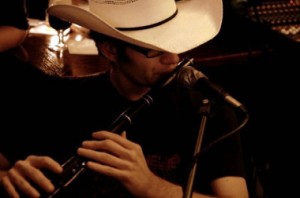
Isaac Alderson, on one of the several instruments at which he excels, the flute.

Isaac Alderson is many things…

At age 27, he‘s young.

As a musician, he’s talented in a manner many dream of but few can lay claim to: In 2002, he was named the All-Ireland Senior Champion on the flute, the whistle and the uillean pipes, in the process making this Chicago native the first American since Joanie Madden to win a tin whistle championship.

For a profession, he is making a living playing the Irish music he loves. “Irish music… I came across it when I was 11 or 12. My mom had a friend who gave me my first practice set of pipes, and I started playing them at 14. The pipes, they’re the most awkward thing for a beginner…I was really enthusiastic about it; through my high school years it was almost like an obsession. I practiced all the time,” Alderson recalled.

“I grew up in a musical household, not Irish music, but my dad had been a professional musician for a short time when he was young. He played the bass, the guitar, the harmonica. I played the saxophone when I was 10.”

Alderson’s teachers, once he discovered his passion for Irish music, were the likes of John Williams, Laurence Nugent, Al Purcell and Kieran O’Hare.

“I had a lot of people helping my interest along the way. I played a session in Evanston, and I learned a lot, hearing them play. Laurence Nugent was a primary influence.”

“My parents, my mother especially, worried about me a lot, about whether I’d be all right financially. When I was 17, my parents said, ‘Well, we think it’s about time you got a job,” and then I got handed down the session at The Hidden Shamrock in Chicago, paying $75,” Alderson laughed.

After graduating from Sarah Lawrence in 2005, Alderson made the decision to move to New York to pursue professionally the career that had begun as a fascination with Irish music and culture.

“I never saw myself getting into it in a professional capacity… I had no idea I’d ever make any money in it at all. New York’s a great place. There are tons of bars to play in, and always lots of traffic from Ireland… you don’t feel like you’re stepping on each other’s music toes.”

There’s a regular crowd of Irish musicians in New York, many of them around the same age, having arrived in the city about the same time. A camaraderie has developed among them, and an ease in playing together.

For Alderson, a collaboration between two of those musicians in particular has emerged: Fiddle player Grainne Murphy and guitar player Alan Murray.

“Alan and Grainne and I started playing together about two and a half years ago, a regular session at the Pig ‘n’ Whistle on 3rd. Six hours of playing together every Sunday for two years… slowly over the course of time, we’ve started to feel really comfortable together musically. We work very well together.”

The Philadelphia Ceili Group has thoughtfully and affectionately arranged for the trio to play at The Irish Center tonight, Friday, April 30, at 8:30 p.m. A last-minute scheduling conflict for Murray is bringing John Walsh and his guitar to town instead with Alderson and Murphy.

“I’ve played loads with Johnny. He was born in The Bronx, but raised in Kilkenny… he’s a remarkably versatile trad musician. He often plays with Paddy Keenan. He also has a recording studio in Westchester.”

The same studio, in fact, where Grainne Murphy recorded her recently launched CD, “Short Stories.”

Murphy hails from Boston, where she was gifted with her first fiddle at the tender age of 4. She learned to play from County Clare’s All-Ireland champion fiddler, Seamus Connolly.

Alderson is effusive in his praise for Murphy, with whom he “absolutely loves“ playing. In addition to her talent on the fiddle, “she has an incredible ability to pursue lots of different things at once. She’s a lawyer by trade, and an avid runner… she maintained her job as a lawyer, finished up her solo recording, kept up her running, and went back and forth to Massachusetts to help her brother, Patrick, in his campaign for city council, which he won.”

For Alderson, for now, his focus is on the music.

“It’s not a glamorous living, but I make enough to get by, and to have fun at the same time. I have thought at times of finding something a little more stable,” Alderson mused.

There doesn’t seem to be much need for that anytime soon. In addition to his regular gigs with Murphy and Murray, Alderson is pretty well booked.

“I freelance, and I get a lot of gigs by virtue of playing the pipes… I get way more gigs as a piper than as a flutist. They share me, I guess. The pipes are the quintessential Irish instrument, especially for stage gigs; people like to see the pipes.”

Oh, yes, Isaac Alderson is many things, including modest.

He can be seen playing with Shannon Lambert-Ryan, Fionan De Barra and Cheryl Prashker in RUNA.

He can be found performing with the group Jameson’s Revenge.

He recently returned from touring with Celtic Crossroads, and is set to go back out on the road with them in July.

And he is working on his first solo CD, which he hopes to finish up this June.

“What I like best above everything else is just playing tunes…playing trad music in its unadorned form.”

For information on their Philadelphia Ceili Group performance, Friday, April 30, visit their Web site. 

People

Derry is Back!

"Irish" Joan Reed gets into the spirit with a cheek shamrock.

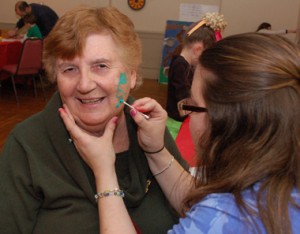
"Irish" Joan Reed gets into the spirit with a cheek shamrock.

It’s been almost a decade since the Derry Society held a social, and if Sunday’s event at the Irish Center was any indication, they were sorely missed.

The family “party,” which featured the Shantys and Bare-Knuckle Boxers, face-painting and kids’ games, Irish dancers, and a buffet, was packed. “There ought to be more of these,” said Tim Murphy of the Bogside Rogues, who was just enjoying the music instead of playing it. “This is just plain fun.”

You can see how much fun everyone was having in our photos.

Columns, How to Be Irish in Philly

How to Be Irish in Philly This Week

This is your week to pick up some interesting tidbits of Irish history.

On Sunday, Celtic scholar Sister Sheila Holly SSJ, will present a talk on “The Ancient Celts who They Were” at the Ancient Order of HiberniansHall in Bristol Borough.

Genealogist and blogger Deborah Large Fox’s Irish genealogy group meets on Thursday morning at the Family History Center in Cherry Hill, where you can learn about tracing your own Irish history.

And on the following Saturday,writer Margaret Lynch-Brennan will talk about her book, “The Irish Bridget,”about Irish immigrant in domestic service from 1840 to 1930, at the historic Ebenezer Maxwell Mansion in Germantown.

On Friday, May 7, the Philadelphia Ceili Group is sponsoring the only Philadelphia screening of the life and times of the late Liam Clancy of the Clancy Brothers and Tommy Makem at the Irish Center. Tickets will not be sold at the door so order yours now (they’re only $10).

Synchronize your calendars: Next Saturday is the fourth annual Irish Street Festival in Phoenixville, a free event filled with music, dancing, vendors, food, and general conviviality in a town that’s vying for “most Irish community” in Pennsylvania (take that as a challenge, Upper Darby).

And on May 23, honor 11 remarkable Irish women and help support the Philadelphia Irish Center at a cocktail party and awards program at the Irish Center, which opens an art exhibit. The fabulous contemporary Irish group, Runa, and members of the musical Boyce family (including Michael and John of Blackthorn and their sister, Karen, who sang with Causeway) will perform. Tickets are only $35 and include hot and cold hors d’oeuvres, wine and beer, and a chance to mingle with some of the most amazing women you’ll ever meet.