People

Always Looking for the Joy in Things

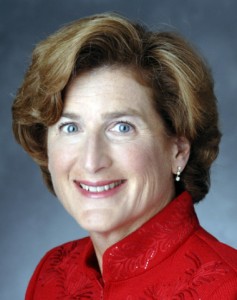
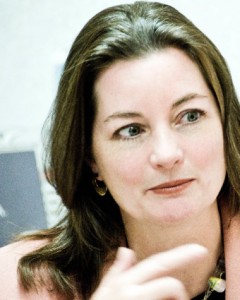
Siobhan Reardon

Siobhan Reardon

Siobhan Reardon (nee O’Loughlin) became the seventh president and director of the Free Library of Philadelphia in September 2008—the first woman ever to serve in this capacity in 114 years.

Previously, Siobhan was executive director of the Westchester (NY) Library System, a 38-member cooperative library system. While there, she launched a public relations and branding program, increased county support by 45 percent, and implemented technological enhancements. Prior to that, she was deputy executive director of the Brooklyn Public Library, serving as chief operating officer of the nation’s fifth largest library system.

Her accomplishments include tripling the size of the Library’s Foundation, spearheading a $15 million capital campaign for an auditorium and plaza for the Central Library, and strengthening the government relations function. She also served as acting executive director and director of finance.

Siobhan began her library career at New York Public Library in several finance roles. She holds a B.A. from SUNY Purchase, an M.A. from Fordham University, and an M.L.S. from the Palmer School of Library Science at Long Island University.

One of nine children in a fourth generation Irish-American family, Siobhan says her parents made sure the family remained closely tied to their heritage. “Growing up with a name like Siobhan O’Loughlin, it was pretty clear that I was Irish,” she jokes.

Her name aside, Siobhan describes her connection to her heritage as something deeper. “I think being Irish comes from within,” she says. “There is a deep sense of pride in culture and a very strong connection to family.”

A strong connection to family has been a constant theme in Siobhan’s life. She credits her parents, especially her mother, as her greatest inspirations in life.

“They believed that a good education is the best investment parents can make in their children,” she explains. Siobhan’s love of learning and stories, which have served her well in her professional career, are traits that she describes as part of “the essence” of the Irish people.

“Being Irish is a beautiful thing,” she says thoughtfully. “The Irish are always looking for the joy in things.”
People

Living Out Her Vows

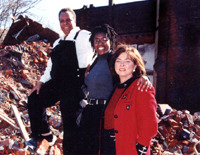
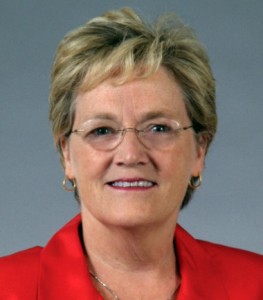
Sister Kathleen Keenan

Sister Kathleen Keenan

This year’s devastating earthquake in Haiti meant a personal loss for Sister Kathleen Marie Keenan, RSM, senior vice president of mission and sponsorship for Mercy Health System, the largest Catholic health care provider in Southeastern Pennsylvania.

As a decade-long member of the Global Health Ministry Board of Catholic Health East, Mercy’s parent organization, she has visited Haiti, Peru, and other developing countries where the Sisters of Mercy have a presence to set up health care teams in remote communities that have never seen a doctor or nurse.

“On my last trip to Haiti, I had a great visit with Archbishop (Joseph Serge) Miot. Less than a year later, he died in the Cathedral with 100 seminarians who were having a retreat experience. For me, these were not just faces on the media, they were people I knew,” she says.

But because of her work, many earthquake survivors received medical care from Mercy teams, some on the ground, some flown in from Mercy hospitals in the Philadelphia region.

Along with her RSM, Sister Kathleen has another set of letters at the end of her name: MBA. This native of Springfield, Delaware County, the descendant of Irish immigrants from Tyrone, has had a 40-year career of leadership in a variety of fields: As a teacher and principal of parish schools; as director of Catholic education for the Sisters of Mercy supervising 45 schools along the east coast; and finally in health care ministry for which she got an MBA in health care administration and another masters in long-term care administration to add to her masters in education administration.

Today, her job is to insure that everyone who works in a Mercy hospital understands Mercy’s mission: “to provide compassionate care and access to people living in the communities where our hospitals are located.

“We don’t turn anyone away from our hospitals, no matter their ability to pay,” she says. “We try to serve the whole person. There’s a pastoral aspect to our care. We treat the person, not just the injury—mind, body, and spirit, and their families are included in that equation. The Sisters of Mercy are unique among religious. All religious take vows of poverty, chastity, and obedience. We take a fourth vow—to serve the poor, sick, and uneducated. In some ways you can see I’ve lived out those vows.”

Not just in some ways.

People

“Nothing Stops Me”

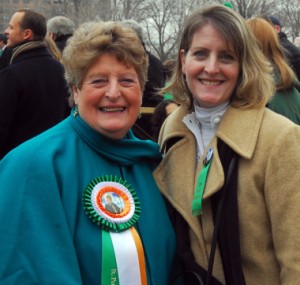
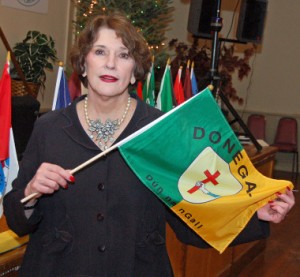
Kathy McGee Burns

Kathy McGee Burns

Kathy McGee Burns grew up in the suburbs of Philadelphia where, except for her sister, she was the only Irish girl in the neighborhood.

“I didn’t have much of an ethnic identity,” she says. “My family was well-to-do: We belonged to three country clubs. We were bused to Catholic school because there were no Catholic schools in our neighborhood. I never knew Irish people did step-dancing. The only Irish record we ever had was Bing Crosby and we only played it on St. Patrick’s Day.”

Yet this “clueless” Irish girl went on to become the first woman president of the Donegal Association of Philadelphia, the first president of the Delaware Valley Irish Hall of Fame, and next year will be only the second woman to serve as president of the Philadelphia St. Patrick’s Day Observance Committee, which oversees the city’s St. Patrick’s Day parade, a Philly tradition since 1771.

That McGee Burns had time to discover her Irish roots is miraculous. By the time she was 21, she was the mother of six children under the age of 4. After the seventh, she became a single mother and enrolled in Montgomery County Community College to get her associate’s degree. It took her eight years. Then another eight years to get her bachelor’s in medieval history at Chestnut Hill College.

In the midst of all that, she met and married Mike Burns, the love of her life, and had two more children. At 50, she entered Temple University Law School where she joined the Brehon Law Society and it was there she had her Irish epiphany.

“In Ireland, Bobby Sands and the other hunger strikers were starving themselves to death, and Bobby was the same age as my son Tony. I thought, here I am, with a son that age, and I thought of Mrs. Sands, waiting for her son to starve to death. What would I give my life for? Of course, my children. And I started getting interested in my roots—but I had no idea where we were from.”

Her father could give her only one clue. “We’re related to every McGee in Bridgeport, PA, Kathy,” he told her. So she contacted every McGee in Bridgeport until she found one who offered one slim lead: the lines to an old song they’d heard their parents sing, “We come from Donegal where they eat potatoes, skins and all.”

Of course, she did find her family in Donegal. “Nothing stops me,” she says. In fact, there’s very little Kathy McGee Burns sets out to do that she doesn’t accomplish. Today, she is a successful realtor, a cancer survivor, and grandmother of 13 who knew what she was really looking for when she began that search for her roots. “I grew up in Flourtown,” she says, “but the Irish community is my real hometown.”

People

Walking the Walk and Talking the Talk

Denise Sullivan Morrison

Denise Sullivan Morrison

You can thank her for less sodium in Campbell’s Soups. For the big push by one of the nation’s largest food manufacturers to earn the right to be called “healthy.”

But in a business world rocked by negative headlines and scandal, you may want to thank Denise Sullivan Morrison for believing that integrity is the keystone of successful leadership. And for walking the talk.

“I have a firm set of values and I will not compromise them,” says Morrison, who is president of Campbell’s top profit center, Campbell USA. “If you have a reputation for high integrity, people trust you and I fundamentally believe that you can’t lead unless you have people’s trust.”

Her drive to the top (and yes, her mission is to someday become CEO of a major company) was fueled by her father, Dennis Sullivan, an AT&T executive, who took his four daughters to work long before there was a “Take Your Daughter To Work” day. “He saw the world opening for women long before it happened and spent a lot of time challenging us on things to get us ready,” she says.

The other Sullivan sisters have also made their mark: Maggie is chairman and CEO of a communications firm; Colleen is regional vice president of sales at Expedia, and Andrea is a champion show jumper who was senior VP of sales at AT&T Wireless.

For Morrison, who rose through the ranks of Proctor & Gamble, PepsiCo, Nestle, Nabisco, and Kraft Foods where she was often the only woman in sales meetings (“Sometimes it’s still that way,” she says), success isn’t entirely measured by profits and titles.

For example, Campbell’s is going healthy not just because it’s a good marketing strategy, but because Morrison thinks it’s the right thing to do. She’s a founding member of the Healthy Weight Commitment Foundation, an initiative composed of manufacturers and retailers designed to combat obesity in the marketplace, workplace and in schools through communication and education.

The mentoring she’s received—from her father, from her current boss, Douglas Conant—she’s giving back through her work with Students in Free Enterprise, an organization of college students, academic professionals and industry leaders whose slogan is “a head for business, a heart for the world.”

“They take on projects that teach the principles of free enterprise and good business ethics and that do something for the community, a powerful message that I totally believe in,” she says. “One of my favorites was a group of students in Ghana who taught a village to make soap which they sell and it sustains the village.”

Underpinning Morrison’s achievements, as she’s quick to point out, is her family—her husband, Tom, an entrepreneur, and their two daughters. “I’m blessed with a wonderful home life,” she says. “I have a good balance which is important to me because if I were successful in business and had an unhappy home life, I would not consider myself successful.”

People

Helping to Make a Difference in the World

Born in Jenkintown and presently residing in Villanova, Emily C. Riley is creative, multi-faceted and generous with her time and connections.

She has been a trustee for a number of significant organizations in such disparate fields as services for the homeless, arts and culture, and higher education. Besides spending happy times with her three adult children and four grandchildren, she loves to travel and has an appreciation for world culture and history.

Emily C. Riley

Emily C. Riley

Today, with her sister Josephine Mandeville as president, and a board of trustees comprised of family members and civic leaders, Emily heads the Connelly Foundation (she is executive vice president) whose mission, simply stated, is to “foster learning and improve the quality of life in the greater Philadelphia area.”

To that end, the foundation gives grants to non-profit organizations working in the fields of education, health and human services, arts, culture and civic enterprise. Its special focus also is providing scholarships to parochial school students to attend archdiocesan high school and developing initiatives in collaboration with the high schools and elementary schools of the Archdiocese of Philadelphia.

The Connelly Foundation, established in 1955 by her parents, John and Josephine Connelly, both children of Irish immigrant parents from Counties Waterford and Tyrone, is the financial legacy of John Connelly’s extraordinary business acumen and work ethic.

Forced to leave school after the eighth grade to help support his family, John Connelly went on to engineer the turnaround of a company, Crown Cork and Seal, that is now literally a textbook example of brilliant business management.

In their lifetime, John and Josephine Connelly raised six children and donated more than $70 million including major grants to Villanova, La Salle, Gwynedd-Mercy and Thomas Jefferson Universities, and Roman Catholic Archdioceses of Philadelphia and Newark, largely to fund Catholic education.

Emily Riley considers herself “fortunate to be able to continue this work.” Though she has a degree in English literature from Rosemont College, philanthropy “was what we were preparing for all our lives.”

“Our parents led by example,” she says. “They both came from modest backgrounds and were very giving people—of their time, resources and compassion. And we trekked along behind them.”

“My work has been rewarding in many ways,” she says, and the word “fortunate” comes up again. “I’ve been fortunate to have the experiences I’ve had and to meet the people I’ve met, like Sister Mary Scullion, who has been a friend for 20 years. It’s part of the pleasure of working in philanthropy to know people like her and to see the difference one person can make in the world … with a little help from their friends.”

Dance, People

A Heart as Big as Her Smile

Rosemarie and Mairead

Rosemarie Timoney and daughter Mairead.

A native of Clady, County Derry, Rosemarie Timoney began Irish dancing the age of four and won the South Derry Championship at the age of 17. In 1961, she came to the United States and five years later, she founded the Timoney School of Irish Dance in Glenside in 1966 as a way to share her love of dance—its fun, camaraderie, and its place in the history of the Irish culture.

Her classes are not just about teaching dancing, but about giving the children the confidence to always be and do their best. Her students don’t compete, but they do support the community. Her dancers have performed at nursing homes, hospitals, for handicapped children and school assemblies, as well as festivals all over.

The 1997 Grand Marshal of the Philadelphia St. Patrick’s Day Parade who also does color commentary during its broadcast on CBS3, Rosemarie is wife, mother of five, grandmother of nine, and has been described as “a virtual library of all things Irish in the Delaware Valley.”

She’s also tough—that must come from her years of playing camogie, the ladies’ version of the Irish game hurling, once described as a cross between hockey, lacrosse, and assault with a deadly weapon. She has traded that for much tamer bowling—she now plays with the St. Luke’s Mother’s League.

Rosemarie Timoney also has a heart as big as her smile. As someone who knows her once said, “It’s useless to try to give Rosemarie anything. She just gives it to someone else she thinks needs it more than she does.” She collects donations of clothes and other items for her thrift shop which benefits her hometown church in Ireland.

And though it will make her blush to hear it, she is beloved. In fact, when you talk to her her family, her dancers, or even the children she crosses to safety in her crossing guard job at Copper Beech Elementary School, the one phrase that comes up again and again is, “we just love her.”

People

Don’t You Just Love Us?

Nearly everybody reads the Bulletin.

That was the advertising slogan of the late, lamented Philadelphia Bulletin. I mean the Bulletin Sandy Grady wrote for, not the Bulletin in its most recent incarnation.

Number me among the ranks of “everybody.” I delivered it, and when I got home I read it all, beginning to end.

Well, the Bulletin (that Bulletin) is long gone. P.M. newspapers are gone, or mostly. Morning newspapers are biting the dust. Those that remain are struggling. (As witness the recent epic battle over the Inquirer and Daily News.)

Some say that small local Web sites like ours are part of the problem. We do what we do (most of us) for free. We have no employees. We have no paper boys or delivery trucks. There are no presses. No paper or ink. Doing what we do costs us almost nothing. And today it might be fair to say: Nearly everybody reads (whatever they read) online.

On the other hand, many of us have no idea what we’re doing. 🙂 A lot of community sites are published by people with no journalistic training, and no understanding of professional journalistic standards. (We’re both Temple J-school grads, and we’ve worked in newspapers, magazines, books and the Web since the days of Ben Franklin. OK, maybe not that long. But long enough to remember editing stories with a pencil.)

Now the people at The Reynolds Journalism Institute at the Missouri School of Journalism want to know: What does irishphiladelphia.com mean to you? Do you like us? Do you trust us? Do we help build the community?

They asked us to post a survey, and of course we said “you betcha.”

Here’s the survey. It’ll take you less than 10 minutes:

http://rjisurvey.irishphiladelphia.sgizmo.com/s3/

Dance, People

Meet the Dark Lord of the Dance

Adam McSharry

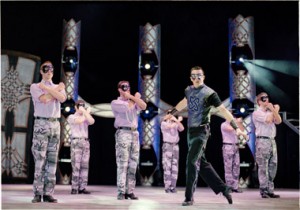
That's Adam McSharry at right, looking dark and evil.

If you’re going to see Michael Flatley’s “Lord of the Dance” at the Merriam next weekend, you’ll know Adam McSharry when you see him. He’s the bad one. The total loser.

Not a bad dancer, not a real loser, but The Dark Lord, “Don Dorcha,” who, no matter how well he dances, can never defeat The Lord of the Dance in this classic story of good and evil set to syncopated hard shoes.

“I never win,” admits McSharry, a native of Birmingham, England who’s played the villain on several continents. “But when I get out there in character during the battle between the two armies on stage, when I’m doing the final duel with the Lord of the Dance, we go to it on the stage and our duel brings each of us to our best. I’m completely focused. Even though I know I’m not going to win, I’m trying to convince audience members that I am going to win.”

A year ago, he considered leaving the troupe and putting Don Dorcha behind him. “I had job interviews ready but then. . . .” He joined Flatley’s other traveling show, “Feet of Flame,” which drew 80,000 people when it played in England and 20,000-30,000 for each of its eight shows in Taiwan. That changed his mind. “I said, ‘What am I thinking? I’m really happy here. This is the job for me.’”

So he took up his evil ways again. “I love it. I’ve been playing this role for eight years. I think it’s another side of me,” he says with a laugh.

Like many Irish dancers, McSharry started very young. At three, his mother had him in lessons and at four he was on stage at his first feis. “It came naturally,” he says. “My mother danced, my uncle danced. My father, when he moved over from Ireland (Leitrim) and was dating my mother (Downpatrick), he was picking her up at dancing class and one guy on the team that was going to the world championships had to drop out so they taught my father to dance, they went to the Worlds and came in second. My sister, Grace, is a great, great dancer. It’s in our blood.”

But he never thought of dancing as a profession until, ironically, he caught a performance by Michael Flatley on TV at the Eurovision Song Contest. “I must have been 14 or 15 and I thought, wow, would you look at that. But I just carried on in competition for a while, doing well [top three in every major competition in Britain, Ireland, the US, and the World Championships; in 2003, he performed for President and Mrs. George Bush] when I got a phone call an they said, ‘There’s a place in Lord of the Dance for you if you like it.’”

He was stunned. So, at the age of 18, he headed to Wembley, England, got fitted for a costume, learned the steps and went on stage. That year, “Lord of the Dance” entered the Guinness Book of World Records for most sold-out performances—19. Nothing like starting at the top.

He even danced opposite Flatley himself in the Taiwan production of “Feet of Fire.” He admits he was in awe.

“The whole cast agrees, he’s always going to be the one you look up to. If he says do it like this, or this will help you get the best out of your character, you listen. He gave me good tips on how to make the best of my bad guy routine. Being on stage with him is different from anything I’ve ever done before. The energy rush is incredible.”

When McSharry isn’t dancing, he’s doing whatever it takes to support his dancing. He and a few members of the troupe play soccer when they have time off. “It really keeps you fit.” And when he’s home. . . he works construction.

A stage star, a championship dancer, doing construction? Really? “Really,” he says. “It’s a good workout. It keeps you active all day, it helps build upper body and leg strength and you’re killing two birds with one stone. I could sit at home and go to the gym, but this way I’m getting paid and getting a workout.”

He may be a professional bad guy, but stupid he’s not.

“Lord of the Dance” will be at the Merriam Theater, 250 South Broad Street, Philadelphia, for six performances May 14-16.