News, People

A Rose by Any Other Name Is … Mairead

Mairead Conley

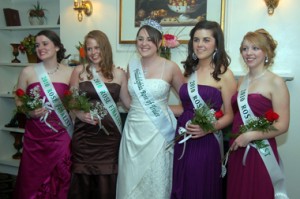
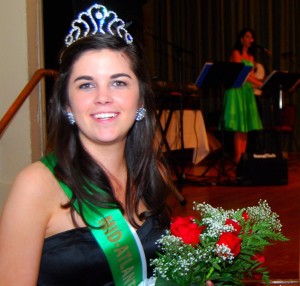
Mairead Conley, moments after being crowned Mid-Atlantic Rose of Tralee.

This August, when women from all over Ireland and the world gather in Tralee for The Rose of Tralee International Festival, Mairead Conley will be there to represent not only Philadelphia, but the Mid-Atlantic region of the United States.

A celebration of “modern young women in terms of their aspirations, ambitions, intellect, social responsibility and Irish heritage,” the festival could have crafted their definition of a Rose around Conley.

Aspirations: “I think it’s great how unexpected life can be. A year ago I never could have pictured myself here. I’m so excited for Ireland and the festival, but I’m even more ecstatic for the upcoming year—to take on such an active role in the Irish community in Philadelphia.”

Ambitions: “I’d always been interested in pursuing a career in non-profit management. Last year, my mom saw the interview that Denise Foley did with Siobhan Lyons [head of the Irish Immigration Center here in Philadelphia] on irishphiladelphia.com and sent it to me. I contacted Siobhan, and we talked about what I was interested in, and what the goals of the center were. I began interning there last August. I never even realized how ignorant I was about the immigration process in this country. So many positive things have come out of working there, including being on the IN-Philly Board.”

Intellect: “In 2007, I graduated from Temple University with a degree in sociology. If I could have, I would have majored in anthropology and African-American studies as well. I’ve always planned to go on for a master’s degree in social work.”

Social responsibility: “Growing up, service was always a part of my life. It was just another activity, like ballet or chorus. We volunteered at St. Vincent’s Soup Kitchen in Germantown, and every Saturday I’d go with my aunt, who was a nun, to collect food from restaurants and farmers markets and deliver it to the St. Francis Inn in Kensington. In the summers, we’d go and stay with another aunt in Ohio (my mom is one of 10 kids) and teach vacation Bible School in Appalachia. The year after I graduated from Temple, I spent a year with the Mercy Volunteer Corps volunteering at a Catholic grade school in Cincinnati. There are so many kids living in poverty, and I think it’s so important to give them outlets and hope. I really believe it’s an important part of my spiritual development and growth.”

Irish heritage: “The Conleys are from Ballina in County Mayo. They emigrated to Canada, and were in Newfoundland before coming down into the U.S., into Indiana and Chicago. My mom’s family is from Strabane, County Tyrone, and from Abbeyfeale, County Limerick. We just visited some family there last summer. And it’s really funny because I was actually in Tralee last year, too. I saw the rose gardens and we saw a show at the National Folk Theatre. It never entered my mind that I’d be going back, let alone as a Rose.”

But when deciding on the Rose, judges look beyond even those characteristics to discern “the truth in her eyes” as William Mulchinock’s song “The Rose of Tralee” characterizes it.

And just so, there is more yet to Conley:“I find it all so overwhelmingly exciting that it’s taking me a while to soak it all in. I really wasn’t going to do it, enter the Rose Festival—I’m someone who’s an observer of people and I generally don’t like the limelight—it’s so strange that the tables have turned,” Conley explained.

“Kathleen Murtagh encouraged me to enter the Miss Mayo Pageant last November, and Sarah [Conaghan, managing director of the Mid-Atlantic Rose of Tralee Center] was a judge there.

After Miss Mayo, Sarah encouraged me to go out for the Rose. I said I would think about it, but it seemed so out of my realm that I put it to the side,” Conley laughed.It wasn’t until more encouragement from City Councilman Bill Green, and the ladies at the Immigration Center’s Senior Lunch, that Conley threw her tiara into the ring.

“In March, at the Philadelphia Rose Selection, I got myself worked up and stressed out over it… so by the end of the night, I was shocked that I was a finalist. I find it difficult still. All of these women are so intelligent, savvy and dynamic. But camaraderie is really emphasized; there truly is a lack of competition.

“And so much is based on service. That’s an area I’m comfortable talking about. I still have a strong desire to do a service year abroad; I’d even started the application process for the upcoming year—I really didn’t think I’d win. I believe in thinking globally and acting locally, in doing something that will make a big difference in a small area.”

In fact, Conley chose two charities to sponsor as the Mid-Atlantic Rose: Holy Family Home and The Little Sisters of the Poor in Southwest Philly, where her grandmother lives, and the Southwest Community Arts Center where she did service work growing up.

“I feel like I’ve been blessed that I’ve had a lot of freedom to be able to choose what I want to do in life, and then do it. This past year has shown me that life is full of surprises and unexpected opportunities.

“Jocelyn McGillian did such an awesome job as Philadelphia’s Rose last year. I have some big shoes to fill. I’m really looking forward to working with Sarah, and the whole Conaghan family. I just have to say how genuinely kind everyone has been, even before the Rose. The Philadelphia Irish community is closeknit but so welcoming… I really think it’s going to be a great year.”

And on August 24, all Irish eyes in Philadelphia will be looking toward Tralee, and rooting for the home town favorite.
Columns, How to Be Irish in Philly

How to Be Irish in Philly This Week

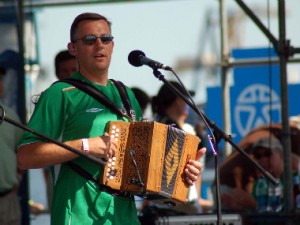
Free Blackthorn tunes this week

Free Blackthorn tunes this week.

Going to the beach this weekend? Think you can evade your duties as a respectable, card-carrying Irishperson?

Guess again, bucko.

If you’re headed down the Shore, you can get your Irish on big-time at Ireland and Old Lace in Historic Smithville, a few miles north of A.C., from 11 to 2 on Saturday. That distinctive little shop (615 East Moss Mill Road in Galloway) will host the kickin’ Celtic rock band Barleyjuice. You can also buy food and beer. Rumor has it, you can buy cheese and onion Taytos crisps.

Hmmmm … food, beer and Irish rock. All of life’s essentials, and all at the Jersey Shore over July 4th weekend, to boot. Does life get any better than this? Oh, yeah, it does … it’s free! Dip your pale Irish body in a vat of SPF 70, and get there.

Sunday, July 4th, brings us another Sunday of Irish tunes and community with the Vincent Gallagher Hour at 11 a.m., followed at high noon by “Come West Along the Road” with Marianne MacDonald, all on WTMR-800 AM. If you can’t pick it up on the radio, hear it clear as a bell on the Web.

You can keep the Independence Day Hibernian buzz going. Head out to Molly Maguire’s in Phoenixville for the Irish music session with Kane and Beatty, starting at 3.

Later in the week, Thursday to be specific, you have a tough, tough choice:

a.) Take yourself out to the ball game. The Camden Riversharks are celebrating Irish Heritage Night Thursday at the beautiful Campbell’s Field, 401 North Delaware Ave., in Camden. the Riversharks are playing the Southern Maryland Blue Crabs. (So, wait … is it an Irish festival or a seafood festival?) Game time is 7:05. Special deal for our Irish Philly fans: Tickets are only 5 bucks when you use the group code “irish” to buy your tickets. Contact Mark in the Riversharks front office at 856-583-0031 or mschieber@riversharks.com.

b.) Pack up your lawn chairs and a picnic dinner for a special free concert by the boys of Blackthorn, at Prospect Park, starting at 7 p.m.

Baseball … Blackthorn. Blackthorn … baseball. Decisions, decisions …

You Delco Irish have a big, fun-filled day in the sun lined up. Next Saturday from 1 to 4, the Irish Club of Delaware County hosts its 2nd annual Irish Picnic at Knights of Columbus De La Salle Pool, 18 Baltimore Pike, in Springfield. Round Tower provides the music (they were great at the Penn’s Landing Irish Festival), the Celtic Flame Dancers will take to their toes, and you can spend the afternoon swimming, playing games, perusing the vendor stalls, and chowing down on picnic chow. Beer and other bevvies, too, of course.

See you next time!

News

Up On The Roof

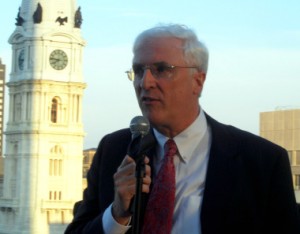
Ambassador Michael Collins joined in the celebration.

Ambassador Michael Collins joined in the celebration. So did Billy Penn. (Click on the photo to view a slideshow.)

In the late afternoon Thursday, severe storms swept through the Delaware Valley, threatening to put a damper on the planned launch party for Irish Network-Philly. IN-Philly is a brand-new organization designed to foster greater cultural, social and economic partnerships among its members and beyond.

The party was supposed to be held high atop The Phoenix at 16th and The Benjamin Franklin Parkway. But lightning and heavy rain kept the outcome in doubt until almost the very last minute.

The skies cleared around 5 p.m., and by 6, a large group of happy new IN-Philly members—business people, lawyers, judges, painters, theatre people, journalists, musicians, dancers and more—took the elevators to the roof for a night of connections (much business card exchanging), welcome cool drinks, superb Tir na nOg nibblies and fun. At the very top of the guest list: Irish Ambassador Michael Collins. (He almost didn’t make it: The storm held up his train from Washington.)

The idea was hatched around St. Patrick’s Day.

“Three months later, here we all are up on top of The Phoenix,” said Laurence Banville, a Center City attorney from County Wexford and president of the IN-Philly board. “We are rolling.”

IN-Philly is not intended to be a hard-core business network, but rather “a stoft type of network that leads to better things,” said Banville. He added that the network plans to reach out to the many existing Irish organizations to help bolster their efforts.

We have photos from the night. Click on the photo at upper right to view the slideshow.

Columns, How to Be Irish in Philly

How to Be Irish in Philly This Week

The Roses

The Roses

Yet another festival this weekend, this one Scottish (but hey, a Celt’s a Celt). The Celtic Fling and Highland Games goes on in Manheim, in Lancaster County, on Saturday with music, dancing, craftsmen and big, beefy athletes who toss things that look like telephone poles into the air to see who can heft them the farthest. Trust us, this is way fun.

Closer to home, you can watch a group of smart, talented, lovely young women compete for the coveted Mid-Atlantic Rose of Tralee crown. There are four Philly entries (good luck, girls!) plus young women from up and down the eastern seaboard vying for the chance to compete for the international title in Ireland. It all takes place at the Irish Center on Saturday night. The bargain price of $35 per tickets gets you dinner, dancing, and a chance to play along (come on, we know you pick the winners when you’re watching Miss Universe at home!).

AOH Black Jack Kehoe Division is holding its annual Night of Irish Music at the Briarcliffe American Legion Hall in Glenolden on Saturday night. The Shantys and other local groups are on the bill, and there’s food and drink as well.

Then, can you take another festival? Sure you can! On Sunday, Bristol Borough holds its annual Celtic Day on the waterfront, featuring the Irish American String Band, bagpiper Ian Ferrick, McHugh and Company, Paddy’s Well and the Fitzpatrick School of Irish Dance. BYO lawn chair, but there’ll be food and goodies to buy and entertainment for the kids.

Other than the sessions just about every night of the week, it’s a bit slow, probably because of the July 4 weekend coming up. We’ll peek a little ahead because there’s some fine stuff coming up, including a free concert with Barleyjuice in Galloway, NJ, on July 3.

Later in July, the incredible Don Stiffe, a singer-songwriter from County Galway, is coming to the Irish Center. You won’t believe this voice! You’ll probably be hearing it on Marianne MacDonald’s “Come West Along the Road” radio show on Sundays at noon on WTMR 800AM since she’s bringing this enormously talented musician to the area. Writing about Stiffe’s first release, “Start of a Dream,” Sean Laffey of Irish Music magazine said “the album is in the premier league… style, taste, pace and final execution are flawless and his choice of songs is inspired … a class act, with a class album.”

Later in the summer, the fiddle-playing Kane sisters, Liz and Yvonne, from Connemara, will be on stage at the Irish Center for a Philadelphia Ceili Group concert.

Dance, Music, People

A Flood of Generosity for Flood Victims

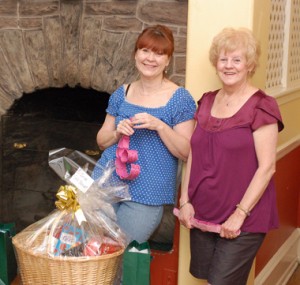
Rath deHouth and Ann McGee sold tickets for some beautiful baskets.

Rath deHouth and Ann McGee sold tickets for some beautiful baskets.

An evening of music and dancing at the Irish Center last week raised more than $2,000 for the people of Kingston Springs, Tennessee, who lost their local elementary school in the floods that wreaked havoc on Nashville and the entire Cumberland River area in May.

It was a gesture of thanks from a group of 52 Irish Philadelphians who found themselves in Kingston Springs after last May’s flooding turned back their tour bus which was taking them to Memphis for a visit to Graceland.

When the group holed up at a BP station, the tour band—local musicians Fintan Malone, Luke Jardel, and Pat Kildea—set up their instruments and started to play. Many of the Philly tourists were dancers, so an impromptu ceili went into full swing—and it was recorded for YouTube by a Texas tourist who was also stranded.

A nearby merchant sent sandwiches and cases of water to the dancers and some of the local residents joined in the fun, dancing and singing as the rain fell.

To repay the kindness, tour coordinator Marianne MacDonald and musician Luke Jardel planned a benefit (“The Gas Pump Ceili Benefit”) at last Thursday’s Rambling House event at the Irish Center.

The people of Kingston Springs responded when photos from the benefit were posted to the city’s Facebook page. Here are a few examples:

“Fabulous!! We heard so much about your visit, yet no one could really tell us who you were or where you came from! Thanks so much for your positive approach during the flood and leaving a positive memory behind. Thanks for entertaining the stranded.”—Laurie Cooper, City Manager

“Thank you… I wish the flood didn’t happen but it was wonderful for us all to come together. Seems like things stopped ( everyday worries) and people came together like they should. What beautiful hearts you have!”—Jennifer Baer Reese

“Thank you all so much for your generosity, kindness and those much needed smiles your created May 2!”—Marie Spafford

We have photos from the benefit. Click on the photo at upper right to view a photo essay.

People

Today Tralee, Tomorrow the World

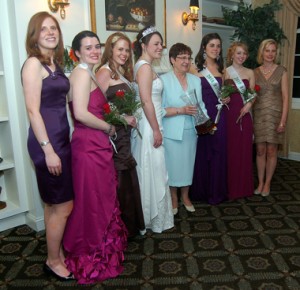
Karen Conaghan Race is at far left and her sister, Sarah Conaghan at far right, with Roses in between.

Karen Conaghan Race is at far left and her sister, Sarah Conaghan at far right, with Roses in between.

As you watch Saturday night’s Mid-Atlantic Rose of Tralee Final at the Philadelphia Irish Center—you are going, aren’t you?—know this: you’re catching a glimpse of the future of this long-running County Kerry Festival.

Since 1959, the festival has been selecting a young woman on a yearly basis to serve as its Rose of Tralee, with the candidates coming from around the world.

Anthony O’Gara, managing director of the festival, says the United States is about to gain many, many new Rose of Tralee Centres–groups of people responsible for running their own local and regional festivals.

“Our ambition is to build 250 centres in America in nine regions,” says O’Gara. “Sarah Conaghan and her sister Karen Conaghan Race have spearheaded the movement here in the United States. This [instead of running just one local festival], they’ll be running a regional festival pulling in six centres.”

This expansion is all part of the international festival’s mission to bring a bit of the Irish culture to the rest of the world. In 2004, the international festival had just 28 centres; today there are 80, only half of them in Ireland.

O’Gara acknowledges that there are many Rose of Tralee Centers in the States already–but they’re scattered. “There are pockets of Irish in cities and regions all over the united States,” he notes. “If you just have one centre for every state, you’re only reaching a tiny portion of the Irish and irish-Americans living in that state,” he says.

If the international committee has anything to say about it, the vast increase in local centres ought to capture a far bigger audience.

If you want to see how that ambitious plan is progressing, check out the Mid-Atlantic final at the Irish Center Saturday night.

[googleMap name=”Philadelphia Irish Center” width=”600″ height=”600″ directions_from=”true”]6815 Emlen Street, Philadelphia, PA 19118[/googleMap]

News, People

Philly’s “Good Guy” Set to Become Harrisburg’s 10th Bishop

Bishop Joseph McFadden

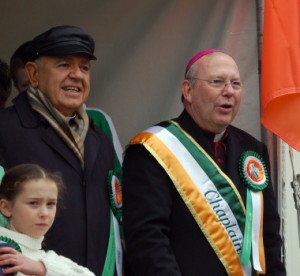
Bishop Joseph McFadden, chaplain emeritus of the Philadelphia St. Patrick's Day Parade, joined St. Thomas More alums in singing the school song.

An “average Joe” is about to helm the Harrisburg Diocese.

Of course, Philadelphia Auxiliary Bishop Joseph P. McFadden is really far from ordinary. In naming him this week to become the 10th bishop of Harrisburg, Pope Benedict XVI surely must have recognized Bishop McFadden’s solid record of accomplishment.

McFadden has been a priest for 29 years, but he was someone special right from the word go. After a brief stint as assistant pastor of Irish St. Laurence Parish in Highland Park, Delaware County, he become administrative secretary to then Cardinal Krol in 1982. Less than 10 years later, he was appointed honorary prelate to Pope John Paul II—as a monsignor.

He later served as president of Cardinal O’Hara High School, pastor of St. Joseph Parish in Downington and, in June 2004, auxiliary bishop under Cardinal Justin Rigali.

Not bad for a guy who grew up in St. Rose of Lima parish in West Philly, graduate of St. Thomas More, and high school basketball coach.

McFadden, contacted Friday just before he left to catch a flight to Rome, was characteristically humble when asked about his sure and steady rise. “For most priests the goal is to answer the call of God and to be of service to Jesus and the preaching of his gospel as a parish priest,” he said. “I don’t think a young man focuses on becoming a bishop. I didn’t. As bishop, a priest is still called to preach the gospel, but it means that you have responsibility of a larger flock, a larger group of people. when God gives you responsibility, you expect to have to answer to that responsiblilty. It’s one thing for an individual to open himself to the grace of God. It’s quite another thing to be responsible for shepherding other people in response to the same call.”

Throughout his rise to the top, Joseph McFadden apparently has not forgotten his humble roots, said Michael Bradley, director of the Philadelphia St. Patrick’s Day Parade, who has known him for a long time—including McFadden’s more recent service as parade chaplain and chaplain emeritus.

“He (McFadden) was president of Cardinal O’Hara when I was athletic director at Broomall,” said Bradley. “We knew of each each other for a long time. He went to Tommy Moore, and my dad went there. But we became close in the ’90s.”

Over the years, Bradley could see how much McFadden loved the Philly parade. The future bishop would march every year with the group from O’Hara. In 2007, when chaplain Father Kevin Trautner died, Bradley named him chaplain. That first year, McFadden spent some time providing commentary in the CBS3 booth. “They raved about him,” said Bradley.

What has appealed most to Bradley about this well-connected prelate, who in his time has tackled some nettlesome issues—including the closing of Cardinal Dougherty and Northeast Catholic high schools—is how down-to-earth he is. “I’ve always felt that he is a regular guy who became a bishop,” said Bradley. “He has an ability, when you’re talking to him, to make you feel like he’s your best friend.”

Bradley, for one, is not happy to see this best friend go. While acknowledging that McFadden’s promotion to preside over the Harrisburg Diocese is a great honor, Bradley wishes the Vatican had looked inside the Harrisburg Diocese to “hire from within. He asked, “Why can’t they get their own good guy?”

Philly’s “good guy” understands that his local friends might miss him. At the same time, he hopes he’ll be able to maintain at least some of his ties to the Philadelphia St. Patrick’s Day Parade while forging new ties with the Irish-Americans of Harrisburg. “I would like to hope I can,” he said. “I love the Philly parade.

My parents, as you know, were born in Ireland. I’m proud of my Irish heritage. the parade has been such a great experience the last several years. It really has become a wonderful event in Philadelphia.”

Arts

Celebrating “Ulysses”

“Mr. Leopold Bloom ate with relish the inner organs of beasts and fowls. He liked thick giblet soup, nutty gizzards, a stuffed roast heart, liver slices fried with crustcrumbs, fried hencod’s roes. Most of all he liked grilled mutton kidneys which gave to his palate a fine tang of faintly scented urine.”

~ James Joyce, “Ulysses”

His name is Hamlet, but his passion is “Ulysses.”

Bloomsday

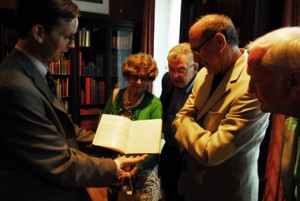
Lucky luncheon goers get up close and personal with Joyce's handwritten manuscript of "Ulysses," which is owned by the Rosenbach Museum. Director Derek Dreher holds the manuscript in the library, which remains dark to protect the books.

For the past seven years, Jim Hamlet, CPA, has served on the committee—two years as its chairman—that brings the marathon June 16 Bloomsday reading of James Joyce’s “Ulysses” to the Rosenbach Museum in Philadelphia.

“Ulysses,” considered one of the best English-language novels of the 20th century, chronicles one ordinary day—June 16—in the life of Joyce’s main protagonist, Leopold Bloom, a modern-day Odysseus who wanders the streets of Dublin, encountering character after character. Its 18 chapters each bear the title of one episode in the life and adventures of Homer’s epic hero, Ulysses, on which Joyce based his work.

While the National Library of Ireland is one of the major repositories in the world for all things Joyce, there’s a coveted, autographed, handwritten copy of the manuscript that calls the Rosenbach Museum home, making it particularly suited to hosting the yearly readings.

Hamlet, his late father, and his son, Michael, have been volunteer readers in past years. This year, he knew he was going to miss it because of an out-of-town work commitment.

So instead, the day before Bloomsday, he was tucking into steak and kidney pie—a tribute to the breakfast enjoyed by Bloom—and other Joycean-inspired dishes prepared by the chef at The Bards for a luncheon at the Rosenbach, sponsored by the John Henry Newman Foundation and Joyce’s alma mater, University College Dublin. Each year, the Rosenbach focuses on a theme related to the novel; this year’s was food, a logical choice for a book that’s a feast of words, many of them about food. Guest speaker for the luncheon was Professor Declan Kiberd, chair of Anglo Irish Literature and Drama at University College Dublin, who explores Joyce’s food themes in his book, “The Art of the Everyday in Joyce’s Masterpiece.”

Hamlet, who does audit work for the Rosenbach and several other museum clients, is keenly aware most people consider a CPA rubbing elbows with Joyce scholars as surprising as finding capers instead of raisins in your oatmeal.

“Most people ask me why I’m so dedicated to Ulysses because I’m a CPA and mostly English majors read the book, but I love Irish literature,” says Hamlet. He had read Joyce, but, he confessed, until he became involved with Bloomsday had never tackled the door-stop-sized “Ulysses” which is famously considered difficult to read, in part because of its stream-of-conscious form and the hundreds of puzzles and allusions that Joyce deliberately inserted “keep the professors busy for centuries arguing over what I meant,” guaranteeing his “immortality.”

But when Hamlet volunteered at the Rosenbach, he jokes, he felt he “had to” read the book, as daunting as it seemed. To make it a little less of the chore he thought it was going to be, he took a class with then University of Pennsylvania Joyce scholar, Vicki Mahaffey, PhD, author of “Reauthorizing Joyce” and “States of Desire: Wilde, Yeats, and Joyce and the Irish Experiment.”

“It took us eight months to read it, chapter after chapter, and Vicki helped us get the references and when we got to parts where we had no idea what was happening, she’d help us get over them. The best advice she gave us was ‘If you don’t understand it, keep going, keep going.’”

He was glad he did. Today he describes the novel that probably thwarts more than it impassions in the same way some people describe the latest Michael Connelly thriller. “It’s really a great yarn,” Hamlet says. “It has so many moving parts. Each chapter reflects the story of Odysseus, but what sets it apart is how he tied that story back to ordinary Irish life.”

And seven years of planning the Rosenbach’s Bloomsday festivities has altered how Hamlet looks at the book’s complexity. “In the past we’ve shown movies, had plays, and one year we had a dance troupe do an interpretive dance of the novel. If you think the book’s confusing,” he said with a laugh, “try looking at a modern dance interpretation.”