News, People

Honors for the ‘Gold Standard of an Irish Gentleman’

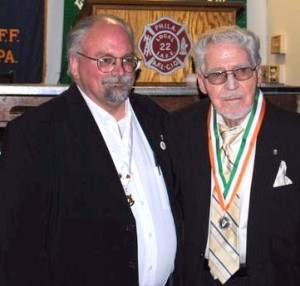
Bob Haley and Joe Montgomery

Bob Haley and Joe Montgomery

When it comes to award banquets and the like, there are times when an organization has a hard time figuring out who to honor.

For the Firefighter John J. Redmond Division of the Ancient Order of Hibernians, it was a no-brainer.

At their Hibernian Service Award ceremony Friday night at the Firefighters Union Hall in Center City, the Redmond AOH honored the only living person to have an AOH division named after him (Division 65 in Upper Darby): Joe Montgomery.

“He was chosen by a committee of our executive board,” says Bob Haley, president of Ancient Order of Hibernians Division 22. “Joe’s name wasn’t even challenged.”

Haley, who is 48, recognizes well that Joe Montgomery is from another generation (he’s 90), but he says Montgomery is not set in his ways and he’s open to new thoughts and ideas. Since he’s been around the block a few times, though, Montgomery can be relied upon to provide wise counsel. And the young guys are all too willing to learn from the master.

“Joe is a friend to almost every division in the Philadelphia area and throughout Pennsylvania,” said Haley. “Joe is Pennsylvania’s oldest Hibernian. He’s been around long enough so that he knows what’s been tried and hasn’t worked. He’ll sit there and listen to you and what you have to say, and he’ll give you advice. Still, he likes to say, ‘It’s your generation who will keep the AOH going.’

“Joe’s been to every convention, not just the state but the national. He’s been an officer on almost every level. Everybody knows Joe Montgomery.”

In addition to Montgomery’s longtime dedication to the AOH, Haley says Montgomery is noteworthy for yet another reason: He’s what Bob Gessler, founder of the Hibernian Hunger Project and a leader among Philadelphia Hibernians, has called “the gold standard for an Irish gentleman.” Haley notes that Montgomery used to live at 11th and Jackson and, as a younger man, worked as a teamster.

“He went to work in a suit and tie every day,” says Haley. “He’d change into his work clothes when he got to work. That’s the kind of guy he was.”

The division honored several other people of note:

Hibernian of the year
Hubert Gantz
President Garrettford – Drexel Hill Vol. Fire Co.
AOH Div. 22 Recording Secretary

Irishman of the Year
Edward Dougherty
National Hibernian Hunger Project Chairman
President AOH Div. 39

Ladies Hibernian of the Year
Debbie Lenczynski
Treasurer LAOH Div. 22


News, People

No Fries with That

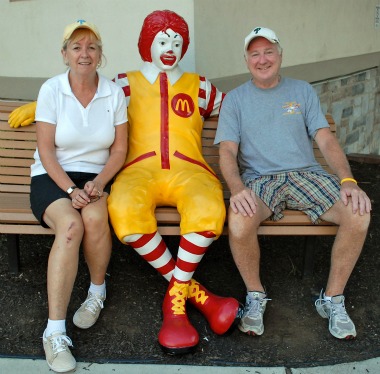
Hibernian Hunger Project volunteers Ed and Pat Costello and friend.

When you’re used to cooking for thousands, dinner for a couple dozen people  is no sweat. Okay, if you’re at the stove, maybe there’s a little sweat. But volunteers from the Philadelphia area’s Hibernian Hunger Project (HHP), a national charitable program of the Ancient Order of Hibernians, didn’t let a little heat drive them out of the kitchen.

On Monday, June 13, they prepared roast beef, mashed potatoes, baked chicken breasts, lasagna, eggplant parmagiana, various veggies, salad, and dessert for the children and families staying at the Ronald McDonald House on Erie Avenue, next to St. Christopher’s Hospital for Children.

Like the Hibernian Hunger Project, which feeds thousands of needy people around the country, the 300 Ronald McDonald Houses around the US trace their roots to Philadelphia and something Irish.

In 1974, a pediatric oncologist at The Children’s Hospital of Philadelphia, Audrey Evans, MD, met with Eagles General Manager Jimmy Murray whose team was raising funds to support a player whose daughter was being treated for leukemia at St. Chris’s. Murray reached out to McDonalds which offered the proceeds from the sales of its Shamrock Shake to build a place where families of children being treated at local medical facilities could stay. Children come from all over the country—in fact, all over the world—to Philadelphia which has three children’s hospitals—CHOP, St. Chris’s, and Shriner’s at Temple University.

The first Ronald McDonald House was carved from a seven-bedroom home on Spruce Street near CHOP and a brand new facility, with 18 guestrooms, opened in 2008 at St. Chris’s. It costs families $15 a night to stay at the Ronald McDonald House, unless they can’t pay. Then, it’s free.

As is much of the labor. There’s only a few paid staff and, though St. Chris’s house has a state-of-the-art kitchen that even Emeril would love, all meals are cooked and served by volunteers.

“I had no idea that all the food was donated,” said Donna Donnelly, who serves on the HHP Board, as she popped two trays of mashed potatoes in one of the ovens, alongside bubbling trays of seasoned chicken breasts. “I also didn’t realize that they had somebody different to cook for them every night. I can see where it would be a comfort, after a day of sitting by a child’s bedside, to come back and have a home-cooked meal.”

On the other side of the kitchen, Ed Costello and his wife, Pat, were slicing up the roasts that had been simmering in 50-gallon slow cookers of all day.

“This is making me hungry!” called another volunteer, sniffing the rich aroma perfuming the air.

At another oven, Kathy Gessler and Patty-Pat Koslowski were minding the lasagna, the eggplant parm, and the chicken gravy. “Pass me the cheese,” said Koslowski, who works for a caterer. “I need to put the finishing touches on this.”

The man who created the Hibernian Hunger Project, Bob Gessler, former president of AOH Div. 87, made the connection with the Ronald McDonald House last March, after he saw volunteers serving breakfast to families on St. Patrick’s Day. “I talked to them about having us come in and while we couldn’t do it on St. Patrick’s Day, we decided to do shamrocks for the staff and the families,” he explained. The potted “shamrocks”—actually oxalis plants—are still in all the kitchen windows.

A tribute to the staff’s ability to attract volunteer chefs, the next available time was in June.

Gessler saw the undertaking as a way to involve more people in HHP, which holds regular “cook-ins” during which they make up to 6,000 meals for the elderly and shut-ins served by Aid for Friends, a nonprofit organization in Northeast Philadelphia. All year long, local AOHs collect canned goods or raise money for HHP. They make and deliver food baskets at the holidays. “We’re always looking for ways to get more people connected to HHP,” says Gessler. While the cook-ins draw hundreds who work, assembly line style, preparing meals for freezing, volunteers rarely see the fruits of their labor—the smile on the face of someone savoring the meal.

“I saw this as something that’s on a smaller scale, something they can own,” he says. “People want to help. Sometimes they don’t know how to help. They don’t have to spend any money. We have the money. What we need are your time and talents.”

At 6 sharp, the receptionist at the front desk announced over the loud speaker: “Dinner is now being served by the Hibernian Hunger Project” and the first takers appeared in the dining room and got into the buffet line: staff members, moms, dads, grandparents, children wearing wrist tags identifying them as patients. The volunteers hung back, watching as the food was scooped and piled onto plates.

And, about 20 minutes into the meal, they got their reward. “They’re coming back for seconds!” whispered one. For a volunteer with the Hibernian Hunger Project, that’s equivalent to “my compliments to the chef.”

See the photos from the Hibernian Hunger Projects kitchen duty at the Ronald McDonald House.

Arts

Review: Gibraltar: An Adaptation after James Joyce’s Ulysses

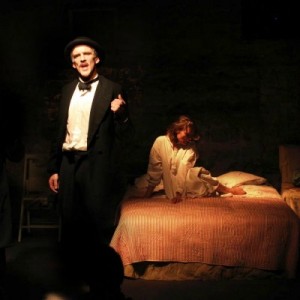
Patrick Fitzgerald and Cara Seymour

Patrick Fitzgerald and Cara Seymour

On the one hand, there is James Joyce’s classic novel Ulysses, a book that has been described as a “complex masterpiece,” with its manifold overlapping themes, rich symbolism and a vast and colorful cast of characters.

On the other hand, there is Patrick Fitgerald’s play Gibraltar: An Adaptation after James Joyce’s Ulysses, to be presented Saturday at 5 p.m. at Plays and Players, which does something both brave and fascinating. Gibraltar plunges deeply and directly into what Fitzpatrick believes is the novel’s heart: the complex, bittersweet love story of protagonist Leopold Bloom and his wife Molly.

The play takes its name from the birthplace of Molly Bloom, played by Cara Seymour. Seymour actually plays several other roles, including the muse, her husband’s deceased Hungarian father Rudolf Virág, Gerty MacDowell (a young girl Bloom encounters on the beach), and, at one or two points, the Blooms’ cat.) Fitzgerald portrays Leopold Bloom. The play premiered in New York in 2010.

Artist Rob Berry and the crew of Throwaway Horse LLC, creators of the online comic Ulysses Seen , were instrumental in bringing the play to Plays and Players. (Read the blog post.)

I’ve previously owned up to my ignorance of Ulysses. And so I have to admit, I was looking to Gibraltar as a gentle, accessible introduction to Joyce’s Dublin and Leopold Bloom’s travels about the city on that single day, June 16.

And so, in some ways, it was just that. It’s not hard to get a grasp on the broad outlines and themes, although at times it can be hard to focus in on specifics because the lines, derived from the language of the novel, come fast and furious. Consequently, some of what transpires onstage is hard to follow.

Still, hang in there, Ulysses newbs, and you’ll catch snatches of Joyce’s language and you’ll gain precious insight into what makes at least these two characters tick—or as much as they themselves have been able to figure out.

It’s hard for me to imagine a more challenging acting assignment, but Fitzgerald and Seymour are more than equal to the task. Fitzgerald’s passion and energy shine through. He makes the stage, with its meager props—a bed, a set of stairs, some dishes and a tea kettle, a hatstand and a Victrola—seem much larger than it really is. We cease to see props; instead, we begin to see Leopold Bloom, his life and his world through the actor’s eyes.

Seymour is a revelation, particularly as she delivers Molly’s soliloquy. It’s from the final chapter of Ulysses, and it takes up most of the second half. The lines are delivered from a squeaky bed at the far right side of the stage—the bed Molly shares with Leopold. Seymour opens the window wide onto Molly’s fundamental humanity as the character takes stock of her life and her relationship with Leopold—reminiscences tinged with longing and regret. As the monologue continued, you could sense that so-called “fourth wall” actors talk about becoming ever more permeable and, finally, dissolving into thin air.

I would never suggest that Gibraltar is easy going. The Sound of Music, it is not. Still, as the week in which Bloomsday is celebrated comes to a close, take the opportunity to see what two very talented actors can do with Joyce’s challenging masterwork.

Ticket information.

Location:

Plays & Players
1714 Delancey Pl
Philadelphia, PA 19103

Columns, How to Be Irish in Philly

How to Be Irish in Philly This Week

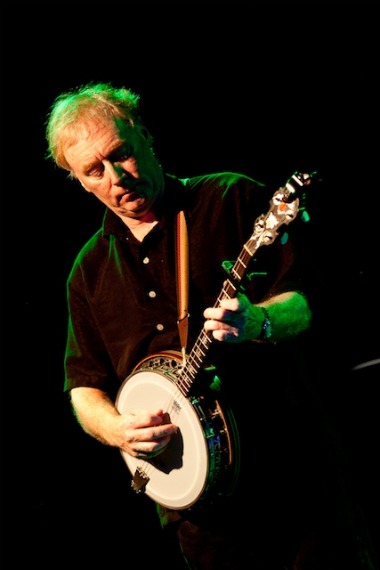
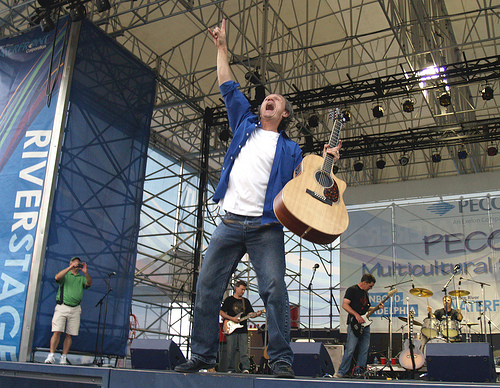
Direct from Ireland, Michael Black will be at the Penn-Mar Irish Festival this weekend.

Here’s a few things Dad might like this weekend, as we celebrate the joys of fatherhood.

The 11th annual Penn-Mar Irish Festival in Glen Rock, PA, is this weekend. Always an incredible lineup of musicians, and this year you’ll see Michael Black (of Ireland’s famous Black family) and a special tribute performance to Patrick Halloran of the band Ceann, who died last February in a car accident. Also on stage: Amhranai Na Gaeilge, Irish Blessing, Martin Family Band, Nua (formerly Rossnareen), and The Spalpeens.

Proceeds from the event benefit Penn-Mar Human Services, a nonprofit agency that provides support services to disabled people and their families.

“Gibraltar,” an adaptation of James Joyce’s Ulysses (Bloomsday was Thursday) is at the Plays & Players Theatre in Delancey Place in Philadelphia on Saturday.

There’s a session Saturday at the AOH Notre Dame Div. 1 Club House in Swedesburg and Belfast Connection, who have been known to show up at these sessions, will be otherwise engaged playing a gig at Brittinghams in Lafayette Hill. If you miss them Saturday night, they’ll be at the Burlap and Bean Coffee House in Newtown Square on Friday, June 24. Local trad musicians Mary Malone (fiddle) and Den Vykopal (pipes) will be joining them.

Later in the week, you might want to head down to Delaware (hey, it’s not that far away) for a performance by The Outside Track, a Celtic group whose members—and music–hail from Scotland, Ireland, Cape Breton and Vancouver. They’ll be at the Lower Brandywine Church on Thursday.

The ever energetic AOH Notre Dame Division 1 is hosting a “Last Friday,” this one with Oliver taking the stage from 7:30-10:30 PM.

Seems like every sports team wants to cash in on Philly’s Irish roots by sponsoring an Irish theme night, and the Philadelphia Soul arena football team is no exception. They’ll be serving green beer (uh-oh, plastic paddy faux pas!) and live Irish bands and dancers throughout the evening Saturday, June 25, at the Wells Fargo Center. And they’ll also be playing the Arizona Rattlers. Maybe Bon Jovi will come out and do a hornpipe. Stranger things have happened.

If you’re down the shore, particularly if you’re in North Wildwood, check into Caseys on Third where the band, Jamison, will be jamming.

And next Sunday, jig on down to the waterfront in Bristol Borough for its 15th annual Celtic Day celebration featuring bands No Irish Need Apply, the Martin Family Band, and the Bogside Rogues. The McCoy and Fitzpatrick Schools of Irish Dance will be performing too. Bring a lawn chair.

And check our calendar for all the details.

Arts

“Ulysses ‘Seen'” … A Comic Odyssey

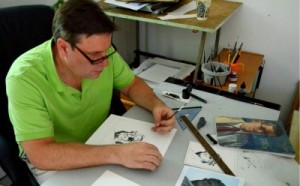
Rob Berry at work.

Rob Berry at work.

As we walk from our meeting place at the Starbucks in the Fairmount section of Philadelphia to Rob Berry’s studio, just a few blocks away, Berry asks the question I’d been both anticipating and dreading: “Have you read ‘Ulysses?’” At which point, I came clean and admitted I hadn’t.

(Although, in my clearly woeful preparation for the interview, I had read the Sparks Notes.)

My ignorance of Irish poet and novelist James Joyce in general and his 1922 masterwork, in particular, apparently didn’t put Berry off. He seemed happy that I hadn’t tried to bluff my way through. He’s asked others the same question, and they’ve, well, lied. Berry himself admits he attempted to read the labyrinthine 265,000-word novel five times before he could make it all the way through.

Still, the fifth time was the charm. Berry got it—and he was hooked.

But perhaps even Berry could not have predicted where his Joycean passion someday might lead. Berry—with graphic and web designer Josh Levitas, Joyce scholar Mike Barsanti and several other equally talented colleagues—is in the early stages of publishing a Web- and iPad-based comic adaptation of “Ulysses.” Two chapters, complete with hypertext-linked reader’s guide, have been published on the Web site “Ulysses ‘Seen’.”

If you’re looking for a way to get a handle on this classic of modernist literature, with its allusions to Homer’s “Odyssey,” its rich symbolism and subtle nuances, “Ulysses ‘Seen’” might be just your ticket.
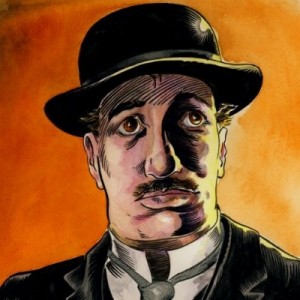
Leopold Bloom, as imagined by artist Rob Berry

Leopold Bloom, as imagined by artist Rob Berry

The project was hatched in June 2004, appropriately enough, in an Irish bar—The Bards at 20th and Walnut—during the Bloomsday Centennial. Bloomsday is the worldwide celebration of Ulysses, held every June 16, which takes its name from Leopold Bloom, who serves as Joyce’s Everyman. All of the events of “Ulysses” occur on that single day in Dublin.

“I was at a Bloomsday reading with a friend of mine who was a cartoonist,” Berry recalls, and talk turned to how “Ulysses” might be portrayed in film. “We were talking about how difficult it is to translate Joyce into other mediums. I was the one to say comics were ideally suited. Joyce uses the weight of visual symbols and he also uses a plasticity of time that you can’t put on film. What you are able to do with comics is to set a rhythm to it (the story) that’s visual, that allows people to know where they are.”

Some who listened to that argument weren’t so sure, and one of his fellow bar patrons bet Berry it couldn’t be done. “I wound up story-boarding 20 pages of ‘Ulysses’,” he says. “I won.”

The idea languished for a few years. in August 2007, at Berry’s wife’s urging, he submitted a snippet from Ulysses to the Philadelphia City Paper for its Comics Issue.

For help in scanning and translating his hand-inked cartoon into a Web-friendly graphic format, he turned to Replica, a high-end print and design shop, which is where Levitas worked. “That’s how I met Josh,” Berry says. “It turned out he actually lives on my block.”

From there, an idea that started out as a barroom bet began to take on a lot more substance. As he continued his wanderings among the “Joyce heads,” Berry met (at a Bloomsday festival) Mike Barsanti, a senior program specialist at the Pew Center for Arts & Heritage and former associate director of the Rosenbach Museum & Library in Philadelphia. He pitched the idea to Barsanti. Barsanti’s reaction was, perhaps, predictable. “At first, he thought it was the craziest idea he’d ever heard,” says Berry, “And Joyce scholars know ‘crazy’.” But the more they talked—over beers, and maybe the brews paradoxically helped lift the fog—the more intrigued Barsanti became, and in time he was on board.

Another partner, copyright attorney Chad Rutkowski—the one who bet that a comic version of Ulysses couldn’t be done—joined the project in 2008 following an encounter at The Bards. Rutkowski became the counsel and business manager for a new company called Throwaway Horse LLC. (Throwaway was the 20-to-1 winner of the Gold Cup race featured in “Ulysses.”)

In time, another passionate Joyce enthusiast joined the project: Janine Utell, former facilitator of the Ulysses Reading Group and Bloomsday coordinator at the Rosenbach, who teaches 20th century British literature at Widener University.

Like a lot of start-up companies, this one is mostly virtual. (Company meetings, Berry says, take place at the Black Sheep near Rittenhouse Square.) If Throwaway Horse can be said to have an “office,” it’s the Callowhill Street studio Berry shared with Levitas.

To reach it, you climb two flights of well-worn gray steps bounded by mustard-colored walls. The studio is a bright, cozy and somewhat cluttered cube, with scuffed white walls and, along one side, exposed brick. At the far end of the studio sits two desks, positioned so they face each other—one of them, covered by illustrations in progress, belonging to Berry; the other, dominated by a large flat-screen monitor, hard drives, a tangle of cables and a pen-and-touch tablet, where Levitas helps translate Berry’s work into an electronic format.

The wall closest to the door is dominated by a cluster of paintings featuring Captain America re-imagined in a wide assortment of characters—black, white, bearded, bespectacled, double-chinned, and one with dark purple lipstick. An equal opportunity Captain America. The theme continues on the wall up above Berry’s left shoulder, where a plastic Captain America costume mask hangs. And here and there, black-and-white comic panels on large sheets of sketchpad paper are tacked into the wallboard.

On the bookshelves, reference works like “Atlas of Human Anatomy for the Artist” and “The Book of a Hundred Hands” share space with ”The Complete Tales of Winnie the Pooh” and the Winston Graham crime novel “Marnie.”

Berry’s musical tastes are eclectic, too. The iPod is set on shuffle, and all the tunes reflect the artist’s diverse interests. It wouldn’t be unusual, Berry laughs, to hear Bach’s “Goldberg Variations” followed by Iggy Pop.

Before moving to Philadelphia in 2000, Berry had an enjoyed a successful career as an artist in Detroit, his easel paintings appearing in many galleries and shows. He says his paintings always followed a narrative style, in effect, telling a story. When he moved to Philadelphia, he says, “I didn’t want to do easel painting any more. The stories were becoming more important to me than the paintings themselves. I started to move away from paint to watercolor and ink drawing. It’s a faster medium to work in and better for print.”

For a time, he considered working in the world of mainstream superhero comics—not surprising, perhaps, for an artist who counts among his earliest creative influences the great comic artists Hal Foster (Prince Valiant), Burne Hogarth (Tarzan) and the immortal Jack Kirby (Captain America, Fantastic Four, X-Men and probably dozens of other comic creations).

Ultimately, though, the idea of creating longer-form stories was more appealing.

And then, in 2007, Steve Jobs and Apple introduced the iPhone. Berry knew things would never be the same, and he began to see creative possibilities on the Web, and—with the dawning of the iPhone—beyond. That’s when Berry’s thoughts about creating a comic version of “Ulysses,” which he had put on a back burner, popped back into his head again. “It all came back when I started to think about the digital page,” he says. “At that point I barely knew how to type. I knew that if I was going to reinvent, I was going to have to reinvent everything.

“I started to look at what had been done with CD-ROMs and hypertext. Hypertext (the presentation of intertwining text, graphics and other info on the Web) was a really exciting approach. With hypertext, you can go behind the page and go right to the reader’s guide. You can join a discussion from there.”

In 2009, Berry and his colleagues launched “Ulysses ‘Seen’” with the publication of the first chapter, “Telemachus.” In 2010, Apple introduced the iPad. In the same year—after a brief media-fueled dust-up resulting in changes to Apple’s prohibition against depictions of nudity and lots more attention to the project—”Ulysses ‘Seen’” became one of the first creative applications for the iPad. “We were geared to the idea that the iPad would come out,” Berry says, “and we would be ready.”

Interestingly, although “Ulysses ‘Seen’” appears in an electronic format, Berry creates the world of “Ulysses” by hand, his panels later scanned by Levitas. “I still use a brush. I still use water colors. It works for me.”

Overall, the process of creating “Ulysses ‘Seen’” is hugely time-consuming. Drawing on the 1922 version of “Ulysses,” which is in the public domain, the team plots out scenes and chapters, with multiple layers of review and re-review. It’s a comic, yes, but there’s an almost academic level of integrity to what the Throwaway Horse team is trying to do.

So, yes, it takes a long time, but the results are stunning. Berry’s renderings of characters like the unhappy Stephen Dedalus, for example, are almost three-dimensional and meticulously detailed. Dedalus fairly pops off the page, in all his unwashed misery, living out the nightmare from which he is trying to awake.

In at least one way, “Ulysses ‘Seen’” is following in the footsteps of the original, which was serialized. The electronic comic version, though, has a much longer timeline. “We’re expecting to be able to do two chapters a year,” he says.

Judging by the critical acclaim with which the first two chapters have been received, it’s well worth the wait.

You can share the Throwaway team’s enthusiasm for Ulysses this week as the Rosenbach hosts the annual all-day outdoor reading of “Ulysses” at its Delancey Place location on Thursday, June 16, from 12 noon to 7 p.m. Berry and Levitas are scheduled to read from 12:55 to 1.

Berry and company are also promoting “Gibraltar: An Adaptation After James Joyce’s Ulysses,” at Plays & Players, 1714 Delancey Place. Showtimes are:

  • Wed, June 15 at 7pm ($15)
  • Thursday, June 16 at 11am and 3pm ($15)
  • Saturday, June 18 at 5pm ($25)

Visit the Web site for more information.

Arts

Bram Stoker’s “Dracula” by Gothic Candlelight

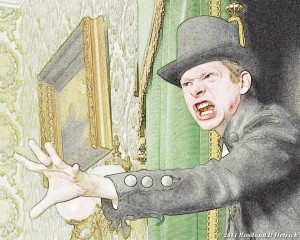
Josh Hitchens, writer and actor, "Stoker's Dracula"

It’s often a jolt for folks when they first hear that the world’s most famous vampire was created by an Irishman. Bram Stoker, author of “Dracula,” was born in Clontarf, north of Dublin, and moved to London in 1878 where he was hired to manage the Lyceum Theatre and act as personal assistant to the theatre’s owner, Henry Irving. But in his spare time, Stoker kept busy creating the ultimate tale of nocturnal terror.

This weekend, the Ebenezer Mazwell Mansion and the Rosenbach Museum & Library are presenting “Stoker’s Dracula,” adapted and performed by Philadelphia actor Josh Hitchens. 

From the time of its completion, Stoker envisioned “Dracula” being turned into a dramatic piece for Henry Irving to enact onstage.  According to Stoker’s grand-nephew, Daniel Farson, who wrote a biography on his relative, Irving walked in on a reading at the theatre (to an audience of two people) and gave his one word review of the piece: “Dreadful!”

That is not a word that’s being applied to this weekend’s presentation.

The Ebenezer Maxwell Mansion is “the perfect backdrop” for Stoker’s legend. Located in Germantown, the Mansion is the only Victorian house museum in Philadelphia. And boy, is it a good one. With its stone façade and gothic tower, visitors can experience the spectral mood before they even enter the dark parlor, lit only by candlelight, where the reading is being held.

Hitchens’ adaptation is abridged, but contains Stoker’s own words—giving the dramatization the authentic sense of horror created by the author.  “This is how Stoker wanted to see his novel,” Hitchens explains.

Also on display at The Mansion this weekend are facsimile copies of Stoker’s notes kept during the seven years he spent writing the novel.  The originals are owned by The Rosenbach Museum & Library, a Philadelphia treasure house that is home to “a nearly unparalleled rare book and manuscript collection, with particular strength in American and British literature and history.”

During Stoker’s lifetime, “Dracula” did not produce the kind of critical and financial success that he had hoped for. When he died in 1912, his widow Florence was forced to sell the notes at a Sotheby’s auction the next year. They were purchased for a little over 2 pounds. 

This weekend’s presentations of “Stoker’s Dracula” promise to thrill and chill audiences with the author’s words that are “better and scarier than any of the ‘Dracula’ movies.”  As of Friday, there were still tickets available for tonight’s 9PM performance, as well as Sunday’s 2PM and 4PM performances. Saturday evening is sold out.

For more information, contact the Ebenezer Maxwell Mansion at 215-438-1861, or online at www.ebenezermaxwellmansion.org/dracula.

Music, News

The Irish Take Over Penn’s Landing

The Hooligans end their set big time.

It was a gorgeous day for an Irish Festival and the crowds at the annual Penn’s Landing fest on Sunday filled the stands. . .er, steps, to hear and cheer their favorite bands (Blackthorn, the Hooligans, and Jamison on the main stage), enjoy some “Irish ice,” and wade in the fountains.

They were also there to cheer on two stalwarts of the Irish community, Irish Edition photographer Tom Keenan, and WTMR radio host Marianne MacDonald, who were honored for their service to all things Irish.

Photographer Gwyneth MacArthur represented www.irishphiladelphia.com (the rest of us had to miss our first fest in five years) and captured the flavors and frivolity of the day.

Check out her photos.


Dance, News

Dance for Dreams

Emily Teitelbaum. Photo by Brian Mengini.

When she was little, Emily Teitelbaum’s parents couldn’t get her interested in anything on TV. She couldn’t care less about “Barney.” But ballet? One day her mother, Terri, caught her then two-year-old daughter standing in front of the set, eyes locked on the screen. “It was a production of the Royal Ballet that just happened to be on,” says Terri. “She stood there transfixed for an hour.”

Emily, now 17, started her first ballet lessons at three. Today, the junior and honor student at Moorestown High School in Moorestown, NJ spends roughly 20 hours a week on her toes, taking classes and practicing. This summer she’ll be training with the Joffrey Ballet in New York.

Declan Crowley was 6 when he had his dance epiphany. His parents had gone to see “Lord of the Dance” in New York and brought back the tape of the Michael Flatley show that turned Irish step dancing into a global craze. He played it over and over.

Crowley’s not sure why the dancing—a combination of quick foot movements like tap, with a straight, stiff upper body like a soldier marching—grabbed him. But, once he saw it he knew it was something he had to do. He had to dance. And someday, he had to perform in “Lord of the Dance.”

“It’s all I ever wanted to do,” says Crowley, 20, now a student at Holy Cross College in Holyoke, MA. Eventually, he was traveling twice a week from his home near Saratoga Springs, NY, to Westtown, NJ, to take lessons at the Broesler School of Irish Dance, founded by world champion Irish step dancer Kevin Broesler. Twice a silver medalist at the World Championships and a All-Ireland winner, Crowley last year achieved the last part of his dream: He was signed to the cast of Flatley’s latest blockbuster, “Feet of Flames,” and went on tour to Taiwan.

On Saturday, June 18, these two young dancers who have given their all to their passion and dreams will be on the same stage at the Painted Bride Art Center in Philadelphia for “Dance for Dreams,” a gala dance performance to benefit Hope Dances, a program that brings dance to special needs children.

Founded in 2010, it’s a melding of two things dear to the heart of founder Brian Mengini: dance—he’s a dance photographer—and Dominic, his 9-year-old son, who was diagnosed at the age of 4 with sensory processing disorder (SPD), a neurological condition that makes it difficult for him to take in and process sensory information about his environment and his body.

“One day it just hit me—dancing works on coordination, it’s exercise, it promotes body awareness, and there’s a social aspect to it too,” says Mengini. “This is perfect for special needs kids. It’s a safe place for kids to go and find their center, almost like meditation. “

He and his wife, Sandy, who are also the parents of six-year-old Micheala, talked it over and decided to do a small test-run, using a Wii dance program called “Just Dance Kids.” The Menginis invited kids from their network of special needs families and held a “Wii Dance Party,” which became a monthly event. At a launch program in January, Pennsylvania Ballet soloist Ian Hussey and Michael Patterson, a ballet teacher at the Barbara Sandonato School of Ballet in Philadelphia, along with some advanced students gave an introductory ballet workshop. (Patterson is one of Emily Teitelbaum’s teachers.)

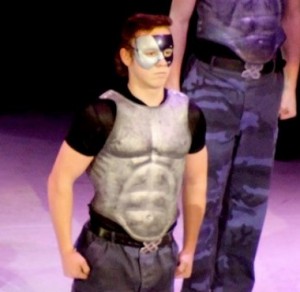
Declan Crowley in "Feet of Flames"

The proceeds from the “Dance for Dreams” gala will go to fund a school at the Performance Garage in Northern Liberties in Philadelphia where Patterson will be one of the instructors for “Hope Dances.”

But the event is more than just a fundraiser—it’s a serious and entertaining look at all forms of dance featuring well-known dancers from around the East Coast, including Crowley (the only Irish stepdancer); Delaware County siblings Jeffrey and Lisa Cirio who are soloists for the Boston Ballet; Zachary Hench and Arantxa Ochoa, principal dancers with the Pennsylvania Ballet; Dylan G-Bowley and Chanel DaSilva of the Trey McIntyre Project, a company founded by one of the leading young dance choreographers in the country; Rennie Harris—Rhaw, a Philadelphia hip-hop choreographer, and Tap Team Two & Company, a street tap (hoofing) company.

Emily Teitlebaum expects the performances to “be incredible,” but she’s not nervous. “I’ve actually been in the Pennsylvania Ballet’s ‘Nutcracker’ so I know what a professional show is like,” she says.

Emily is actually living proof of Mengini’s belief that dance has the power to help children overcome obstacles. Like Dominic Mengini, Emily Teitlebaum also has SPD. In her case, it affects her body awareness. “I mainly had trouble with the feeling in my arms,” she says. “I worked really hard to gain strength in them.”

“Part of the problem is that Emily couldn’t feel exactly where her limbs were, which is very difficult for ballet,” says Terri Teitelbaum. “Of all the things to pick. We would towel off her arms and legs in the morning so she could feel them better. But her teachers at Barbara Sandonato School—Barbara and Michael, who were both with the Pennsylvania Ballet—were really helpful. They would instinctively position her arms and rub them, so her brain would have a memory of where she was putting her limbs.”

Eventually for Emily, ballet took the place of occupational and physical therapy, helping her, she says, to “grow out of” SPD, something that’s possible with early intervention.

Declan Crowley too credits his dancing for more than just killer legs and cardio fitness. “The discipline of dancing helps with so many things,” he says. “It worked like cross training for me when I played lacrosse in school. It gives you motivation. No one is very motivated to do homework, but if you have dance practice at 7 it has to be done, you have no choice.”

Ironically, says Mengini, his son Dominic hasn’t shown an interest in dance, even when it just involved Wii. “He’s pretty busy with horseback riding, swimming and soccer so he’s doing alright,” he laughs.

The “Dance for Dreams” Gala is slated for June 18 at 7:30 PM at the Painted Bride Art Center, 230 Vine Street, Philadelphia. Tickets are $25 each and can be ordered online.