News, People

Philadelphia’s Fond Farewell to Alan Farrelly

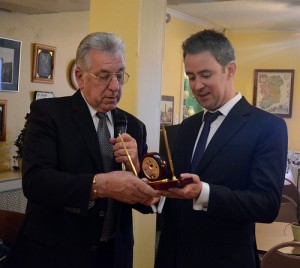
The Irish Center's Tom Farrelly (no relation) presents a token of recognition to outgoing New York Irish Vice Consul Alan Farrelly.

The Irish Center's Tom Farrelly (no relation) presents a token of recognition to outgoing New York Irish Vice Consul Alan Farrelly.

Irish Vice Consul Alan Farrelly has spent a good deal of time in Philadelphia, strengthening ties with the Quaker City Irish community.

He’s leaving the post after four years and returning to Ireland in August, but Philadelphia’s Irish made sure his hard work here was recognized.

There were a few speeches, some parting gifts and a bit of music and dance to mark the occasion. But mostly, representatives of the Philadelphia Irish Center and the organizations that make their home there lined up to shake his hand, say a few words of thanks and to have their pictures taken with Farrelly in the center’s cozy little Fireside Room. (Earlier, they had him out on the roof, looking out upon the badly needed repairs. An unfailingly polite young man in a dark suit on a hot day, standing out above the trees of Mount Airy, still doing the government’s business.)

President of the Irish Center Vince Gallagher and board member Tom Farrelly (no relation) led the brief, mostly informal ceremonies, which also honored first secretary Lorraine Christian, who also is returning to Ireland.

“They were never strangers here,” said the Philadelphia Farrelly. “We adopted them, and they adopted us.”

As the Irish Farrelly accepted a commemorative pen-and-clock set from his local admirers, he acknowledged that the admiration is mutual, and he added, “we’re proud to have been a part of the work you do here.”

Farrelly’s involvement—indeed, the involvement of the entire Irish Consulate staff in New York—has been deeply appreciated in the Philadelphia area, said Siobhán Lyons, executive director of the Irish Immigration Center of Philadelphia.

“Alan has just been great,” said Lyons. “The Consul General can’t be every where, so one of Alan’s jobs has been to travel to different places. A lot of that started with (former New York Consul General) Niall Burgess’s recognition that the East Coast of the United States is not just New York City.

“Alan’s been extremely helpful with the Irish Immigration Center. He was there when I was taking it over, and helping to figure out the future strategy of the center. He’s met everybody. It’s going to be a shame to lose him because he knows so many people and he likes Philadelphia. Those will be very big shoes to fill.”

We captured some photographs of Farrelly’s farewell fete at the Irish Center. Check them out.

Arts

Shining a Bright Light on an Ancient Irish Martial Art

John Hurley with son Liam

John Hurley with son Liam

Irish history means everything to John W. Hurley.

It starts with his family. His grandfather William Hurley was from a coastal town called Ballyheigue in County Kerry. Young William fought in the British army in World War I, then with the Irish Republican Army in the war of independence, and later on the side of those who were opposed to the 1921 Anglo-Irish Treaty.

That turned out to be the losing side, and so William packed up his family (including then 24-month-old Michael J., John’s dad) and moved to Jersey City.

Like many emigrants, the Hurleys assimilated—but they never forgot where they came from, and they made sure they passed on their Irish pride to their children and grandchildren.

“My dad really valued his heritage and his culture and tried to instill that pride in us,” says the soft-spoken Hurley, a graphic artist from Pipersville, now back in college and hoping to one day teach high school social studies.

Clearly, something must have penetrated, and pretty deeply at that. Although he’s only an amateur historian, John W. Hurley has managed to make himself into a passionate expert in a very obscure yet fascinating subject: the history of shillelagh.

Most people think of this iconic symbol of old Ireland as a walking stick. But Hurley knows what it really is: a weapon.

He started to come by this knowledge early in life, mostly by making some chance connections.

For a start, he recalls hearing his grandmother speak Irish. Like a lot of kids, he paid little attention to what the grown-ups were doing. And then, one day, when he was in high school (Essex Catholic, taught by the Christian Brothers), “it dawned on me that there was an Irish language, separate from the English language. it was an epiphany, and I wondered what else about Irish culture I was missing.”

Around the same time, he and his family went to the Irish festival in Holmdel, N.J., and he found a book of stories by the little-known Irish novelist William Carleton. In one of the stories, there was an account of a “stick fight.”

“I was a kid who watched a lot of kung fu movies,” Hurley says. “In this scene, two guys are fighting, and one guy moves in close and flips the other guy over his shoulder. I thought to myself: This is like kung fu. That made me realize that there was more to stick fighting than barroom brawling.”

Indeed, fighting with the shillelagh proved to be Ireland’s own martial art. Once Hurley made that connection, he became obsessed with the idea. He wanted to know more.
He went on to attend the University of Dayton for a degree in commercial design, and then, in 1975, he went to Ireland to spend time with family. While there, he found a 1975 book, The Irish Faction Fighters of the 19th Century, by Patrick O’Donnell. It provided more detail on stick fighting, and by then it clear to Hurley that that battling with a shillelagh was not just about two hard-headed Irishmen frantically whaling away at each other. There was a formal discipline and an art to stick fighting, passed down from father to son, together with an elaborate set of unspoken rules—shillelagh law—for how a fight must be conducted.

It was Hurley’s father Michael who urged him to follow his passion.

“I was talking to my dad about it (stick fighting) one day,” says Hurley. He was the one who suggested I should write a book about it. I had always wanted him to write. He really was like an old fashion seanchie (the Irish word for story-teller). He was a really good guy with an outgoing personality. The problem was, he didn’t have the patience to sit down and write. But I was a lot more introverted.”

So the more reserved son began a project that would drag on for years, through marriage, kids, jobs, layoffs and all the other joys and challenges of adult life. Right from the start, Hurley knew he had his work cut out for him.

“When I was a kid, I knew what a shillelagh was. Everyone knew what a shillelagh was. It was iconic, like a harp. I also knew that not a lot of people realized it (fighting with a shillelagh) had been a martial art. I knew it would be hard to convince them. So I really wanted to make it a good book, to provide evidence that it was for real.”

Hurley spent countless hours tracking down every bit of documentation he could find, piling up copious notes.

Around 1994, he was reading a kung fu magazine–that interested had never faded away–and he discovered a story about a stick fighter in Canada by the name of Glen Doyle, who had learned the art from his father.

Hurley wrote to him, and for a while they corresponded, but not much came of it.

Then a few years later, Hurley again found information about Doyle, this time on the web–and now Doyle was actively teaching his family’s stick fighting method. At this point, Hurley was a able nail down even more detailed information.

Finally, after years of fact-gathering, Hurley wrote his book, “Shillelagh: The Irish Fighting Stick.” Self-published in 2007, it is Hurley’s densely documented, 370-page homage to a forgotten Irish art. It is dedicated to his father, who, by all accounts, was proud. (Michael Hurley died in November 2010.)

Hurley’s book is not exactly sailing off the shelves, but ultimately, it’s not whether the book becomes a best-seller. It’s that the book exists at all.

“I just thought I always wanted to do something like this, almost in a patriotic way,” he says. I wanted to contribute something to Irish culture somehow. No one else was interested. It seemed the one thing I could do.”

Arts, History

Colin Quinn Makes a “Long Story Short”

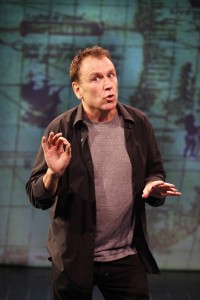
Colin Quinn in "Long Story Short"

Colin Quinn, you are funny.

I already knew that, but I had it reconfirmed for me on the opening night of Quinn’s one man show, “Long Story Short,” at the Suzanne Roberts Theatre on Broad Street. Fresh from Broadway, and making its Philadelphia debut, this 75 minute tour-de-farce of history bites where it’s supposed to and makes short work of some of history’s biggest moments.

And keeps the audience laughing throughout the entirety of the evening.

Quinn’s point, made with his trademark raspy-voiced rat-a-tat delivery, is that in all the years humanity has been evolving, we haven’t changed all that much: “With all the progress, where’s the progress?” he asks early in the show.

He points out that “our ancestors weren’t the ones who starved to death waiting their turn in line for food.”  In other words, survival of the fittest doesn’t mean survival of the nicest.

Directed by Jerry Seinfeld (I looked all around the theater in the hopes that he is a hands-on director who was perhaps directing from the seat next to me; no luck), the show’s style of humor reflects the sensibility of the man best known for his show about nothing. This time, however, he’s steering a show about all things universal.

No history stone is left unturned: politics, philosophy, psychology, arts & literature. Quinn touches on all of them. And the points he makes are the kind that have you going, “Oh, yeah…” Like his take on democracy, for instance:

“It’s sad. Marxism didn’t work. Communism didn’t work. Capitalism doesn’t work.  Nothing works. Even democracy doesn’t work. Democracy—the greatest form of government and we have two choices for who’s our leader. In fascism you only have one choice. That’s great. We have one more choice than the worst form of government.”

It’s sageness like this that keeps the audience holding fast for the next pithy piece of insight wrapped in humor to be delivered by the craggy-faced man pacing the stage.  It’s actually a bit like sitting around with a funny friend, the one who minored in history and knows how to draw the connections between the follies of early civilizations and our own modern messed-up universe.

As Quinn makes perfectly clear, we have always been searching for the truth of our existence, or as he puts it: “Don’t judge me by what I do…judge me by what I’m telling you when I’m doing the opposite.”

“Long Story Short” is here in town through July 10th, and it’s worth an evening of your time.  For more information, check out The Philadelphia Theatre Company’s website: http://philadelphiatheatrecompany.org/events/LSS.html

Columns, How to Be Irish in Philly

How to Be Irish in Philly This Week

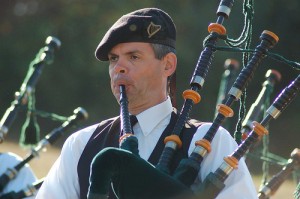
Piping hot

Piping hot

Well, I can tell you for certain how one local Irish group will celebrate the 4th of July.

The Philadelphia Emerald Society Pipe Band is marching in the 114th Riverton, N.J., 4th of July Parade, one of the truly great local small-town Independence Day traditions. I know this because I will be joining the drum line for the day. Why? Because there’s nothing that says “Ain’t that America?” to me more than wrapping a heavy woolen blanket around my hips, strapping on a 14-pound drum and marching a couple of miles in extreme heat and humidity.

Join me in praying for a cooling breeze off the Delaware.

So what are you doing over the holiday weekend and beyond? Well, judging by our calendar, a lot of you have your own plans.

Sure, the South Jersey Irish Society is holding its big picnic Sunday from 11 a.m. to 7 p.m. in Yardville. And that promises to be a great day, with Irish music and dance, swimming, grilling and lots of outdoor activities for everybody. Details here.

As for the rest of the week, there are Irish traditional music sessions all over the landscape. I’m always amazed at the folks who have never taken in an Irish music session. Local Irish musicians—it can be a few, or it can be well over a dozen—get together and play every tune they ever knew (even if they don’t always remember the names of those tunes). Sessions take place at pubs all over the place, and the music is free. (The food and drinks aren’t.) Your being there also helps support local Irish businesses, and in a down economy that’s always a good thing. So take a look at our calendar and by all means, go.

We want to draw your attention to something brand new, if a bit off the beaten track, toward the end of this week.

If you’re up for a road trip, trek on down to Anne Arundel, Maryland, for the Annapolis Irish Festival on Saturday (July 9). It’s a bit of a hike, but on the plus side you get to experience the unbridled joy of driving on I-95. Seriously, we’ve been to the Anne Arundel County Fairgrounds many times over the years, and it’s a beautiful rural venue, a terrific place for a summer Irish festival.

This is the first Annapolis Irish Festival, as I say, so you can be in on the ground floor. One of our favorite local bands, Burning Bridget Cleary, is on the bill, as are many other Irish musical groups and performers, including the irrepressible Seamus Kennedy (if you haven’t seen him, do), Screaming Orphans, The Rovers, the Shamrogues, and more. The Chesapeake Caledonian Pipes and Drums will circle up and play from time to time. There are Gaelic games, tons of food and drink, vendors galore, and kiddy activities (pony rides!). Don’t worry about the heat. The festival organizers promise there will be a “misting tent.” (I want one of those.) The whole deal runs from 11 a.m. to 9 p.m. Details and directions here.

There’s more coming up this month, including the Celtic Heritage Festival in Graeme Park, Horsham, on the 16th, and a great concert at the Coatesville Traditional Irish Music Series—Irish Fiddle & Flute Music: Maeve Donnelly & Conal Ó Gráda—on the 20th. Keep checking our calendar for more. New events pop up all the time.

And if you are holding an Irish event and it ain’t on our calendar, then it just ain’t happenin’. Submit your event here.

News

Bristol Hosts Its 15th Celtic Festival

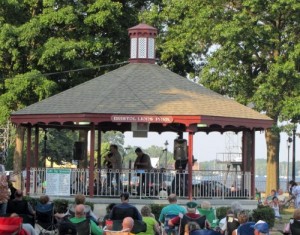
Irish tunes at the gazebo

Irish tunes at the gazebo

The wonderfully diverse Bristol is a small borough in Lower Bucks County—population 9,726—but it has a big Celtic heart.

You can see it on display Sunday from 1 to 8 p.m. as the borough’s Celtic Heritage Foundation takes over Lions Park at the foot of friendly Mill Street (at Samuel Cliff Drive).

Dave McGlynn, for one, is looking forward to the day. “Each ethnic group in the borough has a festival in the summer time,” says McGlynn, vice president of the 300-member group. “The Puerto Rican Day Festival is in July, the Afro-American Festival is in August, and the Bristol Lions Italian Festival is in September. We’re the first one, in June.

“Fifteen years ago, when we started, we held it in July. The we found out it was a little warm for the Celts. So we switched it to the end of June. Turns out that’s not always too cool, either.”

This Sunday should be pretty nice, though. The weatherman predicts partly sunny skies, with the high a relatively comfy 84.

Expect the day to be jam-packed with Irish tunes. The music begins at 1 p.m., with the band No Irish Need Apply. The Martin Family Band follows at 3, and the Bogside Rogues at 6, running to the festival’s end.

You’ll see plenty of the area’s toe-tapping dancers, too, with the McCoy School appearing at 2:15, and the Fitzpatrick School at 5.

All of that action happens at the gazebo behind the Bristol Riverside Theatre. Bring a lawn chair.

Between tunes and steps, you can check out the many food and merchandise vendors in the park nearby.

If the experience of past years is any indicator, you can expect to run shoulders with a lot of local Irish.

“We get anywhere from 4,000 to 5000 people,” says McGlynn. “We get good crowds.”

Learn more.

Arts, People

5 Questions With Colin Quinn

Colin Quinn (photo by Carol Rosegg)

Colin Quinn (photo by Carol Rosegg)

History class is in session. It’ll only take 75 minutes, but at the end you’ll know everything.

You’ll know how empires rose and fell. You will learn how the British conquered the world through the sheer force of their withering contempt, why the Chinese just couldn’t stop building that wall, and why there are fewer countries more irrelevant than Australia.

And it’ll all be lots funnier than history as taught by Sister back in the fourth grade. She was a humorless cow, anyway.

“Long Story Short,” Colin Quinn’s acid interpretation of the events that shaped great nations and then brought them to their knees—punch-drunk, bewildered and condemned to keep committing the same disastrous mistakes over and over again—comes to the Susanne Roberts Theatre this week. The one-man show, directed by Jerry Seinfeld, runs from June 28 through July 10, 2011.

You’ll remember Quinn from his five-year stint on Saturday Night Live.  His face redefines the meaning of craggy, and his widow’s peak carves out an impressive capital letter M across his forehead. Quinn has amazingly literate comedic sensibilities, and he offers up some head-spinning observations on the human condition, but the lines are delivered in a streetwise Brooklyn-ese, with a voice that sounds like a truck dumping a load of crushed rock. He stalks the stage (with a crumbling Roman amphitheatre as a backdrop), making some astonishing points as he goes along. For example, a riff in which he compares Antigone of Greek mythology to “Jersey Shore’s” self-obsessed Snooki, or re-envisioning Caesar as Goodfella mobster Ray Liotta. The show is fast-paced—in Quinn’s world, each empire rises and falls in about ten minutes’ time.

Of course, you’re not meant to take any of it seriously. Scott Brown, writing for New York Magazine, recalled a quote from director Seinfeld in which he described the making of “Long Story Short” as “taking a fatuous premise and proving it with rigorous logic.”

We chatted with Quinn by phone this week, and here’s what he had to say about the show and his Irish-American upbringing.

Q. A headline for the Hollywood Reporter review described your show like this: “The History Channel meets Comedy Central.” It was actually a pretty good review, but that kind of Hollywood pitch line description doesn’t really measure up to what you’ve done. The history of the world in 75 minutes is an Olympian task. How hard was it to pull all of that material together and make all the connections?

A. It like to play around with this stuff, anyway. I always think in terms of “combinations.” It’s always in my head somehow. It’s all people stuff to me. Altogether, it took a few months to bring together—different hours, different times.

Q. If you’re going to talk about the British Empire and the Roman Empire (and more), you really do have to have some sense of history. You couldn’t have tackled the “demise of empires” with just a Cliff’s Notes knowledge of history. So I suppose I could put this more delicately, but how did you get so smart?

A. Most of it, I feel like its common enough knowledge. And we (comedians) have a lot of free time. We can read any time we want. I read a lot. I don’t reads that much history—I was never all that interested in history. I’m really more interested in the global village. I feel like everything else. These connections have been going on since time began.

Q. For those who haven’t seen the show, how did you figure out that you could make the connection between Antigone and Snooki?

A. That junction is just based on the fact that what people used to watch is not like what people watch now. (Now) we see Snooki crying on her knees over the loss of her cell phone.Most people wouldn’t know who Antigone is, but I went to a few acting classes so I know my stuff.

Q. You’ve probably been asked this before, but did you have any qualms about how or whether stand-up translates to a long-running Broadway monologue—the kind of story-telling that has been compared to the work of Spalding Gray? What were the challenges?

A. My own form of comedy is long-form, rambling comedy. I just wanted to do something thematic for a change of pace. To me, that was really like a natural state. It wasn’t like I was doing a bunch of one-liners before that, anyway.

Q. We’re an Irish web site, so of course we need to ask you something Irish. Happily, you’ve already gone there with an earlier show, “Colin Quinn: An Irish Wake.” And here again you’ve been lauded for your story-telling powers. The New York Times review described you as a kind of modern-day incarnation of the Irish “seanchai.” (“Story-teller,” in the Irish language.) You grew up in Brooklyn, coming from an Irish family, and knowing a lot of the local Irish–evidently providing you with a wealth of material. Can you tell us how growing up Irish influenced you?

A. Irish people, they like to read more than most people. I feel like that helps a lot. And I feel like Irish people are very verbal. I definitely feel like my Irish blood helps me to be a performer and a writer of comedy.

For more information on the show, check out the Philadelphia Theatre Company Web site.

How to Be Irish in Philly

How to Be Irish in Philly This Week

Enter the Haggis

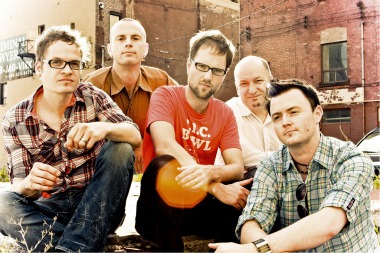
One of the most popular groups to come out of Canada since Dudley Do-Right, Snidely Whiplash and Nell Fenwick is Enter the Haggis. They’re a Toronto-based Celtic rock band that doesn’t spend much time in Toronto. They’re on the road about 150 days out of the year, hitting major and minor venues and probably every Celtic festival from coast to coast, racking up an impressive number of fans.

You can see what the fuss is all about on Saturday at the brand new World Café Live at the Queen in Wilmington, DE where they’ll be on stage rousing the rabble. Very high energy—like an overdose of Red Bull. If you travel out to Manheim on Friday, you can also catch them at the Celtic Fling and Highland Games on the grounds of the Pennsylvania Renaissance Faire. They’ll be back in the area on July 24 for a show at the Sellersville Theatre (book now—they usually sell out).

If you’re in Wildwood on Saturday, wander over to Caseys on Third in North Wildwood to hear Jamison.

Also on Saturday, join the Philadelphia Soul for its Irish Theme night with green beer and Irish music and dance as the Soul kicks the daylights out of the Arizona Rattlers at the Wells Fargo Center. It’s arena football.

On Sunday, Bristol Borough is holding its 15th annual Celtic Day with Now Irish Need Apply, Martin Family Band, the Bogside Rogues, and the McCoy and Fitzpatrick Schools of Irish Dance. It’s on the borough’s picturesque waterfront and there will be food and merchandise for sale. BYO lawnchair.

Later in the week (that would be Wednesday), comedian Colin Quinn will be doing his one-man show, directed by Jerry Seinfeld, called “Long Story Short” at the Suzanne Roberts Theatre on South Broad Street in Philadelphia. (It runs through July 10). Quinn gives you the history of the world in 75 minutes and includes his take on everyone from Socrates to Snooki. (I saw the HBO special of the show and it was hilarious.)

As always, check the calendar for all the details.

Sports

How the Notre Dame Rugby Sevens Got Their Kicks

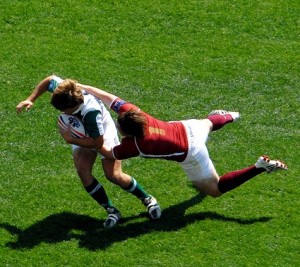
No one escapes the rough and tumble that is rugby.

No one escapes the rough and tumble that is rugby. (Photo by Brian Mengini)

It’s called seven-a-side rugby, with seven players instead of the standard 15.

But don’t let anyone fool you. It doesn’t matter whether seven guys are on the field or 15 … this game is hard-hitting and just a little nuts.

We had a chance to see rugby sevens up close and personal recently when the Sevens Collegiate Rugby Championship came to town. (Specifically: The Philadelphia Union stadium in Chester).

All of it was fun to watch, but still, upstanding Irish persons that we are, we just had to take in a game featuring the Notre Dame Fighting Irish.

We’re happy to report that they kicked the hind ends off the team from Boston College, 30 to zip.

That sent the Fighting Irish on to games with Navy, Utah, Ohio, and Dartmouth (see scores below).

  • NOTRE DAME- 28 V OHIO STATE – 7
  • NOTRE DAME -19 V DARTMOUTH – 24
  • NOTRE DAME -17 V UTAH – 21
  • NOTRE DAME-12 V NAVY -10

In the final challenger match, Louisiana State University beat ND 24 to 0.

Ultimate winner though: Dartmouth. They brought back the trophy.

The Sevens Collegiate Rugby Championships were televised on NBC. This is the first time they were held in the Philadelphia area.

We can’t match NBC’s coverage. (After all, they just spilled $2.201 billion for the rights to broadcast the Oympics. They’re in a league of their own. Most of the time, we have beer money and, if we’re lucky, enough left over for a bag of chips.) That said, we can still bring some of the excitement to you courtesy of our very talented photographer Brian Mengini.

Check out the pics.