Browsing Category

News

News, People

Two Philadelphia Emissaries and an Ambassador

As the school year progresses, we frequently hear of children trekking to Washington, our nation’s capital, for all the historic and memorial sites. But those trips seldom, if ever, include a visit to the Irish Embassy. It is probably not well known that the Embassy of Ireland in Washington, D.C., is open to the public Monday to Friday from 9 a.m. to 1 p.m. and from 2 to 4 p.m. Calling in advance is highly recommended.

Two Philadelphia natives, Brian Grady and Paddy O’Brien, recently visited Washington to see the Arlington National Cemetery and the National Law Enforcement Officers Memorial in Washington, D.C., where Brian placed wreaths in Arlington at the grave of his uncle and at the memorial walls for slain Philadelphia Police Officers Daniel Faulkner, Gary Skerski, Daniel Boyle and Chuck Cassidy.

On the following day, the two set out to visit the various World, Vietnam and Korean War memorials and happened to be riding in a taxi when they passed the Irish Embassy at about 9 a.m. They asked the taxi driver to pull over so they could snap a few photos and found that the embassy was open. After sending the taxi on its way, the two went inside.

After explaining that they had traveled from Philadelphia to pay respects at the various memorials, they inquired if it was possible to take a tour. They were escorted to a waiting area where they were later greeted by Martina Monaghan, the executive officer of the embassy. Ms. Monaghan indicated that the embassy does not typically give tours unless scheduled. While chatting with the very pleasant Longford native, it was mentioned that there may be something scheduled in the afternoon and that if the Philadelphia lads left a contact number that someone would ring if an opportunity became available.

Brian Grady with Ambassador Michael Collins
To their complete surprise, about a half hour later, Ms. Monaghan phoned Brian and asked if they could return around 3 p.m. The Philly guys visited other historic sites, and upon their return in the late afternoon, they were once again overwhelmed by the hospitality and pleasantries of true Irish personalities.

Paddy O’Brien with the ambassador.
As they toured the magnificent building, they passed by an office, and were coaxed to enter and they were introduced to himself, Michael Collins, Irish ambassador to the United States. The introduction would have been enough, but the defining moment was when the ambassador asked them to have a seat. The ambassador inquired what they were doing in Washington and Brian had about a 20-minute chat describing his mission to lay wreaths at the memorials.

The ambassador was extremely cordial and discussed his experiences with the Northern Ireland Peace Accord, the disarmament of weapons, the Good Friday Agreement and other issues such as the undocumented Irish in America, the devolution of policing and justice powers, and the challenges surrounding visas.

The ambassador showed the lads a picture of himself and Dr. Ian Paisley, which the ambassador indicated he was very proud of, of them shaking hands after helping broker the renewed peace in Northern Ireland through diplomatic means. The ambassador also showed them a silhouette of Ireland cut from a single piece of metal that Paddy O’Brien correctly identified as a piece of armor plating from one of the towers dismantled in Northern Ireland. As the ambassador commented that Paddy O’Brien knew his Irish history, he presented the lads with copies of the program from Bertie Ahern’s address to the joint session of Congress.

After Paddy O’Brien commented that he had voted for Bertie Ahern when he lived in Ireland, and that Bertie Ahern was one of only a few foreign heads of state to address both the U.S. Congress and the British Parliament; the ambassador turned once again to his personal desk and said, “I am sorry that I only have one copy of this left, but I would like you to have it.” And the ambassador handed a copy of the program from when Bertie Ahern addressed the British Parliament to Paddy O’Brien. The ambassador then cordially autographed both programs. The lads snapped a few photos, shook the ambassador’s hand and went on their way, not immediately realizing that they had just met for over an hour with one of the most historic and influential peacemakers of the 21st century.

Paddy O’Brien stated later “I learned more in a half hour from the ambassador about the challenges the Irish and Irish Americans are facing today than I have learned in the last 10 years from U.S. media and local Irish groups, I am committed to helping more than ever before.”

Brian Grady said of the ambassador, “He was such a great person to speak with, and he had such a demeanor of comfort, intellect and focus about him, that you would certainly be impressed through your life that you had indeed met a great man.”

In speaking to the Irish Philadelphia staff, Paddy O’Brien said, “in respect of the ambassador’s great efforts on behalf on the Irish people and Irish Americans, I am honored to donate the two autographed programs of Bertie Ahern’s historic speeches to a local heritage historical collection which is yet to be selected. There are several Philadelphia area based historical societies, and we are evaluating and discussing with them the appropriate manner to display and preserve these two pieces of history.”

Brian Grady is a Philadelphia attorney, heavily involved with the law enforcement and Irish communities. Paddy O’Brien is an information technology project manager who is a member of several charitable groups such as the Knights of Columbus, American Legion and various Irish and Celtic Heritage organizations.

– Submitted by Paddy O’Brien

News

Salute the 32 Counties on New Year’s Eve

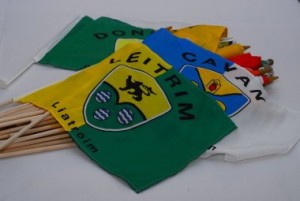
Seven of these flags need bearers.

Seven of these flags need bearers.

The final celebration of the 50th anniversary of The Irish Center will be a 32-County Ball on New Year’s Eve at the Commodore Barry Club, Carpenter and Emlen Streets. Key to the event is a ceremonial parade of flags from each of Ireland’s counties, carried by someone with ties to the area.

Unfortunately, right now, says the Ball committee, they’re about seven counties short. So, if you or an ancestor comes from Carlow, Cork, Kilkenny, Meath, Offaly, Westmeath, or Wexford and don’t have any New Year’s Eve plans, raise your hand. Better yet, contact 32 County Ball chairperson Kathy McGee Burns at mcgeeburns@aol.com, or 215-872-1395, or Vince Gallagher at 610-220-4142.

The evening will start at 7 PM with a cocktail hour followed by a buffet dinner at 8 PM, catered by Mickey Kavanaugh, with music provided by the Vince Gallagher Band. Tickets are $50 per person and are available through Mc Gee Burns, Gallagher, or Brenda McDonald (609-841-4664) or Barney and Carmel Boyce (610-449-9374).

News, People

Three New Inductees to the Delaware Valley Irish Hall of Fame

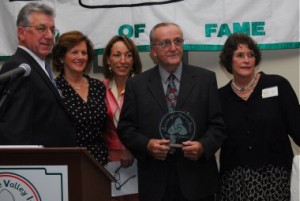
From left, the evening's emcee Tom Farrelly, Carmel Boyce, Ann Donofry's daughter, Jeannine, husband Frank, and Hall of Fame President Kathy McGee Burns.

From left, the evening's emcee Tom Farrelly, Carmel Boyce, Ann Donofry's daughter, Jeannine, husband Frank, and Hall of Fame President Kathy McGee Burns.

Librarian and amateur historian Billy Brennan, retired pastor and community activist Father John McNamee, and tireless volunteer, the late Ann Donofry, were inducted into the Delaware Valley Irish Hall of Fame at a dinner on Sunday at the Irish Center in Mt. Airy.

Mrs. Donofry’s husband,Frank, and her daughter, Jeannine, accepted the award on her behalf in front of an audience of more than 200 at the 8th annual event.

We were there and captured many of the memorable moments, which you can see in our photo essay.

News

Philadelphia Mayo Association 2008 Ball

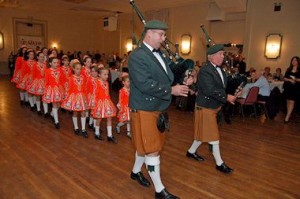
The Emerald Pipe Band ushers in the dancers.

The Emerald Pipe Band ushers in the dancers.

The Mayo Association knows how to celebrate. They started the evening at the Philadelphia Irish Center by honoring scholars, then moved on to salute one of their best and to crown their 2008 Miss Mayo.

This year’s winner of the Mayo President’s award was Thomas Staunton, a man praised by president Maureen Brett Saxon as ‘the one you can always depend on.”

Winner of the Miss Mayo contest—and that just had to be a tough contest to judge—was Colleen Mullarkey.

We have pictures to remember it all.

News

A Great Day for the Irish

During last year’s St.Patrick’s Day parade in Philadelphia, Barack Obama supporters were toting homemade signs spelling their candidate’s name O’Bama. Funny, but hinting at the truth: Obama is a Kenyan name, of course, but the new President-elect can trace some of his roots to a small town in County Offaly that his great-great-great grandfather, Fulmuth Kearney, left in 1849 to make his way in America.

Obama not only knows about his Irish ancestors, he told an ITV reporter during the campaign that he was looking forward to going to Moneygall for a pint. According to this morning’s Irish Times, Moneygall is up for it too. Read their story here.

Even better, sing a song of our new president’s roots with a Moneygall group called Hardy Drew and the Nancy Boys. Fair warning: It’s hard to get it out of your head. Tooralay, tooralama, there’s no one as Irish as Barack Obama?  Listen to it here.   

Of course, Joe the Vice President is of Irish descent. His mother, whom he quoted liberally while campaigning (every time I heard him say,“As my mother would say, “God bless him,” I thought of every elderly relative in my family) was a Finnegan from County Mayo. The Bidens came from Liverpool, though the new vice president-elect once told Niall Dowd of the Irish Voice that his father swore it was an Irish name. Given Senator Biden’s gift for gab, I tend to believe that. You can read that long-ago interview with Dowd here.

In his autobiography, Senator John McCain traced his roots to the highlands of Scotland, but Ulster Heritage Magazine says that the McCains left those highlands long ago for County Antrim, where they lived until the early 1700s. You can read about it here.

There’s a Paddy in Sarah Palin’s family tree as well.  Her mother’s maiden name is Sheeran (or Sheiran) and the governor’s great-great-great-grandfather, Michael Sheiran, was born near the Longford-Roscommon border in Knockhall, Ballykilcline in the parish of Kilglass, Strokestown, in 1823 and emigrated to America in 1844. Read about Palin’s Irish roots here. 

Interested in tracing your own Irish roots? Start here.

Arts, News

The Mysteries in the Bog

One April morning in the west of Ireland, a farmer cutting turf in his bog makes a gruesome discovery: the head of a woman, face tanned like leather, with long red hair. As two experts arrive to investigate—one an Irish archeologist named Cormac Maguire and the other an American pathologist called Nora Gavin—the mystery of the ancient “bog body” becomes entangled with the recent suspicious disappearance of another woman, the wife of a local landowner, and their toddler son.


That is the premise of the debut mystery novel, “Haunted Ground,” by American writer Erin Hart. Published in 2003, this complex and evocative book was nominated for two of the top literary prizes for mysteries, the Agatha and Anthony Awards, for best first novel. Hart masterfully crafts a satisfying mystery into which she has woven strands of history, archeology, Irish folklore, and music (Cormac plays the flute and Nora is, like Hart herself, a sean nos singer). The two characters reappear in Hart’s second novel, “The Lake of Sorrows,” which likewise melds ancient and current mysteries—two bodies, murdered centuries apart, discovered in a commercial bog in Ireland’s midland county of Offaly (where Hart’s husband, two-row button accordion player, Paddy O’Brien, was born).

I recently spent a delightful hour talking on the phone with Erin Hart from her home in Minnesota, where she co-founded the Irish Music and Dance Association. The conversation ranged from what first piqued her interest in bog bodies, her longtime passion for Irish music, and why it took her almost two decades to finally write her first mystery. That last bit of information should give renewed hope to aspiring novelists who’ve been toting a killer plot in their temporal lobes but haven’t actually gotten around to writing it down. There’s time!

How did you get the idea for your first novel?

I was always interested in words and reading, but the idea of writing a book was so completely out of my sphere of possibility, until I heard a true story about two farmers out cutting turf who found the head of a red-haired girl. I was in Donegal, staying with a friend [Altan’s Daithi Sproule, who now makes his home in Minnesota] and his mother told me that her son-in-law was a famous archeologist who studied artifiacts and people found in the bogs, and his father was also an archeologist. She told me about the red-haired girl. Later, I wrote him a letter to ask him about it, and he wrote back a beautiful letter about his memory of the event, which happened when he was 9 or 10 years old. He and his father went out to the farm of the men who found the head and they had it in a biscuit tin on their kitchen table. Hs father took the tin and put it in the back seat of the car and drove back to Dublin with it. He remembered exactly what it looked like: upper teeth biting through the lower lip, the clean cut through the neck, all those wonderful, gruesome details you could use to launch a story. He told me that it “still haunts me. Forty years later, she’s still with me.’ I thought, Wow, that woman deserves a story, even if I have to make it up.

So after hearing that story, did you immediately sit down to write about it?

Well, no. [Laughing] I was looking at my journal from that time and I had written, “What a great opening for a mystery. Someone ought to write that.” Of course, I didn’t do anything with it then. The other thing I wrote was “thinking of writing a story about a red-haired girl whose head was found in a bog.” The last entry was, “Must find out more about bogs.” [Laughing.]

How did you finally do it?

When I first heard about the red-haired girl, it was the ‘80s and I was working at the Minnesota State Arts Board. One day, when I was at the copier making a gabillion news releases to send out, I thought, “I have to take a class to keep my brain alive.” When I looked into it, I had two alternatives: Get my MBA or go into creative writing, so I chose creative writing, but I decided to stick to nonfiction because you don’t have to make stuff up. I started writing all these memoir pieces about my happy childhood, and it didn’t take too long before I realized that if you had a happy childhood, no one wants to read your memoir. So I took some journalism classes and started to do some freelance work. It was good experience learning how to meet deadlines. I was freelancing for newspapers and wound up as the theater critic for the Pioneer Press in St. Paul, writing reviews and art features. My teacher at the university was the on-air theater critic for NPR, and when he moved to San Francsico, I waltzed over to NPR and said, “You don’t have a theater critic anymore and you need one.” So for five years I was theater critic for NPR. And actually, seeing all those plays, hearing all that great dialogue, and seeing how story arcs were made really helped when I sat down to write.

Were you writing the novel all that time?

No [laughing]. Actually, 10 years went by while I went to grad school, worked fulltime, and had my freelance career as a theater critic. In grad school, I took a fiction writing class, which made me feel terrified because you have to make stuff up. Then I started writing a short story and realized, hey, you can make stuff up. But after 8 years of grad school, I only had one story. I submitted it to a magazine called Glimmertrain, which was offering a nice $1,200 cash prize for new fiction. That was around 1996. I was lying in bed one morning with pneumonia and I get a phone call: “Guess what, you won the award for new writers.” I was flabbergasted. I had been lying there in bed with pneumonia, reading all these mysteries and I started thinking, “Hey, I stepped across the creek, now I think I’ll swim the ocean.” What helped push me in that direction was after I won the prize, I got calls from several agents who had read the story and were looking for new clients. Two asked me send more of my fiction work and, as you recall, I didn’t have any. I wasn’t about to say, I have all these happy childhood memoirs, so I mentioned that I had an idea for a mystery novel set in Ireland. One said, “Sounds interesting. Let me know when you finish it.” I figured I’d never hear from her again, and I didn’t. One said, “Send me 50 pages.” It took me six years to write them. It didn’t hurt that “Angela’s Ashes’ had been published. The agent told me to hurry up and finish before “Irishness goes out of fashion.” [More laughing]

How did you choose Nora and Cormac as your lead characters?

Logic. You just ask yourself, who would be interacting with an event of this type, who comes to a bog when human remains are involved: the police, the pathologist who would decide whether it’s a modern or ancient crime, and of course, definitely, an archeologist should be the hero, and probably a pathologist interested in bog remains. Originally, my lead characters were two guys so there was no element of romance, but my agent and I and had similar ideas, that they should be a man and a woman and one Irish and one American, so they would know different things and be able to educate each other and the reader.

Did you have a good sense of who they were and where the plot would take them?

In order to find out about my characters, I have to write, I can’t just sit and plot. Playwright August Wilson said that he didn’t write plays, he took dictation. I used to think that was baloney, but it’s true. Once you’re writing, your characters do things you don’t expect, and there are plot turns you don’t expect. It’s a very intuitive process. And 90 percent of the mystery writers know say that’s their experience.  

Nearly all of your characters play some kind of instrument or, like Nora, sing, which makes sense given your involvement in Irish music.

I put a lot of music in it because everyone I know in Ireland is involved in music in some way. Devaney, the policeman in “Haunted Ground,” is a fiddle player, Cormac is a flute player, not an accordian player like Paddy, but Paddy is very partial to the flute. One of the farmers in the story, Fintan, plays the pipes. I was was half thinking of making Nora an unaccompanied singer and thought, nah, that would be too much. But Nora shares a job and interests with a woman who was a teacher at Trinity, Maura Delaney, a medical doctor. When I met her she mentioned something about going to a gig. I said, ‘Oh, what instrument do you play?’ and she said, ‘Oh, I don’t play, I’m a singer.’ So Nora became a singer because if it’s handed to you on a plate, you take it.

How did you meet your husband, Paddy?

He was traveling around the states and was playing in St. Paul. In 1981 I had gone to Ireland for a two-month language course in Connemara and had traveled around going to music festivals and things. The day I got home some friends said, “come down to this bar and hear this great band.” Halfway through the evening, I heard this booming voice saying, ‘And now well have a song from Erin Hart,’ and that was Paddy.  My friends had told him I was a singer. He would come to town every three or four months and we’d have a date. That went on for two years and then he went home to Ireland for a while. Then he came back and moved in with me. That was in 1983, and in 1987 we got married.

Has he been a source of information for you when you’re writing your mysteries?

Paddy actually used to work on big industrial bogs as a fitter. He repaired heavy machines. I wore him out with questions. He drew me diagrams about how everything works, gave me information on shifts, the weather. In “Lake of Sorrows,” there’s a scene where there’s a peat storm, where the wind picks up the peat and whirls it around. He told me about that and the “fairy wind,” a tiny tornado of peat, that gets taken across the bog. It’s spooky and is considered a premonition of something bad happening. Then there was a really odd coincidence. We were getting ready for the “Haunted Ground” launch in Ireland and guess what, they found a new body in the bog in Offaly. They thought the body might be 2,000 years old, which is exactly what I was considering for “Lake of Sorrows.” I thought, what were the chances of this turning up exactly when I needed it? I was reading the story to Paddy about how this farmer, Kevin Barry, was surprised when he climbed out of his digger to find this body, and Paddy said, “Did you say Kevin Barry?” I said, “Yes.” He said, “I think that fellow’s my cousin.” And he was. So I was freaking out. My response was, “So, do you have his phone number?” He did and we went there for two weeks and Kevin showed us all around.

You have a third book coming out, don’t you?

I just sent the manuscript in! And I’m glad I did. I couldn’t go out in the yard without one of my neighbors screeching up and asking, “When’s the book going to be done?” I was outside the other day painting some trim and my neighbor asked me, “Why aren’t you writing?” [Laughing]

Can you tell us a little bit about it? When we last leave Nora and Cormac, she’s heading home to see her parents who are still grieving over the disappearance of her sister—Nora’s back story from “Haunted Ground”–and Cormac is going to Donegal because his father has had a stroke.

It begins in St. Paul in a place called Hidden Falls Park, which is an excellent place to hide a body. Nora is coming home on plane, remembering the details sisters’ disappearance, and Cormac is in Donegal, so it kind of takes place in both places. They talk back and forth—there are still things they have not revealed to one another. He still hasn’t told her what’s happening to his father and she doesn’t tell him about coming home and meeting the policeman she was interested in before she went to Ireland and that she’s delving into her sister’s case.  

No bog bodies in this one?

Actually, that park has seepage marshes that are something like microsite bogs. Because we have freezings and thawings, extremes of temperature unlike Ireland, it’s likely people wouldn’t have remained intact. The working title of the book is “False Mermaid,” which is also the name of a plant that grows in the Mississippi and will be a botanical clue. And I think that’s all I’m going to say about it.

News, People

Slip on Your Dancing Shoes and Ceili for Kayleigh Sunday, November 2

As medical disorders go, methylmalonic acidemia—MMA—probably is one of the lesser known. There are no monster Labor Day telethons to fund research into this inherited metabolic disorder. MMA can cause a buildup of methylmalonic acid in the bloodstream, resulting in severe ketoacidosis and, often, death.

The boys of Blackthorn can’t single-handedly replicate the success of a Jerry Lewis telethon, but, hey, they’re going to give it their best.

You can help Blackthorn raise money for research into MMA by slipping into your dancing shoes and traipsing on down to the Knights of Columbus on Baltimore Pike in Springfield-Delco Sunday, November 2, for the 8th annual “Ceili for Kayleigh.” All proceeds benefit MMA research.  The event goes from 4 to 8 p.m.

The organization is named in honor of (soon to be) 9-year-old Kayleigh Moran. The Moran and Boyce families, together with her wide circle of friends, created the fund in her name to raise money for the research that is being conducted to find a cure for this disease.

“Ceili for Kayleigh” is dependent on continued and new support from individuals, clubs, organizations, and corporate sponsors to further its work. The organization is asking you to contribute to the cause in any way you can.

At the 8th annual benefit, organizers will be holding a “Pick-a-Prize” raffle table. Donors are welcome to give any type of “new” item that can be raffled off at this table during the benefit. (Examples: Gift certificates, sports items, signed memorabilia, crafts, electronics, business t-shirts.) You can also sponsor a table, enabling you to place your business cards, menus, coupons, and signs on the table that you sponsor. Because this event will be well attended by the local community—last year’s attendance reached 500 people—it is a great opportunity to advertise your business for the low cost of $50. Please make checks payable to “Ceili for Kayleigh.”

Tickets are $25. For tickets, call Marty Moran at (610) 356-6072.

News, People

5 Questions For. . . Kevin Kane

Kevin Kane, center, and his brothers, John, left, and Christian, during a recent trip to Galway, Ireland.

Kevin Kane, center, and his brothers, John, left, and Christian, during a recent trip to Galway, Ireland.

Every Ancient Order of Hibernians division across the US spends a good part of its time and effort raising money for local charities. In Havertown, the Dennis Kelly Div. 1 AOH is no different. But its focus has been on helping veterans, either on the battlefield or, as they’re doing this year, on the home front. We spoke to Div. 1 Vice President Kevin Kane about Saturday’s benefit at St. Denis Gym in Havertown—featuring live Irish music by The Shantys, comedy, TVs all around for watching the Phillies, and gourmet food and drink—that will raise money for The Hero’s Homecoming Fund, the division’s own charity.

What is the Hero’s Homecoming Fund?

The “Hero’s Homecoming Fund” is a name we gave to the monies that we will be raising at our October benefit.  The idea is to cut as many checks as possible directly to injured troops and their families for them to use as they see fit to improve their holiday season this year. We did not want to shower a family with $300 worth of Christmas gifts if what they really needed was help with their PECO bill, so it would seem actual checks cut directly to the troops would be the most effective way to help. Last year our fundraiser was “Treasures for our Troops” where we raised money, bought the care items for troops currently stationed in Iraq and Afghanistan, and sent over about 100 individual packages to them.  This year, we are going on the home front with returned soldiers.

What got you personally involved in this particular charity?

It’s a cause near and dear to my heart. On October 14, 2006,  Staff
Sergeant Joseph Kane, my cousin and friend, was killed by an IED (improvised explosive device) outside Baghdad.  He was a Monsignor Bonner graduate and from Darby. Because of my AOH Division’s work in the cause and also my obvious family attachments to the cause, I was put in touch with one of the heads of Operation First Response, Nick Constantino.  While it is a national organization that helps wounded troops, Nick is a local guy in Broomall who knows my aunt and uncle well (the parents of my cousin who was killed in action. After the final tally from our event we will sit down and figure out how many checks we can write, then Nick will give our division access to as many cases as we wish to review for donations.  We hope to be able to help local guys but will not hesitate to go outside of the area as well.

Your division has other personal links to the troops, isn’t that right?

Yes, one of our division members, Jim McCans, spent time
in Iraq last year with his cadaver dog “Stashe.” When Jim was working with the military there, they came across a land mine and two of the soldiers assigned to help and guard Jim were severely wounded, Sgt. Rob Laux and Sgt. Chris Payne.  Both soldiers are still recovering from their injuries at Walter Reed Hospital.  Our division is putting both of the up for the night at a
local hotel, and they will be the guests of honor at our event.

[Editor’s note: This week, Havertown paramedic Jim McCans and Stache will receive an ASPCA Presidential Service Award for their work in Iraq, searching for the remains of US troops. The incident Kane refers to resulted in Stache breaking his eardrum, leading to temporary hearing loss from which the four-year-old Police Academy-trained black lab has since recovered.]

Like the other AOHs in the region, your division is active in the Hibernian Hunger Project, which was launched in this area and is now a national AOH charity. You’ve linked your work with veterans to that too, haven’t you?
 
Our commitment to veterans is also evident by our selection of recipients for our recent Hibernian Hunger Drive, where local schools and parishes donated food stuffs that we delivered to The Philadelphia Comfort House, at 41st and Baltimore Avenue, a temporary residence operated for the benefit of financially needy veterans and family members who require temporary housing while being treated at the VA Hospital. Our division also supported the recent charity benefits for Corporal Matthew Sonderman, another local severely wounded vet.

Your division recently co-sponsored a charity basketball game at Msgr. Bonner High School involving a ball team from a Belfast School. Tell us about that.

Our division sponsors a group of Irish basketball players from St. Malachy’s in Belfast to come over and tour the area, and play some basketball against some local high school basketball teams.  In turn, we send a dozen or so local high school players once a year over to Belfast to do the same. We used part of the monies we raised at our “Bonner to Belfast and Back” basketball game this past Monday night to donate, along with the Bonner Fathers Association, a $500 check to the foundation set up for Officer Patrick McDonald, a Philadelphia cop of Irish descent shot and killed in the line of duty last month.

If you can’t make it to the benefit, you can still donate to help a returning injured vet. Send checks payable to “AOH Inc.” and mail them to division financial secretary Chuck Harrington at 715 Ardmore Ave, Ardmore, PA 19003.