
Members of Brooklyn’s Commodore Barry Club traveled by bus last Sunday to Philadelphia to honor one of the major figures of the American Revolution—Commodore John Barry, father of the US Navy, who is buried at Old St. Mary’s Church in Philadelphia. It’s an annual trek over the Memorial Day weekend and they’re joined by members of the Commodore Barry Club (The Irish Center) in Philadelphia at a Mass, a wreath-laying, and for a meal and some dancing. We caught that last part in photos.
All Posts By
Denise Foley
Talk about an embarrassment of riches. There are two great Irish plays on stage in the region.
The Inis Nua Theater Company, the only company in Philadelphia dedicated to producing contemporary plays from Ireland, Scotland, Wales and England, is presenting “Made in China,” set in a re-imagined Dublin underworld, Made in China involves martial artists, rogue cops, savage lowlifes and a curious love of snack foods. A dreadful accident creates a tug of war between two criminal footsoldiers over the loyalty of a third. Self-loathing, guilt, loneliness and black, black humor emerge in this frenzied narrative, culminating in a blistering battle for survival. The play was written by Dublin native Mark O’Rowe. It’s at the Adrienne
Theater, 2030 Sansom Street, in Philadelphia.
At the Arden Theater, the Tony-nominated Broadway hit, “The Seafarers,” will be playing through June 14. It’s set at a boozy poker game on Christmas evening in Ireland and involves a group of men, brought together by their own misfortunes. James “Sharkey” Harkin, an alcoholic who has recently returned to live with his blind, aging brother, Richard Harkin, attempts to stay off the bottle during the holidays. But he has to contend with the hard-drinking Richard and his own haunted conscience.
On May 24, the Commodore Barry Club of New York makes its annual trek to join the Philadelphia Barry Club for a mass at Old St. Mary’s Church, where Commodore John Barry is buried, a wreath-laying at the Barry statue near Independence Hall, and dining and dancing at the Irish Center with the Vince Gallagher Band.
If it’s Memorial Day, Blackthorn must be playing at Canstatter’s German Club in the Northeast, and they are.
On Thursday, come join Marianne MacDonald and me for a viewing of “Songbirds, The First Ladies of Irish Song,” an Irish TV special featuring singer Fil Campbell performing the music that a generation of Irish grew up with, all of which were originally performed by Delia Murphy,Maggie Barry, Mary O’Hara, Ruby Murray or Bridie Gallagher. The curtain goes up at 8 PM at the Irish Center. The bar will be open and we’ll have some free treats for the audience.
Things stay as quiet as they ever are (sessions every night, hurling practice, regular events at the Irish Center) until next weekend when the on-air radiothon begins to help raise $36,000 to keep the WTMR Irish radio shows on the air for another year. Move your dial to 800 AM at 11 AM through 1 PM and call in your pledge to keep the Vince Gallagher Irish Radio Hour and Marianne MacDonald’s “Come West Along the Road” playing your favorite songs. St. Patrick’s Parade Director Michael Bradley will kick off the month-long event. For those of you who don’t know Michael Bradley, he’s a force of nature with a great sense of humor, a rabid Penn State alum whose emails end with a quote from Joe Paterno, “Believe deep down in your heart that you’re destined to do great things.” He’s one of those people who, as they say, “can talk the birds out of the trees.” Tune in and you’ll see that resistance is futile.
After the radiothon event, there’s a benefit brunch at the Auld Dubliner in Gloucester City, NJ, with music and food. It’s a great place, just over the bridge from Philadelphia. I spent St. Patrick’s Day there and fell in love with the place, which will remind you of your favorite pub at home (or that place you wish was your home).
Next Saturday, the Irish Center will be rocking. So rocking, you might be able to hear it in Upper Darby. The Dublin City Ramblers and the Camden County Emerald Society Pipes and Drums are playing a double bill. The Ramblers have been wowing audiences for more than 25 years and have eight gold records for their mix of folk music, ballads, and comedy.
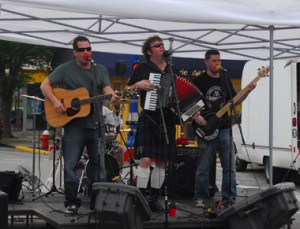
The Bogside Rogues at center stage.
There’s practically an Irish pub, restaurant, or gift shop in every other storefront in Phoenixville, the former steel town along the Schuykill in Montgomery County. That makes it the perfect place for a street fair featuring Irish music, food and vendors.
Check out the photos from the third annual event held Saturday, May 8.
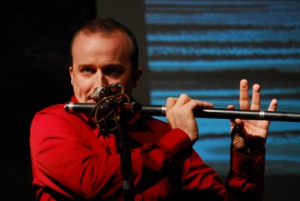
Teada's flute player, Damien Stenson.
We’ve got one word for you: Teada. It’s pronounced Tay-da and it’s the name of one of the finest modern-day traditional bands to come out of Ireland. They packed them in at the Irish Center for their Christmas show, and they’re back on Saturday, May 16, to demonstrate again why “Living Tradition” magazine calls them “brilliant young musicians who present Irish music as it really is: the joy of it, the full breadth and depth of it, the power and pace of it.” The concert is sponsored by the Philadelphia Ceili Group. Don’t miss it.
The first of several benefits for the WTMR Irish radio shows occurs on Tuesday, with the Camden County Emerald Society sponsoring a night of Irish music at the Coastline Restaurant in Cherry Hill. Lots of local musicians are pitching in their talent and there’s a free buffet meal.
And you know, if this is the Philadelphia area, there’s an Irish traditional session going on somewhere just about every night of the week, usually in the proximity of some good draft Irish beer (with apologies to the South Jersey Irish seisun, which serves coffee at its new locale, the Coffee Garden in Audubon).
Check our calendar for all the local listings. And if you have an event, please add it to our calendar (yes, you can do it yourself).
Don’t forget to eat, drink, and buy Irish.
Taking a page from public radio–and from last year’s successful fundraiser–the hosts of the Irish radio shows at WTMR 800AM will be launching their on-air pledge drive on Sunday, May 31. Vince Gallagher of the Vince Gallagher Irish Radio Hour and Marianne MacDonald, host of “Come West Along the Road” need to raise $36,000 this year to keep the two shows on the air. (You can hear them between 11 and 1 every Sunday morning.)
The “radiothon” will run for five weeks, ending June 30. St. Patrick’s Day Parade Director Michael Bradley will kick off the give-fest on May 31, taking pledges and requests from callers. Other local Irish organizations are also donating their time, including the Mayo Association (June 7), the Donegal Association (June 14), the Tyrone Society (June 21), and the Irish of Havertown (June 28). Other volunteers are welcome and needed to answer phones and help with mailings.
This year, there are even pledge incentives – gift certificates, and CDs and DVDs of your favorite Irish performers, all donated. If you’d like to help or donate, contact Vince (610-220-4142 ) or Marianne (856-236-2717).
As they say on TV infomercials: But wait, there’s more. On Tuesday, May 19, the Camden County Emerald Society is sponsoring a night of Irish music and dance at the Coastline Restaurant, 1240 Brace Road, Cherry Hill, N.J. from 7-9 P.M. For a $10 donation at the door, the evening will feature music and dancing with Kevin Brennan, Vince Gallagher, Muriel Prickitt, Mary Malone, Den Vykopal and other local musicians and the Emerald Society Pipe Band. There will be a free dinner buffet, all drinks will be $1 and raffle prizes.
On Sunday, May 31, the Auld Dubliner Pub at 157 S. Burlington Street, Gloucester City, N.J., will hold a special fundraising brunch immediately following the radio shows. Everyone is welcome, there will be live music and dancing along with a special brunch menu and raffle prizes. Reservations can be made by calling (856)432-6578.
The Rose of Tralee Committee has pledged a special quiz night with proceeds going to the radio shows. They are also donated two tickes to the Rose of Tralee Gala on June 27 along with $30 in raffle tickets.
On June 17, all Pizzaria Uno Restaurants in the area will be donating a percentage of their proceeds to the radio shows when customers either show a special voucher or ask for the voucher for the radio shows.
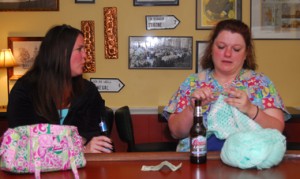
Kerri Lenox,right, knits a baby blanket at the bar while chatting with fellow dance mom, Lori Scanlon.
Most pubs are pretty quiet on a Monday night, but not the bar at the Philadelphia Irish Center. The Cummins School of Irish Dance gives lessons in the ballroom, so the Irish dance moms and dads have a beer or soft drink at the bar while they wait. Some bring their laptops so they can work, others read, study, or, in one case, knit.
Like an Irish pub, it’s not really just a bar. It’s a place where people can congregate, bring their families, chat, or sit quietly and read or watch TV. “This place is so special,” said dance mom Shiela Ruen. “It’s like something out of another time. It’s a real gem. People don’t even know what a treasure they have here. I love it.”
So do we.
He doesn’t remember the first beating he had at the hands of his mother. It happened before he was born. “My older brother Patrick told me that he saw her punching her stomach over and over when she was pregnant with me,” says Ken Doyle, 44, sitting in his Gloucester City, NJ, row home, his arms around his blue-eyed white husky, Lobo. “She was shouting, ‘I don’t want this f——-g child.’”
And it was clear she didn’t want him. Or Patrick either. In the book the brothers wrote—“Mother from Hell,” published last month by O’Brien Press in Dublin—chronicles the horrific abuse the two boys underwent growing up in Tullamore, County Offaly, in the 1960s and 70s. While their father, Patsy, was away in America working, they say, their mother Olive starved, beat, and humiliated them on a daily basis.
She stuffed tea towels or nylons into their mouths to muffle their screams, tied them to a chair, then beat them senseless with a wooden cheese board. To hide the bruises, she would plunge them into a cold bath and then lock them in their bedroom—which they called “the torture chamber”—until the bruises faded. They were forced to cook the meals every day, but not permitted to eat anything. To prevent them from sneaking food while she took her afternoon nap, she tied them to her bed. In the morning, she sent one or more of their other seven siblings with them to school to make sure they didn’t get food from anyone—or from the trash bins they would creep from their room at night to raid.
Though she had a perfectly good vacuum, she made them pick up dirt from the rugs with their hands, scrub the linoleum floor with a toothbrush, and the toilets with their fingernails. She would strip them naked and pin on a homemade diaper made of woolen cloth with a plastic trash bag over it, sometimes sewn to their shirts so they couldn’t take it off, parading them in front of the other children and encouraging them to laugh. Many days, they were forced to sit in their own urine. There was one thing that could sometimes protect them from their mother’s wrath –the things they stole for her. Jewelry, rose bushes from a neighbor’s yard, food from the supermarket, cut glass from shops, even money from the church poor box. Their mother would hand them cash, tell them what she wanted, and then send them out with the admonishment, “ and bring back the money.”
It was all a secret. She kept it from their father, they say, only abusing them when he was an ocean away. She kept it from the neighbors and the teachers at the National School by imprisoning the boys until they bore no marks of their torture, feeding them and giving them drinks only when they looked so ill they might need to be hospitalized. She kept them quiet with threats. Even when she stomped on nine-year-old Ken’s leg and broke it, fear of her retaliation kept him from telling doctors in the emergency room what really had happened. Instead, he gave them the story she told him to tell–that he had fallen down the stairs.
But it wasn’t a secret, something Ken and Patrick didn’t find out until a few years ago. When Ken, then living in Arizona, was undergoing treatment for serious spinal problems brought on by his early injuries, he wrote to Ireland for his medical records. Instead, he received his childhood history from 1965 to 1980, as recorded by the country’s social service system. It was in those records that they learned that their father had reported the boys’ torture at the hands of their mother to the authorities. “In 1969, my father went to the courthouse and reported that his six-year-old son—me—was wasting away,” says Ken. One document that appears in their book reads, “Father says child is neglected and is only getting one meal a day. Hospital admittance for malnutrition.”
“Until we saw that, we had no idea that our father knew,” says Ken, a former house painter who is now unable to work and runs a small, online Irish gift shop. Other documents—and there were more than 200 pages of them–revealed that many people knew, including Child Protective Services, local priests, doctors, teachers, neighbors, the boys’ paternal grandparents, their school mates, even the police whom Ken believes turned a blind eye to what was going on because their parents had friends on the force. Ken and Patrick were occasionally removed from their home by one authority or another and sent to boarding schools (in one, Ken was raped). But what respite there was, was cruelly abbreviated: They were always sent home on the weekend, and the abuse would continue.
“Nobody ever came to save us,” says Ken, whose dark eyes are both sad and wary at the same time. One of his teachers came forward, but only after Ken contacted the gardai a few years ago with the trail of evidence that had come to him by accident. “He told them he knew it was going on but by the time he realized it I had already been expelled from the school for stealing other children’s lunches and eating out of the bins,” say Ken. “After I was expelled, all the other boys came forward and told him what my mother was doing to me. But he thought it was too late to do anything.”
Ken eventually filed suit to force the Irish government to compensate him for his medical treatment, a case that dragged on for six years “because the government’s lawyer refused to speak to us.” It resulted in a small settlement that pays for his psychiatric treatment for post-traumatic stress disorder, but nothing else. Ken is on six medications that he pays for out of pocket, and he can’t afford the spinal operation that might allow him to live without constant physical pain. Patrick, a father of seven who lives in Wales, has a congenital heart problem and needs a transplant, but his treatment is covered under the UK’s health care system.
In 2002, the Sunday World, Ireland’s largest circulation newspaper, wrote about the Doyles’ case in a story headlined, “The Most Evil Mum in Ireland.” It drew the attention of O’Brien Press, and Ken and Patrick, working with writer Nicola Pierce, spent two years composing their brutal memoir, in part to help deal with their lingering demons: Both men have a history of alcoholism and substance abuse; both have contemplated suicide. A younger brother who was not abused did kill himself several years ago. “We were all living under the same roof,” says Ken, by way of explanation. “There was a lot of damage to the rest of the family.”
Ken has only returned once to Ireland since he left in 1980—to deal with his case against the government. And he hasn’t seen his mother since then either, though they spoke on the phone and he asked her pointblank why she abused him. He recalls that conversation dispassionately, though it is chilling.
“I asked her, ‘Why did you do what you did to me as a child?’” Ken says. “’Why did you starve me?’ She said, ‘You didn’t like food.’ At one point I was diagnosed with celiac disease which was the only way they could explain my symptoms, though they were caused by starvation. Then I asked her, ‘Why did you break my leg?’ She said, ‘It was self-defense.’ When I talked to my father, his response was, ‘I don’t want to talk about it. It’s all water under the bridge.’”
But for Ken Doyle and his brother, their ruined childhood, no matter how many years pass, is as present as the nightmares, the rage, the physical pain they deal with every day. “I walk around every day in pain knowing who is responsible for my pain,” he says.
Ironically, those reams of paper that unraveled their story served only to deepen Ken’s anger, and not just at his parents. “What I have had trouble coping with is that other people knew and could have saved me, but they did nothing to stop it,” he says. “In my mind they are as evil as my mother. I wouldn’t have minded so much the little bit of money the Irish government gave me if there had been a little apology. ‘We’re sorry, we screwed you over, we failed you.’ But there was nothing.”
His book, which his mother has told him she won’t read, is his attempt to make something good out of the life he believes she destroyed. “I hope people read it and if they see a child who is hungry or in pain that they’ll do something,” says Ken. “Children have the right to be nurtured, educated, safe at home—things that we didn’t have. They have the right to survive.”
“Mother from Hell” will be in Irish bookstores in June and is available in the US on Ken Doyle’s website at www.emeraldisleirishfoodsandgifts.com or by calling 1-856-456-8959. You can read more about Ken and Patrick’s ordeal at http://home.comcast.net/~cooffaly64/ .
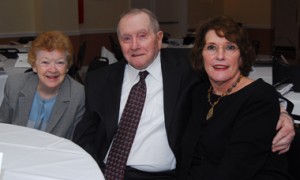
Tommy Moffit with Vera Gallagher, left, and Kathy McGee Burns.
Many Irish Philadelphians of a certain age will remember dancing or singing to the music of Tommy Moffit, the Roscommon man who came to America as a 16-year-old in the 1950s, learned accordian, then started playing at every house party in Philadelphia by the time he was 18. For many years he played every Sunday night in the Fireside Room of the Irish Center then at Emmet’s Place—which closed this year—every weekend, pausing for an hour to do his own Irish radio show on Sunday.
There are a lot of Irish Philadelphians who know Jack McNamee too. They might have eaten at his Springfield restaurant, C.J. McGee’s, or know him from the many St. Patrick’s day parade events and other fundraisers he’s hosted to raise money for charity. They might not know about all the generosity he’s shown over the years to those charities and his alma mater, Cardinal Dougherty High School. McNamee is the community’s own “quiet man” who prefers his good deeds unsung.
And anyone who doen’t know Blackthorn, the high-energy Celtic rock band, has been in a coma for years. Blackthorn spells instant success when it’s booked for a benefit–as every Irish organization and charity in the Philadelphia region is aware. John McCroary, John and Michael Boyce, Michael O’Callaghan and Seamus Kelleher make up the band that has recorded five CDs and continues to pack them in wherever they appear.
On Sunday, May 3, AOH Joseph E. Montgomery Division 65 of Springfield honored these stalwarts of the Irish community at its third annual Fleadh an Earraigh event, held at the Knights of Columbus Hall in Springfield, Delaware County.
McNamee, who is recovering from treatment for leukemia, was represented by his wife, Loretta.
We were there and took lots of photos.