All Posts By

Denise Foley

Dance

They Could Have Danced All Night

Round the House

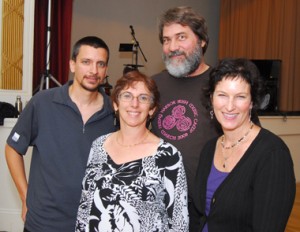
Round the House members, from left, Mark Roberston-Tessi, Sharon Goldwasser, Dave Firestine, and Claire Zucker.

“If you can walk and count to eight, you can contra dance,” Sharon Goldwasser assured me at this week’s Thursday Night Contra Dance at the Glenside Memorial Hall.

The fiddler from Tucson’s celebrated Celtic band, Round the House, wasn’t exaggerating. As someone who considers shoelaces a mortal enemy and for whom the Black-Eyed Peas’ lyrics, “you got me trippin’, stumblin’, flippin’, fumblin’” resonate deeply, I thought I might be able to do it, even if there is math involved.

Contra dancing is a real aerobic workout—there were lots of flushed faces and sweat–but it’s really just walking to music. Reminiscent of square dancing and Irish ceili or set dancing with a little ‘60s line dancing thrown in, it involves a set of moves or figures dictated by the caller executed by a couple and a second couple and so on down the line.

“The figures of contra dancing are about 250 to 300 years old,” explained Glenside regular Bill Buckenhorst, who asked me to dance. “It’s two lines and four people. How the figures are combined is different for every dance. There’s no fancy steps, no one-two-three. You walk.”

And twirl, and do-si-do, and, as far as I could see, there’s some allamande  lefting going on too. And lots of whirling,  which necessitates a flippy or flowy skirt. Alas, I was wearing capris, so I had to turn Bill down. I won’t dance, don’t ask me. Fortunately, Louise showed up. “Louise!” said Bill. “I’d love to!” said Louise.

But I did get a chance to catch up with Round the House which, when they aren’t playing contra dances, play Irish traditional music in concerts and at festivals (you can catch them at this weekend’s Pen-Mar Festival in Glen Rock, PA, a fundraiser for Pen-Mar Human Services). Sharon Goldwasser, who has studied with Randall Bays, and string player Dave Firestine, an instructor at Colorado Roots Camp,  host sessions in the Tucson area. Guitarist and mandolin player Mark Robertson-Tessi has won the Four Corners States Mandolin Championships twice. And bodhran player, singer, and contra dance caller Claire Zucker won the Mary Yolanda Dowling Vocal Competition at the Feis in the Desert two years in a row.

I guess you’re noticing that there aren’t really any Irish names among the group. “Our first names are Irish,” quips Claire, who is half Irish, half Jewish, but occasionally sings in Irish. “We like to say we’re 33 1/3 Jewish.  But we started doing this because we all loved the music. We find that all over the country as we travel. Ethnicity doesn’t matter.”

Though they’re not, Sharon Goldwasser says, “pure drop,” you couldn’t tell by me. I’ve been listening to their 2007 CD, “Safe Home,” for a couple of years now, and it satisfies my Irish music yen. Their version of “Rory Og McRory” is almost enough to make me get up and contra dance. Almost.

Columns, How to Be Irish in Philly

How to Be Irish in Philly This Week

What, another festival? Why yes. This Saturday marks the 39th year of the New Jersey Irish Festival, which is being held in Lakewood. Our feeling is, if you’ve been doing it for 39 years, you’re probably doing something right, so the trip is worth it.

The Brigade is playing at Molly Maguire’s Pub in Phoenixville on Saturday night It’s a great place and Phoenixville is more Irish than you may realize.

On Sunday, head down to Wilmington, DE, to hear the group Seven Rings play Irish pub songs and ballads at the Bellevue Arts Center band shell. Bring your blanket, bring your baby, but check first about the bucket of beer.

Round the House, the fabulous Irish traditional band from Tuscon, AZ, will be in the area next week, first at the Harp and Fiddle Pub in York, and then on Thursday at the Contra Dance at Glenside Memorial Hall in Glenside.

A head-up about next weekend. There are two great festivals on tap—the Irish Hunger Festival in Yardley, PA, which raises money for the Hibernian Hunger Project and the 9th Annual Pen-Mar Irish Festival in Glen Rock, PA. And there are currach races! If you haven’t seen these traditional Irish boats on the water, consider heading down to Columbus Club on State Road in Bensalem and watch this wonderful Irish sport in action.

Luka Bloom is also in town next Saturday at World Café Live—so much to do, so little time.

Check the world famous calendar for more details.

Don’t forget to tune into WTMR 800 AM on Sunday morning at 11 AM and make your pledge to keep Irish radio alive in the Delaware Valley. The Donegal Association (my peeps!) will be manning the phones. If you have roots in dear old Donegal, let’s make this the biggest pledge day ever!

History, News, People

Relive the Story of the Molly Maguires

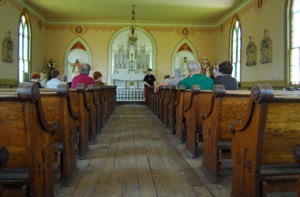
The restored Irish church in Eckley is now a museum.

The restored Irish church in Eckley is now a museum.

At the edges of Pennsylvania’s coal region, the tiny village of Eckley, population 21, preserves the memory of a time and place that many immigrant families wished they could forget.

In the mid to late 1800s, the Irish, Welsh, Germans, and Slovaks from all over Eastern Europe worked side by side in the mines—dank, dark, and dangerous places where they could be killed at any moment by a cave-in or fire. If they were, their bodies were carried to their shanty, dumped on the front doorstep, and their widows were warned that if they didn’t find someone to work for them in 48 hours, they would be evicted from their company-owned homes. If a man survived the 12-hour days, the six-day work week deep below the earth, the coal dust imbedded in his lungs would take him before he was 50. 

Boys as young as 9 and 10 worked as “breaker boys,” squatting over the conveyor lines filled with coal, cracking them into smaller pieces and winnowing out the slate. They were prone to a condition called “red top”—bleeding finger tips. Most had lost fingers before they were out of their teens.

The miners and laborers had to pay for their own tools and supplies, including lamps, picks, and explosives. Food and clothing was available at exorbitant prices at the company store. The rent on their homes was taken out of their $3 a- day-pay.  

Into this picture came the Molly Maguires, a violent secret society, an outgrowth of the Ancient Order of Hibernians, that laid the foundation for the labor unions that eventually changed conditions for Pennsylvania’s miners. Though they were ultimately put down and their leaders hanged, they made their mark. And places like Eckley, with its social stratified layout (shantys for the laborers, larger homes for the miners, mansions for the owners) have become like fossils, preserved remains of a time when corporate greed brought unimagined misery to those who had fled thousands of miles from conditions they believed could not have gotten worse.

Eckley, purchased by the state of Pennsylvania in 1971 and now operating as a miners’ museum, has become a mecca not only for Irish and Irish-American history buffs, but for movie fans who love the romanticized version of life in Eckley in the Sean Connery movie, “The Molly Maguires,” filmed in the village in 1968. A group of young Irish immigrant footballers from Philadelphia appeared as extras in the film, including Vince Gallagher, president of the Commodore Barry Club (The Irish Center). Last Saturday (June 6), Gallagher and 50 other people made the trek from Philadelphia to Eckley and on to Jim Thorpe, where some of the Molly Maguires were held in the Carbon County Prison and hanged there in June 1871.  It was Gallagher’s first trip back in more than 40 years. 

In the movie, Gallagher was part of a scene in which the miners play a version of Gaelic football, using a round ball wrapped in what looked like rope. “It weighed about five pounds and you couldn’t throw it. It was more like a bowling ball,” Gallagher recalled. “Everyone went home with sprained fingers. They brought us in because they wanted to make it all look authentic, but it didn’t. And they shot the same damn scene 72 times.”

But the movie seemed to make less of a lasting impression on Gallagher than the shameful story of Eckley and other coal “patch towns,” where human beings were treated only slightly better than the mine mules who went blind and lost their hair because they spent their entire lives underground.

“I hope there’s a special place in hell for the mine owners,” said Gallagher, “and they burn there forever.”

Check out our photo essay, and learn more about the story of Eckley and the Molly Magures.

News, People

Second Annual Mass at the Irish Memorial

Lord Mayor of Cork

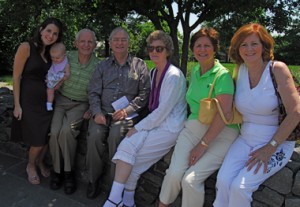
Lord Mayor of Cork Brian Bermingham and his wife, Elma, center, flanked by Karen Boyce McCollum and daughter Sarah; Barney Boyce, Mary Crossan, and Carmel Boyce.

Under a blue sky and hot spring sun, Father Edward E. Brady of St. Isidore’s Parish in Quakertown celebrated the second annual Mass of Thanksgiving at the Irish Memorial on Penn’s Landing in Philadelphia on Sunday, June 7.  Karen Boyce McCollum sang, and music was provided  by Jeff Meade, Dennis Gormley Kathy DeAngelo and Phil Bowdren.

It was a lovely and poignant start to the day of the Penn’s Landing Irish Festival.

AOH Division 88 lowered both the American and Irish flags they erected several months ago, and the Irish Society took its turn supplying the banners for the Memorial.

The Lord Mayor of Cork, Brian Bermingham, made a surprise visit–a surprise even to himself. In Philadelphia to meet with City Council to discuss common interests between his city and ours (William Penn lived in Cork and sailed to Philadelphia from its port, among other things), he said he was passing by on a tour bus and saw the sign for the Irish Memorial “and thought I’d have a look.”  He admired the monument, created by sculptor Glenna Goodacre. “A few weeks ago we had a ceremony marking the famine,” he said. “But we have nothing like this.”

He joined members of the Irish Memorial committee in front of the statue to have his photo taken.

See our photo essay. 

News

Save The Irish Radio Shows

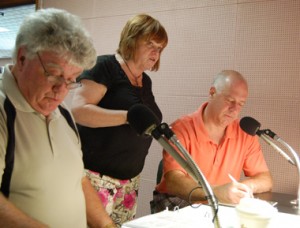
Going over pledge drive strategy are, from left, radio hosts Vince Gallagher and Marianne MacDonald, and St. Patrick's Day parade director Michael Bradley.

Going over pledge drive strategy are, from left, radio hosts Vince Gallagher and Marianne MacDonald, and St. Patrick's Day parade director Michael Bradley.

“It’s Pentecost Sunday,” Michael Bradley told the listeners to Vince Gallagher’s Irish Radio Hour on Sunday, May 31, as he kicked off the five-week fundraiser for the WTMR 800AM Irish radio shows. “”I hope the Holy Spirit moves you.”

Apparently it did, because the city’s St. Patrick’s Day Parade director and a group of volunteers including dance teachers Rosemarie Timoney and Olivia Hilpl (Rince Ri) pulled in more than $5,000 in two hours, including a $1,000 donation from the St. Patrick’s Day Observance Association, headed by local restaurateur Michael Callahan, who called in.

In the last three weeks, says Marianne MacDonald, host of the show, “Come West Along the Road,” more than $8,000 in donations have come in, including proceeds from a benefit by the Camden County Emerald Society Pipes and Drums and a brunch at the Auld Dubliner, a restaurant in Gloucester City, NJ.

Tune in on Sunday morning, from 11 AM to 1 PM, and call in your pledge. Or give it director to Gallagher and MacDonald at the Penn’s Landing Irish American Festival on Sunday, June 7, where they’ll be sponsoring the Traditional Tent.

Check out our photos and videos from last Sunday’s fundraisers.

See the photos.

Check out videos:

Columns, How to Be Irish in Philly

How to Be Irish In Philly This Week

Prepare to enjoy yourself this week. There are three festivals and you can go to all three if you want! They overlap a little but the determined fun-seeker can do it!

The annual AOH Notre Dame Div. 1 Festival in Mont Clare, PA, runs all weekend from Friday night on with great music (Tom McHugh and Company, Timlin and Kane, Oliver McElhone, John McGillian, Sarah Agnew, Irish Thunder), dancing, food, and a beer wagon. Proceeds from the event go to AOH charities, as usual.

On Saturday. Historic Cold Spring Village in Cape May will hold its annual event, also with music, food, dancing, and vendors.

On Sunday and head down to the annual Penn’s Landing Irish American Festival (where appropriate good weather is forecast) for eight hours of music, food, dancing, headlined by Blackthorn. Before you go, tune in to WTMR 800AM and make a pledge to keep the Irish radio shows on the air for another year.

(Hope you’re not festivaled out—the 39th annual New Jersey Irish Festival is scheduled for next Saturday at the Blueclaws’ stadium in Lakewood.)

The Tony-nominated play, The Seafarers, continues at the Arden Theatre.

On Saturday night, Eileen Ivers and Immigrant Soul will be rocking Longwood Gardens. We’re major fans of both Ivers and Longwood and we think this is a good combo.

On Monday, The Friendly Sons of St. Patrick is holding its annual golf tournament at the Sandy Run Country Club in Oreland. If you’ve got some time and a hankering to spoil a good walk, check out our calendar for the info. There are still spots available.

On Wednesday, you’re in for a real treat. “The Fellas”—three of Ireland’s top comics—will be appearing at The Trocadero Theater on Arch Street in Philadelphia, part of mini-tour of the east coast (with a detour to Chicago). We’ve been looking at their videos all week, and we’re still laughing. One, Ardal O’Hanlon (whom we loved as the dopey Father Dougal in the “Father Ted” series) talked to us this week. Read his interview here.

On Thursday, the long-awaited Rambling House event resumes at the Irish Center. Lots of music, dancing, songs, and stories. What could be bad?

Arts

The Kings of Irish Comedy

Ardal O’Hanlon is explaining the difference between his comedy and that of his two companions—Dylan Moran and Tommy Tiernan, the reigning triumverate of the Irish comic scene known collectively as “The Fellas” who are headlining at The Troc in Philadelphia on Wednesday night. It’s clear he’s given it a great deal of serious thought.

“We’re quite different really,” says O’Hanlon perhaps best known in the States for his turn as the “incredibly silly stupid priest,” Father Dougal, in the BBC series, “Father Ted.” (Think Jessica Simpson’s brain in the head of a good-looking young guy in a cassock and collar.)

“Tommy Tiernan is very radical, radically different from myself, extremely high energy, bares his soul on stage. He’s quite shocking in some ways [The Irish Senate twice accused him of blasphemy], but immensely popular in Ireland. He represents the counterculture. He’s like a messiah to some people in Ireland. Tommy for them speaks the truth and I suppose he goes where other comics do not dare to tread.”

And Dylan Moran, whom most American audiences know from his roles in the Simon Pegg comedies, “Shaun of the Dead,” and “Run Fatboy Run”? “Dylan is a very cerebral comic. For me, he is occasionally profound in ways other comics aren’t. He has an Oscar Wildian wit. He’s always been one of my favorite comics. He has a lovely way with words, a lot of integrity, he doesn’t pander to the masses.”

As for himself, O’Hanlon seems to have given that less thought. “I find it hard to describe my own style,” he admits. “It’s observational, deadpan in tone, surreal around the edges. That’s it in a nutshell.”

One of six children of prominent Irish Fianna Fail politician, Dr. Rory O’Hanlon and his wife, Teresa, the Monaghan-born Ardal O’Hanlon says he’s not sure why he wound up in comedy. His siblings found their way into medicine, politics, and accounting (“They seemed like good jobs until a year ago—who’s laughing now?”), and he was by his own admission “a quiet, shy boy, always doodling with a pen” who wanted to be a writer. Then, in college in the 80s, he fell in with funny companions. Inspired by the exuberant young British comedy scene, they founded one of Ireland’s first comedy clubs, The Comedy Cellar, in Dublin.

“It was a tiny club, haphazardly and badly organized, and we would get only about 50 people there on a Wednesday night,” O’Hanlon recalls. It all might have died there had O’Hanlon and company not done what millions of Irish have done over the last several hundred years: emigrate. “Not till we moved to London enmasse did we take off. Like New York at one time, London was alive with comedy clubs where every serious comic wanted to go.”

A comedy diaspora? Growing up in pre-Celtic Tiger Ireland, O’Hanlon says, “you assumed you were going to leave. It wasn’t even daunting. It was accepted. It’s what we do.” (In one of his earlier monologues, O’Hanlon quipped that he was “typically Irish, really in the sense that I don’t live there anymore.”)

Though his father was a doctor—and government minister—they weren’t rich by any means, so O’Hanlon and his siblings worked over school holidays to make money to pay for their education. “Ireland was a pretty poor country in the 80s and 90s, and on an average doctor’s salary, you can’t put six children though college,” he says. Hence, on his resume, a stint at a British pea cannery and a season on an Irish pig farm. A pig farm? “I grew up in a pig-farming area of Ireland,” he explains. “It was a good thing. In a way, everything was easier after that. I knew it was one of the things I never wanted to do again, and although I’ve been in some horrific dressing rooms, nothing is as bad as a slurry-covered truck.”

And the move to London in 1994 was a boon too. “There you could pit your wits against the best in the business and you only got better.”

After a couple of years on the UK comedy circuit, “Father Ted” came along: a sitcom about a group of priests living on a remote island (Craggy Island) off the West coast of Ireland. O’Hanlon landed the role as Father Dougal McGuire, the simple-minded, rollerblading, non-religious priest whose choice of career bewilders Father Ted Creely “Dougal, how did you get into the church in the first place? Was it, like, ‘collect 12 crisp packets and become a priest?’”

Dougal’s failure to grasp even the rudiments of his calling endeared him to viewers.

Dougal: God, I’ve heard about those cults, Ted. People dressing up in black and saying ‘Our Lord’s going to come back and save us all.’
Ted: No, Dougal, that’s us. That’s Catholicism.
Dougal: Oh right.

But the wackadoodle priest was almost too beloved. When the series ended in 1998, O’Hanlon took his stand-up act on the road and almost quit the business when well-meaning Dougal fans wanted him to be “a cuddly priest”, not the “everyman sliding toward middle age, a man confused by the world around him” he is in both his act and in real life.

“There are certain traces of me in Father Dougal,” admits O’Hanlon, who also says he based his character on “watching dogs a lot. Dougal has a lot of dog-like naivete.

“When I first started doing stand-up I was more wide-eyed and more confused than I am now. But I still think one of the things I like about comedy is the naivete and innocence, and it’s not something I’d like to lose entirely either—this way of looking at the world from an almost almost alien perspective. For me it’s true, I genuinely am confused. The reason I love stand-up is that it’s a way to deal the nonsense.”

He eventually left the road but stayed in the business, doing two more series. He had more dramatic role in the British show, “Big Bad World,” and then he was “sucked back into fluffy sitcom land” with “My Hero,” about an alien who falls in love with a human nurse, “a shameless ripoff,” of Robin Williams’ career-making “Mork and Mindy.”

Aside from the steady paycheck and the “companionship,” series work has its perks. “You’re pampered. People bring you fruit. That doesn’t happen in stand-up,” says O’Hanlon. “Standup is more of a solitary existence. The writing side of it as well. You spend a lot of time navel gazing. That’s one reason that all of us [he, Moran and Tiernan] are happy to go on the road together.”

You can see “The Fellas” on Wednesday night, starting at 7 PM, at the Trocadero at 1003 Arch Street. See our calendar for the details.

Columns, How to Be Irish in Philly

How to Be Irish In Philly This Week

There are many great days for the Irish this coming week. Start it off right with an evening with the Dublin City Ramblers, joined by the Camden County Emerald Society Pipes and Drums, at the Irish Center on Saturday night. Have a beer, tap your feet, sing along—the Ramblers love that, or so frontman Sean McGuinness tells us.

The Tony-nominated play, “The Seafarers,” set in Ireland, continues at the Arden Theater through mid-July. (Local trivia note: On Broadway, the leading role of the troubled alcoholic brother, James Harkin, was played by Chestnut Hill-based actor, David Morse, whom you know from the TV shows, “Hack,” and “St. Elsewhere,” and the movie, “The Green Mile.”)

Singer Moya Brennan, known as “the voice of Clannad,” is appearing on Sunday night at the Tin Angel in Philadelphia. You may have seen her in March on NBC’s Today Show which was broadcast from Ireland for a week.

On Thursday at 8 PM, join Marianne MacDonald and me at the Irish Center for a special showing of the movie, “The Molly Maguires,” starring Sean Connery and a host of local folks who were extras in the film, which was shot near Jim Thorpe, PA. (We have it on good authority that some of them will be there. Haven’t heard back from Connery yet.) As always, the movie is free as are the sandwiches. If you’re going on the bus trip to Jim Thorpe on Saturday, this is a good opportunity to bone up on your movie trivia.

Friday kicks off the annual weekend-long Irish Festival sponsored by AOH Notre Dame Div. 1. Expect lots of great food, fun, and music (Sarah Agnew, Tom McHugh and Company, Timlin and Kane, Oliver McElhone, Paddy’s Well, Irish Thunder Pipes and Drums, and the Catrin and Coyle Dancers). It all takes place at St. Michael’s Picnic Grounds (rain or shine) in Mont Clare and benefits AOH charities. A weekend package costs only $15—a small price to pay for such a good time.