All Posts By

Denise Foley

Columns, How to Be Irish in Philly

How to be Irish In Philly This Week

First, an apology. Due to human error, we inadvertently sent you to the Sellersville Theatre on Saturday, August 1, to hear The Young Dubliners. They weren’t there, were they? That’s because they’re not showing up until August 11. That would be two 1s, not one 1. Sorry for the error, and we hope you made the best of it.

This Sunday, head over to Cardinal Dougherty High School in Philadelphia for a full card of hurling and football, starting at 1 PM, when the Notre Dames square off against the Maired Farrells. Once the women are finished, they’re followed by the Kevin Barrys vs. Four Provinces, then the Eire Ogs take on the St. Pats. Bring water and Celtic-strength sunscreen.

Don’t forget the dance classes on Thursday night at the Irish Center. Geraldine Trainor and Laura Gittings of the Take the Lead Dance School in Philadelphia are teaching jive, foxtrot and other dances in a six-week session that will be repeated again in the fall.

Coming up on next Sunday, August 16, a special mass to honor Our Lady of Knock at the Irish Center, with dinner following. A second Our Lady of Knock Mass is scheduled for August 21 at Holy Name of Jesus Church in Philadelphia.

And to come: The 7th annual Berks Celtic Oyster Fest, the legendary Tommy Sands comes to Sellersville (look for an exclusive irishphiladelphia.com interview by Lori Lander Murphy coming soon), a music-packed Sunday Radio Shows benefit on August 23, with Barleyjuice heading our way on August 28. That brings us up to September—that’s festival month in the Philly area. There are at least four on tap. Get some rest.

Dance

So, You Think You Can’t Dance

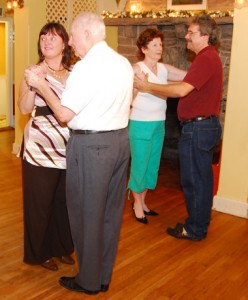
The dancers wait for instructions. That's teacher Geraldine Trainor in the green capris.

The dancers wait for instructions. That's teacher Geraldine Trainor in the green capris.

A lot of things happen in Geraldine Trainor’s kitchen.

It’s where she learned to jive back in Country Tyrone to the sound of Ireland’s Queen of Country, Philomena Begley, using the door jamb as her partner.

And it was her kitchen in Norristown where she planned to teach her kids and their friends how to jive, but then they got wrapped up in the Gaelic football season.

But dancing lessons seemed like too good an idea to just toss, especially since her son is dating a dance instructor.

So, for the last three weeks (with three more to come, she and her son’s girlfriend, Laura Gittings of Take the Lead dance studio on Pine Street in Philadelphia, are teaching adults how to swing, jive, and foxtrot at the Philadelphia Irish Center in Mt. Airy on Thursday nights.
 
“I thought it would be good for people who want to get ready for the Mayo and Donegal balls this year,” said Trainor, whom I caught up with recently after a grueling hour of box-stepping and foxtrotting. And she has some other good ideas. “I’m thinking about having a couple of competitions this year, our own ‘Dancing with the Stars.’ I don’t know who the stars will be—it might be ourselves!” She laughs.

It was the popular celebrity dance show on ABC-TV that prompted her children to ask her about learning to dance. “The kids are all talking about it, and I thought it was important for them to learn. I think everyone in the world should dance,” she says. “The boys are embarrassed to learn, but I said, ‘Now, don’t fight with me because you know it’s no use.’”

Trainor plans to repeat the classes in the fall when the kids have promised to trade football gear for dancing shoes. But the classes are open to all, even her husband, Sean, who, while he can dance, “can’t jive,” she laughs.

Music, People

A Memorial to Frank Malley

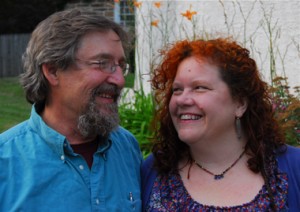
Frank's daughter, Courtney, with her husband, Sam Cohen.

Frank's daughter, Courtney, with her husband, Sam Cohen.

Her father, longtime Philadelphia Ceili Group member Frank Malley, knew he was dying, so Courtney Malley broached the difficult subject: his memorial service.

“He said that we could do something at The Mermaid,” said Courtney, referring to the tiny bar off Mermaid Lane in Chestnut Hill where Frank—and Courtney herself—frequently performed. “’I said The Mermaid? It’s too small.’ He didn’t expect that many people would show up.”

He was wrong. Courtney chose to hold the memorial service to her father at the Philadelphia Irish Center on Saturday, August 1, which bulged with more than 600 who came to say goodbye to the man they knew as father, friend, lover, grandfather, brother, neighbor, singer, story teller, and skilled artisan.

All around the Fireside Room, Malley’s family and friends posted family photos, scattered his architectural drawings, trademark hats, and tacked up a quilt, sewn by Malley’s longtime companion, Connie Koppe, made from his t-shirts, including those from the Philadelphia Ceili Group Irish Festival he so often directed.

Musicians played and sang, and friend and family offered stories and poems to honor a man whom a friend said “didn’t always consider himself adequate.”

“He would have been stunned at the outpouring of emotion,” said Connie Koppe. And, she added, “he would be trying to figure out how to get that many people to come to the Irish Festival and pay full fare.”

People, Sports

A New Shepherd for Irish Immigrants

When she fields the calls from Ireland, Siobhan Lyons makes it clear that she’s executive director of the Irish Immigration Center of  Greater Philadelphia,  not the Welcome Wagon.

“I’ve taken several calls from people who say, ‘I’m coming over, how do I find jobs?’ I say, ‘Please don’t come,’” says Lyons, who has been on the job at the 10-year-old center in Upper Darby for only about three months. “’You do not want to come here undocumented, because that’s getting harder and harder.’”

Although there aren’t any hard figures on new immigration trends, Lyons says that other Irish immigration experts are expecting to take more of those calls as economic conditions in Ireland—where unemployment, in the double digits, is at a 14-year high—continue to deteriorate.

New laws and programs in the US and Pennsylvania in particular have made it dicey for immigrants to overstay their visas. “For example, you need to prove that you are in the country legally in order to get or renew your driver’s license in Pennsylvania,” says Lyons, who was born in Dublin and came to this country (legally) five years ago. “That means that undocumented immigrants will either be forced not to drive or could be arrested for driving without a license. Local police officers are also being tasked with enforcing immigration laws.  So, under the ‘Secure Communities’ program, the fingerprints of people arrested for any reason, including minor traffic offenses, are checked against the Immigration and Customs Enforcement database, meaning that you could end up deported after running a red light.”

Laws like those are likely to drive the undocumented Irish underground even further, making them fearful of contacting the police if they’re victims of a crime or coming forward as a witness. “These policies are not the solution,” she says.   “We need comprehensive immigration reform to create an immigration system that works and that is flexible enough to respond to the changing needs of the American workforce.”

Getting here legally is no picnic either, as Lyons knows personally. She’s held several visas, including the H4 (as the spouse of an temporary foreign worker), the F2 (for spouses and children of a foreign student), and the TD (for immediate family of  a foreign worker), all of which prepares her well for dealing with the Byzantine legal regulations immigrants face and gives you a little insight into her own history.

The daughter of an Irish diplomat, Lyons spent her childhood and teen years in Dublin,  Nairobi, Washington, DC, London, and Riyadh, Saudi Arabia. While at university, she visited her father in the Arab capitol where she caught a glimpse of the older Saudi princesses with their black costumes and tribal tattoos “who were so different from all the young princesses I knew who spoke English, skied, and wore designer clothes.” She paid close attention when the wife of the then British ambassador, an Arabic speaker, approached and began to chat with them. “I thought I’d really like to know what these women have to say,” she recalls. So instead of getting the law or history degree she thought she wanted, she majored in Arabic at the School of Oriental and African Studies in London.

Of course, like all best laid plans, this one has gone astray. She hasn’t really had to use her language skills, even though she served in the Irish diplomatic service. “My area was looking at Ireland’s role in the EU (European Union), specifically whether the money we gave to the EU was being spent the way it should have been,” she explains. Today, she says with a grin, “my taxi Arabic is good.”

She came to the US in 2005  with her then-husband, a Canadian who was finishing his PhD at Princeton and later launched a start-up company in Philadelphia—hence the plethora of spouse visas. But those visas had a major drawback—while Lyons was here legally as a spouse, she couldn’t work. So she began volunteering with nonprofits “just to fill up my days.”

While her marriage didn’t last, her love for the area did. But to stay, she needed a company that was willing to go through intense rigmarole to hire her. “If you’re looking for a job the first thing they ask is if you have a Green Card. If the answer is no, clunk!” She pantomimes a phone being slammed down. “To hire a foreigner, a company has to prove that the candidate is better than any other American who applied for the job and that they’re not undercutting standard wages.”

Companies who want to hire foreign workers face an uphill battle. Workers need to be offer employment by April 1 (leaving a small window for recruitment and interviewing ) and can’t start work until the following October. Only 65,000 work or H1B visas are issued each year and in the past there have been as many as 145,000 applications so even after a worker has passed the employment tests and been hired, the visas are only issued after a lottery. “You have about a one in three chance of getting one,” she says. For a company that has spent considerable time and money recruiting, interviewing and hiring a worker and filling out all the forms and paying the fees, that means it all could come down to the luck of the draw.  

“This is something Bill Gates of Microsoft is always complaining about,” says Lyons. “Of course, my bugbear is the visas for spouses. If America wants to attracts PhDs and MBAs and other skilled professionals, you have to understand that highly educated people tend to have highly educated spouses who don’t want to end up working as a volunteer.”

Lyons eventually was hired by the World Affairs Council in Philadelphia as its director of communications and foundation relations,  largely, she says, “because they’d never hired a foreigner before and didn’t know what they were getting into! But, of course, I will be eternally grateful that they didn’t back out once they realized.”

A chance meeting with a member of the Immigration Center board last St. Patrick’s Day while she was attending the annual breakfast sponsored by Judge Jimmy Lynn at The Plough and the Stars led to the offer of a job to be the executive director of the 10-year-old center, founded by Donegal-born Tom Conaghan, who is continuing a director of immigration services on a voluntary basis.

Lyons has her work cut out for her. Anticipating a favorable change in immigration laws—a campaign promise of the Obama administration—she’s working with her 10-member board on plans to prepare local undocumented Irish for eventual legalization.

“They’re going to need proof of residence, proof that they’ve paid taxes, and are of good moral character, and paying taxes is one way of showing that,” she explains. “The problem is, many undocumented workers may be using false names, not keep a proper address, have nothing in their name, using other people’s phones, just to stay under the radar. They’re going to need to be able to prove that they’ve been here a while and didn’t just arrive as a tourist. They’re going to need a tax EIN (a federal tax identification number) so they can pay taxes since they don’t have Social Security numbers.”

One goal: To have the immigration center certified by the US Board of Immigration Appeals “so that we can provide assistance to Irish workers in dealing with some of the legal issues for a nominal fee. If we’re recognized,” she says, “it will help stop unscrupulous people from taking advantage of undocumented residents. Those people are already out there and they see easy money to be made.”

Another target: Creating as many new American citizens as possible. As as many Irish citizens as she can. “We want to push citizenship on both sides so the Irish who live here can gain all the advantages of being American and Americans can gain the advantages of being Irish.”

In fact, Americans whose parents or grandparents were born in Ireland qualify for Irish citizenship and passports. The more Irish there are, she reasons, the more powerful they are as a constituency. The Irish diaspora—historically a source of pain and sorrow for many Irish—is also one of Ireland’s greatest strength, she says. “Having Americans with connections to Ireland has been a great thing for Ireland. In hard years, Irish Americans send money home. In good times, they travel to Ireland. It turned out to be to Ireland’s benefit and the opportunity for dual citizenship helps Irish Americans keep that connection to Ireland.”

There are also other benefits for Americans who gain their IRish citizenship—lower cost visas to other countries, no visas for Europe, breezing through customs, the latter no small thing to anyone who has ever had their packed unmentionables manhandled in front of an audience.

“So everyone needs to come in and we’ll help,” she promises with a laugh.

The Irish Immigration Center of Greater Philadelphia (formerly the Irish Immigration and Pastoral Center) provides confidential counseling services at its office at 7 S. Cedar Lane (at its intersection with Route 3) in Upper Darby. Phone: 610-789-6355. Website: www.philadelphiairishimmigrants.org

News, People

Frank Malley: A Tribute

“The person of a man may leave, or be taken away, but the best part of a good man stays. It stays forever.”
— William Saroyan, The Human Comedy

Frank Malley didn’t just have a zest for life, he had a hammerlock on it. The doctors who diagnosed his cancer gave him 18 months to live. He turned it into five years of “not doing anything I don’t want to do,” as he told me about a year ago, standing at the bar at the Irish Center, nursing his Guinness.

He was a singer, story teller, world traveler, and as organized as the blueprints he worked on as an architectural steel detailer, which stood him in good stead when he joined the Philadelphia Ceili Group in the 1970s. He chaired its annual festival of Irish traditional music and dance for the last decade, even while enduring grueling rounds of chemo. When it came to labors of love, he couldn’t stop, not even for cancer.

“A few years ago, when he had just finished up a round of chemo and was still recovering and very weak, he came to do my radio show and talked for a solid hour about the upcoming festival,” recalls Marianne MacDonald, host of the WTMR radio show, “Come West Along the Road.” “I told him that he shouldn’t do it if he wasn’t up to it, and he really wasn’t, but he did it. He was such a fighter, so totally dedicated.”

Malley was at his draftboard—where he worked on high profile architectural projects such as the Philadelphia Art Museum expansion and the Academy of Music restoration—until a few weeks ago. “Most people didn’t even know he was sick,” says his daughter, Courtney, a singer who inherited her love of music and Irish culture from her father, the son of immigrants.

Frank Malley, 67, died this week at home, surrounded by his family. “He was my best friend,” says Courtney who, like her father, serves on the board of the Ceili Group. “I keep telling my family, yes, this is a huge loss, and that’s the double- edged sword. With my father, there were no boundaries between generations. We were friends as well as family, and that makes it even harder to lose him.”

Many of those who knew him for a long time considered him family as well as friend. Robin Hiteshew, a contractor and photographer who co-chaired the Ceili Group Festival with Malley in the 1980s, traveled with him to Ireland, and commiserated with him about living with cancer.  “That was another thing we had in common,” says Hiteshew, a cancer survivor who records and archives performances at the Irish Center.

He admitted that the two occasionally butted heads. “Frank was a bull,” he says, fondly. “But he was straight up. You always knew where you stood. He blew steam out his ears like most Irishmen, and you didn’t want to be on the wrong side of his temper, but his motivation was always the best. He wanted the best for the festival. What can I say? That was Frank. He was my friend. And in the end, our friendship held us together.”

With Frank Dalton, a Ceili Group member and founder of the Coatesville Traditional Music Series, Malley shared a love of Irish and old-time music. And they didn’t always agree either. “But Frank was really open-minded,” says Dalton.  “He knew he didn’t know everything there was to know about traditional Irish music but he listened. He listened to whatever anyone was saying and he took advice, something most of us have trouble doing. He was one of the sharpest, most intelligent guys I ever met.”

It safe to say that many never knew what Frank Malley did for a living, except for the steel erectors in the city who “came to him when no one else could figure out a job,” says Hiteshaw. “Everyone would come to him because he was accurate. He was the master of his trade. He was the best structural steel detailer around. He made the actual nuts-and-bolts drawing that tells steel erectors how to bolt beams together so they fit correctly and look like the architectural drawing said they should look.”

A few weeks before his death, says his daughter, she helped him put his office in order. “I have about 50 of his drawings, which he did by hand, not by computer, that are works of art.”

Most people knew Frank Malley as as a singer and storyteller. He made two CDs, “Live at the Mermaid” and “The Captain’s Old Dog.” He performed regularly at the Ceili Group Festival, the Philadelphia Folk Festival (he was also a member of the Philadelphia Folk Song Society), and the Heritage Dance Festival.

“He didn’t get involved in music till he was a teenager and he loved listening to Big Band and jazz, classical music and folk, and he was always an opera fan,” recalls Courtney. “He loved old cowboy tunes and bluegrass, but with Irish music he found the love of his life.”

Malley was born in Norristown to Patrick and Katherine Duffy Malley. His father was from Coor Point, Donegal, and his mother from Skaheen, Kilmove, County Mayo. His father was the resident farmer on the Highlands estate in Whitemarsh, a Georgian house dating to 1794, which now belongs to the state and is open as a museum. Malley’s father worked for the Roosevelts, relatives of President Teddy Roosevelt, who owned the property for many years.

“He seemed to get a lot of nurturing from his parents in the Irish culture,” recalls friend Jim McGill, a Ceili Group board member. Once, he said, Malley organized an Irish event at the Highlands. “He had tried to set up a museum there to honor the Irish domestic people who came over and worked for people around the Hill, but the hobnobbers wouldn’t have anything to do it. When we had our festival there, Frank said the former owners ‘would be turning over in their graves if they knew the Irish were having fun on the lawn.’”

If he were writing Frank Malley’s obituary, Hiteshew says, “I would have to call Frank a seanchaí, a modern seanchaí, a storyteller, and a hardworking man, someone you could depend on who gave you his word and stuck to it. I think he would want to be remembered as the guy who worked hard for the Ceili Group, an active member of the Folksong Society, who was devoted to his family.”

In addition to his daughter, Frank Malley is survived by a son, Bryan Patrick Malley; brothers John and James Malley; his longtime companion, Connie Koppe; his former wife, Rose Marie Burke Malley, and five grandchildren.

A memorial service will be held at 3 p.m. Saturday, August 1, at the Irish Center, Emlen Street and Carpenter Lane in Mt. Airy. Memorial donations may be made to any member of “Team Canada” for the Breast Cancer 3Day walk at www.the3day.org.

Listen to a few tracks from Frank Malley’s CDs, thanks to Frank Dalton.

See a compilation of photos of Frank Malley. 

View photos as a slide show.

What others have to say:

Anne McNiff, Philadelphia Ceili Group Member

I unfortunately only knew Frank a short time. We met the summer of 2007. As a relative new-comer to Mount Airy, I attended a Ceili Group meeting thinking that I might be interested in volunteering a time or two, given that I loved Irish traditional music and was looking for a way to become more involved in the local community. Little did I know how going to that meeting would change my life!

Frank was festival chair and spoke passionately about what still needed to be done to prepare for the festival and I remember thinking that he was getting quite riled up about what seemed to me, at the time, to be a relatively uncomplicated event. (Ha! Little did I know!) There was concern at that time about e-mails going out about the festival in a timely manner and the Web site. I tentatively raised my hand and said I would be happy to help out with both those things if I could. I was immediately put on a committee and plans were made to meet with Frank about the issues specific to the festival. We met up a short time later and so it began.

There are some people that you meet that you immediately are drawn to their commitment and passion about what they are doing. Frank was that kind of person. Don’t get me wrong, Frank had no delusions about the festival, the people working on it, or the people attending. As a matter of fact, he had a few pithy remarks about all three groups!  His dry, somewhat cynical, wit but obvious love for the event and the people involved really drew me in.

And so, after doing what I could to help in advance, I showed up on the Saturday of the festival and reported to Frank. He told me, “Annie (one of the few outside my immediate family who calls me that), I have someone I want you to meet, I think you will both like each other very much.” This was quite a intimidating introduction to his daughter, Courtney Malley, who amidst running the door, chasing after twins, and generally being second in command, took the time to get my story and tell me it didn’t matter if I didn’t really know anyone and didn’t have much to do outside of work. That would now all change, starting on Thursday nights. I think Frank may have had a small, self-congratulatory smile.

And so because of Frank Malley and his uncanny way of bringing people together, I found my community, a group of friends I have come to love and care about more then I can say.  A group of people that Frank and his family are at the center of.

I loved the “Renaissance man” aspects of Frank’s personality—the man who would tell me a bawdy story as easily as he would discuss fine French and Italian wines; who talked about theater we had both seen (or been in) and the World Series; who made me laugh and think and mostly just smile to be in his company.

Because of his death, it feels like there is a hole in the fabric of so many of our lives. I will miss him very much.

Mary Lou McGurk, President of the Philadelphia Ceili Group:

I don’t remember when I met Frank. It’s been so long that I feel that I have always known him.

I was a teenager when I joined the Ceili Group in 1976. They had already held one festival that I missed, and I can’t remember if Frank was involved, but I do remember the next couple. They were held at Fisher’s Pool in Lansdale, and it was the boonies. It was a big, open place. It was hard to believe that a festival would be there.

Frank had a crew of workers that would go there a few days in advance and change it from an open field to a concert area. He had plans and sketches! He rented flatbed trucks and turned them into stages. On the day of the festival he was like magic. Anything that you needed, he was there: fix a sign, move a speaker or rig up a hospitality area for the musicians. He was all ready to help and so were all the people on the committee. He had the attitude that he was there to make things run smoothly and he wanted his people to have that attitude also. He was a great leader.

I remember when we were trying to set the prices–most of the people on the festival were young and single. We didn’t know how to price tickets for children. Frank used Courtney as the measure for the cut-off; anyone Courtney’s age or younger got in for free. Of course, every year the age limit went up until she was 17, I think.

People drifted in and out of the PCG as their lives made different demands, but Frank was a constant. He even talked me back onto the board a few years ago, and I don’t regret it. He was a good man.

Columns, How to Be Irish in Philly

How To Be Irish in Philly This Week

There are some great parties coming up this week and guess what? We’re all invited!

On Saturday at 8 PM, head over to McFadden’s Tavern in Upper Darby for a beef-and-beer to raise money for the Donegal/4 Province Football team, 2007 New York champs and a great bunch of folks to party with. They’ve really helped put Philly on the Gaelic Athletic Association map.

On Sunday, from 1 to 6 PM, you can have your Irish stew and listen to five hours of great live Irish music too—at the Shanachie Pub and Restaurant in Ambler. Owners Ed Egan and Gerry Timlin are sponsoring a benefit to raise money for the Sunday Irish radio shows on WTMR, 800 AM. The Jameson sisters are going to kick off the musical portion of the show and it’s likely that Vince Gallagher, host of the Vince Gallagher Irish Radio Hour, will perform too.

Also on Sunday, Owen’s Pub in North Wildwood, NJ, has declared it “Tic Toc Day” to honor AOH Division #87 member James A. “Tic Toc” Casson. Proceeds from the day will benefit the Division 87 Scholarship Fund and Shriners Hospital.

The New Dubliners with local group, Na’Bodach, will be at the Sellersville Theatre on Saturday night.

On Tuesday, McGillin’s Old Ale House shows just how old it is—150 years to be exact. McGillin’s is celebrating its big one with a series of parties. This Tuesday and on several Tuesday nights throughout August and September, you can combine your taste for brews with your taste for books. The pub will be hosting free readings from authors who have mentioned McGillin’s in their books. “Joe Sixpack”—Inquirer beer columnist Don Russell—will read from his new book, “Joe Sixpacks’ Philly Beer Guide” at 6 PM at the center city tavern to launch the book-n-beer parties. McGillin’s 1860 IPQ beer will be reduced to $2 a pint during the events. Among the other sudsy writers on tap: William Lashner, author of the thriller “Blood and Bone;” Duane Scwierczynski, author of “The Punisher” comic book and crime novels; Lew Bryson, who wrote “Pennsylvania Breweries,” and Dr. Lewis Losoncy, author of “Early Poppers: Growing when the Heat is On.”

On Friday night, come over to the Irish Center and vie for a coveted spot on the new game show, “Who Wants to Be A  Hundredaire?” The brainchild of sisters Sarah Conaghan and Karen Conaghan Race—they’re also the brains and beauty behind the annual Philadelphia Rose of Tralee pageant (now Mid-Atlantic Rose of Tralee)— this fun event will raise money for the Sunday Irish radio shows—and for some lucky winners. We’re thinking of competing, so if for nothing else, come out to see a couple of folks who have more senior moments than they care to think about make total fools of themselves. Seriously, it will be a treat.

Another real treat: Irish singer Andrew Strong (you know him as Deco Cuffe from the great Irish flick, “The Commitments”) will be appearing at the Sellersville Theatre on Friday night.

Of course, all the details are on our calendar. We did some updating this week, and you need to check out September—the second best time to be Irish in Philly after March. There’s the Philadelphia Ceili Group Festival, Green Lane Scottish-Irish Festival, The Celtic Classic in Bethlehem and the Irish Weekend Festival in North Wildwood (and thank God they run more than one day, because the dates overlap).

History

Murder Most Foul

Duffy's Cut

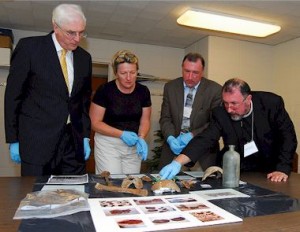
Irish Ambassador Michael Collins and his wife, Marie, look at the remains of 18-year-old John Ruddy with Duffy's Cut Project managers Dr. William Watson and the Rev. Dr. Frank Watson.

He was 18 years old. He’d come to Pennsylvania from Inishowen, County Donegal, Ireland, on the ship, the John Stamp, with a box that contained all his earthly possessions. He had been hired by a railroad contractor named Phillip Duffy to help lay a stretch of railroad tracks (known as mile 59) through densely wooded hills and ravines near Malvern. Two months after he arrived, he was dead. No one alive today remembers John Ruddy. But 177 years after his death, his bones are finally telling his story.

Ruddy was one of 57 Irish railroad workers who died in 1832 during a cholera epidemic. The men were not given medical help and some historians—notably William Watson, PhD, head of the history department at Immaculata University—suspected at least some of the men had been murdered to keep them from spreading the deadly disease. For the past six years, Watson, his twin brother, the Rev. Dr. Frank Watson, and a team of archeologists, historians, anthropologists, and students, have been sifting through the dirt at the site, now called Duffy’s Cut, where last March they found the first human remains.

The unfused skull with its zig-zag fault line told forensic anthropologists that the body was that of a teenager. When the Watsons looked at the manifest of the John Stamp, which brought many of the workers from Donegal, Derry, and Tyrone to Philadelphia, there was only one teenager—John Ruddy. The small indentation in the top of the skull and the larger hole in the forehead in which a rock had been wedged told the anthropologists that the young man had likely not died of cholera, but had been murdered, his body dumped from a sled into a shallow makeshift grave where he lay sprawled for almost two centuries. Pieces of the sled were found with him. Suddenly, their archeological dig had become a crime scene.

“For us, seeing this was completely heartbreaking,” says Frank Watson. But also exciting: They were witnessing an old folk legend come alive.

“This is an urban legend,” said Bill Watson, surveying the bones he had placed carefully on a table near his office last week, arranged so they could be viewed by Irish Ambassador Michael Collins and his wife, Marie, who were driving up from Washington just to see them.

This urban ghost story got its start 177 years ago with the first account of “ghosts dancing on their graves” reported by a local passing by the site. It continued, with some strange synchronicity, with Watson, who may have seen the ghosts of Duffy’s Cut himself—three strange neon figures not 10 feet from him, there and then gone. If there are ghosts, appearing to Watson was a serendipitous choice on their part. His Irish-American family has a connection to Duffy’s Cut.

The Watsons’ grandfather worked for the Pennsylvania Railroad. After his death, their grandmother entrusted to Frank some papers he’d left, detailing the initial efforts of the president of the railroad to have a memorial erected to the memory of the dead workers and then, inexplicably, his cover-up of the entire incident. After Bill’s ghostly sighting, Frank remembered the papers, and they began their tireless effort to uncover—both literally and figuratively—the truth about what happened to those 57 men.

It was also wise of Duffy’s Cut’s ghosts to bide their time. It was not only unlikely that anyone would have stumbled upon their mass grave (“It’s the valley that time forgot,” says Frank. “It’s useless for farming or raising animals. It’s a valley. It’s hard getting up and out of it”), but they chose to reveal themselves in the era of forensic science. John Ruddy’s teeth are “in good shape,” according to the forensic dentist who examined them. They are likely to yield a good sample of DNA that can be matched to living descendants.

The forensic scientists have already started to tell the story of the teenaged John Ruddy, says Frank Watson. “They know from his bones that he was heavily muscled and probably malnourished,” he says. “He stood about five-feet-six. We have his ear canal and they know that he had a lot of ear infections. He’s also missing a right front molar. It wasn’t knocked or taken out—it was never there.”

That last tiny fact stirred something in a family named Ruddy in Donegal. After reading about the findings, they contacted the Watsons to offer them their DNA for matching. “Many members of their family are also missing that right front molar,” he says.

The Watsons have no intention of keeping the bones for display, so if they’re able to find a DNA match, John Ruddy may finally find his way home again.

Music

Come on to Their House–for Some Great Music

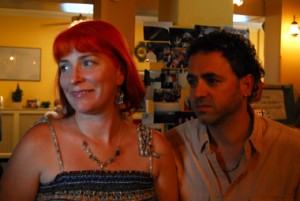
Newlyweds Bob Hendren and Bette Conway outside the Irish Center, which was one of the reasons they moved to Philly.

Newlyweds Bob Hendren and Bette Conway outside the Irish Center, which was one of the reasons they moved to Philly.

When she was house hunting, Bette Conway probably looked at the same things most home buyers do—structural soundness, good location, maybe even updated kitchen and baths. But she had other things in mind too: Acoustics, parking, enough room for audiences. Conway wasn’t just buying a house—she was buying a house concert hall.

The 120-year-old three-story house on Third Street in Lansdale was literally a dream come true. “It was a dream I always had, and Bob shared that dream with me, to have a house big enough for our musician friends from up and down the coast and Ireland to be able to stay with us,” says Conway, a fiddler, jewelry maker, and senior geologist with the US Environmental Protection Agency in Philadelphia.

Bob is Bob Hendren, the man Conway married on May 8 in their new home, Spring Hill House, and now home to Spring Hill House Concerts. The two, who met at a musical house party, moved from Indiana to start a new life in the Philadelphia which is to them the well spring of Irish and old-time music. “The Commodore Barry Club (Irish Center) is one of the reasons we moved out here,” says Conway, who lived in the area about 20 years ago and remained as much a part of the music scene here as she could in absentia, coming in yearly for the Philadelphia Ceili Group Festival and the Philly Folk Festival.

Music is so much a part of their lives and relationship that when Hendren, a lawyer and environmental consultant, talks about their wedding album, he isn’t thinking about photographs. “A friend of ours recorded the music from our wedding, mostly old-time, on two CDs,” he says, laughing. “I’ll have to get you one. They’re top notch players, fabulous musicians.”

There’s no doubt about that. Between the two of them—she had house concerts in her Indiana home, he produced and promoted concerts, both were plugged into the Irish music scene at Indiana University—they have some remarkable friends. A few weeks ago, some of their friends from the Midwest stopped by for the first of the Spring Hill House Concerts—legendary button accordian player Paddy O’Brien and guitarist and singer Pat Egan, two- thirds of the trad group, Chulrua (the other member is Patrick Ourceau). Next week, friend Albert Alfonso, noted bodhran player and maker, will be stopping by with his friend Skip Healy, celebrated wooden flute maker and performer who has played solo at Carnegie Hall and with Mick Moloney, Paddy Keenan, Kevin Burke, Aoife Clancy, Joannie Madden and many other “names” from the Irish traditional music world.

(Alfonso and Healy will conduct workshops in their respective instruments on Wednesday, July 22, 6-8 PM, at Spring Hill House, 136 E. Third Street, Lansdale. Afterwards, they’ll sit in on the session at the Mermaid, 7673 Germantown Avenue, Philadelphia. Then on Thursday, they’ll be playing a house concert at Spring Hill House starting at 8 PM.)

“This house is really acoustically fine for music,” says Conway. “ One of the first parties had here, we had (Philadelphia accordian player) Kevin McGillian in the front room with Irish music going on, and blue grass in the family room, with all the doors open, and they didn’t clash. I love the high ceilings and the way the music resonates through here. When I saw this place I just knew, oh my goodness, this is the perfect place.”

It sits on an unusually large lot in a small, quiet neighborhood a few blocks from Lansdale’s downtown in a very old subdivision called “Spring Hill” on historical town maps. “The realtor explained that the sideyard was a ‘Hollywood’ lot—one that they used to raffle off at the theater,” explains Conway. And she learned quickly why the area was known as Spring Hill. “We have a spring in the basement,” she laughs. “The owners had turned it into a well.”

Conway and Hendren plan to refinish the third floor “so we have additional room where our friends can stay.” As it is, they have their first long-term house guest, fiddler and metalsmith Louise Walisser of the group Tenaigin who is helping Conway with her jewelry business.

Conway came to music early. As a youngster in Indiana, she played concert violin. “Then I became bored with it and quit,” she explains. “But when my daughter was two [she is now 16], I decided we needed to have some music in the house. I took some old-time lessons with Brad Leftwich, the famous old-time fiddler. Then one day I was helping a friend move into an apartment and met a friend who played Irish music. He offered to teach me a few tunes and I fell in love with it.”

Hendren has played guitar and banjo “for many years, but it doesn’t show,” he jokes. “I’m sort of a beginner in everything I do forever. I play bluegrass music on the banjo, plus I’ve played folk music and write oddball music myself. Coming here, this is a whole new thing—the level of the music, the quality, is just a lunar leap. We had good sessions and players in Indiana, but overall the tradition of the music here and the openness is just a delight. Not only is it a delight to be here, but to bring other musicians here.”

The difference, says Conway, is that in the Midwest, musicians came to Irish traditional tunes because they loved the sound. “Here, they come to it because it’s in their families. They grew up with it. As a friend here says, it was another member of the family.”

She remembers one of her visits to Philly with the girlfriends she used to lure from Indiana to the Philly Folk Fest (where she’s still known as Bette Fiddler). They were visiting with Kevin McGillian and his wife, Mary, “and they let us stay there all day, drinking tea and playing tunes with Kevin all day. ‘Do you know this one?’ ‘How about this one?’ And I thought, it seems like family to me. That’s what I want.”

It’s hard to avoid that family feeling when you’re listening to a superlative Irish musician playing in a living room in front of the bay window. But be forewarned: Once you go to a house concert, you may never want to hear music any other way.